
Model of Scientific Inquiry Victoria B Grade 7
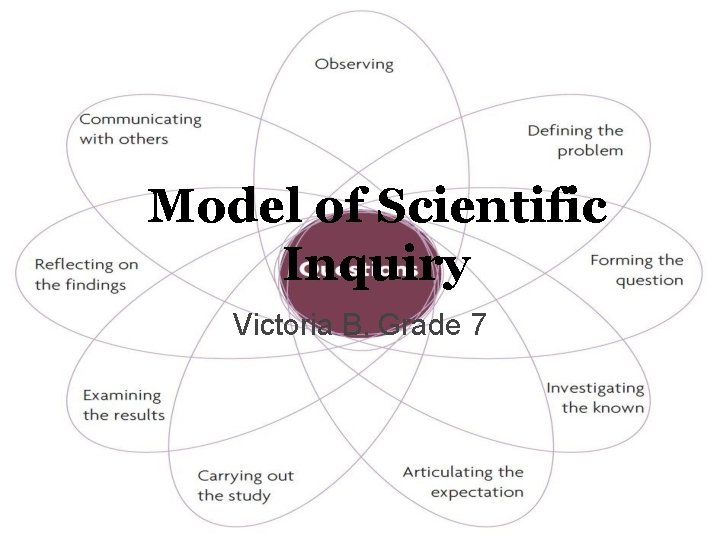
Model of Scientific Inquiry Victoria B. Grade 7
❖ Posing a question starts or begins the process of scientific inquiry. ❖ An example is: Why do bears hibernate? ❖ This is an important step in the scientific inquiry process because without posing a question, you wouldn’t be able to follow anything. Posing a questions is your guideline for the experiment.
❖ A hypothesis is an educated guess. ❖ It is also an explanation about what will happen. It must be testable. To test a hypothesis, you must design an experiment. ❖ An example would be: I think that the reason bears hibernate is because they need to keep warm during the winter. ❖ Forming a hypothesis is an important part of the scientific process because you need to have an educated guess of what will happen so you can prove yourself right or wrong.
❖ To design an experiment means to make a controlled experiment to test your hypothesis. ❖ In a controlled experiment only one variable is changed (manipulated variable). By changing the manipulated variable, another factor will result (responding variable). ❖ An example of designing an experiment would be: Record the weather where bears live and how they are affected when winter approaches. ❖ It is important part in scientific inquiry because with the experiment you will be able to test your hypothesis.
❖ To collect and interpret data means to gather facts, figures, and other evidence from prior experiments. ❖ The best way to interpret data is to write out a graph. This will help you to follow the data more closely and can reveal patterns or trends. ❖ An examples is: To collect the data from past weather, from summer to fall and see how the bears have acted. ❖ After all the data have been collected, they need to be interpreted. ❖ This is important in scientific inquiry because in order to draw a conclusion, you have to collect
❖ After you gathered and interpreted your data, you can draw a conclusion about your hypothesis. ❖ A conclusion is a decision about how to interpret what you have learned from an experiment. ❖ Sometimes, no conclusion can be reached and more data are needed. ❖ Even after you have drawn a conclusion from one experiment, scientific inquiry does not end. ❖ An example is to conclude that bears hibernate during the winter months and
❖ An important part of scientific inquiry is communicating with the results. ❖ Communicating is the sharing of ideas and experimental findings with others through writing and speaking. ❖ Scientists share their ideas in many ways. ❖ An example would be that scientists exchange information on the Internet, or publish articles in scientific journals.
- Slides: 7