
Model of Scientific Inquiry By Connor Grade 7
Model of Scientific Inquiry By : Connor Grade 7
Posing Questions ● Posing questions is when you ask yourself a scientific questions that interests yourself and others. ● Example: What is lightning? Does it consist of electricity? ● This is an important step in scientific inquiry because it is the beginning of the process of scientific inquiry.
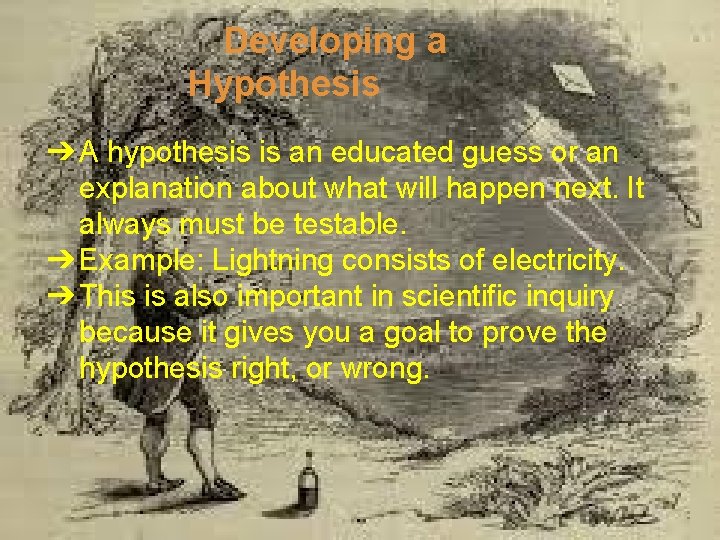
Developing a Hypothesis ➔ A hypothesis is an educated guess or an explanation about what will happen next. It always must be testable. ➔ Example: Lightning consists of electricity. ➔ This is also important in scientific inquiry because it gives you a goal to prove the hypothesis right, or wrong.
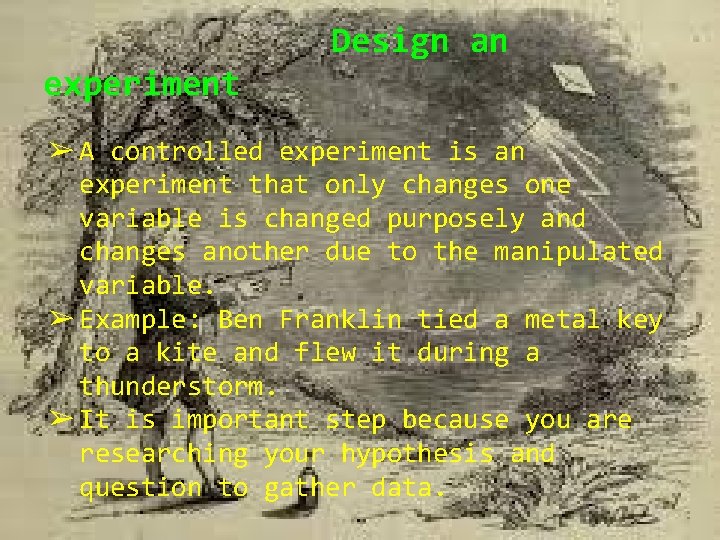
Design an experiment ➢ A controlled experiment is an experiment that only changes one variable is changed purposely and changes another due to the manipulated variable. ➢ Example: Ben Franklin tied a metal key to a kite and flew it during a thunderstorm. ➢ It is important step because you are researching your hypothesis and question to gather data.
Collect and Interpret Data ❖ Data are facts, figures, measurements, or pictures that are gathered through an experiment or observations. ❖ Example: The lightning struck the kite and jolted along the metal wire and leapt on the metal key. ❖ This step is important in the process of scientific inquiry because it gathers evidence to show if your hypothesis is right or wrong.
Draw Conclusions ● To draw a conclusion is to sum up the whole project and come up to the answer to your scientific question. ● Example: Ben Franklin concluded that lightning consisted of electricity. ● This is important to the process of scientific inquiry because this gives you the answer to your question and your hypothesis.
Communicating ❏ Communicating is the sharing of ideas and experimental finding with other through writing and speaking. ❏ Example: Ben Franklin wrote to other scientists about his discovery via letter. ❏ This is important because you share your findings with other scientists to interest them in a topic.
- Slides: 7