
Model of a Revolution Parts of a Revolution

![Stage three The Terror [Radicals take control and favor HUGE changes in society]](https://slidetodoc.com/presentation_image/0f90873c92ffcc4af025ea974d36aab8/image-8.jpg "Stage three The Terror [Radicals take control and favor HUGE changes in society]")
- Slides: 17
Model of a Revolution
Parts of a Revolution • Historians have noticed that many revolutions follow similar paths. • They all seem to follow a similar plan, make the same mistakes, and change drastically in terms of goals and tactics. • But not all revolutions follow all six stages or parts.
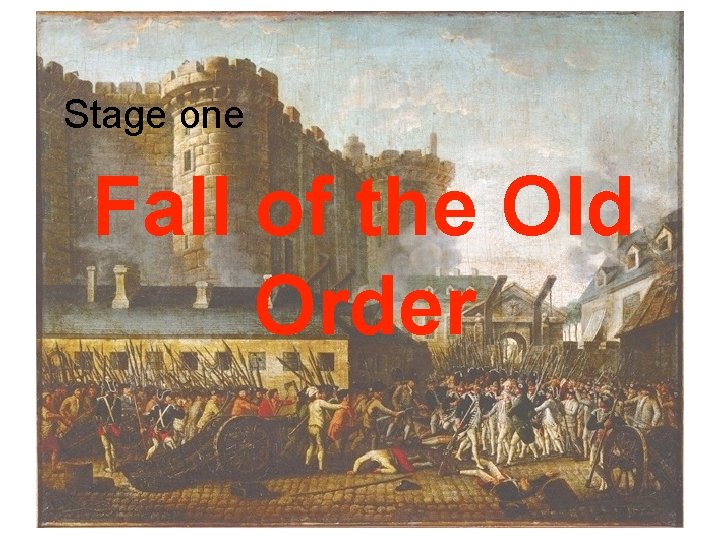
Stage one Fall of the Old Order
FALL OF THE OLD ORDER! • Symptoms: ✦people are unhappy ✦Taxes are usually high ✦the economy poor ✦famine & starvation are common ✦The majority of the people often have little or no say in the government. ✦The country is often at war.
FALL OF THE OLD ORDER! • The government does not respond to the needs of its society. At times it even attacks the people who want change. • Because of this, the government is unable to get enough support from any group to save itself. • Revolutionaries gain power & seem united.
Stage two: Rule by Moderates [moderates holds a middle position between two opposite viewpoints. A moderate position is neither extreme or radical. They want some change, not total change]
RULE BY THE MODERATES • The moderates of the revolution take control of the new government. • Once in power, revolutionaries begin to fight among themselves, and unity begins to dissolve. • Often, the new leaders cannot solve the problems that started the revolution.
Stage three The Terror [Radicals take control and favor HUGE changes in society]
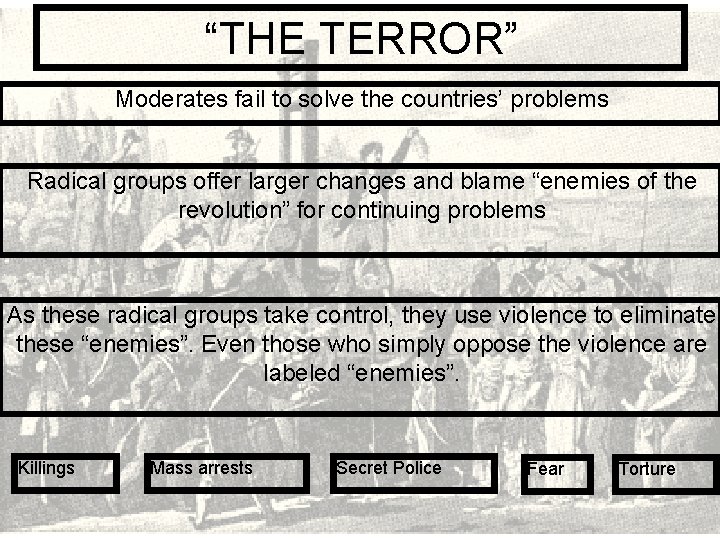
“THE TERROR” Moderates fail to solve the countries’ problems Radical groups offer larger changes and blame “enemies of the revolution” for continuing problems As these radical groups take control, they use violence to eliminate these “enemies”. Even those who simply oppose the violence are labeled “enemies”. Killings Mass arrests Secret Police Fear Torture
Stage four: TURN AWAY FROM RADICAL RULE/Thermidorian Reaction The “OOPS!” stage
The end of the Terror Either 1. People get tired of the fear and the violence 2. The threat of the counterrevolution lessens or 3. there is simply no one left to kill. People turn against the radicals, most likely killing them. revolution becomes moderate again, yet is without a leader.
Stage five: Military Rule
MILITARY RULE • A military ruler often uses the weakness of the country as a chance to take power and stabilize the country. • Oftentimes, this new leader takes the powers of a dictator to bring order to a country.
Stage six: RESTORATION
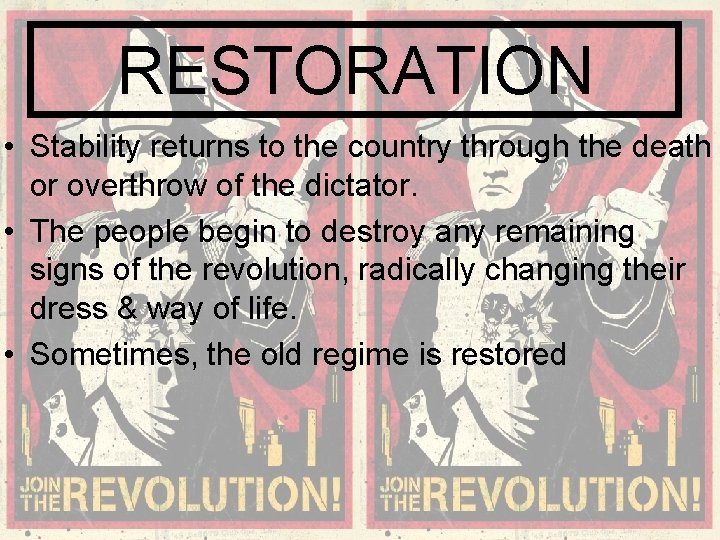
RESTORATION • Stability returns to the country through the death or overthrow of the dictator. • The people begin to destroy any remaining signs of the revolution, radically changing their dress & way of life. • Sometimes, the old regime is restored
Rise and Fall of Revolutions Activity Do fall of the old order together. 16
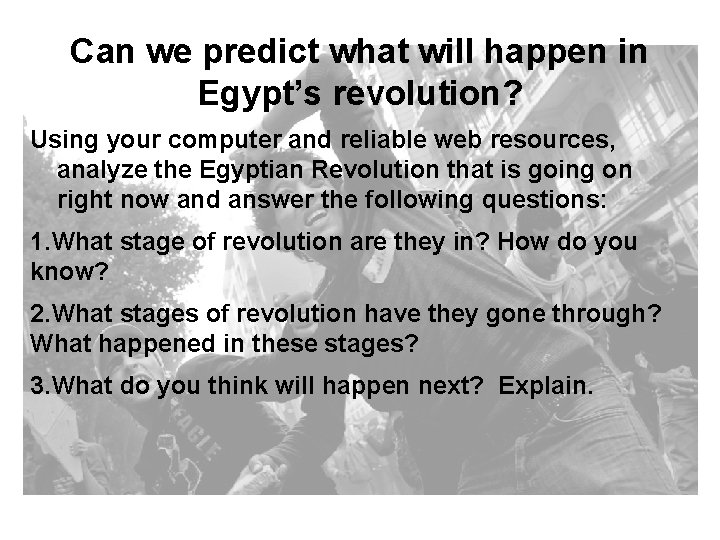
Can we predict what will happen in Egypt’s revolution? Using your computer and reliable web resources, analyze the Egyptian Revolution that is going on right now and answer the following questions: 1. What stage of revolution are they in? How do you know? 2. What stages of revolution have they gone through? What happened in these stages? 3. What do you think will happen next? Explain.