
Model Minimum Uniform Crash Criteria MMUCC 5 th
- Slides: 15
Model Minimum Uniform Crash Criteria (MMUCC) 5 th Edition Sarah Weissman Pascual National Highway Traffic Safety Administration December 6 -7, 2016
What is MMUCC? MMUCC is a voluntary guideline that provides States and localities with information data elements collected at the scene of a crash and included in the State database. about 2
Preparing for a New Edition A • • 3 Comprehensive Review: Comments emailed to www. mmucc. us (2012 -present) FHWA HQ, Division Offices and State partners FMCSA staff and field partners NHTSA practitioners, Regional Offices and State TRCCs GHSA and State partners Traffic Records community Expert Panel
Results of the Review • • • 4 Confusion on how to apply guidelines to State practices Format not consistent with State practices States required additional elements for FHWA and FMCSA programs MMUCC and FARS needed better alignment A national PAR was desired Non-motorist stakeholders needed better data “Collected at Scene” and “Derived or Linked” designations hindered advanced States New questions concerning automated vehicle systems Edit checks were desired Distraction data still a challenge
MMUCC 5 T H EDITION APPROVED CHANGES 5
MMUCC Mapping Rules Confusion on how to apply guidelines to State practices The MMUCC mapping rules (first edition) were created to help States determine how their data aligns to MMUCC. The rules provide States a single way to measure the alignment through mapability. Previously, 55 States and Territories had 55 ways to map their crash reports and State databases to MMUCC. Now there is one. 6
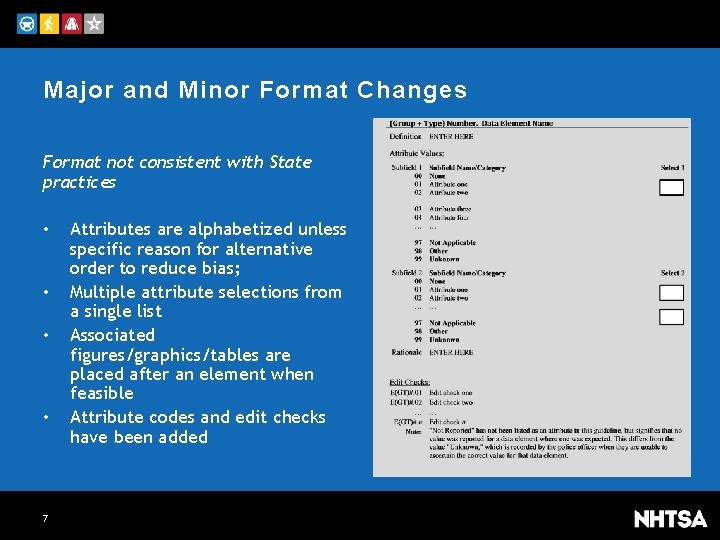
Major and Minor Format Changes Format not consistent with State practices • • 7 Attributes are alphabetized unless specific reason for alternative order to reduce bias; Multiple attribute selections from a single list Associated figures/graphics/tables are placed after an element when feasible Attribute codes and edit checks have been added
Accommodating Partner Data Needs Fatal Crash Section • Three (3) elements added to new section from FARS: – “Attempted Avoidance Maneuver” – “Alcohol Test Type and Results” – “Drug Test Type and Results” 8
Accommodating Partner Data Needs Large Vehicle/Hazardous Materials (LVHM) Crash Section • Five (5) elements shifted from Vehicle to LVHM Section • Five (5) new elements added at request of FMCSA: – “Trailer License Plate Number” – “Trailer VIN(s)” – “Trailer Make(s)” – “Trailer Model Year(s)” 9
Accommodating Partner Data Needs Non-Motorist Crash Section • Definition of “non-motorist” changed with addition of this section: – A non-motorist no longer includes occupants of motor vehicles, whether or not they are in transport. • Six (6) elements shifted from Person to Non-Motorist Section • One (1) new element added at public stakeholders’ request: – “Initial Contact Point on Non-Motorist” 10
Increased Flexibility “Collected at Scene” and “Derived or Linked” designations hindered advanced States The 5 th Edition will no longer define elements as “collected at scene” and “derived or linked”. States will be free to determine the method for collecting each element. MMUCC will encourage States to minimize the burden on law enforcement by linking or deriving as much data as possible. 11
Anticipating Future Trends New questions concerning automated vehicle systems • • • 12 After significant debate, the expert panel opted to include an automated vehicle systems element, “Motor Vehicle Automation, ” that will capture: – Automation System in Vehicle – Automation System Levels Engaged at Time of Crash Element will reside in new Dynamic Data Element Section, reviewed annually at the International Traffic Records Forum. Training and additional information will be coordinated between the new MMUCC website and Federal automation partners.
New Resources • • • Model edit checks for each element Model MMUCC police crash report Updated MMUCC mapping rules Updated figures and diagrams Updated and expanded glossary of terms • Updated MMUCC website, to be hosted by NHTSA. gov – Resource/information coordination with the ANSI D 16 update and Federal automation vehicle systems partners – Training for users 13
Next Steps • • • 14 Initial draft of 5 th Edition incorporating all approved changes is completed and under initial review; Update and complete the 5 th Edition edit checks; Update the MMUCC mapping rules; Update the glossary of terms; Prepare a table of changes; Update and finalize the MMUCC crash report; Draft and finalize the various narratives (introduction, executive summary, etc. ); Conduct final review and approval by all appropriate stakeholders; and Publish MMUCC 5 th Edition by mid-2017 (estimated).
Questions? sarah. weissman@dot. gov