
Model Independent Approach for Dark Matter Phenomenology Signatures
![�Dark matter signature in ILC Signal Formula [fb/Ge. V] dσ/d. Eγ = κe where](https://slidetodoc.com/presentation_image_h2/61996e834691b6ad2258717863e0224b/image-6.jpg "�Dark matter signature in ILC Signal Formula [fb/Ge. V] dσ/d. Eγ = κe where")
- Slides: 9
Model Independent Approach for Dark Matter Phenomenology ~ Signatures in linear colliders and cosmic positron experiments ~ Shigeki Matsumoto (KEK, Theory) Collaborated with Nobuchika Okada (KEK) Pointing out Up-coming cosmic e+ experiments may give a important information to the dark matter phenomenology at ILC
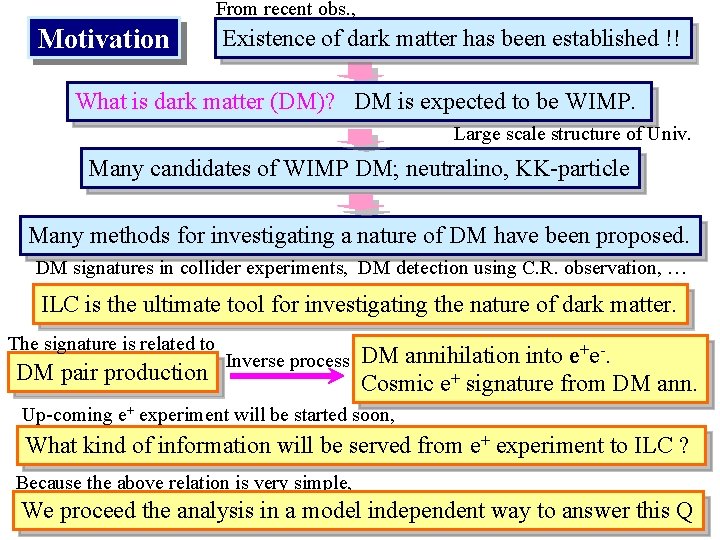
From recent obs. , Motivation Existence of dark matter has been established !! What is dark matter (DM)? DM is expected to be WIMP. Large scale structure of Univ. Many candidates of WIMP DM; neutralino, KK-particle Many methods for investigating a nature of DM have been proposed. DM signatures in collider experiments, DM detection using C. R. observation, … ILC is the ultimate tool for investigating the nature of dark matter. The signature is related to DM pair production Inverse process DM annihilation into e+e-. Cosmic e+ signature from DM ann. Up-coming e+ experiment will be started soon, What kind of information will be served from e+ experiment to ILC ? Because the above relation is very simple, We proceed the analysis in a model independent way to answer this Q
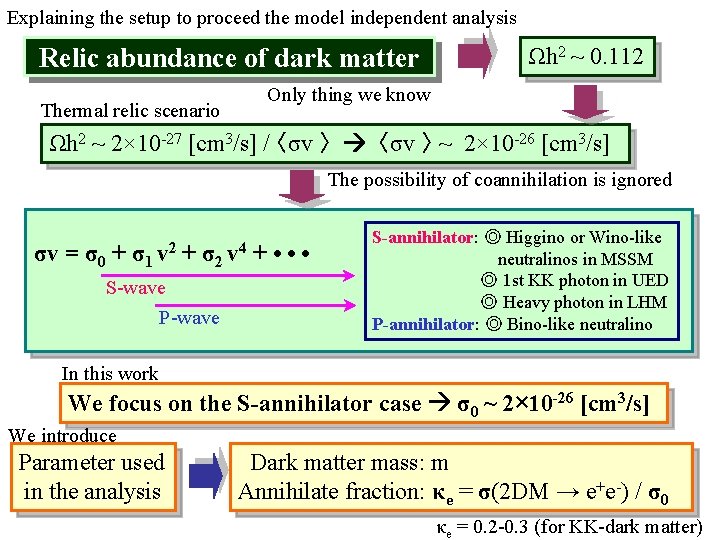
Explaining the setup to proceed the model independent analysis Relic abundance of dark matter Ωh 2 ~ 0. 112 Only thing we know Thermal relic scenario Ωh 2 ~ 2× 10 -27 [cm 3/s] / 〈σv 〉 ~ 2× 10 -26 [cm 3/s] The possibility of coannihilation is ignored σv = σ0 + σ1 v 2 + σ2 S-wave P-wave v 4 + • • • S-annihilator: ◎ Higgino or Wino-like neutralinos in MSSM ◎ 1 st KK photon in UED ◎ Heavy photon in LHM P-annihilator: ◎ Bino-like neutralino In this work We focus on the S-annihilator case σ0 ~ 2× 10 -26 [cm 3/s] We introduce Parameter used in the analysis Dark matter mass: m Annihilate fraction: κe = σ(2 DM → e+e-) / σ0 κe = 0. 2 -0. 3 (for KK-dark matter)
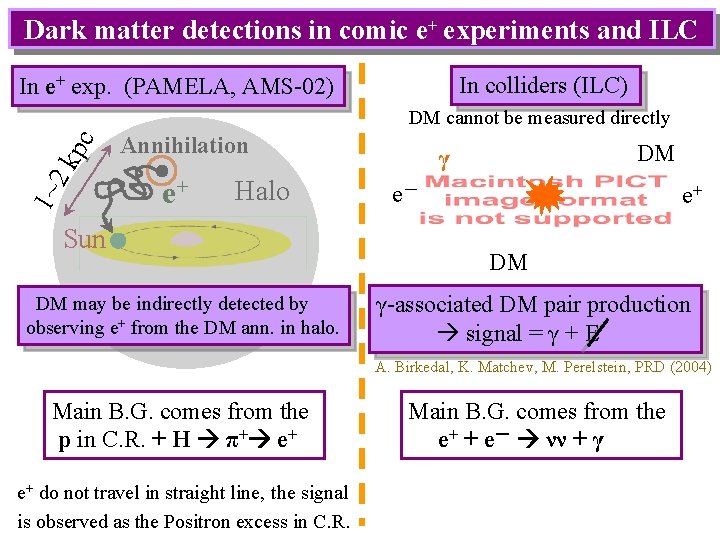
Dark matter detections in comic e+ experiments and ILC In colliders (ILC) In e+ exp. (PAMELA, AMS-02) 1~ 2 k pc DM cannot be measured directly Annihilation e+ Halo Sun DM may be indirectly detected by observing e+ from the DM ann. in halo. DM γ e- e+ DM γ-associated DM pair production signal = γ + E A. Birkedal, K. Matchev, M. Perelstein, PRD (2004) Main B. G. comes from the p in C. R. + H π+ e+ e+ do not travel in straight line, the signal is observed as the Positron excess in C. R. Main B. G. comes from the e+ + e- νν + γ
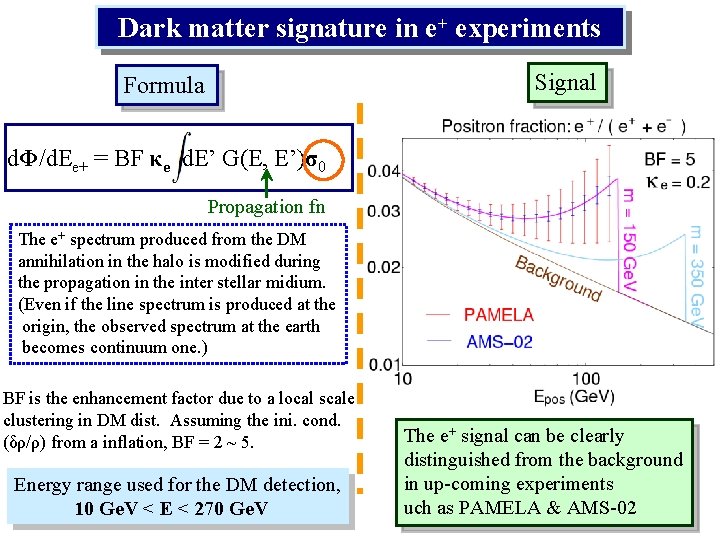
Dark matter signature in e+ experiments Signal Formula dΦ/d. Ee+ = BF κe d. E’ G(E, E’)σ0 Propagation fn The e+ spectrum produced from the DM annihilation in the halo is modified during the propagation in the inter stellar midium. (Even if the line spectrum is produced at the origin, the observed spectrum at the earth becomes continuum one. ) BF is the enhancement factor due to a local scale clustering in DM dist. Assuming the ini. cond. (δρ/ρ) from a inflation, BF = 2 ~ 5. Energy range used for the DM detection, 10 Ge. V < E < 270 Ge. V The e+ signal can be clearly distinguished from the background in up-coming experiments uch as PAMELA & AMS-02
�Dark matter signature in ILC Signal Formula [fb/Ge. V] dσ/d. Eγ = κe where cross section: dσ/d. Eγ Dressing fn In general, there is no model-independent relation between DM pair productions and those associated with γ. However, emitted γ is either soft or collinear with the beam, we have such a relation !! This method has been developed by “A. Birkedal, K. Matchev, M. Perelstein, PRD (2004)”, and the validity of the approximation has been also confiremed. In cγ-integration, we use the cut, sinγ > 0. 1, p. T, γ > 7. 5 Ge. V Total cross section for the signal is ~ 1 -10 [fb].
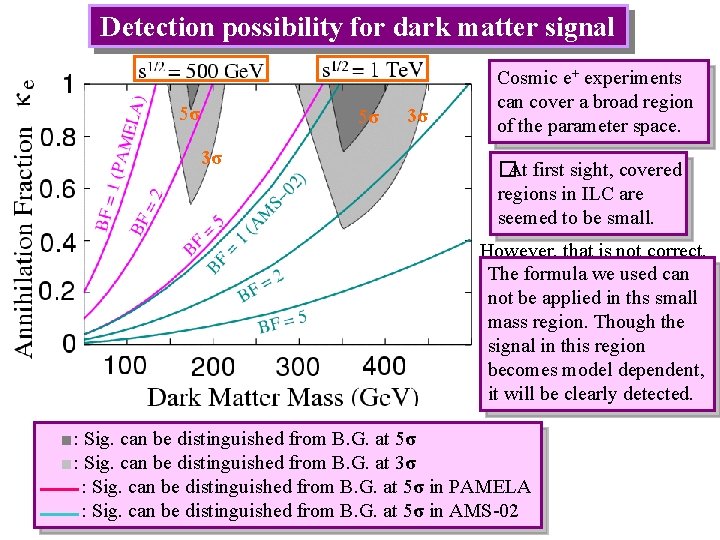
Detection possibility for dark matter signal 5σ 5σ 3σ 3σ Cosmic e+ experiments can cover a broad region of the parameter space. � At first sight, covered regions in ILC are seemed to be small. However, that is not correct, The formula we used can not be applied in ths small mass region. Though the signal in this region becomes model dependent, it will be clearly detected. ■: Sig. can be distinguished from B. G. at 5σ ■: Sig. can be distinguished from B. G. at 3σ : Sig. can be distinguished from B. G. at 5σ in PAMELA : Sig. can be distinguished from B. G. at 5σ in AMS-02
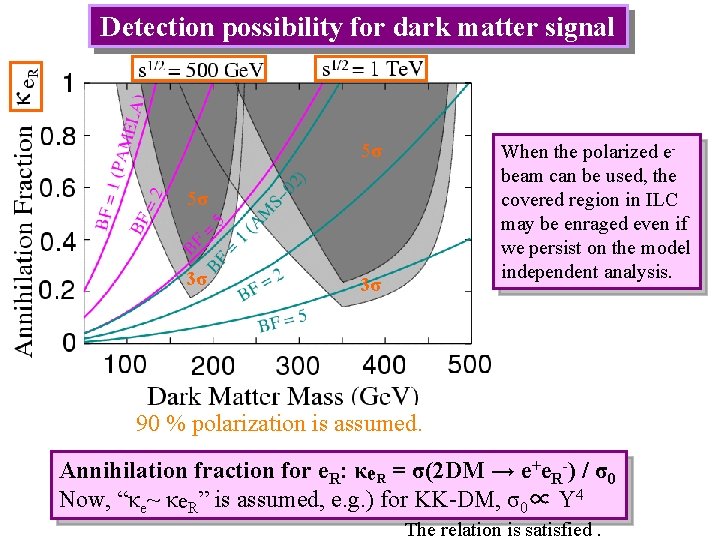
Detection possibility for dark matter signal 5σ When the polarized ebeam can be used, the covered region in ILC may be enraged even if we persist on the model independent analysis. 5σ 3σ 3σ 90 % polarization is assumed. Annihilation fraction for e. R: κe. R = σ(2 DM → e+e. R-) / σ0 Now, “κe~ κe. R” is assumed, e. g. ) for KK-DM, σ0∝ Y 4 The relation is satisfied.
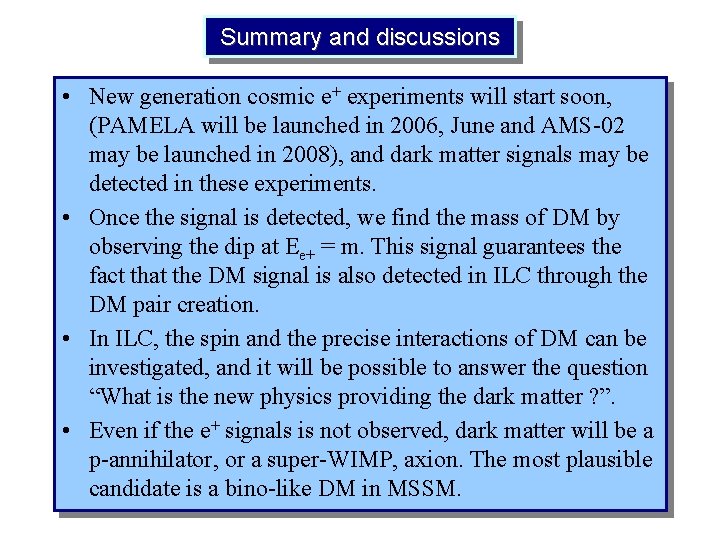
Summary and discussions • New generation cosmic e+ experiments will start soon, (PAMELA will be launched in 2006, June and AMS-02 may be launched in 2008), and dark matter signals may be detected in these experiments. • Once the signal is detected, we find the mass of DM by observing the dip at Ee+ = m. This signal guarantees the fact that the DM signal is also detected in ILC through the DM pair creation. • In ILC, the spin and the precise interactions of DM can be investigated, and it will be possible to answer the question “What is the new physics providing the dark matter ? ”. • Even if the e+ signals is not observed, dark matter will be a p-annihilator, or a super-WIMP, axion. The most plausible candidate is a bino-like DM in MSSM.