
Model Execution Environment for Investigation of Heart Valve
- Slides: 1
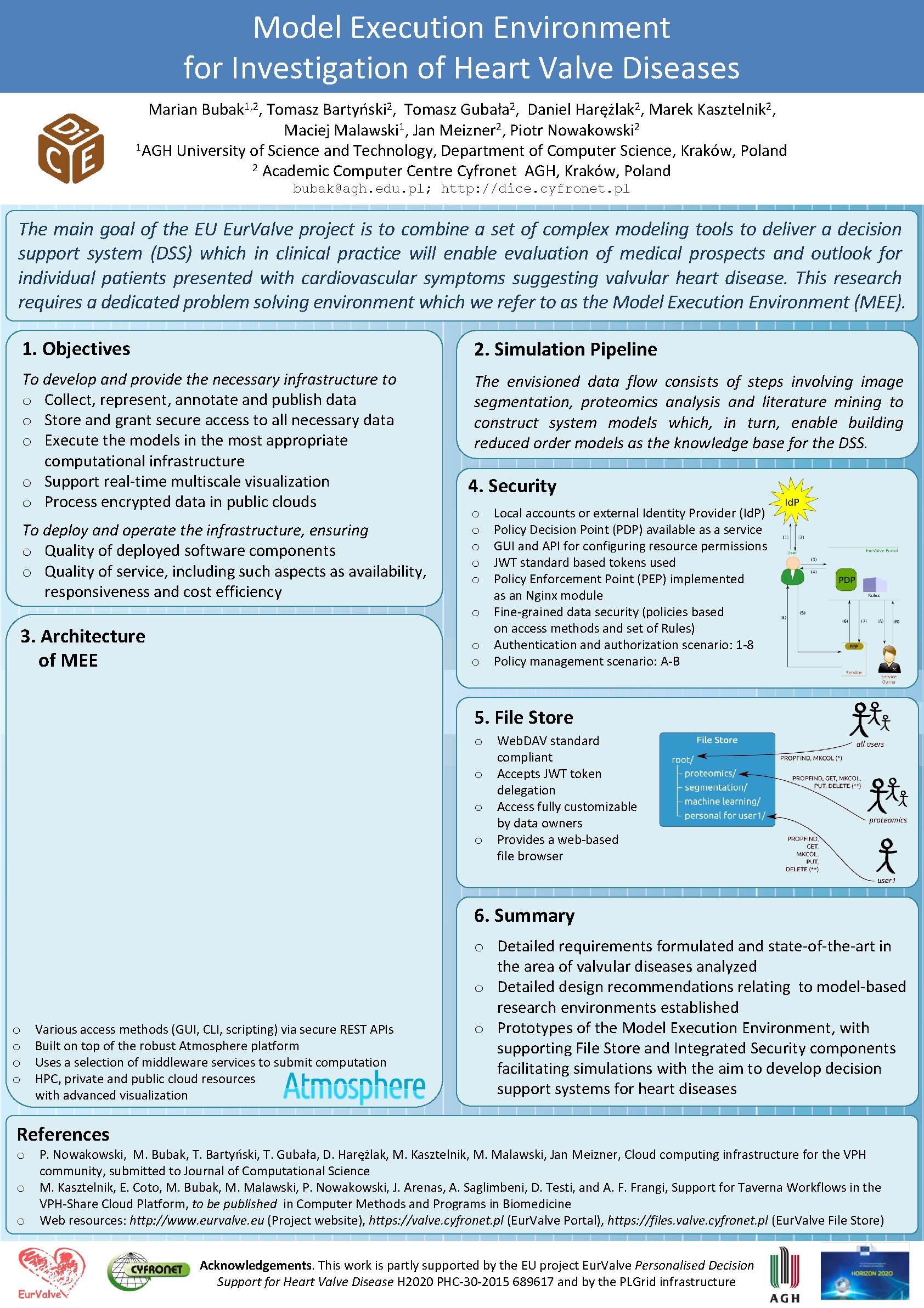
Model Execution Environment for Investigation of Heart Valve Diseases Marian Bubak 1, 2, Tomasz Bartyński 2, Tomasz Gubała 2, Daniel Harężlak 2, Marek Kasztelnik 2, Maciej Malawski 1, Jan Meizner 2, Piotr Nowakowski 2 1 AGH University of Science and Technology, Department of Computer Science, Kraków, Poland 2 Academic Computer Centre Cyfronet AGH, Kraków, Poland bubak@agh. edu. pl; http: //dice. cyfronet. pl The main goal of the EU Eur. Valve project is to combine a set of complex modeling tools to deliver a decision support system (DSS) which in clinical practice will enable evaluation of medical prospects and outlook for individual patients presented with cardiovascular symptoms suggesting valvular heart disease. This research requires a dedicated problem solving environment which we refer to as the Model Execution Environment (MEE). 1. Objectives 2. Simulation Pipeline To develop and provide the necessary infrastructure to o Collect, represent, annotate and publish data o Store and grant secure access to all necessary data o Execute the models in the most appropriate computational infrastructure o Support real-time multiscale visualization o Process encrypted data in public clouds The envisioned data flow consists of steps involving image segmentation, proteomics analysis and literature mining to construct system models which, in turn, enable building reduced order models as the knowledge base for the DSS. To deploy and operate the infrastructure, ensuring o Quality of deployed software components o Quality of service, including such aspects as availability, responsiveness and cost efficiency 4. Security o o o 3. Architecture of MEE o o Local accounts or external Identity Provider (Id. P) Policy Decision Point (PDP) available as a service GUI and API for configuring resource permissions JWT standard based tokens used Policy Enforcement Point (PEP) implemented as an Nginx module Fine-grained data security (policies based on access methods and set of Rules) Authentication and authorization scenario: 1 -8 Policy management scenario: A-B 5. File Store o o Web. DAV standard compliant Accepts JWT token delegation Access fully customizable by data owners Provides a web-based file browser 6. Summary o o Various access methods (GUI, CLI, scripting) via secure REST APIs Built on top of the robust Atmosphere platform Uses a selection of middleware services to submit computation HPC, private and public cloud resources with advanced visualization o Detailed requirements formulated and state-of-the-art in the area of valvular diseases analyzed o Detailed design recommendations relating to model-based research environments established o Prototypes of the Model Execution Environment, with supporting File Store and Integrated Security components facilitating simulations with the aim to develop decision support systems for heart diseases References o o o P. Nowakowski, M. Bubak, T. Bartyński, T. Gubała, D. Harężlak, M. Kasztelnik, M. Malawski, Jan Meizner, Cloud computing infrastructure for the VPH community, submitted to Journal of Computational Science M. Kasztelnik, E. Coto, M. Bubak, M. Malawski, P. Nowakowski, J. Arenas, A. Saglimbeni, D. Testi, and A. F. Frangi, Support for Taverna Workflows in the VPH-Share Cloud Platform, to be published in Computer Methods and Programs in Biomedicine Web resources: http: //www. eurvalve. eu (Project website), https: //valve. cyfronet. pl (Eur. Valve Portal), https: //files. valve. cyfronet. pl (Eur. Valve File Store) Acknowledgements. This work is partly supported by the EU project Eur. Valve Personalised Decision Support for Heart Valve Disease H 2020 PHC-30 -2015 689617 and by the PLGrid infrastructure