
Model Driven Architecture in the Enterprise Amit Keyur




- Slides: 26
Model Driven Architecture in the Enterprise Amit, Keyur, Sabhay and Saleh
Model Driven Architecture in the Enterprise • • • Introduction to MDA The Role of UML in MDA Introduction to EDOC Other Enterprise Modeling Approaches Modeling Tools Supporting MDA Project Current Status
Modification in Our Scope • Objective Before: – Evaluate EDOC, apply it to a test • Objective Now, to answer the questions – How far is UML and MDA related/consistent? – What kind of support do modeling tools do for MDA/EDOC? – How far is the EDOC from today’s enterprise modeling practices and tools market?
Introduction to MDA • • Abstraction: A Historical Lesson MDA: Why? MDA: How? MOF: MDA’s Genie
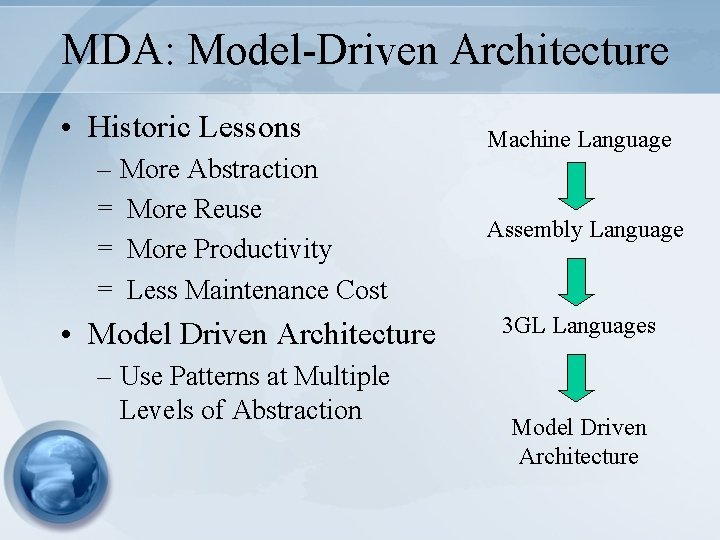
MDA: Model-Driven Architecture • Historic Lessons Machine Language – More Abstraction = More Reuse = More Productivity = Less Maintenance Cost Assembly Language • Model Driven Architecture 3 GL Languages – Use Patterns at Multiple Levels of Abstraction Model Driven Architecture
Model-Driven Architecture: Why • Platform-independent Modeling – Rapidly Changing Technology – Applications Spanning Multiple Platforms • Viewpoints-Based Modeling – Different abstractions for the same system – Different models for the same system • Issues – Consistency? – Changeability?
Model-Driven Architecture: How • Metamodels – Modeling modeling languages – Open-ended modeling capability • Technology Mappings – Transformation Rules – From modeling language to technology
OMF: MDA’s Genie • Modeling Language for Defining Virtually Any Modeling Languages • Intersects with UML Syntactically & Semantically • Tools interchange meta models via XMI • Tools transform platform-independent models – Generate platform-specific models or implementation
UML’s Role in MDA • History of UML – Early 1990 s – Object Oriented Analysis and Design (OOAD) had three groups • Rumbaugh • Booch • Jacobson – In 1996 – Creation of Universal Modeling Language (UML) v. 1. 1
UML’s Role in MDA (UML 1. x) • Strengths: – Separation of Abstract Syntax from Concrete Syntax • Meta-model – Enables Extensibility • UML Profiles
UML’s Role in MDA (cont. ) • Strengths: – Support for Platform Independent models • Defines relationships without details of implementation – Open System • Custom plug-ins
UML’s Role in MDA (cont. ) • Weaknesses: – Lack of support for component based modeling • Unsatisfactory results – Lack of communication • No means of inter-tool communication – UML and MOF not in synch • Problems for developers
UML 2. 0 • Many UML 1. x Weaknesses Resolved – New set of structural and behavioral diagram – Support for component-based modeling • Composite Structures – UML and MOF • Inconsistencies have been corrected – Improved Behavioral Modeling • Action model – Better Communication • Interchange specification using XML
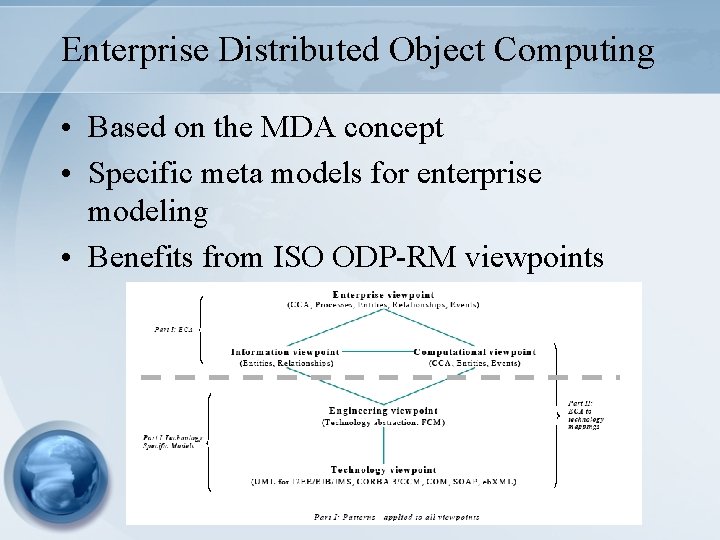
Enterprise Distributed Object Computing • Based on the MDA concept • Specific meta models for enterprise modeling • Benefits from ISO ODP-RM viewpoints
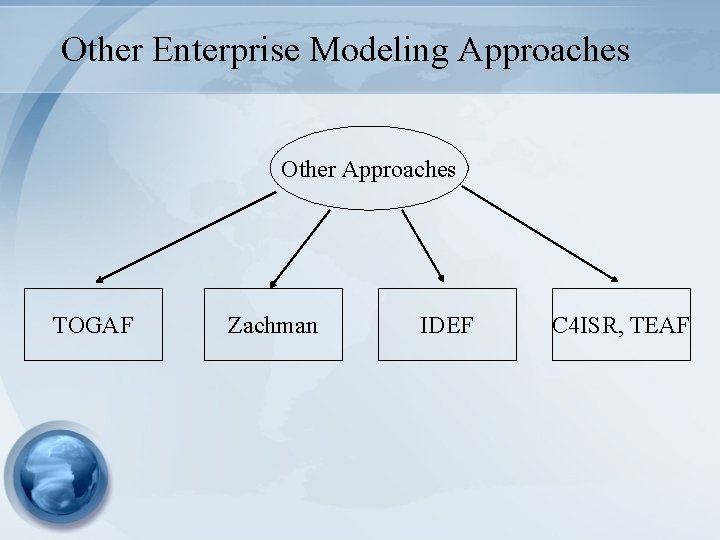
Other Enterprise Modeling Approaches Other Approaches TOGAF Zachman IDEF C 4 ISR, TEAF
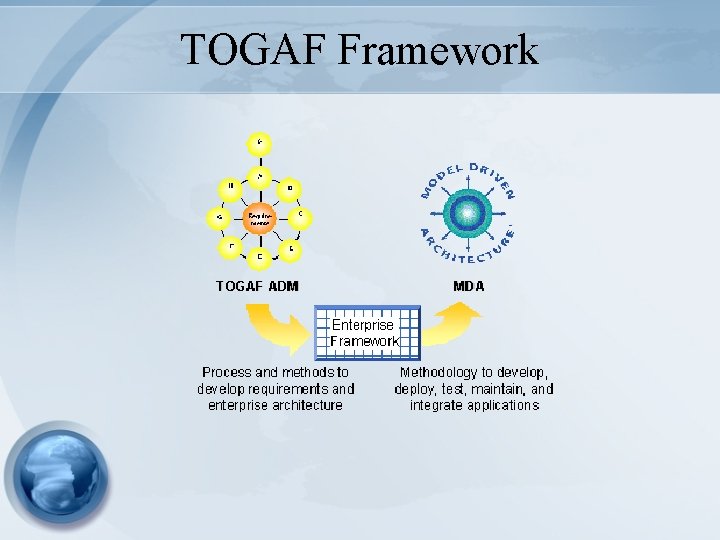
TOGAF Framework
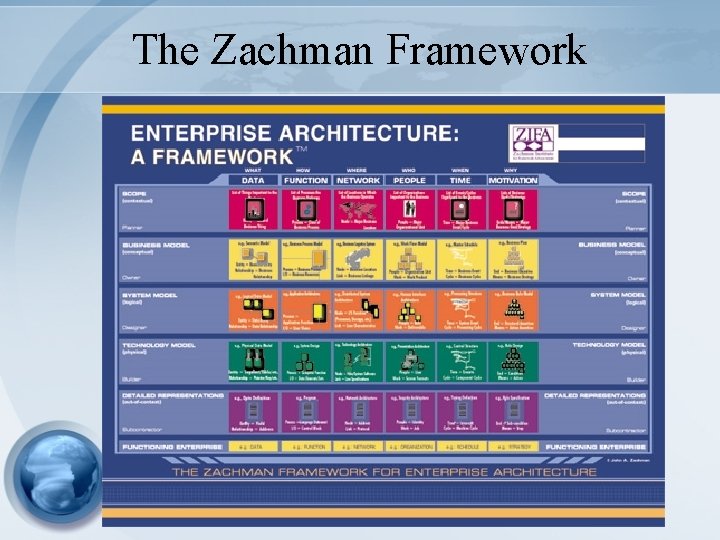
The Zachman Framework
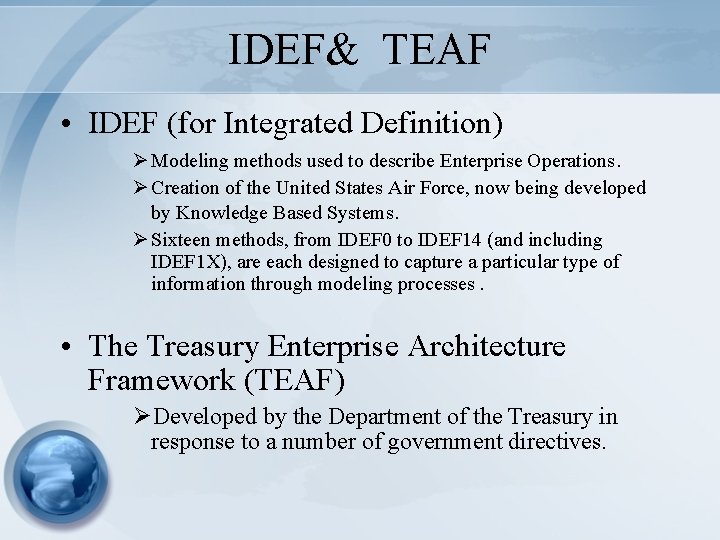
IDEF& TEAF • IDEF (for Integrated Definition) Ø Modeling methods used to describe Enterprise Operations. Ø Creation of the United States Air Force, now being developed by Knowledge Based Systems. Ø Sixteen methods, from IDEF 0 to IDEF 14 (and including IDEF 1 X), are each designed to capture a particular type of information through modeling processes. • The Treasury Enterprise Architecture Framework (TEAF) ØDeveloped by the Department of the Treasury in response to a number of government directives.
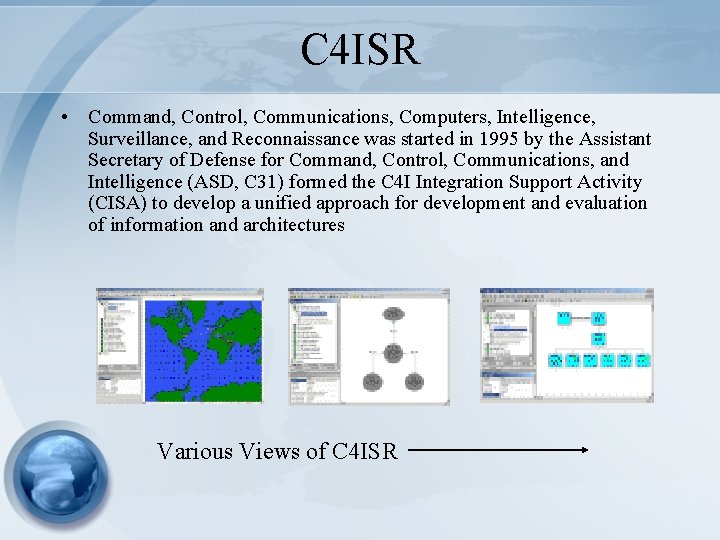
C 4 ISR • Command, Control, Communications, Computers, Intelligence, Surveillance, and Reconnaissance was started in 1995 by the Assistant Secretary of Defense for Command, Control, Communications, and Intelligence (ASD, C 31) formed the C 4 I Integration Support Activity (CISA) to develop a unified approach for development and evaluation of information and architectures Various Views of C 4 ISR
Modeling Tools Supporting MDA What is considered an MDA supported tool? – Is the model on the highest level of abstraction ? – Are the transformation definitions maintainable by you? – Do transformations generate a majority of the application? – Do transformations support incremental and iterative modeling and development?
Tools supporting MDA Component-X by Data Advanced Technology ü Seems to be the official EDOC tool. ü A triple standards alignment with eb. XML, EDOC and EAI to become component model for XML web services. ü EDOC has been implemented in Component-X. ü Component-X and the EDOC Component Collaboration Architecture are part of the UML family of languages. ü Supports integrating applications across platforms, technologies, Internet and the enterprise.
Tools supporting MDA Open. MDX: An Advanced MDA Framework ü Advanced implementation of the MDA initiative. ü Industrial-strength, model-driven runtime engine, open, and framework for PIMs. ü Open. MDX provides a generic, distributed object engine which serves as a PIM platform. Rhapsody by I-Logix ü One of the market leading UML 2. 0 Model-Driven Development ü Focuses on the needs of the embedded developer and fully supports the concepts of MDA
Tools supporting MDA The TAU Generation 2 Approach to MDA – Based on UML 2. 0 to substantially improve software productivity and quality. – Automate the transformation of a PIM requirements into a PSM Executable. UML (x. UML) – Creation of PIM with the UML diagrams. – Multiple Executable UML models can be assembled together to form complex systems
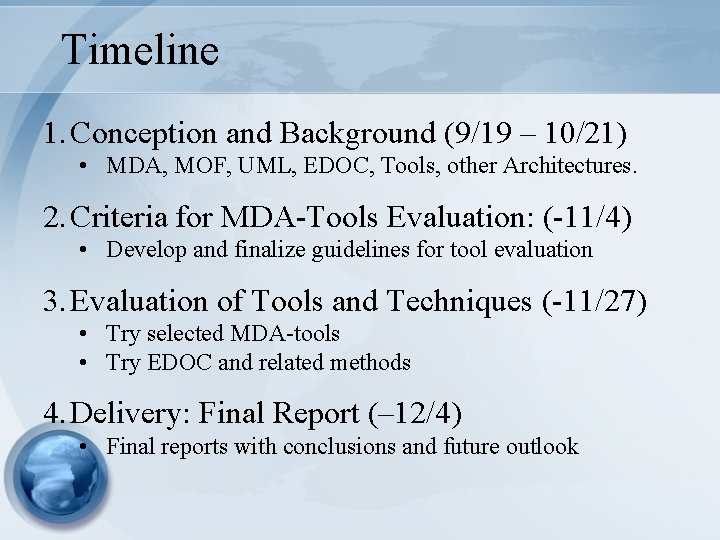
Timeline 1. Conception and Background (9/19 – 10/21) • MDA, MOF, UML, EDOC, Tools, other Architectures. 2. Criteria for MDA-Tools Evaluation: (-11/4) • Develop and finalize guidelines for tool evaluation 3. Evaluation of Tools and Techniques (-11/27) • Try selected MDA-tools • Try EDOC and related methods 4. Delivery: Final Report (– 12/4) • Final reports with conclusions and future outlook
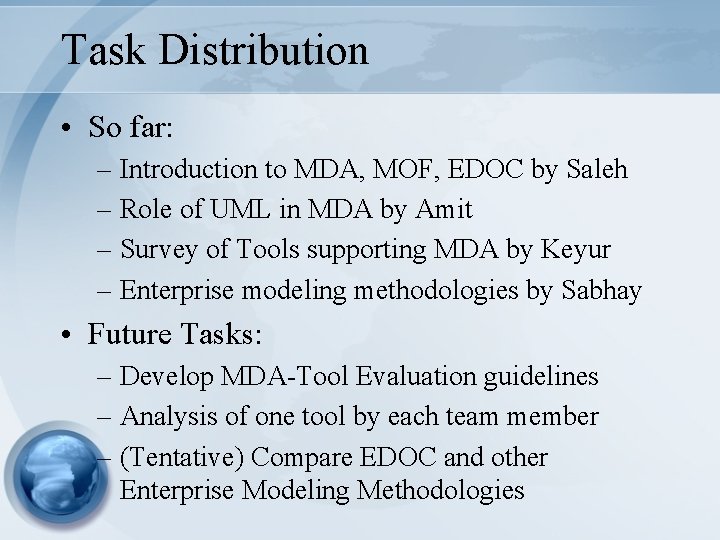
Task Distribution • So far: – Introduction to MDA, MOF, EDOC by Saleh – Role of UML in MDA by Amit – Survey of Tools supporting MDA by Keyur – Enterprise modeling methodologies by Sabhay • Future Tasks: – Develop MDA-Tool Evaluation guidelines – Analysis of one tool by each team member – (Tentative) Compare EDOC and other Enterprise Modeling Methodologies
Questions?