
Model Congress An Overview Teams 7 G and

- Slides: 12
Model Congress: An Overview Teams 7 G and 7 S Social Studies and IRLA
What is Model Congress? • Model Congress is a 4 th marking period project involving both Social Studies and IRLA. • Model Congress is a research project and a performance-based assessment. • During Model Congress you will be expected to work hard during class and outside of class time (flex and home). Now is not the time to slack off!
Research Project: • You will be researching a topic for a Bill that you would like to see made a law for our country and writing a persuasive essay on your position using your research as your support. • You are assessed on your content/knowledge, and your reading and writing skills.
Performance-Based Assessment: • After the research and persuasive essay is complete, Model Congress becomes a performance-based assessment. • You will be working in a committee to write a bill and then presenting this bill to Congress. You will participate in a live session of Congress to defend your bill and convince Congress to vote the bill into law. • Model Congress assesses our 21 st Century Competencies: • • • Information Literate Researcher Collaborative Team Member Flexible and Self-Directed Learner Effective Communicator Creative and Practical Problem Solver Globally Aware and Responsible Student/Citizen
Model Congress has 3 Main Parts: 1) Research/Writing (an individual persuasive, research-based essay) 2) Committee Work 3) Live Congress
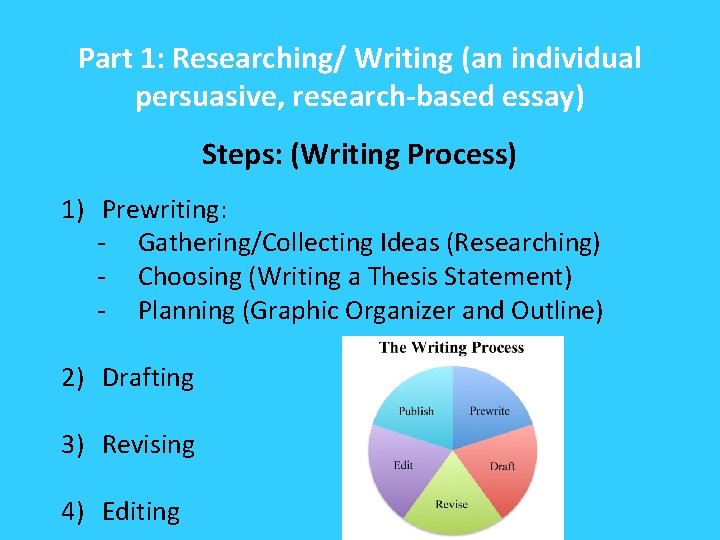
Part 1: Researching/ Writing (an individual persuasive, research-based essay) Steps: (Writing Process) 1) Prewriting: - Gathering/Collecting Ideas (Researching) - Choosing (Writing a Thesis Statement) - Planning (Graphic Organizer and Outline) 2) Drafting 3) Revising 4) Editing
Part 2: Committee Work (in groups by topic) Steps: 1) Share research and read each other’s essays. 2) Write a bill (a proposed law). 3) Create a pamphlet to provide members of Congress with important information pertaining to your topic. 4) Create a Power. Point presentation to show/use during your persuasive presentation in live Congress. 5) Write an opening statement for presentation to Congress.
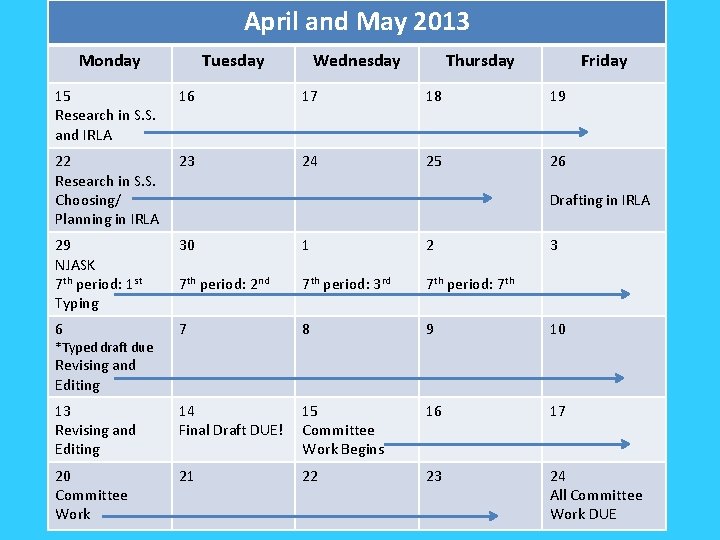
April and May 2013 Monday Tuesday Wednesday Thursday Friday 15 Research in S. S. and IRLA 16 17 18 19 22 Research in S. S. Choosing/ Planning in IRLA 23 24 25 26 29 NJASK 7 th period: 1 st Typing 30 1 2 7 th period: 2 nd 7 th period: 3 rd 7 th period: 7 th 6 7 8 9 10 13 Revising and Editing 14 Final Draft DUE! 15 Committee Work Begins 16 17 20 Committee Work 21 22 23 24 All Committee Work DUE *Typed draft due Drafting in IRLA 3 Revising and Editing
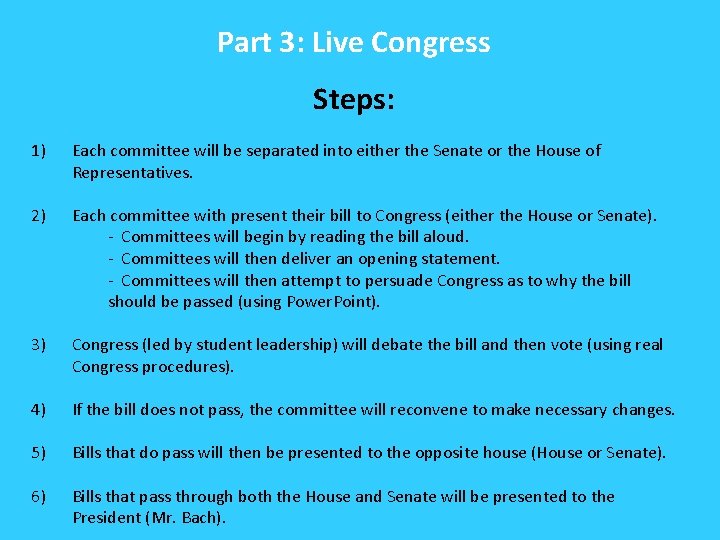
Part 3: Live Congress Steps: 1) Each committee will be separated into either the Senate or the House of Representatives. 2) Each committee with present their bill to Congress (either the House or Senate). - Committees will begin by reading the bill aloud. - Committees will then deliver an opening statement. - Committees will then attempt to persuade Congress as to why the bill should be passed (using Power. Point). 3) Congress (led by student leadership) will debate the bill and then vote (using real Congress procedures). 4) If the bill does not pass, the committee will reconvene to make necessary changes. 5) Bills that do pass will then be presented to the opposite house (House or Senate). 6) Bills that pass through both the House and Senate will be presented to the President (Mr. Bach).
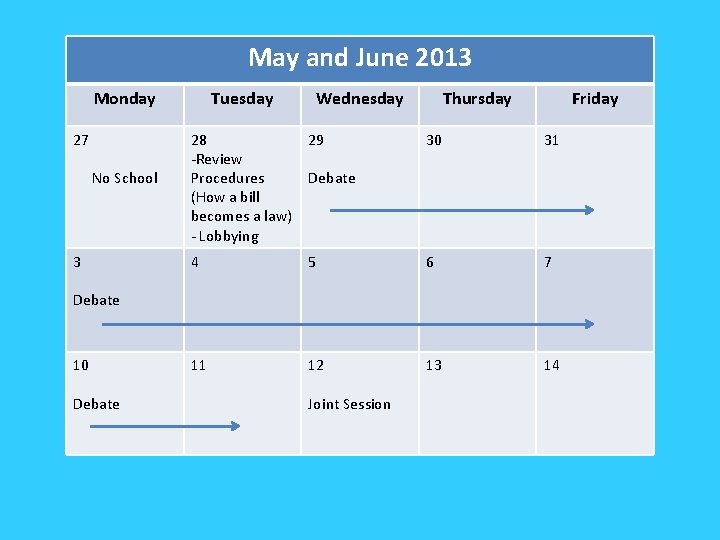
May and June 2013 Monday 27 No School 3 Tuesday Wednesday 28 -Review Procedures (How a bill becomes a law) - Lobbying 29 4 11 Thursday Friday 30 31 5 6 7 12 13 14 Debate 10 Debate Joint Session