
Model 4580 MicroPace Dual Chamber Temporary Pacemaker an
Model 4580 Micro-Pace Dual Chamber Temporary Pacemaker an introduction by APC Cardiovascular Ltd
Training Objective To ensure that clinicians and medical staff members receive training in the proper use of the equipment To enable clinicians and medical staff members to perform their duties optimally To ensure that patient care is not compromised
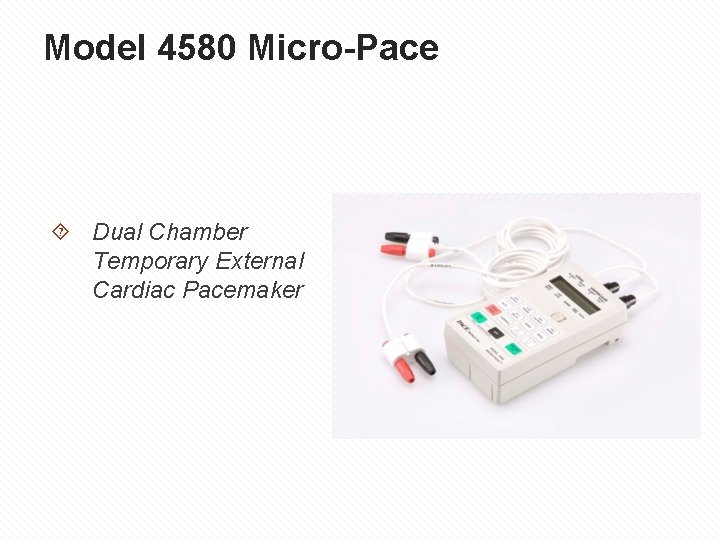
Model 4580 Micro-Pace Dual Chamber Temporary External Cardiac Pacemaker
Overview The Model 4580 Micro-Pace is a programmable, dual chamber temporary cardiac pacemaker capable of multi-mode, multiparameter operation In its most sophisticated mode, DDD, the Micro-Pace will sense and pace in both the atria and ventricles, restoring A-V synchrony and improving cardiac output The ability of the Micro-Pace to pace and track at high rates in DDD mode allows Cardiologists and Surgeons to address the needs of post-operative, open heart patients, regardless of age In spite of its many advanced technical features, the Micro-Pace is exceptionally “user friendly”
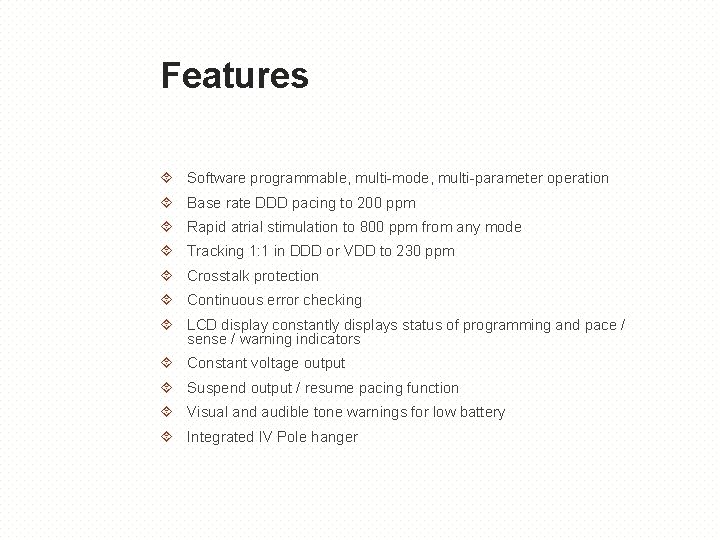
Features Software programmable, multi-mode, multi-parameter operation Base rate DDD pacing to 200 ppm Rapid atrial stimulation to 800 ppm from any mode Tracking 1: 1 in DDD or VDD to 230 ppm Crosstalk protection Continuous error checking LCD display constantly displays status of programming and pace / sense / warning indicators Constant voltage output Suspend output / resume pacing function Visual and audible tone warnings for low battery Integrated IV Pole hanger
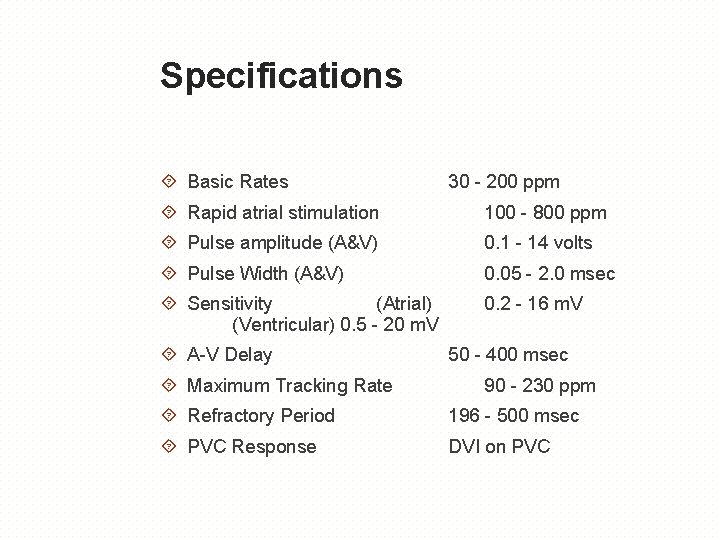
Specifications Basic Rates 30 - 200 ppm Rapid atrial stimulation 100 - 800 ppm Pulse amplitude (A&V) 0. 1 - 14 volts Pulse Width (A&V) 0. 05 - 2. 0 msec Sensitivity (Atrial) (Ventricular) 0. 5 - 20 m. V 0. 2 - 16 m. V A-V Delay Maximum Tracking Rate 50 - 400 msec 90 - 230 ppm Refractory Period 196 - 500 msec PVC Response DVI on PVC
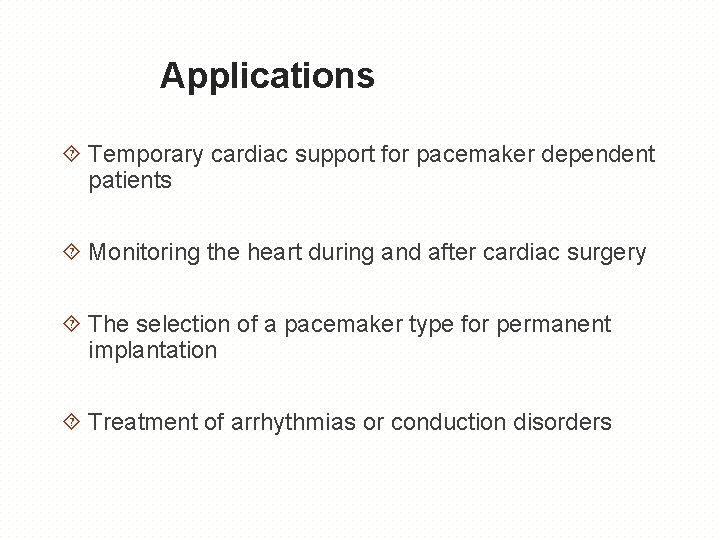
Applications Temporary cardiac support for pacemaker dependent patients Monitoring the heart during and after cardiac surgery The selection of a pacemaker type for permanent implantation Treatment of arrhythmias or conduction disorders
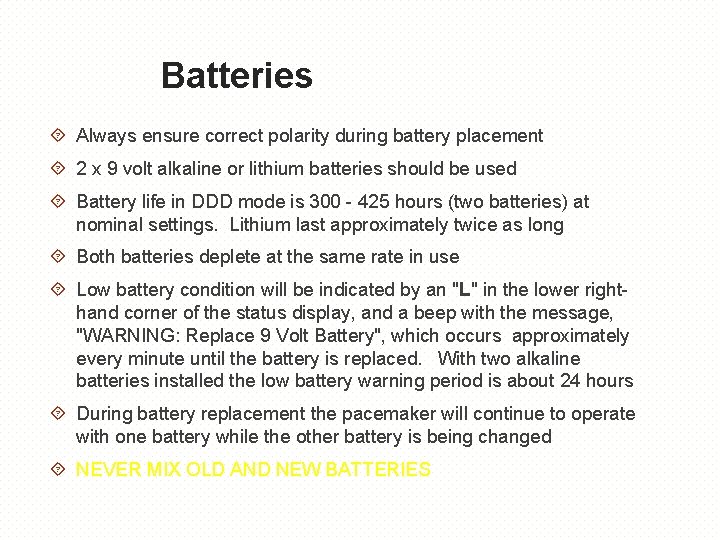
Batteries Always ensure correct polarity during battery placement 2 x 9 volt alkaline or lithium batteries should be used Battery life in DDD mode is 300 - 425 hours (two batteries) at nominal settings. Lithium last approximately twice as long Both batteries deplete at the same rate in use Low battery condition will be indicated by an "L" in the lower righthand corner of the status display, and a beep with the message, "WARNING: Replace 9 Volt Battery", which occurs approximately every minute until the battery is replaced. With two alkaline batteries installed the low battery warning period is about 24 hours During battery replacement the pacemaker will continue to operate with one battery while the other battery is being changed NEVER MIX OLD AND NEW BATTERIES
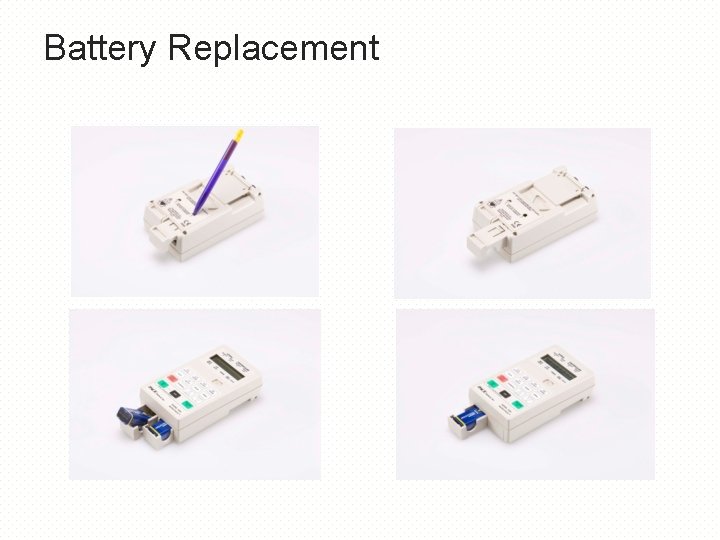
Battery Replacement
DDD On / Off / Resume Press the DDD ON key to power up the 4580. The unit will begin pacing in DDD mode at nominal parameter settings If the RESUME ON key is used to turn the device on, the mode and parameter values in use at the time the device was last turned off (provided the batteries have not been removed) will immediately take effect To turn the 4580 off, press and briefly hold the DDD ON and OFF keys simultaneously
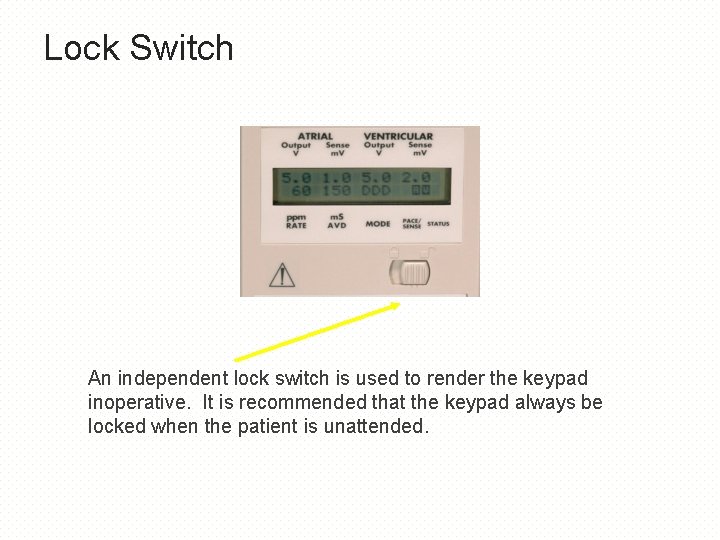
Lock Switch An independent lock switch is used to render the keypad inoperative. It is recommended that the keypad always be locked when the patient is unattended.
Mode Selection Press MODE to enable selection of chamber to be paced or sensed and the pacemaker’s response to sensed events Use the cursor ‘+’ or ‘-‘ keys to scroll through the mode options Press MODE again to confirm selection when desired option is displayed Modes available: VVI VOO AAI AOO AAT DVI DOO VVT DDI DDD VDD
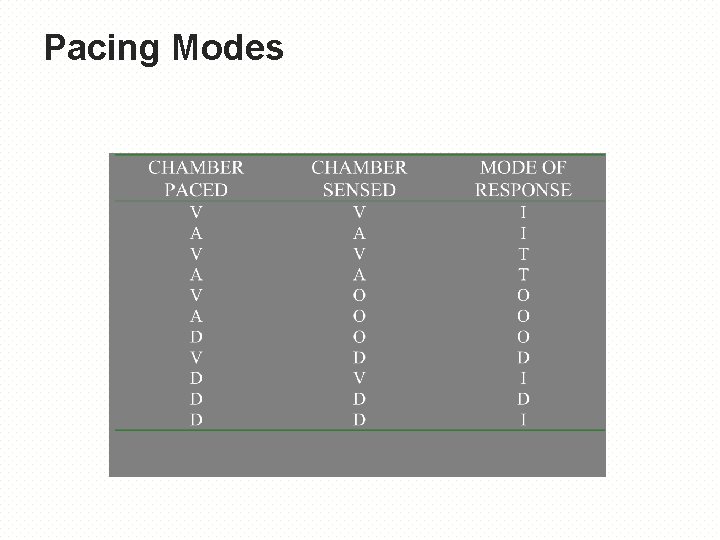
Pacing Modes 13
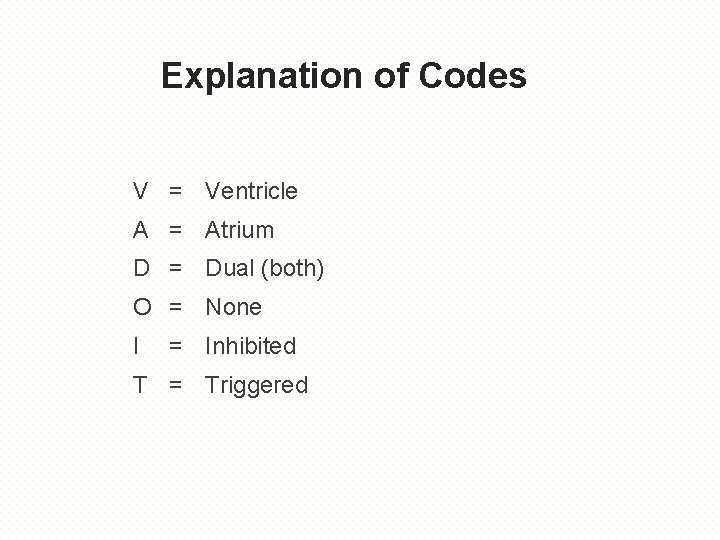
Explanation of Codes V = Ventricle A = Atrium D = Dual (both) O = None I = Inhibited T = Triggered
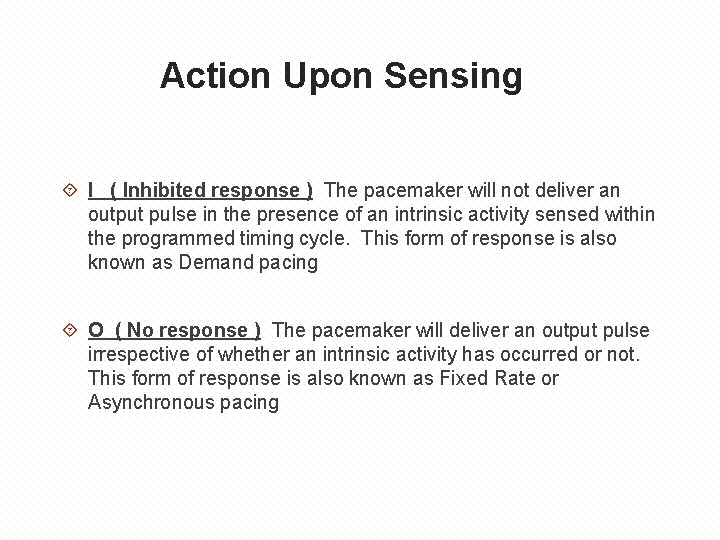
Action Upon Sensing I ( Inhibited response ) The pacemaker will not deliver an output pulse in the presence of an intrinsic activity sensed within the programmed timing cycle. This form of response is also known as Demand pacing O ( No response ) The pacemaker will deliver an output pulse irrespective of whether an intrinsic activity has occurred or not. This form of response is also known as Fixed Rate or Asynchronous pacing
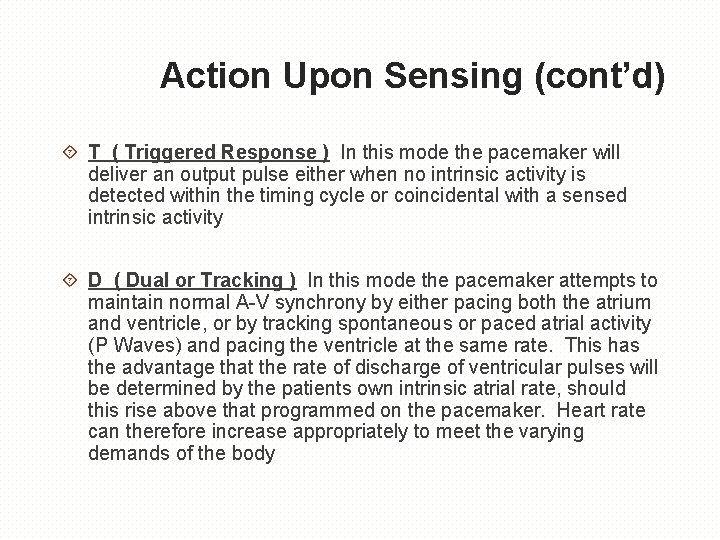
Action Upon Sensing (cont’d) T ( Triggered Response ) In this mode the pacemaker will deliver an output pulse either when no intrinsic activity is detected within the timing cycle or coincidental with a sensed intrinsic activity D ( Dual or Tracking ) In this mode the pacemaker attempts to maintain normal A-V synchrony by either pacing both the atrium and ventricle, or by tracking spontaneous or paced atrial activity (P Waves) and pacing the ventricle at the same rate. This has the advantage that the rate of discharge of ventricular pulses will be determined by the patients own intrinsic atrial rate, should this rise above that programmed on the pacemaker. Heart rate can therefore increase appropriately to meet the varying demands of the body
Setting Parameter Values Standard operating parameters that can be programmed include RATE OUTPUT SENSITIVITY A-V DELAY To change a parameter first press the selected key until the cursor appears on the display. Then use the ’+’ or ‘-‘ keys to increase or decrease the value No further confirmation is required
Menu Functions Repeated pressing of the MENU key allows access to and selection of the following functions (according to the pacing mode selected): SUSPEND OUTPUT: allows the output of the pacemaker to be temporarily suspended and is activated by pressing both ATRIAL and VENTRICULAR OUTPUT keys at the same time. As soon as the keys are released pacing resumes at the programmed values. Available from any mode.
Menu (cont’d) MEMORY: enables parameter settings to be stored and retained in memory (‘+’ key) for later recall (‘-‘ key) in each of the eleven pacing modes provided the batteries are not removed. PULSE WIDTH: atrial and / or ventricular values may be adjusted, according to the mode selected, by pressing the ‘+’ or ‘-‘ keys. VENTRICULAR REFRACTORY PERIOD, VENTRICULAR BLANKING, ATRIAL REFRACRORY PERIOD and PVARP (Post Ventricular Atrial Refractory Period) values may be adjusted, depending on the pacing mode, by selecting the parameter and pressing the ’+’ or ‘-‘ keys.
Menu (cont’d) MAXIMUM TRACKING RATE: adjustable in dual chamber modes with the ’+’ or’-‘ keys up to the higher BLOCK value (set in conjunction with PVARP). Between the MTR and BLOCK values the pacemaker will attempt to reduce the heart rate by electronic Wenkebach (progressively extending the P-R interval until a ‘P’ Wave is not sensed and therefore not followed by a ventricular stimulus). If unsuccessful and the rate increases above the value set for 2: 1 BLOCK the pacemaker attempts a 2: 1 or greater block (i. e. by ignoring every other ‘P’ Wave) in order to control the heart rate. RAPID PACING: accessible from any mode for atrial use only. The desired rapid pacing rate is first programmed using the ‘+’ or ‘-‘ keys and then activated by pressing and holding the RATE key. On release of the RATE key the pacemaker resumes pacing at the basic programmed rate.
Automatic Parameter Adjustments As the programmed rate is increased (or decreased) several parameters may automatically be adjusted, according to the pacing mode selected, to accommodate a shortening (or lengthening) of the pacing cycle. MTR: this normally adjusts to remain at least 30 bpm above the programmed rate.
Automatic Parameter Adjustments VENTRICULAR REFRACTORY: the first parameter to reduce as the rate is increased. A-V DELAY: the second parameter to reduce (for dual chamber modes) as the rate is increased. After a shortening of the VENTRICULAR REFRACTORY period and the A-V DELAY following an increase in the programmed rate, both values will increase in the reverse order (A-V DELAY first then VENTRICULAR REFRACTORY) as the programmed rate is subsequently reduced.
Display Indicators These provide the operator with information pertaining to the performance of the pacemaker A = Atrial output pulse V = Ventricular output pulse P = Atrial channel sensed event (P Wave) R = Ventricular channel sensed event (R Wave) L = Low battery condition (replace batteries) N = Interference (noise) detected (oversensing; reduce sensitivity level increasing the numerical value) by W = Device is performing Wenkebach in the presence of high atrial rate B = Device is performing 2: 1 or greater block in the presence of high atrial rate S = Device is performing ventricular safety standby pacing (increase blanking period and / or decrease atrial output) X = Device is detecting possible crosstalk (increase blanking period, decrease atrial output and / or decrease ventricular sensitivity). = Device is detecting ‘noise’ early in the noise sampling period (increase ventricular refractory period)
Emergency Pacing Pressing the STAT PACE key activates the emergency pacing function causing the mode to change to DDI, the output to increase to 10 volts and the pulse width to increase to 1. 5 msec. This mode is often used in an attempt to regain capture when a loss of capture has occurred.
Nominal Values Pressing this key restores the pacemaker settings to nominal parameters, as defined in the operating manual, according to the mode of pacing selected. The pacing mode is unaffected
Output Adjustment To evaluate the Stimulation threshold To overcome problem of Exit block To reduce muscle twitching
Stimulation Threshold Defined as the minimum energy required to ‘capture’ the heart and induce contraction of the chamber being paced Energy delivered to the heart is a function of the voltage output and pulse duration. Threshold values can be plotted at different combinations in a Strength Duration Curve
Stimulation Threshold Evaluation Set the mode to VVI Set pacemaker rate above the patient’s intrinsic rate and the Output to 4 V (or higher if needed) Gradually reduce the output of the pacemaker until a pacing spike is seen on the bedside monitor without a corresponding QRS or P wave Increase the output until the pacemaker is seen to ‘capture’ the heart (threshold value) Set the output level to a safety margin of 2 – 4 times that of the threshold value For an atrial lead, the above may be repeated in an appropriate mode; eg. AAI or DVI with the atrial lead connected to the atrial output terminals
Sensitivity Adjustment To eliminate undersensing of QRS or P waves To eliminate oversensing Myopotentials After potentials Cross talk T waves To reduce sensing in the presence of atrial fibrillation / flutter or retrograde P waves
Sensitivity Threshold Evaluation Set the mode to VVI Set the pacemaker rate below the patient’s intrinsic rate Set the Sensitivity control to a level that ensures continuous sensing (i. e. 1 m. V) Set the Output control to minimum
Sensitivity Threshold Evaluation Gradually reduce the sensitivity value (i. e. increase numerical value) until the ‘R’ enunciator on the pacemaker display is replaced by ‘V’ Increase the sensitivity (i. e. reduce numerical value) until the ‘R’ wave is detected (threshold value) and the ‘V’ enunciator changes back to ‘R’ Set the sensitivity level to a safety margin of 2 – 4 times that of the threshold value Return the Rate and Output controls to normal values Repeat if necessary for the atrial lead using AAI mode
Ventricular Safety Pacing Ventricular safety pacing is designed to minimize the risk of inappropriate inhibition of the pacemaker's ventricular output pulse, if crosstalk occurs. This is accomplished by having the pacemaker alert for crosstalk for a short period of time after the blanking period. The duration of the crosstalk detection window is equal to 80 milliseconds minus the blanking period. If any signal is sensed during the crosstalk detection window, the pacemaker is triggered to deliver a ventricular output pulse 120 milliseconds after the atrial output pulse. Detected signals which repeat with a frequency equal to or greater than 6 Hz will cause reversion to the interference mode. Safety pacing is indicated by the appearance of an "S" occurring coincidentally with the ventricular status enunciator, "V", in the extreme right-hand position on the display, following an initial "A".
Interference Mode Any detected signal with a repetition rate equal to or less than 10 Hz will cause pacemaker inhibition (or triggering depending upon the mode programmed) If the signal has a repetition rate in excess of 10 Hz, a pacemaker programmed to VVI will operate at its base ventricular rate, asynchronously, while it continues to sample for the presence of noise Normal function is resumed when the level of interference is sufficiently reduced If a procedure involving the use of EC / ES equipment is planned on a patient wearing a MICRO-PACE, it is recommended that such use be limited either to short bursts or that the MICROPACE be programmed to a non-sensing mode during the procedure.
Connection of Accessories Whenever an extension cable is used, it should be connected to the pulse generator prior to the pacing lead being connected to the extension cable. Turn the Model 4580 on before connecting to the patient’s pacing leads. Failure to follow this instruction could result in the delivery of a pacing pulse into the vulnerable portion of the T-wave.
Connecting the Patient Cable to the Model 4580 The extension cables provided with the Model 4580 pacemaker have been designed to provide a prompt and secure means of interconnecting the pacemaker and an implanted temporary lead system. The Model 4580 is provided with separate Redel terminals for the Atrial and Ventricular cables. The Redel connectors on the extension cable can be easily inserted into the Redel terminals by orientating the connector correctly and pushing directly into the terminal To disconnect the cable, pull back the outer sleeve of the connector Do not twist or turn the connectors
Connection of Lead to Cable On the distal end of the cables are two collet terminals and two 2 mm shrouded pin sockets. With bipolar, transvenous electrodes or leads where only one electrode is in contact with the myocardium, connect the proximal or skin electrode to the indifferent (+) red terminal and the distal or contacting electrode to the active (–) black terminal
Connection of Lead to Cable For transvenous leads having 2 mm shrouded pin connectors, fully insert each connector pin into its shrouded socket, observing polarity. For transvenous leads or myocardial heart wires having exposed male pin connectors, connect to the collet terminals, observing polarity. Do not over-tighten the terminal caps.

Cleaning of the 4580 Model 4580 MICRO-PACE is both durable and water resistant. It is not water-proof. A clean, soft cloth moistened with 70% isopropyl alcohol or a dilute solution of a mild, non-abrasive detergent and water may be used to clean the Model 4580 External Pulse Generator. The Velcro elastic straps may be machine washed with laundry detergent WARNING: Do not sterilize a MICRO-PACE by use of autoclaving (Et. O or steam), ultrasonics or gamma irradiation. Do not immerse in cleaning or sterilizing solutions. Such procedures can seriously damage a MICRO-PACE
Extension Cable Cleaning As supplied, the cable is NON-STERILE. It may be cleaned and / or sterilised using the following processes: CLEANING: 70% isopropyl alcohol or mild detergent followed by rinsing with water. Air dry thoroughly. Have a qualified technician test the cable for electrical continuity. MACHINE CLEANING: The cables may be cleaned in automatic cleaning machines. Running cycles including one hour (60 minutes) at 100ºC, have been tested with no negative results. STERILISING: The cable may be sterilized by steam autoclaving at 121 C for 15 minutes, or other approved cycles. Ethylene oxide sterilization will not affect the cable any more than steam sterilization, but no specific method can be recommended. Do not attempt to resterilise an extension cable using gamma irradiation.
Care of Equipment The Model 4580 and its extension cables should be routinely inspected for signs of physical damage or contamination, particularly damage or contamination that may have a detrimental effect on the electrical isolation properties of the pacemaker or cable. If such damage or contamination is identified, the Model 4580 should be returned to the manufacturer for repair, and / or the extension cable should be promptly replaced. The Model 4580 pacemaker has been designed to maintain a constant surveillance of critical components and operations and, in the event an abnormality or failure is detected, to provide an alert to the operator and, in some instances, to automatically adjust the pacemaker to a back-up mode of operation
Care of Equipment In the event of certain failures involving the software and some key hardware elements, pacing is maintained where possible with dual-chamber asynchronous output. However, proper function usually cannot be assured and continued use is not recommended, even if the error condition can be cleared. The MICRO-PACE should be removed from service and returned for repair The battery and contact terminals should be checked for corrosion at regular intervals Avoid contamination of the terminals or cable connector with blood or other body fluids. If it is necessary to clean the connector, use only isopropyl alcohol. Do not use any other chemical cleaner.
- Slides: 41