
Modals Chapter 7 Warm up Answer these questions


- Slides: 112
Modals – Chapter 7
Warm up Answer these questions: • What are some things that you can do now, but you couldn’t do when you were a child? • What are some things you will be able to do next year? • What is something people should know before they move to the United States? • Who do you think will be the next president of the United States?
Review!
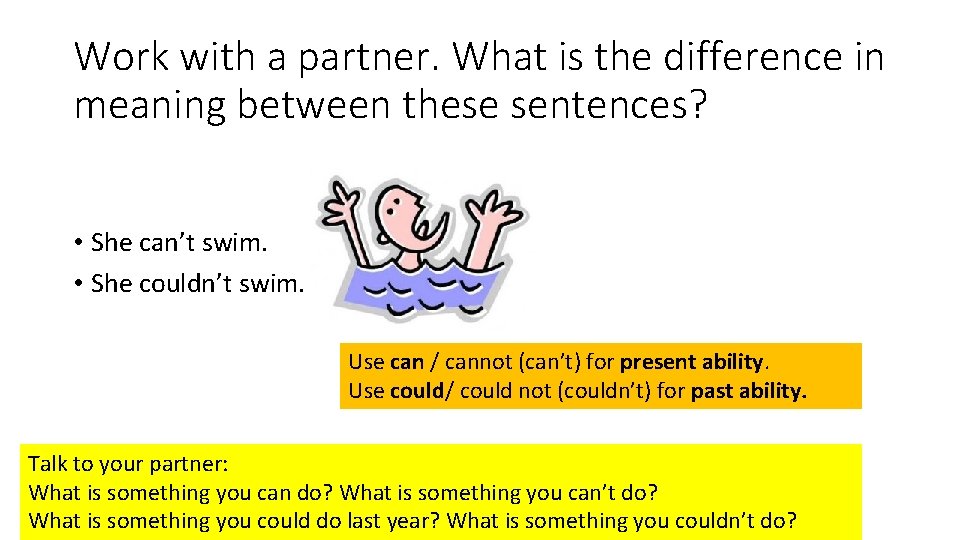
Work with a partner. What is the difference in meaning between these sentences? • She can’t swim. • She couldn’t swim. Use can / cannot (can’t) for present ability. Use could/ could not (couldn’t) for past ability. Talk to your partner: What is something you can do? What is something you can’t do? What is something you could do last year? What is something you couldn’t do?
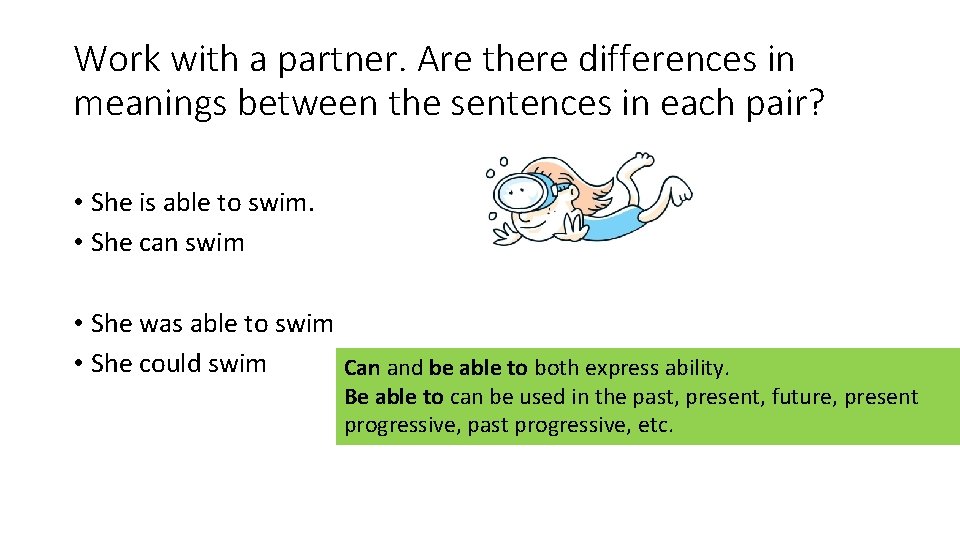
Work with a partner. Are there differences in meanings between the sentences in each pair? • She is able to swim. • She can swim • She was able to swim • She could swim Can and be able to both express ability. Be able to can be used in the past, present, future, present progressive, past progressive, etc.
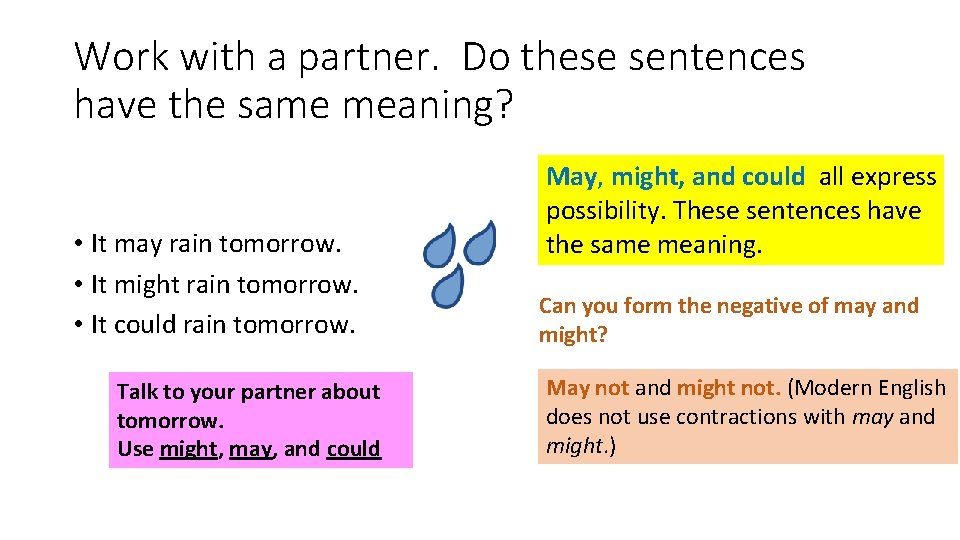
Work with a partner. Do these sentences have the same meaning? • It may rain tomorrow. • It might rain tomorrow. • It could rain tomorrow. Talk to your partner about tomorrow. Use might, may, and could May, might, and could all express possibility. These sentences have the same meaning. Can you form the negative of may and might? May not and might not. (Modern English does not use contractions with may and might. )
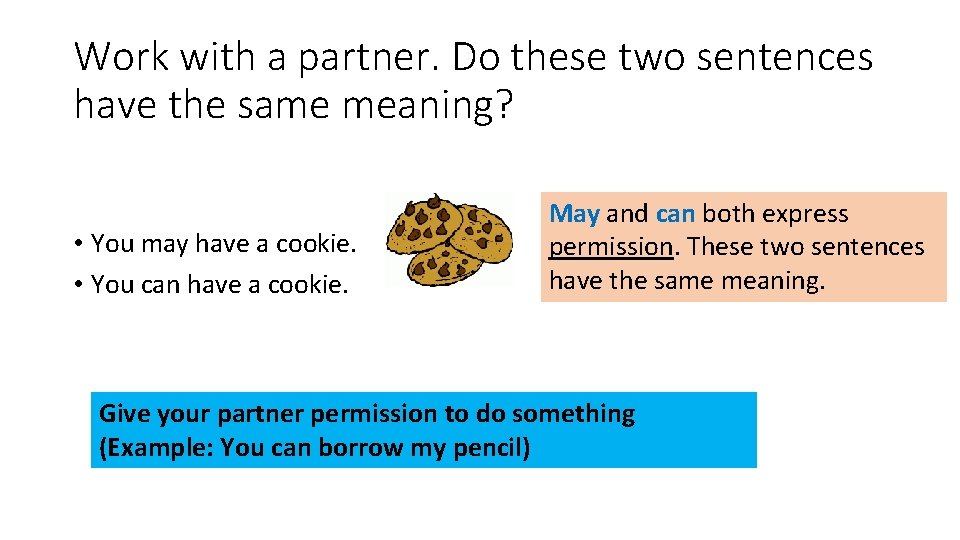
Work with a partner. Do these two sentences have the same meaning? • You may have a cookie. • You can have a cookie. May and can both express permission. These two sentences have the same meaning. Give your partner permission to do something (Example: You can borrow my pencil)
Work with a partner. Are there differences in meaning among the three sentences? • Mary should study harder. • Ryan ought to study harder • Lisa had better study harder! All of these sentences give advice Had better is the strongest advice. Can you form the negative of these sentences? Mary should not study harder. Lisa had better not study harder. ** ought to is not used in the negative form
Work with a partner. Do these two sentences have the same meaning? • I have to study tonight. • I have got to study tonight. Have to and have got to express basically the same meaning. Have to is more commonly used. Have got to is more informal. What are two things you’ve got to do tonight? What are two things you have to do tomorrow?
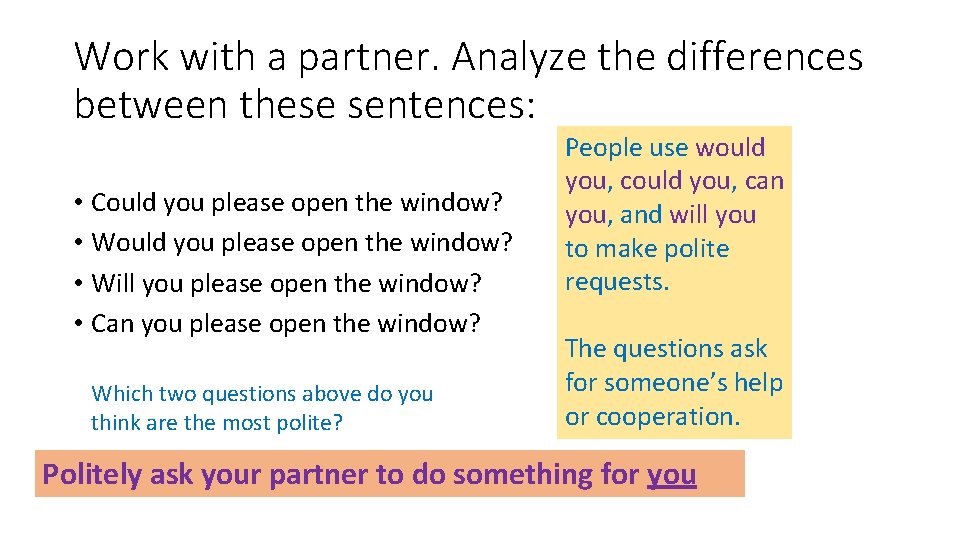
Work with a partner. Analyze the differences between these sentences: • Could you please open the window? • Will you please open the window? • Can you please open the window? Which two questions above do you think are the most polite? People use would you, can you, and will you to make polite requests. The questions ask for someone’s help or cooperation. Politely ask your partner to do something for you
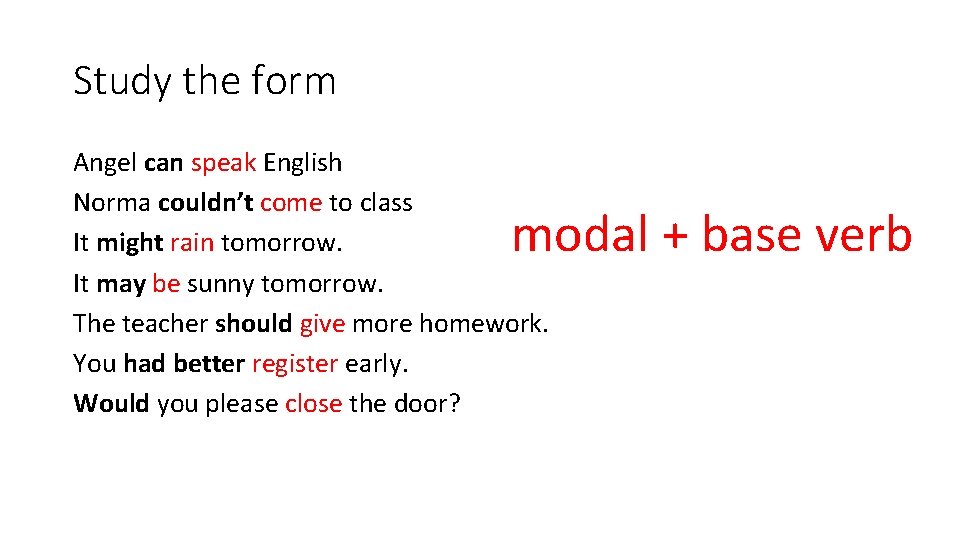
Study the form Angel can speak English Norma couldn’t come to class It might rain tomorrow. It may be sunny tomorrow. The teacher should give more homework. You had better register early. Would you please close the door? modal + base verb
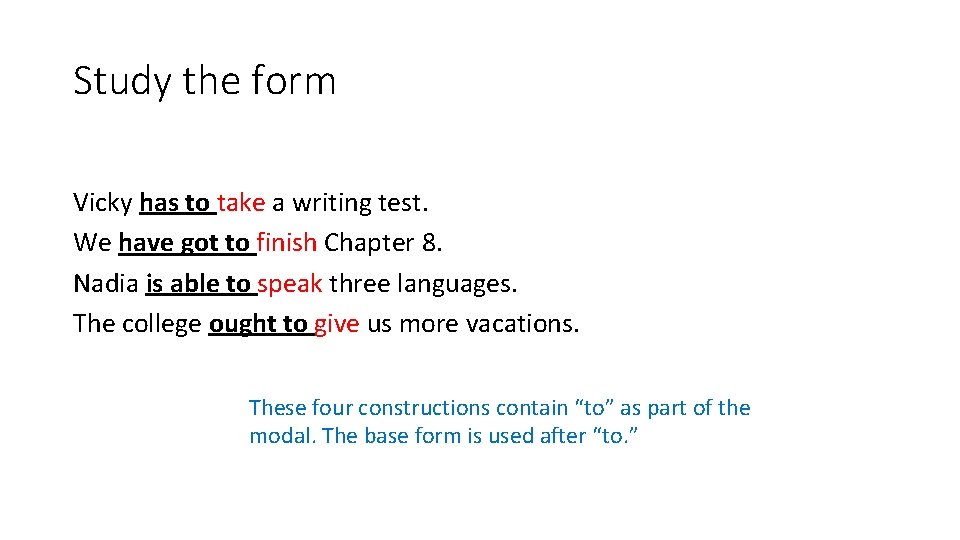
Study the form Vicky has to take a writing test. We have got to finish Chapter 8. Nadia is able to speak three languages. The college ought to give us more vacations. These four constructions contain “to” as part of the modal. The base form is used after “to. ”
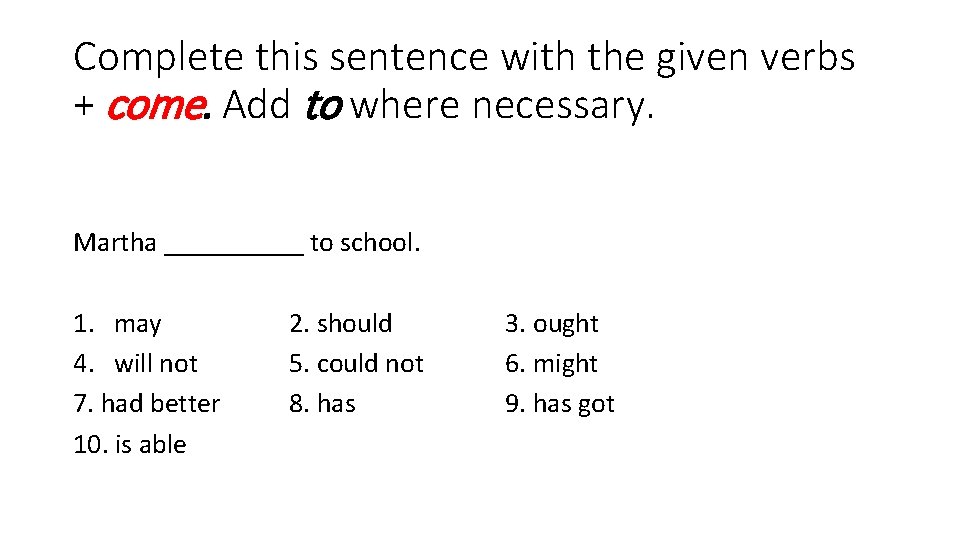
Complete this sentence with the given verbs + come. Add to where necessary. Martha _____ to school. 1. may 4. will not 7. had better 10. is able 2. should 5. could not 8. has 3. ought 6. might 9. has got
Exercise 3, p. 179 • Before you listen to the sentences, decide which sentences need the word to. Add to where needed. Then listen and check your answers.
Exercises 4, p. 179 Discuss the sentences with your partner.
Exercise 5 • Complete the sentences orally. • Complete the first time using can, can’t • Complete the sentences again (orally) using be able to
Exercise 10, p. 183
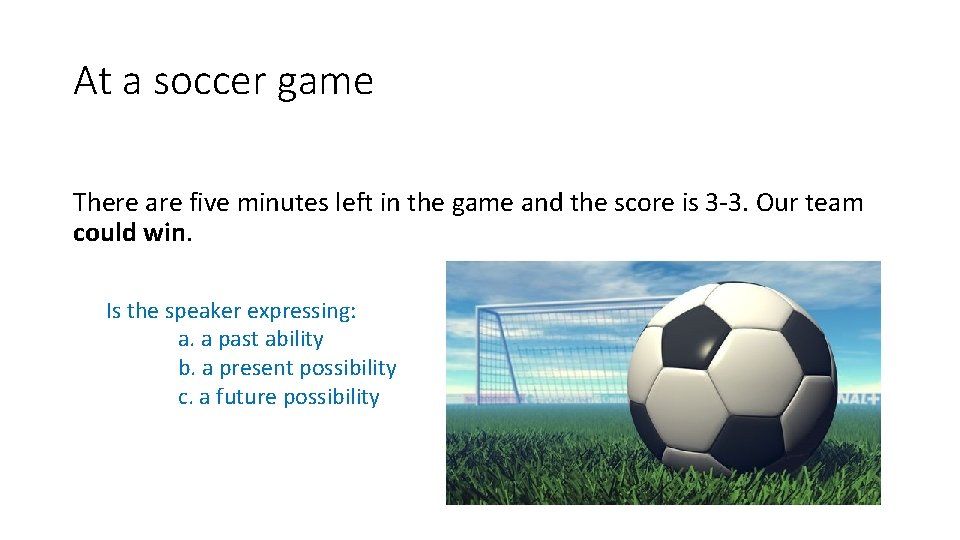
At a soccer game There are five minutes left in the game and the score is 3 -3. Our team could win. Is the speaker expressing: a. a past ability b. a present possibility c. a future possibility
At a soccer game The goalie is on the ground. He could be hurt. Is the speaker expressing: a. a past ability b. a present possibility c. a future possibility
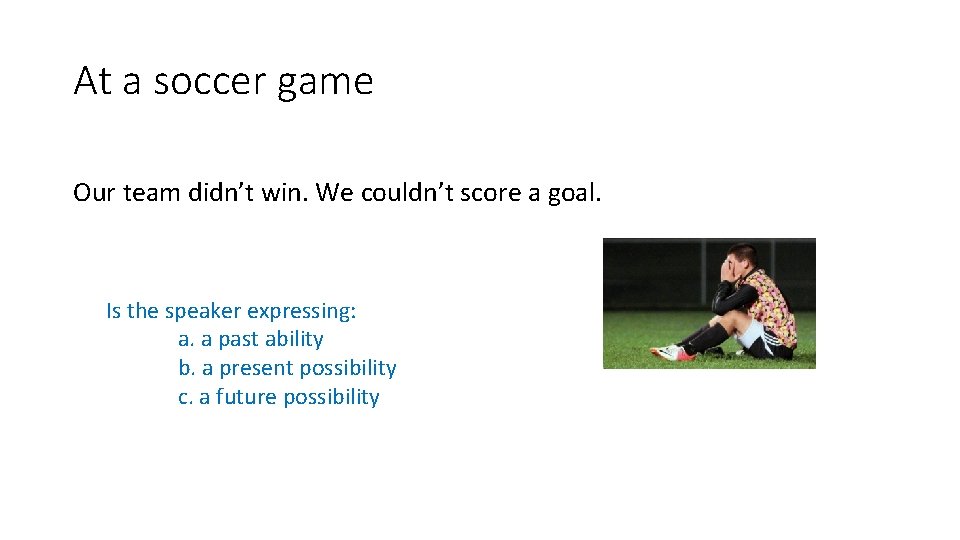
At a soccer game Our team didn’t win. We couldn’t score a goal. Is the speaker expressing: a. a past ability b. a present possibility c. a future possibility
Read the sentences in exercise 15 on page 185 Does could express past, present, or future time? What is the meaning – ability or possibility? Check: 2. past ability 3. present possibility 4. past ability 5. future possibility 6. present possibility
Work with a new partner Read the situation out loud to your partner. Suggest possible solutions. Use could.
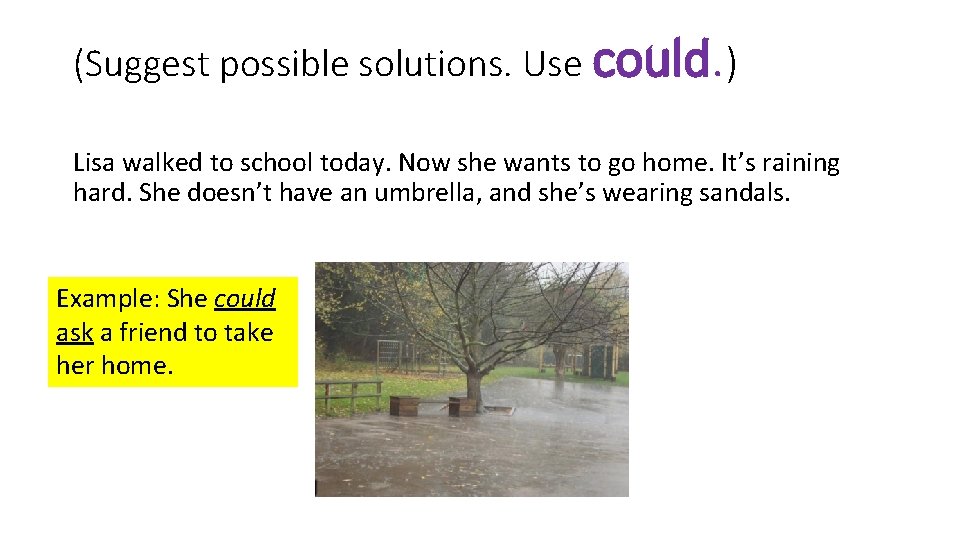
(Suggest possible solutions. Use could. ) Lisa walked to school today. Now she wants to go home. It’s raining hard. She doesn’t have an umbrella, and she’s wearing sandals. Example: She could ask a friend to take her home.
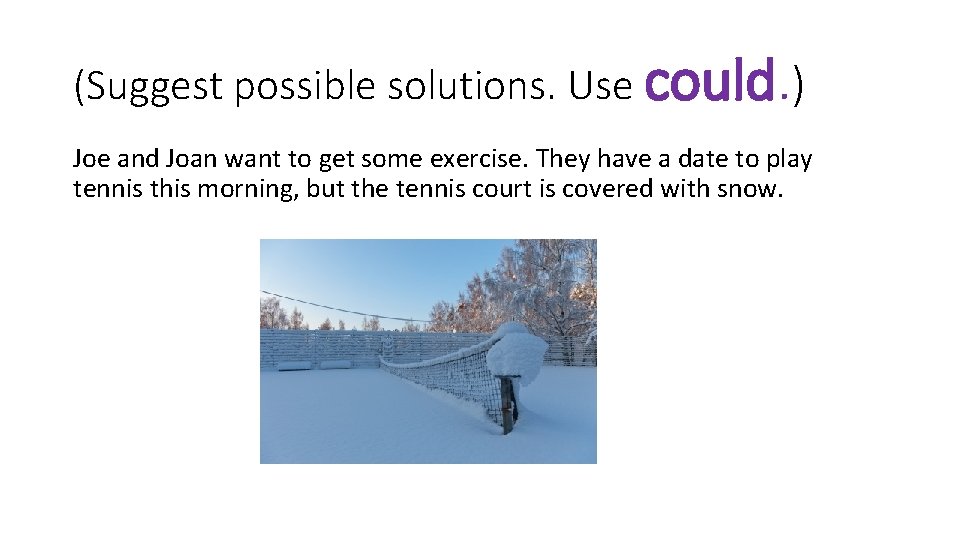
(Suggest possible solutions. Use could. ) Joe and Joan want to get some exercise. They have a date to play tennis this morning, but the tennis court is covered with snow.
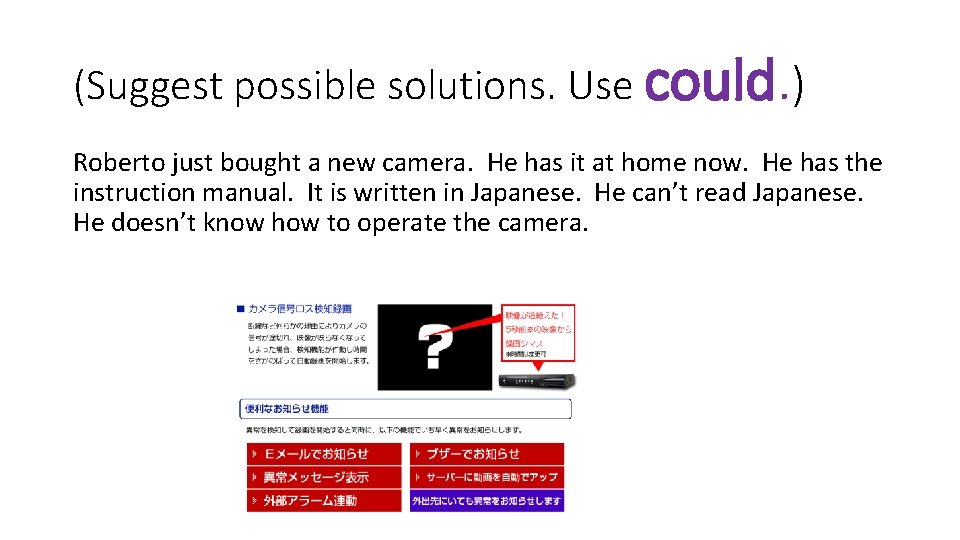
(Suggest possible solutions. Use could. ) Roberto just bought a new camera. He has it at home now. He has the instruction manual. It is written in Japanese. He can’t read Japanese. He doesn’t know how to operate the camera.
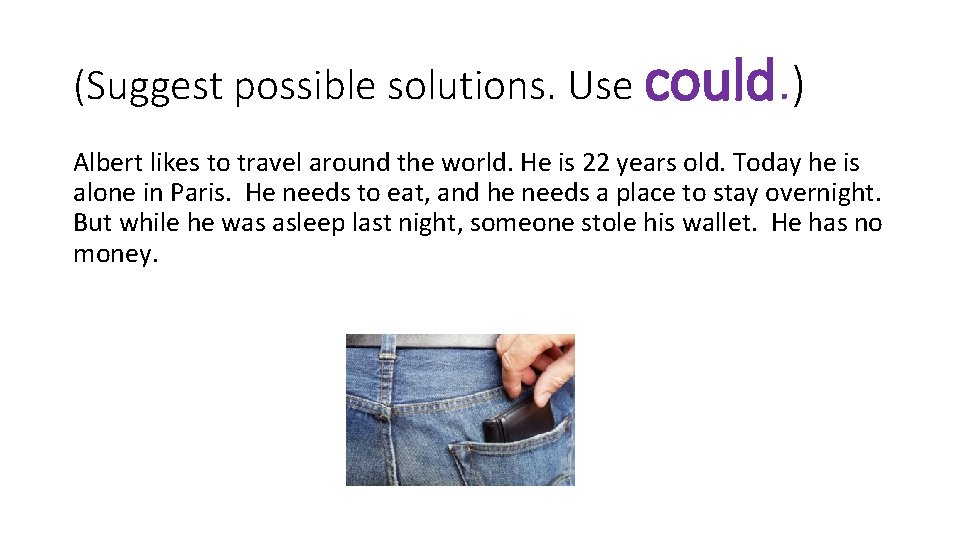
(Suggest possible solutions. Use could. ) Albert likes to travel around the world. He is 22 years old. Today he is alone in Paris. He needs to eat, and he needs a place to stay overnight. But while he was asleep last night, someone stole his wallet. He has no money.
Listen to the conversation between a husband wife • Listen again and complete the words that you hear. (page 186) Answers: 1. could be 2. might be 3. could ask 4. may be 5. can
Review Do these three sentences mean the same thing? May I use your cell phone? Can I use your cell phone? Could I use your cell phone? Yes. All three sentences have the same meaning.
Read the situations. Make a polite request. Use: Can, Could, Will, or May
Use: Can, Could, Will, or May You want to talk to your teacher privately after class.
Use: Can, Could, Will, or May You’re trying to watch a movie, but some people are talking loudly.
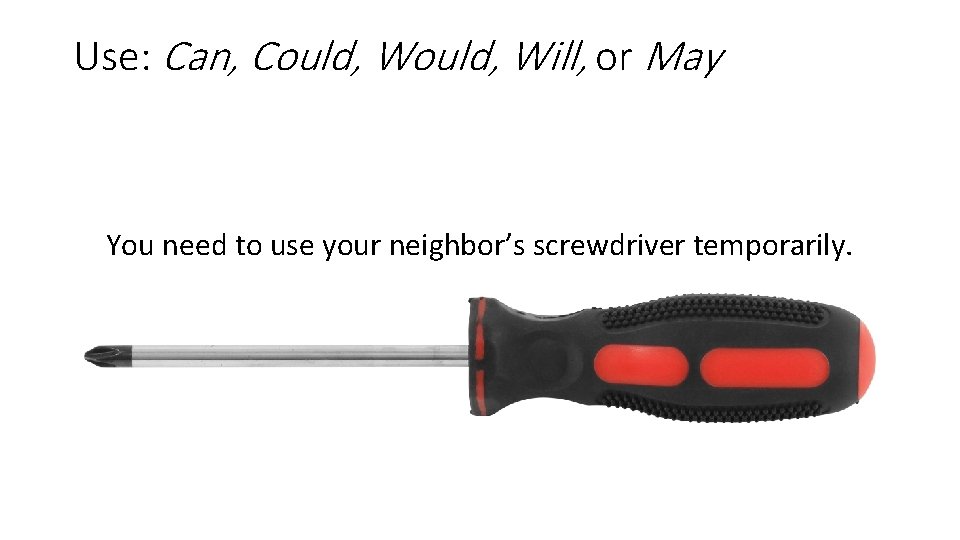
Use: Can, Could, Will, or May You need to use your neighbor’s screwdriver temporarily.
Use: Can, Could, Will, or May You don’t know how to use the ATM machine. Ask someone for help.
Use: Can, Could, Will, or May You’re in a restaurant. You’re thirsty. Ask the waitress for water.
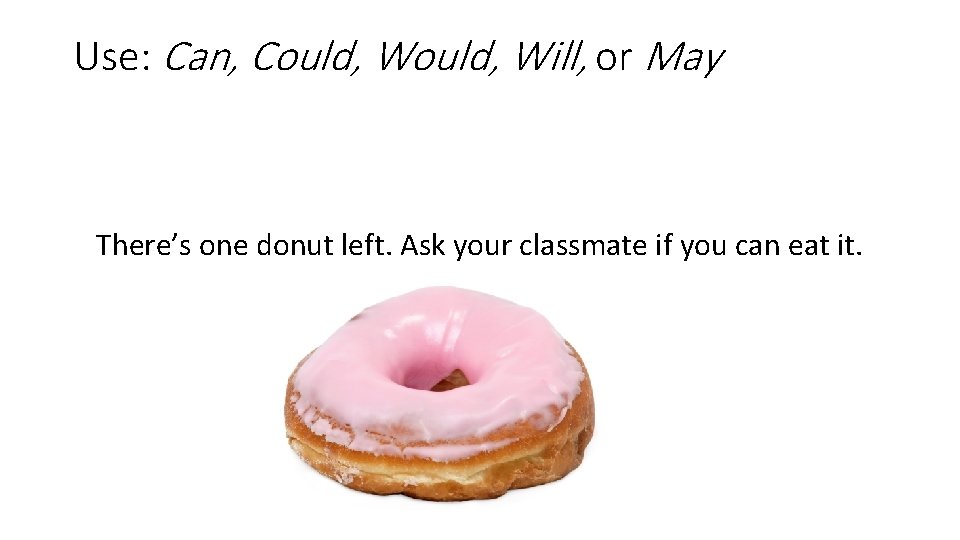
Use: Can, Could, Will, or May There’s one donut left. Ask your classmate if you can eat it.
Use: Can, Could, Will, or May You just bought a large TV. Ask if you can pay with a check.
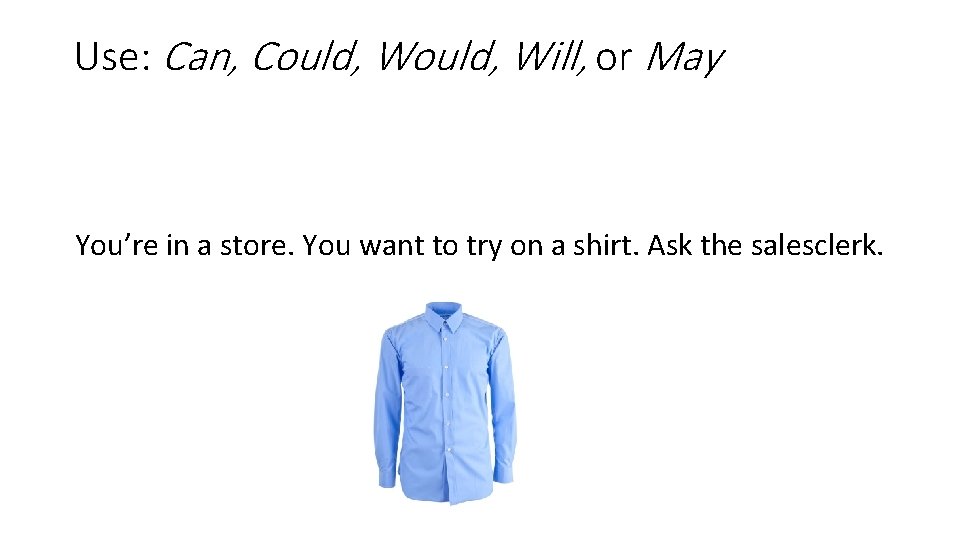
Use: Can, Could, Will, or May You’re in a store. You want to try on a shirt. Ask the salesclerk.
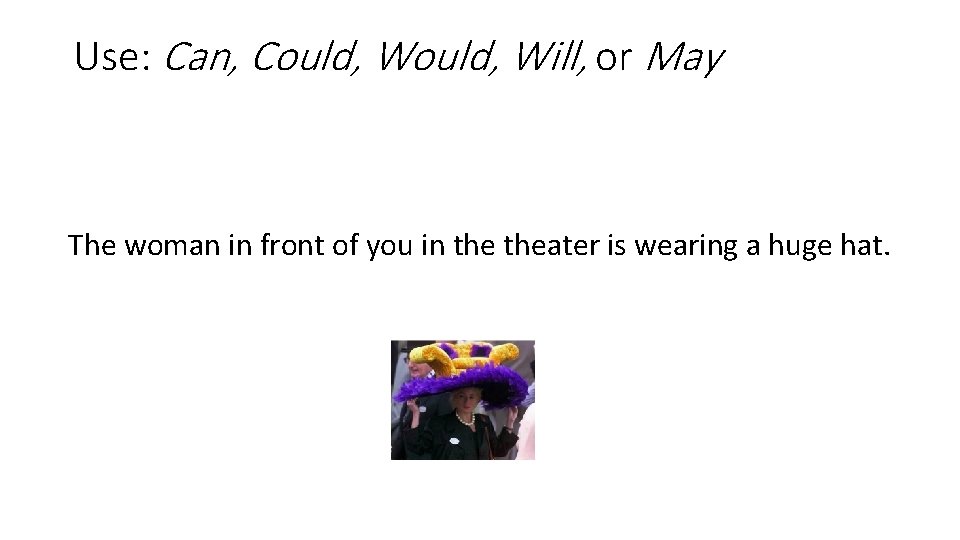
Use: Can, Could, Will, or May The woman in front of you in theater is wearing a huge hat.
Use: Can, Could, Will, or May You don’t know where the bathroom is. Ask your classmate.
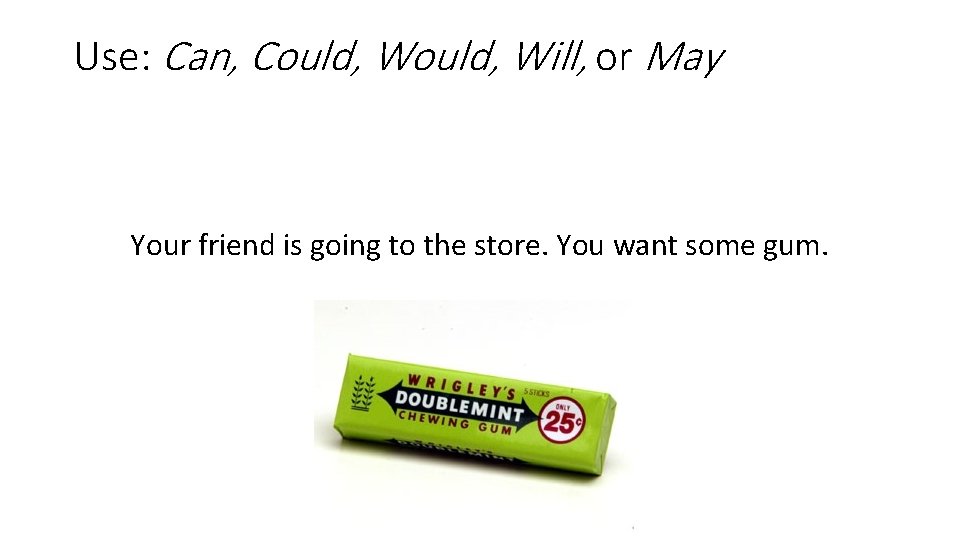
Use: Can, Could, Will, or May Your friend is going to the store. You want some gum.
Use: Can, Could, Will, or May Your friend is reading your text messages over your shoulder. This annoys you.
Use: Can, Could, Will, or May You didn’t hear what the teacher just said.
Use: Can, Could, Will, or May The classroom door is open. The noise outside is loud.
Use: Can, Could, Will, or May Your friend’s baby is hungry. You have some food.
Use: Can, Could, Will, or May Ask your teacher if you can leave early today.
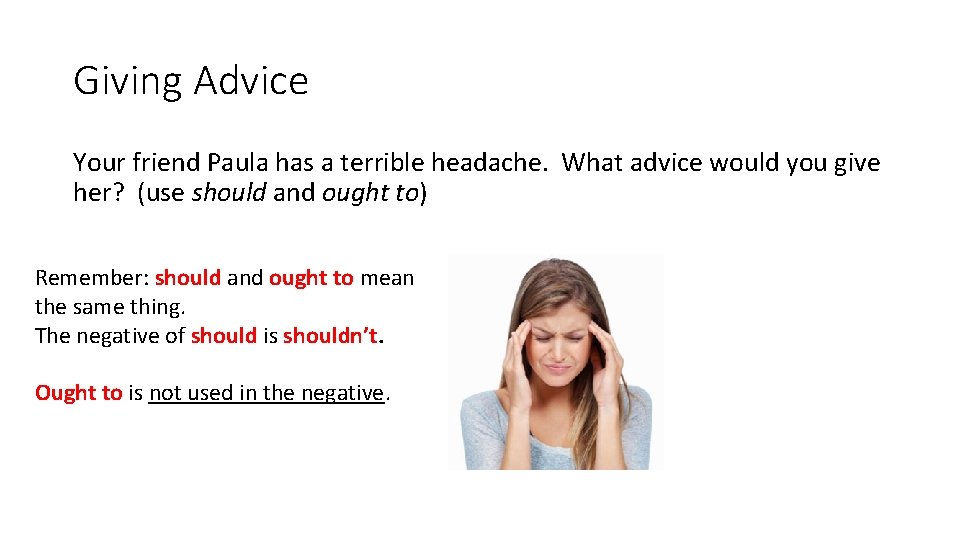
Giving Advice Your friend Paula has a terrible headache. What advice would you give her? (use should and ought to) Remember: should and ought to mean the same thing. The negative of should is shouldn’t. Ought to is not used in the negative.
Work with a new partner Partner A, read the problems on page 191 (ex. 25) Partner B, give advice. Use should and ought to.
Review What’s the difference between should and had better? Should and had better both express advice. Had better is more urgent than should or ought to. It often implies a warning about possible bad consequences. The contraction for had better is ‘d better. Example: You’d better not eat that meat. It looks spoiled.
Work in groups of four The first person reads the problem. The second person gives a suggestion using should The third person gives a solution using ought to The fourth person gives a solution using had better
Problem – Physics class I study, but I don’t understand my physics class. It’s in the middle of the semester, and I’m failing the course. I need a science course in order to graduate. What should* I do? (*should is usually used in questions asking for advice. Answers can contain should, had better, or ought to)
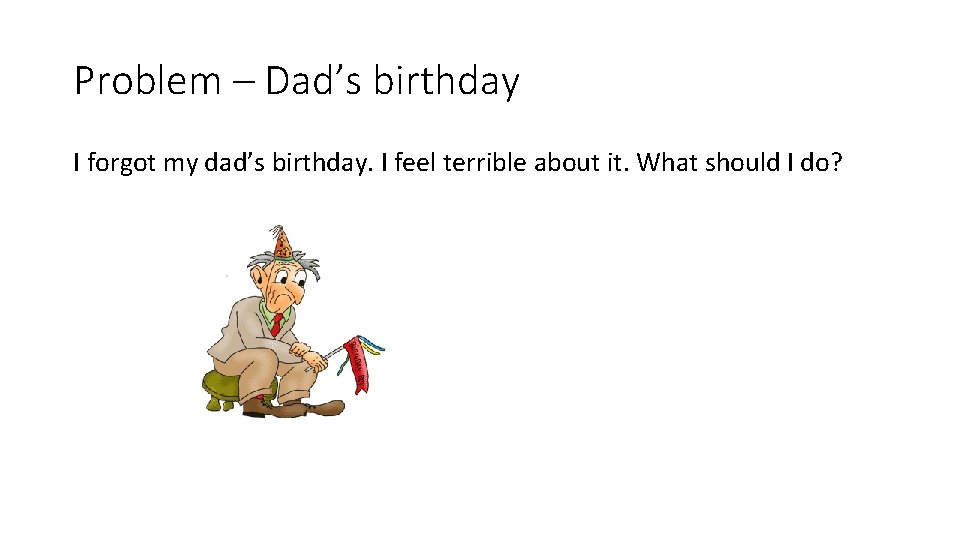
Problem – Dad’s birthday I forgot my dad’s birthday. I feel terrible about it. What should I do?
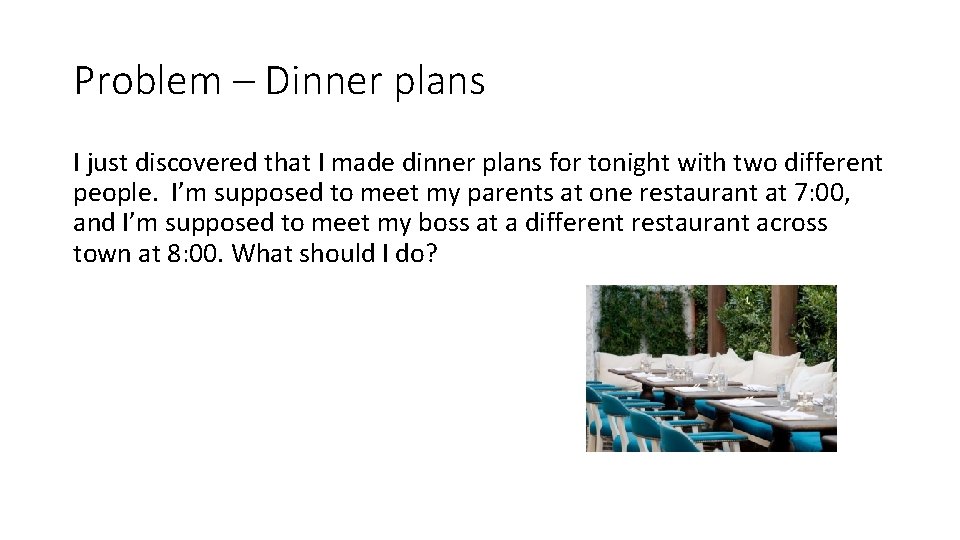
Problem – Dinner plans I just discovered that I made dinner plans for tonight with two different people. I’m supposed to meet my parents at one restaurant at 7: 00, and I’m supposed to meet my boss at a different restaurant across town at 8: 00. What should I do?
Problem – Accidental theft Samira accidentally left the grocery store with an item she didn’t pay for. Her young daughter put it in Samira’s shopping bag, but she didn’t see it. What should Samira do?
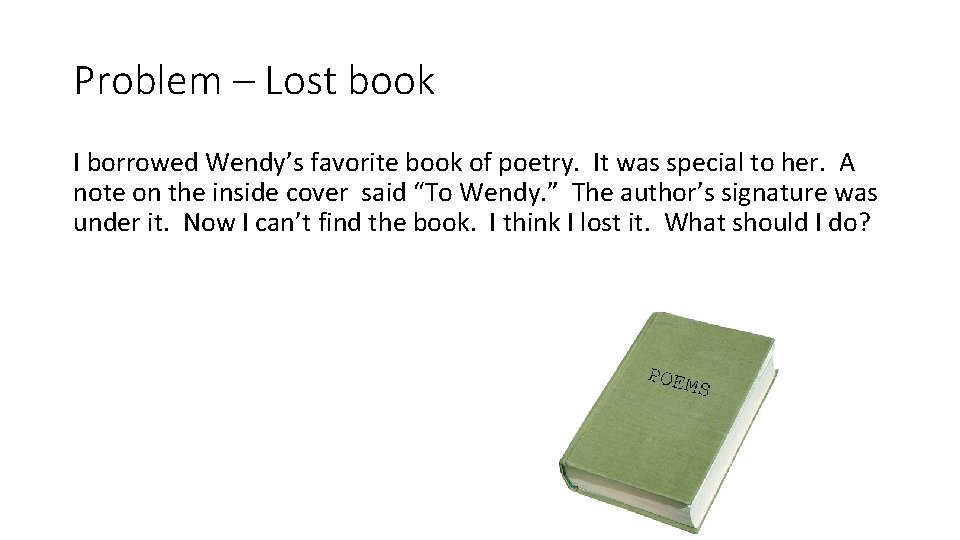
Problem – Lost book I borrowed Wendy’s favorite book of poetry. It was special to her. A note on the inside cover said “To Wendy. ” The author’s signature was under it. Now I can’t find the book. I think I lost it. What should I do?
Editing Exercise 28, page 192
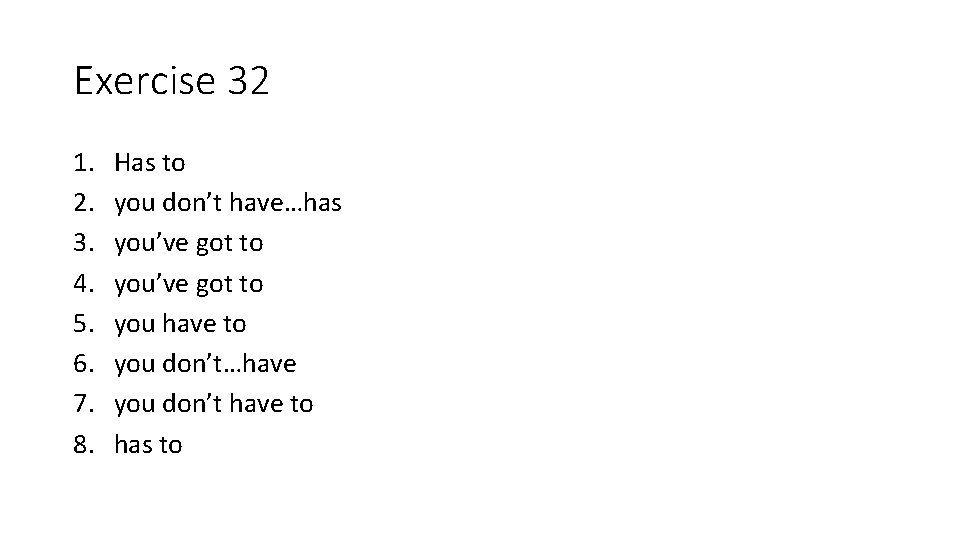
Exercise 32 1. 2. 3. 4. 5. 6. 7. 8. Has to you don’t have…has you’ve got to you have to you don’t…have you don’t have to has to
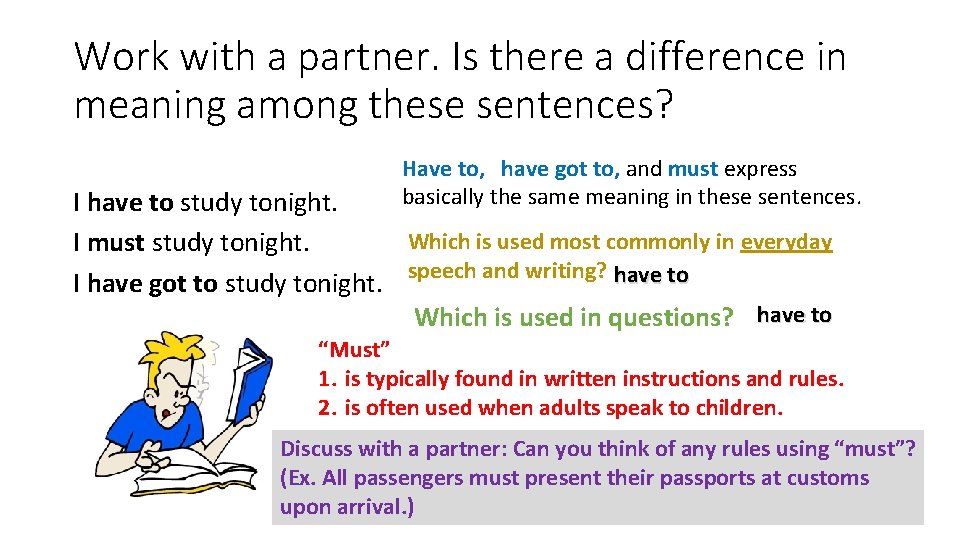
Work with a partner. Is there a difference in meaning among these sentences? Have to, have got to, and must express basically the same meaning in these sentences. I have to study tonight. Which is used most commonly in everyday I must study tonight. I have got to study tonight. speech and writing? have to Which is used in questions? have to “Must” 1. is typically found in written instructions and rules. 2. is often used when adults speak to children. Discuss with a partner: Can you think of any rules using “must”? (Ex. All passengers must present their passports at customs upon arrival. )
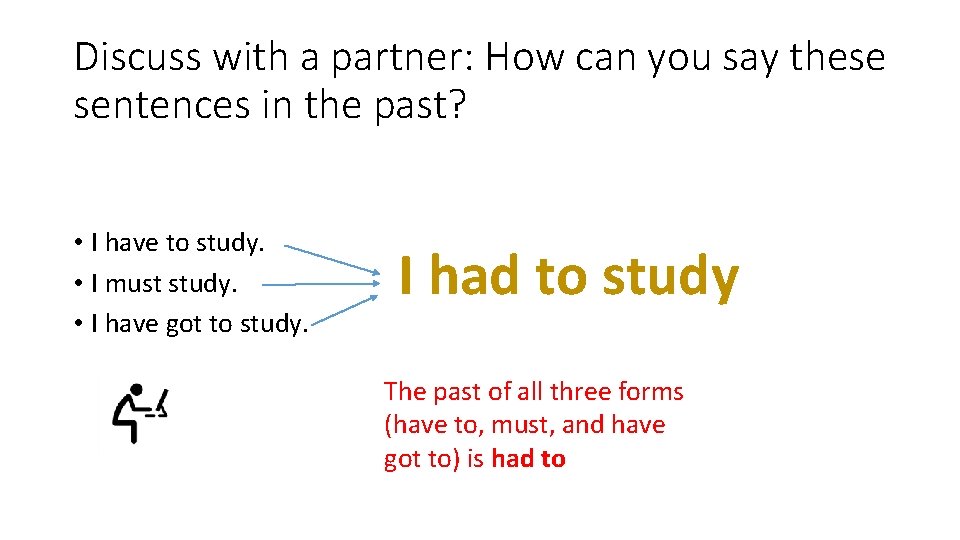
Discuss with a partner: How can you say these sentences in the past? • I have to study. • I must study. • I have got to study. I had to study The past of all three forms (have to, must, and have got to) is had to
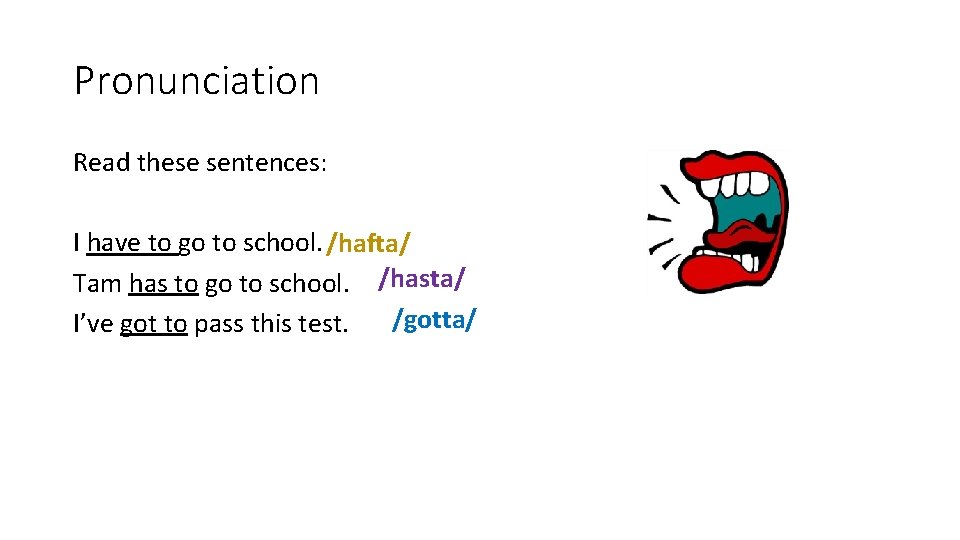
Pronunciation Read these sentences: I have to go to school. /hafta/ Tam has to go to school. /hasta/ /gotta/ I’ve got to pass this test.
Answer the questions with a partner • What is something you had to do yesterday? • What is something you have to do soon? • What is something you have to do after class today?
Answer the questions with a partner • To get a visa for the U. S. , what do you have to do? • Did you have to wake up early this morning? What about last Sunday?
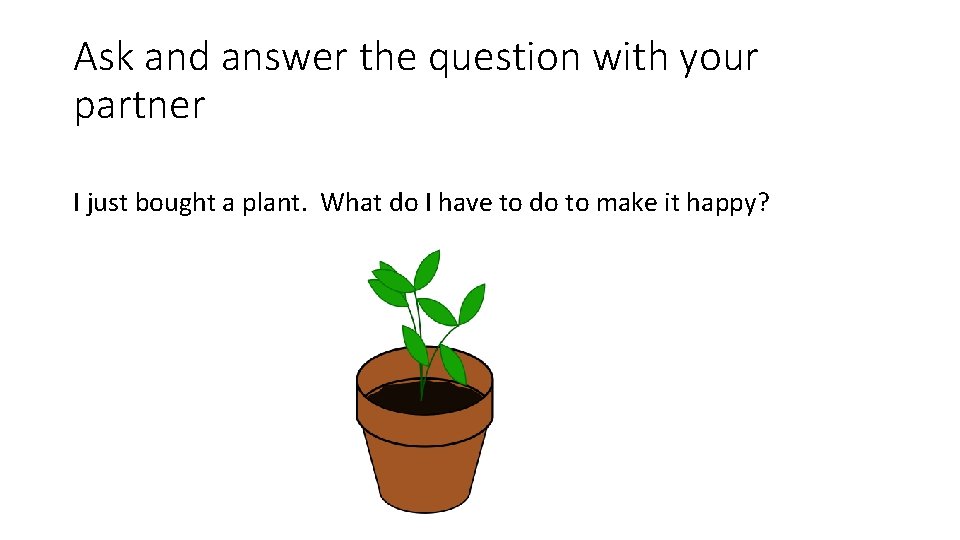
Ask and answer the question with your partner I just bought a plant. What do I have to do to make it happy?
Is it difficult to keep a pet? What do pet owners have to do?
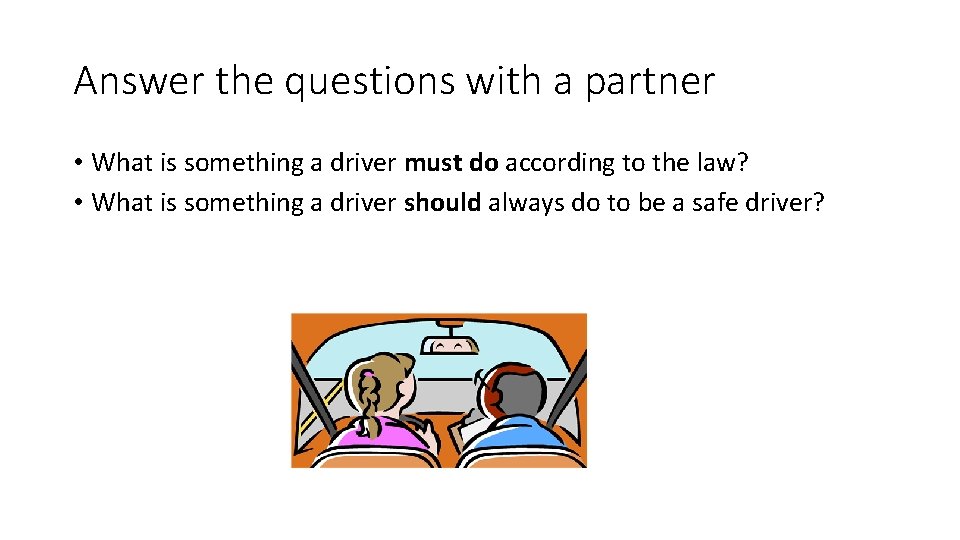
Answer the questions with a partner • What is something a driver must do according to the law? • What is something a driver should always do to be a safe driver?
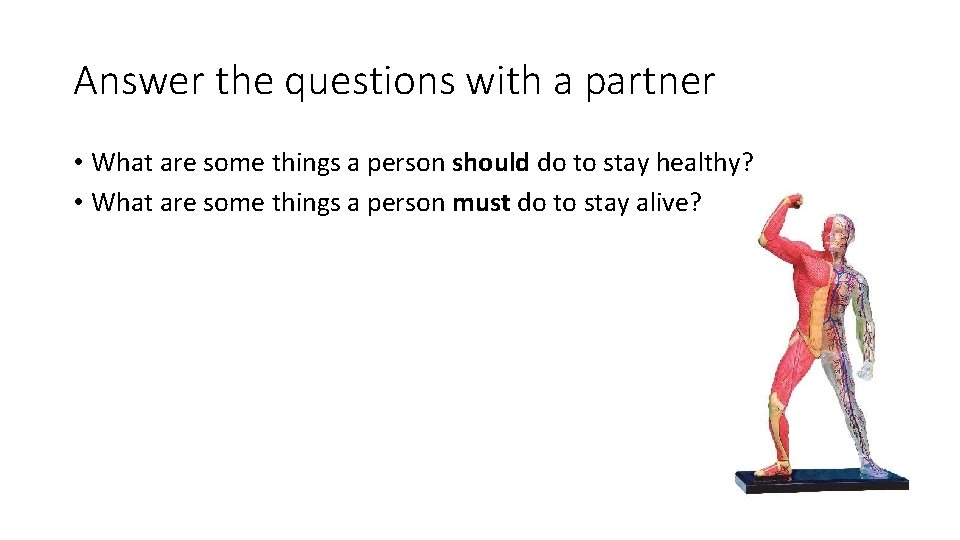
Answer the questions with a partner • What are some things a person should do to stay healthy? • What are some things a person must do to stay alive?
Read the passage on 195 (ex. 33) This family needs advice. What should they do? Write a letter to Mr. and Mrs. Hill. Give them advice. (Your teacher will collect this letter. )
Warm up What is the difference between these sentences? You must not ask any questions. You don’t have to ask any questions.
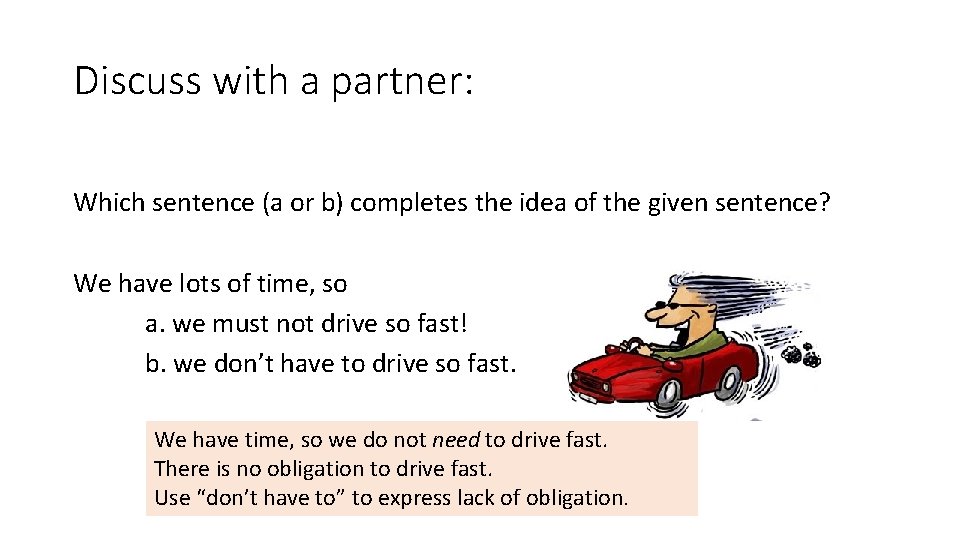
Discuss with a partner: Which sentence (a or b) completes the idea of the given sentence? We have lots of time, so a. we must not drive so fast! b. we don’t have to drive so fast. We have time, so we do not need to drive fast. There is no obligation to drive fast. Use “don’t have to” to express lack of obligation.
Read the examples. I finished all of my homework this afternoon. I don’t have to study tonight. Tomorrow is a holiday. Mary doesn’t have to go to class. Don’t / doesn’t have to express the idea that something is not necessary.
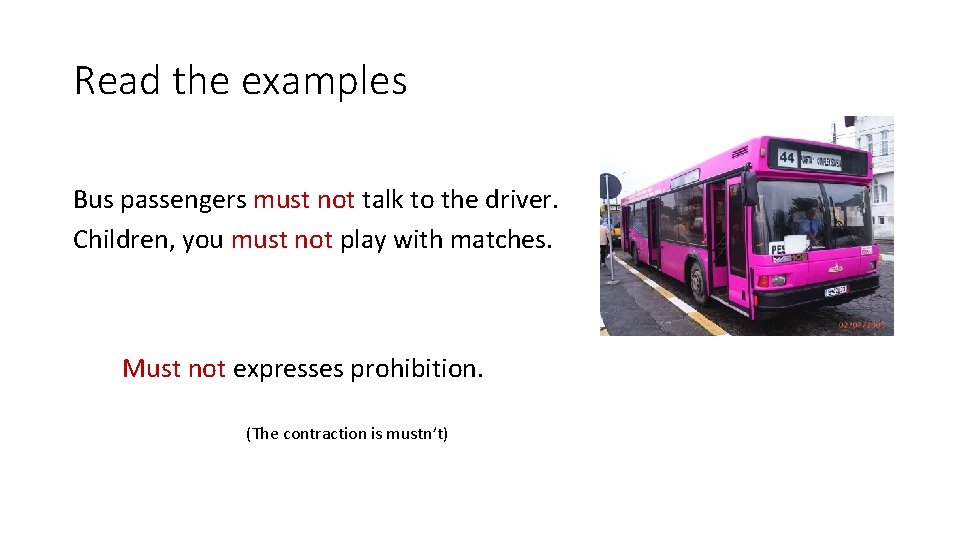
Read the examples Bus passengers must not talk to the driver. Children, you must not play with matches. Must not expresses prohibition. (The contraction is mustn’t)
Work with a partner • Complete the following sentences orally
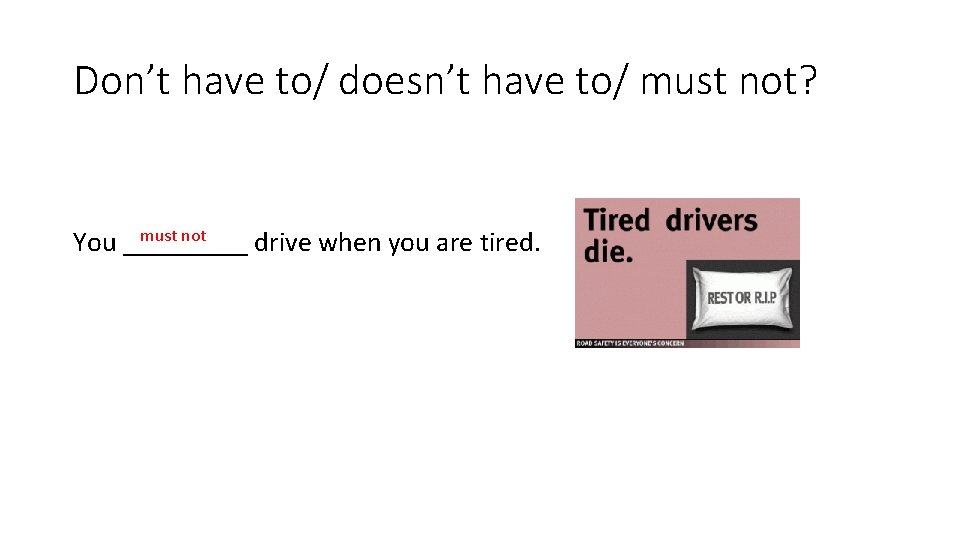
Don’t have to/ doesn’t have to/ must not? must not You _____ drive when you are tired.
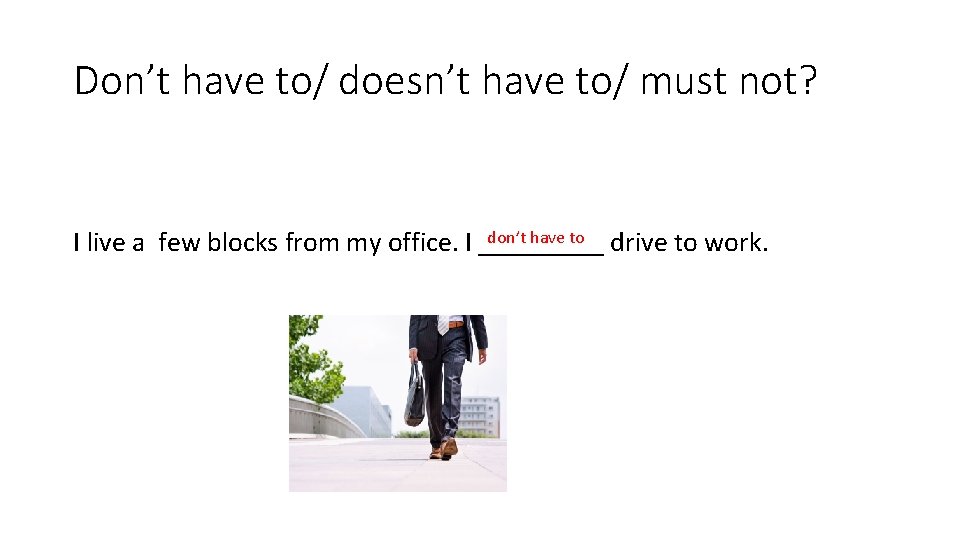
Don’t have to/ doesn’t have to/ must not? don’t have to drive to work. I live a few blocks from my office. I _____
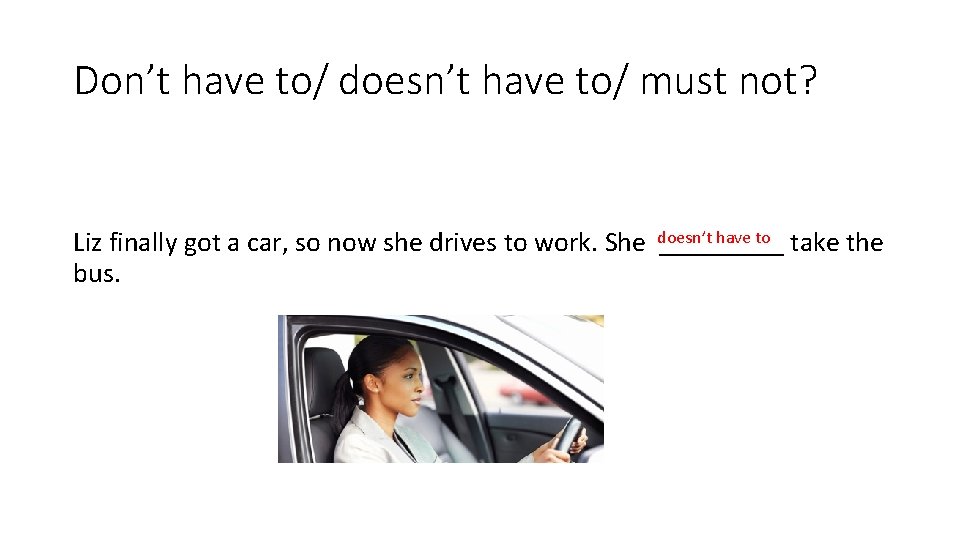
Don’t have to/ doesn’t have to/ must not? have to take the Liz finally got a car, so now she drives to work. She doesn’t _____ bus.
Don’t have to/ doesn’t have to/ must not? have to work for a living. Mr. Murphy is very wealthy. Hedoesn’t _____
Don’t have to/ doesn’t have to/ must not? must not You _____ tell Dad about the birthday party. We want it to be a surprise.
Don’t have to/ doesn’t have to/ must not? A: Did Professor Acosta give an assignment? have to read Chapter 5. B: Yes, she assigned Chapters 4 and 6, but we don’t _______
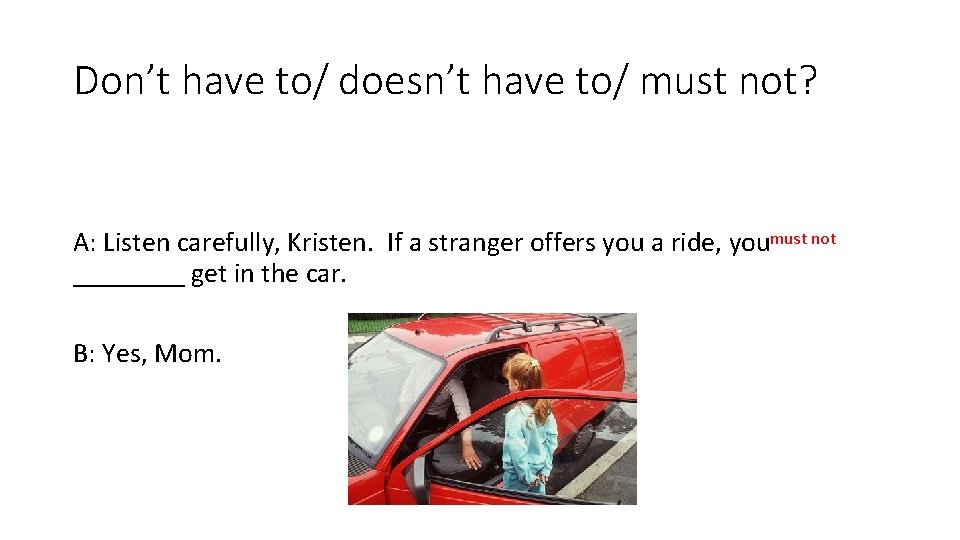
Don’t have to/ doesn’t have to/ must not? A: Listen carefully, Kristen. If a stranger offers you a ride, youmust not ____ get in the car. B: Yes, Mom.
Practice twice! Exercise 35, p. 196
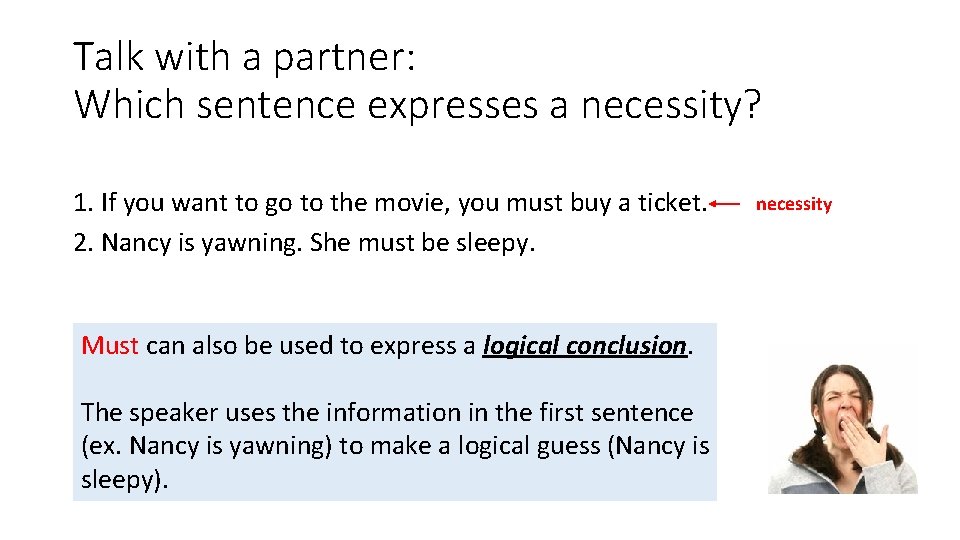
Talk with a partner: Which sentence expresses a necessity? 1. If you want to go to the movie, you must buy a ticket. 2. Nancy is yawning. She must be sleepy. Must can also be used to express a logical conclusion. The speaker uses the information in the first sentence (ex. Nancy is yawning) to make a logical guess (Nancy is sleepy). necessity
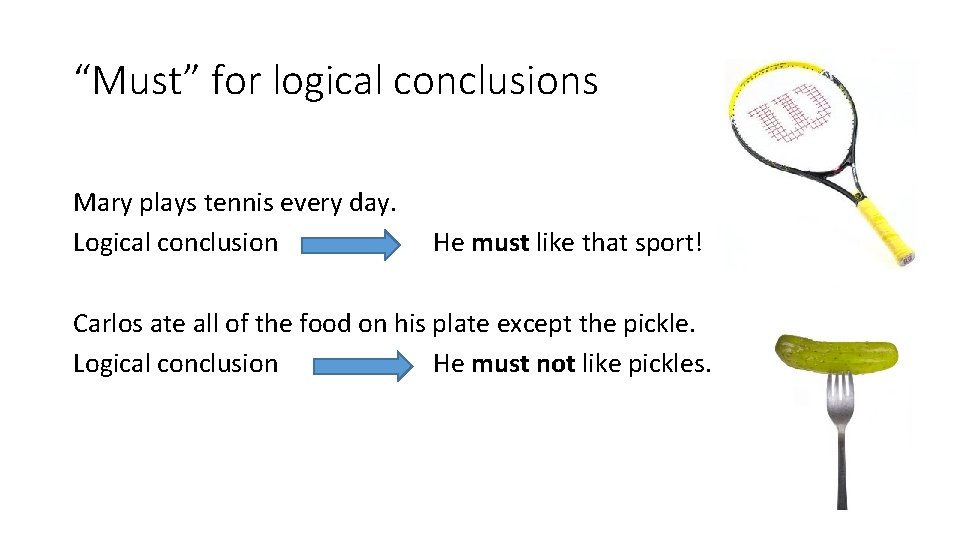
“Must” for logical conclusions Mary plays tennis every day. Logical conclusion He must like that sport! Carlos ate all of the food on his plate except the pickle. Logical conclusion He must not like pickles.
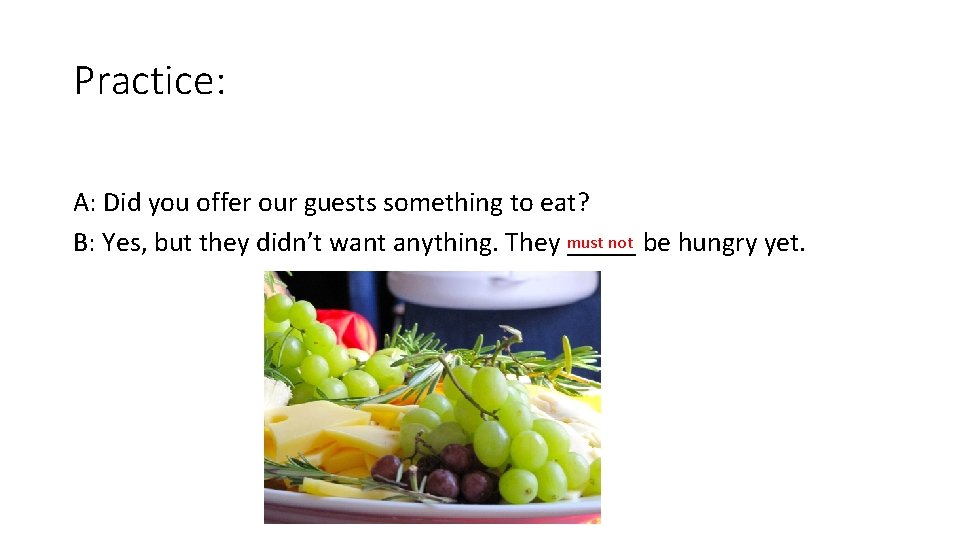
Practice: A: Did you offer our guests something to eat? not be hungry yet. B: Yes, but they didn’t want anything. They must _____
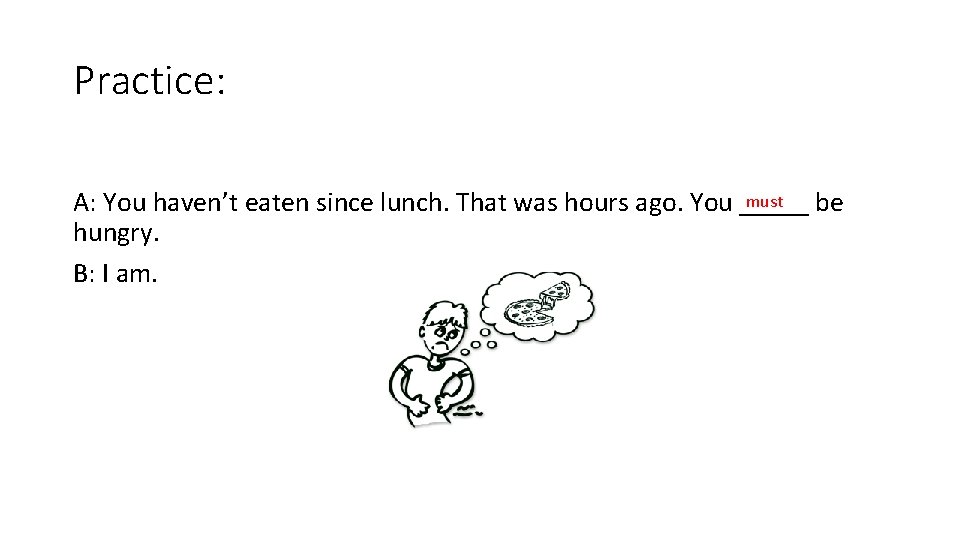
Practice: must A: You haven’t eaten since lunch. That was hours ago. You _____ be hungry. B: I am.
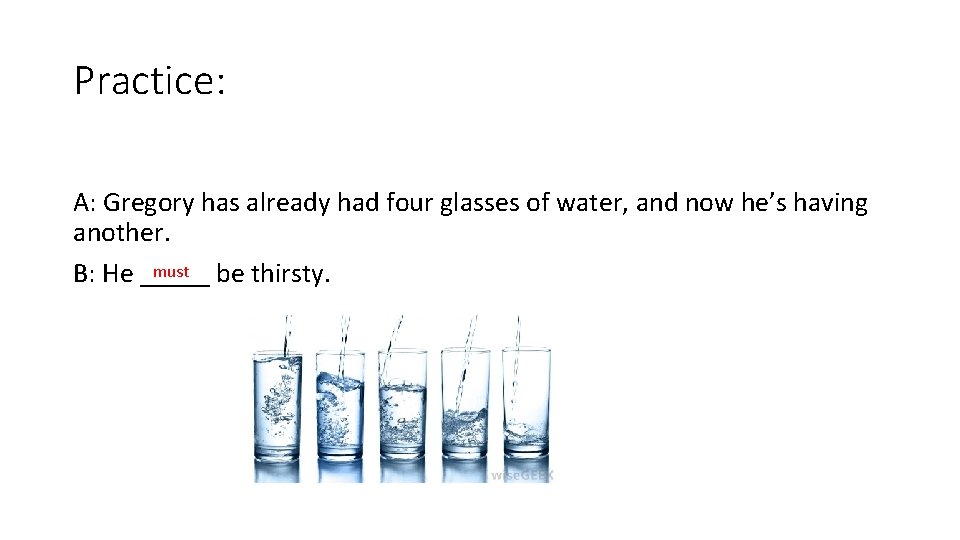
Practice: A: Gregory has already had four glasses of water, and now he’s having another. must be thirsty. B: He _____
Practice: A: I offered Holly something to drink, but she didn’t want anything. must not be thirsty. B: She _____
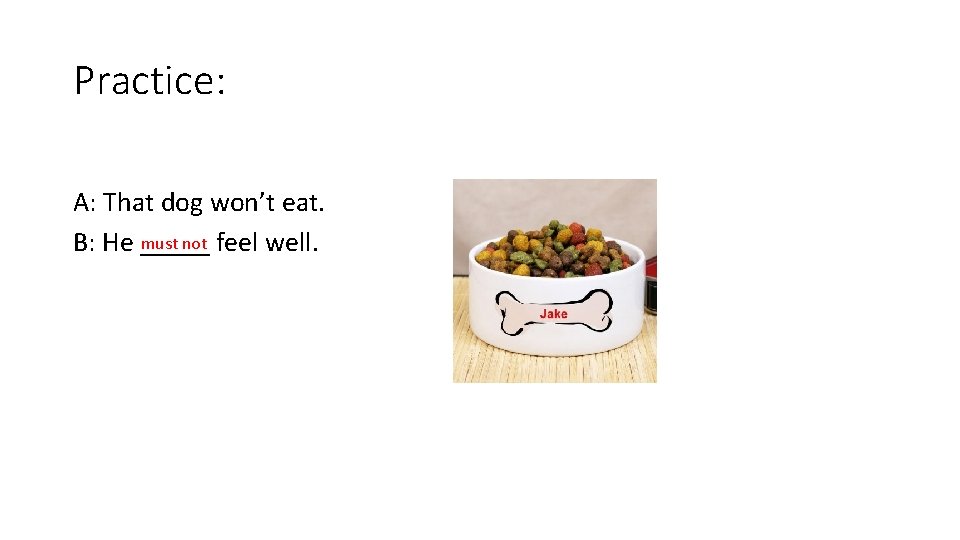
Practice: A: That dog won’t eat. must not feel well. B: He _____
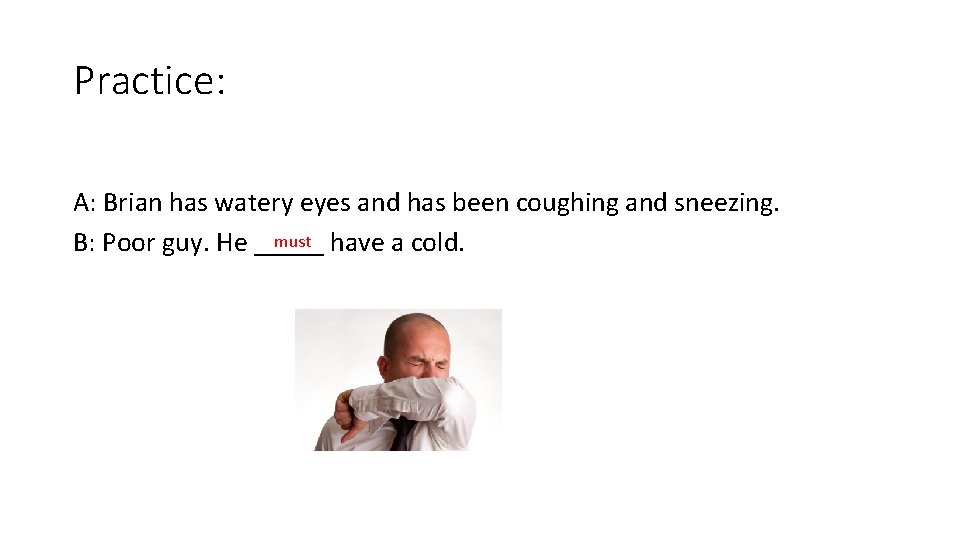
Practice: A: Brian has watery eyes and has been coughing and sneezing. must have a cold. B: Poor guy. He _____
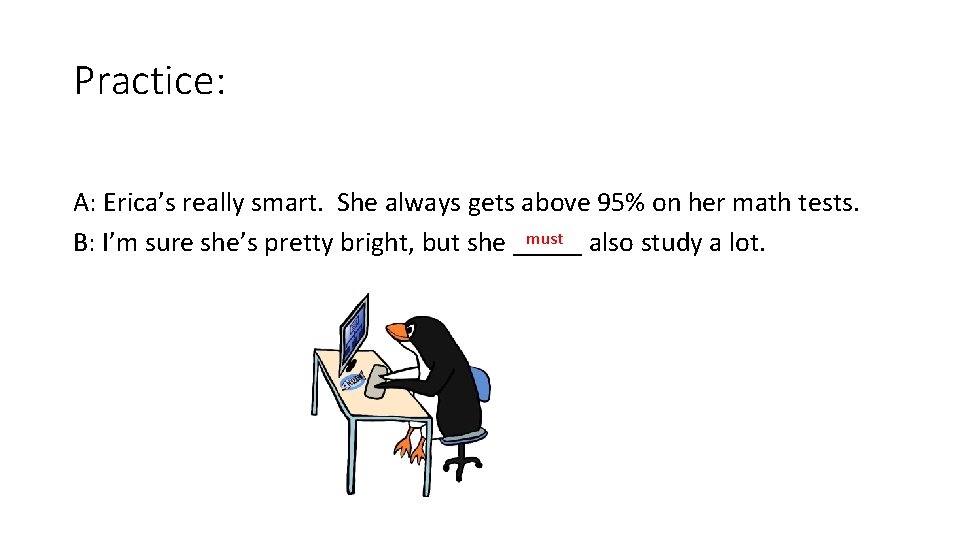
Practice: A: Erica’s really smart. She always gets above 95% on her math tests. must also study a lot. B: I’m sure she’s pretty bright, but she _____
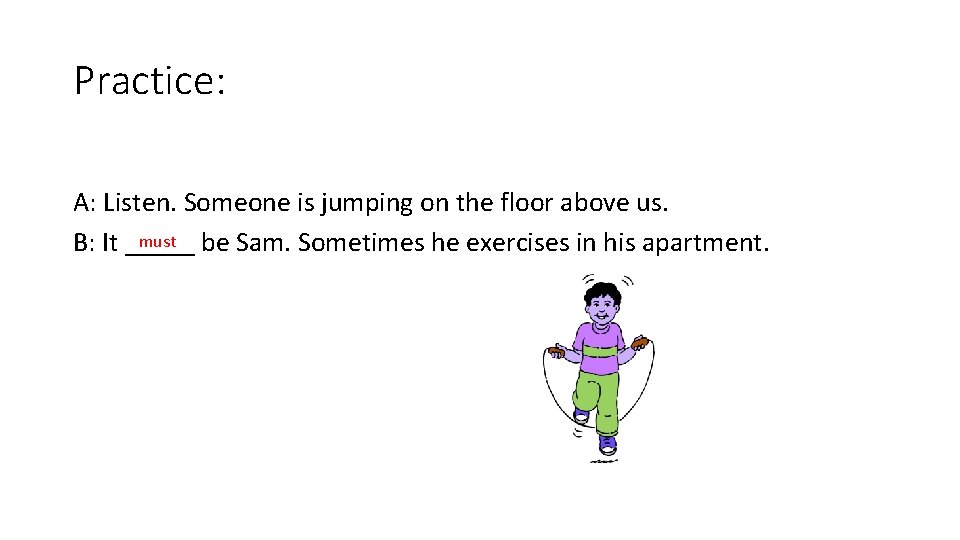
Practice: A: Listen. Someone is jumping on the floor above us. must be Sam. Sometimes he exercises in his apartment. B: It _____
Practice twice! Ex. 37, p. 197
Ex. 38, p. 198 Make a logical conclusion for each situation. Use must. Write your answers and then share them with a partner.
Work in groups of three Read the following situations. Make several logical conclusions.
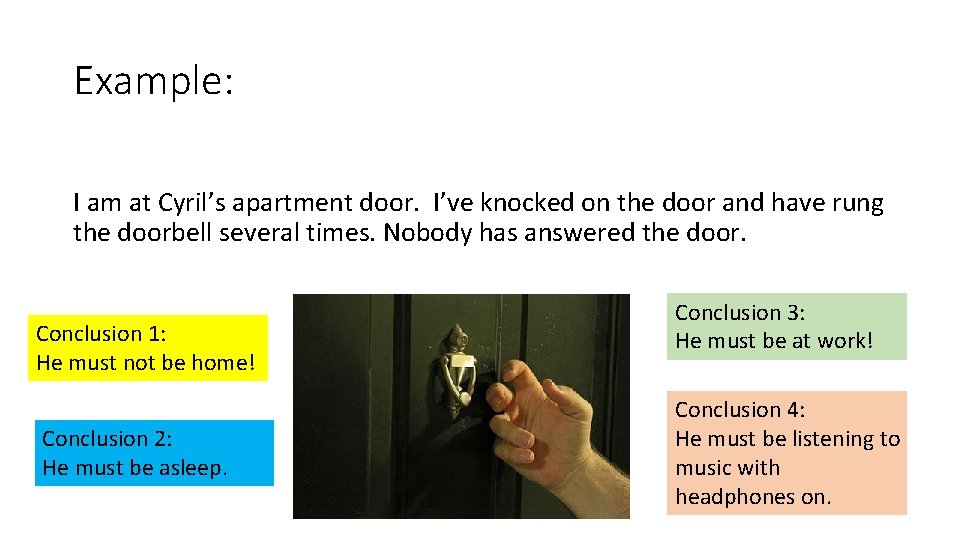
Example: I am at Cyril’s apartment door. I’ve knocked on the door and have rung the doorbell several times. Nobody has answered the door. Conclusion 1: He must not be home! Conclusion 2: He must be asleep. Conclusion 3: He must be at work! Conclusion 4: He must be listening to music with headphones on.
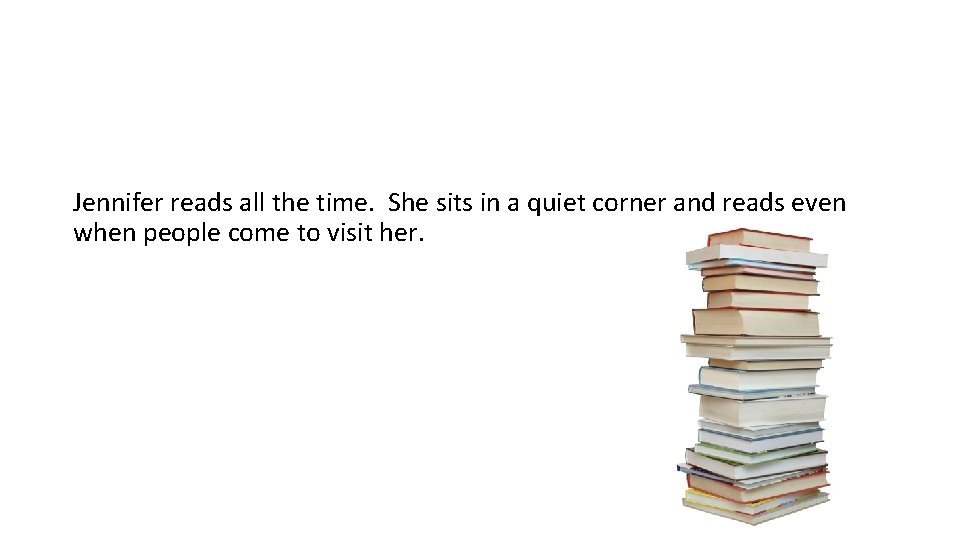
Jennifer reads all the time. She sits in a quiet corner and reads even when people come to visit her.
Lara has a full academic schedule, she plays on the volleyball team, has the lead in the school play, is a volunteer at the hospital, takes piano lessons, and has a part time job at an ice cream store.
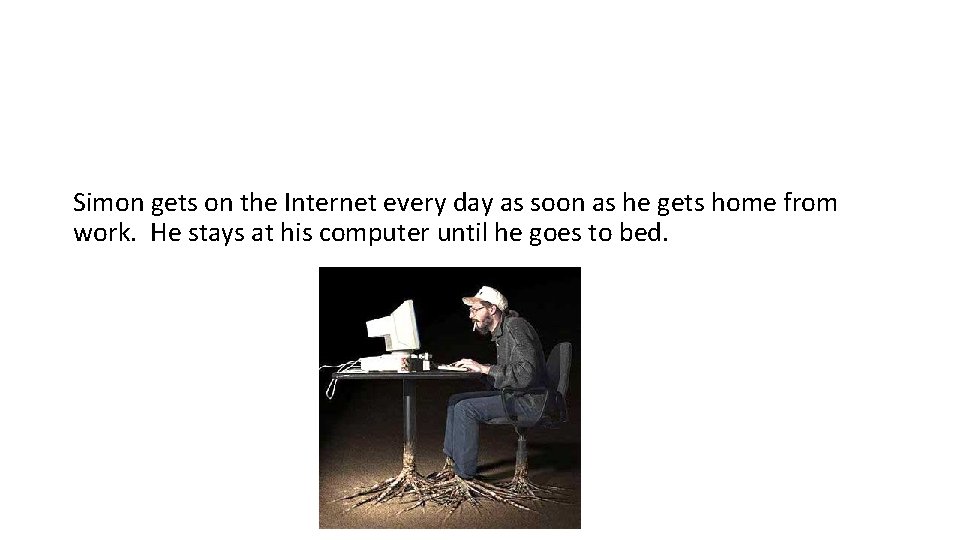
Simon gets on the Internet every day as soon as he gets home from work. He stays at his computer until he goes to bed.
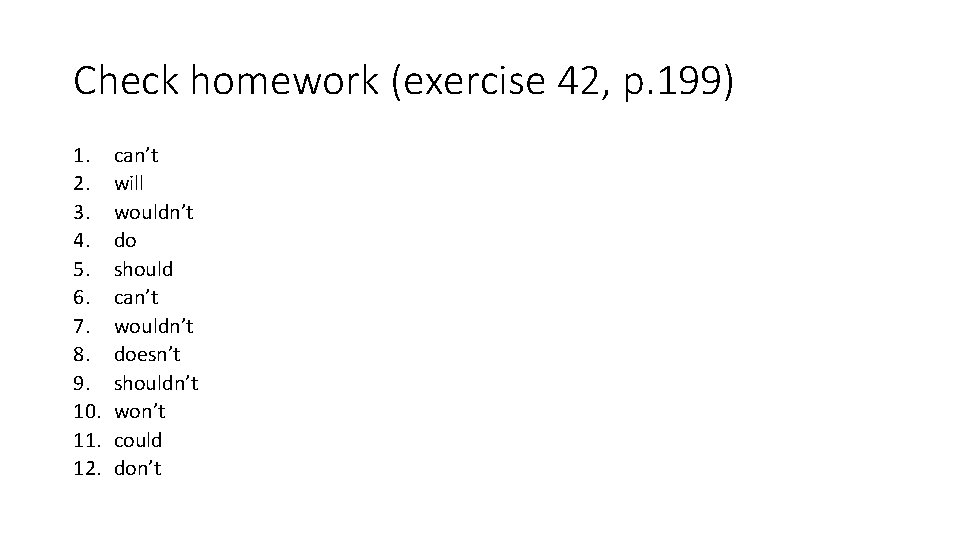
Check homework (exercise 42, p. 199) 1. 2. 3. 4. 5. 6. 7. 8. 9. 10. 11. 12. can’t will wouldn’t do should can’t wouldn’t doesn’t shouldn’t won’t could don’t
Giving suggestions (for you and another person to do) It’s hot today go to the beach • Let’s ____ go to the beach? • Why don’t we____
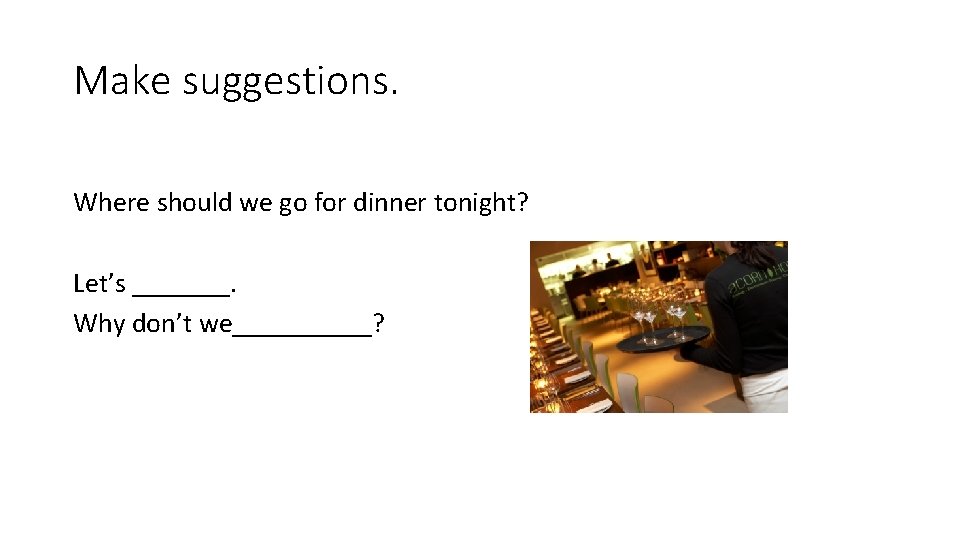
Make suggestions. Where should we go for dinner tonight? Let’s _______. Why don’t we_____?
Make suggestions Use “let’s” and “why don’t we” 1. Who should we ask to join us for dinner? 2. What time should we meet at the restaurant? 3. Where should we go afterwards?
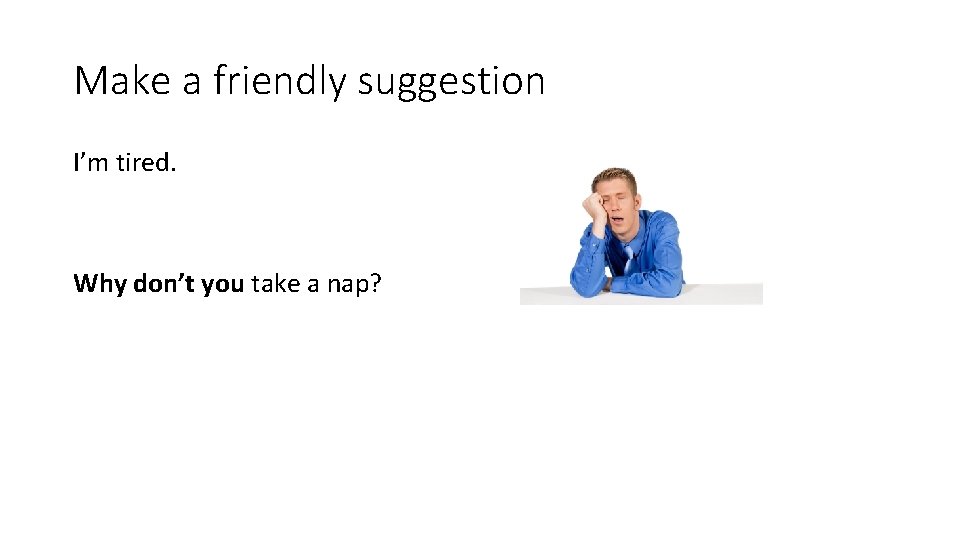
Make a friendly suggestion I’m tired. Why don’t you take a nap?
Work in groups of three • Read the situations on page 203, ex. 49. Make friendly suggestions with why don’t you. . ?
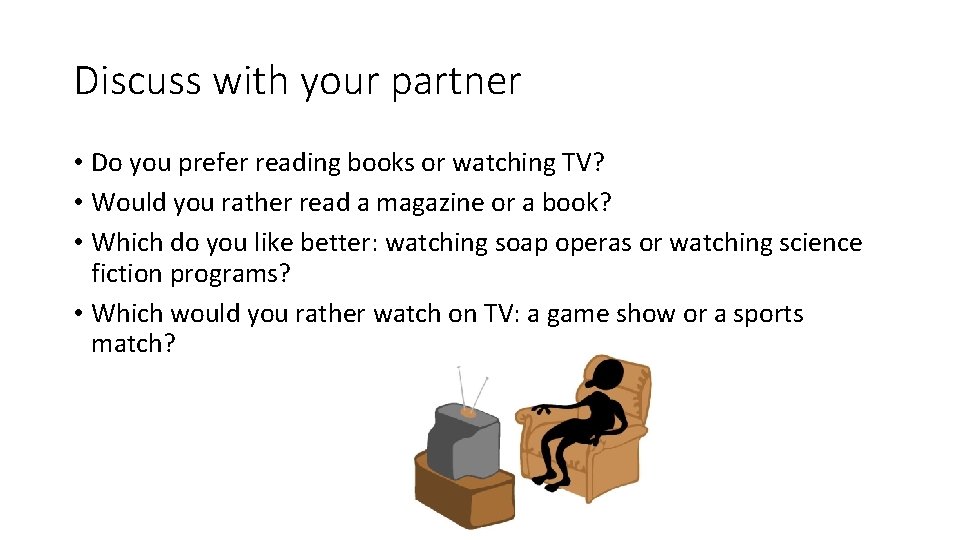
Discuss with your partner • Do you prefer reading books or watching TV? • Would you rather read a magazine or a book? • Which do you like better: watching soap operas or watching science fiction programs? • Which would you rather watch on TV: a game show or a sports match?
Prefer + noun + to + noun • On a piece of paper, write a personal sentence with this structure.
Prefer + ing verb + to +ing verb • On your paper, write a personal sentence with this structure.
Would rather Contraction = ‘d rather I’d rather watch TV than read. Would rather + base verb + than + base verb Examples: Men would rather watch adventure programs Women would rather see a game show than sports • On your paper, write personal sentences with these structures.
Like … better than Like + noun + better than +noun Like + ing verb + better than +ing verb Examples: Men like sports better than dramas They like reading nonfiction better than reading novels. • On your paper, write personal sentences with these structures.
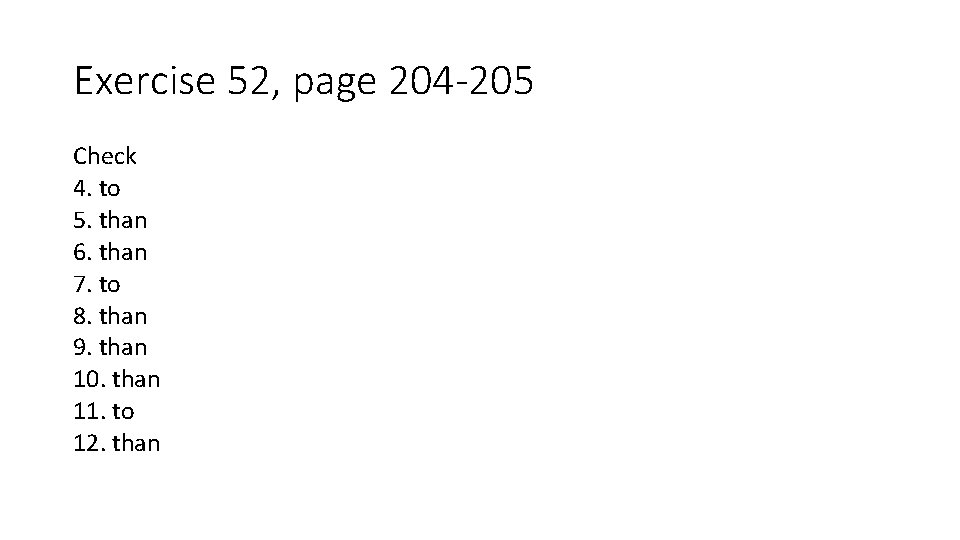
Exercise 52, page 204 -205 Check 4. to 5. than 6. than 7. to 8. than 9. than 10. than 11. to 12. than
Communicative: If you had to choose. . Page 205 Ex. 53 Read the situations with your partner. Discuss the questions. Use these phrases in your conversation: would rather … than… prefer … to …. like… better than
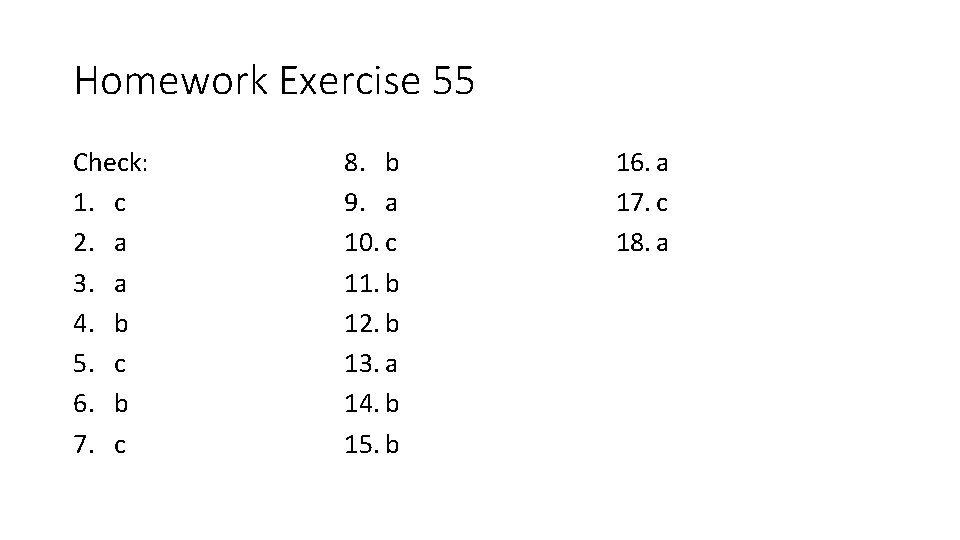
Homework Exercise 55 Check: 1. c 2. a 3. a 4. b 5. c 6. b 7. c 8. b 9. a 10. c 11. b 12. b 13. a 14. b 15. b 16. a 17. c 18. a
Check homework (exercise 42, p. 199) 1. 2. 3. 4. 5. 6. 7. 8. 9. 10. 11. 12. can’t will wouldn’t do should can’t wouldn’t doesn’t shouldn’t won’t could don’t