
MODALITY Prepared by Muhammed Ashour Submitted to Prof
MODALITY Prepared by: Muhammed Ashour Submitted to: Prof. Dr. Walid Amer
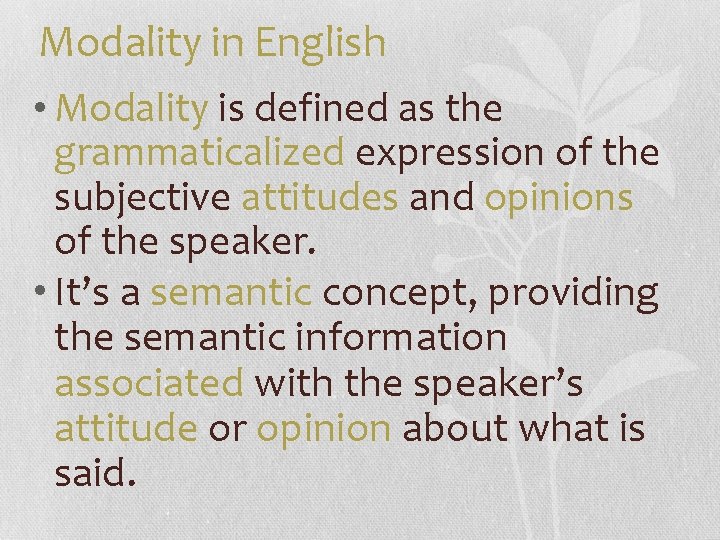
Modality in English • Modality is defined as the grammaticalized expression of the subjective attitudes and opinions of the speaker. • It’s a semantic concept, providing the semantic information associated with the speaker’s attitude or opinion about what is said.
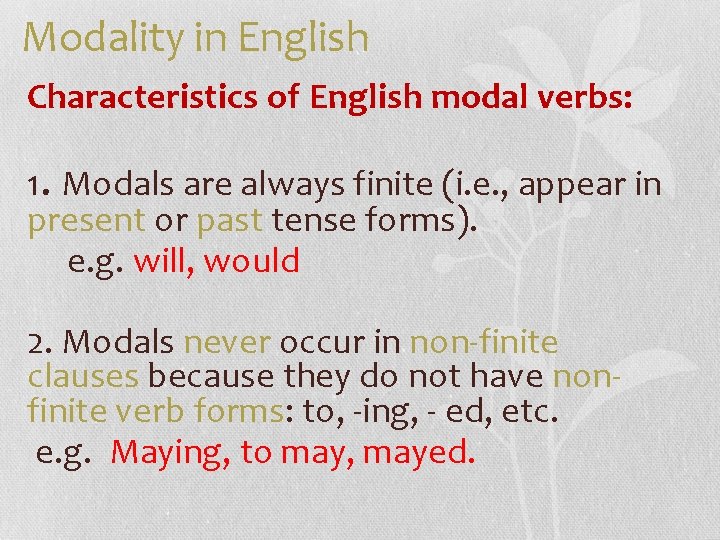
Modality in English Characteristics of English modal verbs: 1. Modals are always finite (i. e. , appear in present or past tense forms). e. g. will, would 2. Modals never occur in non-finite clauses because they do not have nonfinite verb forms: to, -ing, - ed, etc. e. g. Maying, to may, mayed.
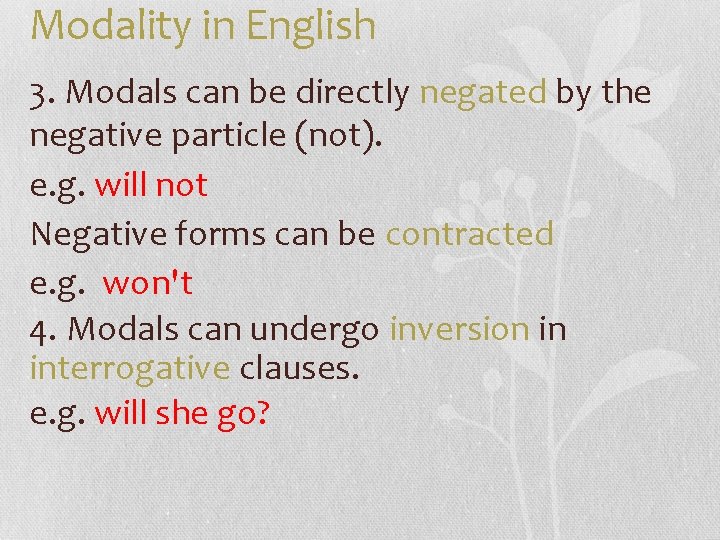
Modality in English 3. Modals can be directly negated by the negative particle (not). e. g. will not Negative forms can be contracted e. g. won't 4. Modals can undergo inversion in interrogative clauses. e. g. will she go?
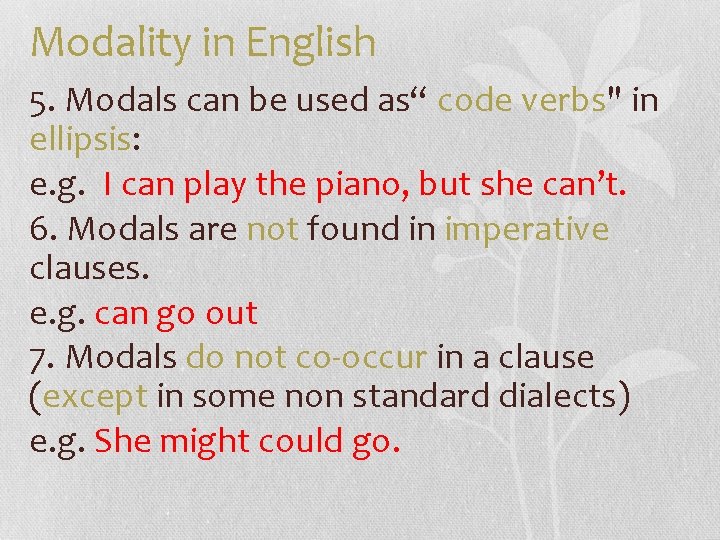
Modality in English 5. Modals can be used as“ code verbs" in ellipsis: e. g. I can play the piano, but she can’t. 6. Modals are not found in imperative clauses. e. g. can go out 7. Modals do not co-occur in a clause (except in some non standard dialects) e. g. She might could go.
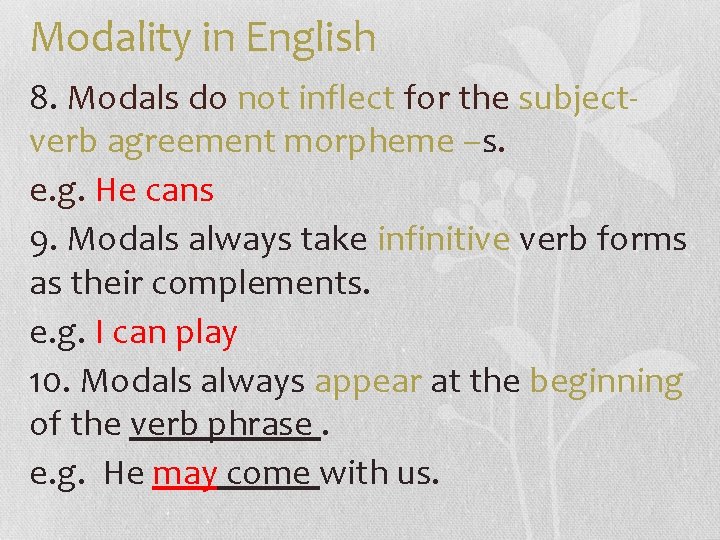
Modality in English 8. Modals do not inflect for the subjectverb agreement morpheme –s. e. g. He cans 9. Modals always take infinitive verb forms as their complements. e. g. I can play 10. Modals always appear at the beginning of the verb phrase. e. g. He may come with us.
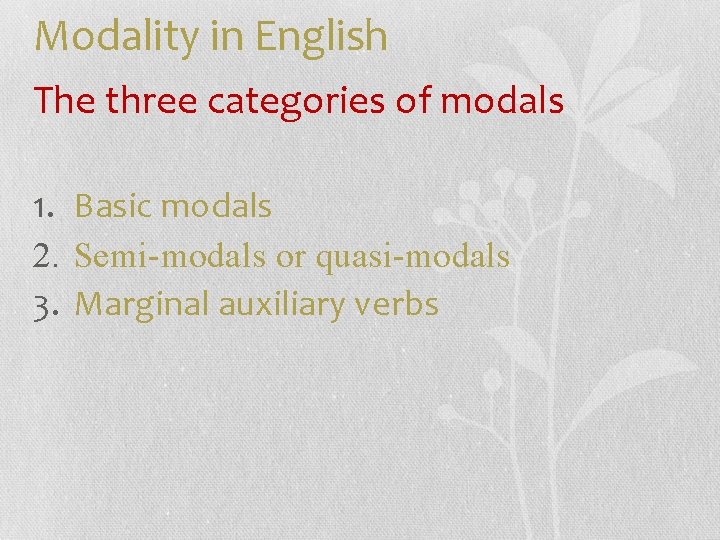
Modality in English The three categories of modals 1. Basic modals 2. Semi-modals or quasi-modals 3. Marginal auxiliary verbs
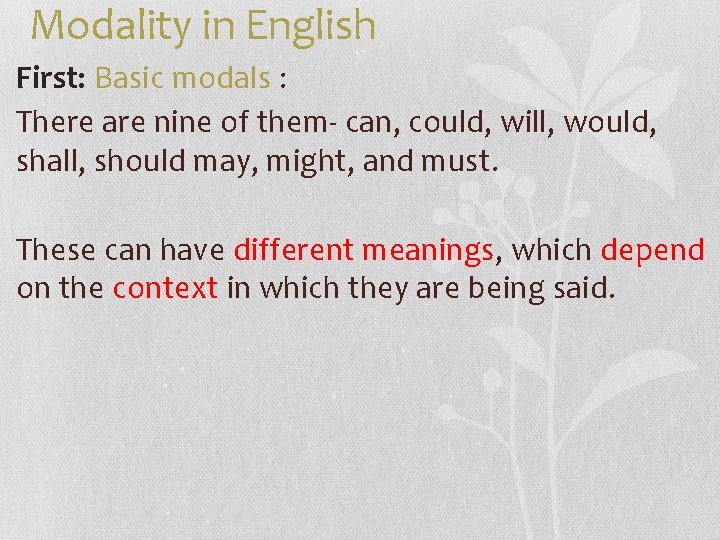
Modality in English First: Basic modals : There are nine of them- can, could, will, would, shall, should may, might, and must. These can have different meanings, which depend on the context in which they are being said.
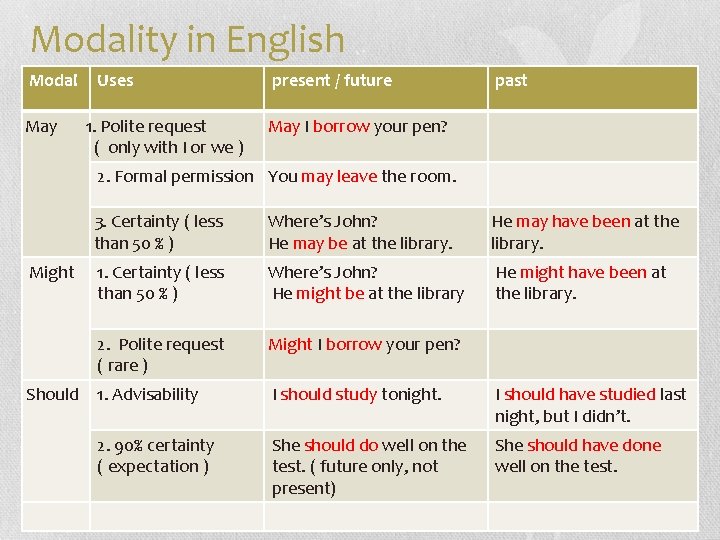
Modality in English Modal May Uses 1. Polite request ( only with I or we ) present / future past May I borrow your pen? 2. Formal permission You may leave the room. Might 3. Certainty ( less than 50 % ) Where’s John? He may be at the library. He may have been at the library. 1. Certainty ( less than 50 % ) Where’s John? He might be at the library He might have been at the library. 2. Polite request Might I borrow your pen? ( rare ) Should 1. Advisability 2. 90% certainty ( expectation ) I should study tonight. I should have studied last night, but I didn’t. She should do well on the test. ( future only, not present) She should have done well on the test.
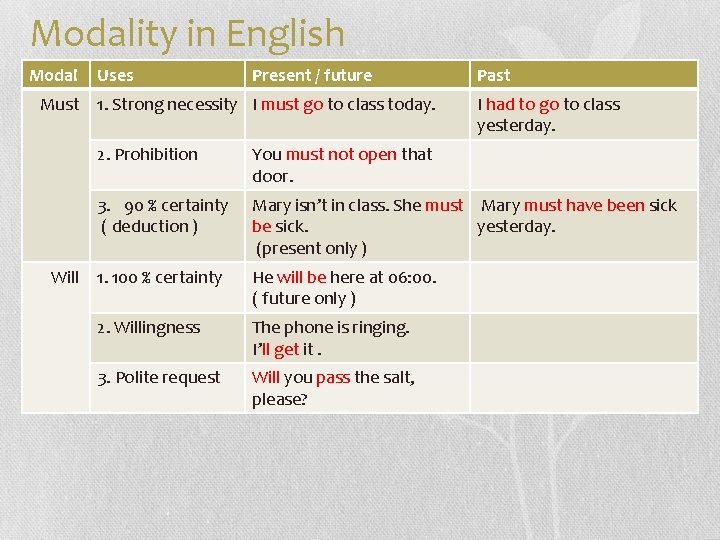
Modality in English Modal Uses Present / future Must 1. Strong necessity I must go to class today. Past I had to go to class yesterday. 2. Prohibition You must not open that door. 3. 90 % certainty ( deduction ) Mary isn’t in class. She must Mary must have been sick be sick. yesterday. (present only ) Will 1. 100 % certainty He will be here at 06: 00. ( future only ) 2. Willingness The phone is ringing. I’ll get it. 3. Polite request Will you pass the salt, please?
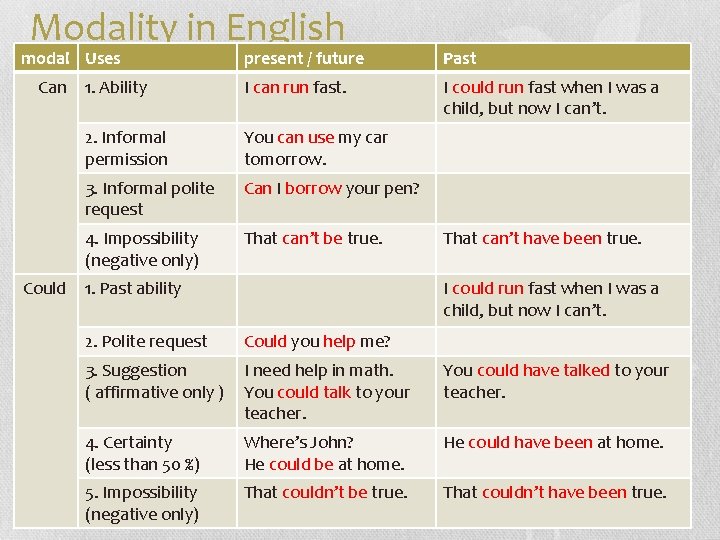
Modality in English modal Uses Can 1. Ability present / future Past I can run fast. I could run fast when I was a child, but now I can’t. 2. Informal permission You can use my car tomorrow. 3. Informal polite request Can I borrow your pen? 4. Impossibility (negative only) That can’t be true. Could 1. Past ability That can’t have been true. I could run fast when I was a child, but now I can’t. 2. Polite request Could you help me? 3. Suggestion ( affirmative only ) I need help in math. You could talk to your teacher. You could have talked to your teacher. 4. Certainty (less than 50 %) Where’s John? He could be at home. He could have been at home. 5. Impossibility (negative only) That couldn’t be true. That couldn’t have been true.

Modality in English modal Uses Present / future would 1. Polite request Would you pass the salt? Would you mind passing the salt? 2. preferences I would rather go to the park than I would rather have gone stay at home. to the park. 3. Repeated action in the past 4. Polite for want When I was a child, I would visit my grandparents every weekend. I would like an apple, please? 5. Unfulfilled wish shall 1. Polite question to make a suggestion Past I would have liked a cookie, but there were none in the house. Shall I open the window? 2. Future I shall arrive at nine. ( with I or we ) will = more common
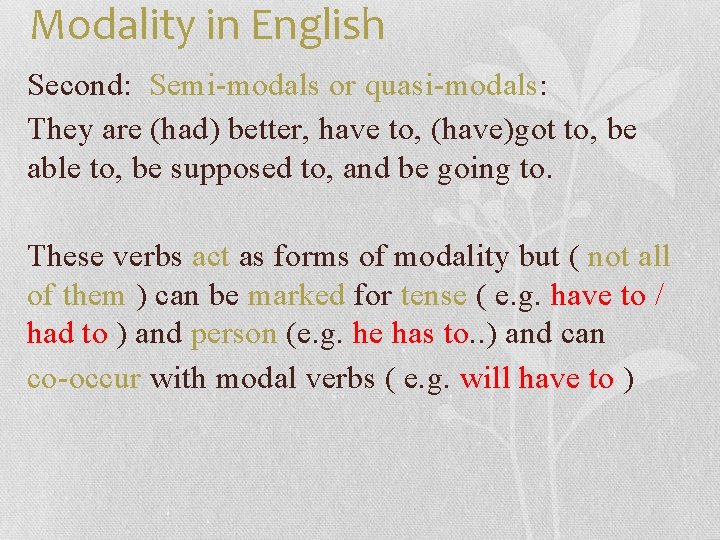
Modality in English Second: Semi-modals or quasi-modals: They are (had) better, have to, (have)got to, be able to, be supposed to, and be going to. These verbs act as forms of modality but ( not all of them ) can be marked for tense ( e. g. have to / had to ) and person (e. g. he has to. . ) and can co-occur with modal verbs ( e. g. will have to )
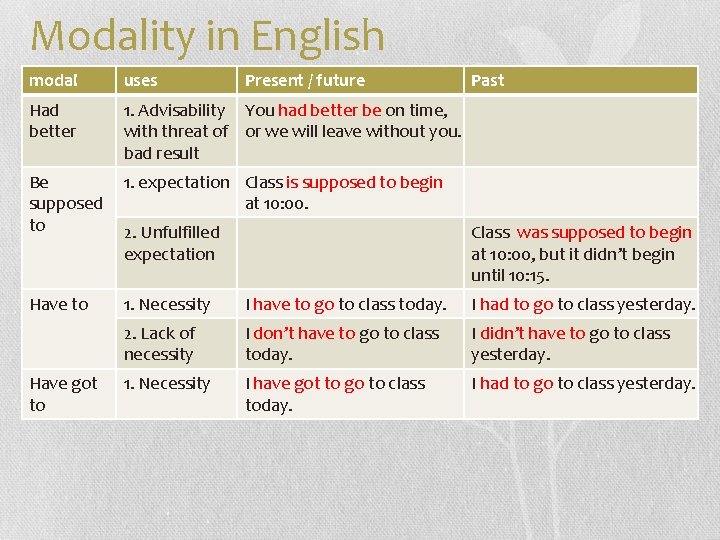
Modality in English modal uses Present / future Had better 1. Advisability You had better be on time, with threat of or we will leave without you. bad result Be 1. expectation Class is supposed to begin supposed at 10: 00. to 2. Unfulfilled expectation Have to Have got to Past Class was supposed to begin at 10: 00, but it didn’t begin until 10: 15. 1. Necessity I have to go to class today. I had to go to class yesterday. 2. Lack of necessity I don’t have to go to class today. I didn’t have to go to class yesterday. 1. Necessity I have got to go to class today. I had to go to class yesterday.
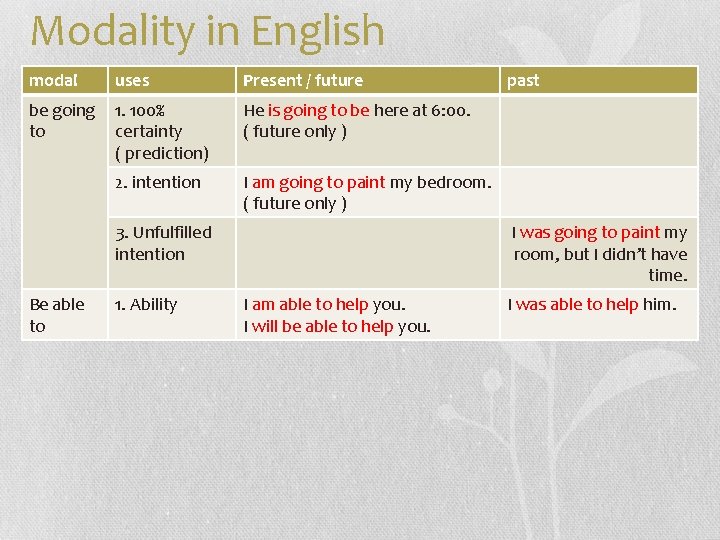
Modality in English modal uses Present / future past be going 1. 100% He is going to be here at 6: 00. to certainty ( future only ) ( prediction) 2. intention I am going to paint my bedroom. ( future only ) 3. Unfulfilled intention Be able to 1. Ability I was going to paint my room, but I didn’t have time. I am able to help you. I will be able to help you. I was able to help him.
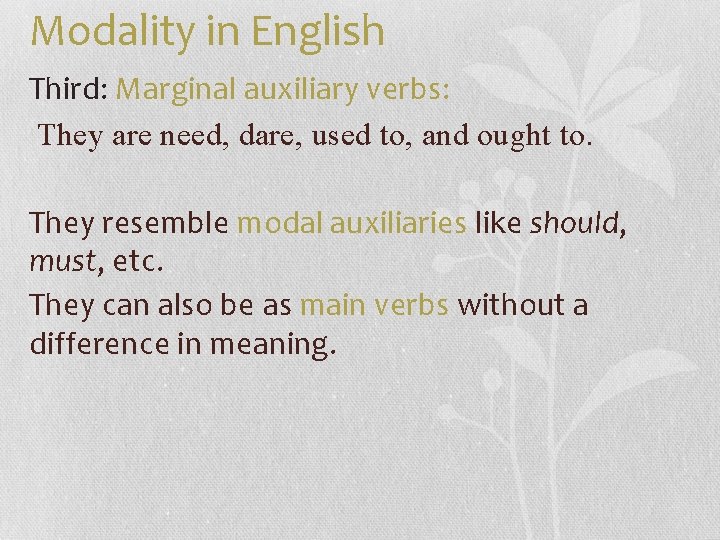
Modality in English Third: Marginal auxiliary verbs: They are need, dare, used to, and ought to. They resemble modal auxiliaries like should, must, etc. They can also be as main verbs without a difference in meaning.
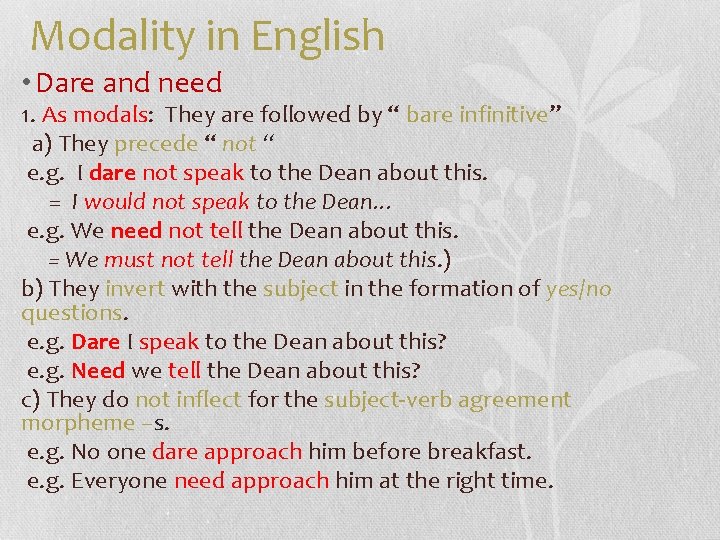
Modality in English • Dare and need 1. As modals: They are followed by “ bare infinitive” a) They precede “ not “ e. g. I dare not speak to the Dean about this. = I would not speak to the Dean. . . e. g. We need not tell the Dean about this. = We must not tell the Dean about this. ) b) They invert with the subject in the formation of yes/no questions. e. g. Dare I speak to the Dean about this? e. g. Need we tell the Dean about this? c) They do not inflect for the subject-verb agreement morpheme –s. e. g. No one dare approach him before breakfast. e. g. Everyone need approach him at the right time.
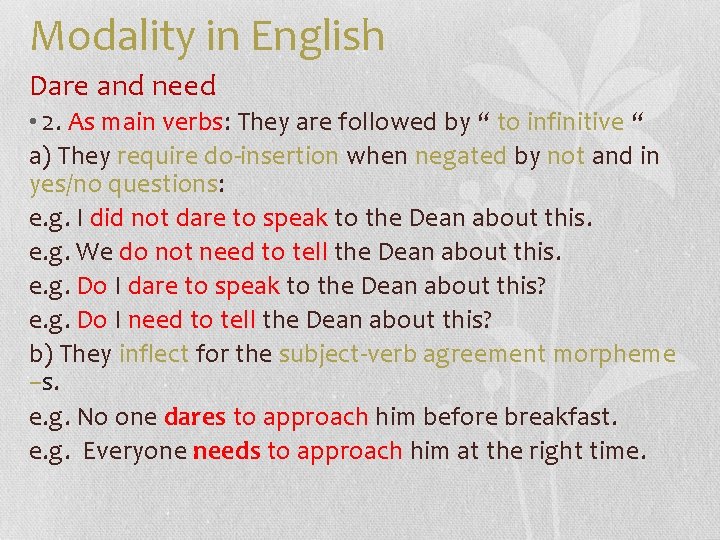
Modality in English Dare and need • 2. As main verbs: They are followed by “ to infinitive “ a) They require do-insertion when negated by not and in yes/no questions: e. g. I did not dare to speak to the Dean about this. e. g. We do not need to tell the Dean about this. e. g. Do I dare to speak to the Dean about this? e. g. Do I need to tell the Dean about this? b) They inflect for the subject-verb agreement morpheme –s. e. g. No one dares to approach him before breakfast. e. g. Everyone needs to approach him at the right time.
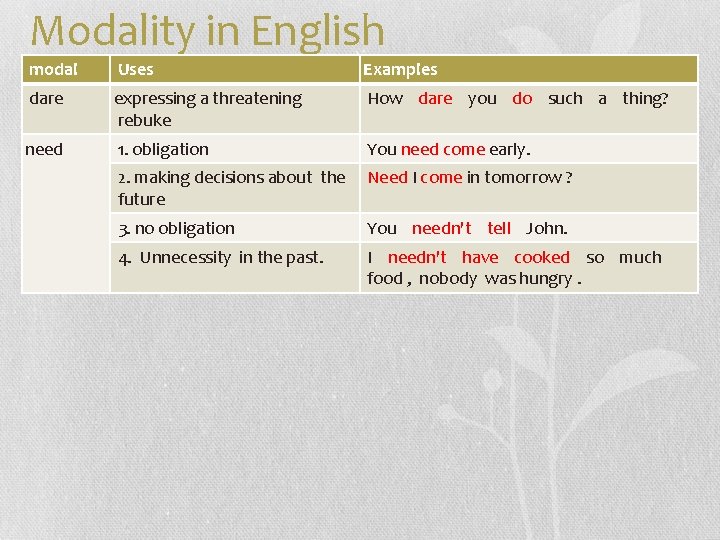
Modality in English modal Uses Examples dare expressing a threatening rebuke How dare you do such a thing? need 1. obligation You need come early. 2. making decisions about the Need I come in tomorrow ? future 3. no obligation You needn't tell John. 4. Unnecessity in the past. I needn't have cooked so much food , nobody was hungry.
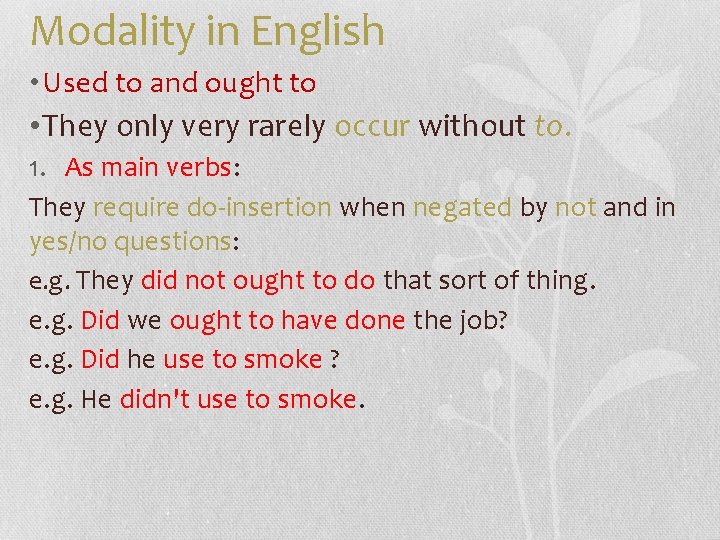
Modality in English • Used to and ought to • They only very rarely occur without to. 1. As main verbs: They require do-insertion when negated by not and in yes/no questions: e. g. They did not ought to do that sort of thing. e. g. Did we ought to have done the job? e. g. Did he use to smoke ? e. g. He didn't use to smoke.
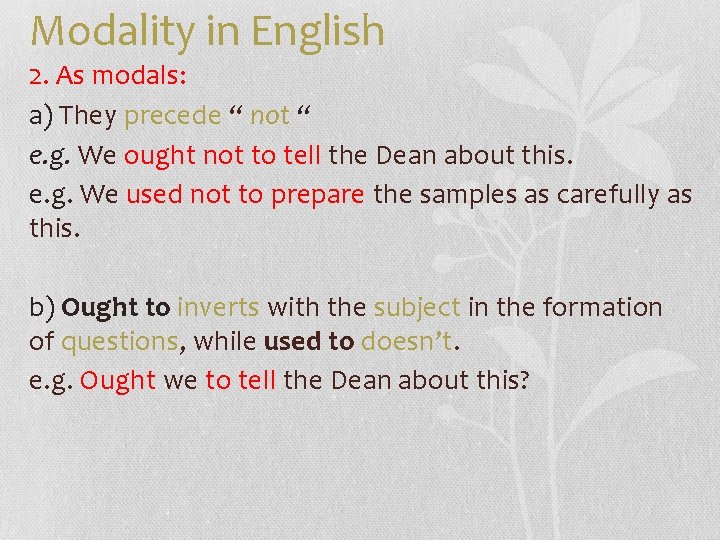
Modality in English 2. As modals: a) They precede “ not “ e. g. We ought not to tell the Dean about this. e. g. We used not to prepare the samples as carefully as this. b) Ought to inverts with the subject in the formation of questions, while used to doesn’t. e. g. Ought we to tell the Dean about this?
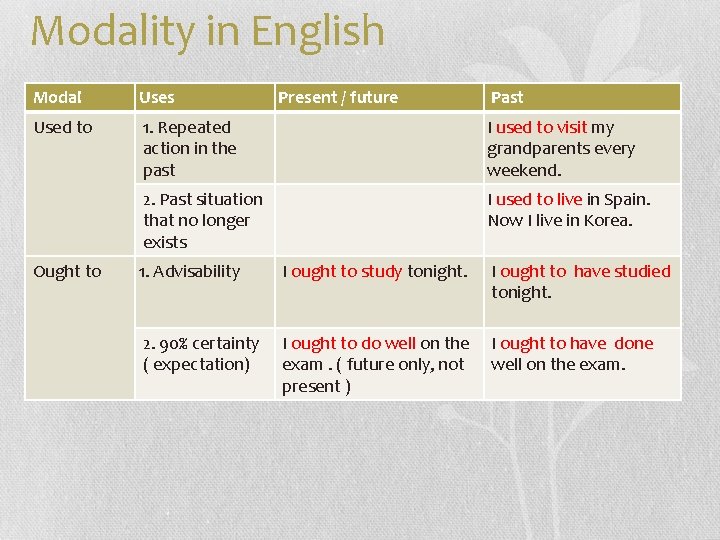
Modality in English Modal Uses Used to 1. Repeated action in the past I used to visit my grandparents every weekend. 2. Past situation that no longer exists I used to live in Spain. Now I live in Korea. Ought to Present / future Past 1. Advisability I ought to study tonight. I ought to have studied tonight. 2. 90% certainty ( expectation) I ought to do well on the exam. ( future only, not present ) I ought to have done well on the exam.
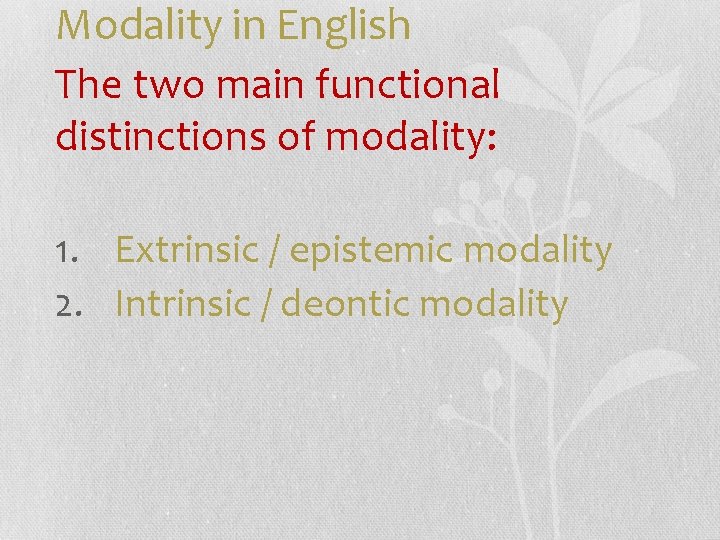
Modality in English The two main functional distinctions of modality: 1. Extrinsic / epistemic modality 2. Intrinsic / deontic modality
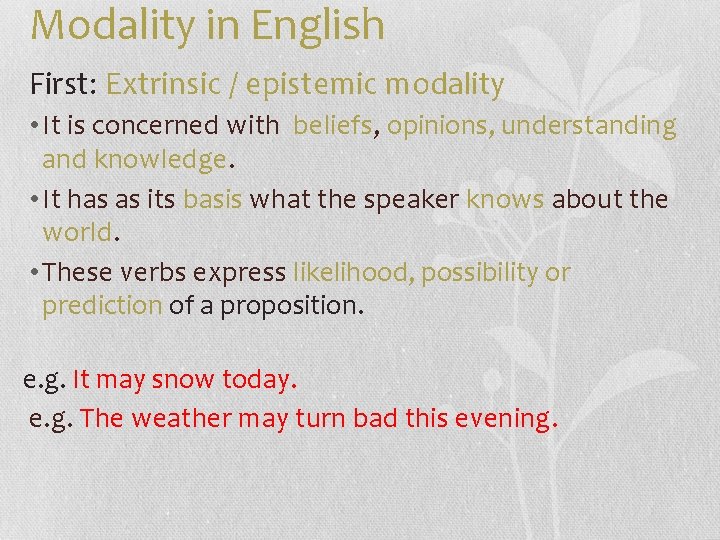
Modality in English First: Extrinsic / epistemic modality • It is concerned with beliefs, opinions, understanding and knowledge. • It has as its basis what the speaker knows about the world. • These verbs express likelihood, possibility or prediction of a proposition. e. g. It may snow today. e. g. The weather may turn bad this evening.
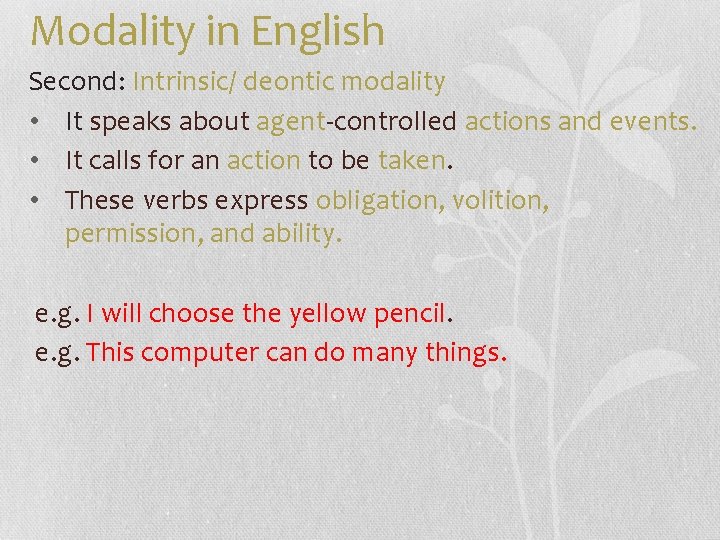
Modality in English Second: Intrinsic/ deontic modality • It speaks about agent-controlled actions and events. • It calls for an action to be taken. • These verbs express obligation, volition, permission, and ability. e. g. I will choose the yellow pencil. e. g. This computer can do many things.
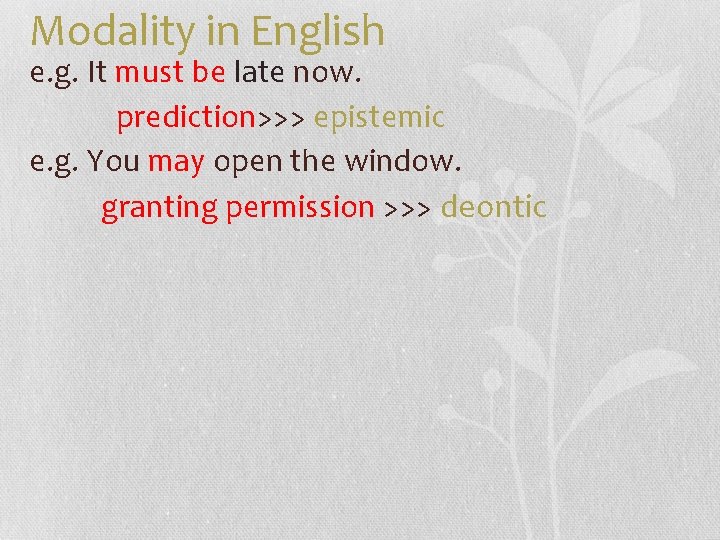
Modality in English e. g. It must be late now. prediction>>> epistemic e. g. You may open the window. granting permission >>> deontic
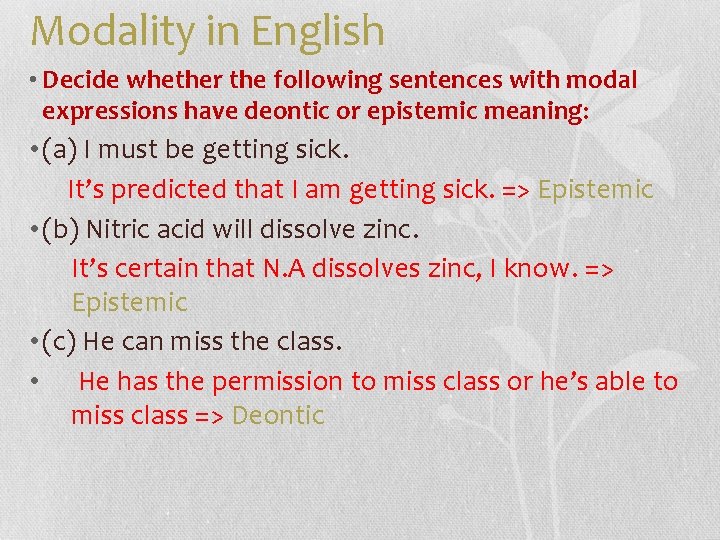
Modality in English • Decide whether the following sentences with modal expressions have deontic or epistemic meaning: • (a) I must be getting sick. It’s predicted that I am getting sick. => Epistemic • (b) Nitric acid will dissolve zinc. It’s certain that N. A dissolves zinc, I know. => Epistemic • (c) He can miss the class. • He has the permission to miss class or he’s able to miss class => Deontic
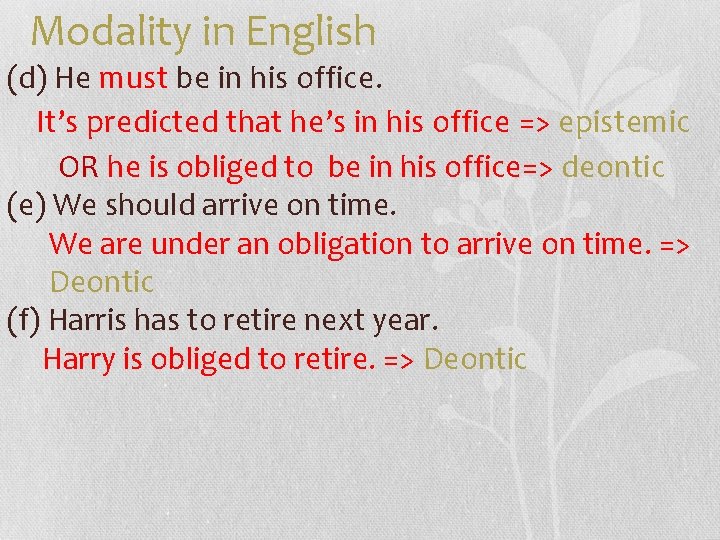
Modality in English (d) He must be in his office. It’s predicted that he’s in his office => epistemic OR he is obliged to be in his office=> deontic (e) We should arrive on time. We are under an obligation to arrive on time. => Deontic (f) Harris has to retire next year. Harry is obliged to retire. => Deontic
Modality in Arabic • Modality in Arabic is expressed by a modal element (a verb or particle) followed by an embedded sentence usually introduced by ‘an. • Modality falls within both the syntactic and semantic categories in English, but only within the semantic category in Arabic.
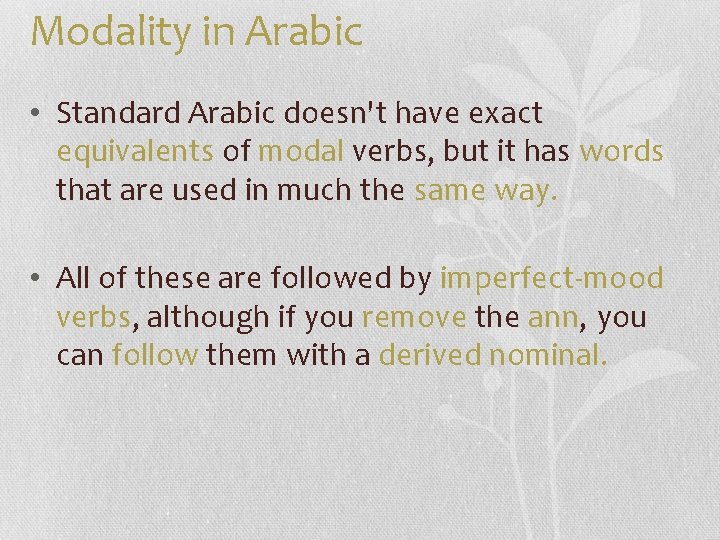
Modality in Arabic • Standard Arabic doesn't have exact equivalents of modal verbs, but it has words that are used in much the same way. • All of these are followed by imperfect-mood verbs, although if you remove the ann, you can follow them with a derived nominal.
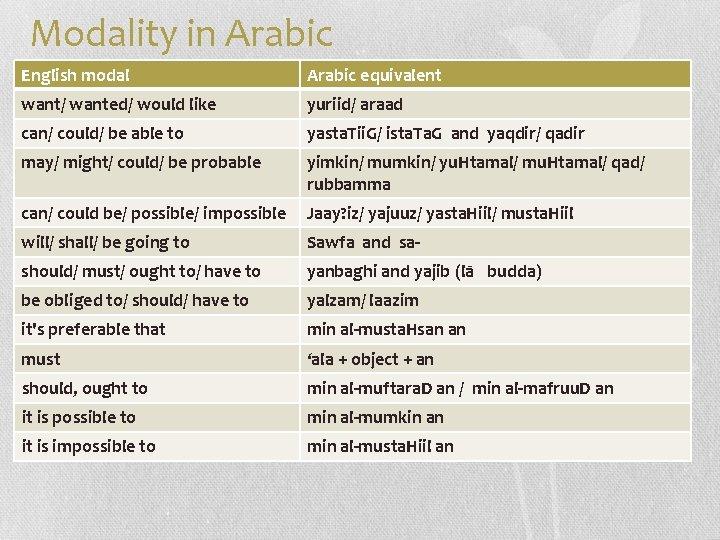
Modality in Arabic English modal Arabic equivalent want/ wanted/ would like yuriid/ araad can/ could/ be able to yasta. Tii. G/ ista. Ta. G and yaqdir/ qadir may/ might/ could/ be probable yimkin/ mumkin/ yu. Htamal/ mu. Htamal/ qad/ rubbamma can/ could be/ possible/ impossible Jaay? iz/ yajuuz/ yasta. Hiil/ musta. Hiil will/ shall/ be going to Sawfa and sa- should/ must/ ought to/ have to yanbaghi and yajib (lā budda) be obliged to/ should/ have to yalzam/ laazim it's preferable that min al-musta. Hsan an must ‘ala + object + an should, ought to min al-muftara. D an / min al-mafruu. D an it is possible to min al-mumkin an it is impossible to min al-musta. Hiil an
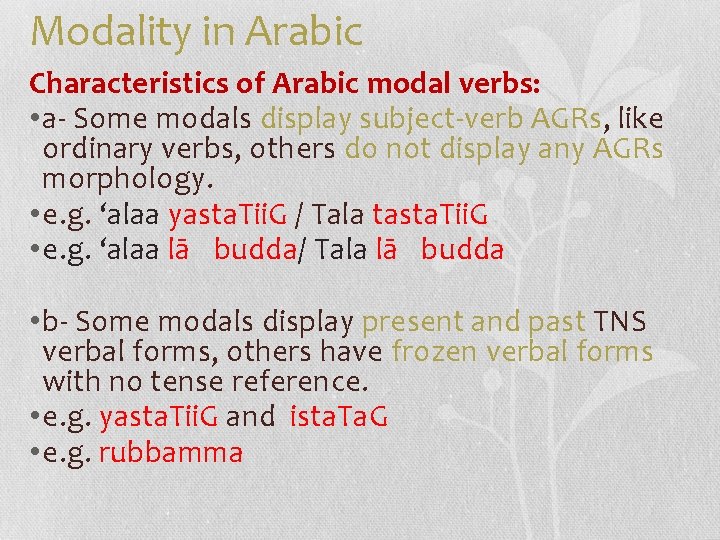
Modality in Arabic Characteristics of Arabic modal verbs: • a- Some modals display subject-verb AGRs, like ordinary verbs, others do not display any AGRs morphology. • e. g. ‘alaa yasta. Tii. G / Tala tasta. Tii. G • e. g. ‘alaa lā budda/ Tala lā budda • b- Some modals display present and past TNS verbal forms, others have frozen verbal forms with no tense reference. • e. g. yasta. Tii. G and ista. Ta. G • e. g. rubbamma
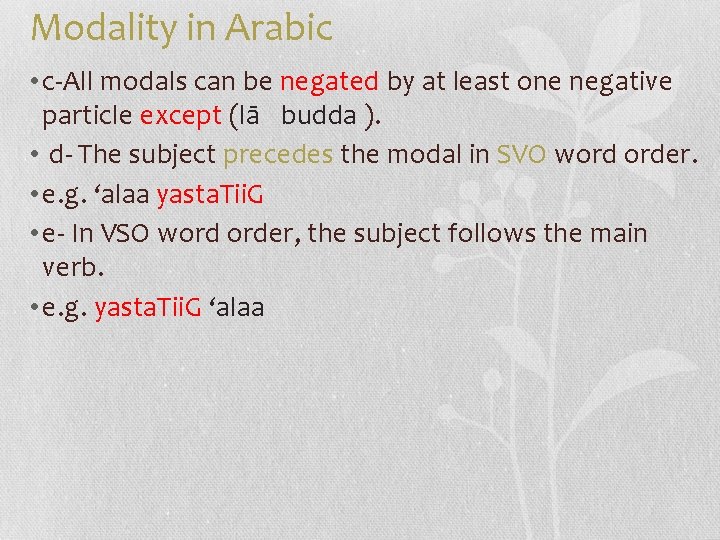
Modality in Arabic • c-All modals can be negated by at least one negative particle except (lā budda ). • d- The subject precedes the modal in SVO word order. • e. g. ‘alaa yasta. Tii. G • e- In VSO word order, the subject follows the main verb. • e. g. yasta. Tii. G ‘alaa
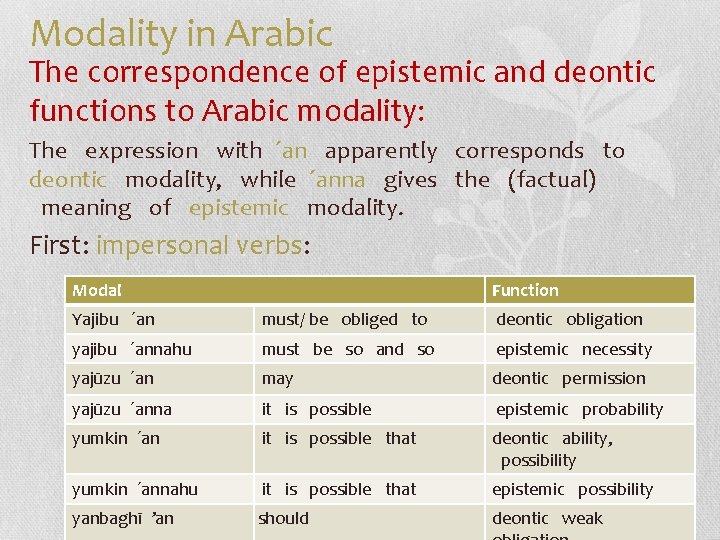
Modality in Arabic The correspondence of epistemic and deontic functions to Arabic modality: The expression with ´an apparently corresponds to deontic modality, while ´anna gives the (factual) meaning of epistemic modality. First: impersonal verbs: Modal Function Yajibu ´an must/ be obliged to deontic obligation yajibu ´annahu must be so and so epistemic necessity yajūzu ´an may deontic permission yajūzu ´anna it is possible epistemic probability yumkin ´an it is possible that deontic ability, possibility yumkin ´annahu it is possible that epistemic possibility yanbaghī ’an should deontic weak
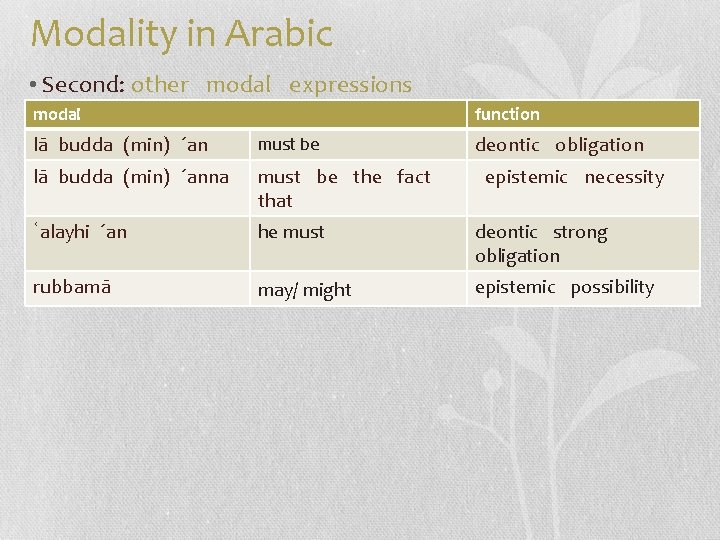
Modality in Arabic • Second: other modal expressions modal function lā budda (min) ´an must be deontic obligation lā budda (min) ´anna must be the fact that epistemic necessity ʿalayhi ´an he must deontic strong obligation rubbamā may/ might epistemic possibility
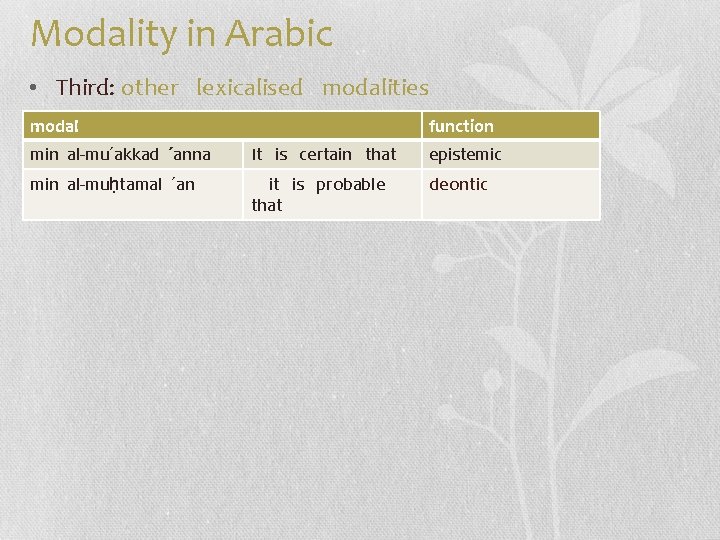
Modality in Arabic • Third: other lexicalised modalities modal function min al-mu´akkad ´anna It is certain that epistemic min al-muḥtamal ´an it is probable that deontic
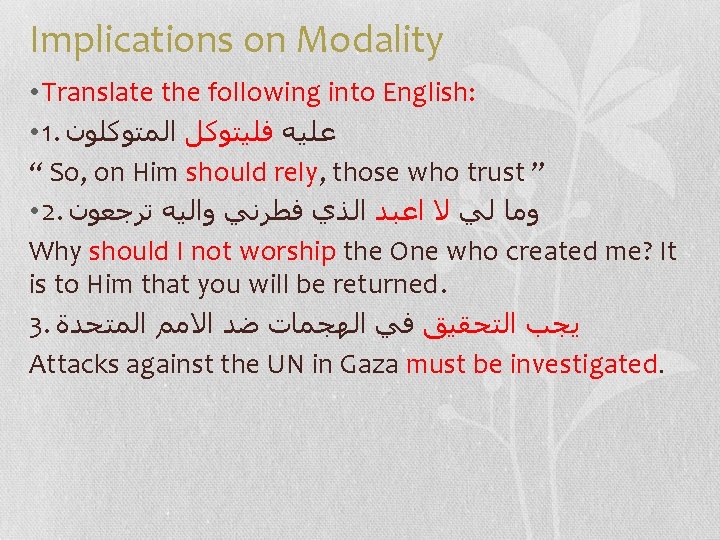
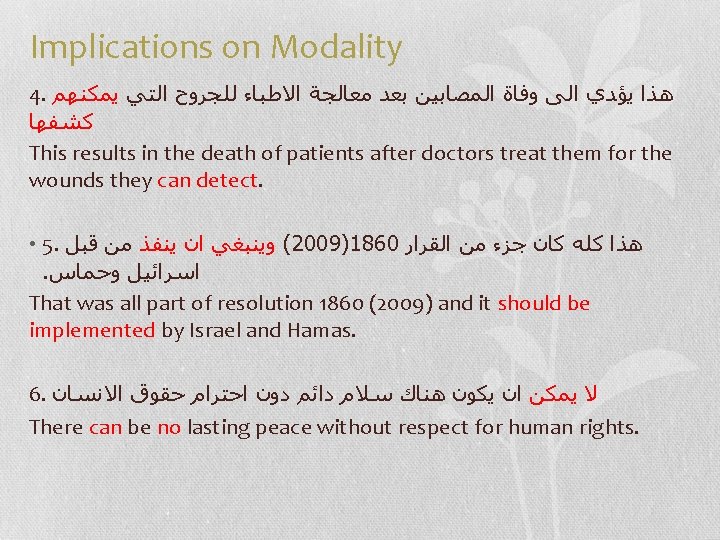
Implications on Modality • Translate the following into English: • 1. ﻋﻠﻴﻪ ﻓﻠﻴﺘﻮﻛﻞ ﺍﻟﻤﺘﻮﻛﻠﻮﻥ “ So, on Him should rely, those who trust ” • 2. ﻭﻣﺎ ﻟﻲ ﻻ ﺍﻋﺒﺪ ﺍﻟﺬﻱ ﻓﻄﺮﻧﻲ ﻭﺍﻟﻴﻪ ﺗﺮﺟﻌﻮﻥ Why should I not worship the One who created me? It is to Him that you will be returned. 3. ﻳﺠﺐ ﺍﻟﺘﺤﻘﻴﻖ ﻓﻲ ﺍﻟﻬﺠﻤﺎﺕ ﺿﺪ ﺍﻻﻣﻢ ﺍﻟﻤﺘﺤﺪﺓ Attacks against the UN in Gaza must be investigated.
References • Al Aqad, M. H. (2015). Translation of English Modality Into Arabic on Selected United Nations Resolutions on Gaza War (Doctoral dissertation, Fakulti Bahasa dan Linguistik, Universiti Malaya). • Boudemagh, W. (2010). Modality in English, French and Arabic Biomedical Discourse. • Alharbi, A. (2002). Verbal modals. Majalat Jami’at Um Alqura, 14(1), 1 -28. • By, S. , Khaleel, H. , Alkariem, S. A. , & Hamzah, L. N. J. (2018). Marginal Verbs in English. • Mejdell, G. ( n. d. ). Lost in translation of modality. • Saoudi, N. (2010). Transfer of modal structure from standard arabic to english. • Modals in standard and Egyptian Arabic • Abdel-Fattah, M. M. (2005). On the translation of modals from English into Arabic and vice versa: the case of deontic modality. Babel, 51(1), 31 -48.

Thank you
- Slides: 40