
MODAL VERBS CAN COULD MAY MIGHT MUST SHALL

MODAL VERBS CAN / COULD / MAY / MIGHT / MUST / SHALL / SHOULD / OUGHT TO / WILL / WOULD/NEED&DARE(semi-modals)
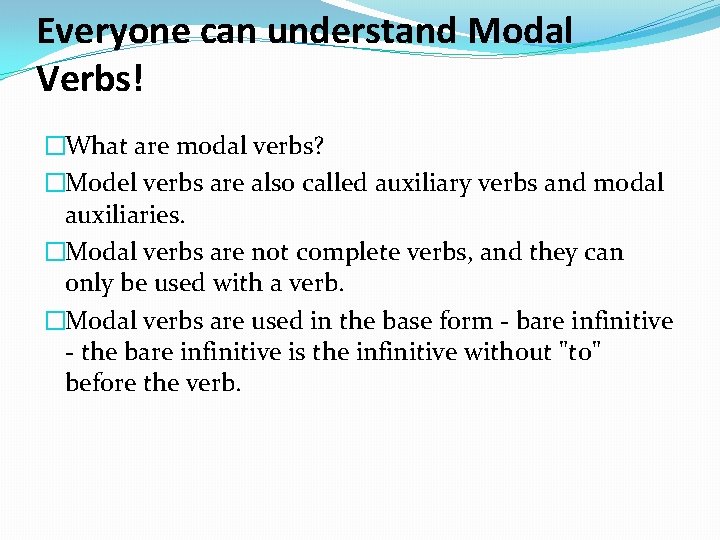
Everyone can understand Modal Verbs! �What are modal verbs? �Model verbs are also called auxiliary verbs and modal auxiliaries. �Modal verbs are not complete verbs, and they can only be used with a verb. �Modal verbs are used in the base form - bare infinitive - the bare infinitive is the infinitive without "to" before the verb.
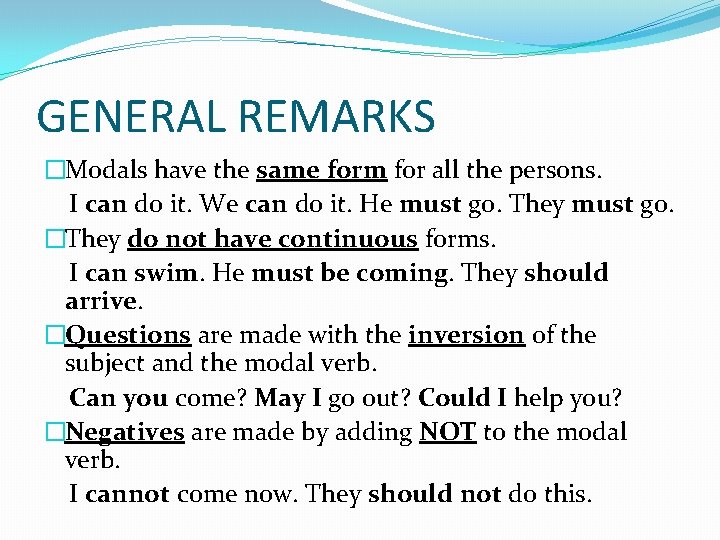
GENERAL REMARKS �Modals have the same form for all the persons. I can do it. We can do it. He must go. They must go. �They do not have continuous forms. I can swim. He must be coming. They should arrive. �Questions are made with the inversion of the subject and the modal verb. Can you come? May I go out? Could I help you? �Negatives are made by adding NOT to the modal verb. I cannot come now. They should not do this.
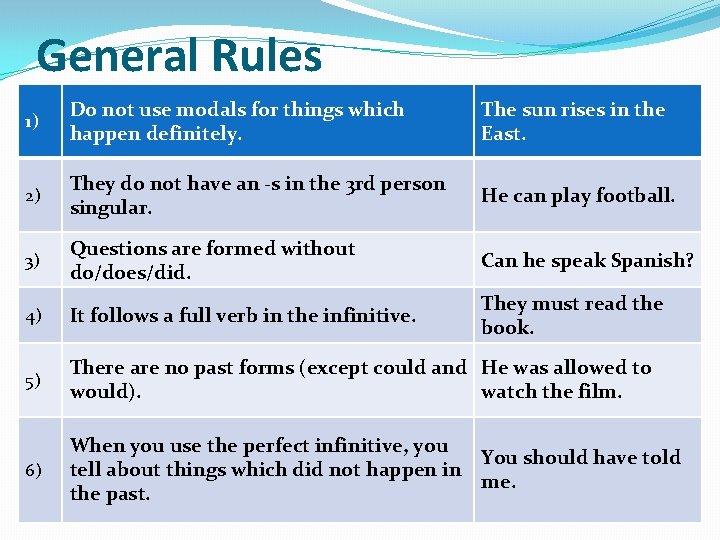
General Rules 1) Do not use modals for things which happen definitely. The sun rises in the East. 2) They do not have an -s in the 3 rd person singular. He can play football. 3) Questions are formed without do/does/did. Can he speak Spanish? 4) It follows a full verb in the infinitive. They must read the book. 5) There are no past forms (except could and He was allowed to would). watch the film. 6) When you use the perfect infinitive, you You should have told tell about things which did not happen in me. the past.

positive long form can could may might ought to need shall should will would negative contracted form 'll 'd cannot contracted form can't could not may not might not ought not to need not shall not should not will not would not couldn't oughtn't to needn't shan't shouldn't wouldn't long form
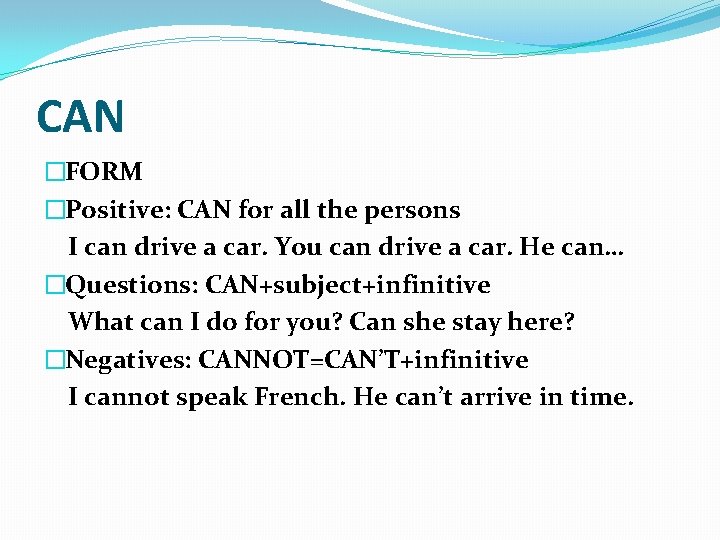
CAN �FORM �Positive: CAN for all the persons I can drive a car. You can drive a car. He can… �Questions: CAN+subject+infinitive What can I do for you? Can she stay here? �Negatives: CANNOT=CAN’T+infinitive I cannot speak French. He can’t arrive in time.
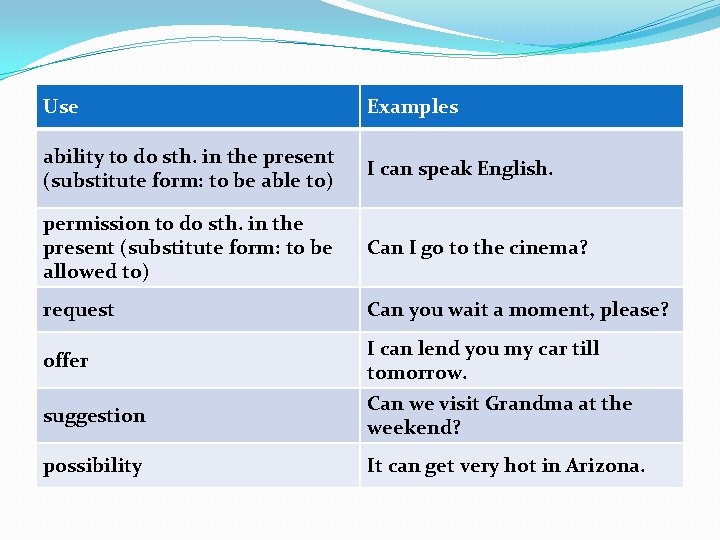
Use Examples ability to do sth. in the present (substitute form: to be able to) I can speak English. permission to do sth. in the present (substitute form: to be allowed to) Can I go to the cinema? request Can you wait a moment, please? offer I can lend you my car till tomorrow. suggestion Can we visit Grandma at the weekend? possibility It can get very hot in Arizona.
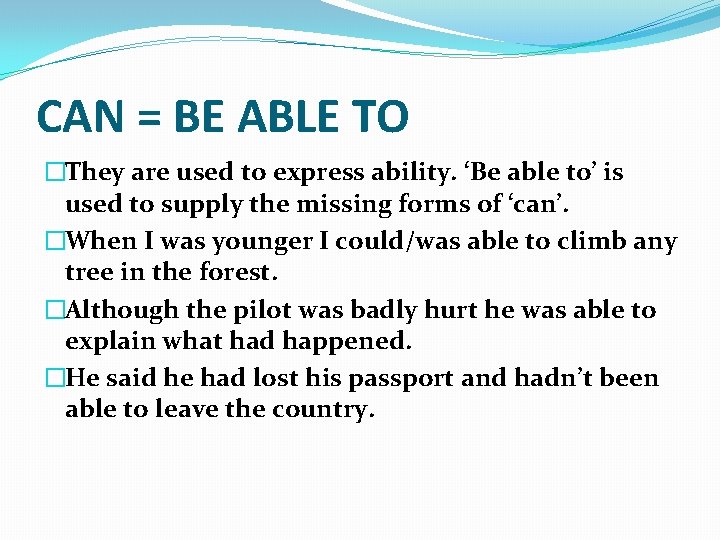
CAN = BE ABLE TO �They are used to express ability. ‘Be able to’ is used to supply the missing forms of ‘can’. �When I was younger I could/was able to climb any tree in the forest. �Although the pilot was badly hurt he was able to explain what had happened. �He said he had lost his passport and hadn’t been able to leave the country.
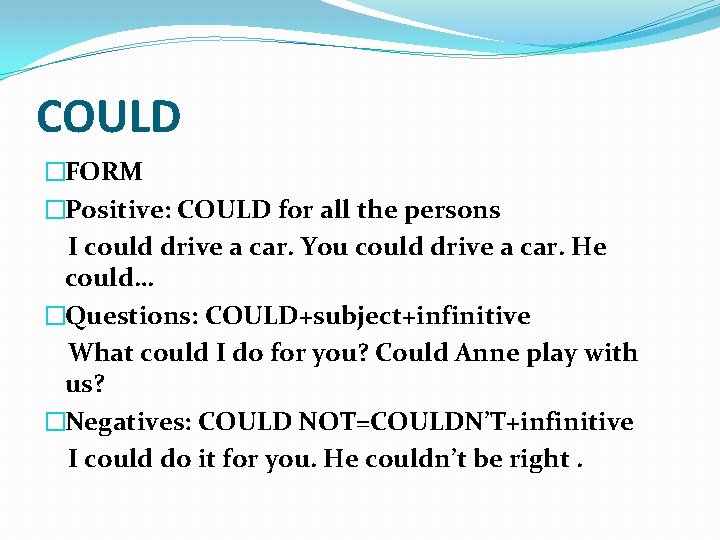
COULD �FORM �Positive: COULD for all the persons I could drive a car. You could drive a car. He could… �Questions: COULD+subject+infinitive What could I do for you? Could Anne play with us? �Negatives: COULD NOT=COULDN’T+infinitive I could do it for you. He couldn’t be right.
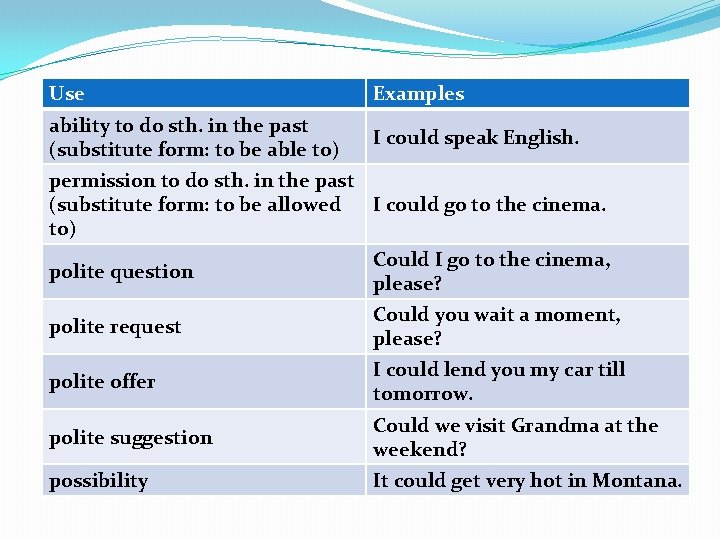
Use Examples ability to do sth. in the past (substitute form: to be able to) I could speak English. permission to do sth. in the past (substitute form: to be allowed I could go to the cinema. to) polite question Could I go to the cinema, please? polite request Could you wait a moment, please? polite offer I could lend you my car till tomorrow. polite suggestion Could we visit Grandma at the weekend? possibility It could get very hot in Montana.
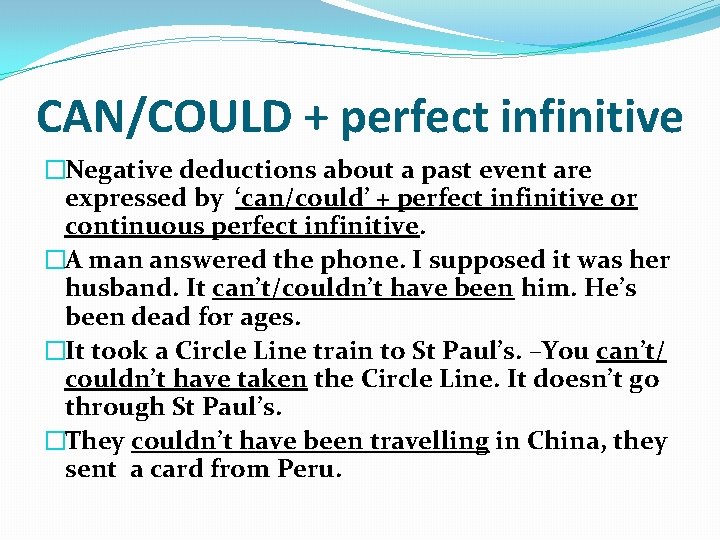
CAN/COULD + perfect infinitive �Negative deductions about a past event are expressed by ‘can/could’ + perfect infinitive or continuous perfect infinitive. �A man answered the phone. I supposed it was her husband. It can’t/couldn’t have been him. He’s been dead for ages. �It took a Circle Line train to St Paul’s. –You can’t/ couldn’t have taken the Circle Line. It doesn’t go through St Paul’s. �They couldn’t have been travelling in China, they sent a card from Peru.
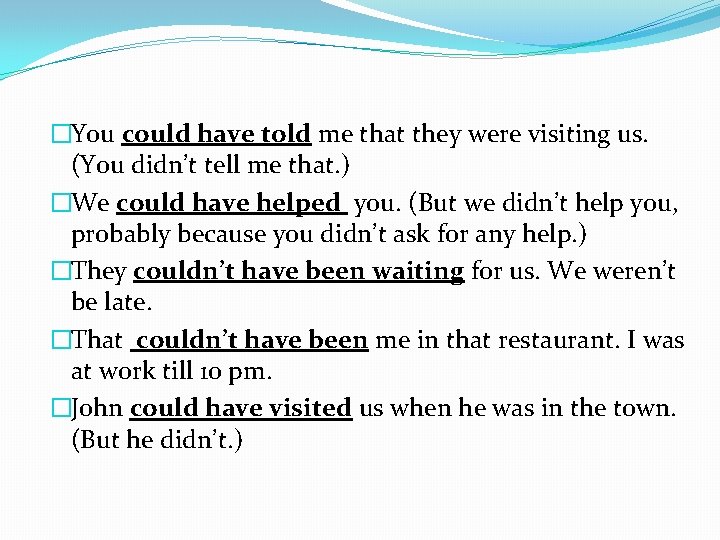
�You could have told me that they were visiting us. (You didn’t tell me that. ) �We could have helped you. (But we didn’t help you, probably because you didn’t ask for any help. ) �They couldn’t have been waiting for us. We weren’t be late. �That couldn’t have been me in that restaurant. I was at work till 10 pm. �John could have visited us when he was in the town. (But he didn’t. )
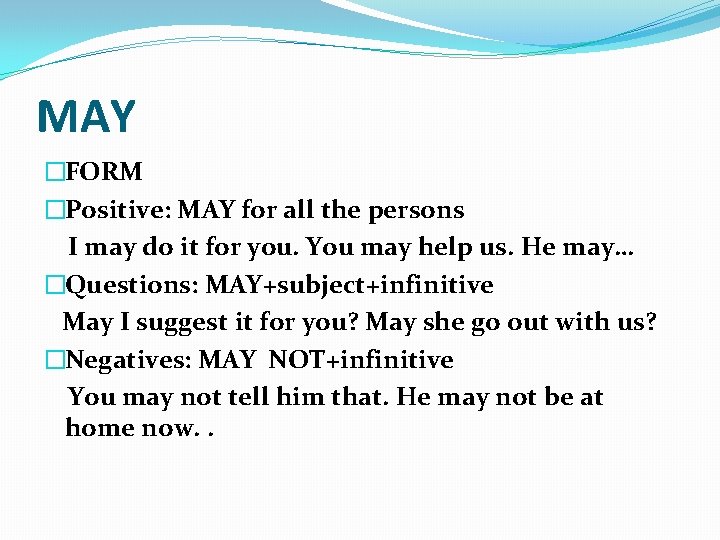
MAY �FORM �Positive: MAY for all the persons I may do it for you. You may help us. He may… �Questions: MAY+subject+infinitive May I suggest it for you? May she go out with us? �Negatives: MAY NOT+infinitive You may not tell him that. He may not be at home now. .
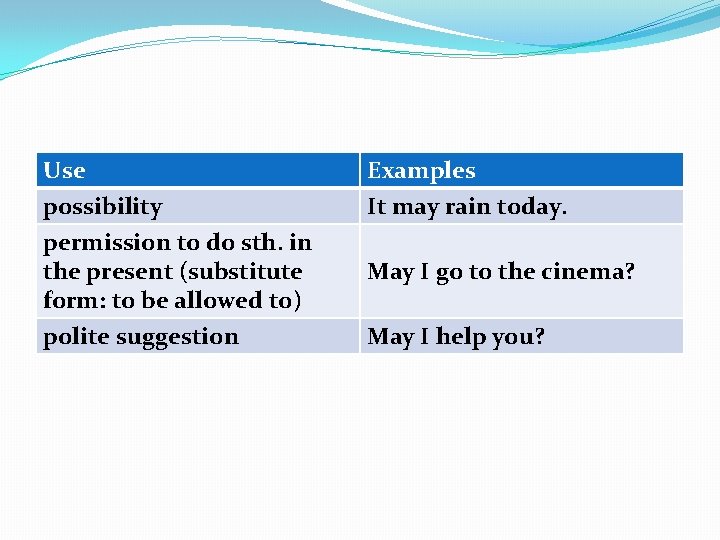
Use possibility permission to do sth. in the present (substitute form: to be allowed to) polite suggestion Examples It may rain today. May I go to the cinema? May I help you?
MIGHT �FORM �Positive: MIGHT for all the persons I might visit them. It might be a sunny day. He might… �Questions: MIGHT+subject+infinitive Might I tell you something? Might she be right? �Negatives: MIGHT NOT+infinitive You might not want to know that. They might not want to come here.
Use possibility (less possible than may) Examples hesitant offer Might I help you? It might rain today.
MAY/MIGHT+perfect infinitive �They are used in speculations about past actions. �He may/might have gone. = Perhaps he went. �They might have come when we were away. �‘Might’ is used when the main verb is in a past tense. �He said/thought that she might have missed the plane. �‘Might’ is used when the uncertainty no longer exists. �He came home alone. You shouldn’t have let him do that. , he might have got lost. (But he didn’t get lost. )
MUST �FORM �Positive: MUST for all the persons I must go now. You must be tired. He must… �Questions: MUST+subject+infinitive �, but better HAVE TO What must I do? = What do I have to do? �Negatives: MUST NOT=MUSTN’T has completely different meaning= prohibition or ban of something �DON’T /DOESN’T HAVE TO is the correct form
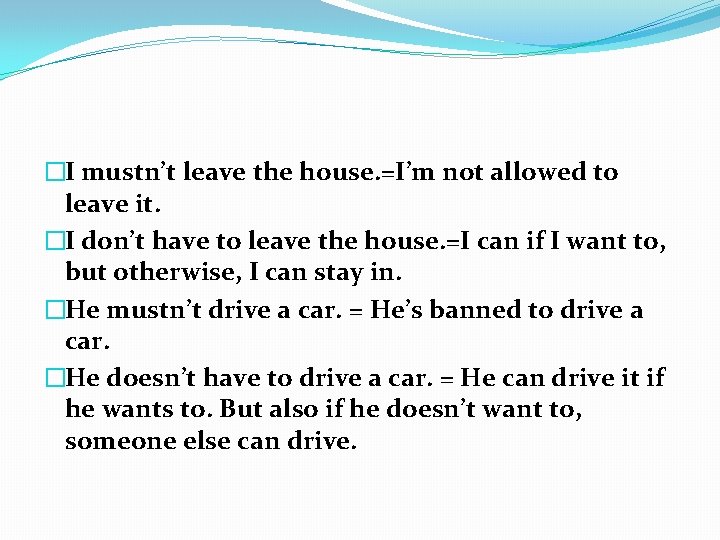
�I mustn’t leave the house. =I’m not allowed to leave it. �I don’t have to leave the house. =I can if I want to, but otherwise, I can stay in. �He mustn’t drive a car. = He’s banned to drive a car. �He doesn’t have to drive a car. = He can drive it if he wants to. But also if he doesn’t want to, someone else can drive.
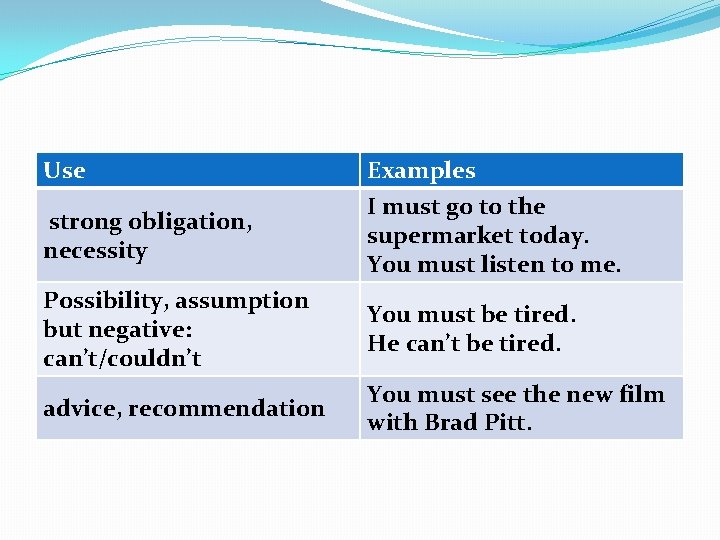
Use strong obligation, necessity Examples I must go to the supermarket today. You must listen to me. Possibility, assumption but negative: can’t/couldn’t You must be tired. He can’t be tired. advice, recommendation You must see the new film with Brad Pitt.
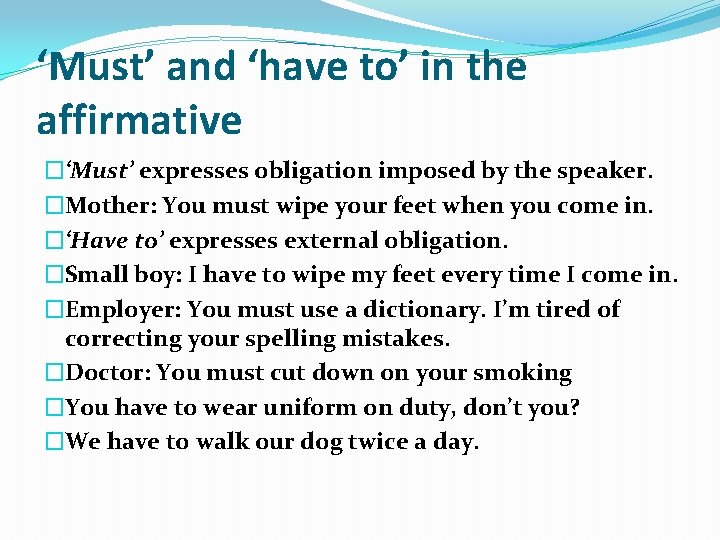
‘Must’ and ‘have to’ in the affirmative �‘Must’ expresses obligation imposed by the speaker. �Mother: You must wipe your feet when you come in. �‘Have to’ expresses external obligation. �Small boy: I have to wipe my feet every time I come in. �Employer: You must use a dictionary. I’m tired of correcting your spelling mistakes. �Doctor: You must cut down on your smoking �You have to wear uniform on duty, don’t you? �We have to walk our dog twice a day.
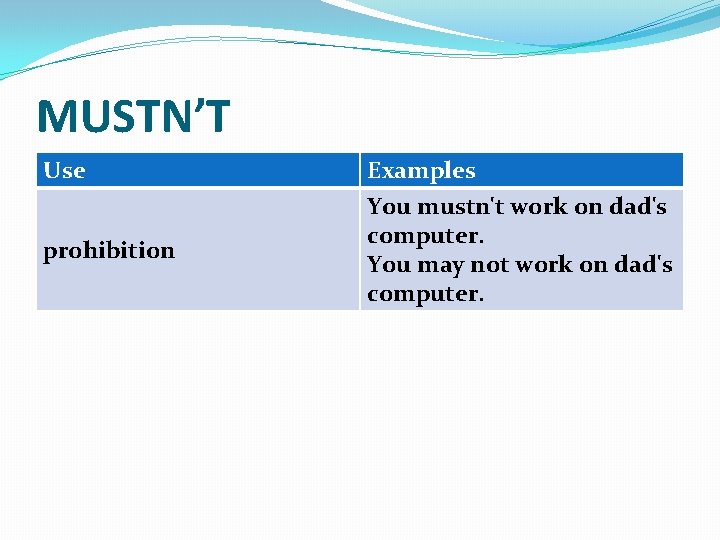
MUSTN’T Use prohibition Examples You mustn't work on dad's computer. You may not work on dad's computer.
MUST + perfect infinitive �It is used for deductions or assumptions in the past. �He must have come by a taxi. ( This implies that he had no choice. ) �It must have been Tom. He’s the only one who was there. �Roxette’s song: It must have been love, but it's over now It must have been good, but I lost it somehow

NEED �Need is used both as an ordinary verb and as a modal verb. �Some grammarians also call it semi-modal verb.

�As an ordinary verb need is used in the sense of ‘require’. It has the usual forms needs and needed. Ordinary need is followed by an infinitive with to. �One needs to be punctual. �Everybody needs to be loved. �He needed some more time to decide the question. �Questions and negatives are made with do. �Do you need to go now? �I don't need to talk to him.
�As a modal verb �The modal form of need is used mainly in questions and negatives. It is also used after negative words like hardly and only. �You need not work today. �Need I go now? �Need we reserve seats? �He need only say what he wants and it will be granted. �I need hardly add that you are always welcome.
�The auxiliary need is followed by an infinitive without to. It has no –s in the third person singular. �He need not wait. (NOT He needs not to wait. ) �You need not come. �Questions and negatives are made without do. �Need I come again? ( Do I need come again? ) �Note that the auxiliary form of need is rare in American English.
Points to be noted �The modal need is mainly used to ask for or give permission. It is not used to talk about habitual or general things. �You need not work today. (Modal - Particular occasion) �You don't need to work on Sundays. (Ordinary habitual thing) �You need not pay for this call. (Modal - Particular occasion) �In most countries, you don't need to pay for emergency calls. (Ordinary - general thing)
�Need is usually used in questions without ‘not’. �Need I wait any longer? �Need he come again? �If the answer is in the negative, you should say – ‘No, he need not’ or ‘No, you need not’. But if the answer is in the positive, you should say – ‘Yes, he must’ or ‘Yes, you must’. The opposite of need not in such a context is not need but must.
NEED NOT=NEEDN’T Use not necessary Examples I needn't go to the supermarket, we're going to the restaurant tonight.
Need not + perfect infinitive �The structure need not + perfect infinitive can be used to say that somebody did something, but that was unnecessary. �They need not have come all this way. (= They came all this way, but it was not necessary. ) �We need not have waited for his approval. (= We waited for his approval, but that was not necessary. ) �You need not have bought a new car. �You need not have paid for that call.
�Note that need not have does not mean the same as did not need to. When we say that somebody did not need to do something, we are simply saying that it was not necessary (whether or not it was done). �Compare: �I need not have bought it. (=I bought it, but it was not necessary. ) �I didn't need to buy it. (=It was not necessary for me to buy it, so I didn’t buy it. )
Need + participle �In British English it is possible to use an –ing form after need. It means the same as a passive infinitive. �Your hair needs washing. (= Your hair needs to be washed. ) �The carpet needs cleaning. (= The carpet needs to be cleaned. ) �The roof needs repairing. �A structure with need + object + present/past participle is also possible in some cases. �You need your hair cutting/cut. �You need your car cleaned.
SHALL �FORM �Positive: SHALL for all the persons I shall visit them. You shall study now. �Questions: SHALL+subject+infinitive What shall I do? Shall we call the doctor? �Negatives: SHALL NOT=SHAN’T+infinitive I shall not visit them. They shan’t stay home today.
�I shall be home soon. �We shall invite them to dinner. �I think I shall send him a wire. �We shall be leaving for Delhi tomorrow. �Shall we report this to the police? ( Do we shall…? ) �No, we shall not. ( We don't shall. )
�With the first persons (I/We) �In the first persons shall expresses simple futurity. It is used to show the strong possibility or near certainty of an action or event which is to take place in the future. �Don’t worry I shall come on time. �We shall be there at 2 p. m.
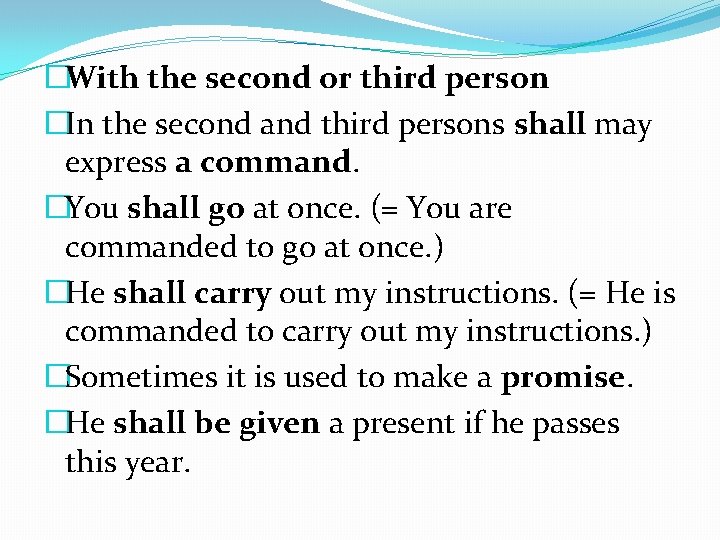
�With the second or third person �In the second and third persons shall may express a command. �You shall go at once. (= You are commanded to go at once. ) �He shall carry out my instructions. (= He is commanded to carry out my instructions. ) �Sometimes it is used to make a promise. �He shall be given a present if he passes this year.
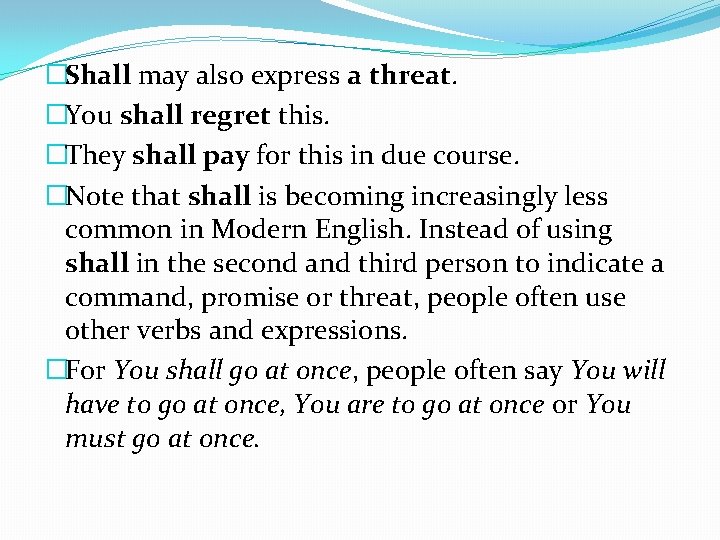
�Shall may also express a threat. �You shall regret this. �They shall pay for this in due course. �Note that shall is becoming increasingly less common in Modern English. Instead of using shall in the second and third person to indicate a command, promise or threat, people often use other verbs and expressions. �For You shall go at once, people often say You will have to go at once, You are to go at once or You must go at once.
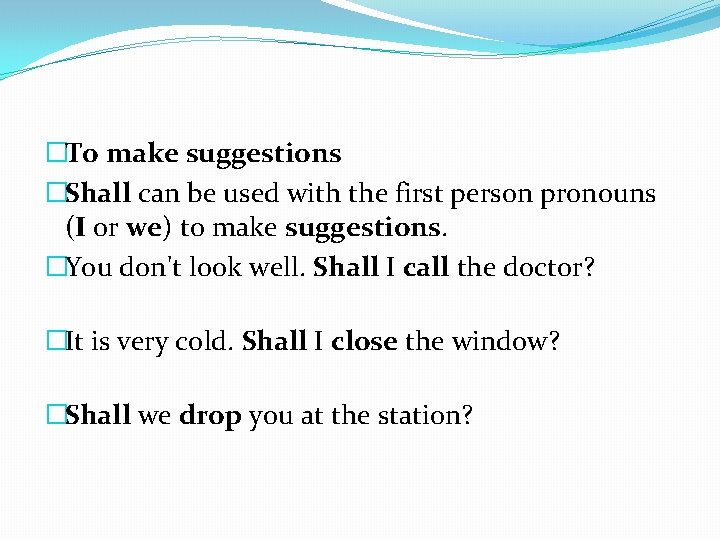
�To make suggestions �Shall can be used with the first person pronouns (I or we) to make suggestions. �You don't look well. Shall I call the doctor? �It is very cold. Shall I close the window? �Shall we drop you at the station?

�To talk about certainty �Shall can show certainty. It is used to say that something will certainly happen, or that you are determined that something will happen. �Don't worry. I shall be there to help you. �She shall clean the kitchen, no matter whether she likes it or not.
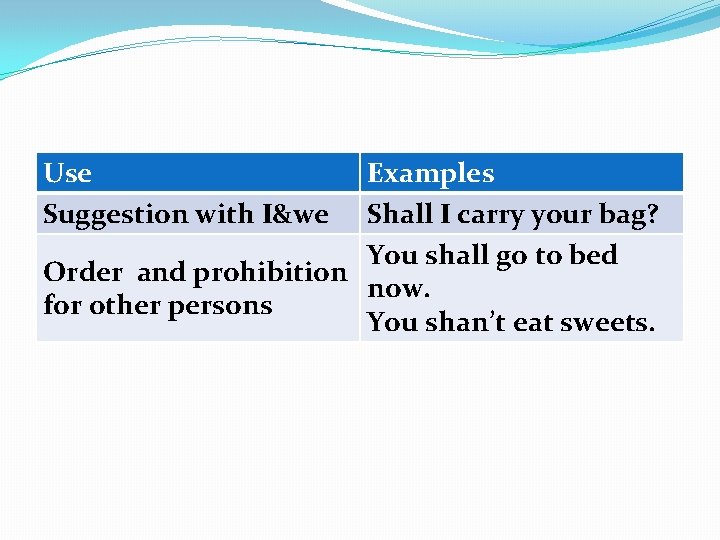
Use Suggestion with I&we Examples Shall I carry your bag? You shall go to bed Order and prohibition now. for other persons You shan’t eat sweets.
SHOULD �FORM �Positive: SHOULD for all the persons I should tell them. John should arrive soon. They should… �Questions: SHOULD+subject+infinitive Should I stay or should I go? What should she do? �Negatives: SHOULD NOT=SHOULDN’T+infinitive You shouldn’t smoke too much. Lucy shouldn’t tell lies.
�He should be here soon. ( He shoulds …) �You should mend your ways. �You should go now. �Should I go now? �No, you should not. �Note that should is the past equivalent of shall in indirect speech. �They asked, ‘What shall we do? ’ �They asked what they should do.
�To express obligation �Should is often used to talk about duty or obligation. It can also be used to say or ask what the correct or best thing to do is. �You should tell the truth. �If you are not feeling well, you should consult a doctor. �There should be an investigation into the cause of the accident. �Note that should is not as strong as must. �In questions, should is used to ask for advice or instructions. �It is rather cold here. Should I turn the heating on? �What should we do now? �Should I seek his opinion? �Should we talk to him?
�To express probability �Should can express logical probability. �You should find this grammar book helpful. �He should be here soon – he left home at six. �‘Granny will be staying with us for a couple of months. ’ ‘That should be nice. ’ �I should be able to beat him. �Mount Everest should be visible from Tiger Hill if the sky is clear.
�Should have + past participle �The structure should have + past participle can be used to talk about past events which did not happen. �I should have sent the money this morning, but I forgot. �This structure can also be used to talk about past events which may or may not have happened. �They should have reached home by now. It is 10 o’clock.
�We can use should not have + past participle to refer to unwanted or unnecessary things that happened. �You shouldn’t have said things like that to her. �It is very kind of you, but you shouldn’t have bothered. �John: I bought you a present. �Anne: Oh, thank you. But you shouldn’t have (bought it).
�Should or Would? �In British English, both would and should can be used after first person pronouns (I and we). There is no difference in meaning. �I would/should like some sweets before I go to bed. �We would/should be happy to receive them at the airport. �Should after why �Should can be used after why to suggest surprise. �Why should anyone want to buy something so useless? �Why shouldn’t she buy it if she can afford it? �I don’t see why we should have to pay for your mistakes.
�Should in subordinate clauses �Should can be used after certain adjectives expressing personal judgments and reactions. Examples are: odd, strange, sad, unfair etc. �It is strange that she should find older men attractive. �It is odd that she should want to trust him again. �It is unfair that she should have died so young. �This also happens after adjectives and nouns expressing the importance of an action. Examples are: necessary, important, essential, vital, eager etc. �It is important that the meeting should be a success. �It is necessary that she should be told.
�Other cases �Should can used after so that, in order that, for fear that, in case and lest to show the purpose of an action. �He took an umbrella so that he shouldn’t get wet. �He ran lest he should miss the train. �He took his umbrella in case it should rain.
�Should in conditional clauses �Should is used in conditional clauses expressing possibilities, suppositions etc. �If he should come, ask him to wait. �Should it rain, there will be no picnic today. �Note that if he should come indicates less likelihood of his coming than if he comes. The sentence means something like this: There is not much chance of his coming. But if he turns up, ask him to wait.
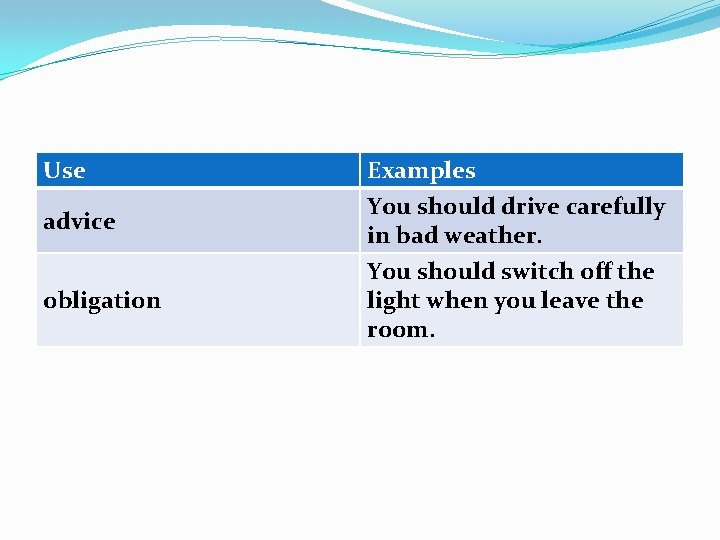
Use advice obligation Examples You should drive carefully in bad weather. You should switch off the light when you leave the room.
OUGHT TO �FORM �Positive: OUGHT TO for all the persons I ought to leave soon. He ought to come early. �Questions: OUGHT TO+subject+infinitive �What ought she to say? �Negatives: OUGHT NOT TO+infinitive You ought not to wait for him anymore.
�She ought to understand. ( She oughts to …) �Ought is different from other auxiliary verbs. It is used with to. �We ought to respect our parents. �We ought to help the poor. �Note that to is dropped in question tags. �You ought to love your country, ought not you? (…ought not you to. )
�Ought does not have infinitives (to ought) or participles (oughting, oughted). Questions and negatives are made without do. �Ought we to help them? ( Do we ought to …) �You ought not to go now. �Ought is rarely used in questions and negatives; should is generally used instead. A structure with think … ought is also common. �We ought to help them, shouldn’t we? (More natural than ought not we? ) �Do you think I ought to consult a doctor? (More natural than Ought I to consult a doctor? ) �Should we tell her? (Less formal than Ought we to tell her? )
�Ought expresses duty, necessity, desirability and similar ideas. It is often used to advise people – to tell them that they have a duty to do things. The meaning is similar to should �You ought to attend office regularly. (Duty) �We ought to help the needy. (Moral obligation) �We ought to buy some furniture. (Necessity) �Ought is not as forceful as must.
�To express probability �Ought can express logical probability. �If he started an hour ago, he ought to be here soon.
�Ought to have + past participle �When ought refers to past time, it is followed by the perfect infinitive. This structure can be used to talk about things which were supposed to happen but did not. �I ought to have written to my parents, but I forgot. �You ought to have invited her to your party. �This structure can also be used to make guesses. �It is ten o’clock. He ought to have reached home.
�Ought not to have can be used to talk about things that happened unnecessarily. �We ought not to have wasted so much time over it. �We have done things that we ought not to have done. �We have left undone things that we ought to have done.
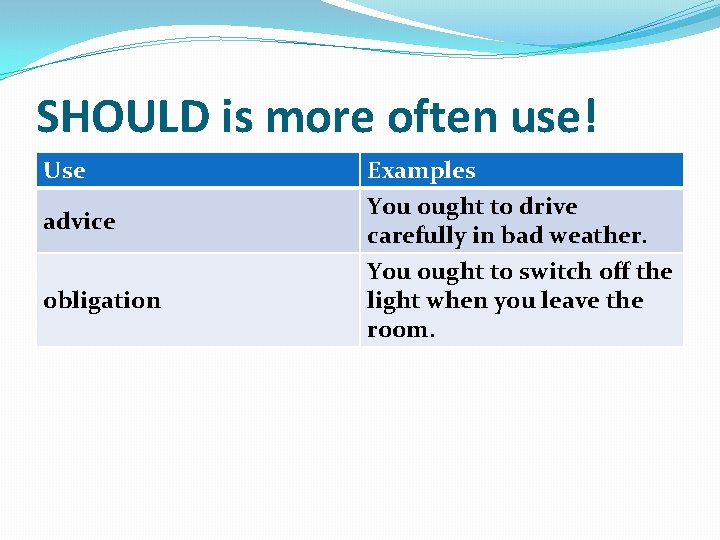
SHOULD is more often use! Use advice obligation Examples You ought to drive carefully in bad weather. You ought to switch off the light when you leave the room.
WILL �FORM �Positive: WILL for all the persons I will wait for them. They’ll be here at 8 pm. �Questions: WILL+subject+infinitive �What will I tell them? Will you be patient, please? �Negatives: WILL NOT=WON’T+infinitive That won’t be a problem, sir. They won’t be here before tomorrow.
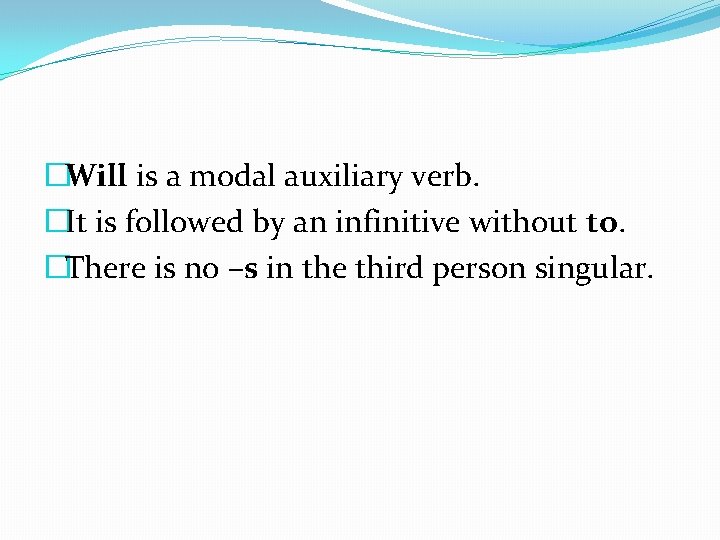
�Will is a modal auxiliary verb. �It is followed by an infinitive without to. �There is no –s in the third person singular.
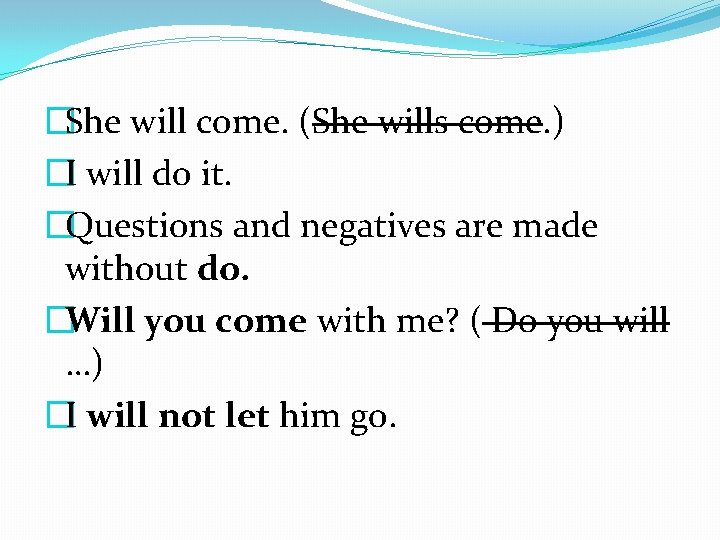
�She will come. (She wills come. ) �I will do it. �Questions and negatives are made without do. �Will you come with me? ( Do you will …) �I will not let him go.
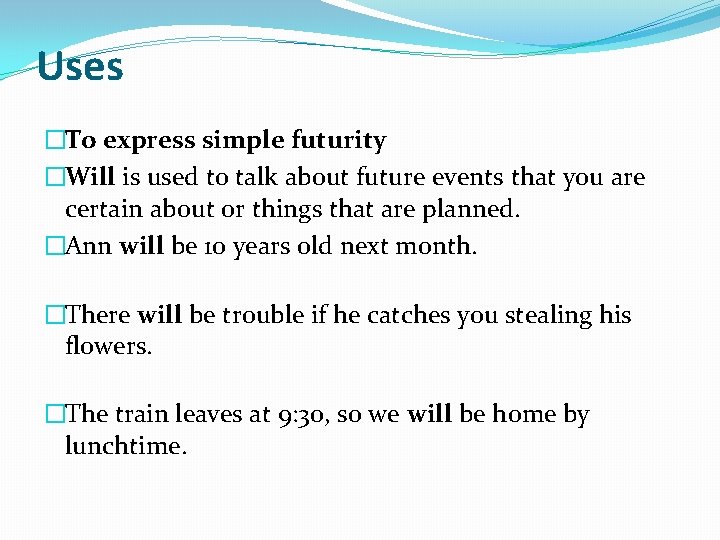
Uses �To express simple futurity �Will is used to talk about future events that you are certain about or things that are planned. �Ann will be 10 years old next month. �There will be trouble if he catches you stealing his flowers. �The train leaves at 9: 30, so we will be home by lunchtime.
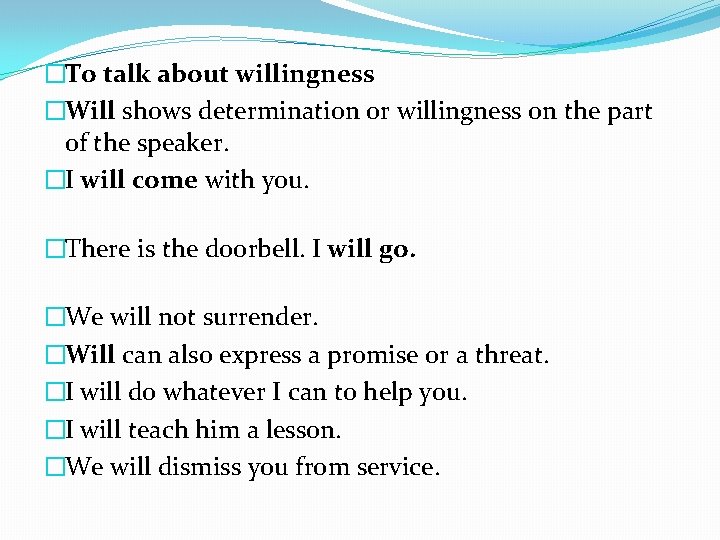
�To talk about willingness �Will shows determination or willingness on the part of the speaker. �I will come with you. �There is the doorbell. I will go. �We will not surrender. �Will can also express a promise or a threat. �I will do whatever I can to help you. �I will teach him a lesson. �We will dismiss you from service.
�To ask someone to do something �Will can be used to ask someone to do something. �Ask John if he will help. �Will you lend me some money? �Will you give the book to John when you meet him?
�To make requests and offers �Will can be used as a polite way of inviting someone to do something or of offering someone something. Note that would is a more polite form of will. �Will you join us for a drink? �Will you send me the report? �Won’t you is used to make a pressing offer. �You will have some coffee, won't you?
�To give orders �Will can be used in orders. �Will you be quiet? �If you don't behave, you will go straight to bed. �To talk about possibility �Will can show possibility. �‘There is the doorbell. ’ ‘That will be Sita. ’
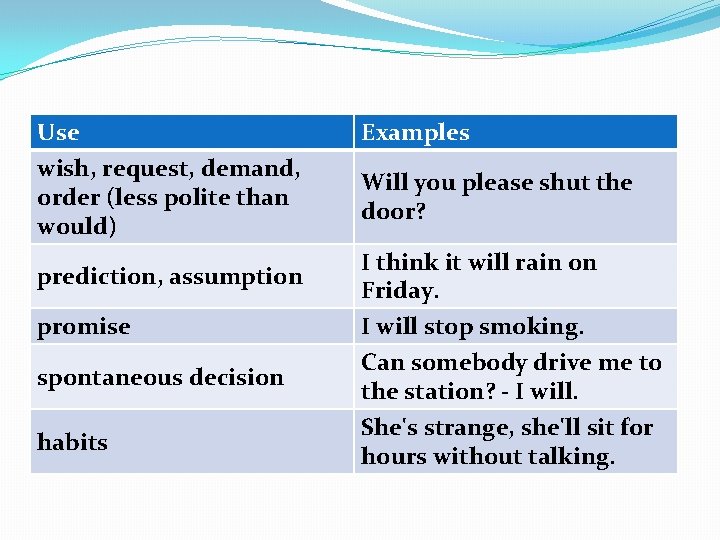
Use wish, request, demand, order (less polite than would) prediction, assumption promise spontaneous decision habits Examples Will you please shut the door? I think it will rain on Friday. I will stop smoking. Can somebody drive me to the station? - I will. She's strange, she'll sit for hours without talking.
WOULD �FORM �Positive: WOULD for all the persons I’d like to introduce you… He would be glad if you phoned him. �Questions: WOULD+subject+infinitive �Would you like a table for two? Where would you live if you had choice? �Negatives: WOULD NOT=WOULDN’T+infinitive I wouldn’t pay so much money for this shirt if I were you. They wouldn’t do such a bad thing!
�Would is a modal auxiliary verb. There is no -s in the third person singular. Would is followed by an infinitive without to. �He said he would try his best to help me. �I would like to know what my duty is. �The doctor said he would visit the patient. �Questions and negatives are made without do. �Would you like some coffee? ( Do you would like …)
Would: Uses �To make polite offers and requests �Would is often used in polite requests and offers. It is a softer, less definite form of will. �Would you mind moving a bit? �Would you mind sharing a room? �I would like to meet the manager. �Would can also be used to express an opinion in a more polite way without being forceful. �This is not what we would expect from a professional service.
Would and Will �Would is a softer, less definite form of will. It is used in polite requests and offers. �I would like to meet him. �Would can act as the past of will in indirect speech. �She said, ‘I will not live here anymore. ’ �She said that she would not live there anymore.
�To talk about past habits �Would can be used to talk about past events that happened often or always. �He would always bring us nice gifts without telling why. �The old man would recline in a corner and sleep most of the time. �After dinner we would sit in a common room and chat for a while. �Would is often used to suggest that what happens is expected because it is typical, especially of a person's behaviour. �She would always trust these persons. �'Ann rang to say that she was too busy to come. ' 'She would - she always has an excuse. '
�To talk about willingness and determination �Would can express willingness or a determination. �He said he would try his best to help me. (Willingness) �He would bet on that horse, though I asked him not to. (Determination) �She would have her own way. �Wouldn't shows unwillingness. �I asked him to move his car, but he said he wouldn't.
�To talk about imaginary situations �Would is sometimes used to refer to a situation that you can imagine happening. �I would hate to miss the show. �I would go myself but I am too busy. �It would have been quite boring to sit through the entire speech.
�Would and used to �Both would and used to can refer to repeated actions and events in the past. �She would/used to always carry an umbrella. �Note that used to can refer to past states; would cannot. �I used to have an old Rolls Royce. ( I would have …)
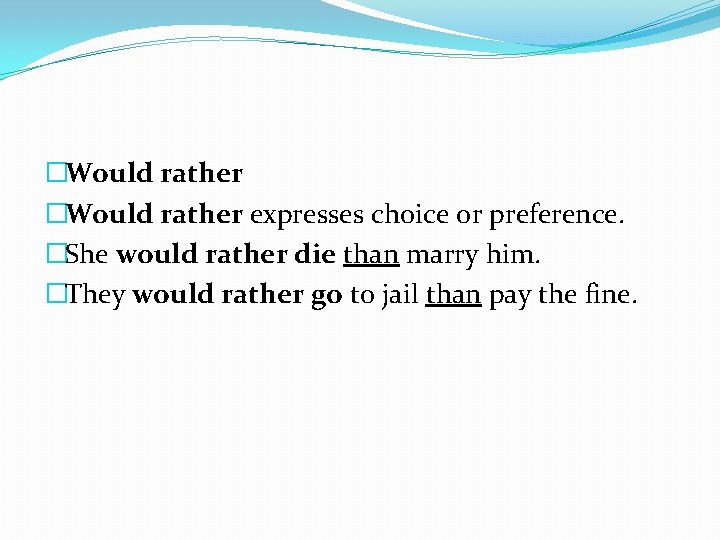
�Would rather expresses choice or preference. �She would rather die than marry him. �They would rather go to jail than pay the fine.
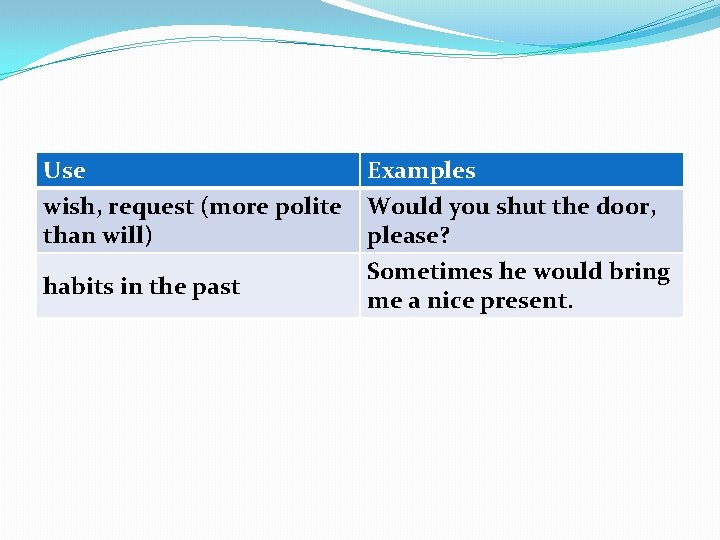
Use wish, request (more polite than will) Examples Would you shut the door, please? habits in the past Sometimes he would bring me a nice present.
- Slides: 79