
Modal Testing as an Aid in Assessing Penetration
- Slides: 28
Modal Testing as an Aid in Assessing Penetration Mechanics Patrick L. Walter Endevco, San Juan Capistrano, CA TCU, Fort Worth, TX E
Goals n Describe a gun-launched earth penetrator test l provide test details l review and analyze test results l draw conclusions concerning analytical/experimental process n Support program theme l measurement system design l transducers, system checks, model verification, modal analysis, data filtering, data sampling, etc. E
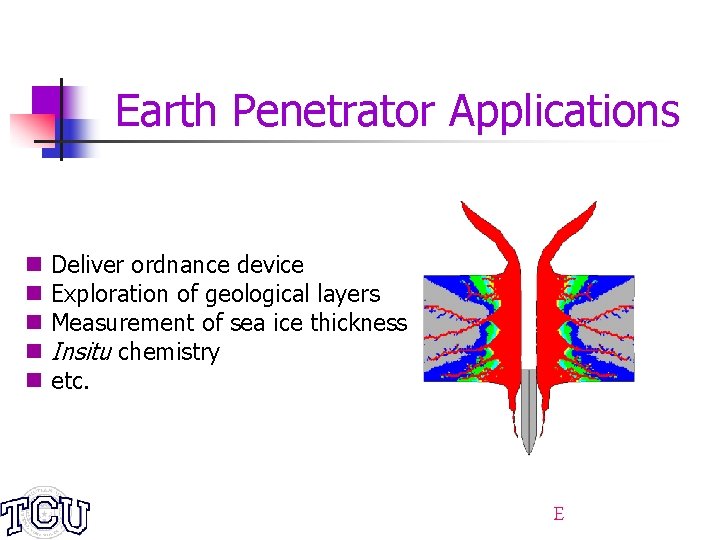
Earth Penetrator Applications n n n Deliver ordnance device Exploration of geological layers Measurement of sea ice thickness Insitu chemistry etc. E
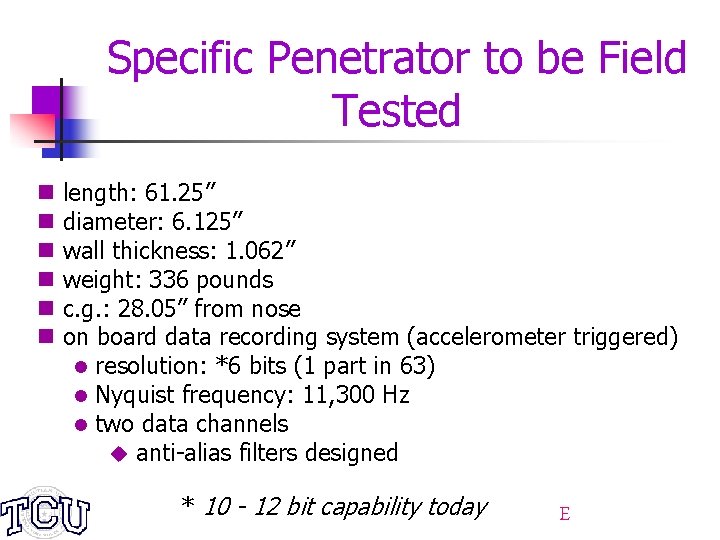
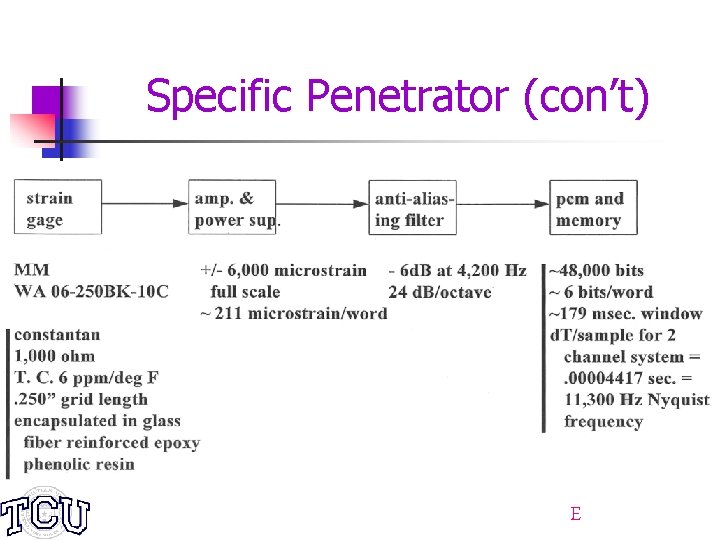
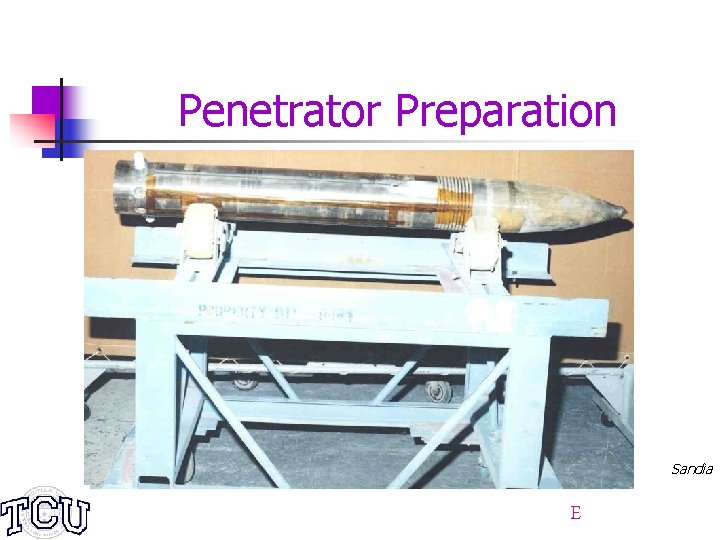
Specific Penetrator to be Field Tested n n n length: 61. 25” diameter: 6. 125” wall thickness: 1. 062” weight: 336 pounds c. g. : 28. 05” from nose on board data recording system (accelerometer triggered) l resolution: *6 bits (1 part in 63) l Nyquist frequency: 11, 300 Hz l two data channels u anti-alias filters designed * 10 - 12 bit capability today E
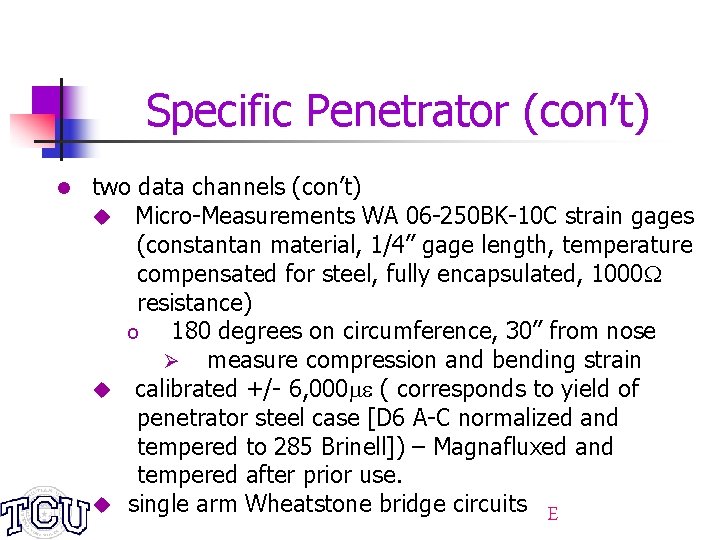
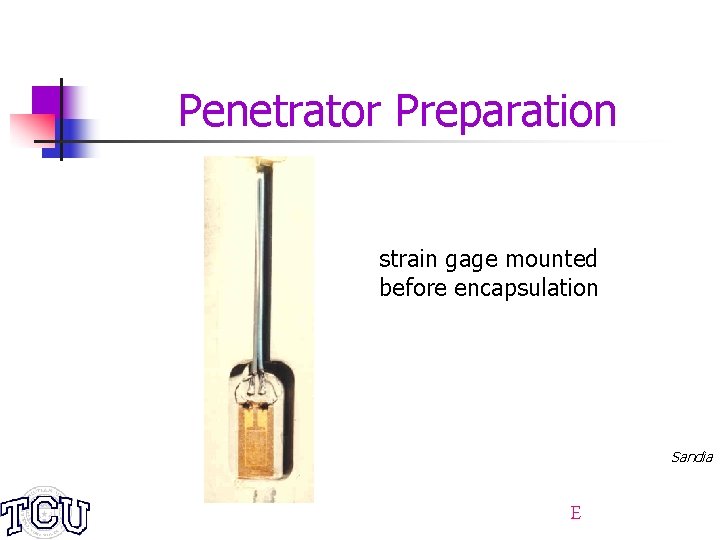
Specific Penetrator (con’t) l two data channels (con’t) u Micro-Measurements WA 06 -250 BK-10 C strain gages (constantan material, 1/4” gage length, temperature compensated for steel, fully encapsulated, 1000 resistance) o 180 degrees on circumference, 30” from nose Ø measure compression and bending strain u calibrated +/- 6, 000 ( corresponds to yield of penetrator steel case [D 6 A-C normalized and tempered to 285 Brinell]) – Magnafluxed and tempered after prior use. u single arm Wheatstone bridge circuits E
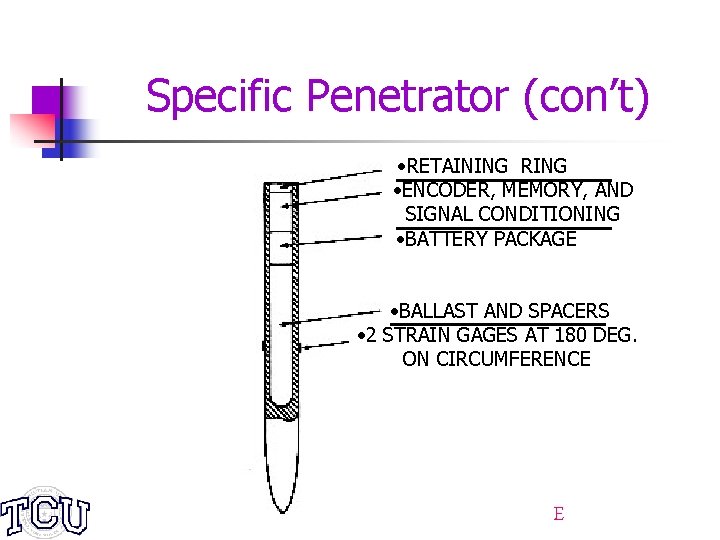
Specific Penetrator (con’t) • RETAINING RING • ENCODER, MEMORY, AND SIGNAL CONDITIONING • BATTERY PACKAGE • BALLAST AND SPACERS • 2 STRAIN GAGES AT 180 DEG. ON CIRCUMFERENCE E
Specific Penetrator (con’t) E
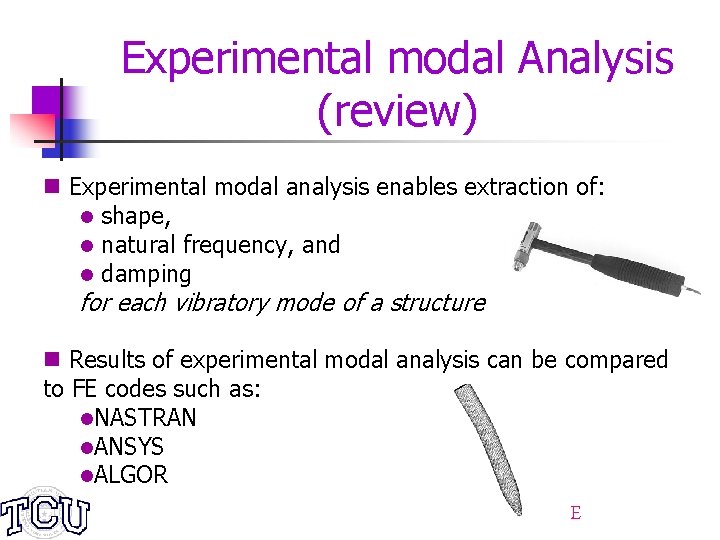
Experimental modal Analysis (review) n Experimental modal analysis enables extraction of: l shape, l natural frequency, and l damping for each vibratory mode of a structure n Results of experimental modal analysis can be compared to FE codes such as: l. NASTRAN l. ANSYS l. ALGOR E
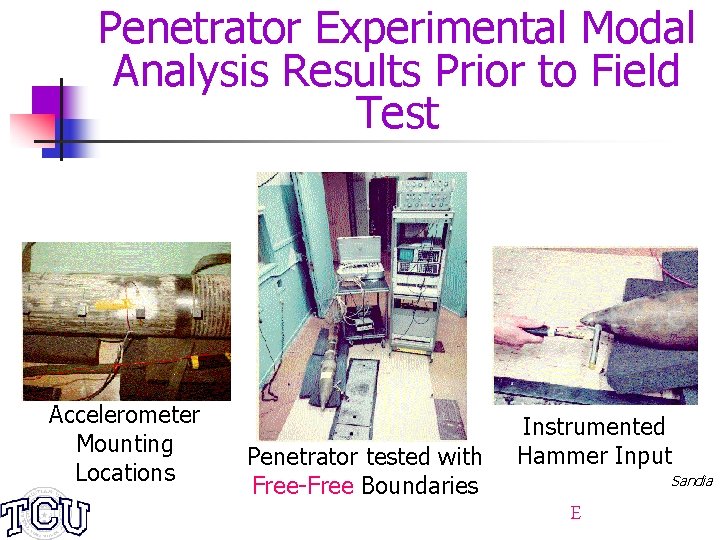
Penetrator Experimental Modal Analysis Results Prior to Field Test Accelerometer Mounting Locations Penetrator tested with Free-Free Boundaries Instrumented Hammer Input Sandia E
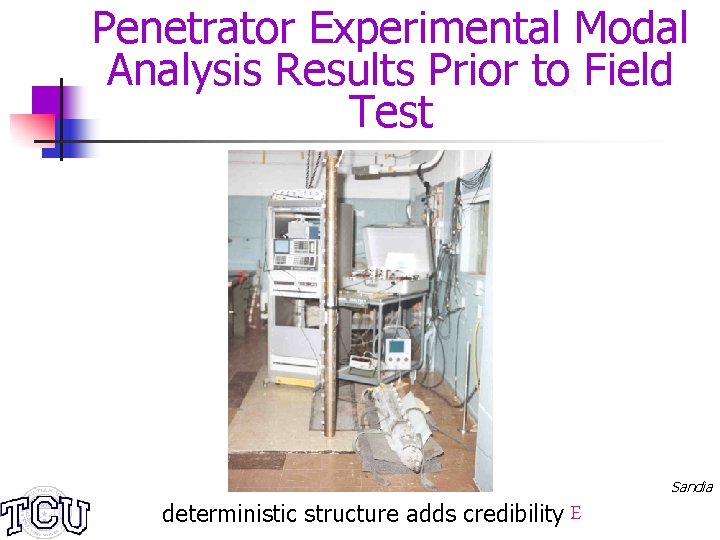
Penetrator Experimental Modal Analysis Results Prior to Field Test Sandia deterministic structure adds credibility E
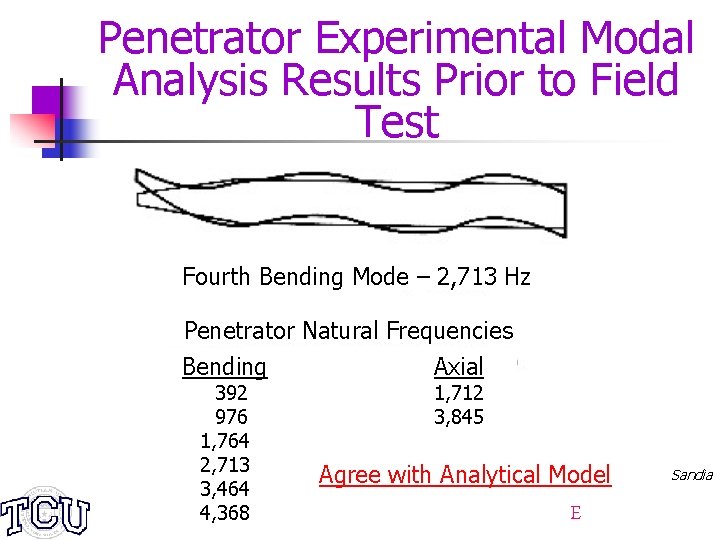
Penetrator Experimental Modal Analysis Results Prior to Field Test Fourth Bending Mode – 2, 713 Hz Penetrator Natural Frequencies Bending Axial 392 976 1, 764 2, 713 3, 464 4, 368 1, 712 3, 845 Agree with Analytical Model E Sandia
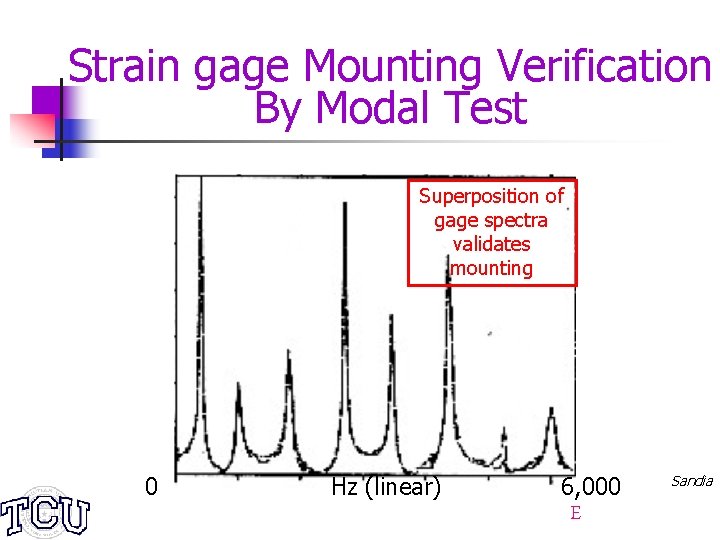
Strain gage Mounting Verification By Modal Test Superposition of gage spectra validates mounting 0 Hz (linear) 6, 000 E Sandia
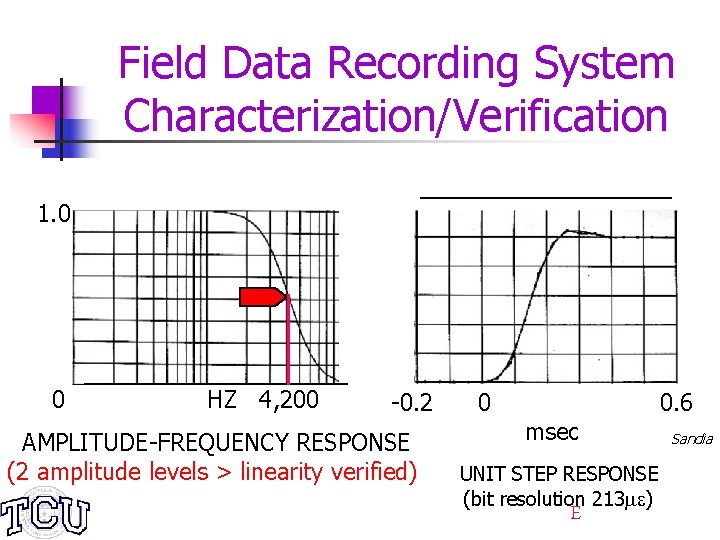
Field Data Recording System Characterization/Verification 1. 0 0 HZ 4, 200 -0. 2 AMPLITUDE-FREQUENCY RESPONSE (2 amplitude levels > linearity verified) 0 msec UNIT STEP RESPONSE (bit resolution 213 ) E 0. 6 Sandia
Penetrator Preparation strain gage mounted before encapsulation Sandia E
Penetrator Preparation Sandia E
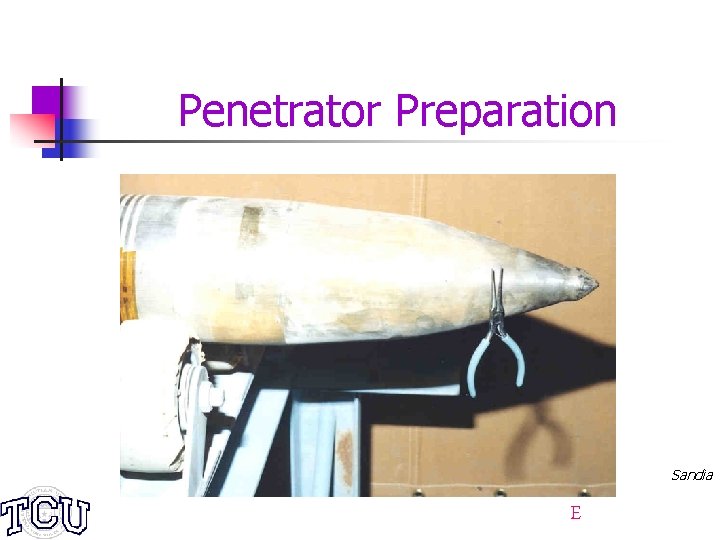
Penetrator Preparation Sandia E
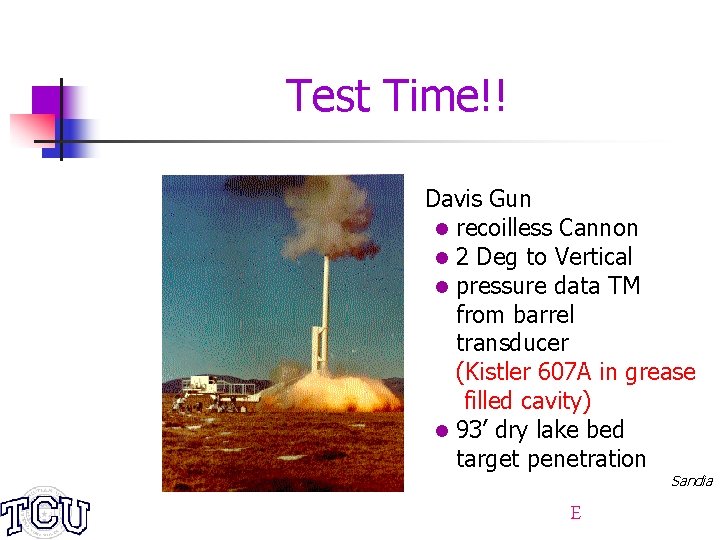
Test Time!! Davis Gun l recoilless Cannon l 2 Deg to Vertical l pressure data TM from barrel transducer (Kistler 607 A in grease filled cavity) l 93’ dry lake bed target penetration Sandia E
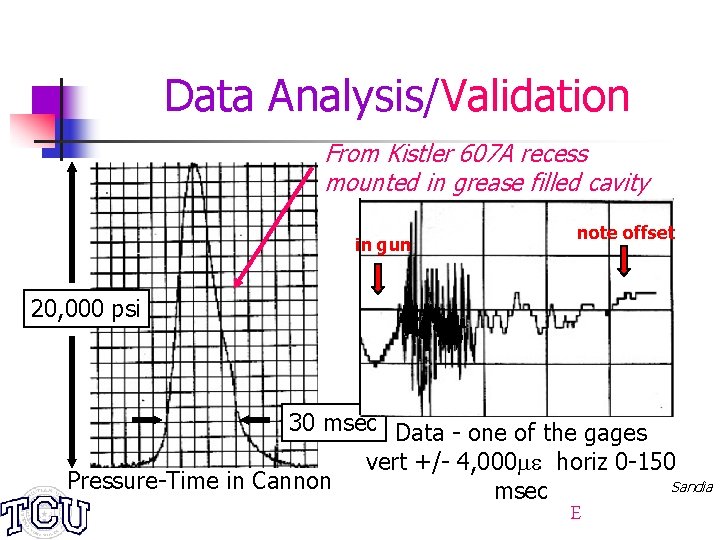
Data Analysis/Validation From Kistler 607 A recess mounted in grease filled cavity in gun note offset 20, 000 psi 30 msec Data - one of the gages vert +/- 4, 000 horiz 0 -150 Pressure-Time in Cannon Sandia msec E
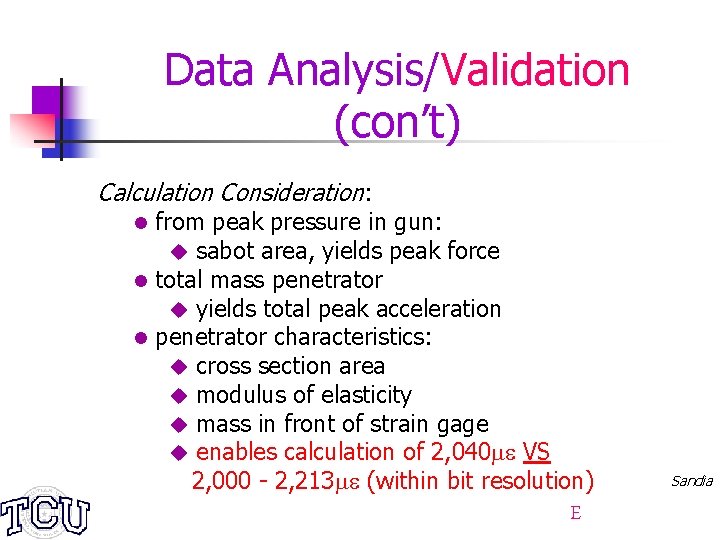
Data Analysis/Validation (con’t) Calculation Consideration: from peak pressure in gun: u sabot area, yields peak force l total mass penetrator u yields total peak acceleration l penetrator characteristics: u cross section area u modulus of elasticity u mass in front of strain gage u enables calculation of 2, 040 VS 2, 000 - 2, 213 (within bit resolution) l E Sandia
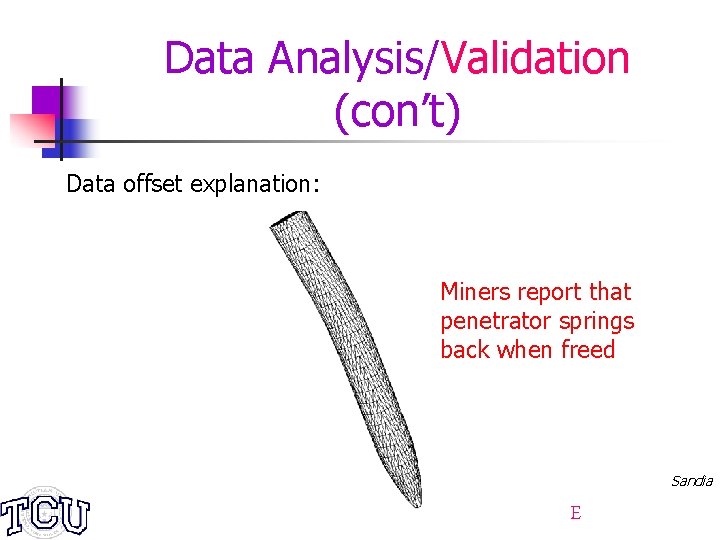
Data Analysis/Validation (con’t) Data offset explanation: Miners report that penetrator springs back when freed Sandia E
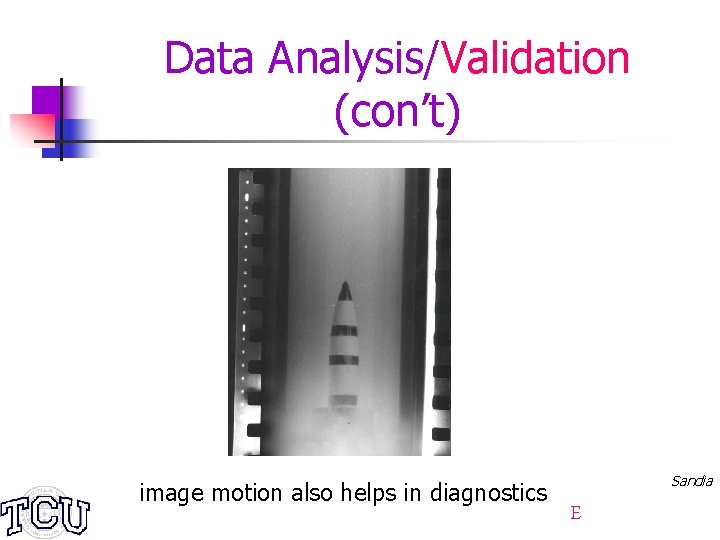
Data Analysis/Validation (con’t) image motion also helps in diagnostics Sandia E
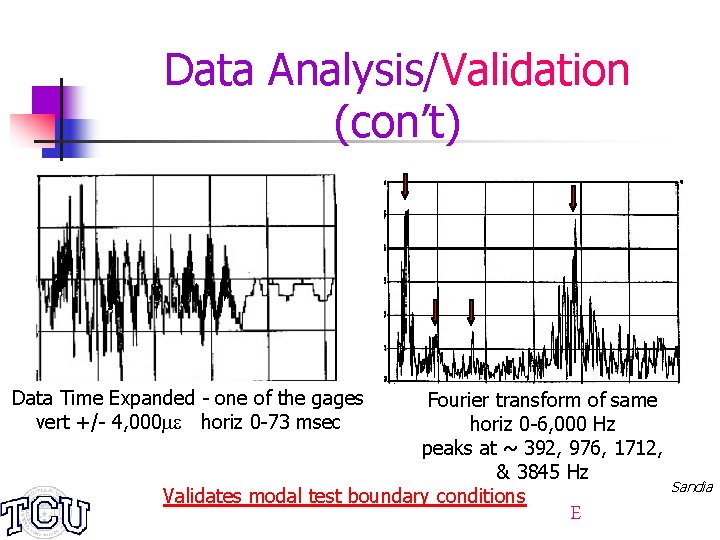
Data Analysis/Validation (con’t) Data Time Expanded - one of the gages vert +/- 4, 000 horiz 0 -73 msec Fourier transform of same horiz 0 -6, 000 Hz peaks at ~ 392, 976, 1712, & 3845 Hz Validates modal test boundary conditions E Sandia
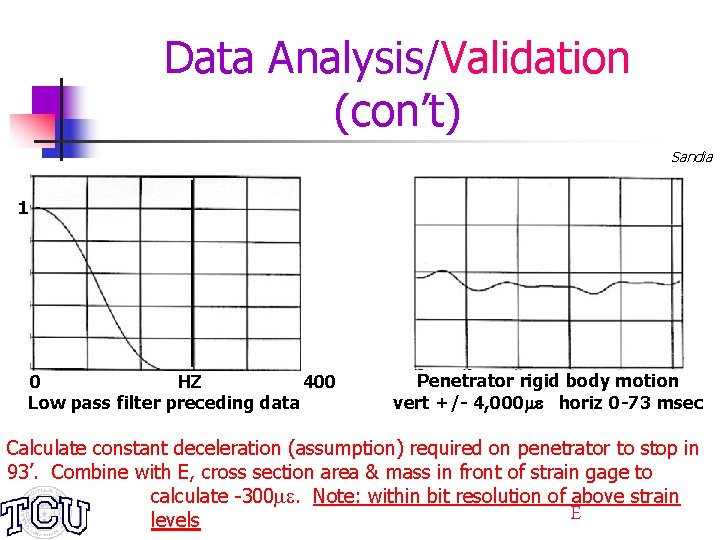
Data Analysis/Validation (con’t) Sandia 1 0 HZ 400 Low pass filter preceding data Penetrator rigid body motion vert +/- 4, 000 horiz 0 -73 msec Calculate constant deceleration (assumption) required on penetrator to stop in 93’. Combine with E, cross section area & mass in front of strain gage to calculate -300 . Note: within bit resolution of above strain E levels
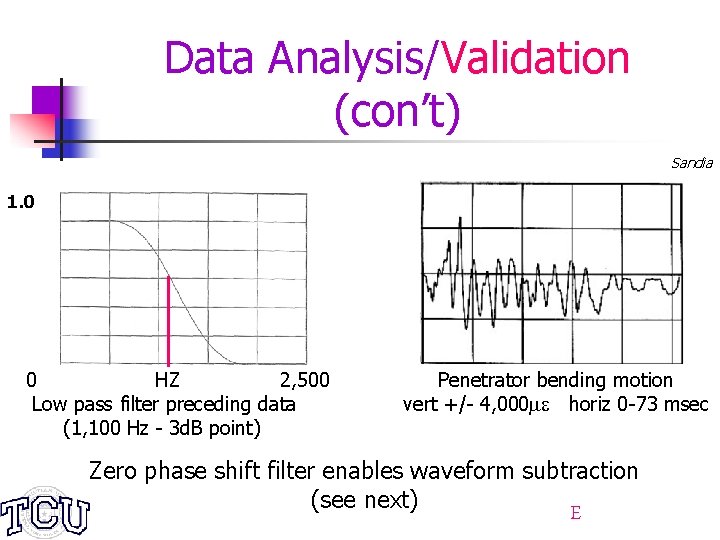
Data Analysis/Validation (con’t) Sandia 1. 0 0 HZ 2, 500 Low pass filter preceding data (1, 100 Hz - 3 d. B point) Penetrator bending motion vert +/- 4, 000 horiz 0 -73 msec Zero phase shift filter enables waveform subtraction (see next) E
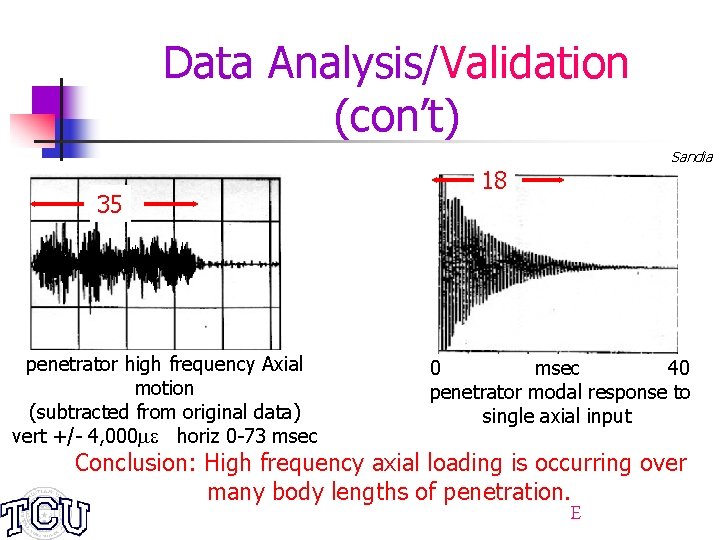
Data Analysis/Validation (con’t) Sandia 35 penetrator high frequency Axial motion (subtracted from original data) vert +/- 4, 000 horiz 0 -73 msec 18 0 msec 40 penetrator modal response to single axial input Conclusion: High frequency axial loading is occurring over many body lengths of penetration. E
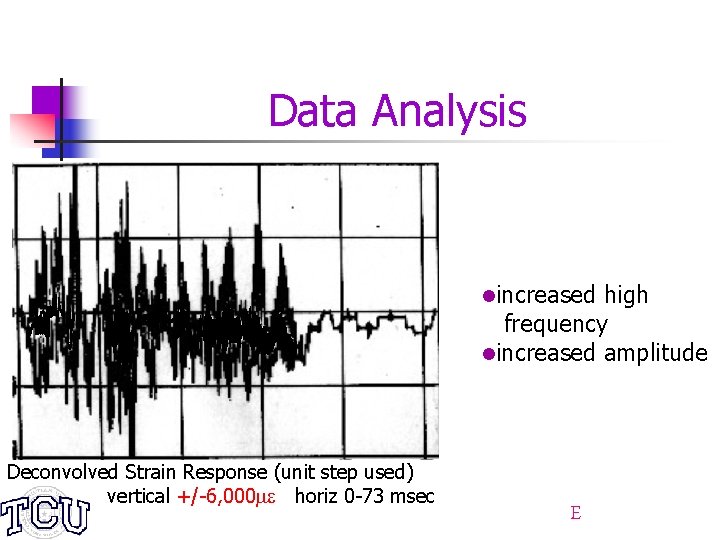
Data Analysis lincreased high frequency lincreased amplitude Deconvolved Strain Response (unit step used) vertical +/-6, 000 horiz 0 -73 msec E
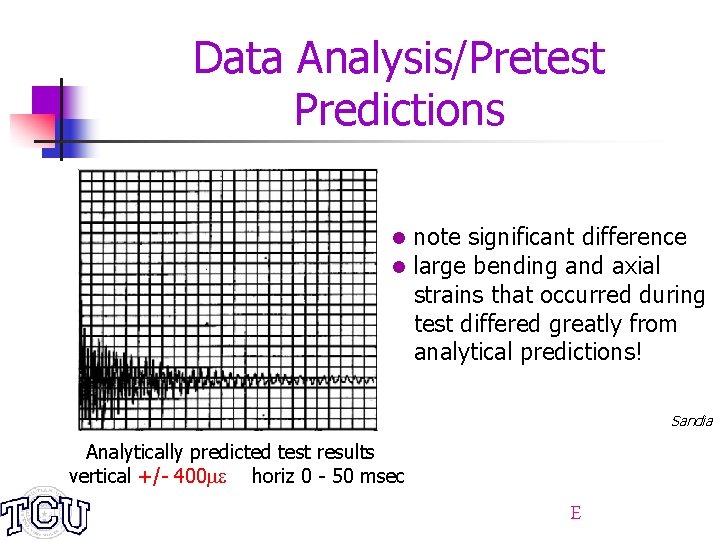
Data Analysis/Pretest Predictions l l note significant difference large bending and axial strains that occurred during test differed greatly from analytical predictions! Sandia Analytically predicted test results vertical +/- 400 horiz 0 - 50 msec E
Conclusions Sandia l l l Pretest, experimental modal analysis results agreed with analytical structural model. Strain gages were verified to be properly mounted. Data recording system was dynamically characterized and verified to be linear. Independent post-test calculations based on pressure-time in gun and depth of penetration correlated with measured strain data. Significant differences were observed to occur between measured and predicted penetrator responses in the field test. The analytical loads applied to the penetrator in the modeling process were incorrect. Improved analytical results are dependent on more representative models for the soil and soil/penetrator E interaction.