
Modal Definable Graph Transduction Kazuhiro Inaba National Institute
Modal-μ Definable Graph Transduction Kazuhiro Inaba National Institute of Informatics, Japan 4 th DIKU-IST Workshop, 2011
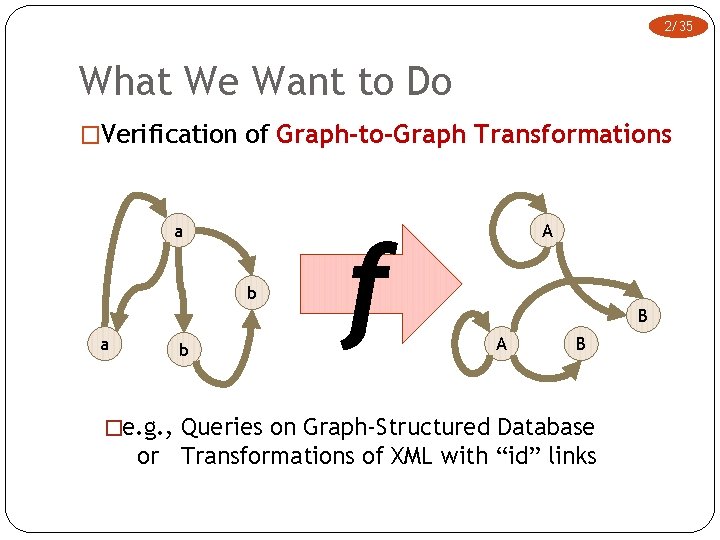
2/35 What We Want to Do �Verification of Graph-to-Graph Transformations a b f A B �e. g. , Queries on Graph-Structured Database or Transformations of XML with “id” links
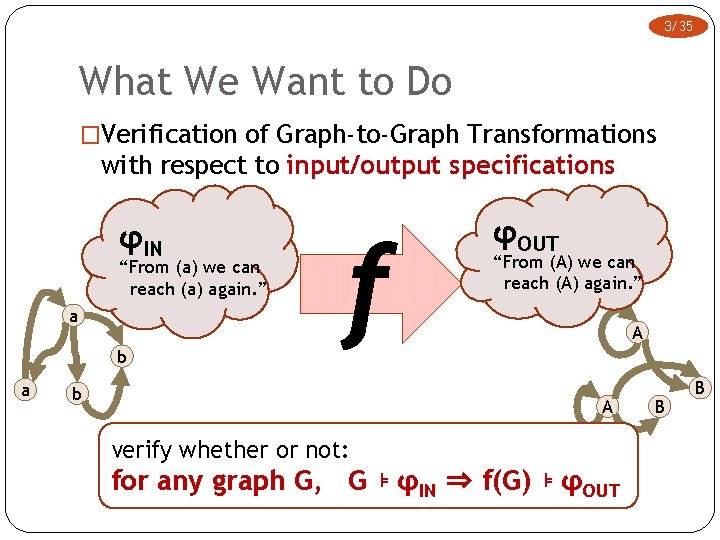
3/35 What We Want to Do �Verification of Graph-to-Graph Transformations with respect to input/output specifications φIN “From (a) we can reach (a) again. ” a b a f b φOUT “From (A) we can reach (A) again. ” A A verify whether or not: for any graph G, G ⊧ φIN ⇒ f(G) ⊧ φOUT B B
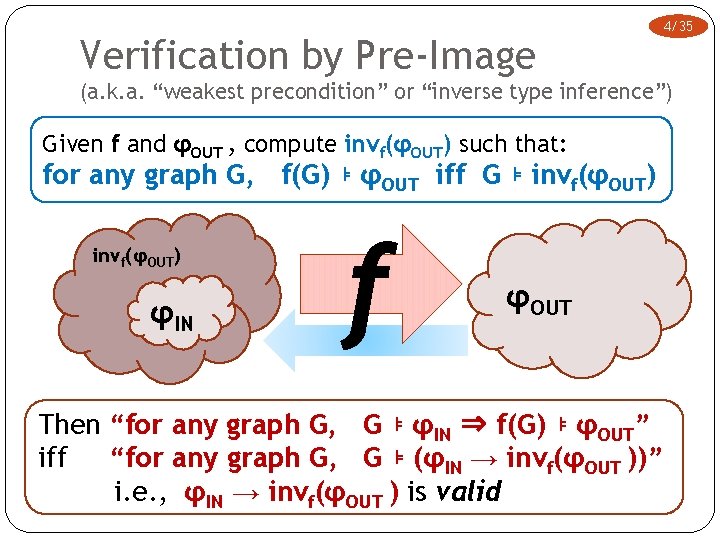
Verification by Pre-Image 4/35 (a. k. a. “weakest precondition” or “inverse type inference”) Given f and φOUT , compute invf(φOUT) such that: for any graph G, f(G) ⊧ φOUT iff G ⊧ invf(φOUT) φIN f φOUT Then “for any graph G, G ⊧ φIN ⇒ f(G) ⊧ φOUT” iff “for any graph G, G ⊧ (φIN → invf(φOUT ))” i. e. , φIN → invf(φOUT ) is valid

5/35 To Be More Concrete… �Which logic can we use for specifying φIN/OUT ? �Must be strong enough to express useful conditions. �Must be weak enough to have decidable validity. �What kind of transformation f can be verified ? �We must be able to compute the pre-image.
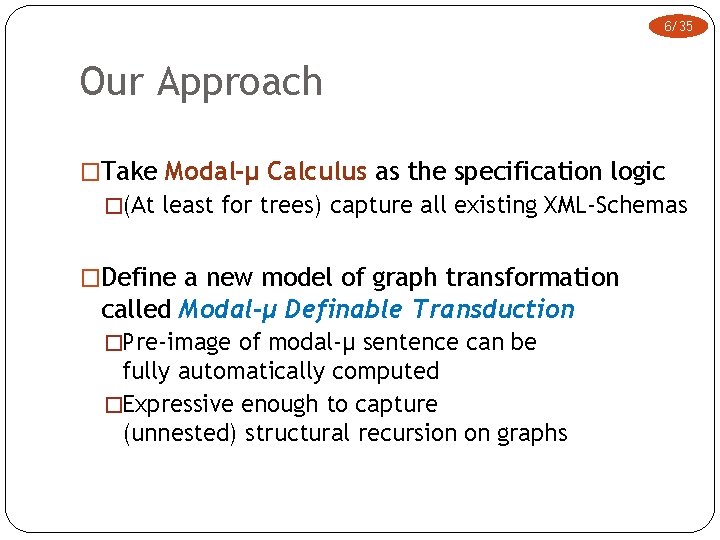
6/35 Our Approach �Take Modal-μ Calculus as the specification logic �(At least for trees) capture all existing XML-Schemas �Define a new model of graph transformation called Modal-μ Definable Transduction �Pre-image of modal-μ sentence can be fully automatically computed �Expressive enough to capture (unnested) structural recursion on graphs
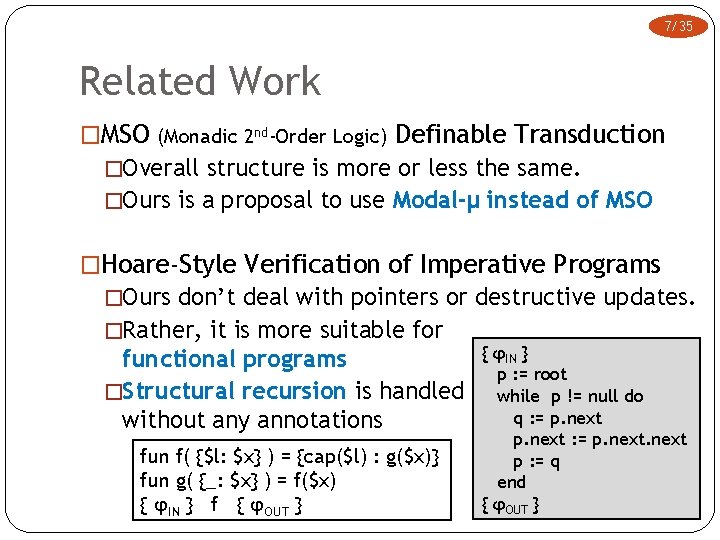
7/35 Related Work �MSO (Monadic 2 nd-Order Logic) Definable Transduction �Overall structure is more or less the same. �Ours is a proposal to use Modal-μ instead of MSO �Hoare-Style Verification of Imperative Programs �Ours don’t deal with pointers or destructive updates. �Rather, it is more suitable for functional programs �Structural recursion is handled without any annotations fun f( {$l: $x} ) = {cap($l) : g($x)} fun g( {_: $x} ) = f($x) { φIN } f { φOUT } { φIN } p : = root while p != null do q : = p. next p : = q end { φOUT }
8/35 Outline �Two Kinds of Logics on Graphs �Predicate Logics �Modal Logics �Why Modal-μ ? �Review: Predicate-Logic Based Approach �MSO-Definable Graph Transduction [Courcelle 94] �Our Work: �Modal-μ Definable Graph Transduction �Computation of Pre-Image
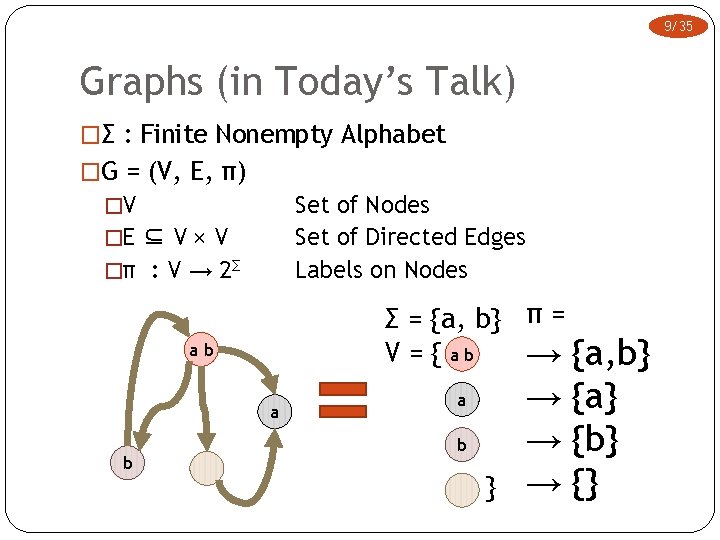
9/35 Graphs (in Today’s Talk) �Σ : Finite Nonempty Alphabet �G = (V, E, π) �V Set of Nodes Set of Directed Edges Labels on Nodes �E ⊆ V × V �π : V → 2Σ Σ = {a, b} π = V = { ab → {a, b} ab a b } → {a} → {b} → {}
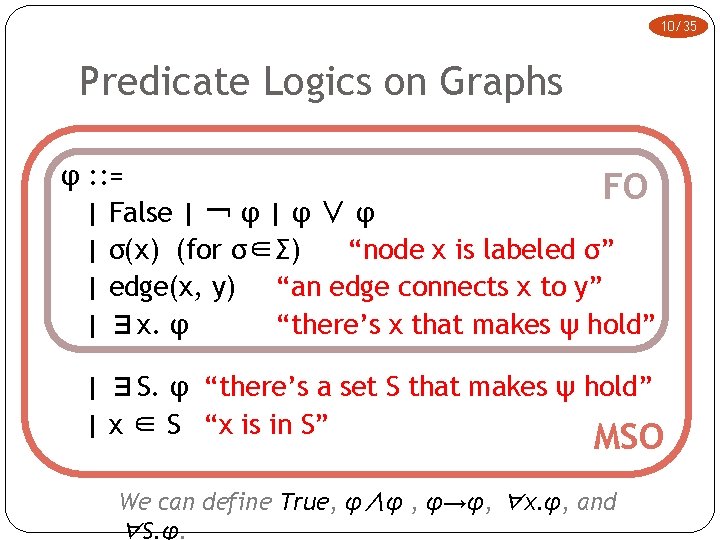
10/35 Predicate Logics on Graphs φ : : = FO | False | ¬ φ | φ ∨ φ | σ(x) (for σ∈Σ) “node x is labeled σ” | edge(x, y) “an edge connects x to y” | ∃x. φ “there’s x that makes ψ hold” | ∃S. φ “there’s a set S that makes ψ hold” | x ∈ S “x is in S” MSO We can define True, φ∧φ , φ→φ, ∀x. φ, and ∀S. φ.

11/35 Semantics �For a graph G=(V, E, π) and an environment Γ : Var→V �G, Γ ⊧ σ(x) iff σ ∈ π(Γ(x)) “node x is labeled σ” �G, Γ ⊧ edge(x, y) iff (Γ(x), Γ(y)) ∈ E “an edge connects x to y” �G, Γ ⊧ ∃x. φ iff there’s v∈V s. t. G, Γ[x: v] ⊧ φ …
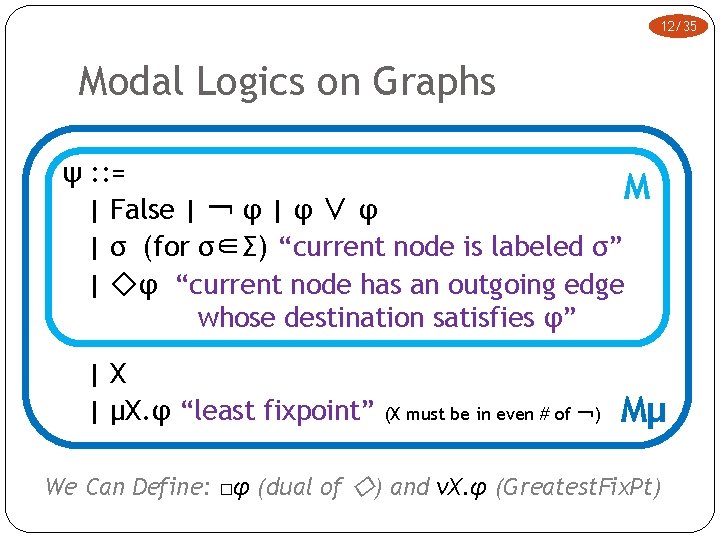
12/35 Modal Logics on Graphs ψ : : = M | False | ¬ φ | φ ∨ φ | σ (for σ∈Σ) “current node is labeled σ” | ◇φ “current node has an outgoing edge whose destination satisfies φ” |X | μX. φ “least fixpoint” (X must be in even # of ¬) Mμ We Can Define: □φ (dual of ◇) and νX. φ (Greatest. Fix. Pt)

13/35 Semantics �For a graph G=(V, E, π), an environment Γ : Var→ 2 V, and the current node v ∈ V �G, v, Γ ⊧ σ iff σ ∈ π(v) “current node is labeled σ” �G, v, Γ ⊧ ◇φ iff there’s w (v, w)∈E & G, w, Γ ⊧ φ “current node has an outgoing edge whose destination satisfies φ” �G, v, Γ ⊧ μY. φ iff v ∈ LFP(F) where F(A) = {w∈V | G, w, Γ[Y: A] ⊧ φ} …

14/35 Examples �“From the node x, we can reach a σ-node” ∀S. ( (x∈S ∧ ∀y. ∀z. (y∈S ∧ (edge(y, z)→z∈S))) → ∃y. (y ∈ S ∧ σ(y))) �“Confluence” ) ∀y. ∀z. ( edge(x, y) ∧ edge(x, z) → ∃w. (edge(y, w) ∧ edge(z, w)) �“From the current node, we can reach a σ-node” μY. (σ ∨ ◇Y) �“Confluence” (No way to express it in Modal-μ)

MSO Definable (1 -copying) Transduction [Courcelle 94] 15/35 A set of MSO formulas T = ・ σOUT(x) for each σ∈Σ ・ edge. OUT(x, y) defines a transformation f. T converting G = (V, E, π) into G’ = (V, E’, π’) where �π’( v ) = { σ | G, x: v ⊧ σOUT(x) } �E’ = { (v, w) | G, x: v, y: w ⊧ edge. OUT (x, y) }
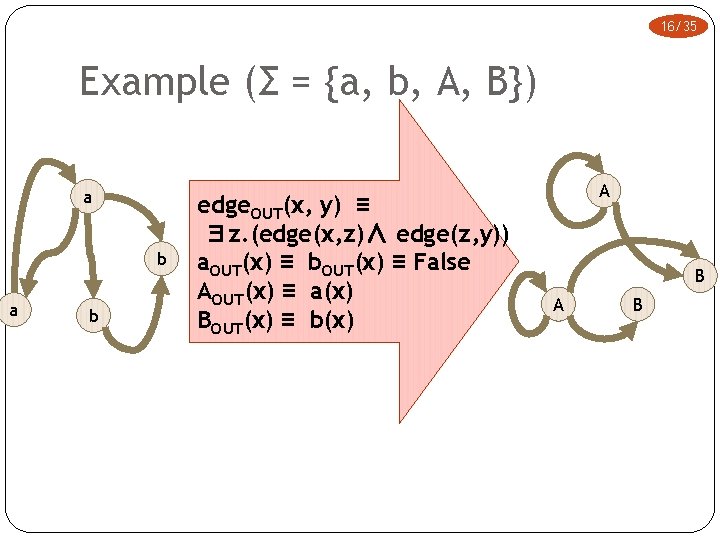
16/35 Example (Σ = {a, b, A, B}) a b edge. OUT(x, y) ≡ ∃z. (edge(x, z)∧ edge(z, y)) a. OUT(x) ≡ b. OUT(x) ≡ False AOUT(x) ≡ a(x) BOUT(x) ≡ b(x) A B
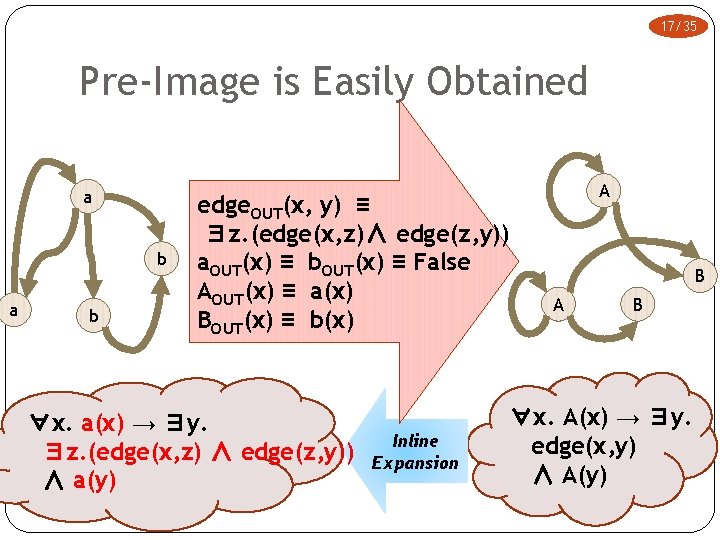
17/35 Pre-Image is Easily Obtained a b edge. OUT(x, y) ≡ ∃z. (edge(x, z)∧ edge(z, y)) a. OUT(x) ≡ b. OUT(x) ≡ False AOUT(x) ≡ a(x) BOUT(x) ≡ b(x) ∀x. a(x) → ∃y. ∃z. (edge(x, z) ∧ edge(z, y)) ∧ a(y) Inline Expansion A B ∀x. A(x) → ∃y. edge(x, y) ∧ A(y)
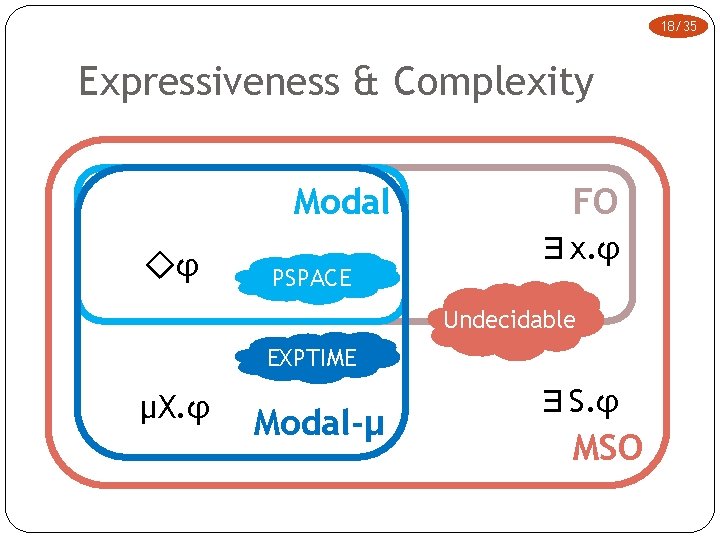
18/35 Expressiveness & Complexity Modal ◇φ PSPACE FO ∃x. φ Undecidable EXPTIME μX. φ Modal-μ ∃S. φ MSO
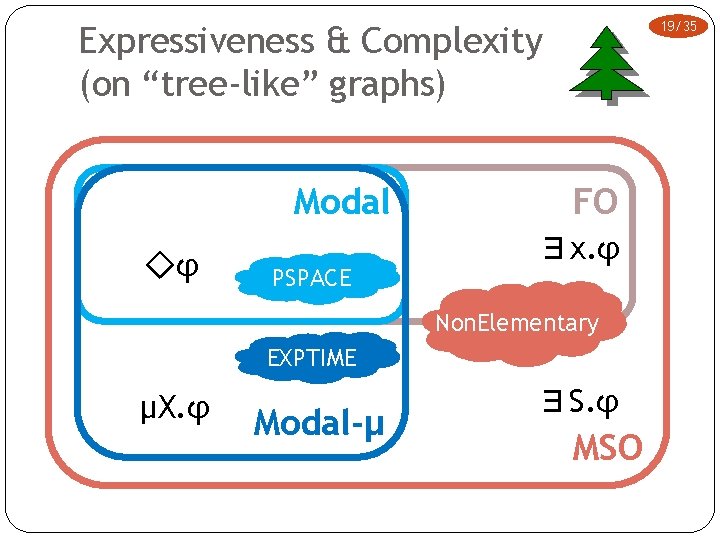
19/35 Expressiveness & Complexity (on “tree-like” graphs) Modal ◇φ PSPACE FO ∃x. φ Non. Elementary EXPTIME μX. φ Modal-μ ∃S. φ MSO
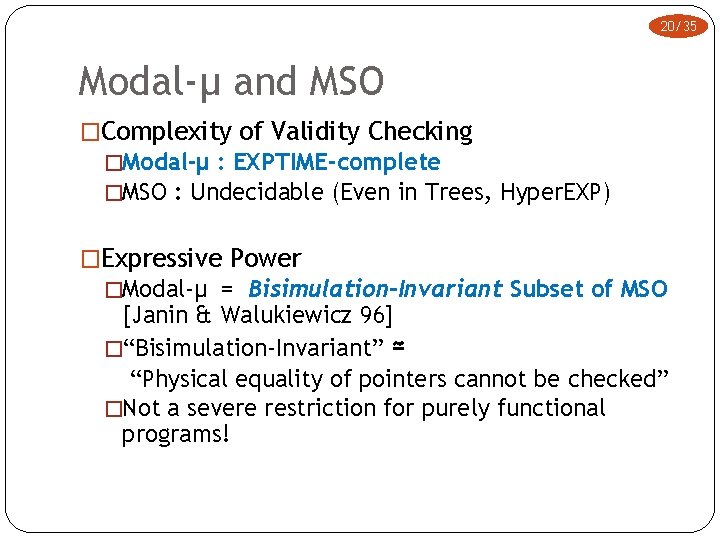
20/35 Modal-μ and MSO �Complexity of Validity Checking �Modal-μ : EXPTIME-complete �MSO : Undecidable (Even in Trees, Hyper. EXP) �Expressive Power �Modal-μ = Bisimulation-Invariant Subset of MSO [Janin & Walukiewicz 96] �“Bisimulation-Invariant” ≃ “Physical equality of pointers cannot be checked” �Not a severe restriction for purely functional programs!

21/35 Modal-μ Definable (1 -copying) Transduction A set of Modal-μ formulas T = ・ σOUT for each σ∈Σ ・ edge. OUT an existential formula Fv={X} defines a transformation f. T converting G = (V, E, π) into G’ = (V, E’, π’) where �π’( v ) = { σ | G, v ⊧ σOUT } �E’ = { (v, w) | G, v, X: {w} ⊧ edge. OUT }
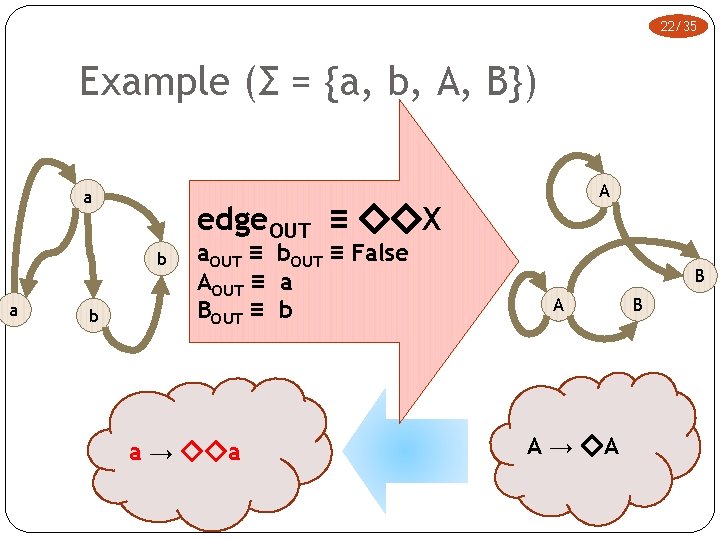
22/35 Example (Σ = {a, b, A, B}) a edge. OUT ≡ ◇◇X b a b A a. OUT ≡ b. OUT ≡ False AOUT ≡ a BOUT ≡ b a → ◇◇a B A A → ◇A B

23/35 Existential Formula �A formula e with one free variable X is existential, if for all G=(V, E, π), v∈V, P⊆V G, v, X: P ⊧ e iff ∃w∈P. G, v, X: {w} ⊧e �Examples: �“X ∨ True” �“◇X” �“□X” �“σ” is not existential (Consider P={}). is existential. is not (when v is a leaf node …). is not, but “X ∧ σ” is.

24/35 Syntactic Condition for all G=(V, E, π), v∈V, P⊆V G, v, X: P ⊧ e iff ∃w∈P. G, v, X: {w} ⊧e �Theorem: e is existential if it is in the following syntax e : : = False | X | Y | e ∨ e | ◇e | μY. e | e ∧ φ where φ is any formula without free variables (True, ¬, σ, □, and GFP must be “guarded” by _ ∧ _) OPEN QUESTION: is this a necessary condition ? (i. e. , do all existential formulas have logically-equivalent forms in this syntax? )
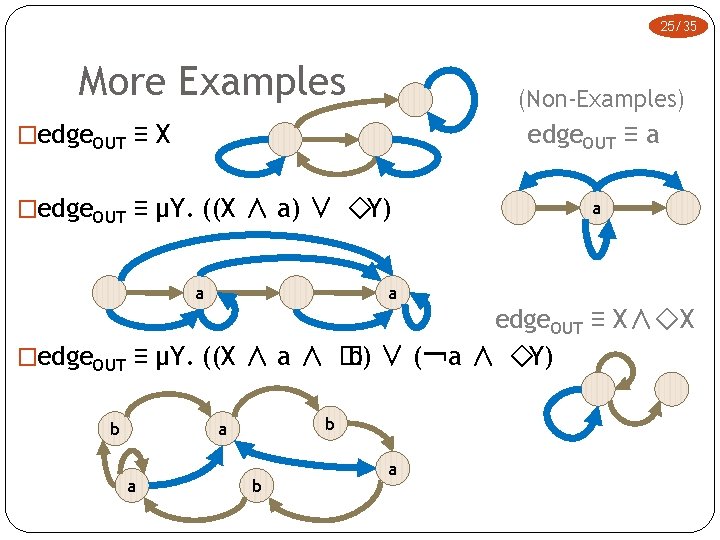
25/35 More Examples (Non-Examples) �edge. OUT ≡ X edge. OUT ≡ a �edge. OUT ≡ μY. ((X ∧ a) ∨ ◇Y) a �edge. OUT a a edge. OUT ≡ X∧◇X ≡ μY. ((X ∧ a ∧ □ b) ∨ (¬a ∧ ◇Y) b b a a b a
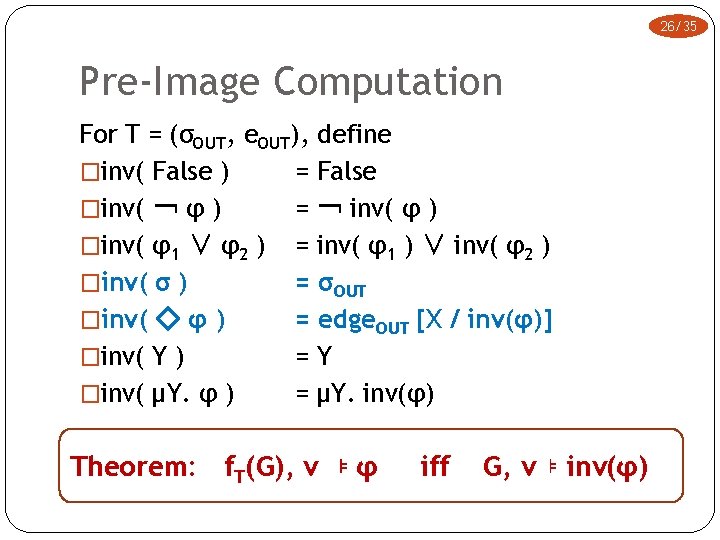
26/35 Pre-Image Computation For T = (σOUT, e. OUT), define �inv( False ) = False �inv( ¬ φ ) = ¬ inv( φ ) �inv( φ1 ∨ φ2 ) = inv( φ1 ) ∨ inv( φ2 ) �inv( σ ) = σOUT �inv( ◇ φ ) = edge. OUT [X / inv(φ)] �inv( Y ) =Y �inv( μY. φ ) = μY. inv(φ) Theorem: f. T(G), v ⊧ φ iff G, v ⊧ inv(φ)

27/35 Proof of the Theorem: f. T(G), v ⊧ φ iff G, v ⊧ inv(φ) �By Induction on φ. The essential case is: G, v ⊧ inv(◇φ) iff G, v ⊧ edge. OUT [X / inv(φ)] (definition of inv) iff ∃w (G, v, X: {w} ⊧ edge. OUT and G, w ⊧inv(φ)) (ext) iff ∃w ((v, w) in E’ and G, w ⊧inv(φ)) iff ∃w ((v, w) in E’ and f. T(G), w ⊧φ) (def of E’) (IH) iff f. T(G), v ⊧ ◇φ (definition of ◇)

n-copying Modal-μ Definable Transduction 28/35 A set of Modal-μ formulas T = ・ σk. OUT for each σ∈Σ, k∈{1. . n} ・ edgeik. OUT for each i, k∈{1. . n} : existential defines a transformation f. T converting G = (V, E, π) into G’ = (V*{1. . n}, E’, π’) where �π’( <v, k> ) = { σ | G, v ⊧ σk. OUT } �E’ = { (<v, i>, <w, k>) | G, v, X: {w} ⊧ edgeik. OUT }
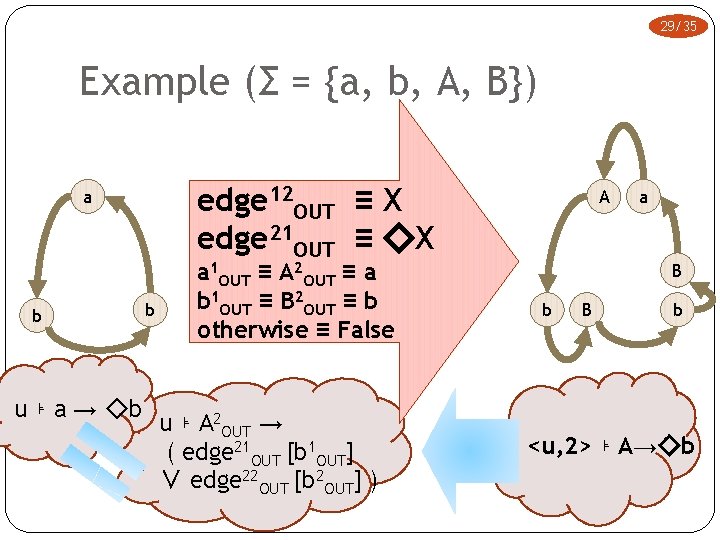
29/35 Example (Σ = {a, b, A, B}) edge 12 OUT ≡ X edge 21 OUT ≡ ◇X a b u ⊧ a → ◇b b a 1 OUT ≡ A 2 OUT ≡ a b 1 OUT ≡ B 2 OUT ≡ b otherwise ≡ False u ⊧ A 2 OUT → ( edge 21 OUT [b 1 OUT] ∨ edge 22 OUT [b 2 OUT] ) A a B b <u, 2> ⊧ A→◇b
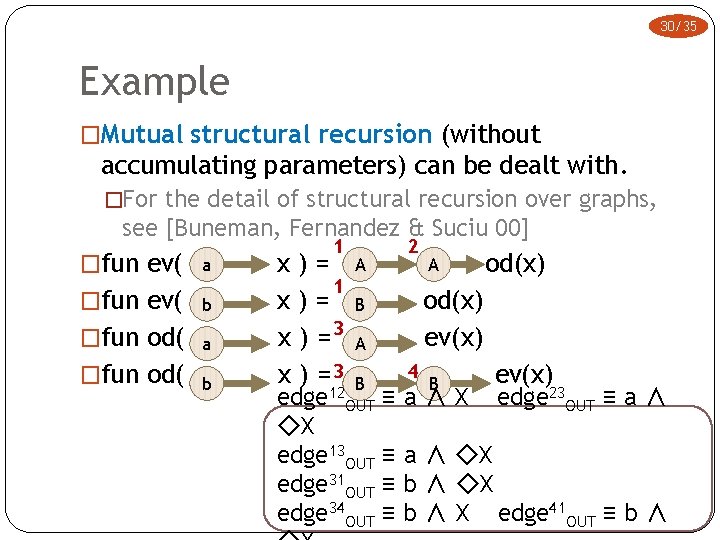
30/35 Example �Mutual structural recursion (without accumulating parameters) can be dealt with. �For the detail of structural recursion over graphs, see [Buneman, Fernandez & Suciu 00] �fun ev( a �fun ev( b �fun od( a �fun od( b 1 x)= x ) =3 A 2 A OUT od(x) ev(x) B B 12 edge A 4 B ≡a∧X ev(x) edge 23 OUT ≡ a ∧ ◇X edge 13 OUT ≡ a ∧ ◇X edge 31 OUT ≡ b ∧ ◇X edge 34 OUT ≡ b ∧ X edge 41 OUT ≡ b ∧


32/35 Example edge 11 OUT ≡ edge 12 OUT ≡ edge 21 OUT ≡ edge 22 OUT ≡ ◇X a 1 OUT ≡ a 2 OUT ≡ a OPEN QUESTION: can �f(G), <v, 1> �G, v ⊧ inv(μ) be shorter than (n-1)!+1 ? ⊧ μY. (a ∧ ◇Y) μY 1. inv 1( a ∧ ◇Y ) μY 1. a ∧ (◇inv 1(Y) ∨ ◇inv 2(Y)) μY 1. a ∧ (◇Y 1 ∨ ◇μY 2. inv 2(a∧◇Y)) μY 1. a ∧ (◇Y 1 ∨ ◇μY 2. a∧(◇inv 1(Y)∨◇inv 2(Y)) �G, v ⊧ μY 1. a ∧ (◇Y 1 ∨ ◇μY 2. a∧(◇Y 1∨◇Y 2))
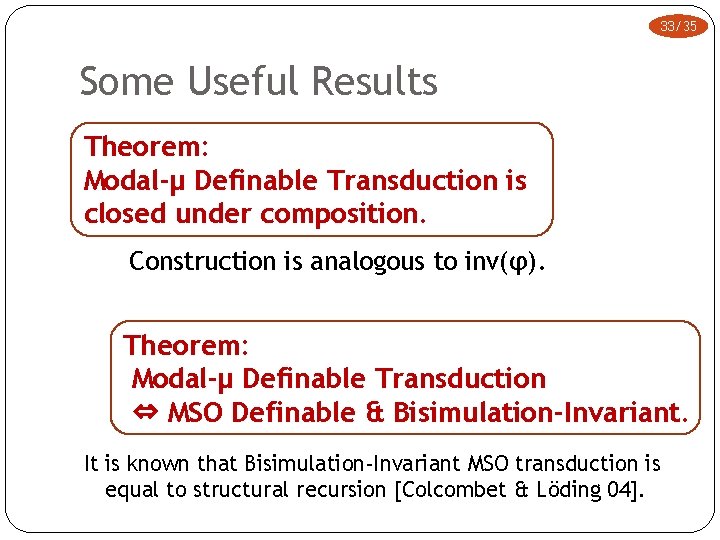
33/35 Some Useful Results Theorem: Modal-μ Definable Transduction is closed under composition. Construction is analogous to inv(φ). Theorem: Modal-μ Definable Transduction ⇔ MSO Definable & Bisimulation-Invariant. It is known that Bisimulation-Invariant MSO transduction is equal to structural recursion [Colcombet & Löding 04].
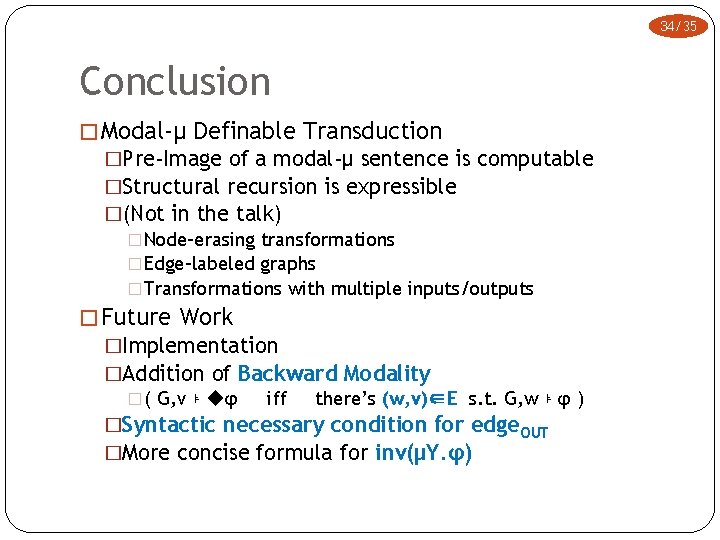
34/35 Conclusion � Modal-μ Definable Transduction �Pre-Image of a modal-μ sentence is computable �Structural recursion is expressible �(Not in the talk) � Node-erasing transformations � Edge-labeled graphs � Transformations with multiple inputs/outputs � Future Work �Implementation �Addition of Backward Modality � ( G, v ⊧ ◆φ iff there’s (w, v)∈E s. t. G, w ⊧ φ ) �Syntactic necessary condition for edge. OUT �More concise formula for inv(μY. φ)
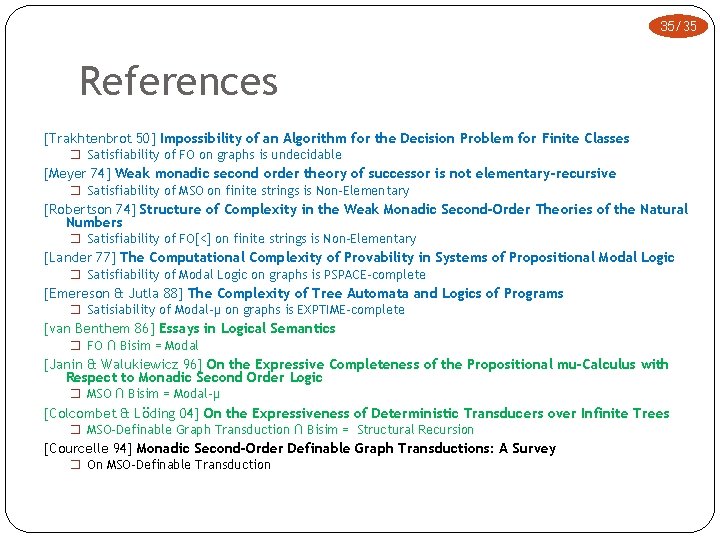
35/35 References [Trakhtenbrot 50] Impossibility of an Algorithm for the Decision Problem for Finite Classes � Satisfiability of FO on graphs is undecidable [Meyer 74] Weak monadic second order theory of successor is not elementary-recursive � Satisfiability of MSO on finite strings is Non-Elementary [Robertson 74] Structure of Complexity in the Weak Monadic Second-Order Theories of the Natural Numbers � Satisfiability of FO[<] on finite strings is Non-Elementary [Lander 77] The Computational Complexity of Provability in Systems of Propositional Modal Logic � Satisfiability of Modal Logic on graphs is PSPACE-complete [Emereson & Jutla 88] The Complexity of Tree Automata and Logics of Programs � Satisiability of Modal-μ on graphs is EXPTIME-complete [van Benthem 86] Essays in Logical Semantics � FO ∩ Bisim = Modal [Janin & Walukiewicz 96] On the Expressive Completeness of the Propositional mu-Calculus with Respect to Monadic Second Order Logic � MSO ∩ Bisim = Modal-μ [Colcombet & Löding 04] On the Expressiveness of Deterministic Transducers over Infinite Trees � MSO-Definable Graph Transduction ∩ Bisim = Structural Recursion [Courcelle 94] Monadic Second-Order Definable Graph Transductions: A Survey � On MSO-Definable Transduction
- Slides: 35