
MOD Journey Digital Twin Context for requirement EST
- Slides: 13
MOD Journey - Digital Twin
Context for requirement - EST (Engineering Support Transformation) The MOD has launched an initiative investigating how Engineering Support can be transformed to support the MOD’s future military force aspirations for “Joint Force 2025” (JF 25). This work is being conducted as part of the Defence Support Network Transformation (DSN(T)) programme and complements parallel work on logistic support and operating models. The Defence Authority for Technical and Quality Assurance (DATQA) has produced its Vision for Engineering Support Transformation (EST) and tasked Jacobs to conduct a discovery and report generation phase, which includes reaching out to; 1. Primes. . . . . 2. Innovators. . . . 3. Technologists. . . . 4. and those forging ahead in other domains. . . . to consider those practices and future technologies which can enable greater efficiency and effect.
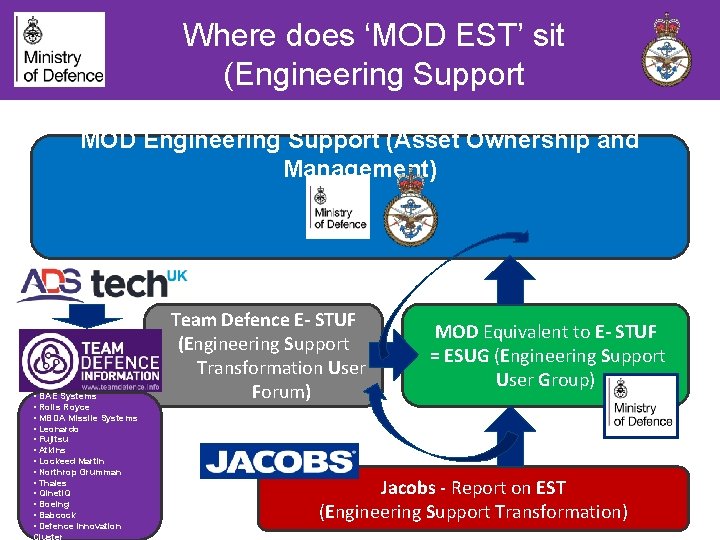
Where does ‘MOD EST’ sit (Engineering Support Transformation) MOD Engineering Support (Asset Ownership and Management) • BAE Systems • Rolls Royce • MBDA Missile Systems • Leonardo • Fujitsu • Atkins • Lockeed Martin • Northrop Grumman • Thales • Qineti. Q • Boeing • Babcock • Defence Innovation Cluster Team Defence E- STUF (Engineering Support Transformation User Forum) MOD Equivalent to E- STUF = ESUG (Engineering Support User Group) Jacobs - Report on EST (Engineering Support Transformation)
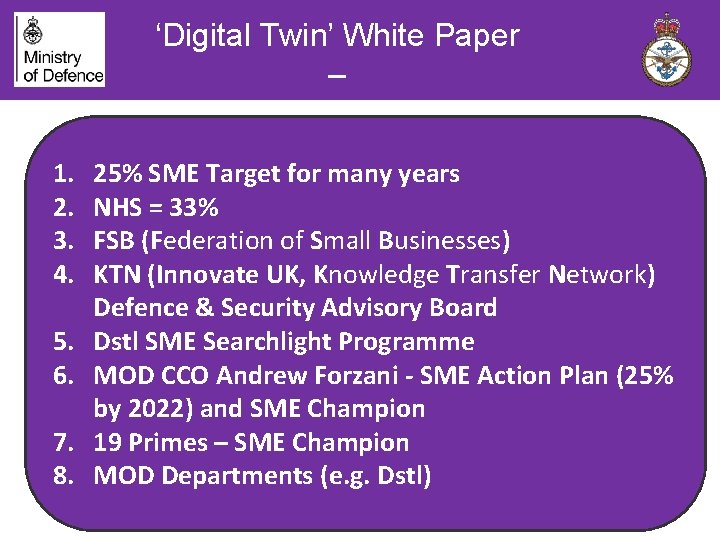
‘Digital Twin’ White Paper – SME Engagement 1. 2. 3. 4. 5. 6. 7. 8. 25% SME Target for many years NHS = 33% FSB (Federation of Small Businesses) KTN (Innovate UK, Knowledge Transfer Network) Defence & Security Advisory Board Dstl SME Searchlight Programme MOD CCO Andrew Forzani - SME Action Plan (25% by 2022) and SME Champion 19 Primes – SME Champion MOD Departments (e. g. Dstl)
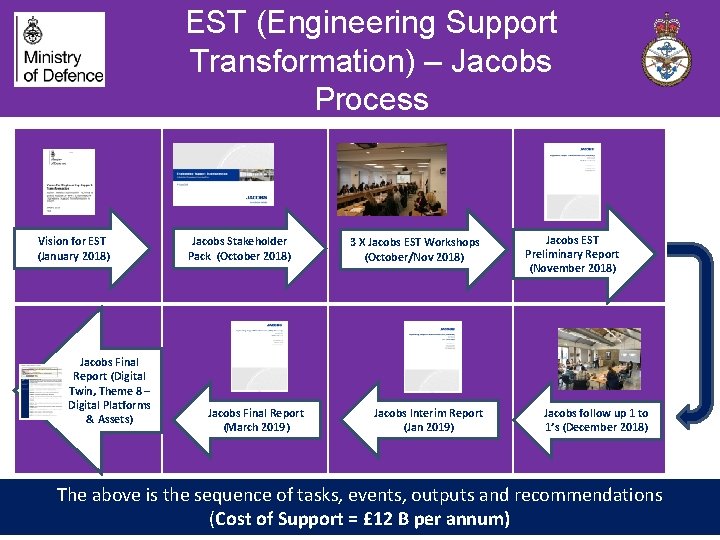
EST (Engineering Support Transformation) – Jacobs Process Vision for EST (January 2018) Jacobs Final Report (Digital Twin, Theme 8 – Digital Platforms & Assets) Jacobs Stakeholder Pack (October 2018) Jacobs Final Report (March 2019) 3 X Jacobs EST Workshops (October/Nov 2018) Jacobs Interim Report (Jan 2019) Jacobs EST Preliminary Report (November 2018) Jacobs follow up 1 to 1’s (December 2018) The above is the sequence of tasks, events, outputs and recommendations (Cost of Support = £ 12 B per annum)
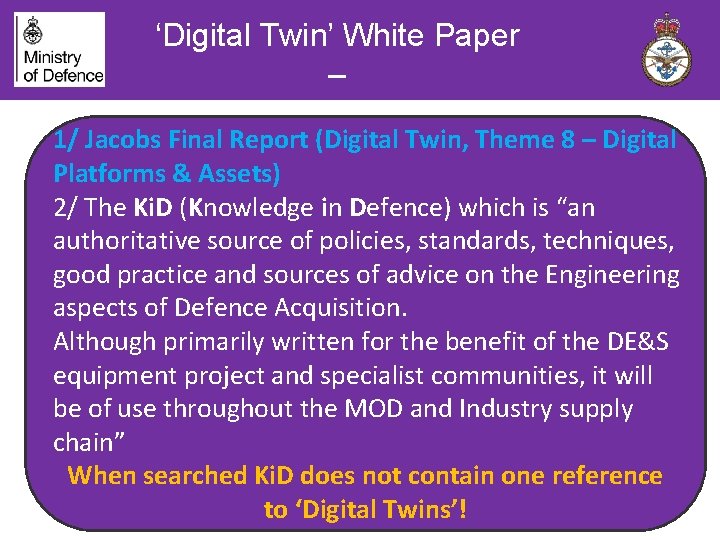
‘Digital Twin’ White Paper – Why it was needed 1/ Jacobs Final Report (Digital Twin, Theme 8 – Digital Platforms & Assets) 2/ The Ki. D (Knowledge in Defence) which is “an authoritative source of policies, standards, techniques, good practice and sources of advice on the Engineering aspects of Defence Acquisition. Although primarily written for the benefit of the DE&S equipment project and specialist communities, it will be of use throughout the MOD and Industry supply chain” When searched Ki. D does not contain one reference to ‘Digital Twins’!
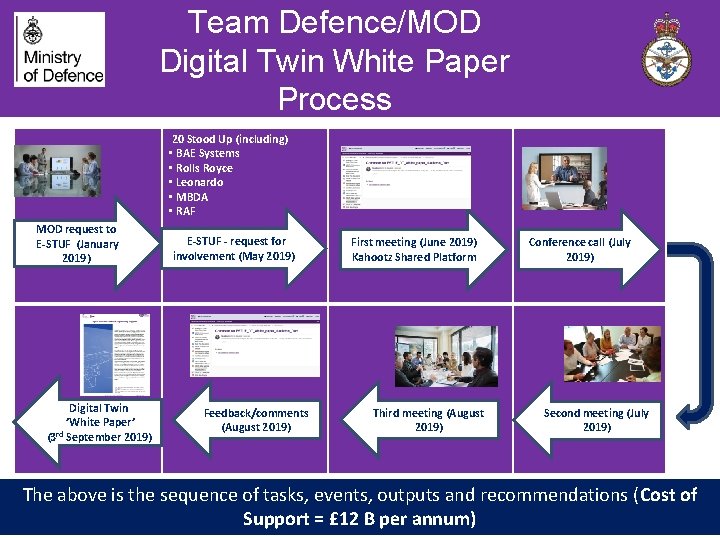
Team Defence/MOD Digital Twin White Paper Process 20 Stood Up (including) • BAE Systems • Rolls Royce • Leonardo • MBDA • RAF MOD request to E-STUF (January 2019) Digital Twin ’White Paper’ rd (3 September 2019) E-STUF - request for involvement (May 2019) Feedback/comments (August 2019) First meeting (June 2019) Kahootz Shared Platform Third meeting (August 2019) Conference call (July 2019) Second meeting (July 2019) The above is the sequence of tasks, events, outputs and recommendations (Cost of Support = £ 12 B per annum)
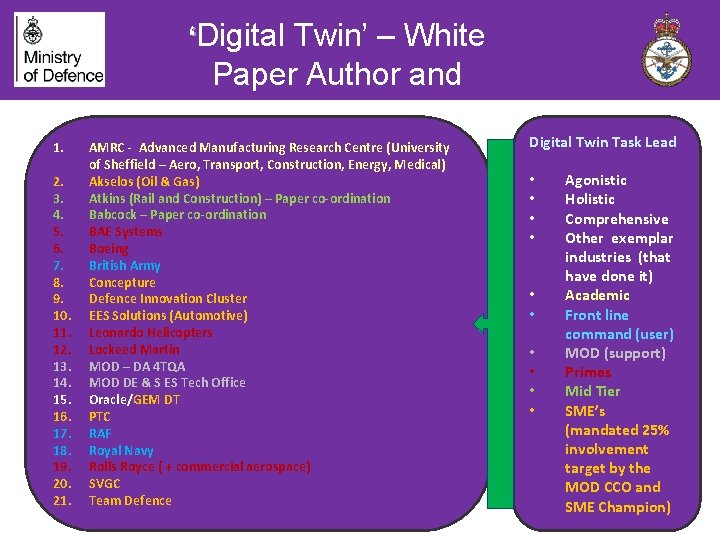
‘Digital Twin’ – White Paper Author and Contribution Team 1. 2. 3. 4. 5. 6. 7. 8. 9. 10. 11. 12. 13. 14. 15. 16. 17. 18. 19. 20. 21. AMRC - Advanced Manufacturing Research Centre (University of Sheffield – Aero, Transport, Construction, Energy, Medical) Akselos (Oil & Gas) Atkins (Rail and Construction) – Paper co-ordination Babcock – Paper co-ordination BAE Systems Boeing British Army Concepture Defence Innovation Cluster EES Solutions (Automotive) Leonardo Helicopters Lockeed Martin MOD – DA 4 TQA MOD DE & S ES Tech Office Oracle/GEM DT PTC RAF Royal Navy Rolls Royce ( + commercial aerospace) SVGC Team Defence Digital Twin Task Lead • • • Agonistic Holistic Comprehensive Other exemplar industries (that have done it) Academic Front line command (user) MOD (support) Primes Mid Tier SME’s (mandated 25% involvement target by the MOD CCO and SME Champion)
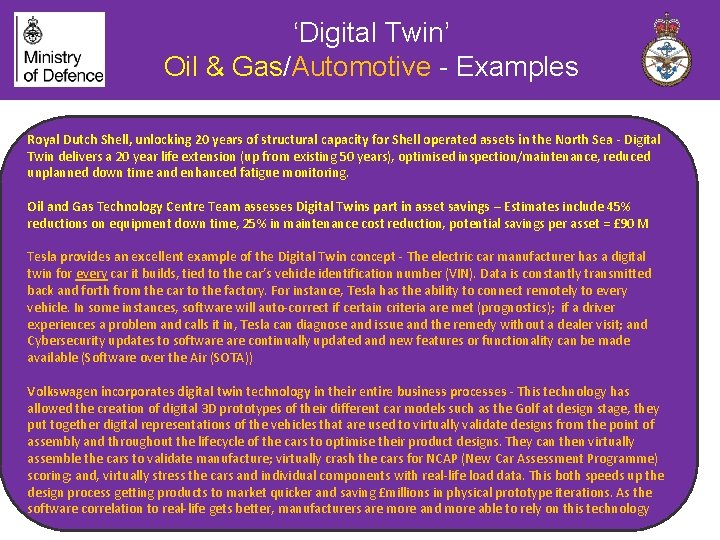
‘Digital Twin’ Oil & Gas/Automotive - Examples Royal Dutch Shell, unlocking 20 years of structural capacity for Shell operated assets in the North Sea - Digital Twin delivers a 20 year life extension (up from existing 50 years), optimised inspection/maintenance, reduced unplanned down time and enhanced fatigue monitoring. Oil and Gas Technology Centre Team assesses Digital Twins part in asset savings – Estimates include 45% reductions on equipment down time, 25% in maintenance cost reduction, potential savings per asset = £ 90 M Tesla provides an excellent example of the Digital Twin concept - The electric car manufacturer has a digital twin for every car it builds, tied to the car’s vehicle identification number (VIN). Data is constantly transmitted back and forth from the car to the factory. For instance, Tesla has the ability to connect remotely to every vehicle. In some instances, software will auto-correct if certain criteria are met (prognostics); if a driver experiences a problem and calls it in, Tesla can diagnose and issue and the remedy without a dealer visit; and Cybersecurity updates to software continually updated and new features or functionality can be made available (Software over the Air (SOTA)) Volkswagen incorporates digital twin technology in their entire business processes - This technology has allowed the creation of digital 3 D prototypes of their different car models such as the Golf at design stage, they put together digital representations of the vehicles that are used to virtually validate designs from the point of assembly and throughout the lifecycle of the cars to optimise their product designs. They can then virtually assemble the cars to validate manufacture; virtually crash the cars for NCAP (New Car Assessment Programme) scoring; and, virtually stress the cars and individual components with real-life load data. This both speeds up the design process getting products to market quicker and saving £millions in physical prototype iterations. As the software correlation to real-life gets better, manufacturers are more and more able to rely on this technology
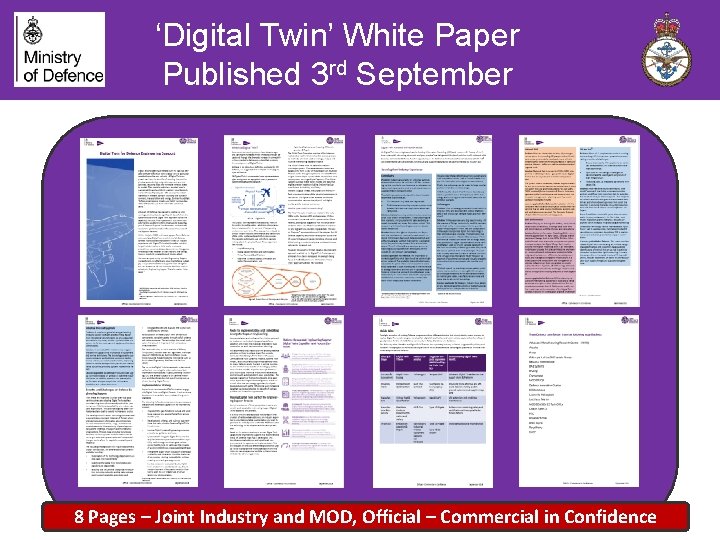
‘Digital Twin’ White Paper Published 3 rd September 2019 Quick wins requirements 8 Pages – Joint Industry and MOD, Official – Commercial in Confidence
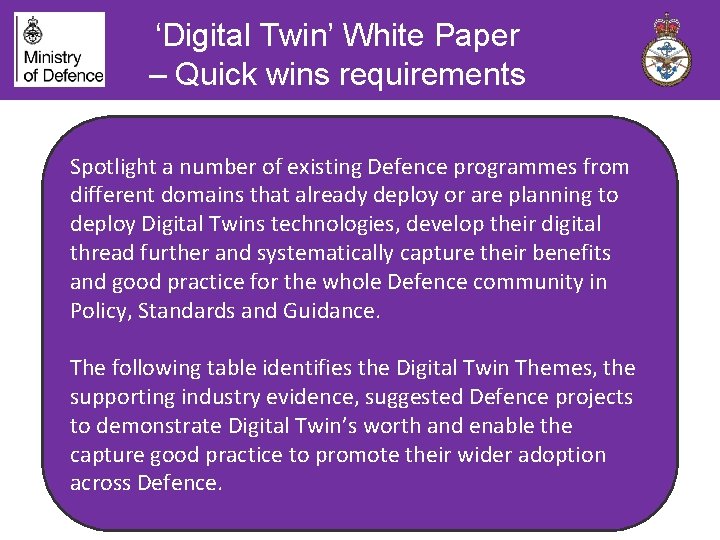
‘Digital Twin’ White Paper – Quick wins requirements Spotlight a number of existing Defence programmes from different domains that already deploy or are planning to deploy Digital Twins technologies, develop their digital thread further and systematically capture their benefits and good practice for the whole Defence community in Policy, Standards and Guidance. The following table identifies the Digital Twin Themes, the supporting industry evidence, suggested Defence projects to demonstrate Digital Twin’s worth and enable the capture good practice to promote their wider adoption across Defence.
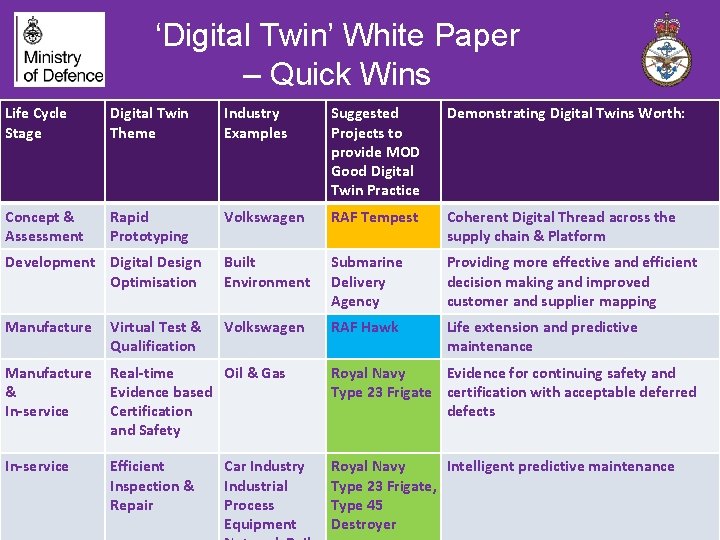
‘Digital Twin’ White Paper – Quick Wins Life Cycle Stage Digital Twin Theme Industry Examples Suggested Projects to provide MOD Good Digital Twin Practice Demonstrating Digital Twins Worth: Concept & Assessment Rapid Prototyping Volkswagen RAF Tempest Coherent Digital Thread across the supply chain & Platform Development Digital Design Optimisation Built Environment Submarine Delivery Agency Providing more effective and efficient decision making and improved customer and supplier mapping Manufacture Virtual Test & Qualification Volkswagen RAF Hawk Life extension and predictive maintenance Manufacture & In-service Real-time Oil & Gas Evidence based Certification and Safety Royal Navy Evidence for continuing safety and Type 23 Frigate certification with acceptable deferred defects In-service Efficient Inspection & Repair Royal Navy Intelligent predictive maintenance Type 23 Frigate, Type 45 Destroyer Car Industry Industrial Process Equipment
‘Digital Twin’ Other work to develop Standards; • Lloyds Register • ABS (American Bureau of Shipping) - US Navy • PLCS is the informal name for ISO 10303 -239 Product Life Cycle Support (AP 239) and defines a standard information model for the sharing of through life product information. PLCS is being used in automotive, defence, aerospace, energy and other industries to improve the speed and quality of information sharing primarily across enterprise borders helping organisation cut costs and deliver new services Requirements; • Study/Systems approach to take full advantage of a remote connected aircraft using correctly framed/specified requirements Collaboration; • Oil and Gas have done it – Live projects acted as real-life ‘map and gap’ analysis to satisfy or create only the necessary requirements • ‘Systems Engineering’ approach needed (UK Automotive proved so) to chart the journey before commencement