
Mock objects Unit tests The objective of unit
Mock objects
Unit tests • The objective of unit testing: to exercise ONE method at a time. • Unit tests v. s. Integration tests – Unit tests cover code in a class – without touching real dependencies. Integration tests touch concrete dependencies. – Unit tests are fast, Integration tests do not need to be. – Unit tests do not touch databases, web services, etc. Integration tests do.
Why mocks? • What if that method depends on other things? – a network? a database? a servlet engine? – Other parts of the system? – We don’t want to initialize lots of components just to get the right context for one test to run. • Solution: Using Mocks / Test doubles
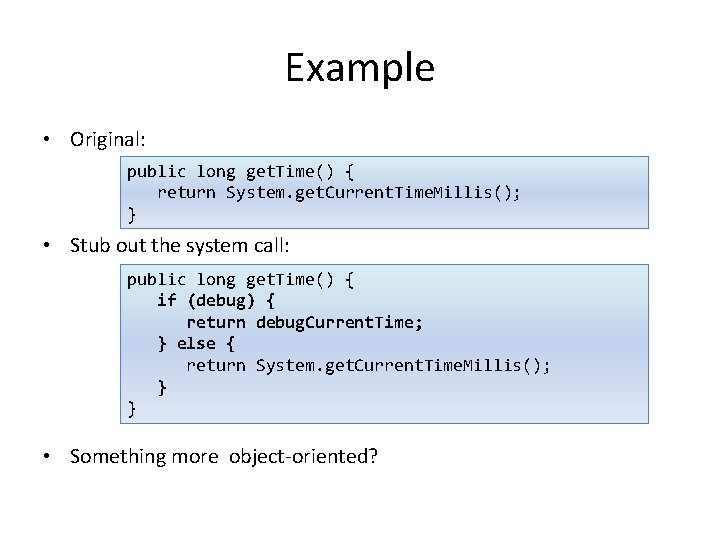
Example • Original: public long get. Time() { return System. get. Current. Time. Millis(); } • Stub out the system call: public long get. Time() { if (debug) { return debug. Current. Time; } else { return System. get. Current. Time. Millis(); } } • Something more object-oriented?
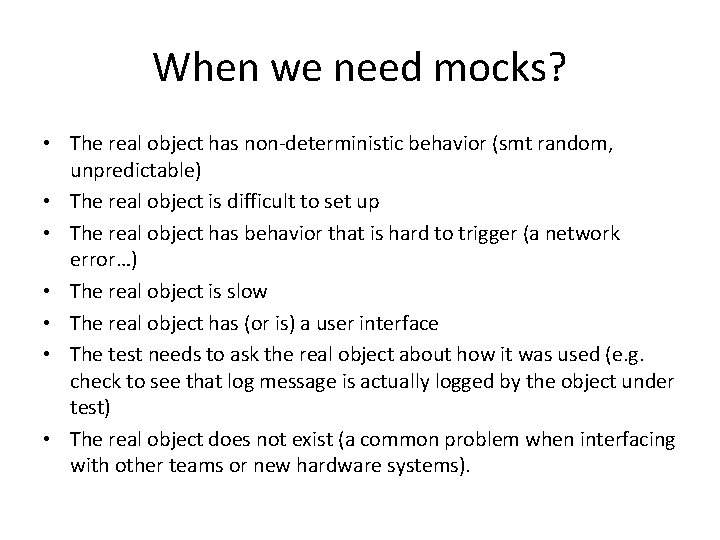
When we need mocks? • The real object has non-deterministic behavior (smt random, unpredictable) • The real object is difficult to set up • The real object has behavior that is hard to trigger (a network error…) • The real object is slow • The real object has (or is) a user interface • The test needs to ask the real object about how it was used (e. g. check to see that log message is actually logged by the object under test) • The real object does not exist (a common problem when interfacing with other teams or new hardware systems).
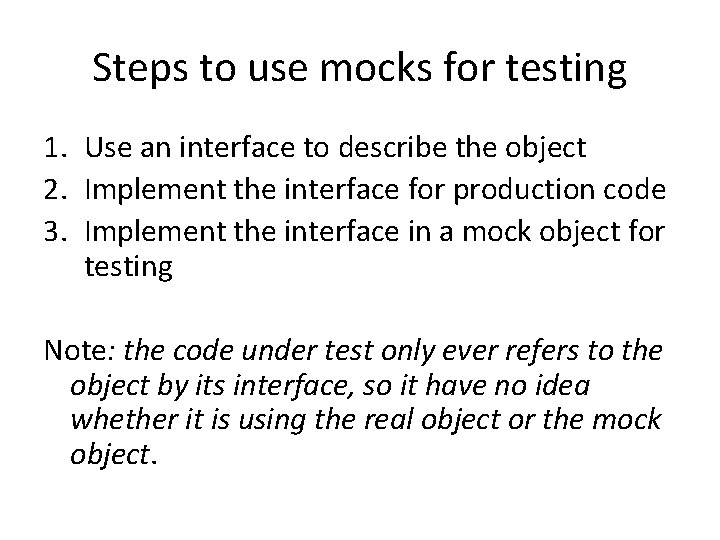
Steps to use mocks for testing 1. Use an interface to describe the object 2. Implement the interface for production code 3. Implement the interface in a mock object for testing Note: the code under test only ever refers to the object by its interface, so it have no idea whether it is using the real object or the mock object.

Example (cont. ): real and mock objects public interface Environmental { public long get. Time(); // other methods omitted… } public class System. Environment implements Environmental { public long get. Time() { return System. get. Current. Time. Millis(); } // other methods } public class Mock. System. Environment implements Environmental { private long current. Time; public void set. Time(long a. Time) { current. Time = a. Time; } public long get. Time() { return current. Time; } // other methods }
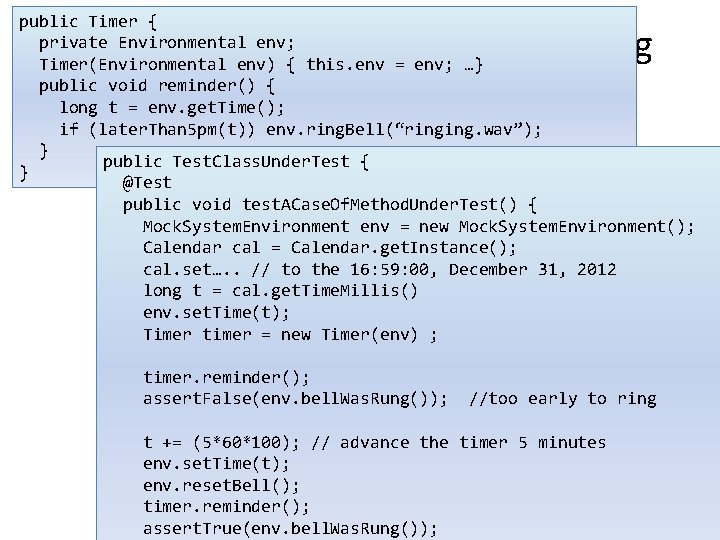
public Timer { private Environmental env; Timer(Environmental env) { this. env = env; …} public void reminder() { long t = env. get. Time(); if (later. Than 5 pm(t)) env. ring. Bell(“ringing. wav”); } public Test. Class. Under. Test { } @Test public void test. ACase. Of. Method. Under. Test() { Mock. System. Environment env = new Mock. System. Environment(); Calendar cal = Calendar. get. Instance(); cal. set…. . // to the 16: 59: 00, December 31, 2012 long t = cal. get. Time. Millis() env. set. Time(t); Timer timer = new Timer(env) ; Example (cont. ): use mock in testing timer. reminder(); assert. False(env. bell. Was. Rung()); //too early to ring t += (5*60*100); // advance the timer 5 minutes env. set. Time(t); env. reset. Bell(); timer. reminder(); assert. True(env. bell. Was. Rung());
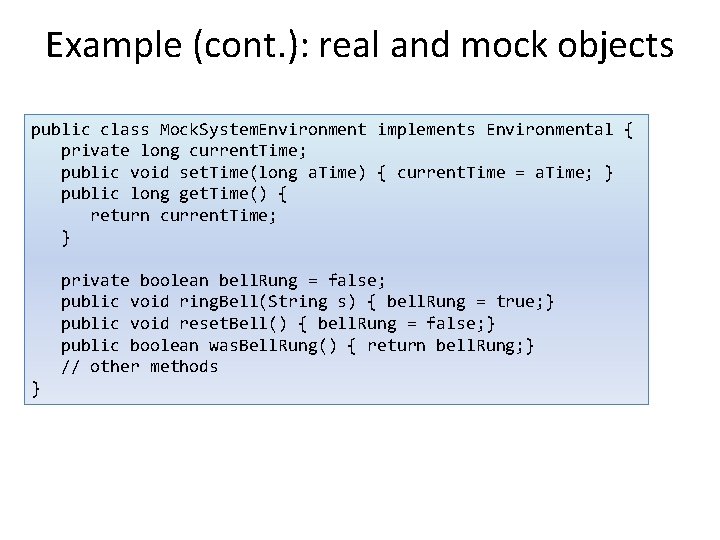
Example (cont. ): real and mock objects public class Mock. System. Environment implements Environmental { private long current. Time; public void set. Time(long a. Time) { current. Time = a. Time; } public long get. Time() { return current. Time; } private boolean bell. Rung = false; public void ring. Bell(String s) { bell. Rung = true; } public void reset. Bell() { bell. Rung = false; } public boolean was. Bell. Rung() { return bell. Rung; } // other methods }

Mock framework • Too much trouble to write mocks? There are frameworks available. • Java: JMock, Easy. Mock • Objective C: OCMock?

Testing models • Interaction Based Testing - you specify certain sequence of interactions between objects, initiate an action, and then verify that the sequence of interactions happened as you specified it. • State Based Testing - you initiate an action, and then check for the expected results (return value, property, created object, etc). • Record & Replay model - a model that allows for recording actions on a mock object, and then replaying and verifying them. – All mocking frameworks uses this model. – implicitly (NMock, Type. Mock. Net, NMock 2) – explicitly (Easy. Mock. Net, Rhino Mocks).
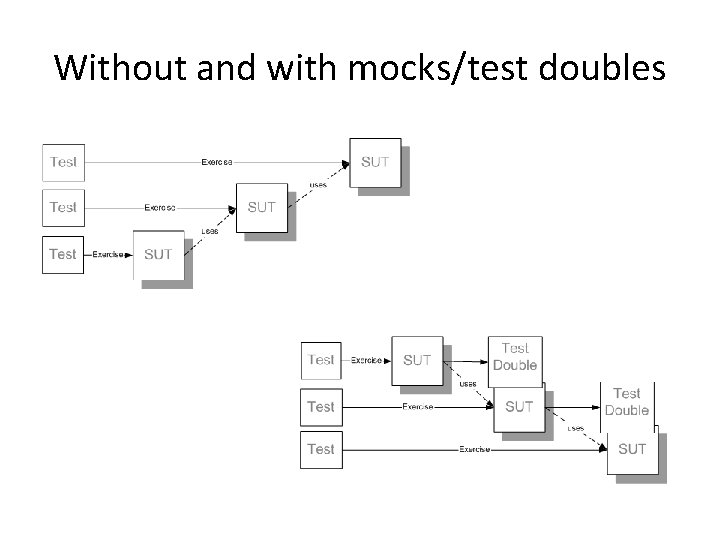
Without and with mocks/test doubles
References • http: //www. michaelminella. com/testing/unittesting-with-junit-and-easymock. html • http: //www. easymock. org/Easy. Mock 3_0_Doc umentation. html • http: //jmock. org/getting-started. html
- Slides: 13