
Mock Object Creation for Test Factoring David Saff
Mock Object Creation for Test Factoring David Saff, Michael D. Ernst MIT CSAIL PASTE, 2004 June
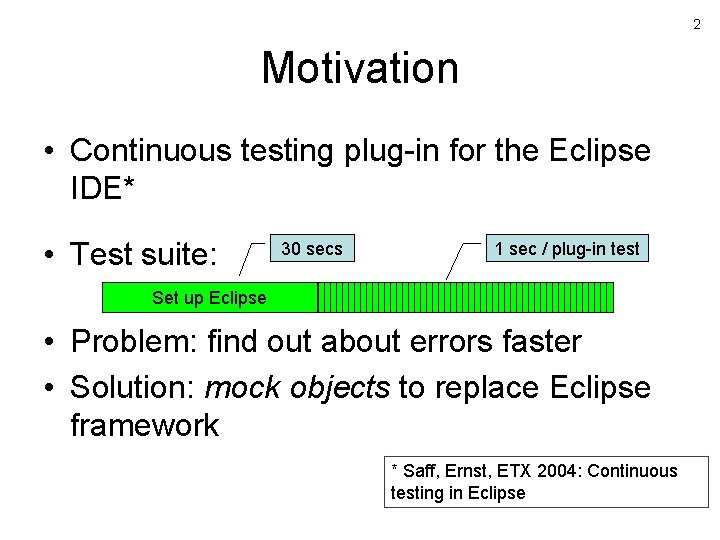
2 Motivation • Continuous testing plug-in for the Eclipse IDE* • Test suite: 30 secs 1 sec / plug-in test Set up Eclipse • Problem: find out about errors faster • Solution: mock objects to replace Eclipse framework * Saff, Ernst, ETX 2004: Continuous testing in Eclipse

3 Outline • • Mock objects introduced Test factoring introduced Mock object creation for test factoring Conclusion
4 Outline • • Mock objects introduced Test factoring introduced Mock object creation for test factoring Conclusion
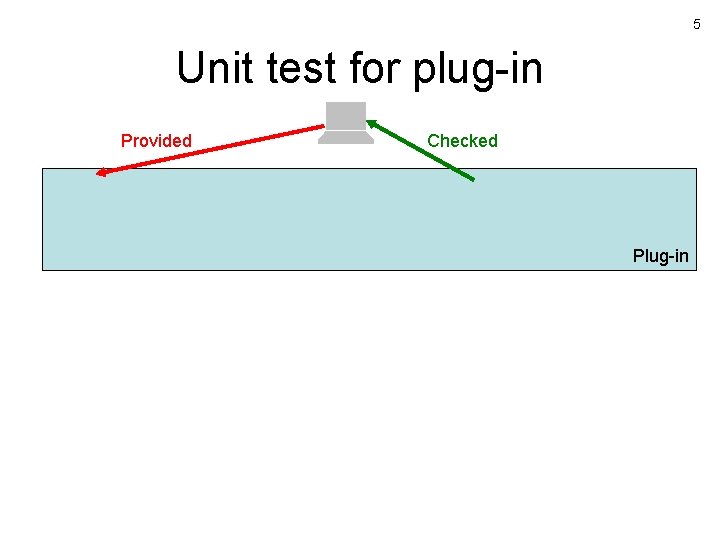
5 Unit test for plug-in Provided Checked Plug-in
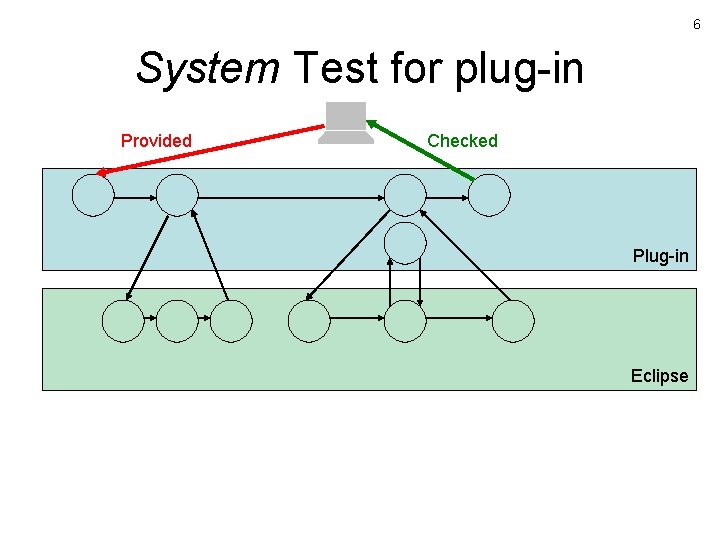
6 System Test for plug-in Provided Checked Plug-in Eclipse
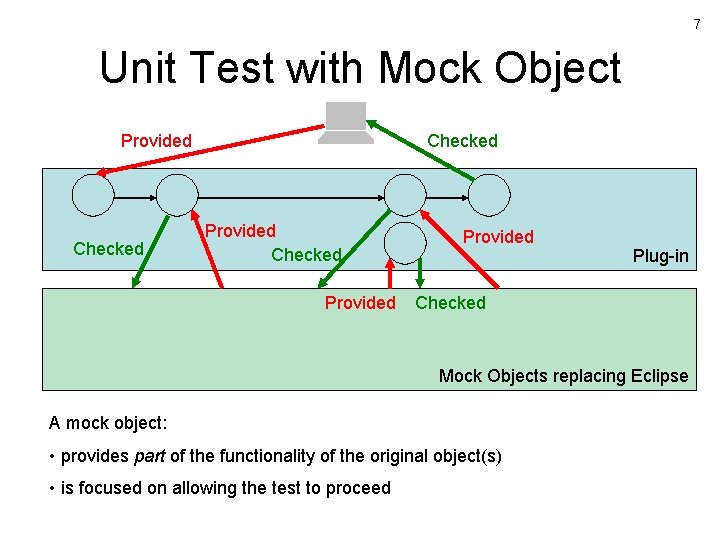
7 Unit Test with Mock Object Provided Checked Provided Plug-in Checked Mock Objects replacing Eclipse A mock object: • provides part of the functionality of the original object(s) • is focused on allowing the test to proceed
8 Mock objects for our example • Using a debugger, determined: – 147 static calls from plug-in to framework • Defined on 49 classes – 8 callbacks from framework to plug-in • Substantial work to define mock objects. • How well can we automate this process without additional manual effort?
9 Outline • • Mock objects introduced Test factoring introduced Mock object creation for test factoring Conclusion
10 What is a factored test? • Split a system test into several smaller factored tests that – exercise less code than system test – can be added to the suite and prioritized • Find out about errors faster – embody assumptions about future code changes
11 Pros and cons of factored tests • Pro: factored test should be faster if system test – is slow – requires an expensive resource or human interaction • Pro: isolates bugs in subsystems • Con: if assumptions about how developer will change the code are violated, can lead to: – false negatives: OK, some delay – false positives: bad, distract developer
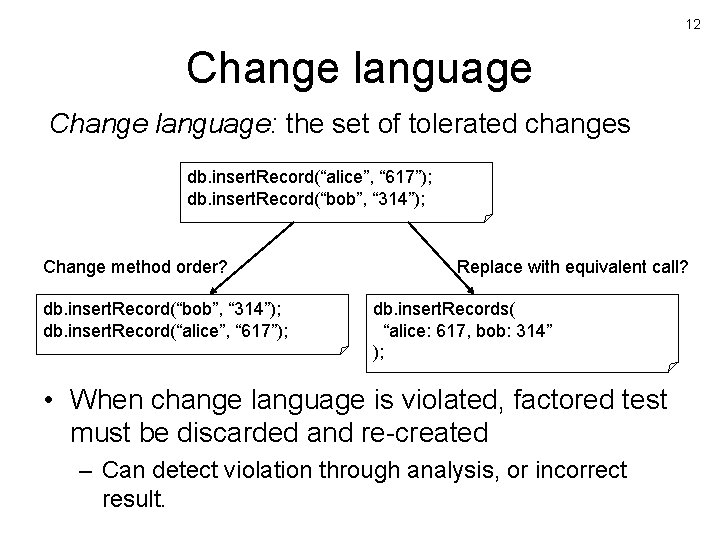
12 Change language: the set of tolerated changes db. insert. Record(“alice”, “ 617”); db. insert. Record(“bob”, “ 314”); Change method order? db. insert. Record(“bob”, “ 314”); db. insert. Record(“alice”, “ 617”); Replace with equivalent call? db. insert. Records( “alice: 617, bob: 314” ); • When change language is violated, factored test must be discarded and re-created – Can detect violation through analysis, or incorrect result.
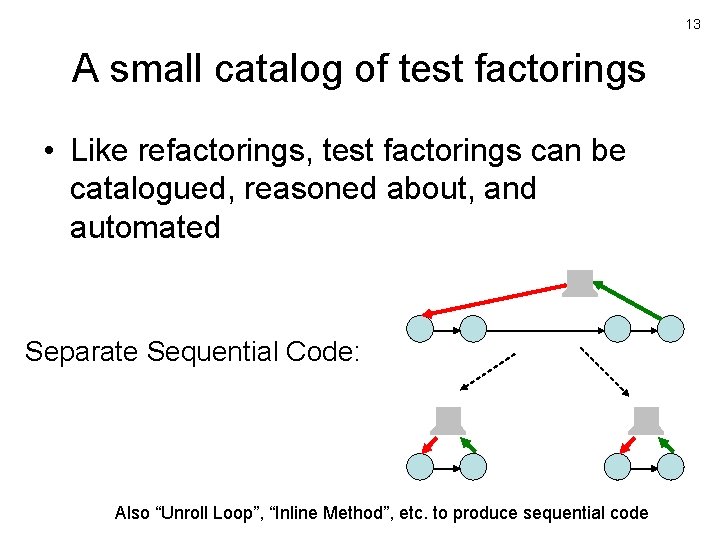
13 A small catalog of test factorings • Like refactorings, test factorings can be catalogued, reasoned about, and automated Separate Sequential Code: Also “Unroll Loop”, “Inline Method”, etc. to produce sequential code
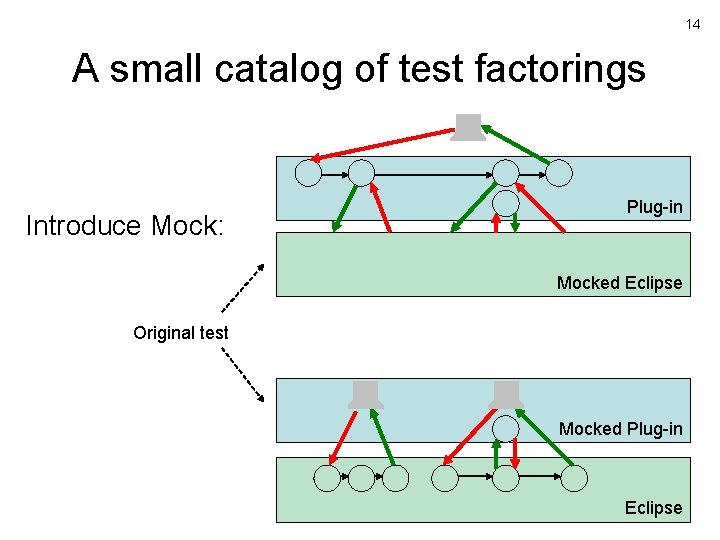
14 A small catalog of test factorings Introduce Mock: Plug-in Mocked Eclipse Original test Mocked Plug-in Eclipse
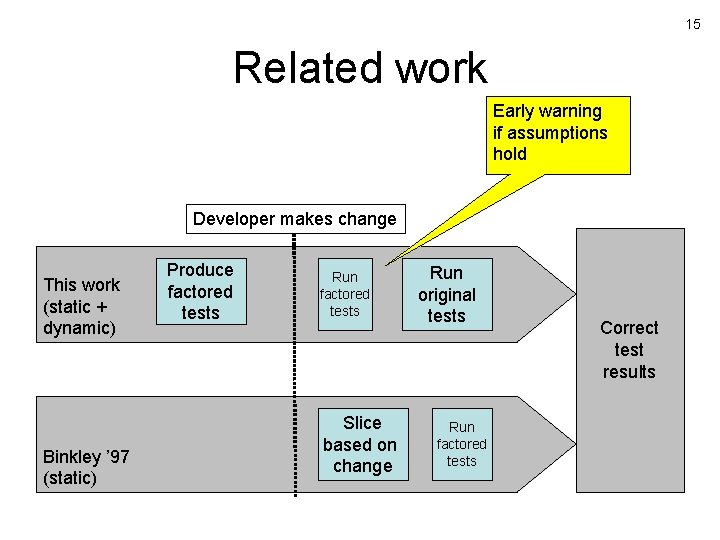
15 Related work Early warning if assumptions hold Developer makes change This work (static + dynamic) Binkley ’ 97 (static) Produce factored tests Run factored tests Slice based on change Run original tests Run factored tests Correct test results
16 Outline • • Mock objects introduced Test factoring introduced Mock object creation for test factoring Conclusion
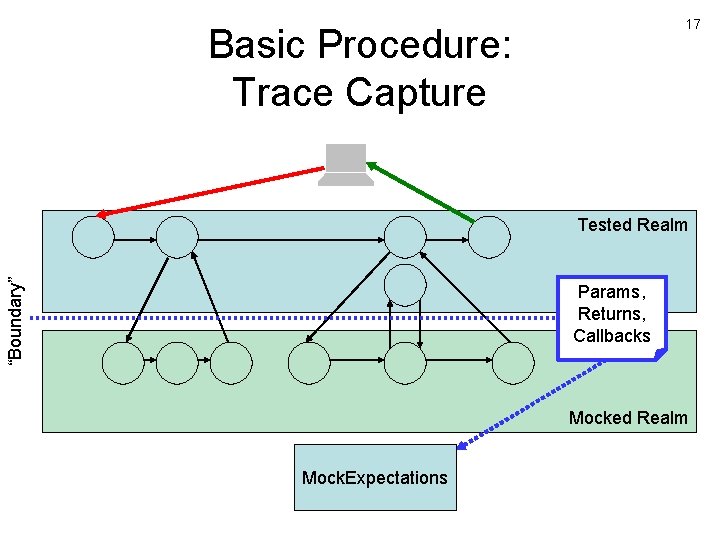
17 Basic Procedure: Trace Capture “Boundary” Tested Realm Params, Returns, Callbacks Mocked Realm Mock. Expectations
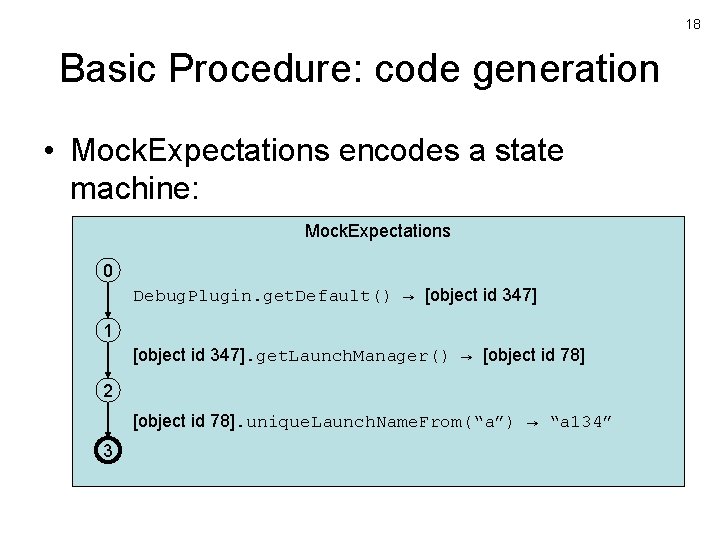
18 Basic Procedure: code generation • Mock. Expectations encodes a state machine: Mock. Expectations 0 Debug. Plugin. get. Default() → [object id 347] 1 [object id 347]. get. Launch. Manager() → [object id 78] 2 [object id 78]. unique. Launch. Name. From(“a”) → “a 134” 3
19 Expanding the change language • Current tolerated change language includes: – Extract method – Inline method • Using static analysis on mocked code, improve the procedure to include: – Reorder calls to independent objects – Add or remove calls to pure methods
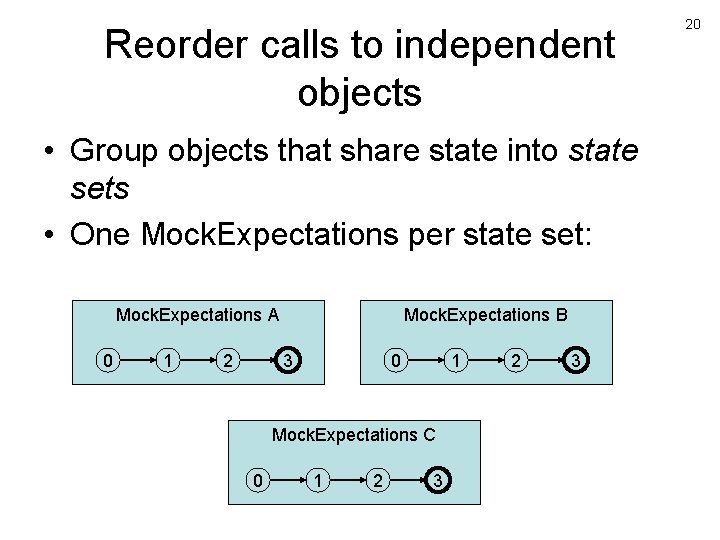
Reorder calls to independent objects • Group objects that share state into state sets • One Mock. Expectations per state set: Mock. Expectations A 0 1 2 Mock. Expectations B 3 0 1 Mock. Expectations C 0 1 2 3 20
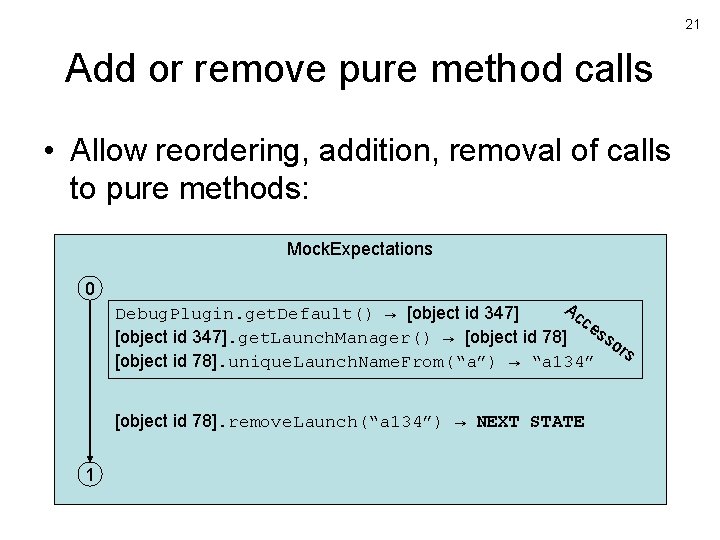
21 Add or remove pure method calls • Allow reordering, addition, removal of calls to pure methods: Mock. Expectations 0 Ac Debug. Plugin. get. Default() → [object id 347] ce ss [object id 347]. get. Launch. Manager() → [object id 78] or s [object id 78]. unique. Launch. Name. From(“a”) → “a 134” [object id 78]. remove. Launch(“a 134”) → NEXT STATE 1
22 Outline • • Mock objects introduced Test factoring introduced Mock object creation for test factoring Conclusion
23 Future work • Develop a framework for test factoring • Implement the “Implement Mock” factoring • Analytic evaluation of framework – Capture real-project change data* – Measure notification time, false positives • Case studies of test factoring in practice – How do developers feel about the feedback they receive? * Saff, Ernst, ISSRE 2003: Reducing wasted development time via continuous testing
24 Conclusion • Test factoring can indicate errors earlier • “Introduce Mock” is an important test factoring for complicated systems • We propose: – Dynamic analysis for building mock objects – Static analysis for increasing the change language • Mail: saff@mit. edu

25
![26 A small catalog of test factorings • Separate Sequential Test: – [graphic] •](http://slidetodoc.com/presentation_image_h2/fee3687b3e6193915d64481b3d163cc5/image-26.jpg "26 A small catalog of test factorings • Separate Sequential Test: – [graphic] •")
26 A small catalog of test factorings • Separate Sequential Test: – [graphic] • Unroll Loop: – [graphic] • Introduce Mock: – [graphic]
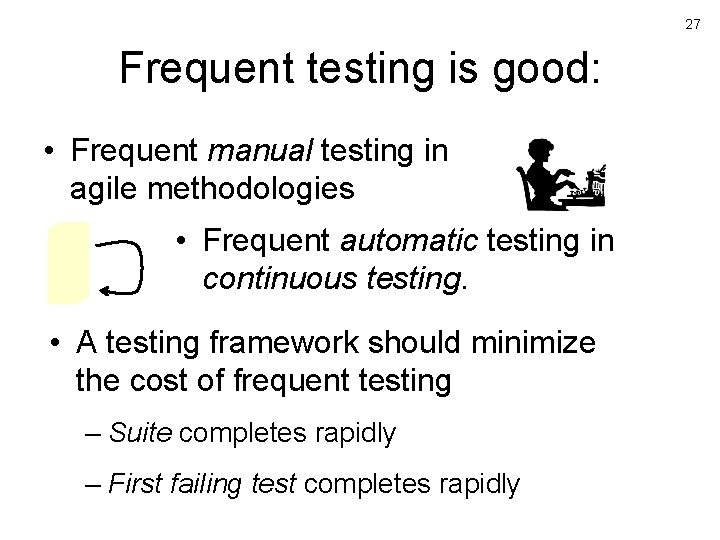
27 Frequent testing is good: • Frequent manual testing in agile methodologies • Frequent automatic testing in continuous testing. • A testing framework should minimize the cost of frequent testing – Suite completes rapidly – First failing test completes rapidly
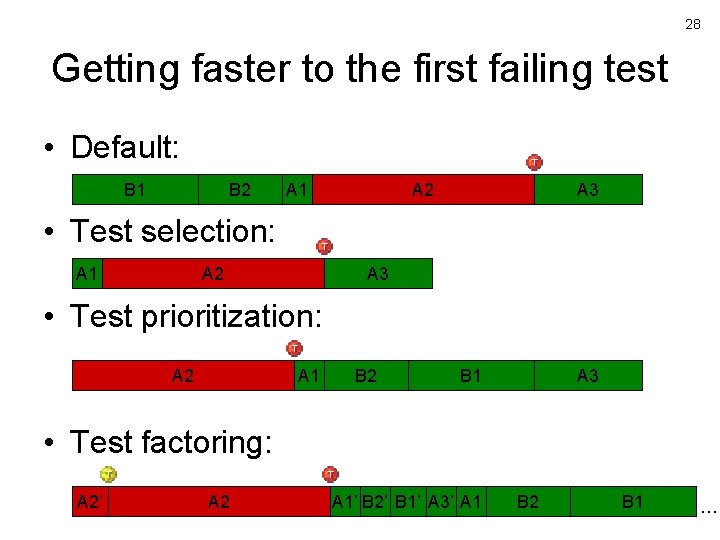
28 Getting faster to the first failing test • Default: B 1 B 2 A 1 A 2 A 3 • Test selection: A 1 A 2 A 3 • Test prioritization: A 2 A 1 B 2 B 1 A 3 • Test factoring: A 2’ A 2 A 1’ B 2’ B 1’ A 3’ A 1 B 2 B 1 …
Dynamic, change-independent test factoring • Dynamic: instrument and run the original test • Change-independent: factoring happens before any changes are made. – Requires a hypothesized change language • Binkley ’ 97: Static, change-dependent test factoring 29
Automatic test factoring: change-dependence • Change-dependent test factoring: – After tested code is changed, generate new tests with same result as old tests for that change. Better • Change-independent test factoring: – Before tested code is changed, generate new tests that have the same result as old tests for some set of changes. 30
Automatic test factoring: static vs. dynamic analysis • Static analysis (Binkley ’ 97) – Analyze code to determine mock object behavior – Well-suited for change-dependent factoring – May fail • without source • when dependent on file system or user interaction – Guaranteed change language may be restrictive • Dynamic analysis (this work) – Instrument and run the original test, gather logs – May run original test after factored test fails 31
- Slides: 31