
Mobility in the Internet TML TKK Helsinki Finland
Mobility in the Internet TML, TKK, Helsinki, Finland Chittaranjan Hota, Ph. D Department of Computer Science and Information Systems Birla Institute of Technology & Science, Pilani Rajasthan, 333031, INDIA E-mail: c_hota@bits-pilani. ac. in 22. 10. 2007
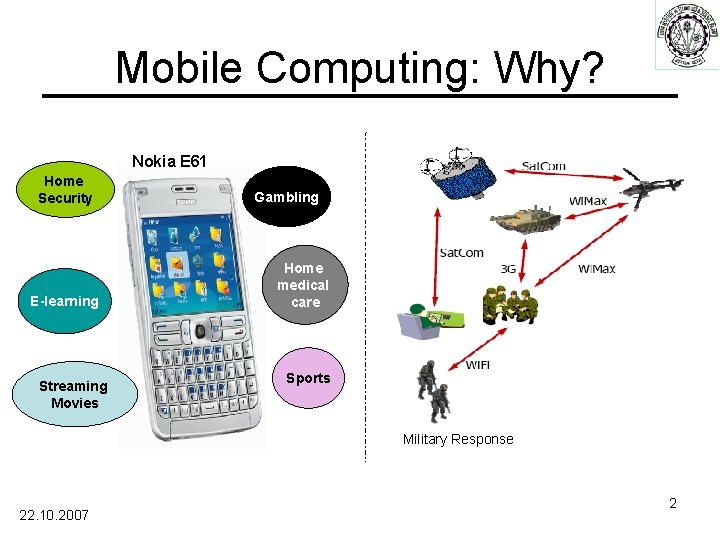
Mobile Computing: Why? Nokia E 61 Home Security E-learning Streaming Movies Gambling Home medical care Sports Military Response 22. 10. 2007 2
![Markets for IP Mobility 22. 10. 2007 3 [Source: Cisco]](http://slidetodoc.com/presentation_image_h/a22f9a88b123b5900bad2db2d197e94d/image-3.jpg "Markets for IP Mobility 22. 10. 2007 3 [Source: Cisco]")
Markets for IP Mobility 22. 10. 2007 3 [Source: Cisco]
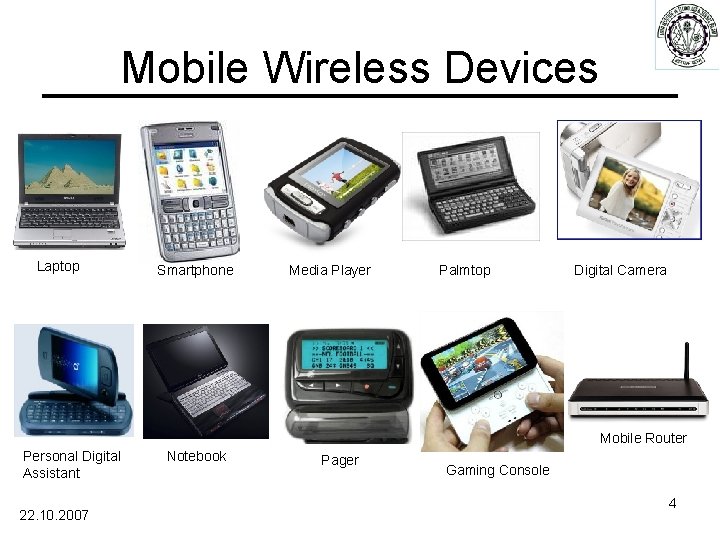
Mobile Wireless Devices Laptop Smartphone Media Player Palmtop Digital Camera Mobile Router Personal Digital Assistant 22. 10. 2007 Notebook Pager Gaming Console 4
Is it Portable Networking? • Portable Networking requires connection to same ISP • Technologies – Bluetooth • Short range, low cost radio links between mobile devices – Wireless Ethernet (802. 11) • MAC Layer technology – Cellular • Cellular Digital Packet Data, 3 G 22. 10. 2007 5
Outline • Will Address – Internet architecture and Motivation for Mobile IP – Mobile IPv 4, HMIP, HAWAII, Cellular IP, MIPv 6, i 3, TCP Indirect, SIP, NEtwork. MObility, HMIPv 6 etc. – Low level protocol details including message formats and headers – Comparison on the basis of location updates, handoff latency, and signaling overhead • Won’t cover – IP Routing (Link state, Distance vector, OSPF, BGP, RIP etc. ) – Wireless Networks – IPv 4, and IPv 6 Protocol details – Security and Qo. S issues related to Mobile IP 22. 10. 2007 6
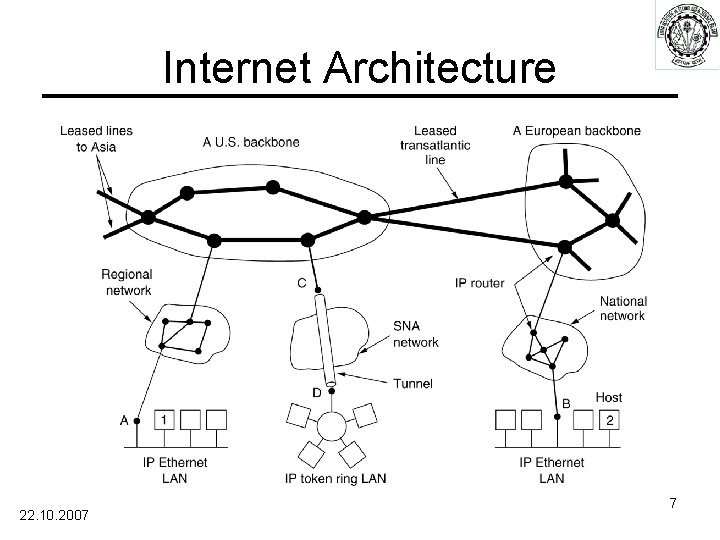
Internet Architecture 22. 10. 2007 7
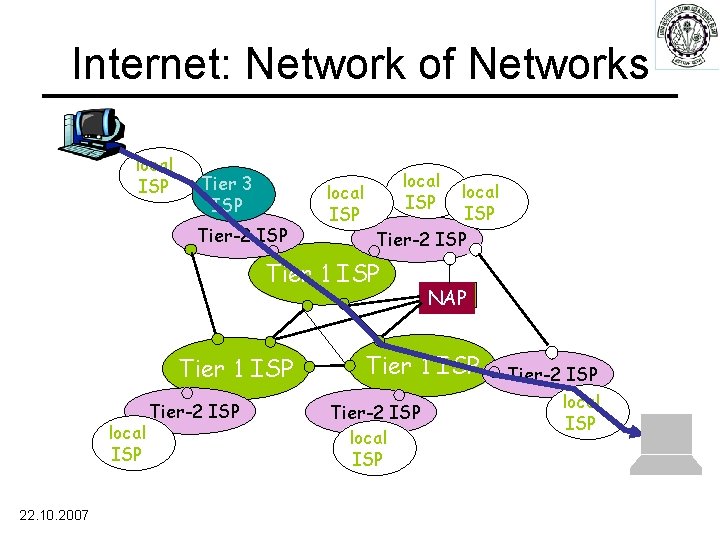
Internet: Network of Networks local ISP Tier 3 ISP Tier-2 ISP local ISP Tier-2 ISP Tier 1 ISP local ISP 22. 10. 2007 Tier-2 ISP NAP Tier 1 ISP Tier-2 ISP local ISP
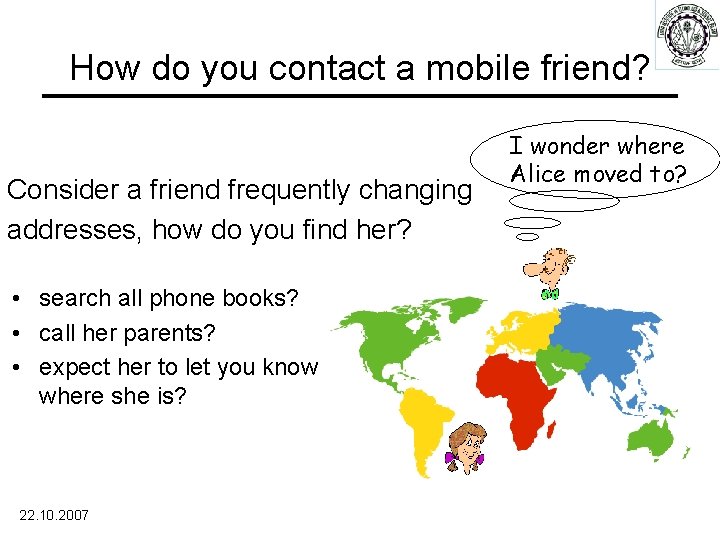
How do you contact a mobile friend? Consider a friend frequently changing addresses, how do you find her? • search all phone books? • call her parents? • expect her to let you know where she is? 22. 10. 2007 I wonder where Alice moved to?
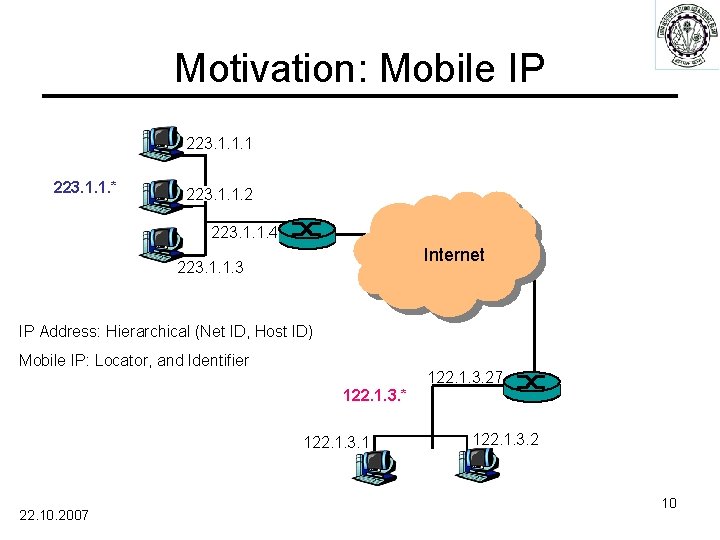
Motivation: Mobile IP 223. 1. 1. 1 223. 1. 1. * 223. 1. 1. 2 223. 1. 1. 4 Internet 223. 1. 1. 3 IP Address: Hierarchical (Net ID, Host ID) Mobile IP: Locator, and Identifier 122. 1. 3. 27 122. 1. 3. * 122. 1. 3. 1 22. 10. 2007 122. 1. 3. 2 10
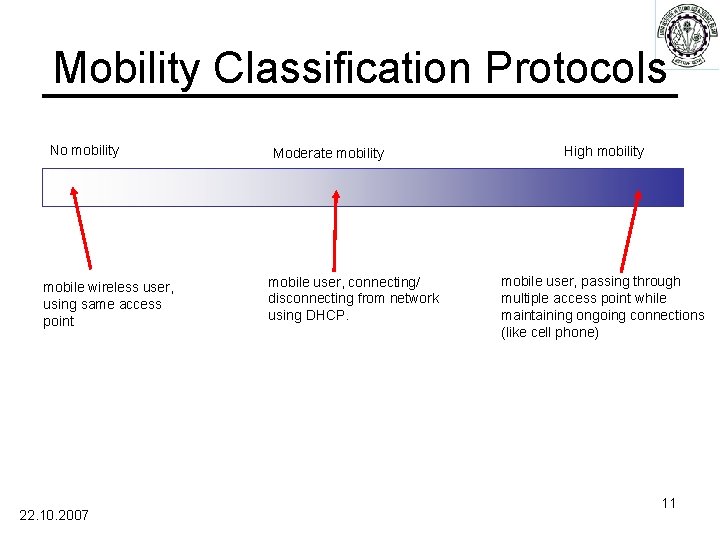
Mobility Classification Protocols No mobility mobile wireless user, using same access point 22. 10. 2007 Moderate mobility mobile user, connecting/ disconnecting from network using DHCP. High mobility mobile user, passing through multiple access point while maintaining ongoing connections (like cell phone) 11
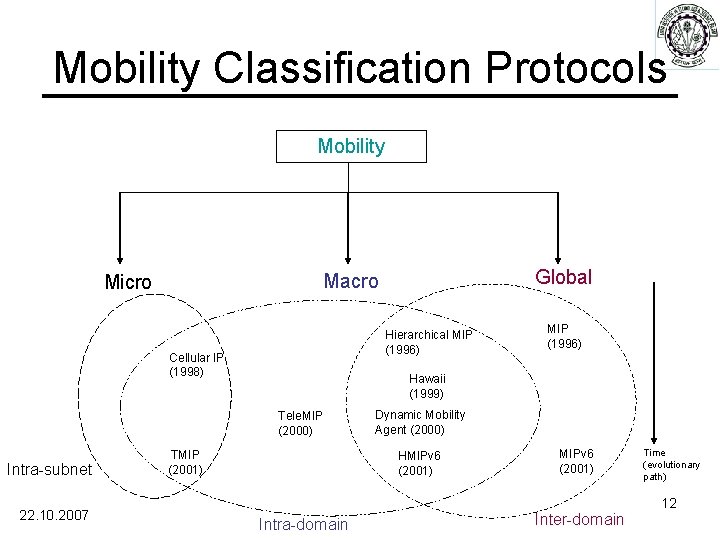
Mobility Classification Protocols Mobility Hierarchical MIP (1996) Cellular IP (1998) 22. 10. 2007 MIP (1996) Hawaii (1999) Tele. MIP (2000) Intra-subnet Global Macro Micro TMIP (2001) Dynamic Mobility Agent (2000) HMIPv 6 (2001) Intra-domain MIPv 6 (2001) Inter-domain Time (evolutionary path) 12
Mobility: Approaches • Let routing handle it: routers advertise permanent address of mobile-nodes-in-residence via usual routing table exchange. – routing tables indicate where each mobile is located – no changes to end-systems • Let end-systems handle it: – indirect routing: communication from correspondent to mobile node goes through the home agent – direct routing: correspondent gets foreign address of mobile, sends directly to mobile 22. 10. 2007 13
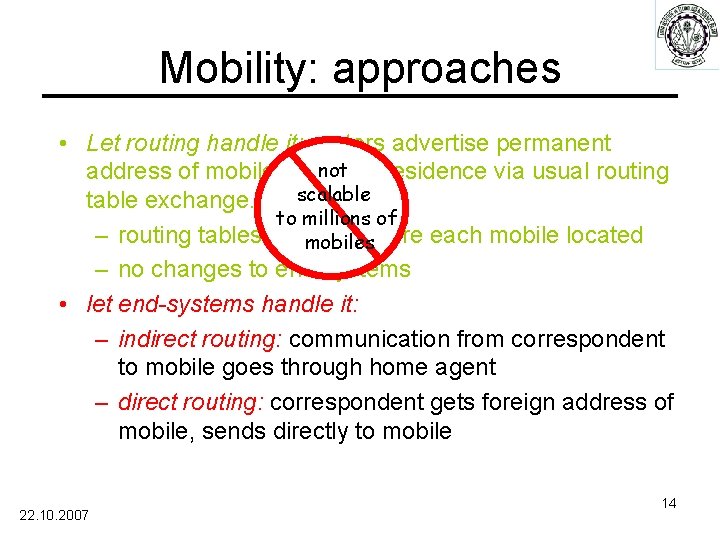
Mobility: approaches • Let routing handle it: routers advertise permanent not address of mobile-nodes-in-residence via usual routing scalable table exchange. to millions of – routing tables indicate where each mobile located mobiles – no changes to end-systems • let end-systems handle it: – indirect routing: communication from correspondent to mobile goes through home agent – direct routing: correspondent gets foreign address of mobile, sends directly to mobile 22. 10. 2007 14
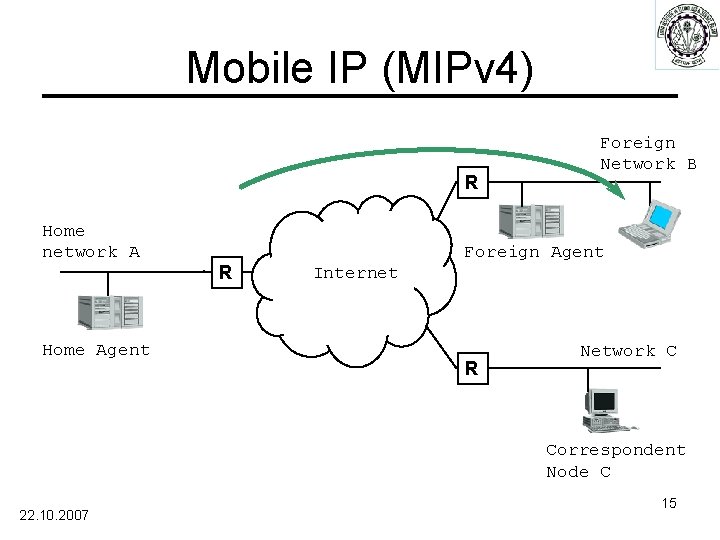
Mobile IP (MIPv 4) R Home network A Home Agent R Foreign Network B Foreign Agent Internet R Network C Correspondent Node C 22. 10. 2007 15
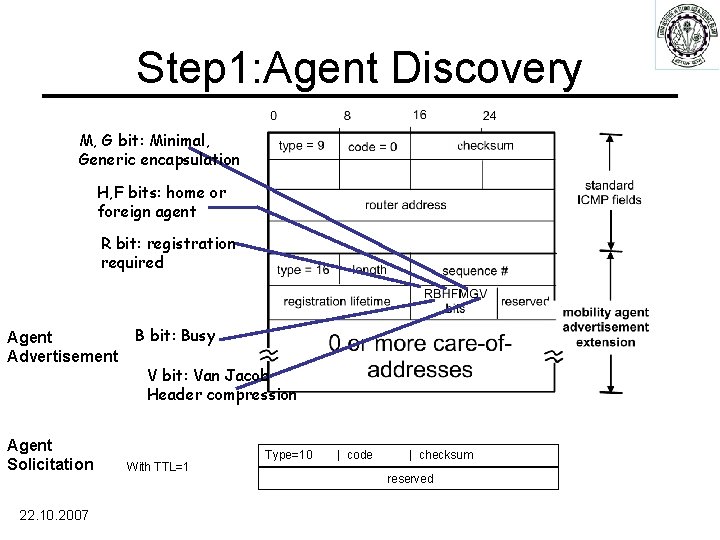
Step 1: Agent Discovery M, G bit: Minimal, Generic encapsulation H, F bits: home or foreign agent R bit: registration required Agent Advertisement Agent Solicitation 22. 10. 2007 B bit: Busy V bit: Van Jacob Header compression With TTL=1 Type=10 | code | checksum reserved
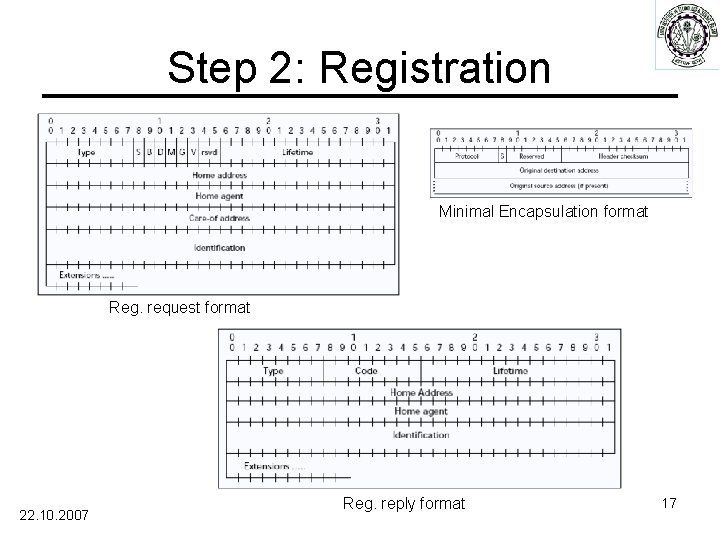
Step 2: Registration Minimal Encapsulation format Reg. request format 22. 10. 2007 Reg. reply format 17
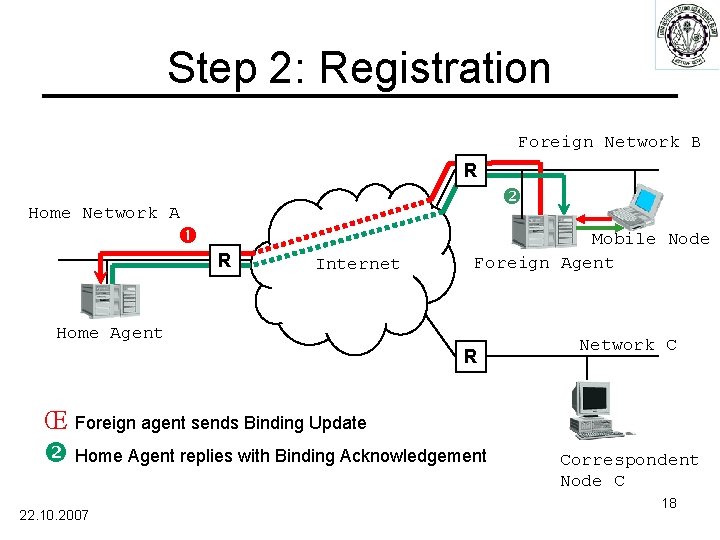
Step 2: Registration Foreign Network B R Home Network A R Internet Mobile Node Foreign Agent Home Agent R ΠForeign agent sends Binding Update Home Agent replies with Binding Acknowledgement 22. 10. 2007 Network C Correspondent Node C 18
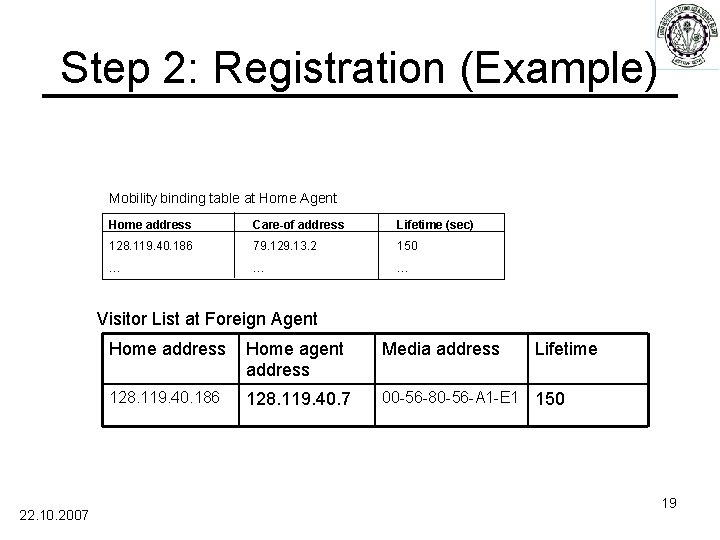
Step 2: Registration (Example) Mobility binding table at Home Agent Home address Care-of address Lifetime (sec) 128. 119. 40. 186 79. 129. 13. 2 150 … … … Visitor List at Foreign Agent 22. 10. 2007 Home address Home agent address Media address Lifetime 128. 119. 40. 186 128. 119. 40. 7 00 -56 -80 -56 -A 1 -E 1 150 19
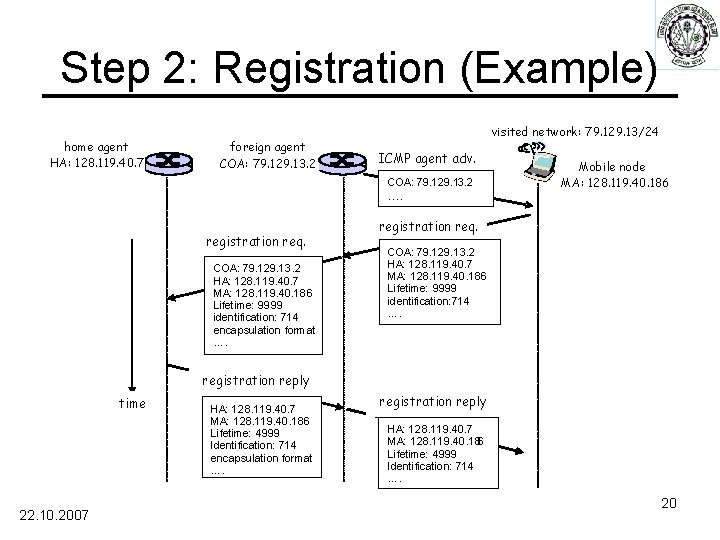
Step 2: Registration (Example) home agent HA: 128. 119. 40. 7 foreign agent COA: 79. 129. 13. 2 visited network: 79. 129. 13/24 ICMP agent adv. COA: 79. 129. 13. 2 …. registration req. COA: 79. 129. 13. 2 HA: 128. 119. 40. 7 MA: 128. 119. 40. 186 Lifetime: 9999 identification: 714 encapsulation format …. Mobile node MA: 128. 119. 40. 186 registration req. COA: 79. 129. 13. 2 HA: 128. 119. 40. 7 MA: 128. 119. 40. 186 Lifetime: 9999 identification: 714 …. registration reply time 22. 10. 2007 HA: 128. 119. 40. 7 MA: 128. 119. 40. 186 Lifetime: 4999 Identification: 714 encapsulation format …. registration reply HA: 128. 119. 40. 7 MA: 128. 119. 40. 186 Lifetime: 4999 Identification: 714 …. 20
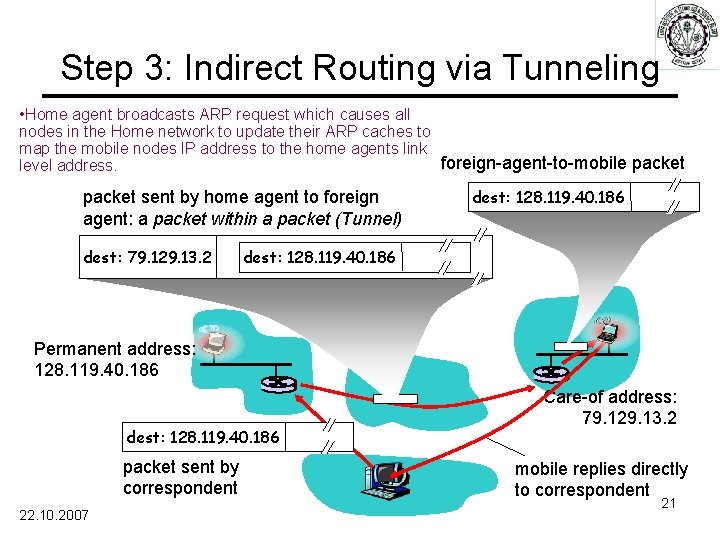
Step 3: Indirect Routing via Tunneling • Home agent broadcasts ARP request which causes all nodes in the Home network to update their ARP caches to map the mobile nodes IP address to the home agents link foreign-agent-to-mobile packet level address. packet sent by home agent to foreign agent: a packet within a packet (Tunnel) dest: 79. 129. 13. 2 dest: 128. 119. 40. 186 Permanent address: 128. 119. 40. 186 dest: 128. 119. 40. 186 packet sent by correspondent 22. 10. 2007 Care-of address: 79. 129. 13. 2 mobile replies directly to correspondent 21
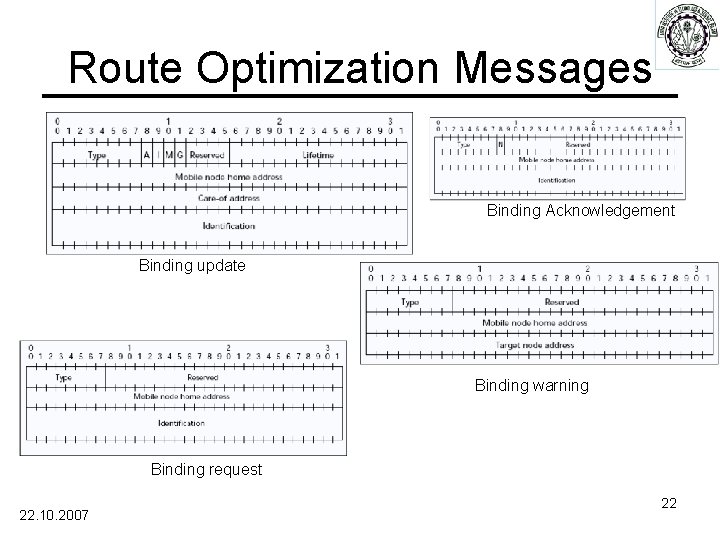
Route Optimization Messages Binding Acknowledgement Binding update Binding warning Binding request 22. 10. 2007 22
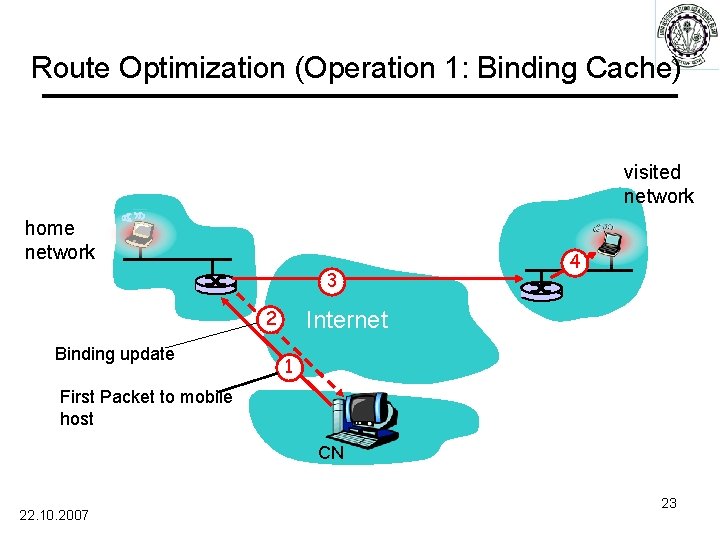
Route Optimization (Operation 1: Binding Cache) visited network home network 3 2 Binding update 4 Internet 1 First Packet to mobile host CN 22. 10. 2007 23
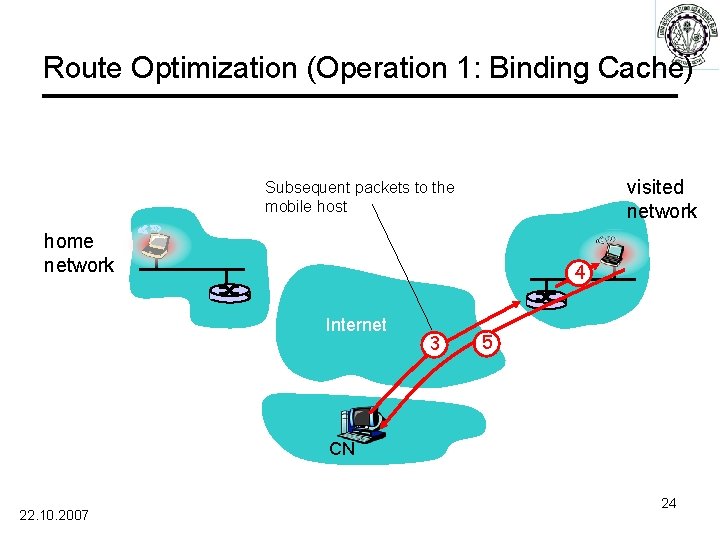
Route Optimization (Operation 1: Binding Cache) visited network Subsequent packets to the mobile host home network 4 Internet 3 5 CN 22. 10. 2007 24
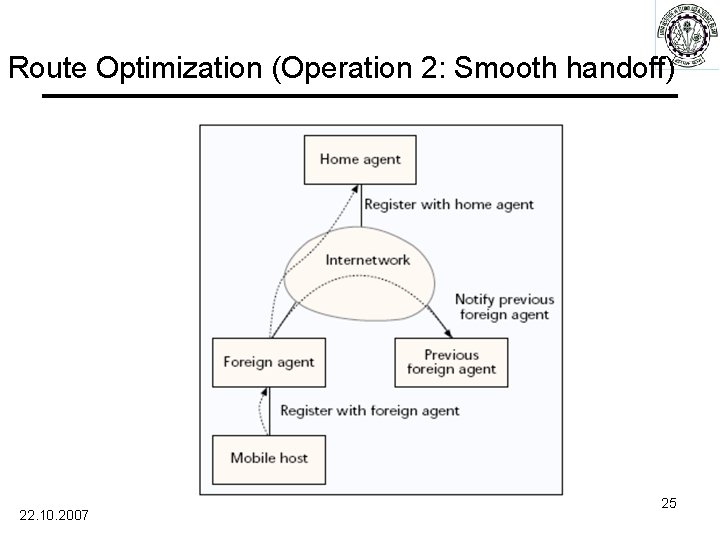
Route Optimization (Operation 2: Smooth handoff) 22. 10. 2007 25
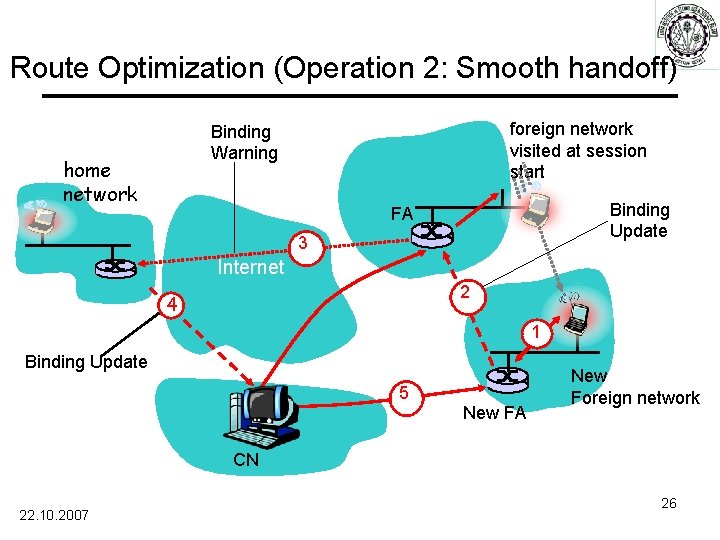
Route Optimization (Operation 2: Smooth handoff) foreign network visited at session start Binding Warning home network Binding Update FA 3 Internet 2 4 1 Binding Update 5 New FA New Foreign network CN 22. 10. 2007 26
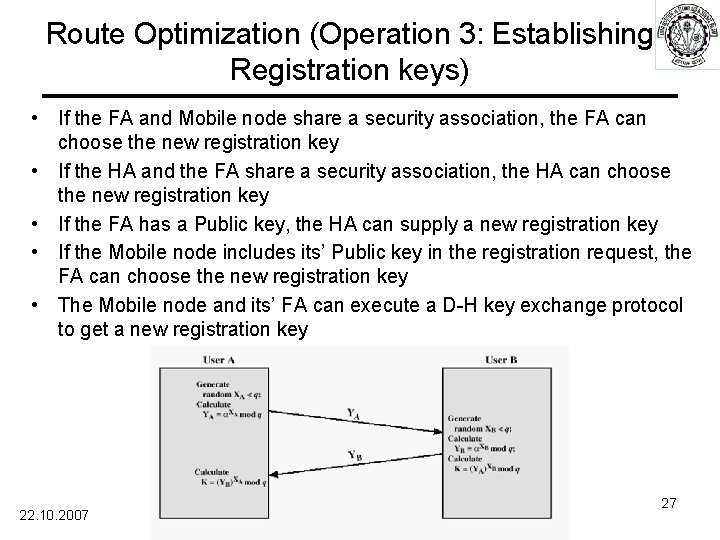
Route Optimization (Operation 3: Establishing Registration keys) • If the FA and Mobile node share a security association, the FA can choose the new registration key • If the HA and the FA share a security association, the HA can choose the new registration key • If the FA has a Public key, the HA can supply a new registration key • If the Mobile node includes its’ Public key in the registration request, the FA can choose the new registration key • The Mobile node and its’ FA can execute a D-H key exchange protocol to get a new registration key 22. 10. 2007 27
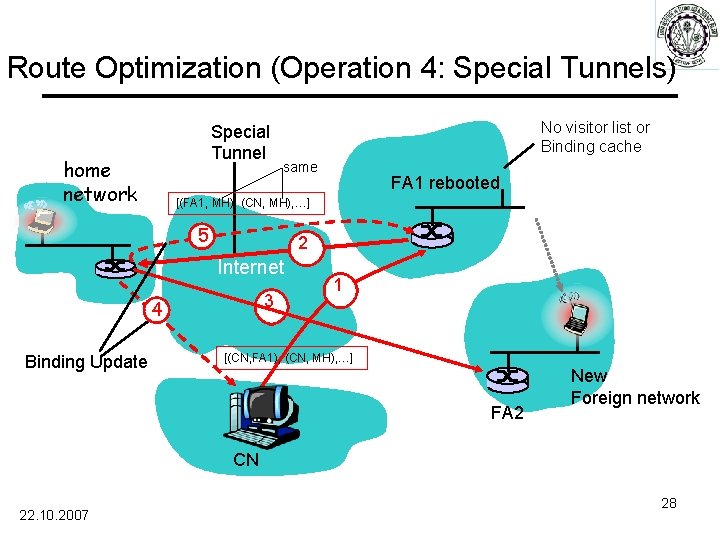
Route Optimization (Operation 4: Special Tunnels) Special Tunnel home network No visitor list or Binding cache same [(FA 1, MH), (CN, MH), …] 5 2 Internet 3 4 Binding Update FA 1 rebooted 1 [(CN, FA 1), (CN, MH), …] FA 2 New Foreign network CN 22. 10. 2007 28
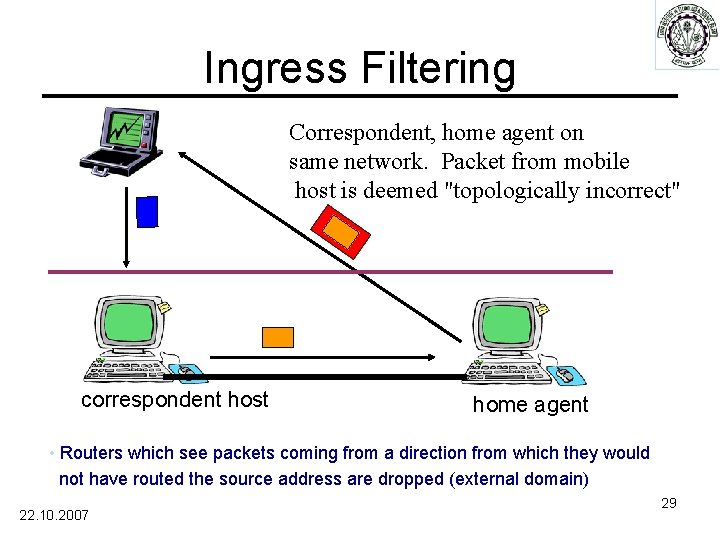
Ingress Filtering Correspondent, home agent on same network. Packet from mobile host is deemed "topologically incorrect" correspondent host home agent • Routers which see packets coming from a direction from which they would not have routed the source address are dropped (external domain) 22. 10. 2007 29
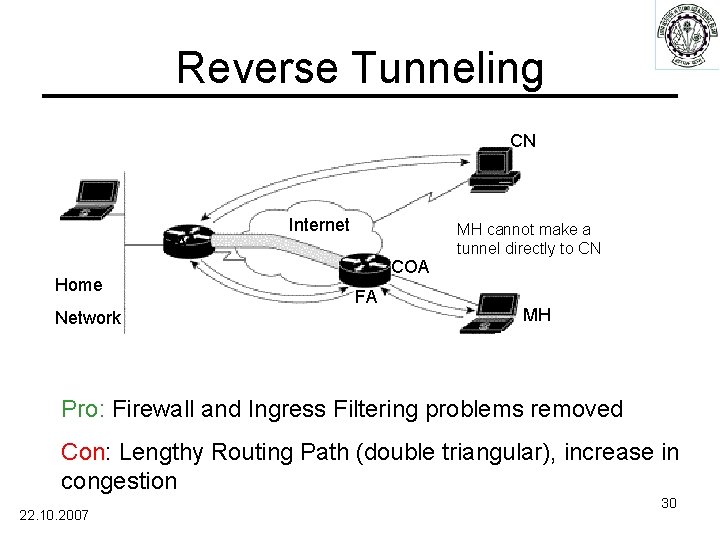
Reverse Tunneling CN HA Home Network Internet COA FA MH cannot make a tunnel directly to CN MH Pro: Firewall and Ingress Filtering problems removed Con: Lengthy Routing Path (double triangular), increase in congestion 22. 10. 2007 30
Other Issues in Mobile IP • How does a Mobile node acquire a care-of-address in the foreign network? Ø By DHCP, Router advertisements, Manually • If Home agent does not reply to registration request Ø Send the request to broadcast address (redundancy) • Reducing registration frequency (in high mobility scenario) Ø FAs into a multicast group, into an anycast group, Hierarchy • Source Routing Option to avoid Tunneling and triangular routing Ø Not feasible as the load on intermediate routers will be more • Security (denial of service attack by bogus registration request) Ø Authentication using MD 5 hashes 22. 10. 2007 Ø Replay attacks are prevented by (timestamp or nonce) 31
Problems with MIPv 4 • Authentication with FA is difficult as it belongs to another organization • Guaranteeing Qo. S to a flow of packets is difficult because of triangulation and tunneling. • Triangular routing and frequent handoffs cause significant end-to-end delay (Micro-mobility helps a bit) • High signaling load on HA if mobile node moves frequently. • To support Global mobility, all routers should have FA and HA functionality (solved with a reduced scope in Macro-mobility). • For some applications, it may be important to track the location of mobile nodes : causes huge power and signaling load. • Paging (the maintenance of information when the node is idle) is not supported by MIP. (Paging is a procedure that allows a wireless system to search for an idle mobile host when there is a message destined to it, such that the mobile user does not need to register its precise location to the system whenever it moves) • User perceptions of Internet reliability. • If FQDN of the Mobile node has many IP addresses, which one to choose? 22. 10. 2007 32
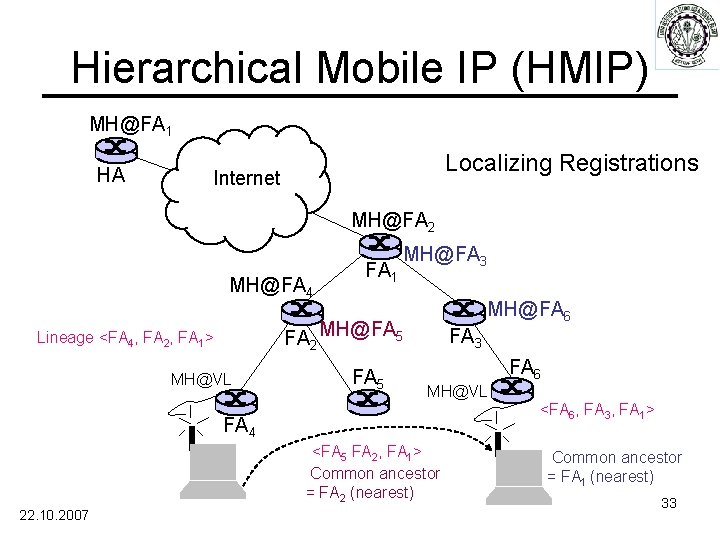
Hierarchical Mobile IP (HMIP) MH@FA 1 HA Localizing Registrations Internet MH@FA 2 MH@FA 4 FA 1 MH@FA 3 MH@FA 6 FA 2 MH@FA 5 Lineage <FA 4, FA 2, FA 1> MH@VL FA 5 FA 3 FA 6 MH@VL <FA 6, FA 3, FA 1> FA 4 <FA 5 FA 2, FA 1> Common ancestor = FA 2 (nearest) 22. 10. 2007 Common ancestor = FA 1 (nearest) 33
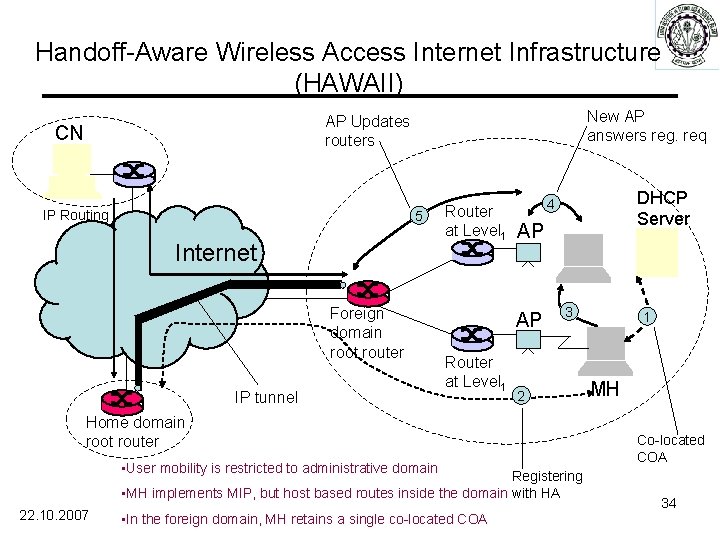
Handoff-Aware Wireless Access Internet Infrastructure (HAWAII) New AP answers reg. req AP Updates routers CN IP Routing 5 Internet Foreign domain root router IP tunnel Router at Level 1 AP AP Router at Level 1 DHCP Server 4 3 2 Home domain root router • User mobility is restricted to administrative domain Registering • MH implements MIP, but host based routes inside the domain with HA 22. 10. 2007 • In the foreign domain, MH retains a single co-located COA 1 MH Co-located COA 34
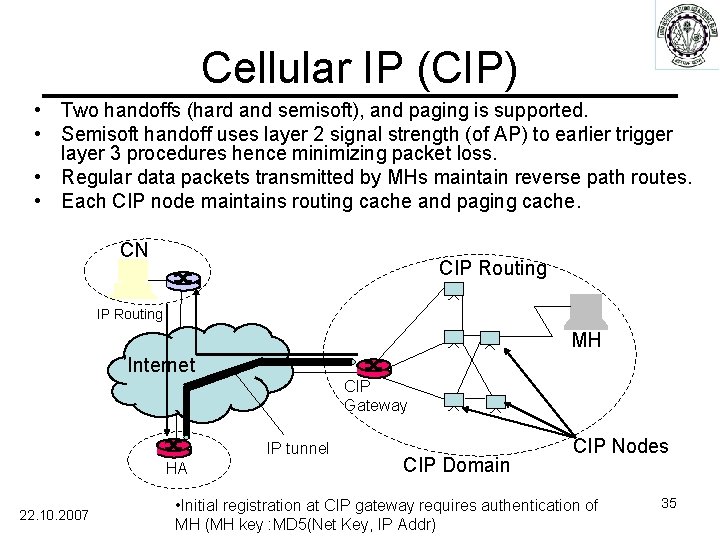
Cellular IP (CIP) • Two handoffs (hard and semisoft), and paging is supported. • Semisoft handoff uses layer 2 signal strength (of AP) to earlier trigger layer 3 procedures hence minimizing packet loss. • Regular data packets transmitted by MHs maintain reverse path routes. • Each CIP node maintains routing cache and paging cache. CN CIP Routing MH Internet CIP Gateway IP tunnel HA 22. 10. 2007 CIP Domain CIP Nodes • Initial registration at CIP gateway requires authentication of MH (MH key : MD 5(Net Key, IP Addr) 35
Mobile IPv 6 (MIPv 6) • Differences between MIPv 4 and MIPv 6 – No FA is needed (no infrastructure change) – Address auto-configuration helps in acquiring COA – MH uses COA as the source address in foreign link, so no ingress filtering – Option headers, and neighbor discovery of IPv 6 protocol are used to perform mobility functions – 128 bit IP addresses help deployment of mobile IP in large environments – Route optimization is supported by header options 22. 10. 2007 36
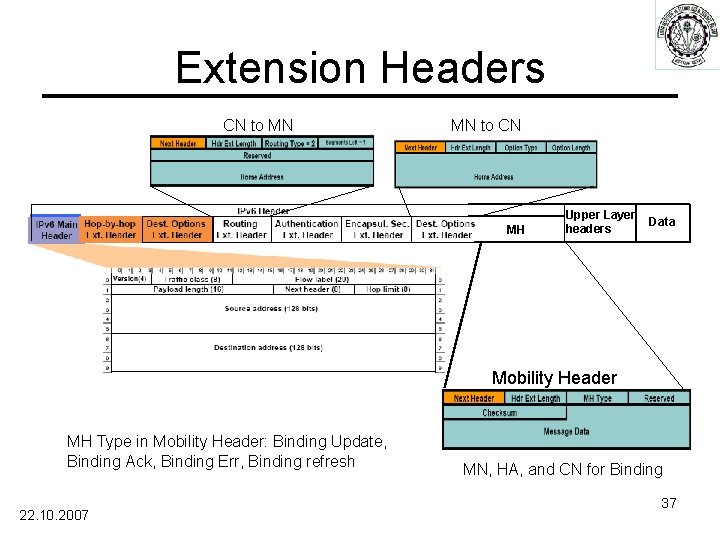
Extension Headers CN to MN MN to CN MH Upper Layer headers Data Mobility Header MH Type in Mobility Header: Binding Update, Binding Ack, Binding Err, Binding refresh 22. 10. 2007 MN, HA, and CN for Binding 37
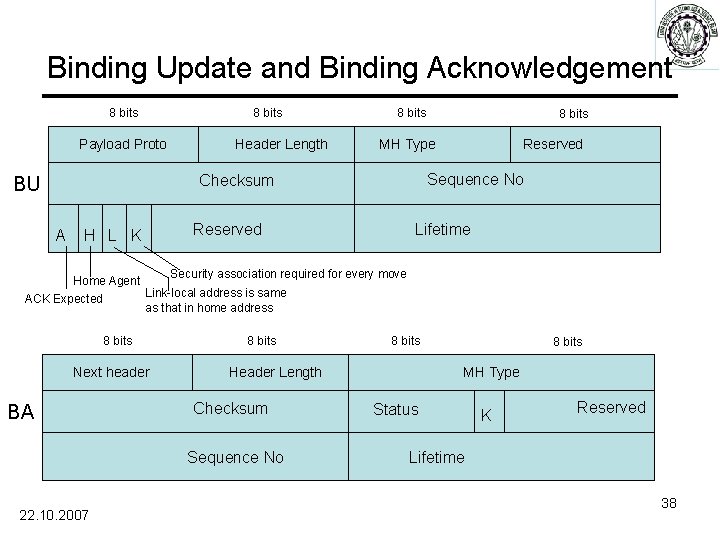
Binding Update and Binding Acknowledgement 8 bits Payload Proto 8 bits Header Length 8 bits MH Type A H L K Reserved Sequence No Checksum BU 8 bits Reserved Lifetime Security association required for every move Home Agent Link-local address is same ACK Expected as that in home address 8 bits Next header BA 8 bits Header Length Checksum Sequence No 22. 10. 2007 8 bits MH Type Status K Reserved Lifetime 38
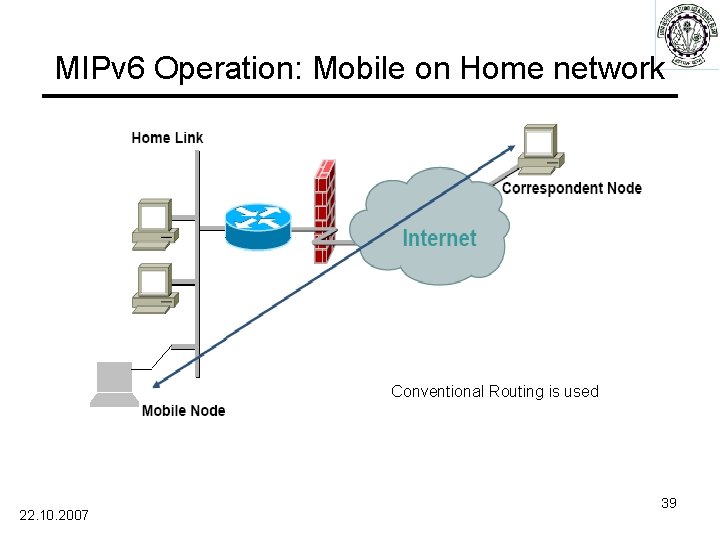
MIPv 6 Operation: Mobile on Home network Conventional Routing is used 22. 10. 2007 39
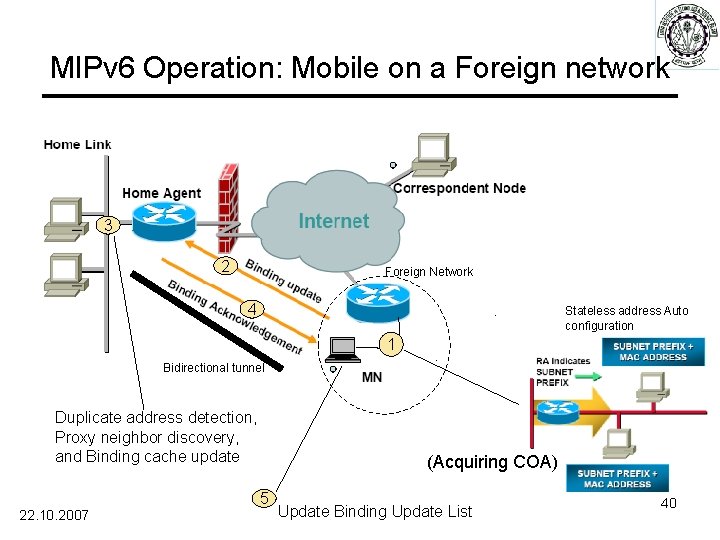
MIPv 6 Operation: Mobile on a Foreign network 3 2 Foreign Network 4 Stateless address Auto configuration 1 Bidirectional tunnel Duplicate address detection, Proxy neighbor discovery, and Binding cache update 22. 10. 2007 5 (Acquiring COA) Update Binding Update List 40
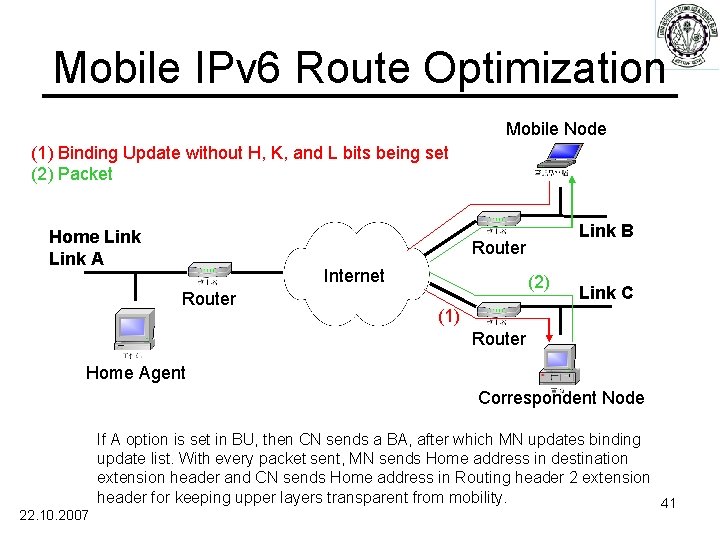
Mobile IPv 6 Route Optimization Mobile Node (1) Binding Update without H, K, and L bits being set (2) Packet Home Link A Link B Router Internet Router (2) Link C (1) Router Home Agent Correspondent Node 22. 10. 2007 If A option is set in BU, then CN sends a BA, after which MN updates binding update list. With every packet sent, MN sends Home address in destination extension header and CN sends Home address in Routing header 2 extension header for keeping upper layers transparent from mobility. 41
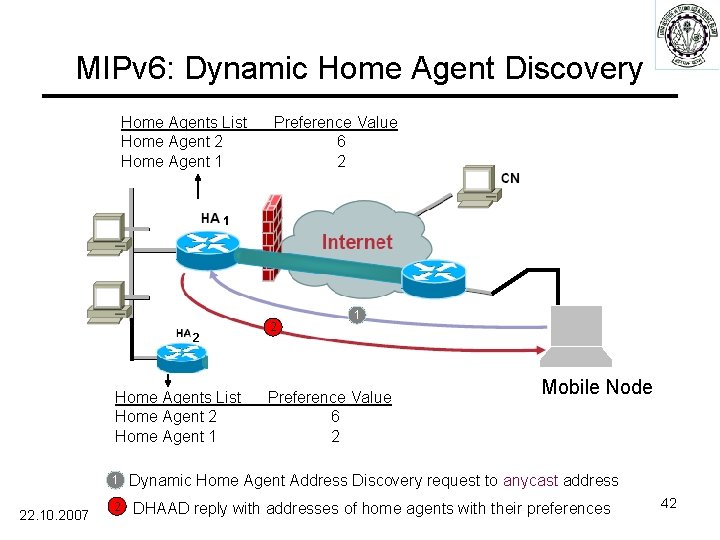
MIPv 6: Dynamic Home Agent Discovery Home Agents List Preference Value Home Agent 2 6 Home Agent 1 2 2 1 Home Agents List Preference Value Home Agent 2 6 Home Agent 1 2 22. 10. 2007 Mobile Node 1 Dynamic Home Agent Address Discovery request to anycast address 2 DHAAD reply with addresses of home agents with their preferences 42
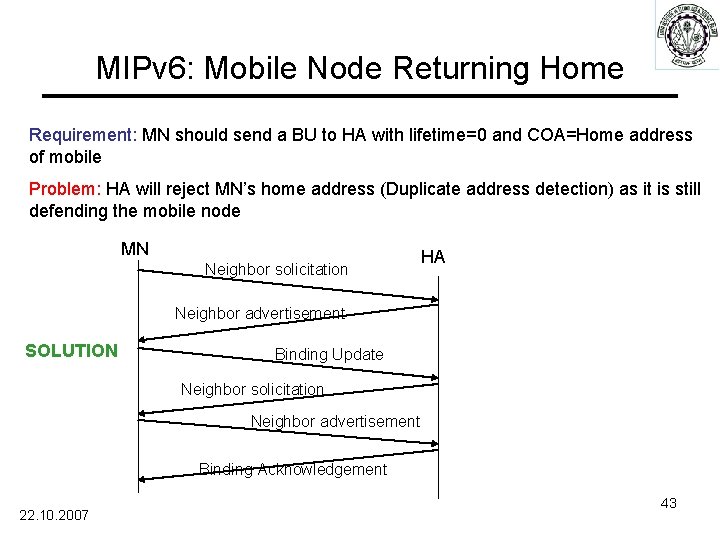
MIPv 6: Mobile Node Returning Home Requirement: MN should send a BU to HA with lifetime=0 and COA=Home address of mobile Problem: HA will reject MN’s home address (Duplicate address detection) as it is still defending the mobile node MN Neighbor solicitation HA Neighbor advertisement SOLUTION Binding Update Neighbor solicitation Neighbor advertisement Binding Acknowledgement 22. 10. 2007 43
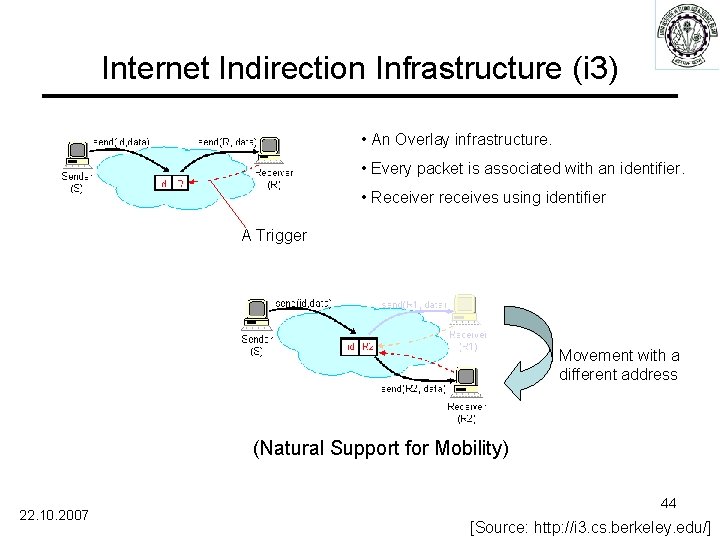
Internet Indirection Infrastructure (i 3) • An Overlay infrastructure. • Every packet is associated with an identifier. • Receiver receives using identifier A Trigger Movement with a different address (Natural Support for Mobility) 22. 10. 2007 44 [Source: http: //i 3. cs. berkeley. edu/]
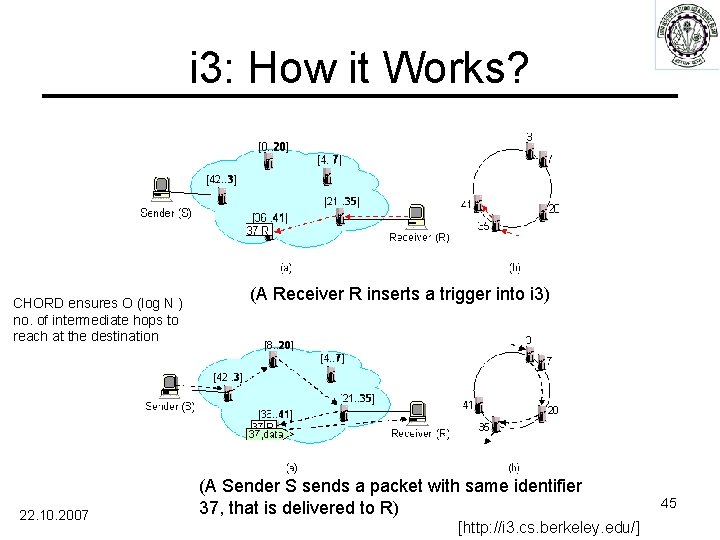
i 3: How it Works? CHORD ensures O (log N ) no. of intermediate hops to reach at the destination 22. 10. 2007 (A Receiver R inserts a trigger into i 3) (A Sender S sends a packet with same identifier 37, that is delivered to R) [http: //i 3. cs. berkeley. edu/] 45
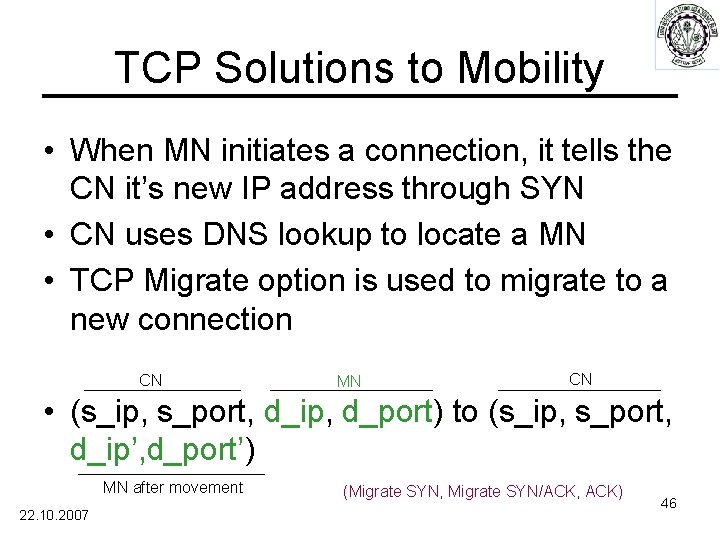
TCP Solutions to Mobility • When MN initiates a connection, it tells the CN it’s new IP address through SYN • CN uses DNS lookup to locate a MN • TCP Migrate option is used to migrate to a new connection CN MN CN • (s_ip, s_port, d_ip, d_port) to (s_ip, s_port, d_ip’, d_port’) MN after movement 22. 10. 2007 (Migrate SYN, Migrate SYN/ACK, ACK) 46
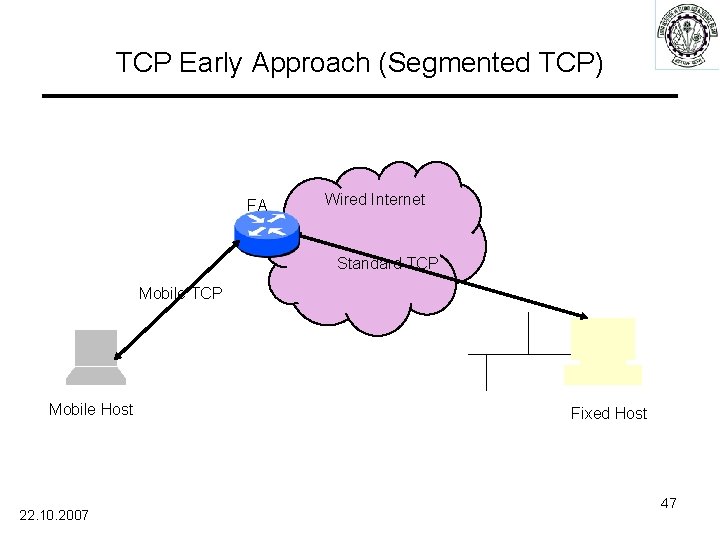
TCP Early Approach (Segmented TCP) FA Wired Internet Standard TCP Mobile Host 22. 10. 2007 Fixed Host 47
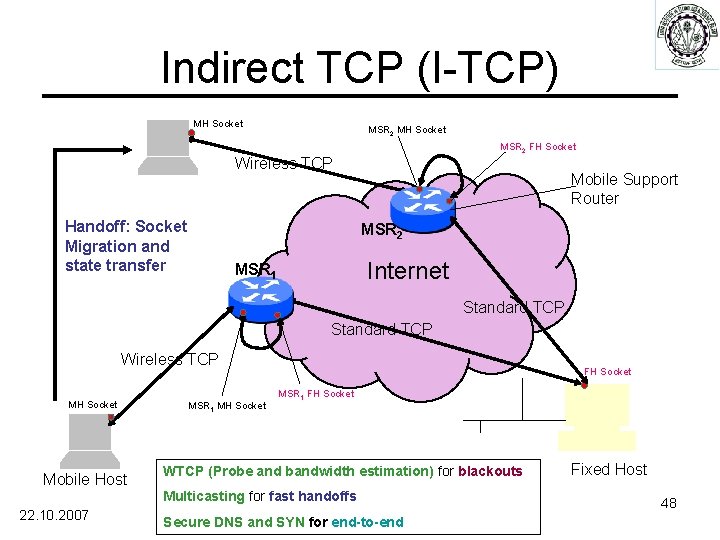
Indirect TCP (I-TCP) MH Socket MSR 2 FH Socket Wireless TCP Handoff: Socket Migration and state transfer Mobile Support Router MSR 2 Internet MSR 1 Standard TCP Wireless TCP MH Socket Mobile Host MSR 1 MH Socket FH Socket MSR 1 FH Socket WTCP (Probe and bandwidth estimation) for blackouts Multicasting for fast handoffs 22. 10. 2007 Secure DNS and SYN for end-to-end Fixed Host 48
Mobility using Session Initiation Protocol (SIP) • A Signaling Protocol • Originally used for negotiating media sessions between end systems • Media may go through different networks • Other uses: Conferencing, Vo. IP, Instant Messaging etc. • Elements (SIP user agent, Servers, and Gateways) • Addressing (URLs) e. g. name@domain and supports both Internet and PSTN address 22. 10. 2007 49
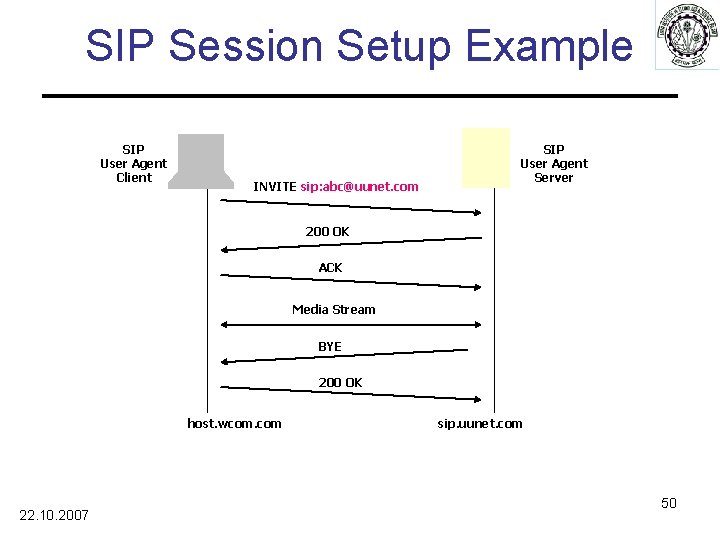
SIP Session Setup Example SIP User Agent Client INVITE sip: abc@uunet. com SIP User Agent Server 200 OK ACK Media Stream BYE 200 OK host. wcom. com 22. 10. 2007 sip. uunet. com 50
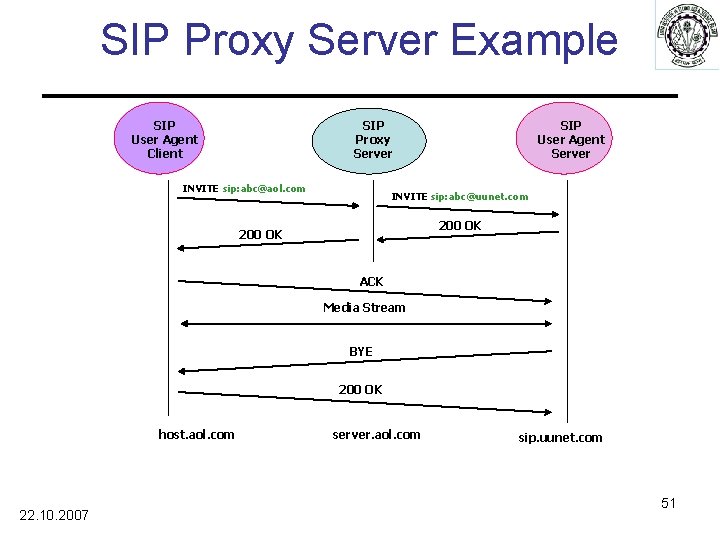
SIP Proxy Server Example SIP User Agent Client SIP Proxy Server INVITE sip: abc@aol. com SIP User Agent Server INVITE sip: abc@uunet. com 200 OK ACK Media Stream BYE 200 OK host. aol. com 22. 10. 2007 server. aol. com sip. uunet. com 51
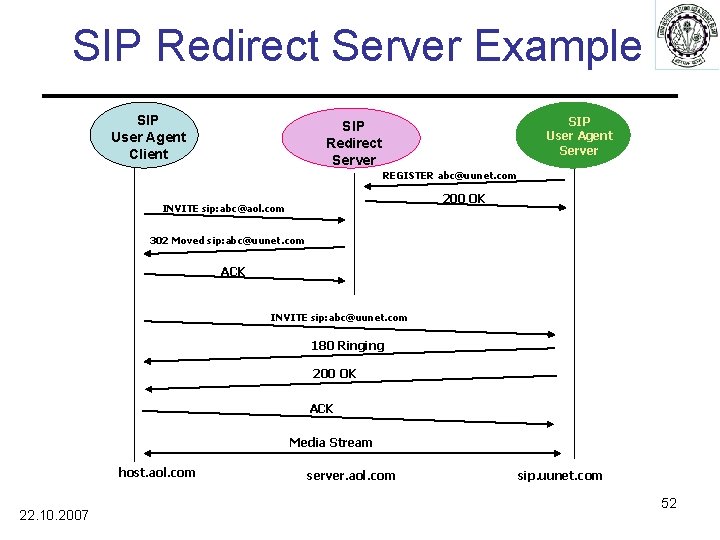
SIP Redirect Server Example SIP User Agent Client SIP User Agent Server SIP Redirect Server REGISTER abc@uunet. com 200 OK INVITE sip: abc@aol. com 302 Moved sip: abc@uunet. com ACK INVITE sip: abc@uunet. com 180 Ringing 200 OK ACK Media Stream host. aol. com 22. 10. 2007 server. aol. com sip. uunet. com 52
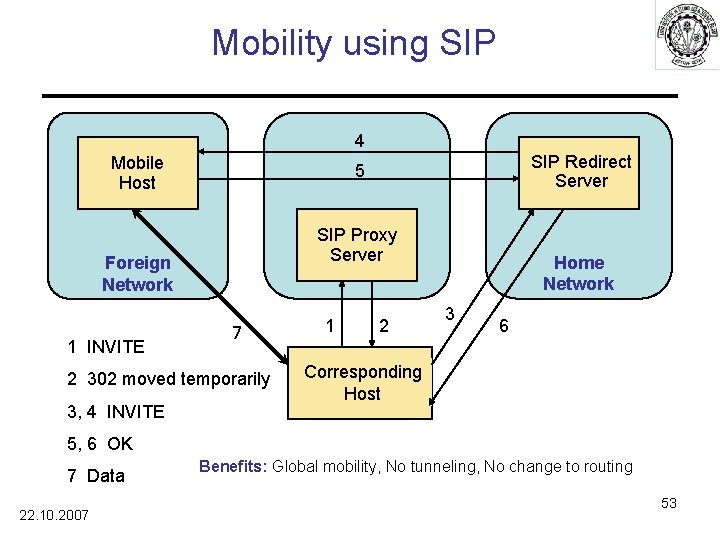
Mobility using SIP 4 Mobile Host SIP Proxy Server Foreign Network 1 INVITE 7 2 302 moved temporarily 3, 4 INVITE SIP Redirect Server 5 1 2 Home Network 3 6 Corresponding Host 5, 6 OK 7 Data 22. 10. 2007 Benefits: Global mobility, No tunneling, No change to routing 53
NEtwork. MObility (NEMO) • New Requirement – Users can access the Internet from anywhere at anytime using any device. • Host Mobility vs Network Mobility – A single user on move (MIP, MIPv 6, SIP etc. ), A set of users as a unit on move (NEMO BSP, HMIPv 6) • Benefits of NEMO – Reduced transmission power because of reduced transmission distance between mobile nodes and MR (only MR needs more power). – Supporting movement of incapable MIPv 6 nodes within the mobile network (MR handles all the mobility transparently) – Less signaling overhead, and less bandwidth consumption – Easier management (MR is the central point) 22. 10. 2007 54
![NEMO Applications (IP enabled devices in aircraft) [Source: CISCO] (Internet Car) MR Bluetooth (Personal](http://slidetodoc.com/presentation_image_h/a22f9a88b123b5900bad2db2d197e94d/image-55.jpg "NEMO Applications (IP enabled devices in aircraft) [Source: CISCO] (Internet Car) MR Bluetooth (Personal")
NEMO Applications (IP enabled devices in aircraft) [Source: CISCO] (Internet Car) MR Bluetooth (Personal Area Network) 22. 10. 2007 55
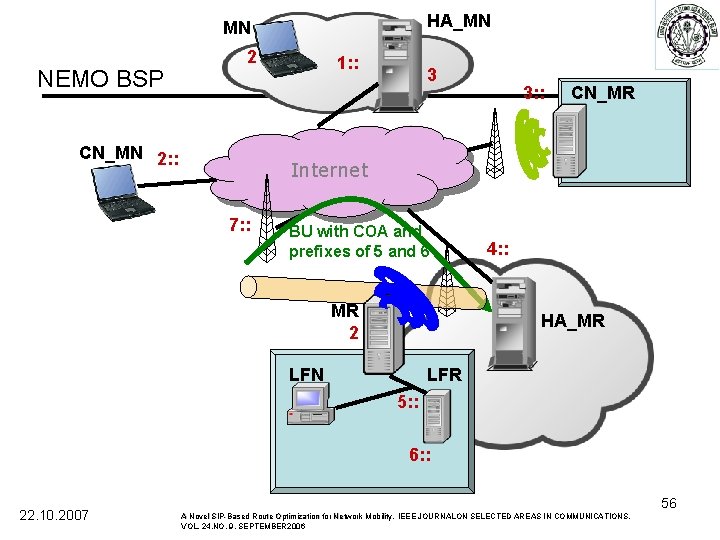
HA_MN MN NEMO BSP 2 CN_MN 2: : 1: : 3 3: : CN_MR Internet 7: : BU with COA and prefixes of 5 and 6 MR 2 4: : HA_MR LFN LFR 5: : 6: : 22. 10. 2007 56 A Novel SIP-Based Route Optimization for Network Mobility, IEEE JOURNALON SELECTED AREAS IN COMMUNICATIONS, VOL. 24, NO. 9, SEPTEMBER 2006
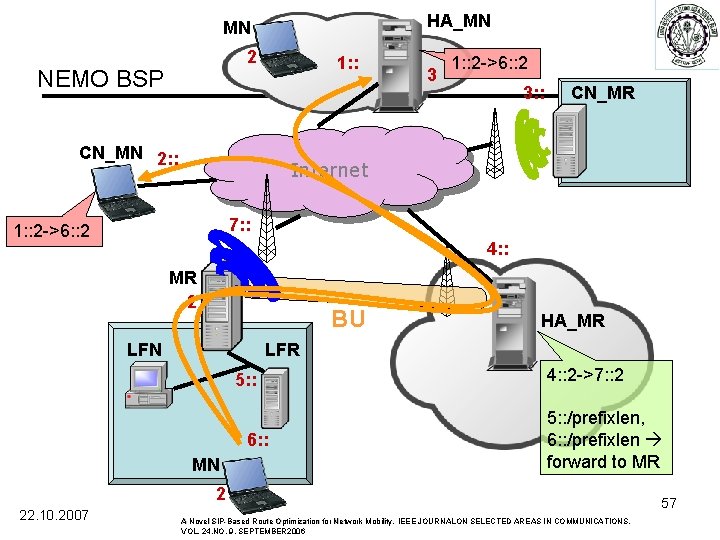
HA_MN MN 2 NEMO BSP 1: : CN_MN 2: : 3 1: : 2 ->6: : 2 3: : CN_MR Internet 7: : 1: : 2 ->6: : 2 4: : MR 2 BU LFN HA_MR LFR 5: : 6: : MN 4: : 2 ->7: : 2 5: : /prefixlen, 6: : /prefixlen forward to MR 2 22. 10. 2007 A Novel SIP-Based Route Optimization for Network Mobility, IEEE JOURNALON SELECTED AREAS IN COMMUNICATIONS, VOL. 24, NO. 9, SEPTEMBER 2006 57
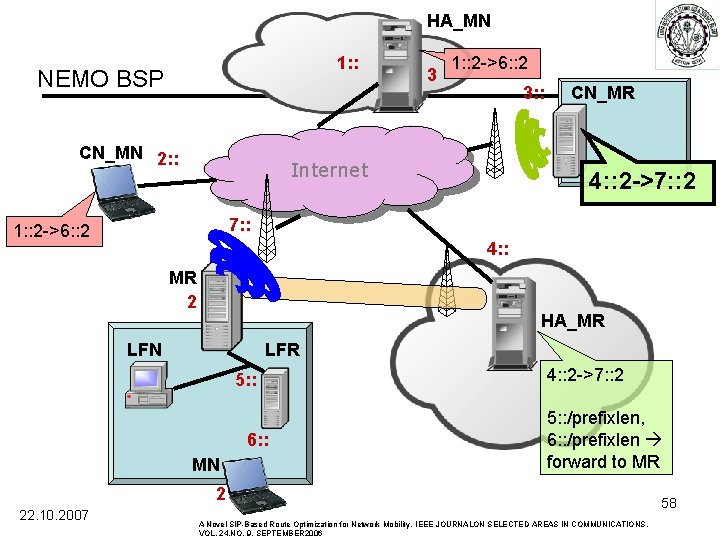
HA_MN 1: : NEMO BSP CN_MN 2: : 3 1: : 2 ->6: : 2 3: : Internet CN_MR 4: : 2 ->7: : 2 7: : 1: : 2 ->6: : 2 4: : MR 2 HA_MR LFN LFR 5: : 6: : MN 4: : 2 ->7: : 2 5: : /prefixlen, 6: : /prefixlen forward to MR 2 22. 10. 2007 A Novel SIP-Based Route Optimization for Network Mobility, IEEE JOURNALON SELECTED AREAS IN COMMUNICATIONS, VOL. 24, NO. 9, SEPTEMBER 2006 58
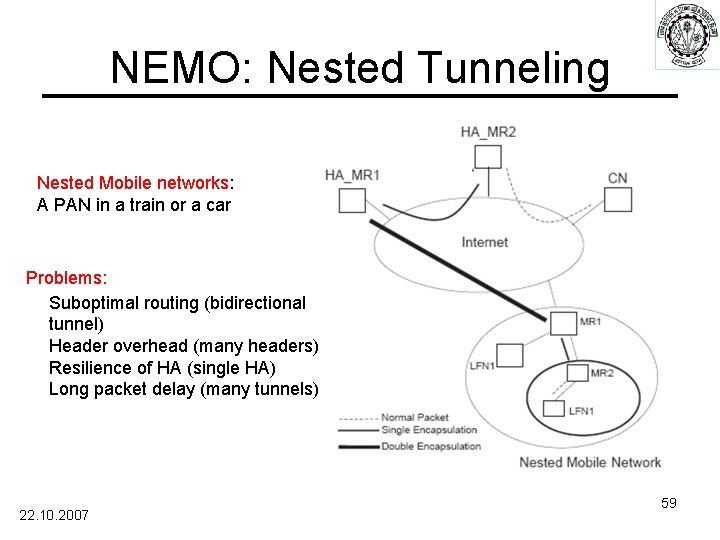
NEMO: Nested Tunneling Nested Mobile networks: A PAN in a train or a car Problems: Suboptimal routing (bidirectional tunnel) Header overhead (many headers) Resilience of HA (single HA) Long packet delay (many tunnels) 22. 10. 2007 59
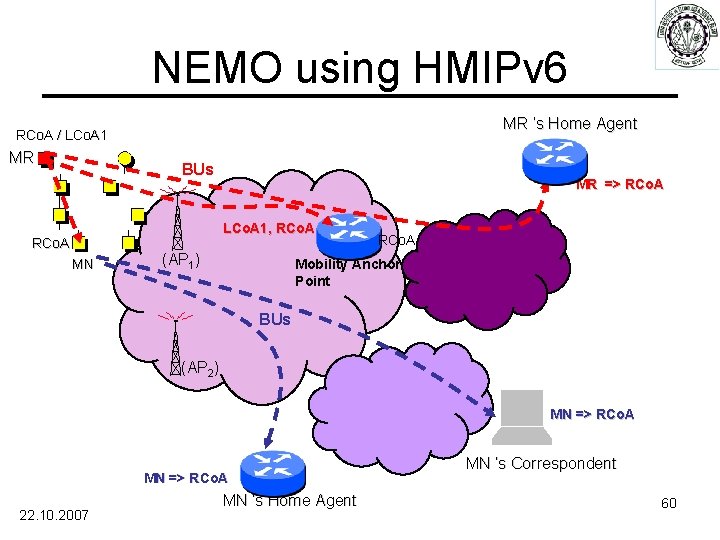
NEMO using HMIPv 6 MR ’s Home Agent RCo. A / LCo. A 1 MR BUs MR => RCo. A LCo. A 1, RCo. A MN (AP 1) RCo. A Mobility Anchor Point BUs (AP 2) MN => RCo. A 22. 10. 2007 MN ’s Home Agent MN ’s Correspondent 60
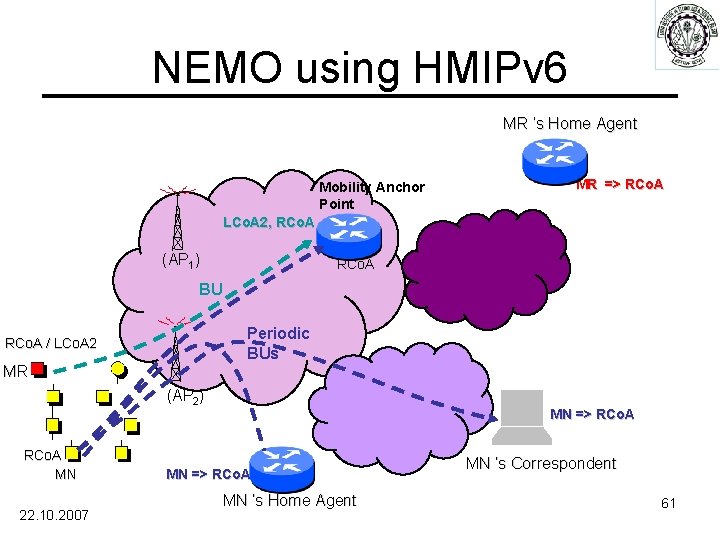
NEMO using HMIPv 6 MR ’s Home Agent Mobility Anchor Point MR => RCo. A LCo. A 2, RCo. A (AP 1) RCo. A BU Periodic BUs RCo. A / LCo. A 2 MR (AP 2) RCo. A MN 22. 10. 2007 MN => RCo. A MN ’s Home Agent MN ’s Correspondent 61
Mobility: Technical Challenges • • Minimizing handoff latency and packet loss Signaling overhead Security Mobile IPv 6 Quality of Service guarantee during handover Mobile. NAT Cross-Layer solutions Standard Interfaces 22. 10. 2007 62
References 1. Mobile IP: Design Principles and Practices, Charles E. Perkins, Addition-Wesley Wireless communication series, AW, 1998. 2. Mobile IPv 6: Mobility in a Wireless internet, Hesham Soliman, PE, 2005. 3. IP Mobility Support for IPv 4, RFC 3220, Jan 2002. 4. Gustafsson, Jonsson, Perkins, Mobile IPv 4 Regional Registration, Internet draft, draft-ietf-mobileip-reg-tunnel-06. txt, Mar 2002. 5. R. Ramjee, T. Porta, S. Thuel, K, Varadhan, HAWAII: A Domain based approach for supporting mobility in wide area wireless networks, Proc. 7 th International Conference on Network Protocols, Toronto, 1999, pp. 283 -292. 6. A. T. Campbell, J. Gomez, et. al. , Design, Implementation and Evaluation of Cellular IP, IEEE Personal Communications, Aug 2000. 7. B. R. Badrinath, A. Bakre, I-TCP: Indirect TCP for Mobile Hosts, Proc. IEEE 15 th International Conference on Distributing Computing Systems (ICDCS), May 1995. 8. Mobility over Transport Control Protocol/Internet Protocol (TCP/IP), J. Ferreira, M. Mara, Nelson L, The Handbook of Ad Hoc Wireless Networks, 2003, CRC Press, pp. 1 -11. 9. Internet Indirection Infrastructure (i 3), Available from: http: //i 3. cs. berkeley. edu/ 10. Mobility Support in IP: A Survey of Related Protocols, Debashis Saha, Amitava Mukherjee, et. al. , IEEE Network, Nov-Dec 2004, pp. 34 -40. 11. Mobile Networking in the Internet, Charles E. Perkins, Mobile Networks and Applications, 1998, BV, pp. 319 -334. 12. Quality of Service and Mobility for the Wireless Internet, J. Antonio Garcia-Macias, et. al. , Wireless Networks, Kluwer Academic Publishers, 2003, pp. 341 -352. 13. Mobile. NAT: A New Technique for Mobility Across Heterogeneous Address Spaces, M. Buddhikot, A. Hari, et. al. , Mobile Networks and Applications, Springer Science, 2005, pp. 289 -302. 14. WTCP: A Reliable Transport Protocol for Wireless Wide Area Networks, P. Sinha, N. venkitaraman, R. Sivakumar, and V. Bharghavan, In Proc. of ACM Mobicom’ 99, Aug 1999. 22. 10. 2007 63

Thank you! Questions 22. 10. 2007 64
- Slides: 64