
Mobility and Gait Evaluation and Management M Kathy
Mobility and Gait – Evaluation and Management M. Kathy Wiley, MD, MS Cathryn Caton, MD, MS
Objectives Understand morbidity and mortality factors associated with falls in elders. Identify fall risk factors. Evaluate medications that may increase fall risk. Demonstrate the evaluation of gait & mobility in elderly patients. Implement appropriate referral and self-management education

Incidence of Falls >1/3 of ambulatory elderly fall each year ◦ For patients with no risk factors, fall risk is 8% ◦ For patients with 4 or more risk factors, fall risk is 78% In 2005 1. 8 million older adults fell ◦ Approximately 15, 800 died from their injuries In South Carolina, over a 6 year period (1996 – 2002) ◦ 26, 298 hip fractures ~ 4400 per year
Cost of Falls In 2002 direct costs for ◦ Fatal falls totaled $0. 2 B ◦ Non-fatal fall-related injuries totaled $19 B In South Carolina ◦ An average charge of $21, 398 is associated with hospitalization per hip fracture repair

Consequences of Falls Physical – Fall-related injuries ◦ 5 – 15% of falls result in fractures or serious soft tissue injuries ◦ Account for ~ 10% of ED visits and 6% of urgent hospitalizations ◦ Loss of function or immobility ◦ Death Social – impacts quality of life Psychological -efficacy – Fall-related fear & loss of self

Self-Efficacy Beliefs in one’s capabilities to organize and execute the courses of action required to produce a given attainment Influenced by ◦ Having relevant skills ◦ Past experiences ◦ Observation of the experiences of others ◦ Social persuasion including provider influence
Case 79 y/o woman presents for f/u CHF, arthritis, depression, difficulty sleeping Medications: antidepressant, diuretic, ACE-I, Beta-Blocker. Also takes OTC sleep and allergy meds Chronic conditions appear stable Daughter reports 2 falls in the past 6 months
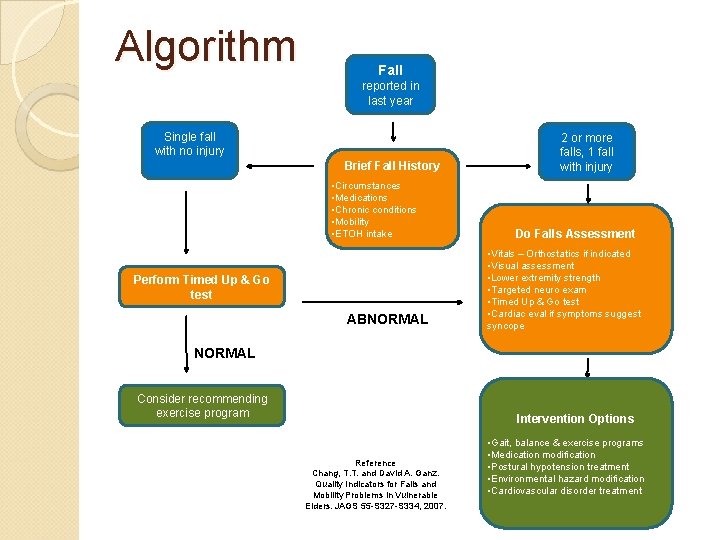
Algorithm Fall reported in last year Single fall with no injury Brief Fall History • Circumstances • Medications • Chronic conditions • Mobility • ETOH intake Perform Timed Up & Go test ABNORMAL 2 or more falls, 1 fall with injury Do Falls Assessment • Vitals – Orthostatics if indicated • Visual assessment • Lower extremity strength • Targeted neuro exam • Timed Up & Go test • Cardiac eval if symptoms suggest syncope NORMAL Consider recommending exercise program Intervention Options Reference Chang, T. T. and David A. Ganz. Quality Indicators for Falls and Mobility Problems in Vulnerable Elders. JAGS 55 -S 327 -S 334, 2007. • Gait, balance & exercise programs • Medication modification • Postural hypotension treatment • Environmental hazard modification • Cardiovascular disorder treatment
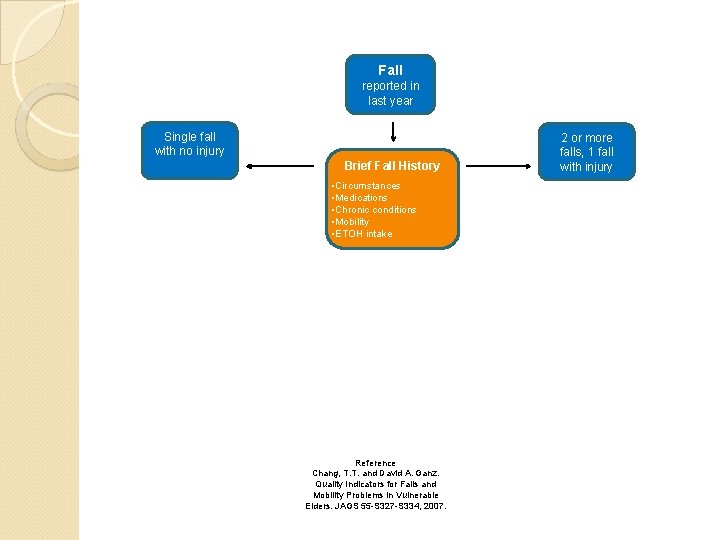
Fall reported in last year Single fall with no injury Brief Fall History • Circumstances • Medications • Chronic conditions • Mobility • ETOH intake Reference Chang, T. T. and David A. Ganz. Quality Indicators for Falls and Mobility Problems in Vulnerable Elders. JAGS 55 -S 327 -S 334, 2007. 2 or more falls, 1 fall with injury
History Ask all patients about falls in past year Establish if recurrent vs. single episode Determine circumstances of fall- “true fall vs. syncope” Evaluate associated symptoms – dizziness, lightheadedness, vision disturbance, LOC, gait or balance problems Determine whether injury occurred Review medications – number of medications (4 or more increases fall risk) recent changes, sedating drugs, narcotics (Beers’ List)
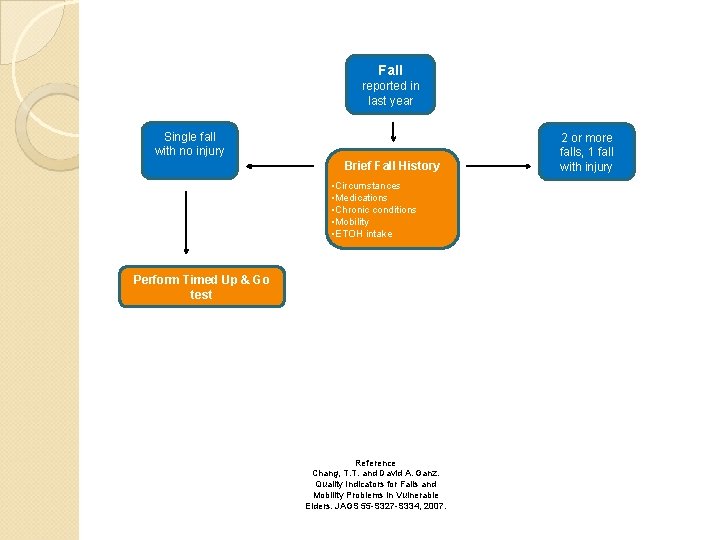
Fall reported in last year Single fall with no injury Brief Fall History • Circumstances • Medications • Chronic conditions • Mobility • ETOH intake Perform Timed Up & Go test Reference Chang, T. T. and David A. Ganz. Quality Indicators for Falls and Mobility Problems in Vulnerable Elders. JAGS 55 -S 327 -S 334, 2007. 2 or more falls, 1 fall with injury
Timed Up & Go Test Patient can use arms or assistive device – must document if either is used Explain the test to the patient Demonstrate the test Do practice trial Perform timed evaluation
Timed Up & Go Test Patient starts from a seated position Time starts when the patient initiates movement The patient walks 10 ft across the room and circles around a marker Time stops when the patient returns and is seated in the chair
Timed Up & Go Test Average results are as follows ◦ Age 60 – 69 7. 24 seconds ◦ Age 70 – 79 8. 54 seconds

http: //webituponline. com/aging/5. htm
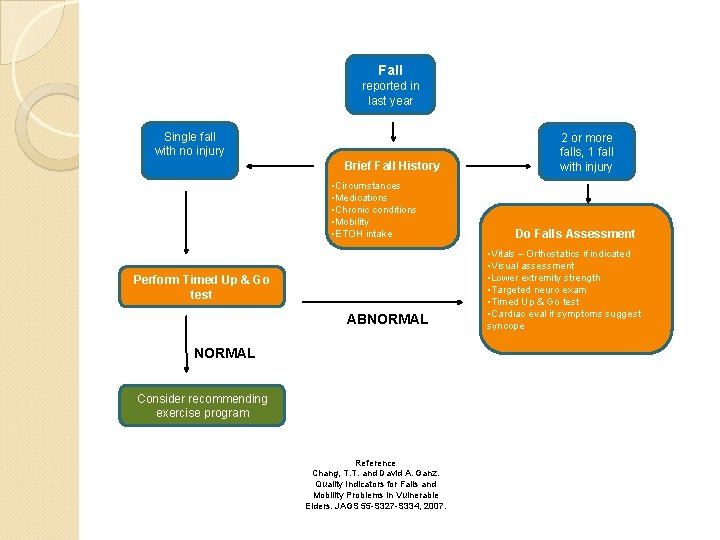
Fall reported in last year Single fall with no injury Brief Fall History • Circumstances • Medications • Chronic conditions • Mobility • ETOH intake Perform Timed Up & Go test ABNORMAL Consider recommending exercise program Reference Chang, T. T. and David A. Ganz. Quality Indicators for Falls and Mobility Problems in Vulnerable Elders. JAGS 55 -S 327 -S 334, 2007. 2 or more falls, 1 fall with injury Do Falls Assessment • Vitals – Orthostatics if indicated • Visual assessment • Lower extremity strength • Targeted neuro exam • Timed Up & Go test • Cardiac eval if symptoms suggest syncope
Physical Exam Check vitals –orthostatics if indicated Visual assessment Test for lower extremity strength Perform targeted neuro exam – proprioception, sensation Perform Timed Up & Go Test – establishes gait and balance abnormalities, normal <10 seconds Do cardiovascular work-up if falls history suggests syncopal event
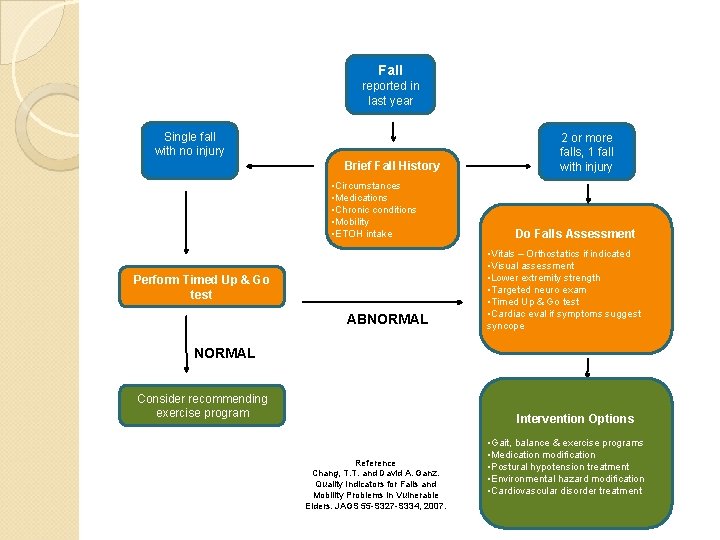
Fall reported in last year Single fall with no injury Brief Fall History • Circumstances • Medications • Chronic conditions • Mobility • ETOH intake Perform Timed Up & Go test ABNORMAL 2 or more falls, 1 fall with injury Do Falls Assessment • Vitals – Orthostatics if indicated • Visual assessment • Lower extremity strength • Targeted neuro exam • Timed Up & Go test • Cardiac eval if symptoms suggest syncope NORMAL Consider recommending exercise program Intervention Options Reference Chang, T. T. and David A. Ganz. Quality Indicators for Falls and Mobility Problems in Vulnerable Elders. JAGS 55 -S 327 -S 334, 2007. • Gait, balance & exercise programs • Medication modification • Postural hypotension treatment • Environmental hazard modification • Cardiovascular disorder treatment
Intervention May require more than one intervention Gait, balance and exercise programs (PT referral, Tai Chi) Medication modification Postural hypotension treatment Environmental hazard modification Cardiovascular disorder treatment if cardiac source is identified as cause of fall
Gait, balance & exercise programs Physical ◦ ◦ ◦ Therapy referral MMSE Geriatric Depression Scale ROM Muscle Performance Quality of gait Ability of patients to multitask – balance while talking on phone, walk and talk ◦ Use of assistive devices ◦ Aging in place
Medication Adjustment Reduction of sedating and narcotic medications – consider Beers’ List Taper to lowest effective dose or stop Be able to justify the addition of a new medication
Postural Hypotension Reduce medications that contribute Teach patients to change position slowly Consider liberalizing salt intake Encourage adequate hydration
Environmental Hazard Modification This may be done as part of the Physical Therapy referral or as a separate Home Health Evaluation Aging in place Hazards include ◦ ◦ ◦ ◦ Clutter Electric cords Slippery throw rugs and loose carpet Poor lighting Lack of stair rails Lack of shower rails / grab bars Proper shoes
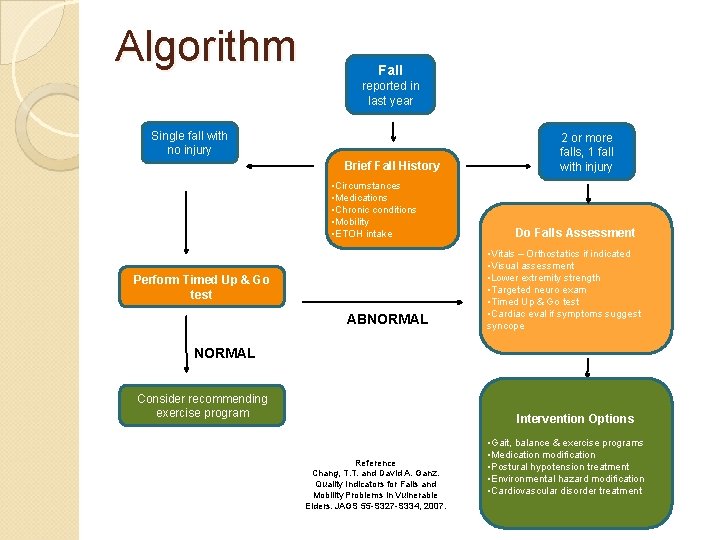
Algorithm Fall reported in last year Single fall with no injury Brief Fall History • Circumstances • Medications • Chronic conditions • Mobility • ETOH intake Perform Timed Up & Go test ABNORMAL 2 or more falls, 1 fall with injury Do Falls Assessment • Vitals – Orthostatics if indicated • Visual assessment • Lower extremity strength • Targeted neuro exam • Timed Up & Go test • Cardiac eval if symptoms suggest syncope NORMAL Consider recommending exercise program Intervention Options Reference Chang, T. T. and David A. Ganz. Quality Indicators for Falls and Mobility Problems in Vulnerable Elders. JAGS 55 -S 327 -S 334, 2007. • Gait, balance & exercise programs • Medication modification • Postural hypotension treatment • Environmental hazard modification • Cardiovascular disorder treatment
Case 79 y/o woman presents for f/u CHF, arthritis, depression, difficulty sleeping Medications: antidepressant, diuretic, ACE-I, Beta-Blocker. Also takes OTC sleep and allergy meds Chronic conditions appear stable Daughter reports 2 falls in the past 6 months
Fall Risk Factors Based on findings of two or more observational studies ◦ Arthritis ◦ Depressive symptoms ◦ Orthostasis ◦ Use of four or more medications ◦ Parkinson’s Disease
Fall Risk Factors Impairment in ◦ Cognition ◦ Vision ◦ Balance and gait ◦ Muscle strength
Fall Risk Factors Medication Classes shown to have strongest link to an increased risk of falling ◦ Serotonin-reuptake inhibitors ◦ Tricyclic antidepressants ◦ Neuroleptic agents ◦ Benzodiazepines ◦ Anticonvulsants ◦ Class IA anti-arrhythmics
Summary We reviewed ◦ Morbidity and mortality factors associated with falls in vulnerable elders ◦ Fall risk factors ◦ Medications that may increase fall risk ◦ Evaluation of gait and mobility in elderly patients ◦ Implement appropriate referral and selfmanagement education
- Slides: 29