
Mobility and Career Development Framework Staff Counci United
Mobility and Career Development Framework Staff Counci United Nations Staff Union Vienna
Objectives • Retain and deploy a dynamic, adaptable and global workforce. • Broader opportunities development. for career • Equal opportunities for service across the United Nations and, for relevant functions, a fair sharing of the burden of service in difficult duty stations.
Opinion of staff in 2010 • In 2010, 55. 5% of staff in Vienna (strongly) agreed with the following statement “I would like the opportunity to move to a duty station other than the one I am currently serving in. ” Only 24. 5% (strongly) disagreed.
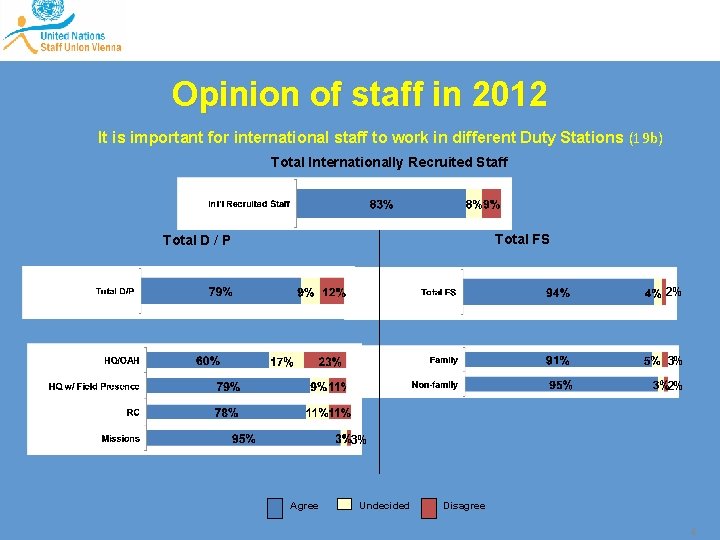
Opinion of staff in 2012 It is important for international staff to work in different Duty Stations (19 b) Total Internationally Recruited Staff Total FS Total D / P 2% 3% Agree Undecided Disagree 4
WHAT IS MOBILITY? • • • a change of role; a change of function; a change of department; a change of duty station; and a move from the Secretariat to a fund, programme or an agency.
• SCOPE All UN Secretariat internationally recruited professional and above and field service staff on fixed term, continuing and permanent appointments, who have been recruited through a competitive process and whose appointments are not limited to service within a specific Department/Office or mission, except staff on nonrotational posts. • A “non-rotational” position is one that requires an advanced level of expertise, knowledge and qualifications in a technical field and where there is no comparable position at the same level in another organizational unit or duty station in the UN Secretariat. • When a staff member is within five years of the mandatory age of separation they will be exempted from geographic mobility, except if the staff member in question specifically
Locally Recruited staff • • • “Managed lateral mobility”; Swaps; Temporary assignments; “Vertical Mobility” -Promotions; and Exceptional consideration: • Relocation. • Internationally recruited General Service. • National Professional Officers.
JOB NETWORKS • Job networks are groupings of job families. In a job family, the same or relatively similar work is performed, a similar skill set is required and it is possible to move within the job family with minimal training. The current job networks (MAGNET, ECONET etc. )
• Each job network has a “Job Network Board” Selection made up of representatives of staff and management in equal numbers and HR/OHRM to review selection and assignment of staff at the FS and P 3 to P 5 levels. • Recommendations for selection and assignment of staff at the D 1 to D 2 levels will be conducted by a single “Senior Review Board” comprised of USGs and ASGs, with prior experience in the UN Common System as a staff member, to the extent possible. Representatives of staff will not be members
POST Occupancy Limits • All staff are subject to minimum and maximum post occupancy limits. Occupancy of a post is governed by three marks: • Mark 1: minimum post occupancy of 1 year. Staff are eligible to apply to new positions after reaching Mark 1. • Mark 2: staff who have reached Mark 2 (12 months before their maximum post occupancy for B to E and 24 months before H and A) will be given priority consideration (see below) when applying for posts. • Mark 3: maximum post occupancy – 7 years for H/A, 4 years for B/C and 3 years for D/E. Staff and their post are placed in a “reassignment pool. ” • For staff who reach the maximum and cannot be reassigned they can be extended for an additional year.
Criteria for Eligibility for Senior Posts at the Managerial Level • To be eligible for managerial posts at the P 5, D 1 and D 2 level, staff members must demonstrate competence and the necessary managerial skills. OHRM will review the possibility of creating a development/assessment process to ensure the managerial capabilities of candidates at the P 5, D 1 and D 2 levels. • To be eligible for P 5, D 1 and D 2 levels, staff members must have at least one prior geographic move of one year or more in their UN common system career.
SPECIAL CONSTRAINTS PANEL • Staff members may request the Special Constraints Panel to remain in the same duty station for their reassignment, based on clear criteria that could include: • medical reasons of the staff member, subject to certification by the UN Medical Services Division; • compelling personal circumstances that a change of duty station would create an undue hardship (this would be weighed against the interest of the Organization and bearing in mind a consistent process for exceptions); and, • any additional criteria identified in the Guidelines of the Special Constraints Panel.
TRANSITIONAL MEASURES • Assuming the General Assembly adopts a resolution on a new mobility framework by 31 December 2012, the following will apply. • New staff members: New staff members joining the Organization on or after 1 January 2013 on a fixedterm appointment will be subject to the mobility policy as of their joining the Organization. • Preparation period: There will be a two-year preparation period starting from 1 January 2013 to 31 December 2014 to allow for the implementation of the mobility policy. • Phased implementation: The implementation of the mobility system will be phased by Job Networks beginning from 1 January 2015.
• TRANSITIONAL MEASURES Eligibility for promotion from P 4 to P 5: Currently serving staff at the P 4 level who have met the lateral move or waiver requirements for eligibility to apply for posts at the P 5 level by 31 December 2012 will continue to be eligible to apply to job openings at the P 5 level in accordance with section 6. 3 of ST/AI/2010/3 for four years from the implementation date (1 January 2015) until 31 December 2018. • As a transitional measure, staff on board as of 31 December 2012 at the P 5 level will be exempt from the requirement for at least one geographic move when applying to job openings at the D 1 level for four years from the implementation date (1 January 2015) until 31 December 2018.
- Slides: 14