
Mobilising Community Strengths and Assets Social Work Student
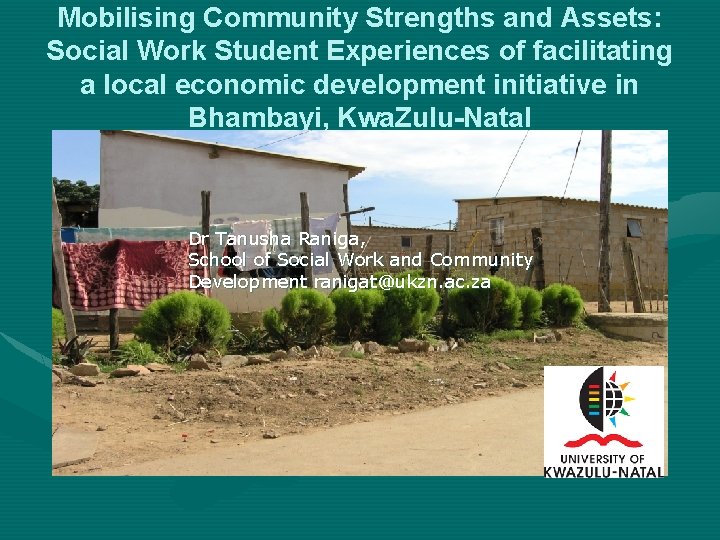
Mobilising Community Strengths and Assets: Social Work Student Experiences of facilitating a local economic development initiative in Bhambayi, Kwa. Zulu-Natal Dr Tanusha Raniga, School of Social Work and Community Development ranigat@ukzn. ac. za
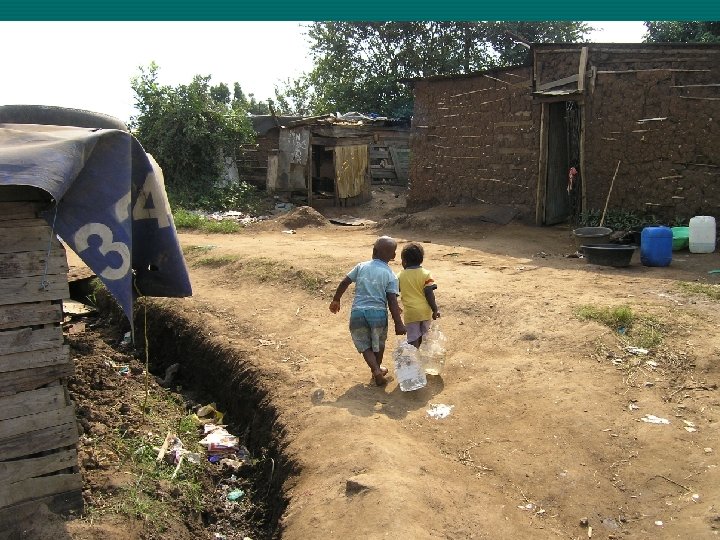

COMMUNITY DEVELOPMENT CHALLENGES • Seventeen years since the advent of the new political dispensation, the South African government has challenged the higher education sector to be more inclusive and responsive to the socioeconomic challenges facing poor communities • Educators of health and social service professionals must consider how best to prepare students to respond appropriately to meet these challenges (Rohleder,
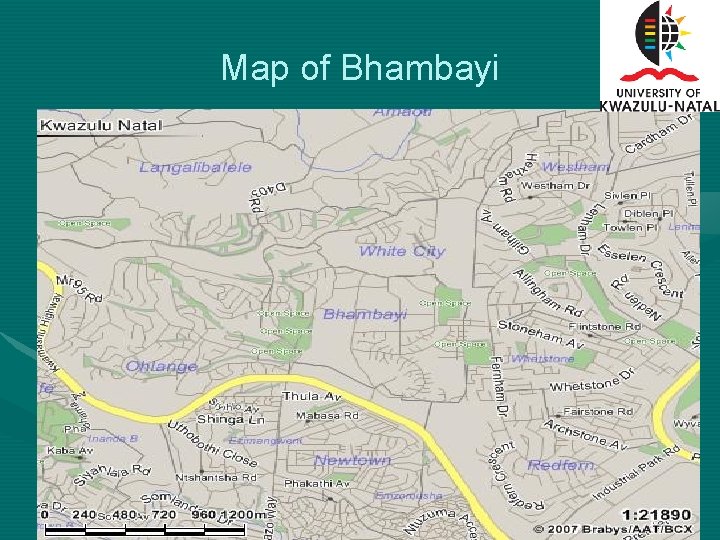
Map of Bhambayi

COMMUNITY ENGAGEMENT IN BHAMBAYI • Bhambayi is a mixed formal/informal community situated in Inanda about 30 km North of Durban City Centre • In the early 1990 s Bhambayi was considered one of the most politically volatile communities in the country and many people lost their lives • It was in 1992 that the School of Social Work at then University of Natal were approached by community members to
Continued • For the past 15 years academic staff and students have provided consistent counselling, group work and community work services to residents. • In 2007 as a response to the increasing and complex development problems, community members and a team of academics embarked on study to investigate the effects of poverty and HIV and AIDS on households
PURPOSE OF THE BROADER STUDY • To explore the impact of poverty on households • To determine the nature and number of social services people receive from government departments, NGO’s and churches • To determine the extent to which people depend on informal helping networks to assist them
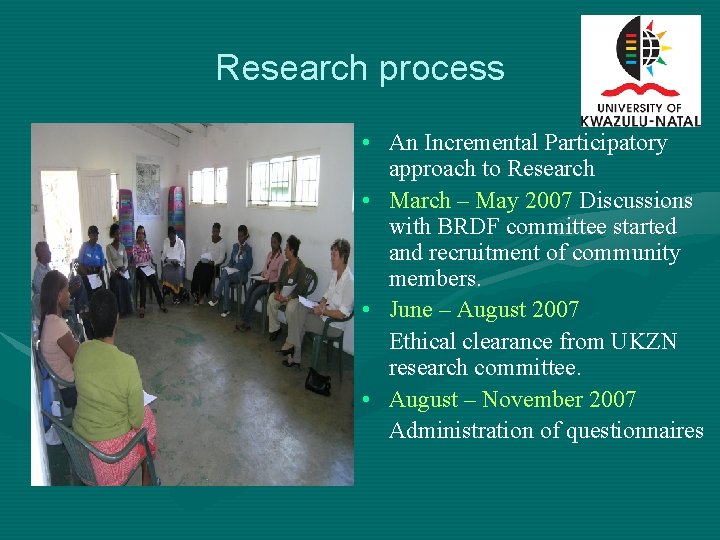
Research process • An Incremental Participatory approach to Research • March – May 2007 Discussions with BRDF committee started and recruitment of community members. • June – August 2007 Ethical clearance from UKZN research committee. • August – November 2007 Administration of questionnaires
PUBLICATION OUTPUT • Raniga, T and Simpson B. (2010). Grandmothers Bearing the Brunt of HIV/AIDS in Bhambayi. Kwa. Zulu-Natal. Social Work Practitioner-Researcher. Vol 22(1), 1 -18. Simpson B and Raniga T (2010). Who Gets and Who Doesn’t: Reflections on the Up-take of the Child Support Grant in Bhambayi, South Africa. Loyola Journal of Social Sciences, Vol XXIV (2), July-Dec 2010.
Continued • Raniga T and Mathe S. (2011). Private Lives Public Issues: Childbearing Experiences of Adolescent Mothers in Bhambayi, South Africa. Social Work/Maatskaplike Werk Vol 47(3), 338349. • Raniga T and Simpson B (2011). Poverty, HIV/AIDS and the Old Age Pension: An Analysis of Older Persons in Bhambayi, Kwa. Zulu-Natal, South Africa. Development
PURPOSE OF THIS PHASE OF THE STUDY • To explore the challenges experienced by social work students in the implementation of the Sustainable Livelihood Model in the facilitation of a community garden project in Bhambayi • A total of 10 social work students have been involved in the initiation, implementation, monitoring and evaluation of this local economic development project since 2009.

DEVELOPMENTAL SOCIAL WELFARE POLICY AND THE SUSTAINABLE LIVELIHOOD MODEL • Post 1994 the development approach to social welfare as enshrined in the White Paper on Social Welfare (1997) was a direct response to the post-apartheid vision to eradicate poverty and promote conditions for the reconstruction and development of the majority of the black population (Weyers 2011, Lombard 2008). • This paradigm emphasizes that social development is contingent on economic
Continued • It stresses that economic development will have very little meaning if it is not accompanied by improvements in social wellbeing of people challenged by poverty (Sewpaul 2005, Gray 2006, Raniga and Simpson 2010). • The Sustainable Livelihoods Approach has emerged as a key intervention model to improve the social and economic profile of communities through increasing opportunities to generate income, strengthening social networks within and outside the community and improving the utilisation of assets and resources in order to
Continued • The process of developing projects is based on collective co-operation and action where local people have the power to change the conditions impacting the quality of their lives. • It builds on the strengths that communities possess five sets of livelihood assets: human capital, natural capital, financial capital, social capital and physical capital
Continued • Underlying principles that guide practice is “valuing local knowledge, local strengths and assets, local processes and local culture” (Ife and Tesseriero 2006: 85). • Social work students receive much of this theory in a module taught to them in third year: ‘Engaging communities in action’- SOWK 305 • In order to explore the challenges of bridging this theory in practice in Bhambayi, four thematic areas are explored: development processes, knowledge and skills, challenges experienced and good practice principles.
TRANSFORMATIVE ACTION METHODOLOGY • Consistent with these objectives, since 2009 social work students have partnered with the Siyazama support group in Bhambayi to initiate, implement and evaluate a community garden project using the sustainable livelihood model. • Participatory action methodology has been embraced to address “issues of research relevance, community involvement, democracy, emancipation and social
RESEARCH PROCESS • In 2009 2 social work students and 1 academic entered into a partnership with members of the Siyazama support group (15) to explore options to embark on a local economic development project using the SLF • As action research is cyclical and incremental in nature, in 2010 4 students and 1 academic and 15 support group members were involved in experiential
CONTINUED • In 2011 4 students, 2 academics and 15 community members are involved in the monitoring and evaluation of the garden project using SLF • Data collection methods include minutes of team meetings, participant observation, focus group sessions with community members, individual interviews with students, monthly field reports
BRIDGING THE GAP BETWEEN THEORY AND PRACTICE • Post 1994 social workers have experienced challenges integrating macro level intervention strategies such as the Sustainable Livelihood Framework in poverty alleviation projects. • It is envisaged that this study will contribute to understanding the relationship between community development processes and SLF, thereby informing interventions in other similar
CONTINUED • It is also providing me with the opportunity to make my teaching of the ‘Engaging communities in action’ module more responsive to practice realities thereby enhancing the output of a cadre of critically reflexive and socially responsive social work professionals.
- Slides: 20