
MobileWireless Networking Overview and Principles Dimitrios Koutsonikolas 02032016
Mobile/Wireless Networking: Overview and Principles Dimitrios Koutsonikolas 02/03/2016 These slides contain material developed by Chunyi Peng for CSE 5469 at OSU and by Kurose-Ross

Family of Networks Core Network (tier-1 ISP) Data center Internet Access (Edge) networks ATM CDN … Wireless networks Ethernet (LAN) Mobile networks Cable, DSL … Fiber optic Wi. Fi (802. 11 a/b/g/n/ac…) 4 G/3 G: LTE, HSPA, EVDO, UMTS, … Wi. Max, Satellite …. whitespace 60 GHz Bluetooth, NFC (RFID), WSN, … (not strictly) 2

Family of Networks Internet Interconnection Access networks end-to-end layering: TCP/IP packet switched … Wireless networks Edge last hop Mobile networks Wireless broadcast Interference coverage … Mobility 3
DESIGN GUIDELINES FOR INTERNET & WIRELESS MOBILE NETWORKS 4
Design Guidelines • The foundation for wireless networking is the Internet design guidelines – End-to-end argument – Always applicable? 5
Key Design Decision • How do you divide functionalities among layers and across different components in the network? – Given the freedom to implement a few functionalities in multiple “places” of the system (physical devices, or protocol layers), where to implement them? • Goals: – Correctness, completeness, performance tradeoffs 6
Options • Telcom approach: “Smart CORE, Dumb Terminal” – The core ensures reliability • TCP/IP approach: “Smart Terminal, Dumb CORE” – The terminal ensures reliability, while the core retains simplicity – Implicit assumption made: terminals have more capabilities: computing power, storage, memory, etc. 7
End-to-End Argument • Think twice before implementing a functionality that is useful to an application at a lower layer • If the application can implement a functionality correctly, implement it a lower layer only as a performance enhancement 8
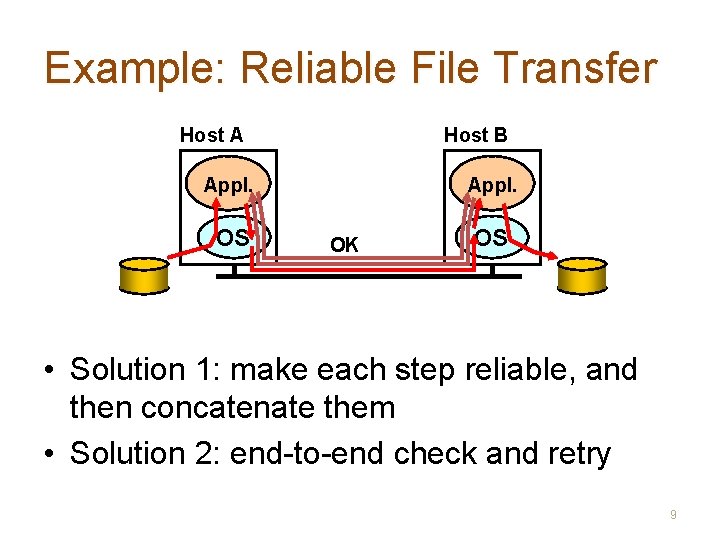
Example: Reliable File Transfer Host A Host B Appl. OS Appl. OK OS • Solution 1: make each step reliable, and then concatenate them • Solution 2: end-to-end check and retry 9
Discussion on Solution 1 • Ensuring reliability at every step is incomplete – Why? • The receiver has to do the check anyway! • Thus, full functionality can be entirely implemented at application layer; no need for reliability from lower layers 10
More Discussions • Is there any need to implement reliability at lower layers? • Yes, but only to improve performance • Example: – Assume a high error rate on a wireless channel – Then, a reliable communication service at link layer might help – Assume high error rate writing to disk – Then, a reliable service at the OS level would help 11
Tradeoffs • Application has more information about the data and the semantics of the service it requires (e. g. , can check only at the end of each data unit) • A lower layer has more information about constraints in data transmission (e. g. , packet size, error rate) • Note: these trade-offs are a direct result of layering! 12
Summary: End-to-End Argument • Add functionality in lower layers iff it is (1) used by and improves performance of a large number of applications, and (2) does not hurt other applications • Success story: Internet 13
Two Forms of E 2 E Guideline • Horizontal: Push complexity outside the network core, into the end systems – Simple IP routers, complex TCP end hosts • Vertical: Push design to higher layers of the protocol stack – End-to-end reliability at the transport layer in TCP/IP – Hop-by-hop reliability at the link layer in telcom 14
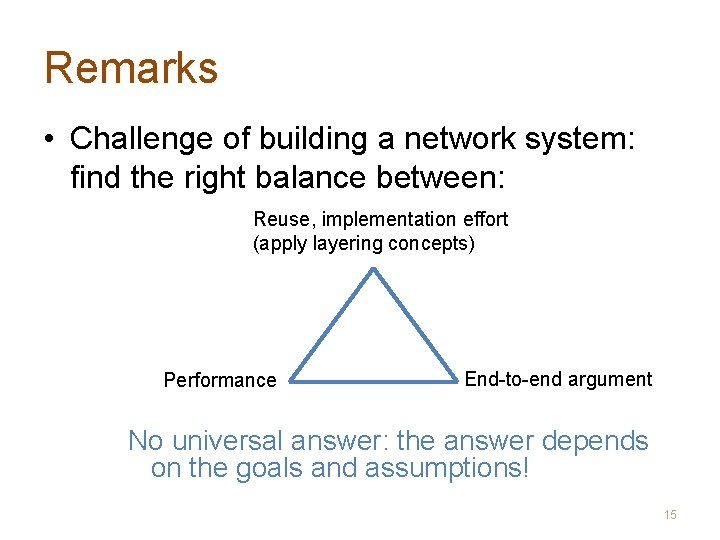
Remarks • Challenge of building a network system: find the right balance between: Reuse, implementation effort (apply layering concepts) Performance End-to-end argument No universal answer: the answer depends on the goals and assumptions! 15
The Problem: What is New Compared to the Wired Internet? • Fundamental challenges for wireless and mobile networking design: – WIRELESS – MOBILITY – Is it so obvious and too trivial? ? ? • Map onto each layer of the protocol stack 16
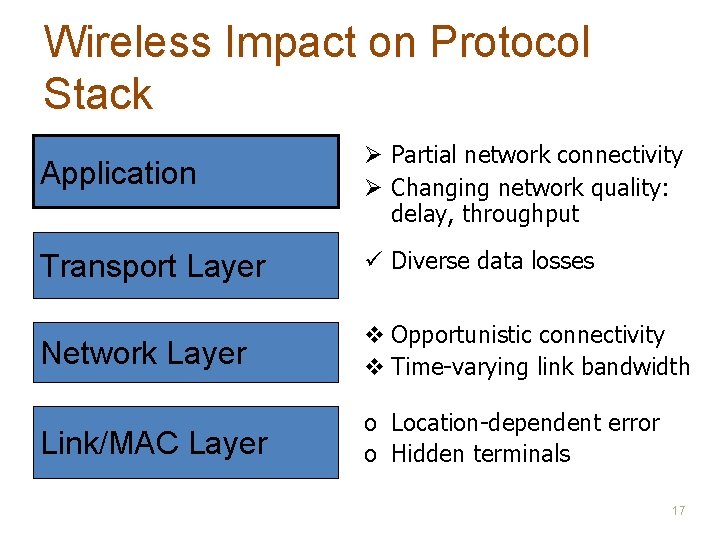
Wireless Impact on Protocol Stack Application Ø Partial network connectivity Ø Changing network quality: delay, throughput Transport Layer ü Diverse data losses Network Layer v Opportunistic connectivity v Time-varying link bandwidth Link/MAC Layer o Location-dependent error o Hidden terminals 17
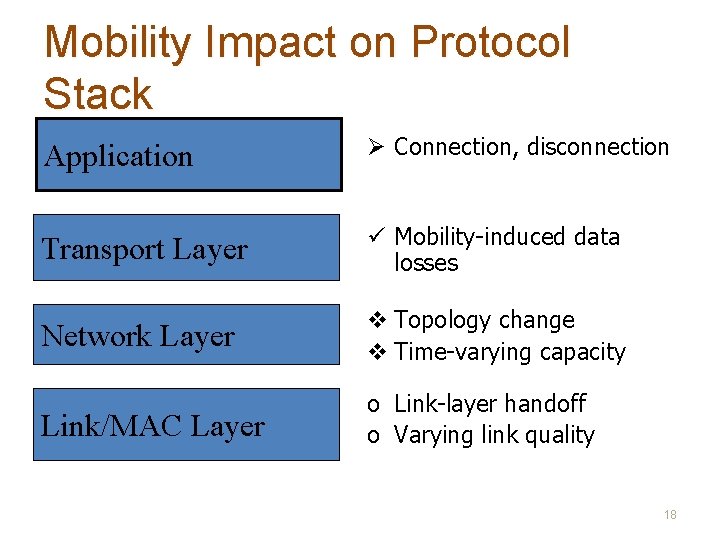
Mobility Impact on Protocol Stack Application Ø Connection, disconnection Transport Layer ü Mobility-induced data losses Network Layer v Topology change v Time-varying capacity Link/MAC Layer o Link-layer handoff o Varying link quality 18
EXAMPLE: TCP IN WIRELESS/MOBILE NETWORKS 19
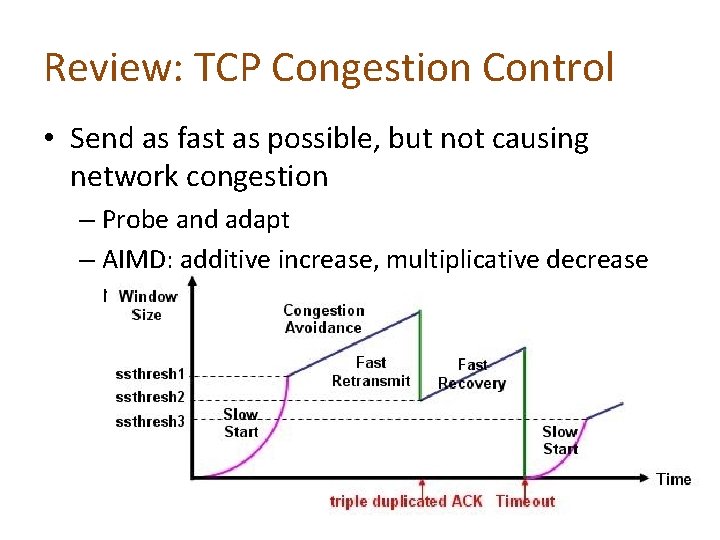
Review: TCP Congestion Control • Send as fast as possible, but not causing network congestion – Probe and adapt – AIMD: additive increase, multiplicative decrease multiply 20
TCP congestion control over the Internet • Premise – Packet loss is caused by congestion • So, loss -> reducing sending rate – Cwnd (congestion window size) reduction – Timeout update 21
Issues for Wireless TCP • Different packet loss behavior violates the assumption of TCP that all packet losses are due to congestion control: – – congestion-induced loss: new flow joins, etc. channel-error-induced loss: bursty or random channel error handoff-induced packet loss: happens during handoff transition routing-induced packet loss: stale routing tables (in a dynamic ad hoc network) • “Uniform” reaction to different losses in TCP: – in TCP, reduce congestion window by half upon packet loss – Does “one-fit-all” work in the wireless scenario ? 22
The Goals • Hide impact of wireless – SAME QUALITY AS WIRED LINK!! • Offer seamless services while mobile • Overall, “Anytime, anywhere” services 23
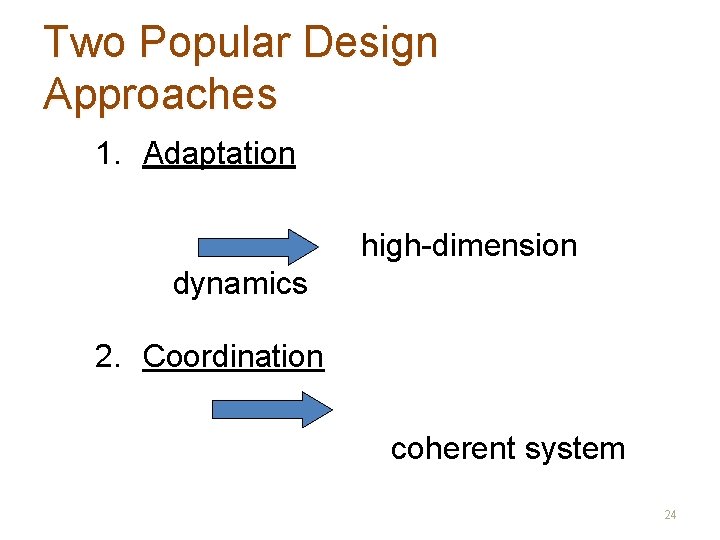
Two Popular Design Approaches 1. Adaptation high-dimension dynamics 2. Coordination coherent system 24
Adaptation As the Guideline • Many concrete forms/instantiations of adaptations – Adaptation to channel variations – Adaptation to mobility – … • Adaptation at different layers of protocol stacks – From PHY, LINK, to TRANSPORT and APP layers • Numerous solutions/papers published – 333000 entries for google search “wireless adaptation” – 956000 entries for google search “mobility adaptation” 25
Research Issues in Adaptation • What to adapt? – Transmission power, transmission rate, # of retries, …? • When to adapt? – when to invoke specific adaptation? • stability versus responsiveness • How to adapt? – specific mechanisms/algorithms in adaptation 26
Forms of Adaptation • Opportunistic design approach – Opportunistically adapt • Model-referenced design – Adapt to trace a reference model 27
Opportunistic Design • Exploit the system population • Leverage system diversity – Multiple receivers, multiple devices, multiple applications/flows, … 28
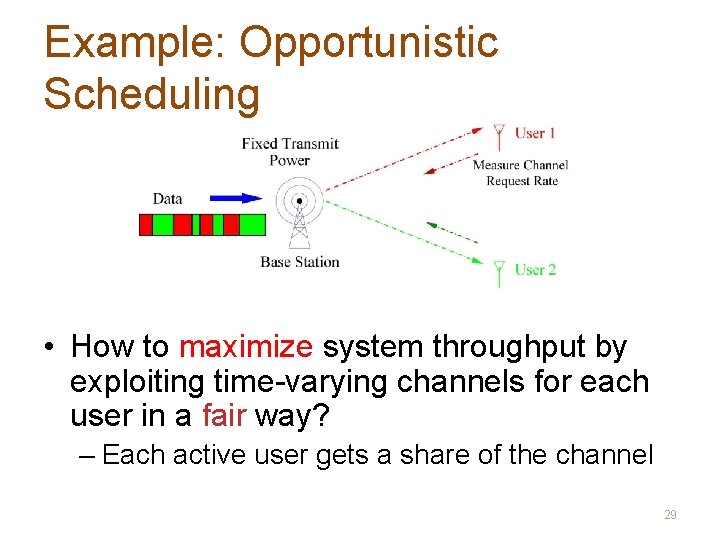
Example: Opportunistic Scheduling • How to maximize system throughput by exploiting time-varying channels for each user in a fair way? – Each active user gets a share of the channel 29
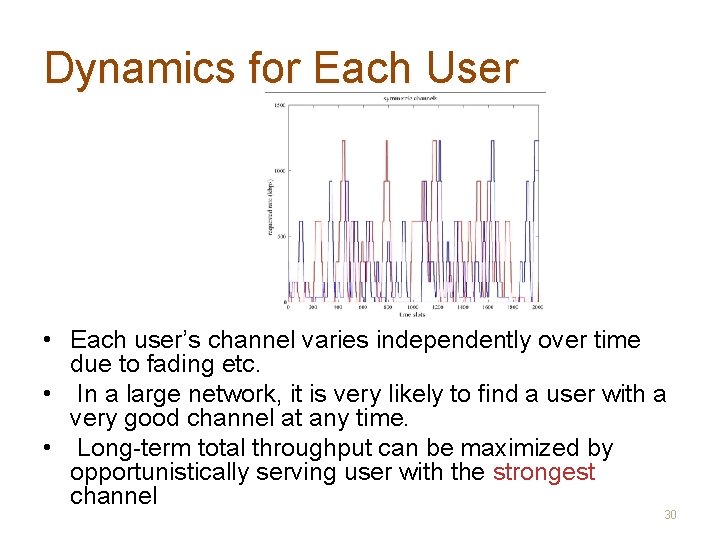
Dynamics for Each User • Each user’s channel varies independently over time due to fading etc. • In a large network, it is very likely to find a user with a very good channel at any time. • Long-term total throughput can be maximized by opportunistically serving user with the strongest channel 30
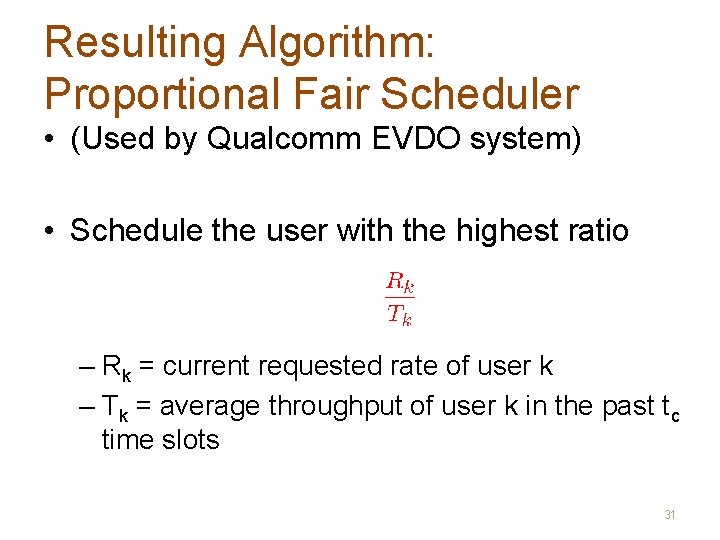
Resulting Algorithm: Proportional Fair Scheduler • (Used by Qualcomm EVDO system) • Schedule the user with the highest ratio – Rk = current requested rate of user k – Tk = average throughput of user k in the past tc time slots 31
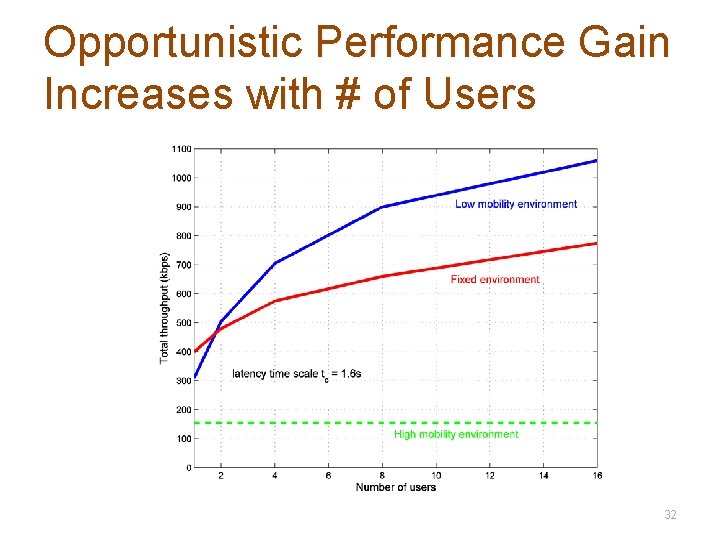
Opportunistic Performance Gain Increases with # of Users 32
Model-Referenced Adaptation • Ideal model to capture expected behaviors under idealized situation – e. g. , error-free, static settings • Track the reference model under realistic conditions/scenarios – Mobility, wireless channel dynamics, … 33
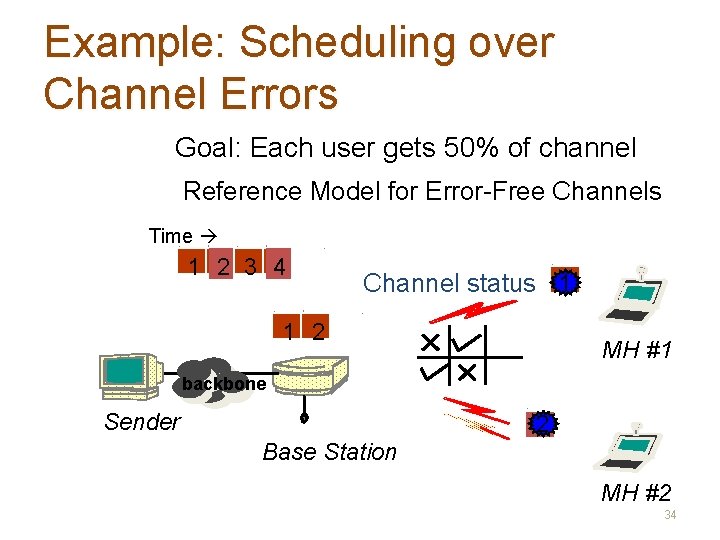
Example: Scheduling over Channel Errors Goal: Each user gets 50% of channel Reference Model for Error-Free Channels Time 1 2 3 4 Channel status 1 1 2 MH #1 backbone Sender 2 Base Station MH #2 34
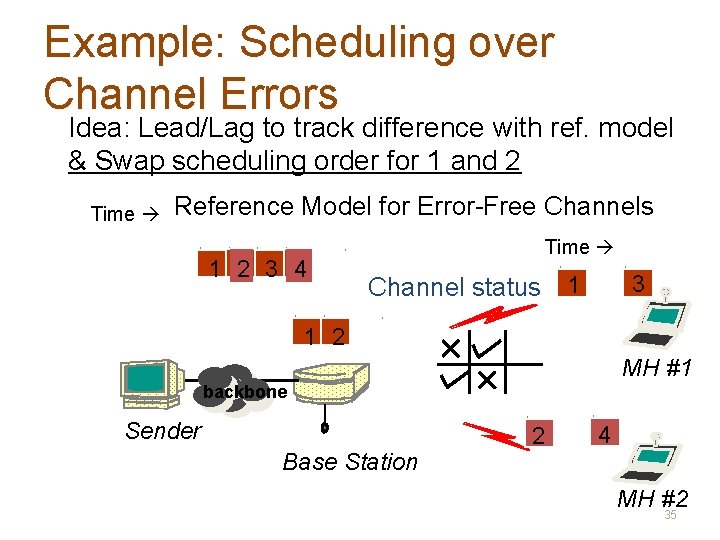
Example: Scheduling over Channel Errors Idea: Lead/Lag to track difference with ref. model & Swap scheduling order for 1 and 2 Time Reference Model for Error-Free Channels 1 2 3 4 Time 3 Channel status 1 1 2 MH #1 backbone Sender Base Station 2 4 MH #2 35
Forms of Coordination • Cross-Layer design – Enable close interactions across non-adjacent layers in the layered protocol stack • Coordination via “indirection” – Adaptation-aware proxy provides indirection 36
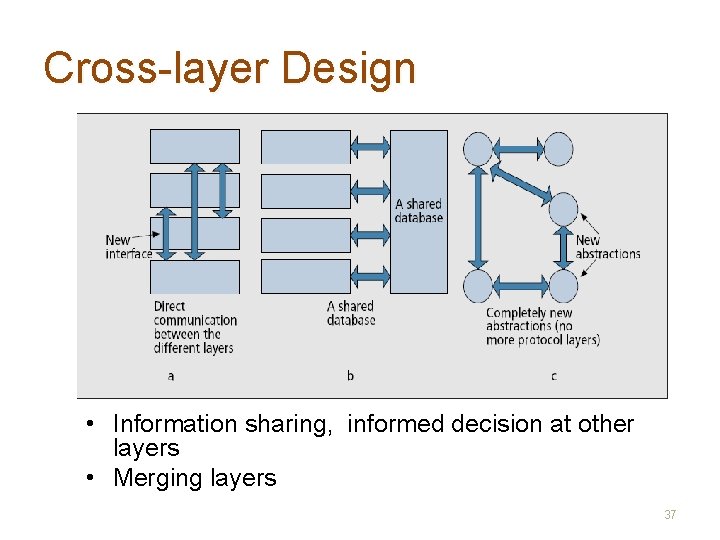
Cross-layer Design • Information sharing, informed decision at other layers • Merging layers 37
Example of Cross-layer Feedback • PHY info to higher layers – Link/MAC layer • Control transmit power, modulations to reduce error rate or retransmit – Network layer • Bit-error rate information in order to switch another network interface with lower bit-error-rate – Application layer • Channel condition information • Various standard coding techniques for multimedia applications 38
Any Bad Effects? • Undesirable consequences on overall system performance • The importance of architecture – Stability – Robustness – Spaghetti design – hard to upkeep –… 39
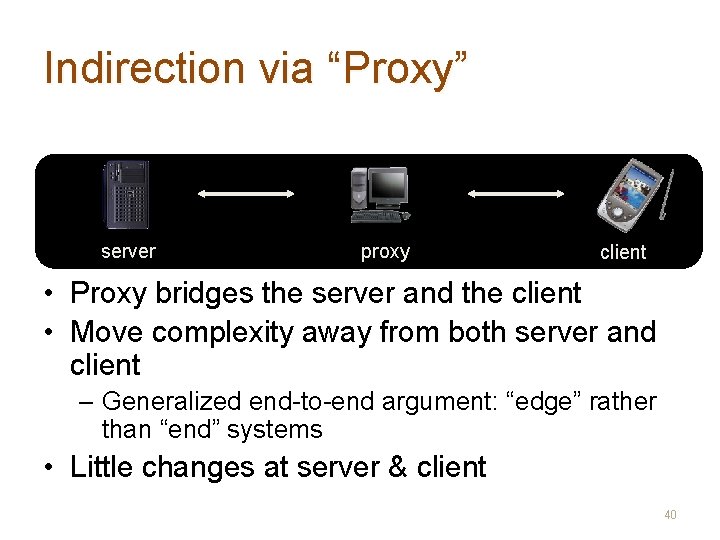
Indirection via “Proxy” server proxy client • Proxy bridges the server and the client • Move complexity away from both server and client – Generalized end-to-end argument: “edge” rather than “end” systems • Little changes at server & client 40
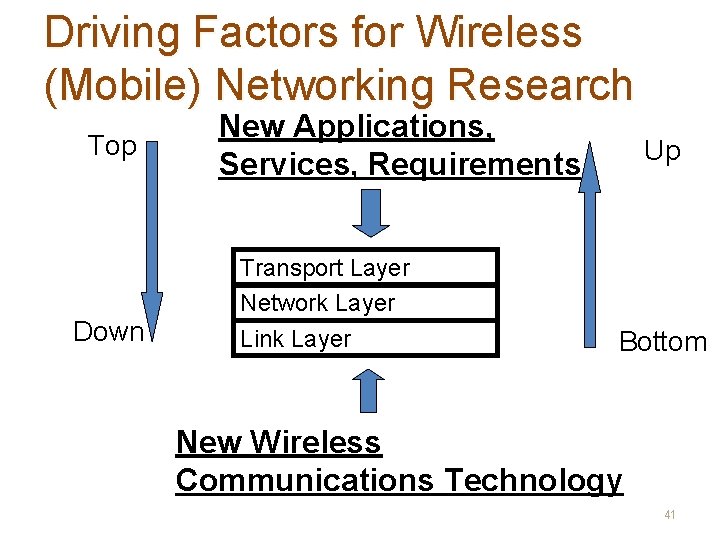
Driving Factors for Wireless (Mobile) Networking Research Top Down New Applications, Services, Requirements Transport Layer Network Layer Link Layer Up Bottom New Wireless Communications Technology 41
Bottom Up Driver: Wireless Communications • Many of them: – Antenna arrays, Smart antennas, … – Adaptive modulation, OFDM, MIMO – Spectrum sharing, cognitive radios, channel management – Multi-interface radios, device heterogeneity –… Challenge: How to exploit these new PHY communication capabilities in the protocols? 42
Root Cause of Problems • two largely disconnected communities • speak different terminologies – wireless communications: • Symbols, signals • probabilistic terms: – information theoretic bounds – confidence factor on symbol reception, … – wireless networking • Packets, bits • deterministic terms – Correct/wrong binary reception 43
Root Cause of Problems (2) • Two largely disconnected communities • different methodologies – wireless communications • solid theoretic foundation on information theory • a set of well known assumptions: noises, interferences, etc. • Theory Design-->Analysis-->prototype in chips-->experiments – wireless networking • mostly on heuristics • network setting “ad hoc”: no agreed benchmarks/base settings • Heuristic Design-->Simulations--Network Prototype->Experiments 44
Perspective From Wireless Networking • We are not on the driver’s seat so far – communication has driven the technology so far – we are followers • Still plenty of space – the direct communication almost NEVER works in reality at the 1 st place! 45
Top Down Driver: User Demands • New applications – MMS, P 2 P image/video sharing, IP TV streaming, … • New requirements – Security, privacy, robustness/dependability, distributed management • New services – Location-based service, Personalized service, … • New trends – Interoperability of different wireless technologies Challenge: How to support such new demands? 46
Cellular Networks: Overview
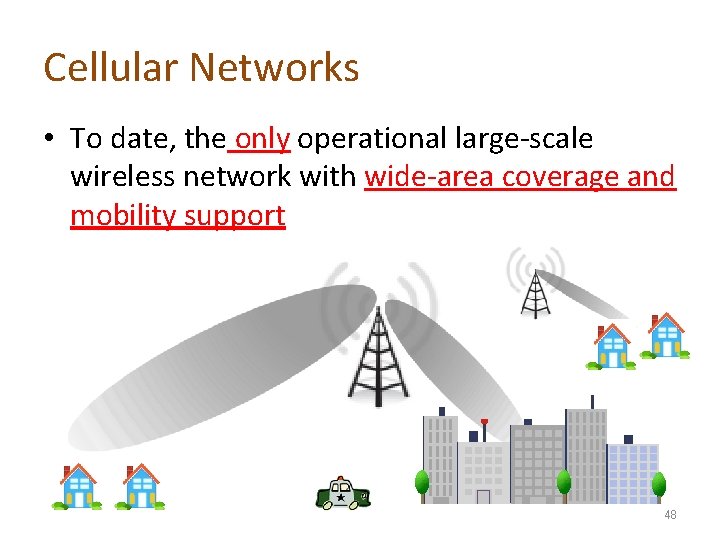
Cellular Networks • To date, the only operational large-scale wireless network with wide-area coverage and mobility support 48
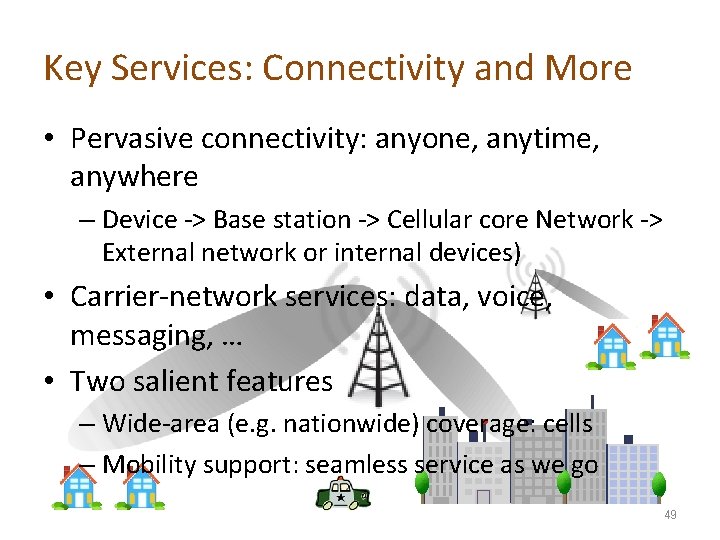
Key Services: Connectivity and More • Pervasive connectivity: anyone, anytime, anywhere – Device -> Base station -> Cellular core Network -> External network or internal devices) • Carrier-network services: data, voice, messaging, … • Two salient features – Wide-area (e. g. nationwide) coverage: cells – Mobility support: seamless service as we go 49
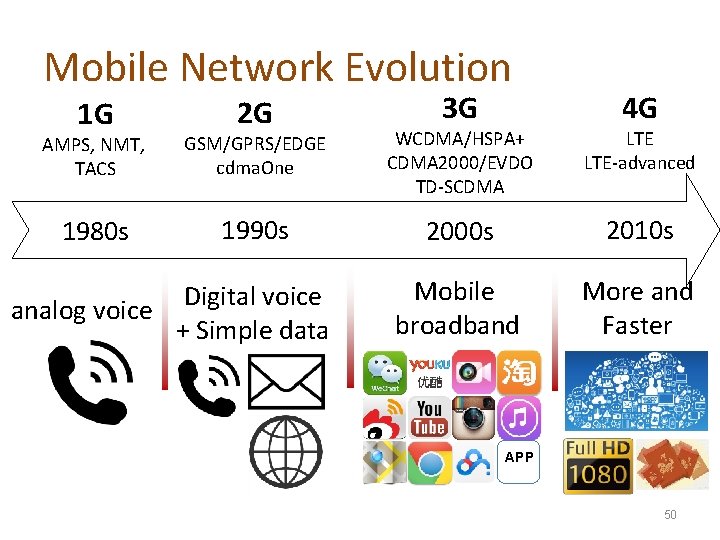
Mobile Network Evolution 1 G 2 G 3 G 4 G AMPS, NMT, TACS GSM/GPRS/EDGE cdma. One WCDMA/HSPA+ CDMA 2000/EVDO TD-SCDMA LTE-advanced 1980 s 1990 s 2000 s 2010 s Mobile broadband More and Faster analog voice Digital voice + Simple data APP 50
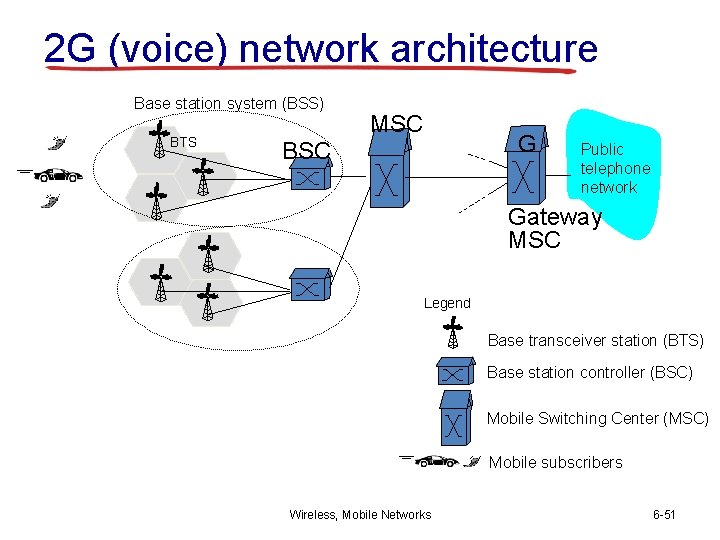
2 G (voice) network architecture Base station system (BSS) BTS MSC G BSC Public telephone network Gateway MSC Legend Base transceiver station (BTS) Base station controller (BSC) Mobile Switching Center (MSC) Mobile subscribers Wireless, Mobile Networks 6 -51
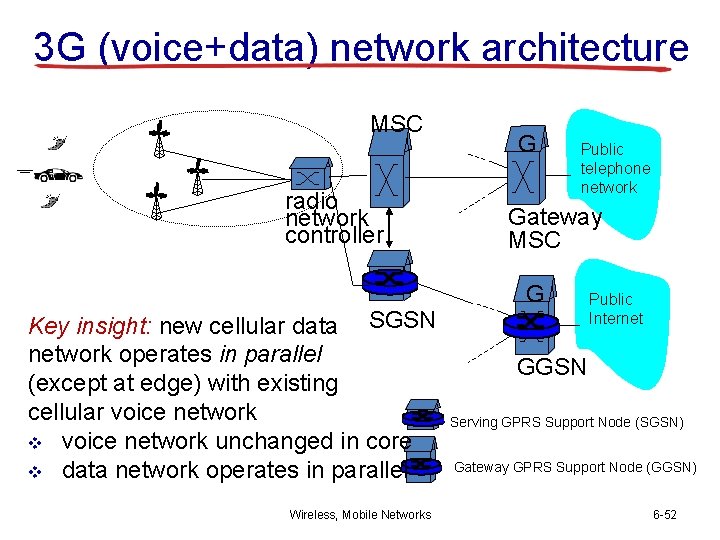
3 G (voice+data) network architecture MSC radio network controller Key insight: new cellular data SGSN network operates in parallel (except at edge) with existing cellular voice network v voice network unchanged in core v data network operates in parallel Wireless, Mobile Networks G Public telephone network Gateway MSC G Public Internet GGSN Serving GPRS Support Node (SGSN) Gateway GPRS Support Node (GGSN) 6 -52
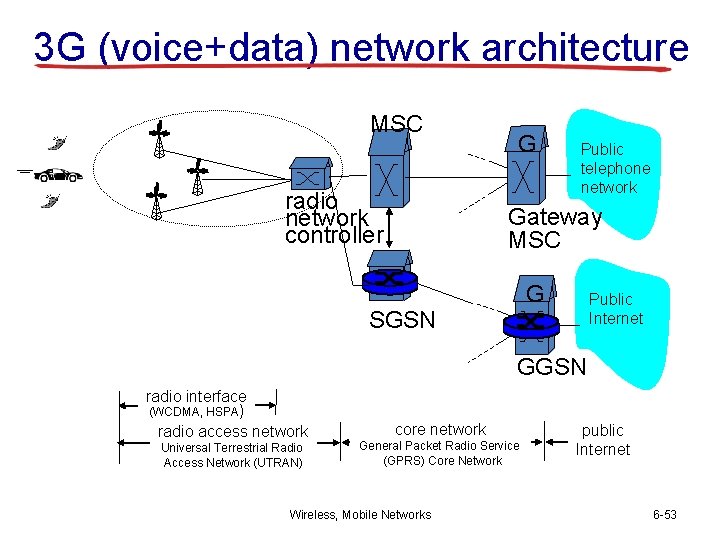
3 G (voice+data) network architecture MSC radio network controller G Public telephone network Gateway MSC G SGSN Public Internet GGSN radio interface (WCDMA, HSPA) radio access network Universal Terrestrial Radio Access Network (UTRAN) core network General Packet Radio Service (GPRS) Core Network Wireless, Mobile Networks public Internet 6 -53
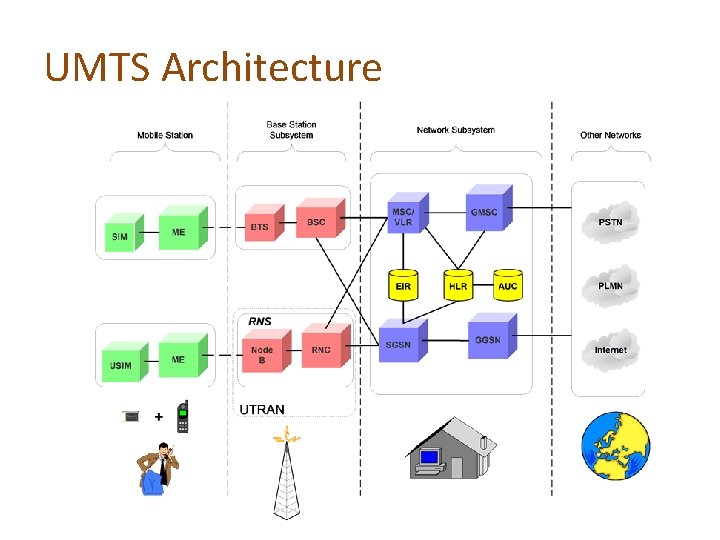
UMTS Architecture
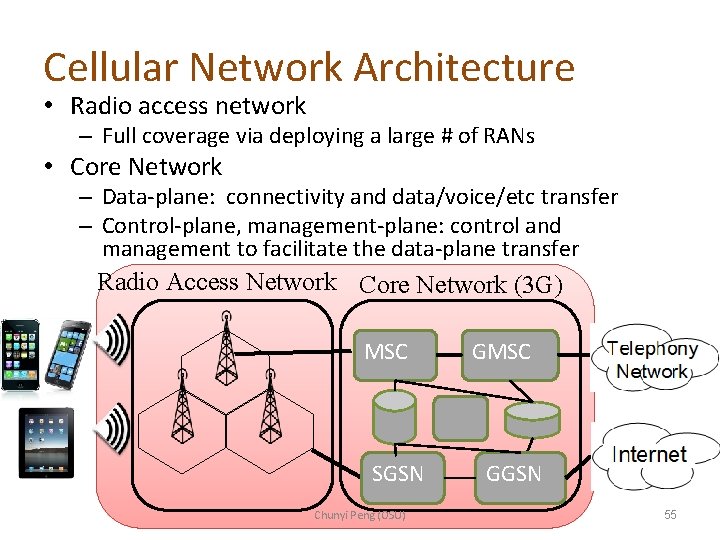
Cellular Network Architecture • Radio access network – Full coverage via deploying a large # of RANs • Core Network – Data-plane: connectivity and data/voice/etc transfer – Control-plane, management-plane: control and management to facilitate the data-plane transfer Radio Access Network Core Network (3 G) MSC SGSN Chunyi Peng (OSU) GMSC GGSN 55
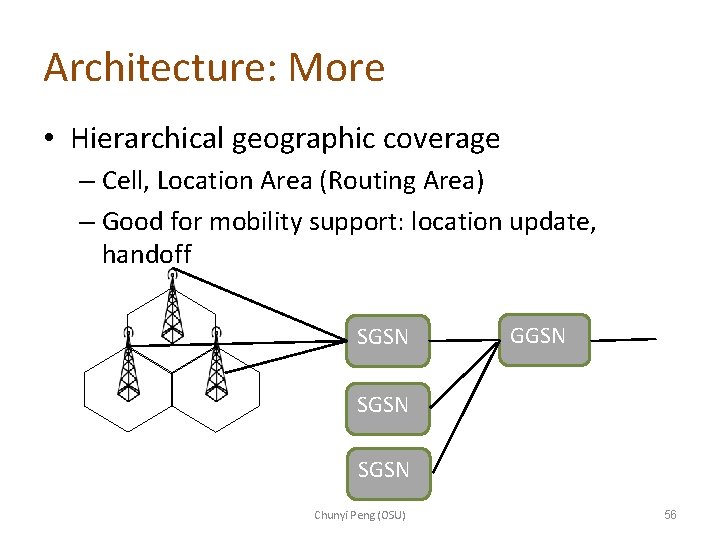
Architecture: More • Hierarchical geographic coverage – Cell, Location Area (Routing Area) – Good for mobility support: location update, handoff SGSN GGSN SGSN Chunyi Peng (OSU) 56
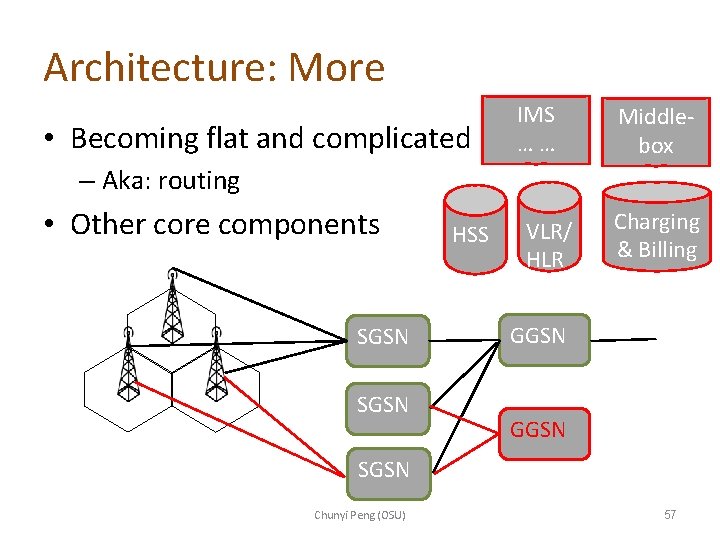
Architecture: More • Becoming flat and complicated IMS …… Middlebox – Aka: routing • Other core components SGSN HSS VLR/ HLR Charging & Billing GGSN SGSN Chunyi Peng (OSU) 57
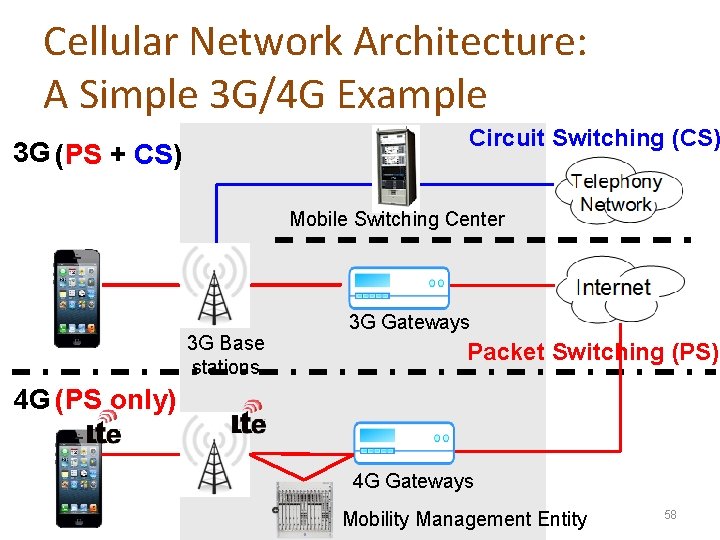
Cellular Network Architecture: A Simple 3 G/4 G Example Circuit Switching (CS) 3 G (PS + CS) Mobile Switching Center 3 G Base stations 3 G Gateways Packet Switching (PS) 4 G (PS only) 4 G Gateways Mobility Management Entity 58
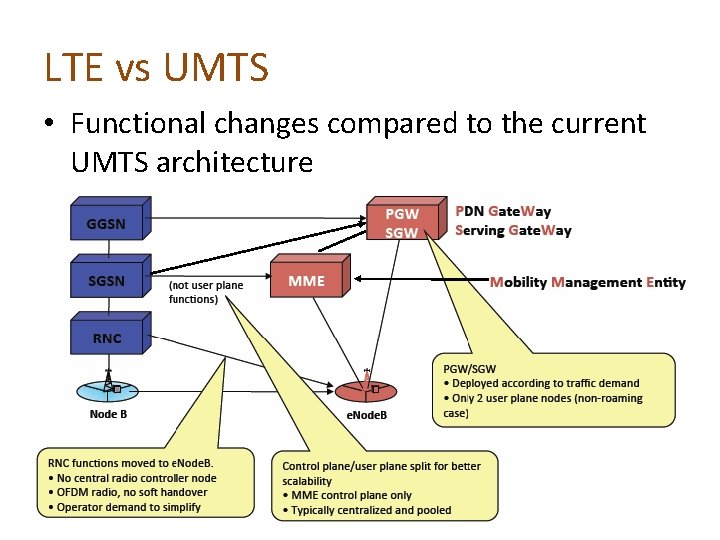
LTE vs UMTS • Functional changes compared to the current UMTS architecture
- Slides: 59