
MOBILE SIMULATION EXERCISE PLANNING An overview of how
MOBILE SIMULATION EXERCISE PLANNING An overview of how Army is using constructive simulations to train forces by MAJ Artem LARIONOV, Acting Chief of Ukrainian Land Forces 270 Mobile Simulation Training Group unclassified Shibu lijack
AGENDA sources of information simulation definition live simulations virtual simulations constructive simulations developing the training environment time resource constraints training audience training objectives security facility survey technical timeline scenario development resource constraints analysis/feedback phase after 2 action review (AAR) unclassified
Sources of information Ukrainian Armed Forces FPX and CPX management/ conducting DIRECTIVE Command Staff Mobile Simulations Exercise (SIMEX) Unit PLANNING GUIDE 3 unclassified
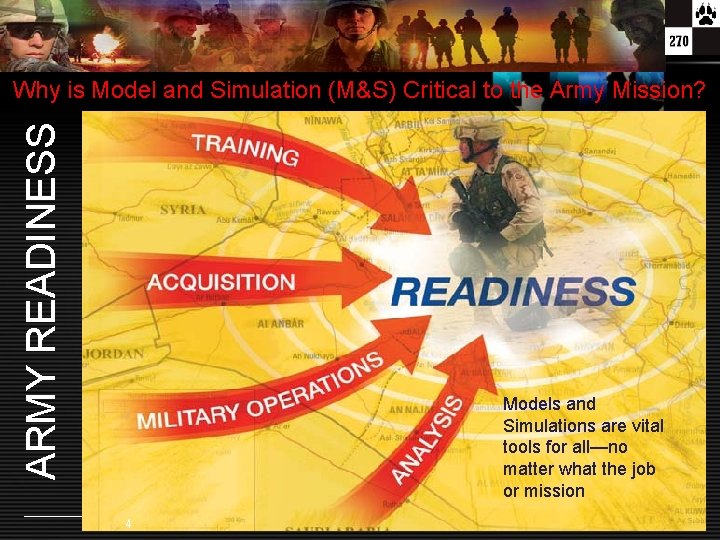
ARMY READINESS Why is Model and Simulation (M&S) Critical to the Army Mission? Models and Simulations are vital tools for all—no matter what the job or mission 4 unclassified
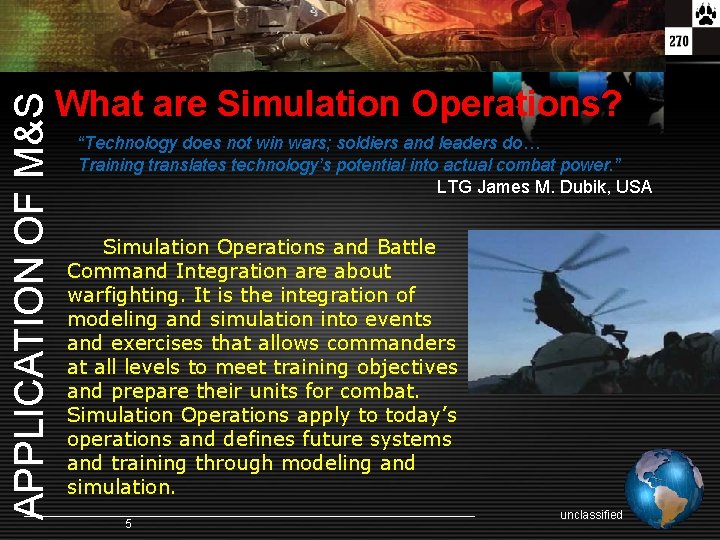
APPLICATION OF M&S What are Simulation Operations? “Technology does not win wars; soldiers and leaders do… Training translates technology’s potential into actual combat power. ” LTG James M. Dubik, USA Simulation Operations and Battle Command Integration are about warfighting. It is the integration of modeling and simulation into events and exercises that allows commanders at all levels to meet training objectives and prepare their units for combat. Simulation Operations apply to today’s operations and defines future systems and training through modeling and simulation. 5 unclassified
Simulation Definition A simulation is “a method for implementing a model(s) over time. ” A simulation application is “A specific, individual project session that requires or uses a M&S to achieve its purpose. ” There are three types of simulations used to support Army applications: § live § virtual § constructive. Examples include: Ø instrumented field exercises (live) Ø manned vehicle simulators (virtual) Ø computer-generated forces (constructive). 6 unclassified
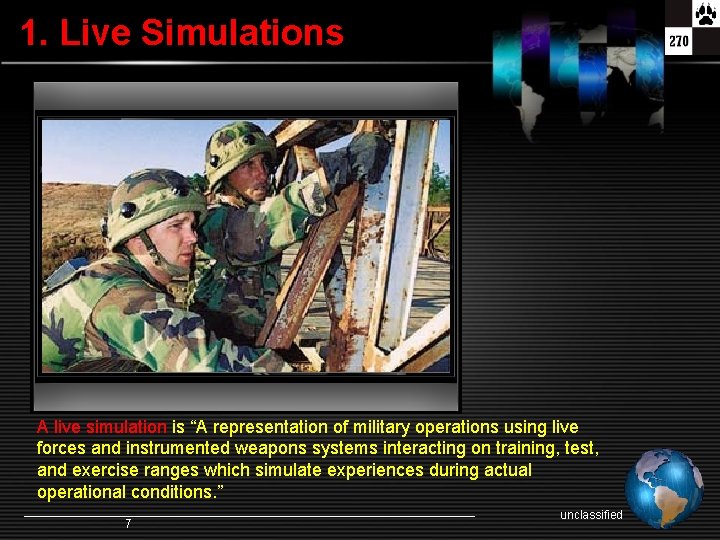
1. Live Simulations A live simulation is “A representation of military operations using live forces and instrumented weapons systems interacting on training, test, and exercise ranges which simulate experiences during actual operational conditions. ” 7 unclassified
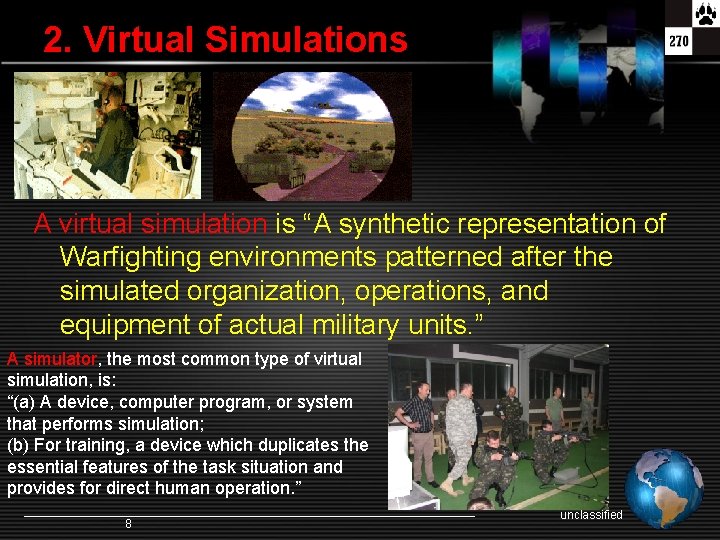
2. Virtual Simulations A virtual simulation is “A synthetic representation of Warfighting environments patterned after the simulated organization, operations, and equipment of actual military units. ” A simulator, the most common type of virtual simulation, is: “(a) A device, computer program, or system that performs simulation; (b) For training, a device which duplicates the essential features of the task situation and provides for direct human operation. ” 8 unclassified
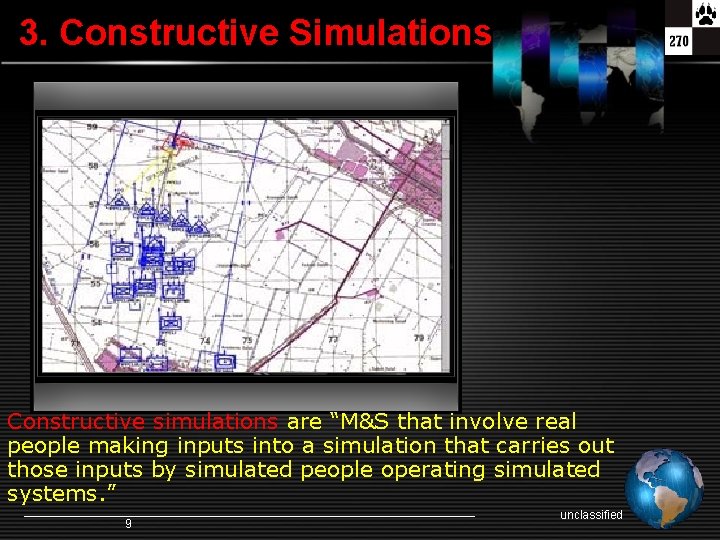
3. Constructive Simulations Constructive simulations are “M&S that involve real people making inputs into a simulation that carries out those inputs by simulated people operating simulated systems. ” 9 unclassified
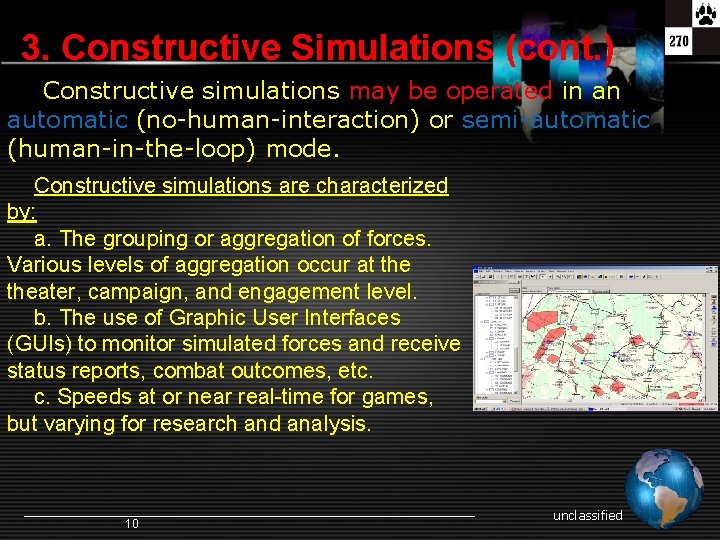
3. Constructive Simulations (cont. ) Constructive simulations may be operated in an automatic (no-human-interaction) or semi-automatic (human-in-the-loop) mode. Constructive simulations are characterized by: a. The grouping or aggregation of forces. Various levels of aggregation occur at theater, campaign, and engagement level. b. The use of Graphic User Interfaces (GUIs) to monitor simulated forces and receive status reports, combat outcomes, etc. c. Speeds at or near real-time for games, but varying for research and analysis. 10 unclassified
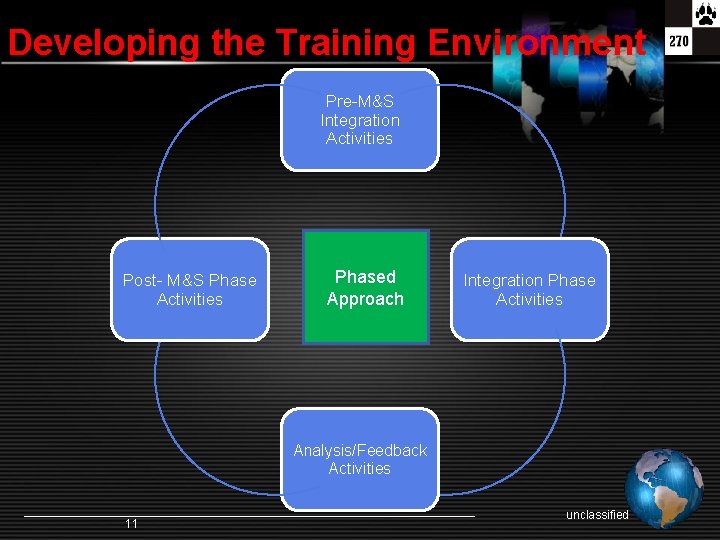
Developing the Training Environment Pre-M&S Integration Activities Post- M&S Phase Activities Phased Approach Integration Phase Activities Analysis/Feedback Activities 11 unclassified
TIME RESOURCE CONSTRAINTS 12 unclassified
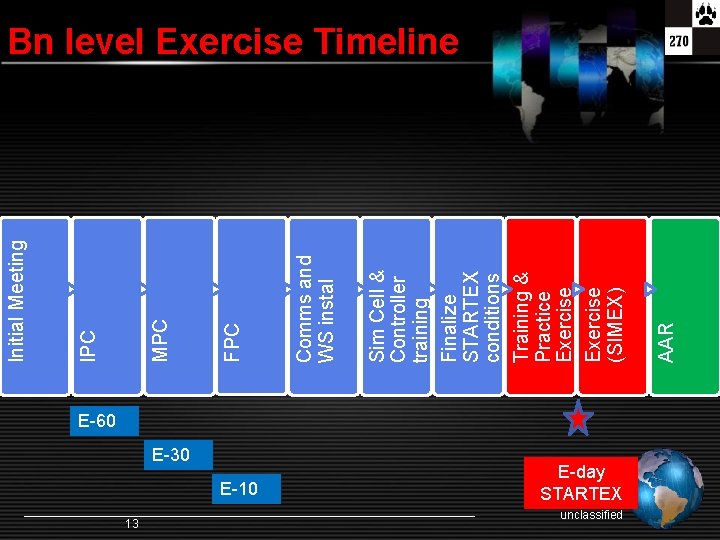
13 E-30 E-10 E-60 E-day STARTEX unclassified AAR Sim Cell & Controller training Finalize STARTEX conditions Training & Practice Exercise (SIMEX) Comms and WS instal FPC MPC Initial Meeting Bn level Exercise Timeline
Pre-M&S Integration Phase a. The exercise organization b. Elimination of potential distracters c. A review of the unit’s mission essential task list (METL) and its specific training objectives d. Milestones, with firm dates and responsible organization(s) e. Simulation(s) capabilities f. Personnel augmentation requirements g. Exercise location(s) h. Unresolved issues and suspenses for resolution 14 unclassified
Initial Meeting Normally, the unit to be trained is responsible for plans, staffing, funding, and equipment. The SIMEX facilitator, in general, is responsible for the scenario, funding, control, facility, and the database. These may change with each situation. Plan on several other meetings that could occur after the initial meeting, such as other planning meetings, site surveys, and syndicate meetings. 15 unclassified
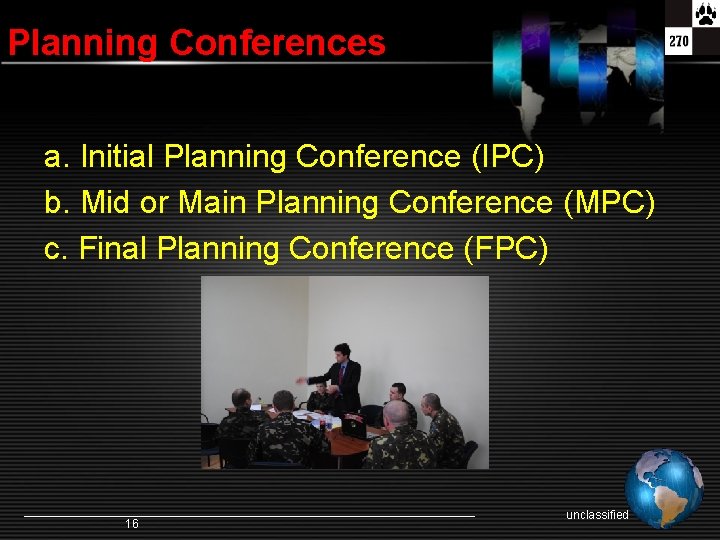
Planning Conferences a. Initial Planning Conference (IPC) b. Mid or Main Planning Conference (MPC) c. Final Planning Conference (FPC) 16 unclassified
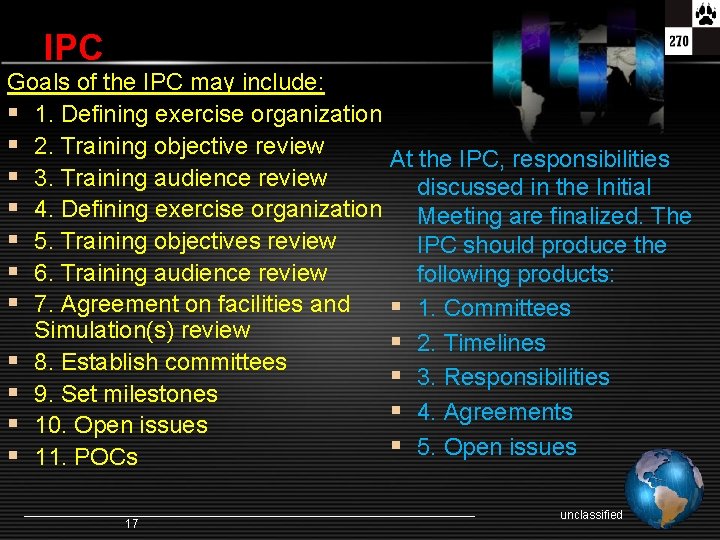
IPC Goals of the IPC may include: § 1. Defining exercise organization § 2. Training objective review § 3. Training audience review § 4. Defining exercise organization § 5. Training objectives review § 6. Training audience review § 7. Agreement on facilities and Simulation(s) review § 8. Establish committees § 9. Set milestones § 10. Open issues § 11. POCs 17 At the IPC, responsibilities discussed in the Initial Meeting are finalized. The IPC should produce the following products: § 1. Committees § 2. Timelines § 3. Responsibilities § 4. Agreements § 5. Open issues unclassified
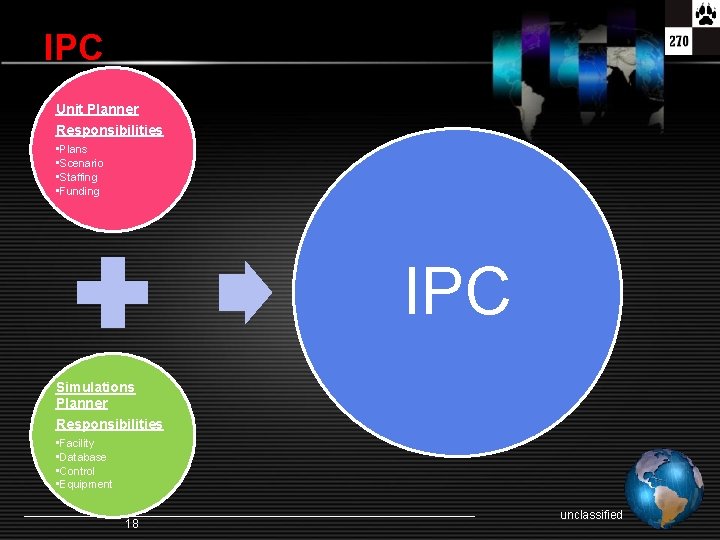
IPC Unit Planner Responsibilities • Plans • Scenario • Staffing • Funding IPC Simulations Planner Responsibilities • Facility • Database • Control • Equipment 18 unclassified
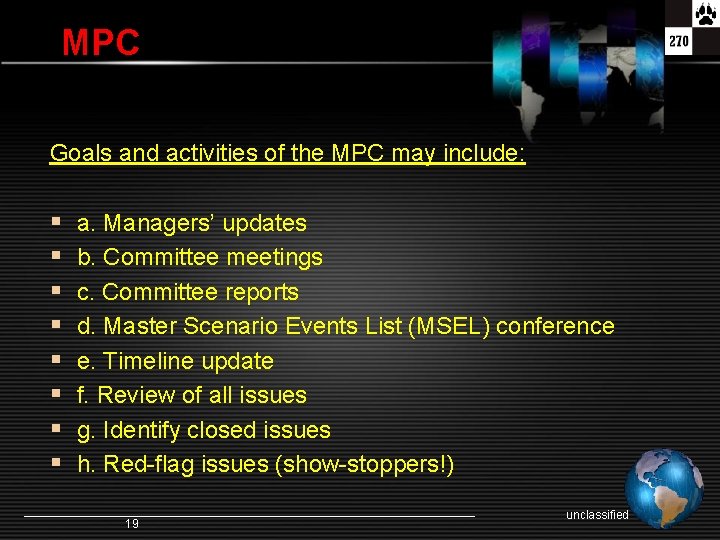
MPC Goals and activities of the MPC may include: § § § § a. Managers’ updates b. Committee meetings c. Committee reports d. Master Scenario Events List (MSEL) conference e. Timeline update f. Review of all issues g. Identify closed issues h. Red-flag issues (show-stoppers!) 19 unclassified
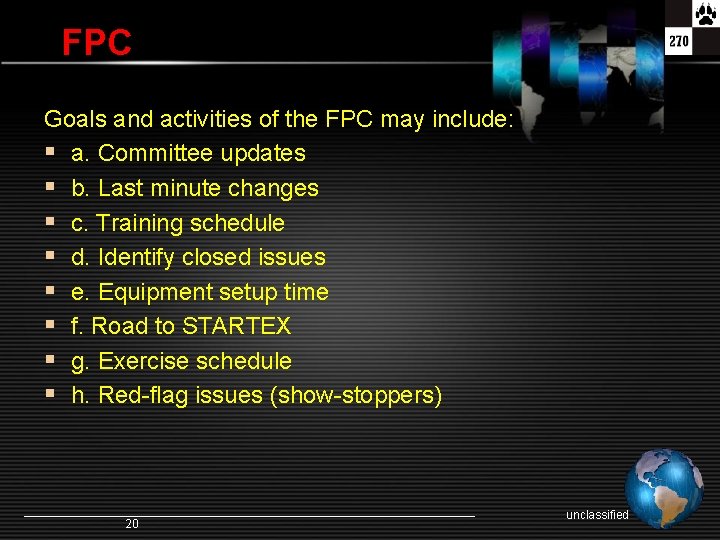
FPC Goals and activities of the FPC may include: § a. Committee updates § b. Last minute changes § c. Training schedule § d. Identify closed issues § e. Equipment setup time § f. Road to STARTEX § g. Exercise schedule § h. Red-flag issues (show-stoppers) 20 unclassified
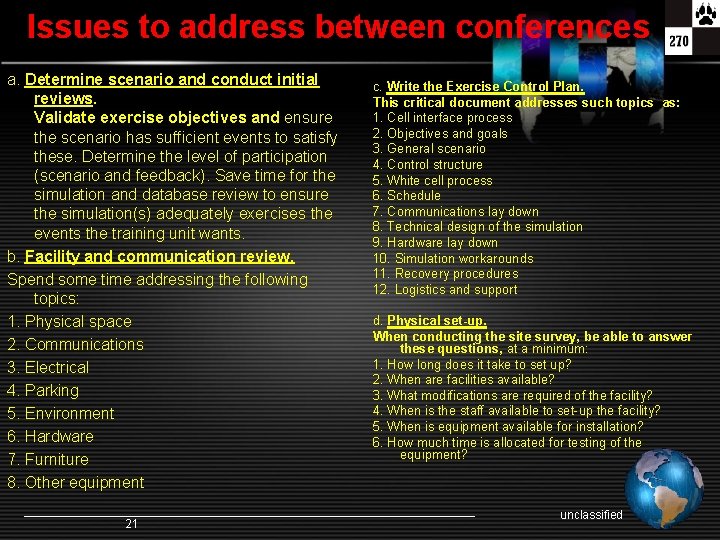
Issues to address between conferences a. Determine scenario and conduct initial reviews. Validate exercise objectives and ensure the scenario has sufficient events to satisfy these. Determine the level of participation (scenario and feedback). Save time for the simulation and database review to ensure the simulation(s) adequately exercises the events the training unit wants. b. Facility and communication review. Spend some time addressing the following topics: 1. Physical space 2. Communications 3. Electrical 4. Parking 5. Environment 6. Hardware 7. Furniture 8. Other equipment 21 c. Write the Exercise Control Plan. This critical document addresses such topics as: 1. Cell interface process 2. Objectives and goals 3. General scenario 4. Control structure 5. White cell process 6. Schedule 7. Communications lay down 8. Technical design of the simulation 9. Hardware lay down 10. Simulation workarounds 11. Recovery procedures 12. Logistics and support d. Physical set-up. When conducting the site survey, be able to answer these questions, at a minimum: 1. How long does it take to set up? 2. When are facilities available? 3. What modifications are required of the facility? 4. When is the staff available to set-up the facility? 5. When is equipment available for installation? 6. How much time is allocated for testing of the equipment? unclassified
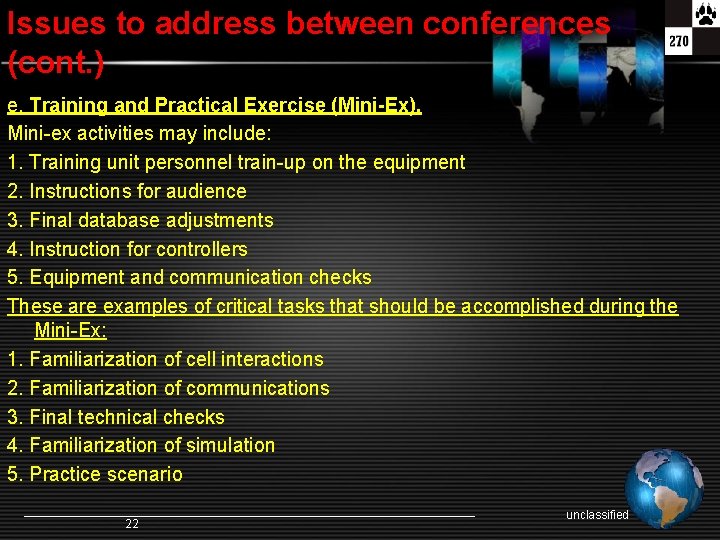
Issues to address between conferences (cont. ) e. Training and Practical Exercise (Mini-Ex). Mini-ex activities may include: 1. Training unit personnel train-up on the equipment 2. Instructions for audience 3. Final database adjustments 4. Instruction for controllers 5. Equipment and communication checks These are examples of critical tasks that should be accomplished during the Mini-Ex: 1. Familiarization of cell interactions 2. Familiarization of communications 3. Final technical checks 4. Familiarization of simulation 5. Practice scenario 22 unclassified
Integration Phase—SIMEX EVENT a. Respond to partial and complete system failure. b. Role-playing. c. Responding to the unexpected. d. Respond to requests. e. Adjust staff according to the situation. f. Interaction of the cells. 23 unclassified
TRAINING AUDIENCE 24 unclassified
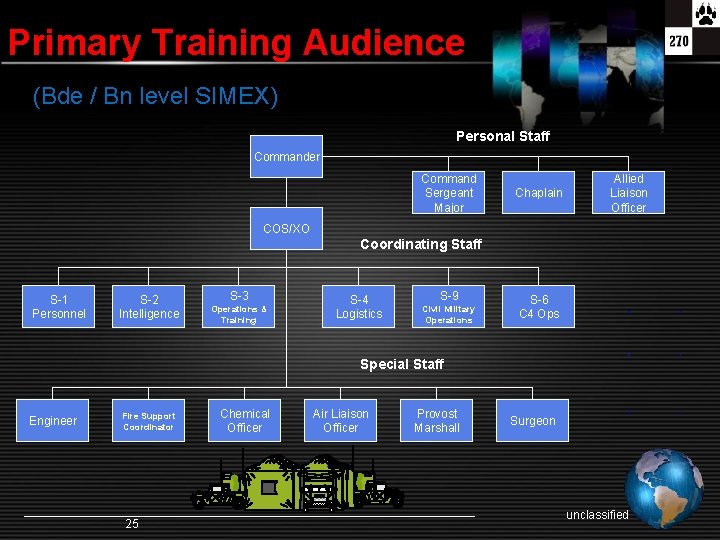
Primary Training Audience (Bde / Bn level SIMEX) Personal Staff Commander Command Sergeant Major Chaplain Allied Liaison Officer COS/XO Coordinating Staff S-1 Personnel S-2 Intelligence S-3 Operations & Training S-4 Logistics S-9 Civil Military Operations S-6 C 4 Ops Special Staff Engineer Fire Support Coordinator 25 Chemical Officer Air Liaison Officer Provost Marshall Surgeon unclassified
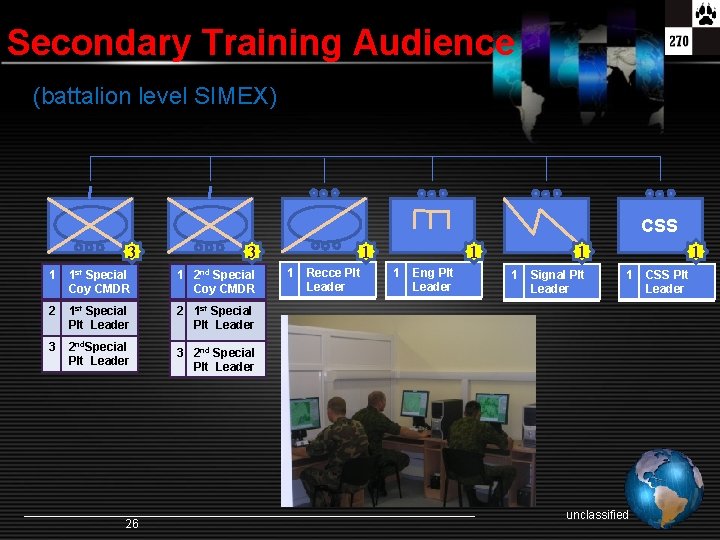
Secondary Training Audience (battalion level SIMEX) CSS 3 3 1 1 st Special Coy CMDR 1 2 nd Special Coy CMDR 2 1 st Special Plt Leader 3 2 nd Special Plt Leader 26 1 1 Recce Plt Leader 1 1 Eng Plt Leader 1 1 Signal Plt Leader 1 1 unclassified CSS Plt Leader
TRAINING OBJECTIVES 27 unclassified
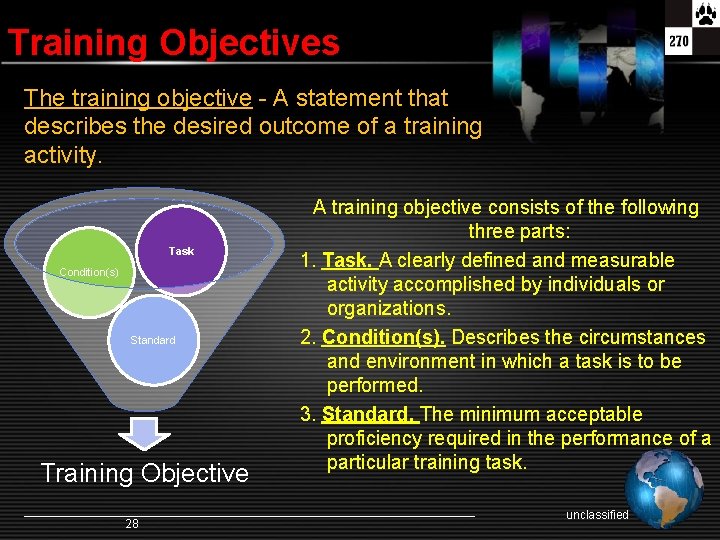
Training Objectives The training objective - A statement that describes the desired outcome of a training activity. Task Condition(s) Standard Training Objective 28 A training objective consists of the following three parts: 1. Task. A clearly defined and measurable activity accomplished by individuals or organizations. 2. Condition(s). Describes the circumstances and environment in which a task is to be performed. 3. Standard. The minimum acceptable proficiency required in the performance of a particular training task. unclassified
Training Objectives When developing training objectives, the following documents are available for reference: ü ü ü ü ü Mission Training Plans, Soldiers Manuals, Soldier Training Publications, Field Manuals, Deployment or mobilization plans, Army Universal Task List (AUTL), Universal Joint Task list (UJTL), NATO Task List, Army, and local regulations, Local standing operating procedures (SOP). 29 unclassified
Security Information Systems Security a. Hardware security b. Software security c. Procedures security d. Communications security e. Personnel security f. Physical security g. Networks security h. Electronics security i. Control of compromising emanations 30 unclassified
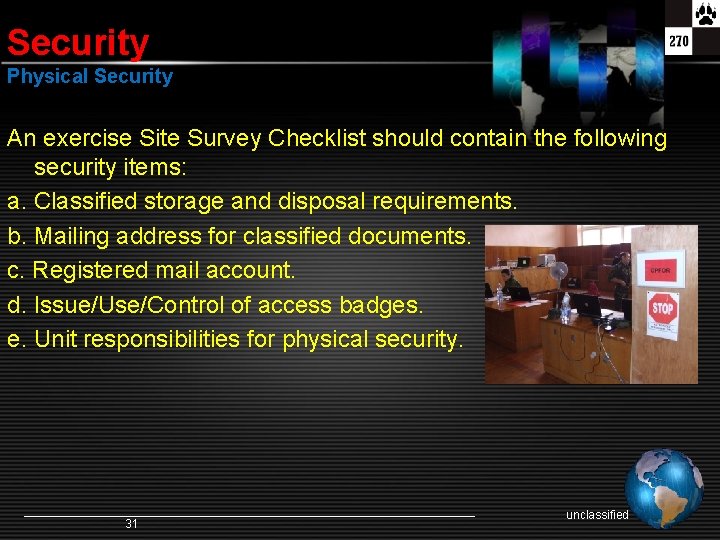
Security Physical Security An exercise Site Survey Checklist should contain the following security items: a. Classified storage and disposal requirements. b. Mailing address for classified documents. c. Registered mail account. d. Issue/Use/Control of access badges. e. Unit responsibilities for physical security. 31 unclassified
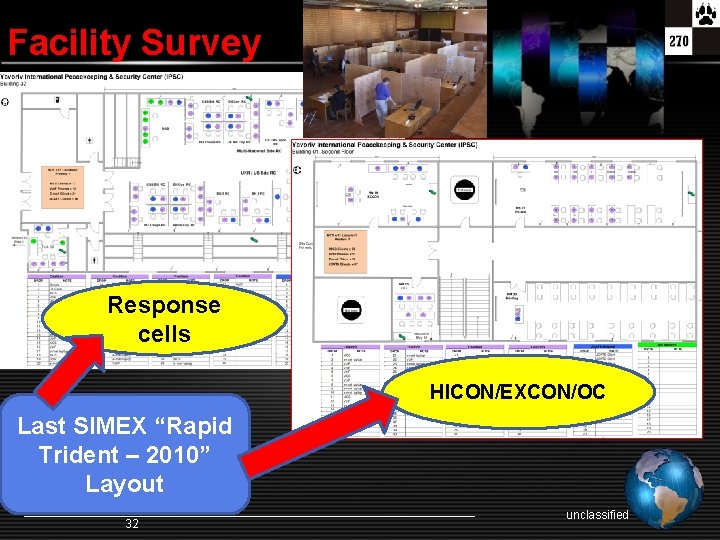
Facility Survey Response cells HICON/EXCON/OC Last SIMEX “Rapid Trident – 2010” Layout 32 unclassified
TECHNICAL TIMELINE 33 unclassified
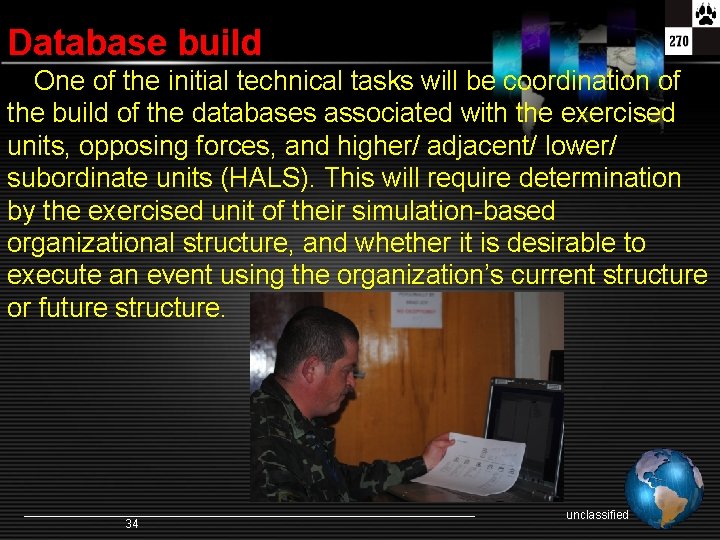
Database build One of the initial technical tasks will be coordination of the build of the databases associated with the exercised units, opposing forces, and higher/ adjacent/ lower/ subordinate units (HALS). This will require determination by the exercised unit of their simulation-based organizational structure, and whether it is desirable to execute an event using the organization’s current structure or future structure. 34 unclassified
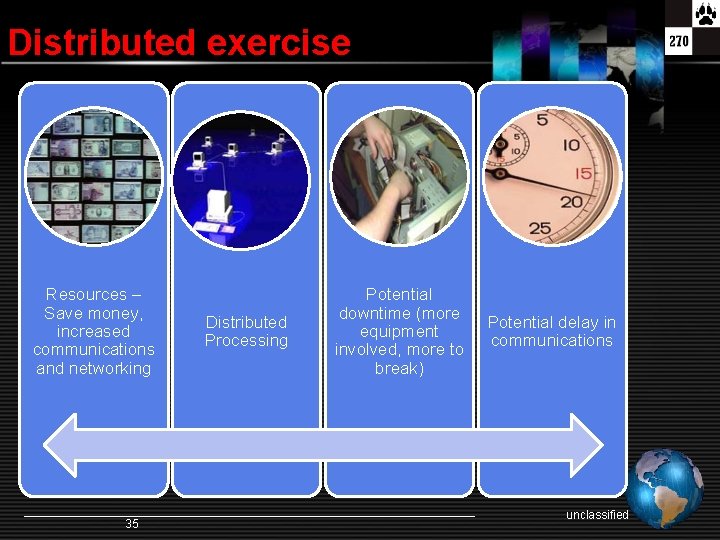
Distributed exercise Resources – Save money, increased communications and networking 35 Distributed Processing Potential downtime (more equipment involved, more to break) Potential delay in communications unclassified
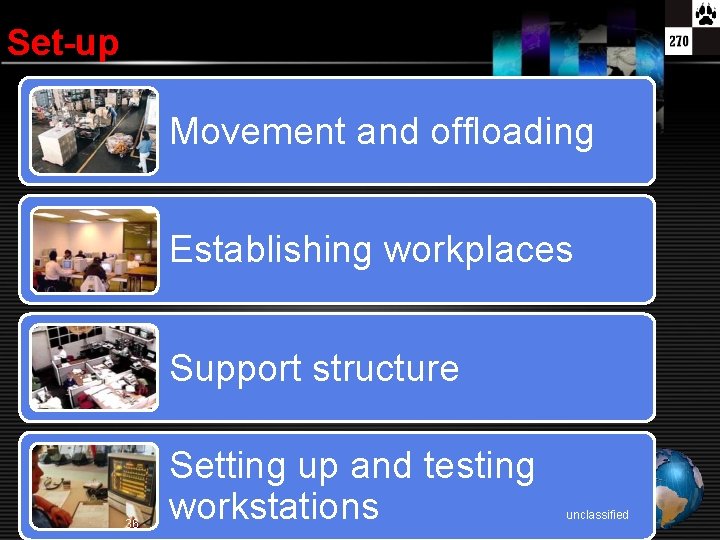
Set-up Movement and offloading Establishing workplaces Support structure 36 Setting up and testing workstations unclassified
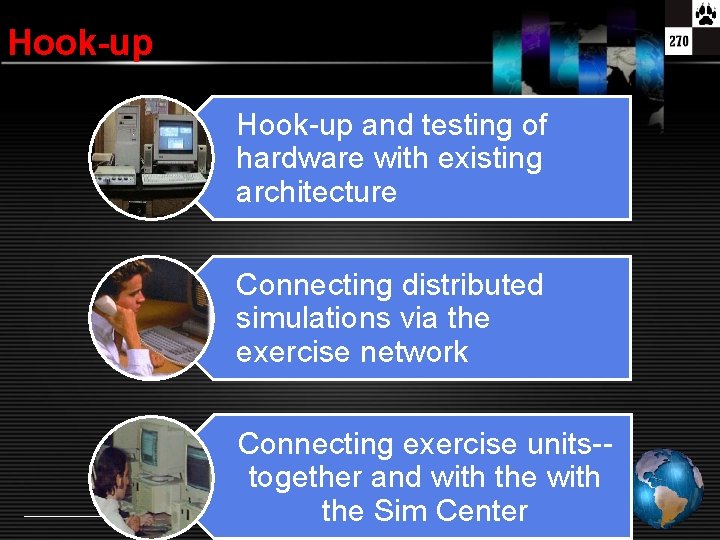
Hook-up and testing of hardware with existing architecture Connecting distributed simulations via the exercise network 37 Connecting exercise units-together and with the Sim Center unclassified
Power-up Once networking requirements are met and connectivity is established, it will become necessary to power-up the system. Because initial estimates have been made and changes, if deemed necessary, made to the facilities, load testing those results will be critical. Initial amperage from simulated systems should be tested and estimates made for power drains by additional equipment required to execute the event. 38 unclassified
Communications plan Communications can be the single most important factor in setting up a simulation application. Effective communications are key to the success of the exercise. Without them, the exercise will fail. Communication between the simulation center and the tactical operation centers will be the responsibility of the exercised unit allowing them to exercise their real world organic assets. Although not responsible for this, simulation facility personnel should be involved to ensure connectivity with the center and how these potential power requirements may impact the distribution plan for the center. 39 unclassified
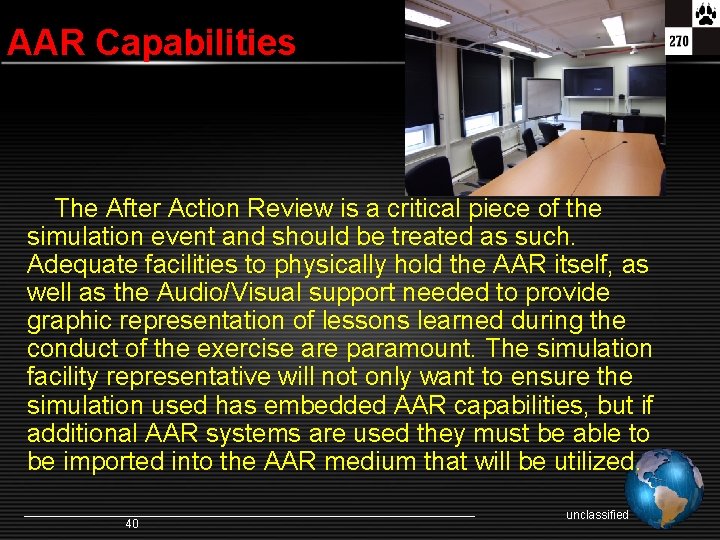
AAR Capabilities The After Action Review is a critical piece of the simulation event and should be treated as such. Adequate facilities to physically hold the AAR itself, as well as the Audio/Visual support needed to provide graphic representation of lessons learned during the conduct of the exercise are paramount. The simulation facility representative will not only want to ensure the simulation used has embedded AAR capabilities, but if additional AAR systems are used they must be able to be imported into the AAR medium that will be utilized. 40 unclassified
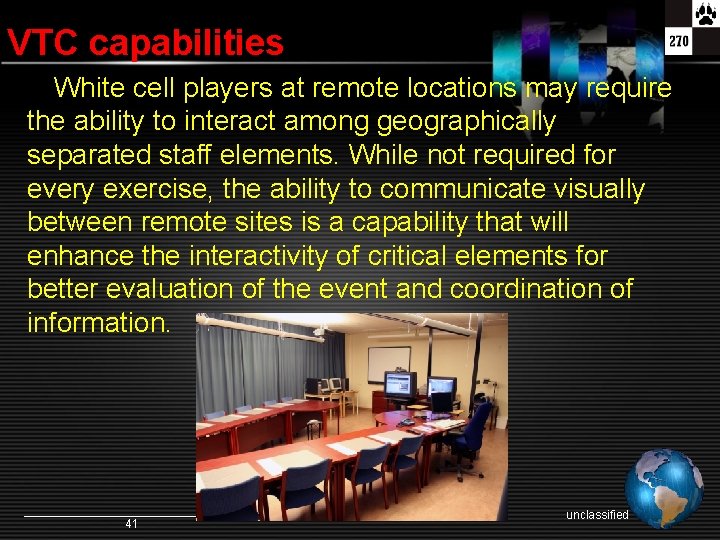
VTC capabilities White cell players at remote locations may require the ability to interact among geographically separated staff elements. While not required for every exercise, the ability to communicate visually between remote sites is a capability that will enhance the interactivity of critical elements for better evaluation of the event and coordination of information. 41 unclassified
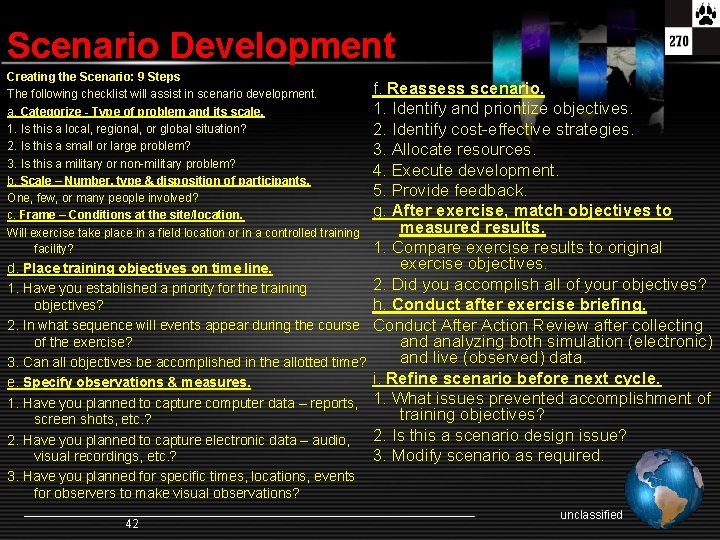
Scenario Development Creating the Scenario: 9 Steps The following checklist will assist in scenario development. a. Categorize - Type of problem and its scale. 1. Is this a local, regional, or global situation? 2. Is this a small or large problem? 3. Is this a military or non-military problem? b. Scale – Number, type & disposition of participants. One, few, or many people involved? c. Frame – Conditions at the site/location. Will exercise take place in a field location or in a controlled training facility? f. Reassess scenario. 1. Identify and prioritize objectives. 2. Identify cost-effective strategies. 3. Allocate resources. 4. Execute development. 5. Provide feedback. g. After exercise, match objectives to measured results. 1. Compare exercise results to original exercise objectives. d. Place training objectives on time line. 2. Did you accomplish all of your objectives? 1. Have you established a priority for the training objectives? h. Conduct after exercise briefing. 2. In what sequence will events appear during the course Conduct After Action Review after collecting and analyzing both simulation (electronic) of the exercise? and live (observed) data. 3. Can all objectives be accomplished in the allotted time? i. Refine scenario before next cycle. e. Specify observations & measures. 1. Have you planned to capture computer data – reports, 1. What issues prevented accomplishment of training objectives? screen shots, etc. ? 2. Is this a scenario design issue? 2. Have you planned to capture electronic data – audio, 3. Modify scenario as required. visual recordings, etc. ? 3. Have you planned for specific times, locations, events for observers to make visual observations? 42 unclassified
RESOURCE CONSTRAINTS 43 unclassified
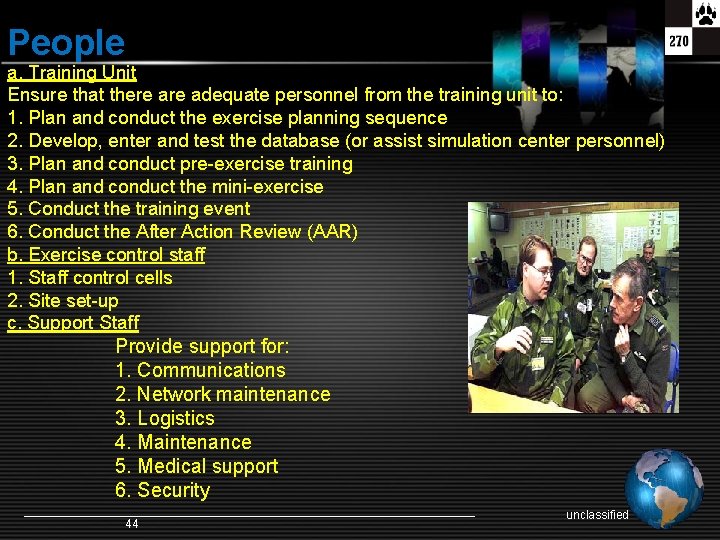
People a. Training Unit Ensure that there adequate personnel from the training unit to: 1. Plan and conduct the exercise planning sequence 2. Develop, enter and test the database (or assist simulation center personnel) 3. Plan and conduct pre-exercise training 4. Plan and conduct the mini-exercise 5. Conduct the training event 6. Conduct the After Action Review (AAR) b. Exercise control staff 1. Staff control cells 2. Site set-up c. Support Staff Provide support for: 1. Communications 2. Network maintenance 3. Logistics 4. Maintenance 5. Medical support 6. Security 44 unclassified
Money a. Simulation Center contractor support b. Dining facility c. Transportation to training site. If parking is limited, transportation may have to be provided d. Office supplies; copiers with paper e. Telephone and Internet use f. Communications / Bandwidth g. Miscellaneous equipment h. TDY costs for those people that need to travel to the training event. 45 unclassified
Time Adequate time allocated for: a. Exercise planning sequence b. Conferences (IPC, MPC, FPC) c. Data entry and testing d. Pre-exercise training e. Site set-up f. Mini-exercise g. Training event h. AAR i. Site cleanup j. Equipment breakdown at conclusion of exercise 46 unclassified
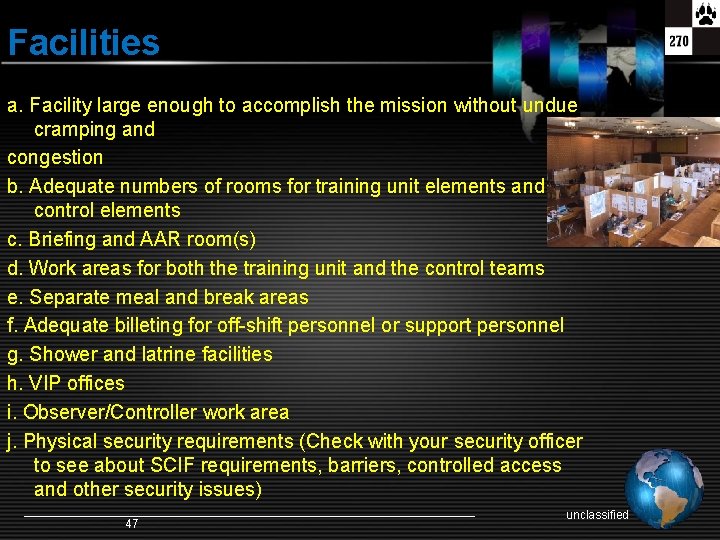
Facilities a. Facility large enough to accomplish the mission without undue cramping and congestion b. Adequate numbers of rooms for training unit elements and control elements c. Briefing and AAR room(s) d. Work areas for both the training unit and the control teams e. Separate meal and break areas f. Adequate billeting for off-shift personnel or support personnel g. Shower and latrine facilities h. VIP offices i. Observer/Controller work area j. Physical security requirements (Check with your security officer to see about SCIF requirements, barriers, controlled access and other security issues) 47 unclassified
Other facility considerations to consider Electrical power source - check to see if there adequate power and outlets for unit and control cell requirements. Parking 1. Adequate for training unit, control personnel, and support personnel 2. VIP parking 3. If parking is limited, arrange transportation (all shifts, to and from an assembly area) Environment 1. Air conditioning 2. Heat 3. Fans 4. Trash removal, including classified trash 5. Cleaning teams (with associated security/escort requirements) Hardware: 1. Adequate workstations for training unit and control teams’ requirements 2. Additional automation to support email and other administrative functions Furniture Adequate desks, tables, chairs, and other necessary furniture Quality of Life. If approved, consider allowing these appliances: 1. Refrigerators 2. Microwave ovens unclassified 48 3. Coffee makers
Communications a. Bandwidth Adequate to handle the data requirements for the simulation(s) to be used, and Internet Email b. Secure capability If classified data will be processed and passed, adequate security procedures and equipment exists. c. Telephones 1. Adequate number for training unit, control teams, and support teams 2. Issue cell phones to those that need them d. Internet access, as needed. 49 unclassified
ANALYSIS/FEEDBACK PHASE 50 unclassified
Collect Observations a. Review the exercise scenario. b. Review the exercise training objectives. c. Identify specific subordinate unit training objectives requiring observation. d. Select personnel to perform Observer/Controller duties based on rank, knowledge, and experience. e. Select sufficient personnel for 24/7 data collection coverage in accordance with the exercise scenario. f. Assign O/Cs to observe designated scenario events based on experience with tasks to be performed. Competence in the specific task to be observed takes precedence over rank. g. Review applicable Army Training and Evaluation Program (ARTEP) Mission Training Plans (MTPs) to understand task, condition, and standard for each event. h. Review all doctrinal manuals for current tactics, techniques, and procedures (TTPs). i. Create data collection forms (if necessary) to ensure all pertinent information such as times, grid locations, call signs, actions and orders observed is collected. j. Verify that all communications devices are in place and operational to coordinate O/C actions as necessary. k. Preplan times/locations for O/Cs to observe critical events. l. Record observations. m. Gather observations, review with all O/Cs, and verify factual content of observations 2 -6 hours prior to AAR based on size of unit observed and preparation time needed. n. Build/create AAR products to clearly illustrate teaching points based on observations. 51 unclassified
AFTER ACTION REVIEW (AAR) 52 unclassified
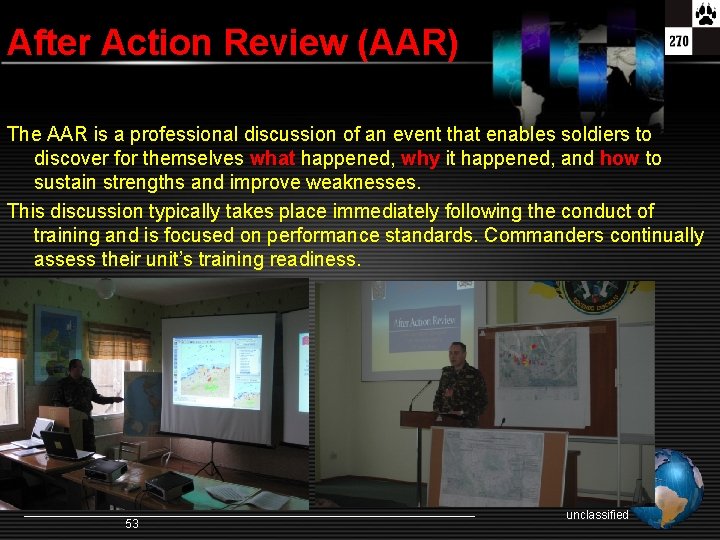
After Action Review (AAR) The AAR is a professional discussion of an event that enables soldiers to discover for themselves what happened, why it happened, and how to sustain strengths and improve weaknesses. This discussion typically takes place immediately following the conduct of training and is focused on performance standards. Commanders continually assess their unit’s training readiness. 53 unclassified
After Action Review (AAR) Formal AAR The following are key points of the formal AAR: a. Conducted during or immediately after each event. b. Focused on intended training objectives. c. Focused on soldier, leader, and unit performance. d. Involves all participants in the discussion. e. Uses open-ended questions. f. Related to specific standards. g. Determines strengths and weaknesses. h. Links performance to subsequent training. 54 unclassified
After Action Review (AAR) Agenda a. Introduction and rules. b. Review of objectives and intent. 1. Training objectives 2. Commander’s mission/intent (what was supposed to happen) 3. OPFOR commander’s mission/intent 4. Relevant doctrine, tactics, techniques, and procedures c. Summary of recent events (what happened). d. Discussion of key issues. 1. Chronological order of events 2. Battlefield operating systems (BOS) 3. Key events/themes/issues e. Discussion of optional issues. f. Soldier/leader skills g. Tasks to sustain/improve h. Statistics i. Others j. Discussion of force protection issues (safety). k. Closing comments (summary). unclassified 55
QUESTIONS? Planning in process 56 unclassified
- Slides: 56