
Mobile Radio Propagation SmallScale Fading and Multipath CS
Mobile Radio Propagation Small-Scale Fading and Multipath CS 515 Mobile and Wireless Networking Ibrahim Korpeoglu Computer Engineering Department Bilkent University 1
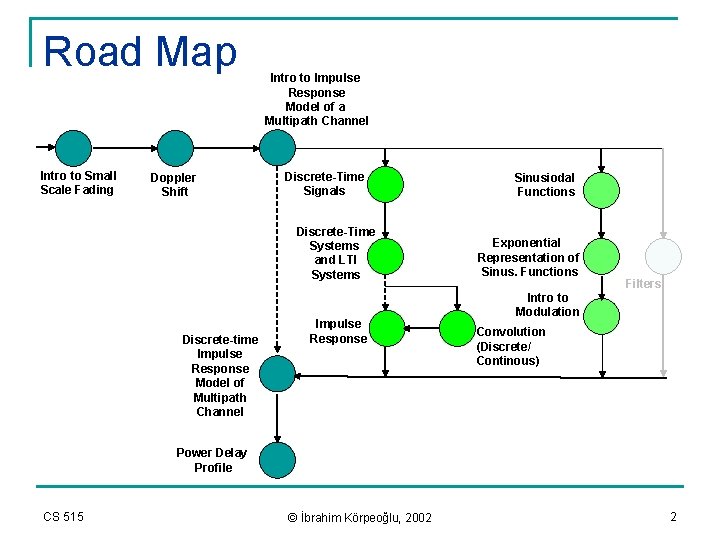
Road Map Intro to Small Scale Fading Doppler Shift Intro to Impulse Response Model of a Multipath Channel Discrete-Time Signals Discrete-Time Systems and LTI Systems Discrete-time Impulse Response Model of Multipath Channel Impulse Response Sinusiodal Functions Exponential Representation of Sinus. Functions Filters Intro to Modulation Convolution (Discrete/ Continous) Power Delay Profile CS 515 © İbrahim Körpeoğlu, 2002 2
Small Scale Fading n n n Describes rapid fluctuations of the amplitude, phase of multipath delays of a radio signal over short period of time or travel distance Caused by interference between two or more versions of the transmitted signal which arrive at the receiver at slightly different times. These waves are called multipath waves and combine at the receiver antenna to give a resultant signal which can vary widely in amplitude and phase CS 515 © İbrahim Körpeoğlu, 2002 3

Small Scale Multipath Propagation n Effects of multipath q Rapid changes in the signal strength q q n Over small travel distances, or Over small time intervals Random frequency modulation due to varying Doppler shifts on different multiples signals Time dispersion (echoes) caused by multipath propagation delays Multipath occurs because of q q CS 515 Reflections Scattering © İbrahim Körpeoğlu, 2002 4

Multipath n At a receiver point q Radio waves generated from the same transmitted signal may come n n n q from different directions with different propagation delays with (possibly) different amplitudes (random) with (possibly) different phases (random) with different angles of arrival (random). These multipath components combine vectorially at the receiver antenna and cause the total signal q q CS 515 to fade to distort © İbrahim Körpeoğlu, 2002 5
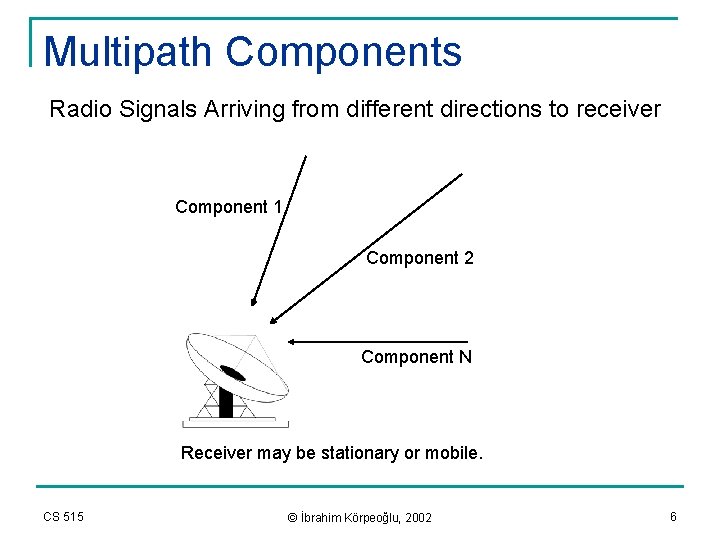
Multipath Components Radio Signals Arriving from different directions to receiver Component 1 Component 2 Component N Receiver may be stationary or mobile. CS 515 © İbrahim Körpeoğlu, 2002 6
Mobility n n Other Objects in the radio channels may be mobile or stationary If other objects are stationary n n n Motion is only due to mobile Fading is purely a spatial phenomenon (occurs only when the mobile receiver moves) The spatial variations as the mobile moves will be perceived as temporal variations q n Dt = Dd/v Fading may cause disruptions in the communication CS 515 © İbrahim Körpeoğlu, 2002 7
Factors Influencing Small Scale Fading n Multipath propagation q Presence of reflecting objects and scatterers cause multiple versions of the signal to arrive at the receiver q q n Speed of mobile q q n With different amplitudes and time delays Causes the total signal at receiver to fade or distort Cause Doppler shift at each multipath component Causes random frequency modulation Speed of surrounding objects q CS 515 Causes time-varying Doppler shift on the multipath components © İbrahim Körpeoğlu, 2002 8
Factors Influencing Small Scale Fading Transmission bandwidth of the channel n q The transmitted radio signal bandwidth and bandwidth of the multipath channel affect the received signal properties: q q CS 515 If amplitude fluctuates of not If the signal is distorted or not © İbrahim Körpeoğlu, 2002 9
Doppler Effect n n Whe a transmitter or receiver is moving, the frequency of the received signal changes, i. e. İt is different than the frequency of transmissin. This is called Doppler Effect. The change in frequency is called Doppler Shift. q It depends on n CS 515 The relative velocity of the receiver with respect to transmitter The frequenct (or wavelenth) of transmission The direction of traveling with respect to the direction of the arriving signal. © İbrahim Körpeoğlu, 2002 10
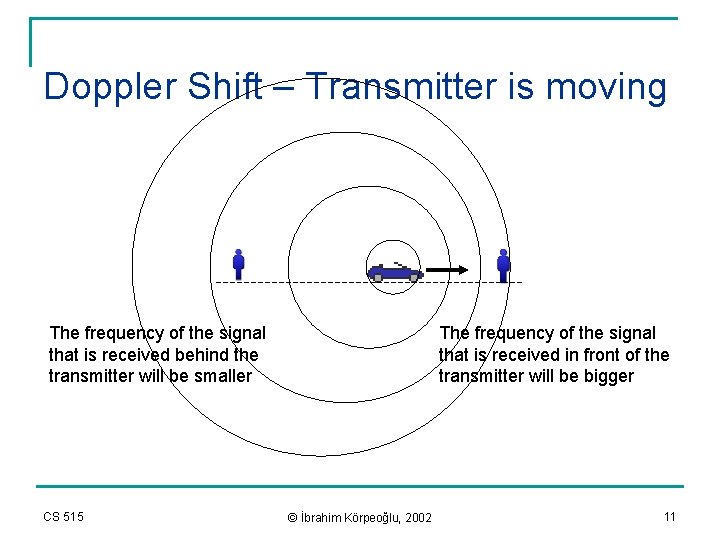
Doppler Shift – Transmitter is moving The frequency of the signal that is received behind the transmitter will be smaller CS 515 The frequency of the signal that is received in front of the transmitter will be bigger © İbrahim Körpeoğlu, 2002 11
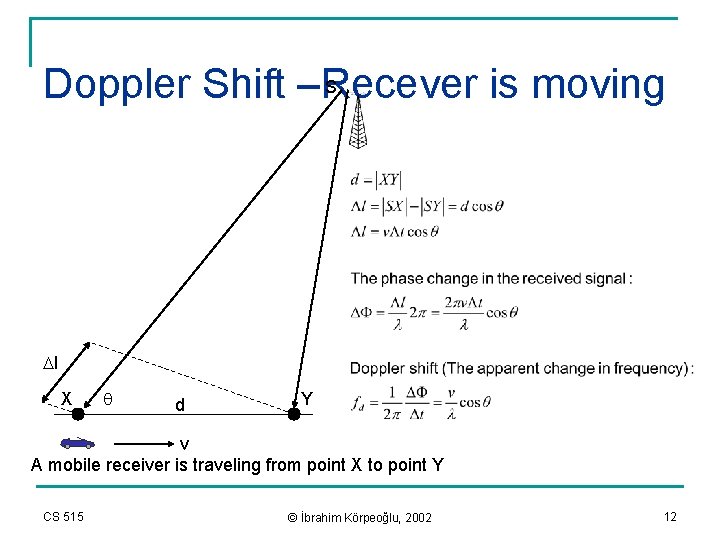
S Doppler Shift –Recever is moving Dl X q d Y v A mobile receiver is traveling from point X to point Y CS 515 © İbrahim Körpeoğlu, 2002 12
Doppler Shift n The Dopper shift is positive q n If the mobile is moving toward the direction of arrival of the wave The Doppler shift is negative q CS 515 If the mobile is moving away from the direction of arrival of the wave. © İbrahim Körpeoğlu, 2002 13
Impulse Response Model of a Multipath Channel n n The wireless channel charcteristics can be expressed by impulse response function The channel is time varying channel when the receiver is moving. Lets assume first that time variation due strictly to the receiver motion (t = d/v) Since at any distance d = vt, the received power will ve combination of different incoming signals, the channel charactesitics or the impulse response funcion depends on the distance d between trandmitter and receiver CS 515 © İbrahim Körpeoğlu, 2002 14
Basic Digital Signal Processing (DSP) Concepts Introduction to Signals and Systems 15
Signals and Systems n Discrete-Time Signals q q n n Time-domain representation Transform domain representation Continuous Time Signals Transformations q q q n Systems n n n Fourier Transform Laplace Transform Z-transform Linear Time Invariant (LTI) Systems Time Varying Systems Impulse Response of Systems CS 515 © İbrahim Körpeoğlu, 2002 16
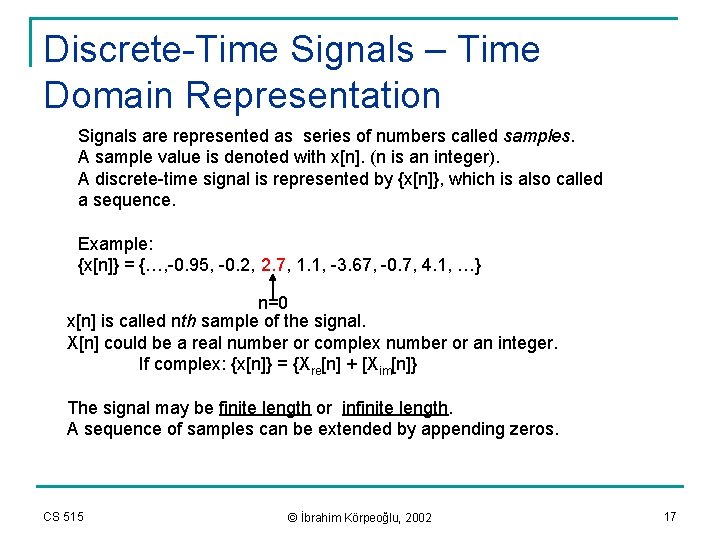
Discrete-Time Signals – Time Domain Representation Signals are represented as series of numbers called samples. A sample value is denoted with x[n]. (n is an integer). A discrete-time signal is represented by {x[n]}, which is also called a sequence. Example: {x[n]} = {…, -0. 95, -0. 2, 2. 7, 1. 1, -3. 67, -0. 7, 4. 1, …} n=0 x[n] is called nth sample of the signal. X[n] could be a real number or complex number or an integer. If complex: {x[n]} = {Xre[n] + [Xim[n]} The signal may be finite length or infinite length. A sequence of samples can be extended by appending zeros. CS 515 © İbrahim Körpeoğlu, 2002 17
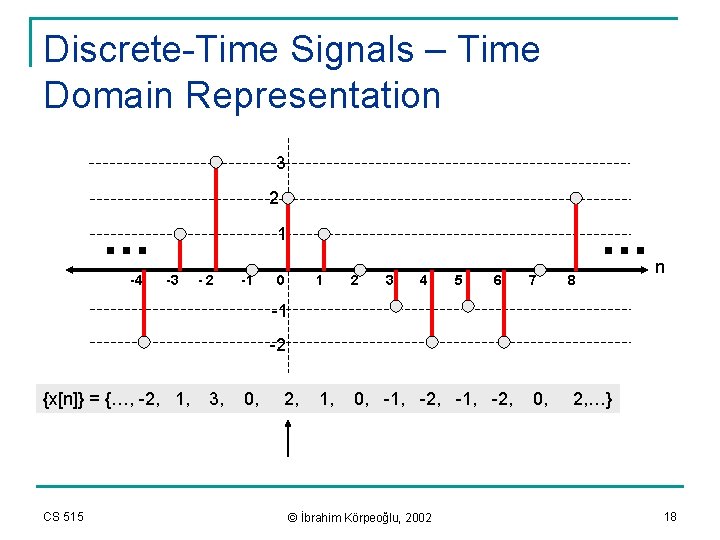
Discrete-Time Signals – Time Domain Representation 3 2 … -4 … 1 -3 -2 -1 0 1 2 3 4 5 6 1, 0, -1, -2, 7 8 n -1 -2 {x[n]} = {…, -2, 1, CS 515 3, 0, 2, © İbrahim Körpeoğlu, 2002 0, 2, …} 18
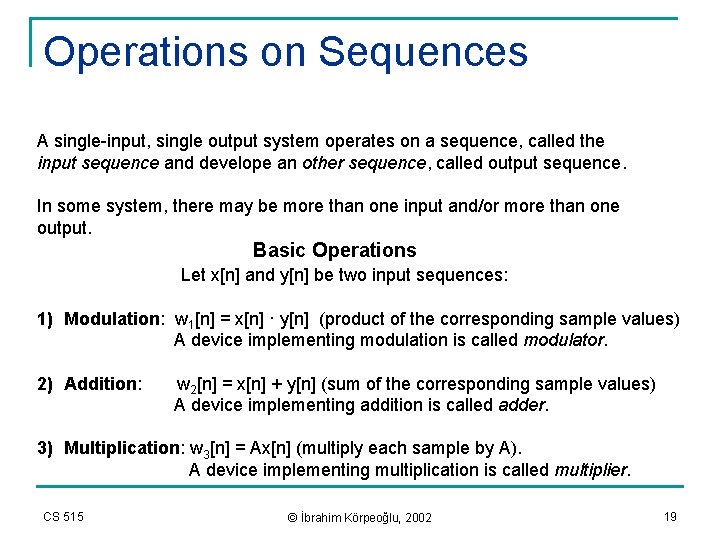
Operations on Sequences A single-input, single output system operates on a sequence, called the input sequence and develope an other sequence, called output sequence. In some system, there may be more than one input and/or more than one output. Basic Operations Let x[n] and y[n] be two input sequences: 1) Modulation: w 1[n] = x[n] · y[n] (product of the corresponding sample values) A device implementing modulation is called modulator. 2) Addition: w 2[n] = x[n] + y[n] (sum of the corresponding sample values) A device implementing addition is called adder. 3) Multiplication: w 3[n] = Ax[n] (multiply each sample by A). A device implementing multiplication is called multiplier. CS 515 © İbrahim Körpeoğlu, 2002 19
![Operations on Sequences 4) Time-shifting: w 4[n] = x[n-N], N is integer. If N](http://slidetodoc.com/presentation_image_h2/d9960e0c3f338c875b0a47f70c673d5e/image-20.jpg "Operations on Sequences 4) Time-shifting: w 4[n] = x[n-N], N is integer. If N")
Operations on Sequences 4) Time-shifting: w 4[n] = x[n-N], N is integer. If N > 0, then this is a delaying operation If N < 0, then this is a advancing operation The device implementing delaying operation by one sample is called unit delay, and a device implementing advancing operation by one sample is called unit advance. 5) Time-reversing (Folding): w 6[n] = x[-n] 6) Pick-off node provides multiple copies of same sequence. CS 515 © İbrahim Körpeoğlu, 2002 20
![Basic Operations on Sequences x[n] w 1[n] X x[n] y[n] w 2[n] = x[n]+y[n]](http://slidetodoc.com/presentation_image_h2/d9960e0c3f338c875b0a47f70c673d5e/image-21.jpg "Basic Operations on Sequences x[n] w 1[n] X x[n] y[n] w 2[n] = x[n]+y[n]")
Basic Operations on Sequences x[n] w 1[n] X x[n] y[n] w 2[n] = x[n]+y[n] w 1[n] = x[n]y[n] A x[n] w 3[n] z -1 w 4[n] Unit Delay w 4[n] = x[n-1] w 3[n] = Ax[n] z x[n] w 5[n] x[n] Unit Advance w 5[n] = x[n+1] CS 515 w 2[n] Adder Modulator Multiplier + x[n]] x[n] © İbrahim Körpeoğlu, 2002 Pick-off Node 21
![Discrete-time System x[n] z-1 a 1 x[n-1] z-1 x[n-2] a 2 z-1 a 3](http://slidetodoc.com/presentation_image_h2/d9960e0c3f338c875b0a47f70c673d5e/image-22.jpg "Discrete-time System x[n] z-1 a 1 x[n-1] z-1 x[n-2] a 2 z-1 a 3")
Discrete-time System x[n] z-1 a 1 x[n-1] z-1 x[n-2] a 2 z-1 a 3 x[n-3] a 4 + y[n] = a 1 x[n] + a 2 x[n-1] + a 3 x[n-2] + a 4 x[n-3] CS 515 © İbrahim Körpeoğlu, 2002 22
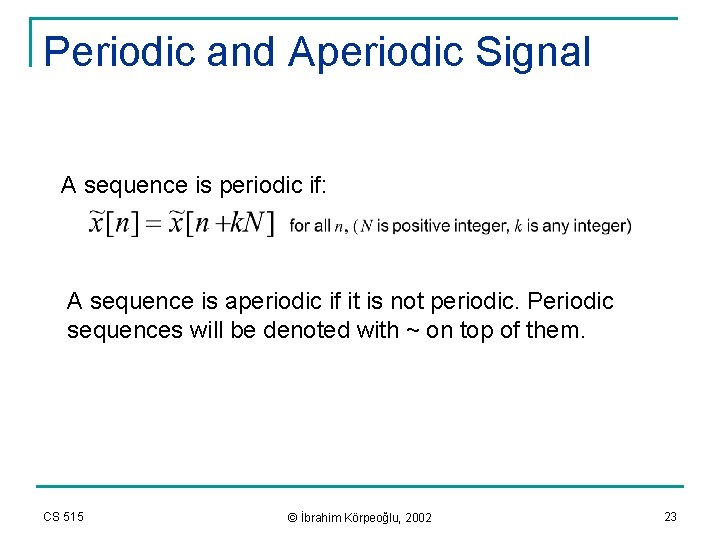
Periodic and Aperiodic Signal A sequence is periodic if: A sequence is aperiodic if it is not periodic. Periodic sequences will be denoted with ~ on top of them. CS 515 © İbrahim Körpeoğlu, 2002 23
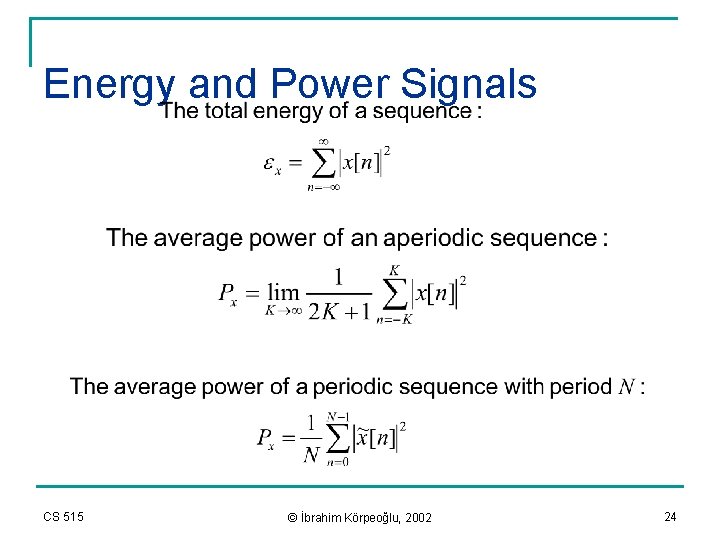
Energy and Power Signals CS 515 © İbrahim Körpeoğlu, 2002 24
Basic Sequences n n n Unit Sample Real Sinusoidal Sequences Exponential Sequences n Complex Exponentials q n CS 515 Real and Imaginary parts Real Exponentials © İbrahim Körpeoğlu, 2002 25
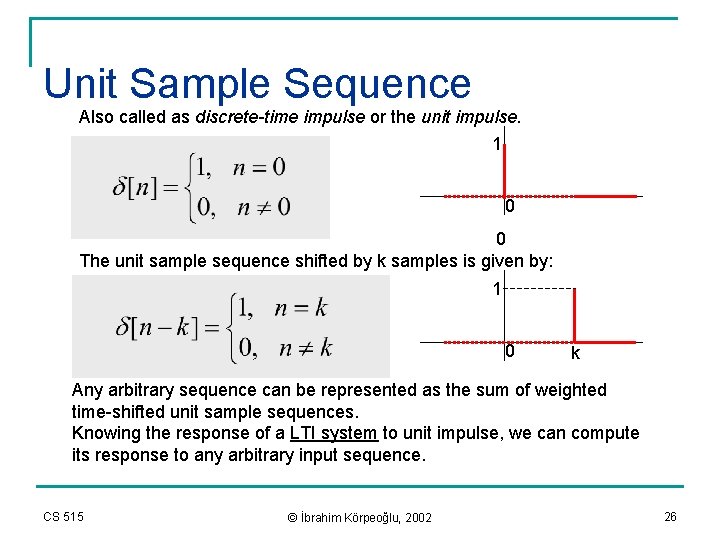
Unit Sample Sequence Also called as discrete-time impulse or the unit impulse. 1 0 0 The unit sample sequence shifted by k samples is given by: 1 0 k Any arbitrary sequence can be represented as the sum of weighted time-shifted unit sample sequences. Knowing the response of a LTI system to unit impulse, we can compute its response to any arbitrary input sequence. CS 515 © İbrahim Körpeoğlu, 2002 26
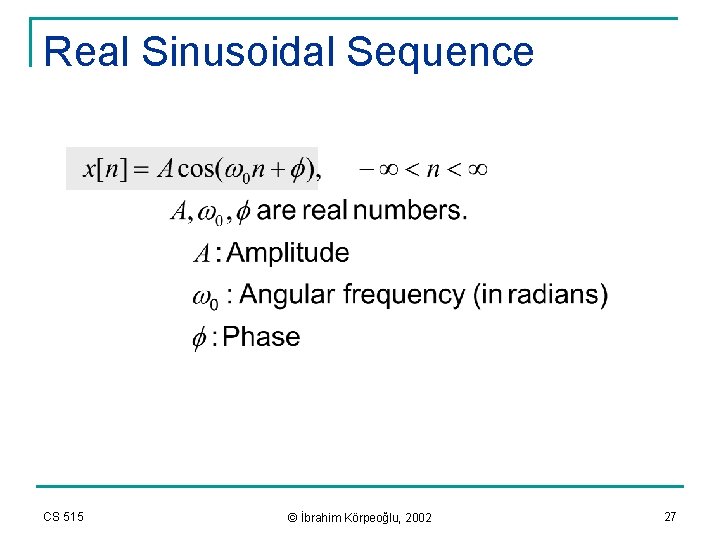
Real Sinusoidal Sequence CS 515 © İbrahim Körpeoğlu, 2002 27
![Example – x[n] = 1. 5 cosw 0 n w 0=0. 1 p w](http://slidetodoc.com/presentation_image_h2/d9960e0c3f338c875b0a47f70c673d5e/image-28.jpg "Example – x[n] = 1. 5 cosw 0 n w 0=0. 1 p w")
Example – x[n] = 1. 5 cosw 0 n w 0=0. 1 p w 0=0. 9 p CS 515 © İbrahim Körpeoğlu, 2002 w 0=0. 2 p w 0=0. 9 p 28
![Example – x[n] = 1. 5 cosw 0 n w 0=1. 1 p CS](http://slidetodoc.com/presentation_image_h2/d9960e0c3f338c875b0a47f70c673d5e/image-29.jpg "Example – x[n] = 1. 5 cosw 0 n w 0=1. 1 p CS")
Example – x[n] = 1. 5 cosw 0 n w 0=1. 1 p CS 515 w 0=1. 2 p © İbrahim Körpeoğlu, 2002 29
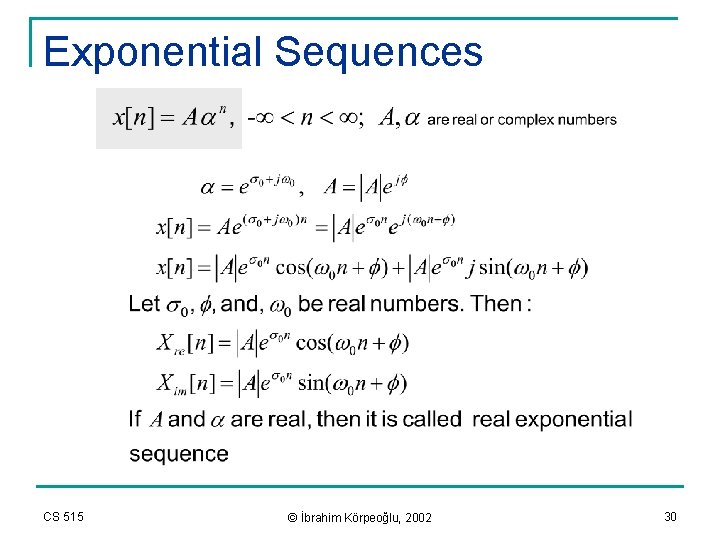
Exponential Sequences CS 515 © İbrahim Körpeoğlu, 2002 30
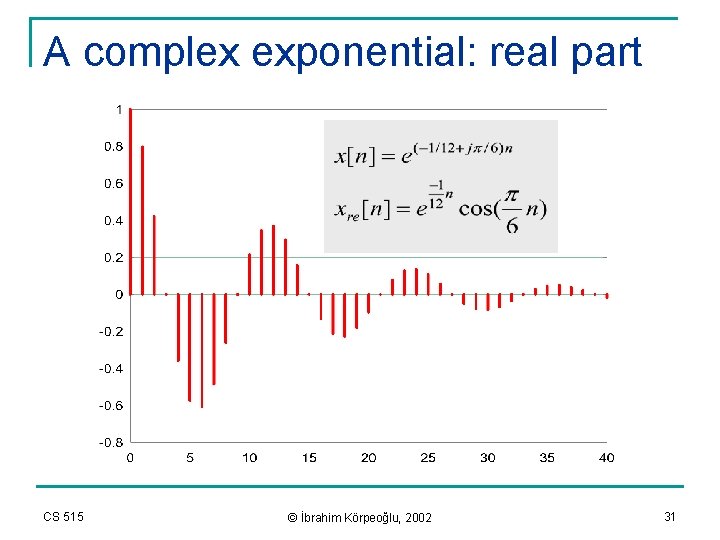
A complex exponential: real part CS 515 © İbrahim Körpeoğlu, 2002 31
![Real Exponentials X[n]=0. 2(1. 2)n a>1 Growing CS 515 X[n]=20(0. 9)n a< 1 Decaying](http://slidetodoc.com/presentation_image_h2/d9960e0c3f338c875b0a47f70c673d5e/image-32.jpg "Real Exponentials X[n]=0. 2(1. 2)n a>1 Growing CS 515 X[n]=20(0. 9)n a< 1 Decaying")
Real Exponentials X[n]=0. 2(1. 2)n a>1 Growing CS 515 X[n]=20(0. 9)n a< 1 Decaying © İbrahim Körpeoğlu, 2002 32
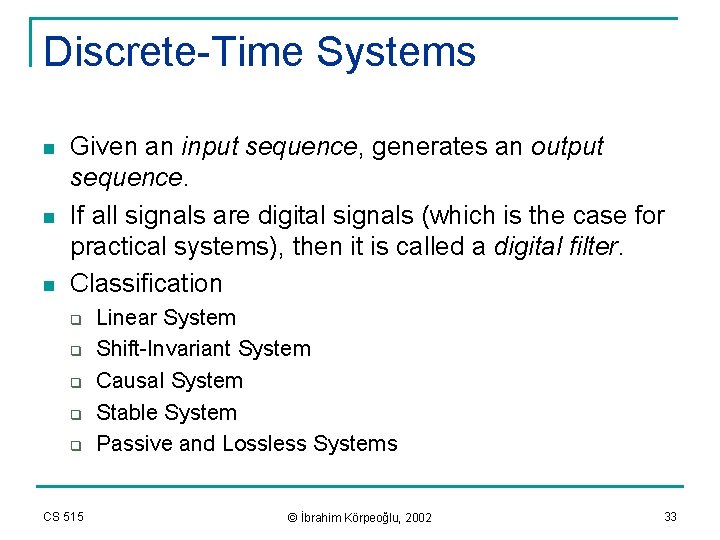
Discrete-Time Systems n n n Given an input sequence, generates an output sequence. If all signals are digital signals (which is the case for practical systems), then it is called a digital filter. Classification q q q CS 515 Linear System Shift-Invariant System Causal System Stable System Passive and Lossless Systems © İbrahim Körpeoğlu, 2002 33
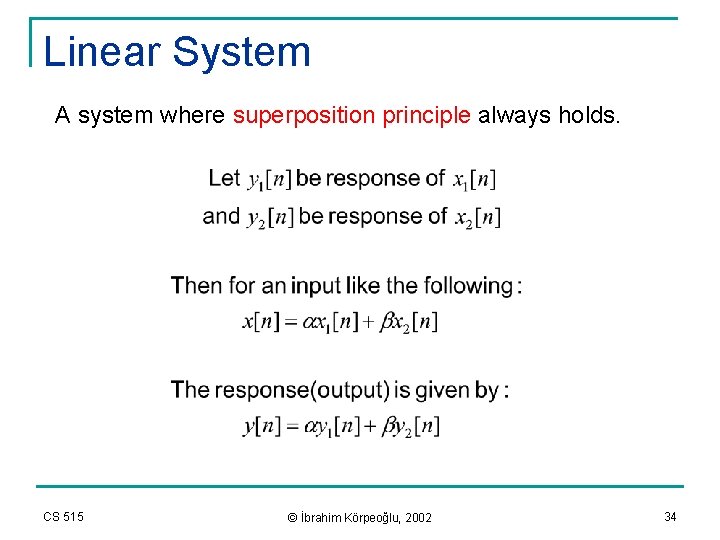
Linear System A system where superposition principle always holds. CS 515 © İbrahim Körpeoğlu, 2002 34
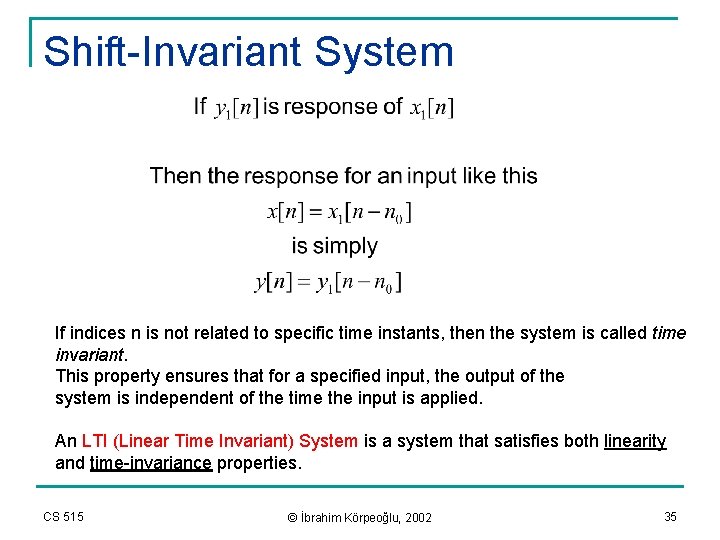
Shift-Invariant System If indices n is not related to specific time instants, then the system is called time invariant. This property ensures that for a specified input, the output of the system is independent of the time the input is applied. An LTI (Linear Time Invariant) System is a system that satisfies both linearity and time-invariance properties. CS 515 © İbrahim Körpeoğlu, 2002 35
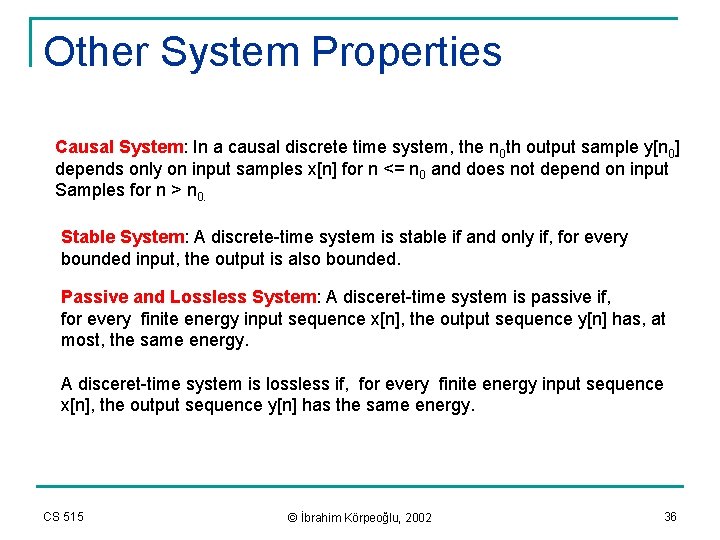
Other System Properties Causal System: In a causal discrete time system, the n 0 th output sample y[n 0] depends only on input samples x[n] for n <= n 0 and does not depend on input Samples for n > n 0. Stable System: A discrete-time system is stable if and only if, for every bounded input, the output is also bounded. Passive and Lossless System: A disceret-time system is passive if, for every finite energy input sequence x[n], the output sequence y[n] has, at most, the same energy. A disceret-time system is lossless if, for every finite energy input sequence x[n], the output sequence y[n] has the same energy. CS 515 © İbrahim Körpeoğlu, 2002 36
![Impulse Response The response of a digital filter to a unit sample sequence {d[n]}](http://slidetodoc.com/presentation_image_h2/d9960e0c3f338c875b0a47f70c673d5e/image-37.jpg "Impulse Response The response of a digital filter to a unit sample sequence {d[n]}")
Impulse Response The response of a digital filter to a unit sample sequence {d[n]} is called the unit response, or simply, the impulse response, and denoted by: {h[n]} A linear time invariant system (filter) is completely characterized in the time-domain by its impulse response. Example: A system is given with the equation below: y[n] = a 1 x[n] + a 2 x[n-1] + a 3 x[n-2] + a 4 x[n-3] By setting x[n] = d[n], we can find out the impulse response of the system: h[n] = a 1 d[n] + a 2 d[n-1] + a 3 d[n-2] + a 4 d[n-3] {h[n]} = {a 1, a 2, a 3, a 4} CS 515 © İbrahim Körpeoğlu, 2002 37
![LTI: Input-Output Relationship {x[n]} = {…, 0, 0, 0. 5, 0, 0, 1. 5,](http://slidetodoc.com/presentation_image_h2/d9960e0c3f338c875b0a47f70c673d5e/image-38.jpg "LTI: Input-Output Relationship {x[n]} = {…, 0, 0, 0. 5, 0, 0, 1. 5,")
LTI: Input-Output Relationship {x[n]} = {…, 0, 0, 0. 5, 0, 0, 1. 5, -1, 0, 0. 75, 0, 0, …} An arbitrary sequence x[n] in the time domain can be represented as a weighted sum of some basic sequences and its delayed versions. A commonly used basic sequence is unit sample sequence (unit impulse). Sequence x[n] described above can be expressed as: CS 515 © İbrahim Körpeoğlu, 2002 38
![LTI: Input-Output Relationship Given Compute y[n] d[n] LTI System h[n] (impulse response of the](http://slidetodoc.com/presentation_image_h2/d9960e0c3f338c875b0a47f70c673d5e/image-39.jpg "LTI: Input-Output Relationship Given Compute y[n] d[n] LTI System h[n] (impulse response of the")
LTI: Input-Output Relationship Given Compute y[n] d[n] LTI System h[n] (impulse response of the LTI system) x[n] LTI System y[n] Lets compute the response of the this system (filter) to input x[n], where Since the system is time-invariant, the response to d[n-n 0] will be h[n-n 0]. Then: CS 515 © İbrahim Körpeoğlu, 2002 39
![LTI: Input-Output Relationship Any x[n] can be expressed as the weighted linear combination of](http://slidetodoc.com/presentation_image_h2/d9960e0c3f338c875b0a47f70c673d5e/image-40.jpg "LTI: Input-Output Relationship Any x[n] can be expressed as the weighted linear combination of")
LTI: Input-Output Relationship Any x[n] can be expressed as the weighted linear combination of delayed and advanced unit sample sequences as follows: x[k] denotes the kth sample value of {x[n]} By using the fact that the response of system to d[n-k] is h[n-k]. by change of variables is called convolution sum of x[n] and y[n] CS 515 © İbrahim Körpeoğlu, 2002 40
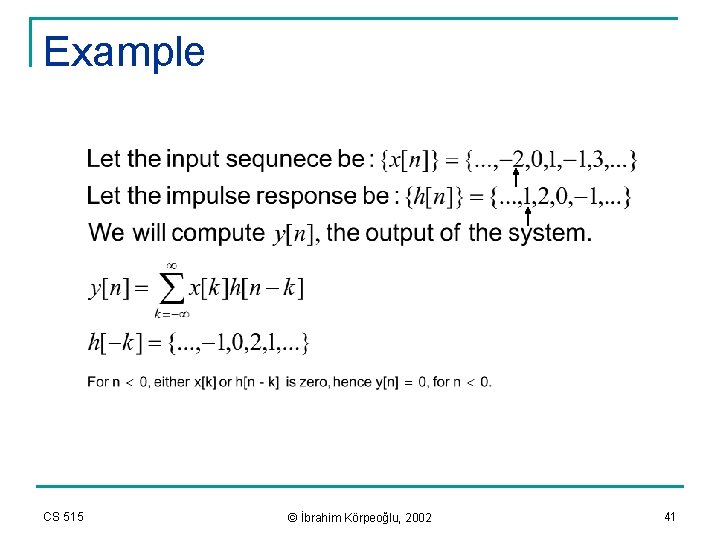
Example CS 515 © İbrahim Körpeoğlu, 2002 41
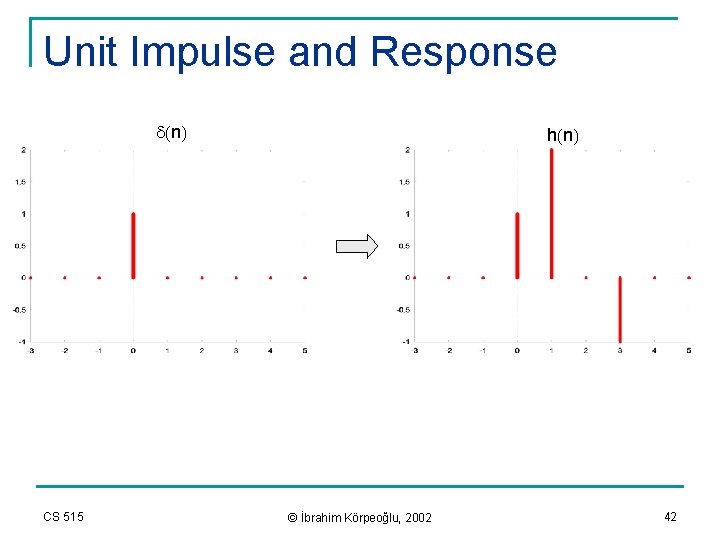
Unit Impulse and Response d(n) CS 515 h(n) © İbrahim Körpeoğlu, 2002 42
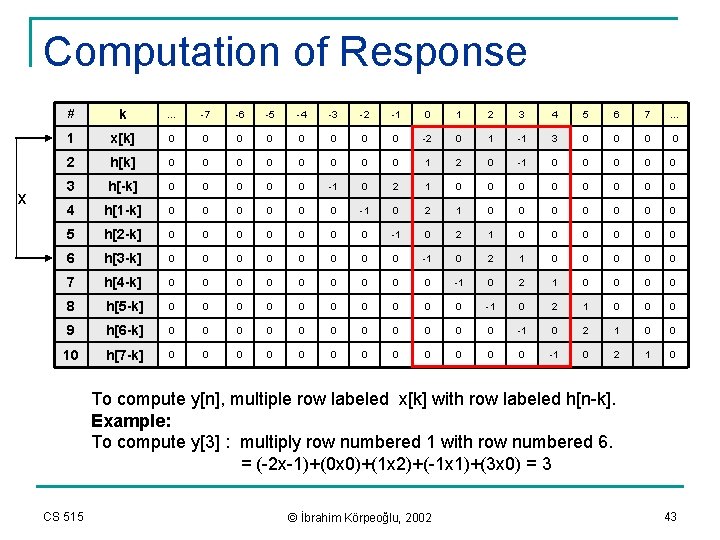
Computation of Response x # k … -7 -6 -5 -4 -3 -2 -1 0 1 2 3 4 5 6 7 … 1 x[k] 0 0 0 0 -2 0 1 -1 3 0 0 2 h[k] 0 0 0 0 1 2 0 -1 0 0 0 3 h[-k] 0 0 0 -1 0 2 1 0 0 0 0 4 h[1 -k] 0 0 0 -1 0 2 1 0 0 0 0 5 h[2 -k] 0 0 0 0 -1 0 2 1 0 0 0 6 h[3 -k] 0 0 0 0 -1 0 2 1 0 0 0 7 h[4 -k] 0 0 0 0 0 -1 0 2 1 0 0 8 h[5 -k] 0 0 0 0 0 -1 0 2 1 0 0 0 9 h[6 -k] 0 0 0 -1 0 2 1 0 0 10 h[7 -k] 0 0 0 -1 0 2 1 0 To compute y[n], multiple row labeled x[k] with row labeled h[n-k]. Example: To compute y[3] : multiply row numbered 1 with row numbered 6. = (-2 x-1)+(0 x 0)+(1 x 2)+(-1 x 1)+(3 x 0) = 3 CS 515 © İbrahim Körpeoğlu, 2002 43
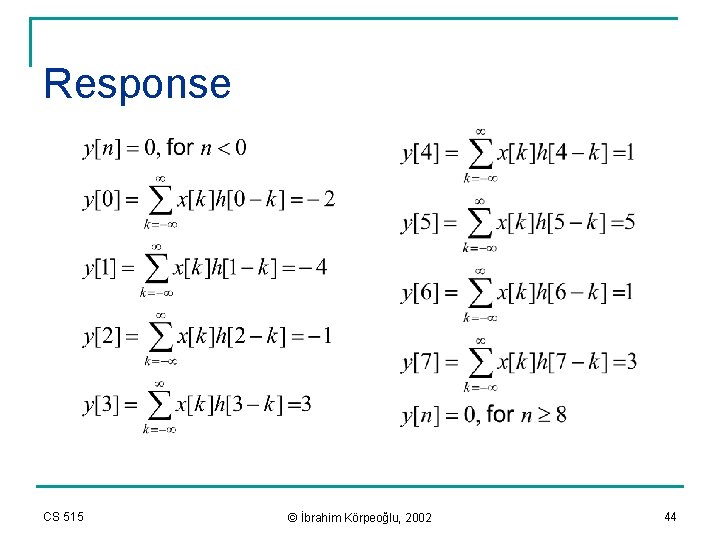
Response CS 515 © İbrahim Körpeoğlu, 2002 44
![Response Sequence: y[n] x[n] y[n] {y[n]} = {… 0, 0, 0, -2, -4, 1,](http://slidetodoc.com/presentation_image_h2/d9960e0c3f338c875b0a47f70c673d5e/image-45.jpg "Response Sequence: y[n] x[n] y[n] {y[n]} = {… 0, 0, 0, -2, -4, 1,")
Response Sequence: y[n] x[n] y[n] {y[n]} = {… 0, 0, 0, -2, -4, 1, 3, 1, 5, 1, -3, 0, 0, 0, …} The convolution of two finite-length sequences results in a finite-length sequence. CS 515 © İbrahim Körpeoğlu, 2002 45
![Simple Interconnection of Systems Cascade Connection: h 1[n] h 2[n] h 1[n] Parallel Connection](http://slidetodoc.com/presentation_image_h2/d9960e0c3f338c875b0a47f70c673d5e/image-46.jpg "Simple Interconnection of Systems Cascade Connection: h 1[n] h 2[n] h 1[n] Parallel Connection")
Simple Interconnection of Systems Cascade Connection: h 1[n] h 2[n] h 1[n] Parallel Connection h 1[n] CS 515 © İbrahim Körpeoğlu, 2002 46
![Classifications of LTI Discrete-Time Systems If h[n] is of finite length, such that h[n]=0](http://slidetodoc.com/presentation_image_h2/d9960e0c3f338c875b0a47f70c673d5e/image-47.jpg "Classifications of LTI Discrete-Time Systems If h[n] is of finite length, such that h[n]=0")
Classifications of LTI Discrete-Time Systems If h[n] is of finite length, such that h[n]=0 for n<N 1 and n>N 2, then the system is called finite impulse response (FIR) discrete time system. In this case, the convolution reduces to: If h[n] is of infinite length, then the system is called infinite impulse response (IIR) discrete-time system. For a causal system, the convolution is expressed as: CS 515 © İbrahim Körpeoğlu, 2002 47
Random Signals n n n Deterministic Signal: They can be uniquely determined by a mathematical expression or a table lookup. Random Signal (Stochastic Signal): Each sample value is generated in a random fashion. A discrete time random signal consists of a typically infinite collection (or ensemble) of discrete time sequences {X[n]}. q q CS 515 At any given time index n, the observed sample value x[n] is the value taken by the random variable X[n]. A random process is a family of random variables {X[n]}. © İbrahim Körpeoğlu, 2002 48
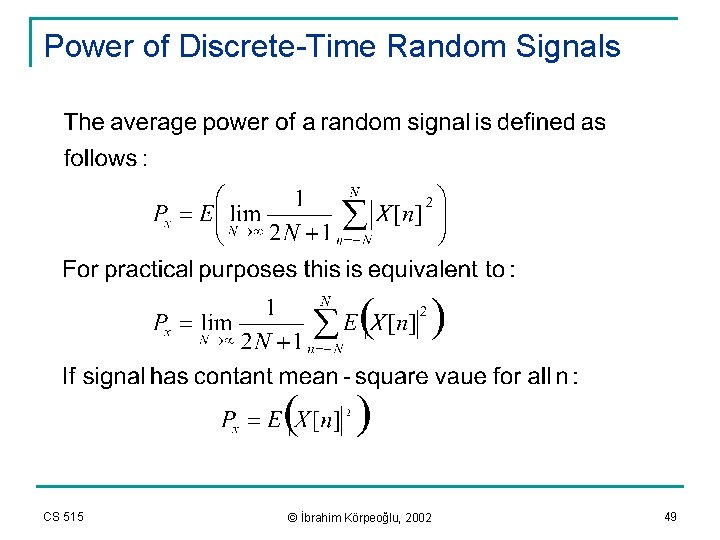
Power of Discrete-Time Random Signals CS 515 © İbrahim Körpeoğlu, 2002 49
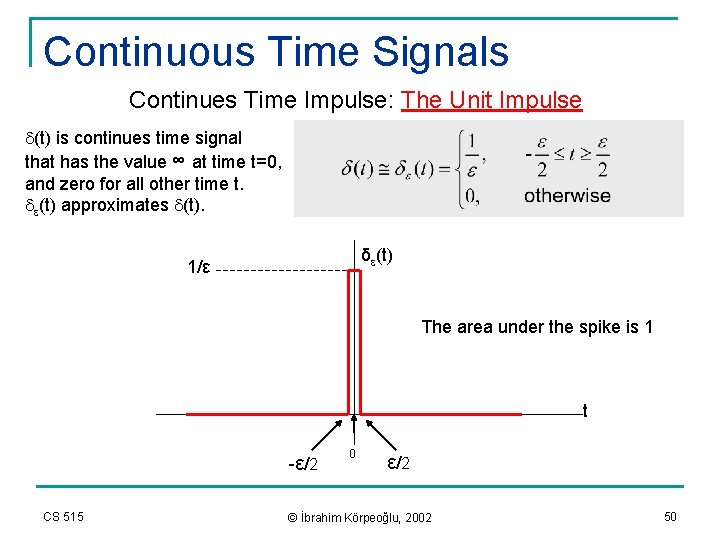
Continuous Time Signals Continues Time Impulse: The Unit Impulse d(t) is continues time signal that has the value ∞ at time t=0, and zero for all other time t. de(t) approximates d(t). δe(t) 1/ε The area under the spike is 1 t -ε / 2 CS 515 0 ε/2 © İbrahim Körpeoğlu, 2002 50
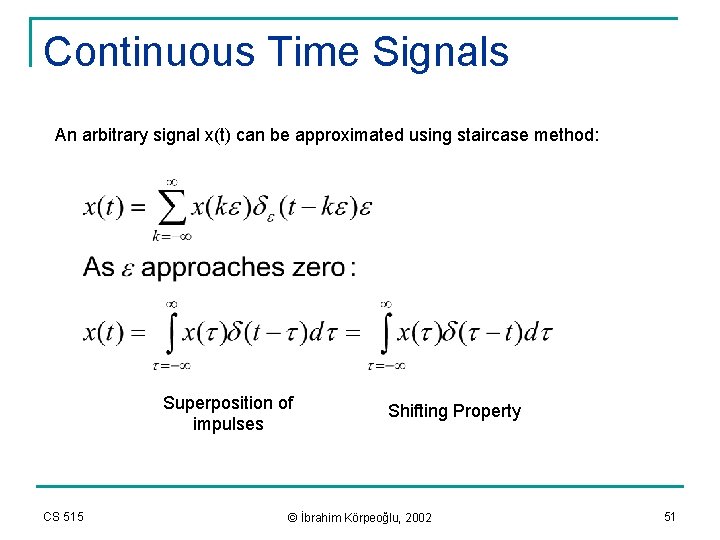
Continuous Time Signals An arbitrary signal x(t) can be approximated using staircase method: Superposition of impulses CS 515 Shifting Property © İbrahim Körpeoğlu, 2002 51
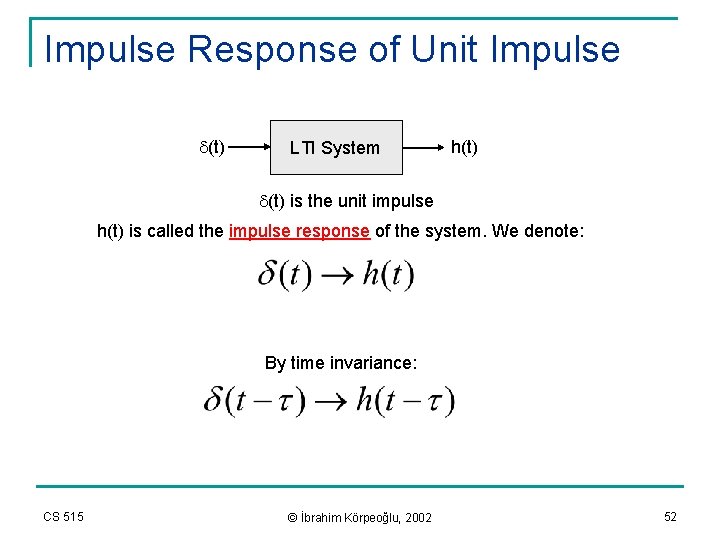
Impulse Response of Unit Impulse d(t) LTI System h(t) d(t) is the unit impulse h(t) is called the impulse response of the system. We denote: By time invariance: CS 515 © İbrahim Körpeoğlu, 2002 52
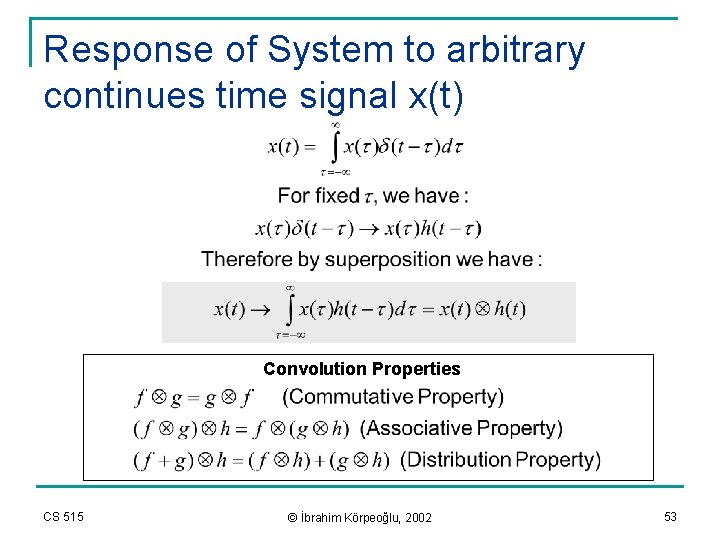
Response of System to arbitrary continues time signal x(t) Convolution Properties CS 515 © İbrahim Körpeoğlu, 2002 53
Multipath Channel Modeling Impulse Response Model of a Multipath Wireless Channel 54
Impulse Response Model of a Multipath Channel n n The wireless channel characteristics can be expressed by impulse response function The channel is time varying channel when the receiver is moving. Lets assume first that time variation due strictly to the receiver motion (t = d/v) Since at any distance d = vt, the received power will ve combination of different incoming signals, the channel charactesitics or the impulse response funcion depends on the distance d between trandmitter and receiver CS 515 © İbrahim Körpeoğlu, 2002 55
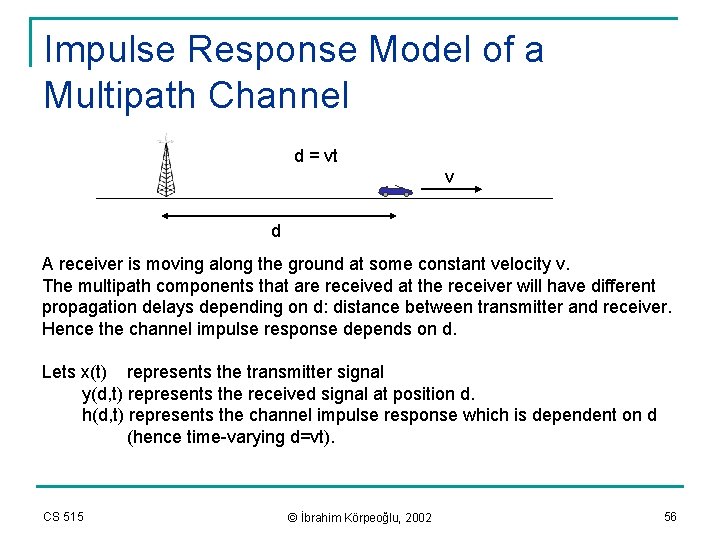
Impulse Response Model of a Multipath Channel d = vt v d A receiver is moving along the ground at some constant velocity v. The multipath components that are received at the receiver will have different propagation delays depending on d: distance between transmitter and receiver. Hence the channel impulse response depends on d. Lets x(t) represents the transmitter signal y(d, t) represents the received signal at position d. h(d, t) represents the channel impulse response which is dependent on d (hence time-varying d=vt). CS 515 © İbrahim Körpeoğlu, 2002 56
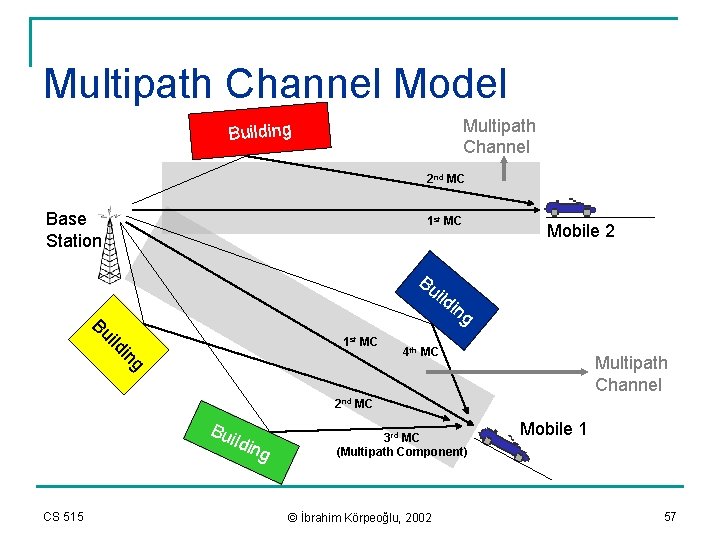
Multipath Channel Model Multipath Channel Building 2 nd MC Base Station 1 st MC Bu ild in ild Bu 1 st MC Mobile 2 in g 4 th MC g Multipath Channel 2 nd MC Bu ildi ng CS 515 3 rd MC (Multipath Component) © İbrahim Körpeoğlu, 2002 Mobile 1 57
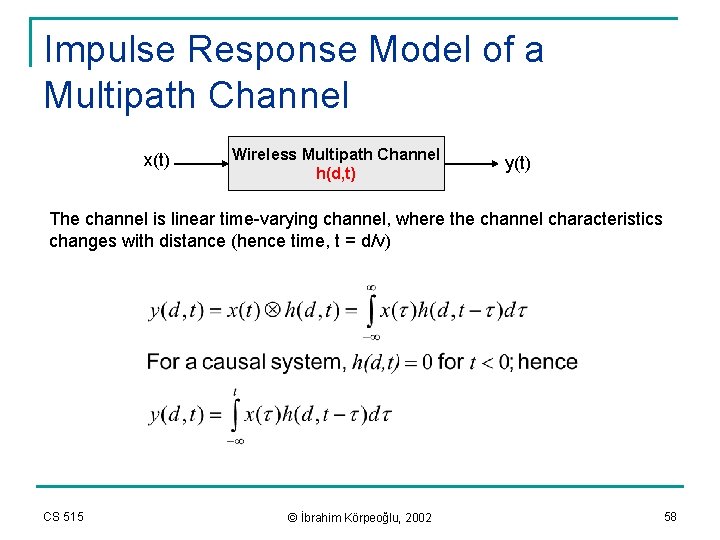
Impulse Response Model of a Multipath Channel x(t) Wireless Multipath Channel h(d, t) y(t) The channel is linear time-varying channel, where the channel characteristics changes with distance (hence time, t = d/v) CS 515 © İbrahim Körpeoğlu, 2002 58
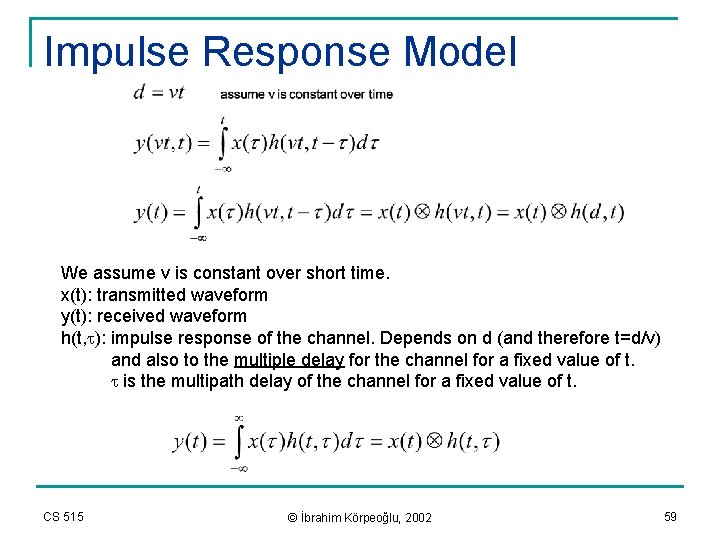
Impulse Response Model We assume v is constant over short time. x(t): transmitted waveform y(t): received waveform h(t, ): impulse response of the channel. Depends on d (and therefore t=d/v) and also to the multiple delay for the channel for a fixed value of t. is the multipath delay of the channel for a fixed value of t. CS 515 © İbrahim Körpeoğlu, 2002 59
Introduction to Modulation Baseband Passband Signals and Comlex Envelopes (We will make a very brief introduction in order to better understand Multipath Channel Model) 60
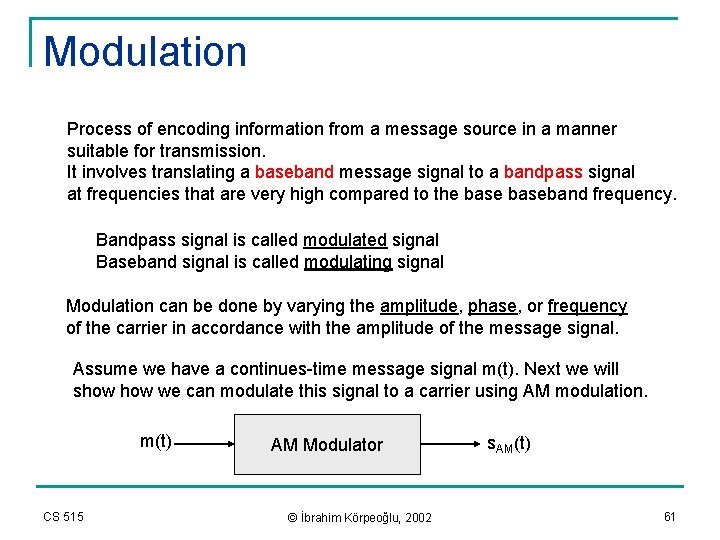
Modulation Process of encoding information from a message source in a manner suitable for transmission. It involves translating a baseband message signal to a bandpass signal at frequencies that are very high compared to the baseband frequency. Bandpass signal is called modulated signal Baseband signal is called modulating signal Modulation can be done by varying the amplitude, phase, or frequency of the carrier in accordance with the amplitude of the message signal. Assume we have a continues-time message signal m(t). Next we will show we can modulate this signal to a carrier using AM modulation. m(t) CS 515 AM Modulator © İbrahim Körpeoğlu, 2002 s. AM(t) 61
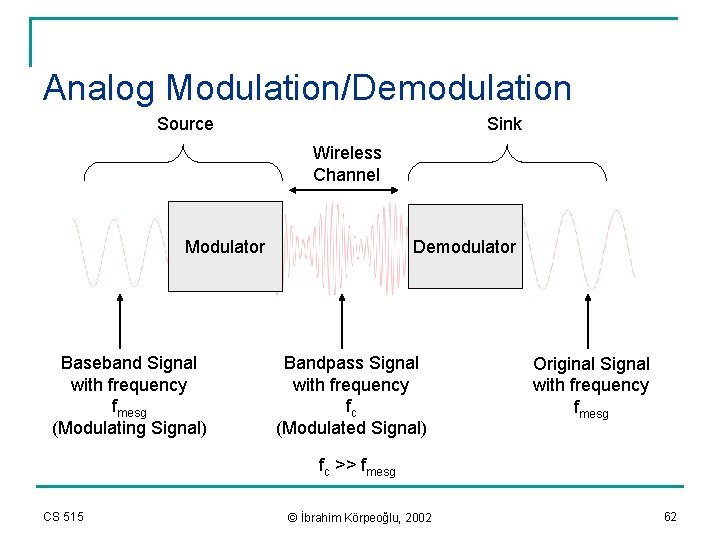
Analog Modulation/Demodulation Source Sink Wireless Channel Modulator Baseband Signal with frequency fmesg (Modulating Signal) Demodulator Bandpass Signal with frequency fc (Modulated Signal) Original Signal with frequency fmesg fc >> fmesg CS 515 © İbrahim Körpeoğlu, 2002 62
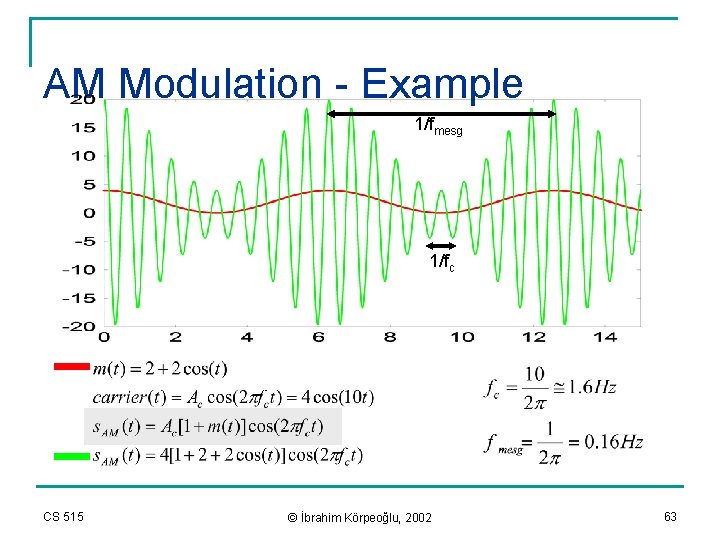
AM Modulation - Example 1/fmesg 1/fc CS 515 © İbrahim Körpeoğlu, 2002 63

Complex Envelope Modulation index k = peak_mesg_signal_amplitude / peak_carrier_amplitide The AM signal s. AM(t) can also be expressed as: m(t) Accos(2 pfct) g(t) is called the complex envelope AM signal CS 515 © İbrahim Körpeoğlu, 2002 64
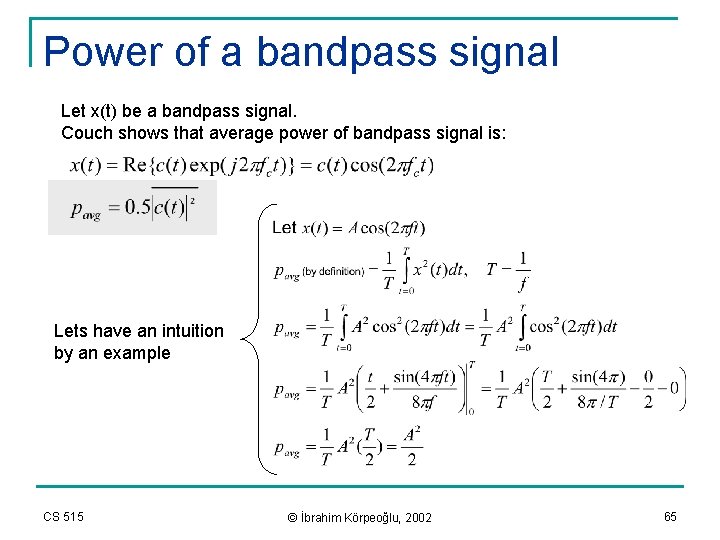
Power of a bandpass signal Let x(t) be a bandpass signal. Couch shows that average power of bandpass signal is: Lets have an intuition by an example CS 515 © İbrahim Körpeoğlu, 2002 65
. . . Continue with Multipath Channel Impulse Response Model 66
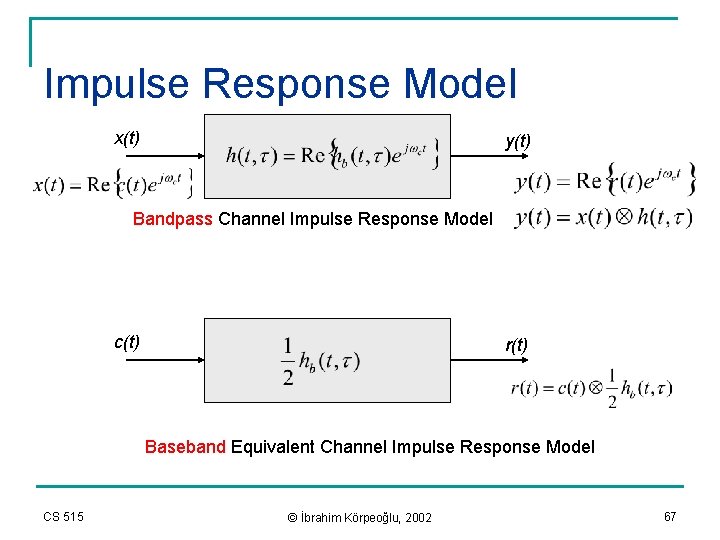
Impulse Response Model x(t) y(t) Bandpass Channel Impulse Response Model c(t) r(t) Baseband Equivalent Channel Impulse Response Model CS 515 © İbrahim Körpeoğlu, 2002 67

Impulse Response Model c(t) is the complex envelope representation of the transmitted signal r(t) is the complex envelope representation of the received signal hb(t, ) is the complex baseband impulse response CS 515 © İbrahim Körpeoğlu, 2002 68
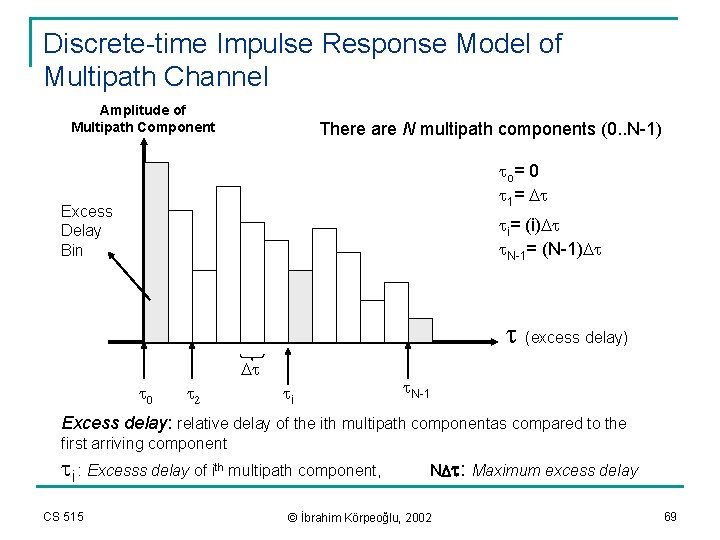
Discrete-time Impulse Response Model of Multipath Channel Amplitude of Multipath Component There are N multipath components (0. . N-1) o= 0 1= D Excess Delay Bin i= (i)D N-1= (N-1)D (excess delay) D 0 2 i N-1 Excess delay: relative delay of the ith multipath componentas compared to the first arriving component i : Excesss delay of ith multipath component, CS 515 ND : Maximum excess delay © İbrahim Körpeoğlu, 2002 69
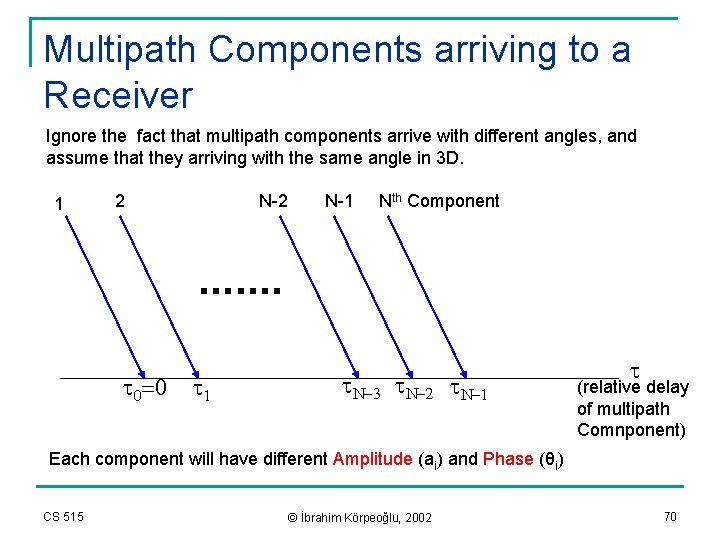
Multipath Components arriving to a Receiver Ignore the fact that multipath components arrive with different angles, and assume that they arriving with the same angle in 3 D. 1 2 N-1 Nth Component . . . . 0=0 1 N-3 N-2 N-1 (relative delay of multipath Comnponent) Each component will have different Amplitude (ai) and Phase (θi) CS 515 © İbrahim Körpeoğlu, 2002 70
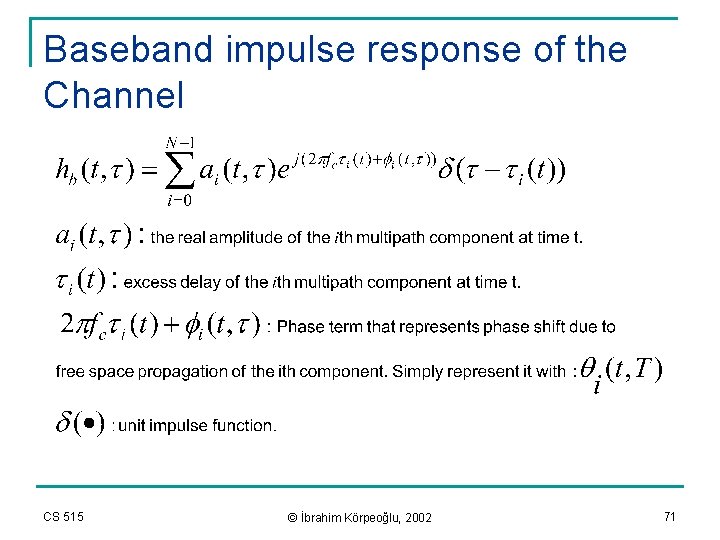
Baseband impulse response of the Channel CS 515 © İbrahim Körpeoğlu, 2002 71
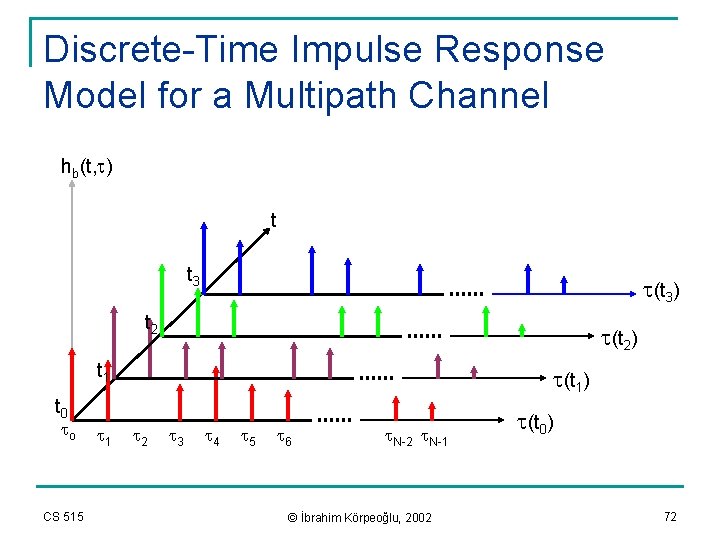
Discrete-Time Impulse Response Model for a Multipath Channel hb(t, ) t t 3 (t 3) t 2 (t 2) t 1 (t 1) t 0 o CS 515 1 2 3 4 5 6 N-2 N-1 © İbrahim Körpeoğlu, 2002 (t 0) 72
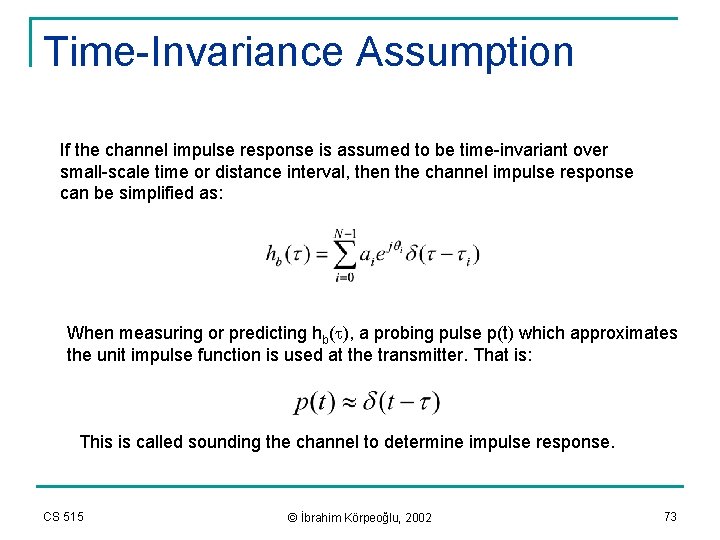
Time-Invariance Assumption If the channel impulse response is assumed to be time-invariant over small-scale time or distance interval, then the channel impulse response can be simplified as: When measuring or predicting hb( ), a probing pulse p(t) which approximates the unit impulse function is used at the transmitter. That is: This is called sounding the channel to determine impulse response. CS 515 © İbrahim Körpeoğlu, 2002 73
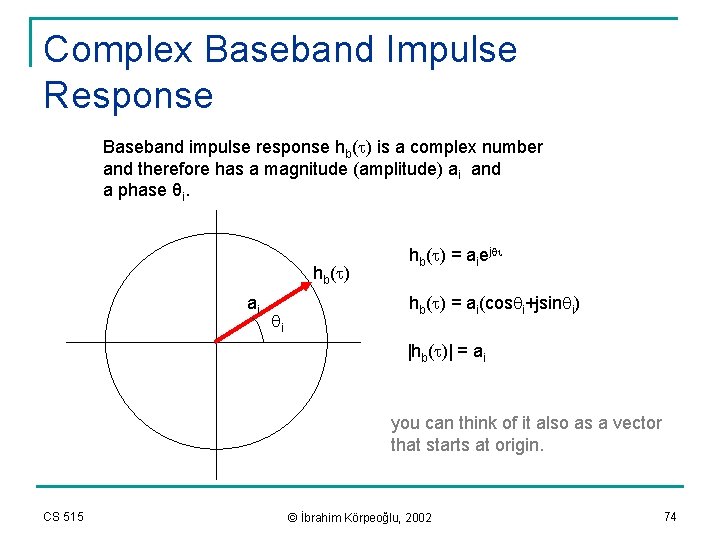
Complex Baseband Impulse Response Baseband impulse response hb( ) is a complex number and therefore has a magnitude (amplitude) ai and a phase θi. hb( ) ai qi hb( ) = aiejqi hb( ) = ai(cosqi+jsinqi) |hb( )| = ai you can think of it also as a vector that starts at origin. CS 515 © İbrahim Körpeoğlu, 2002 74

Amplitudes and Phases of Multipath Components 1 st Arriving Multipath Component (Say 0 th Component) q 0=0 (phase) 2 a 0 fc Two components emerge from the same source at the same time. They belong to the same transmitter signal. But they travel different paths. They arrive at the same receiver with time difference equal to i. fc 2 ai qi=2 pfc i ith Multipath Component 0 qi is expressed in radians CS 515 © İbrahim Körpeoğlu, 2002 i 75
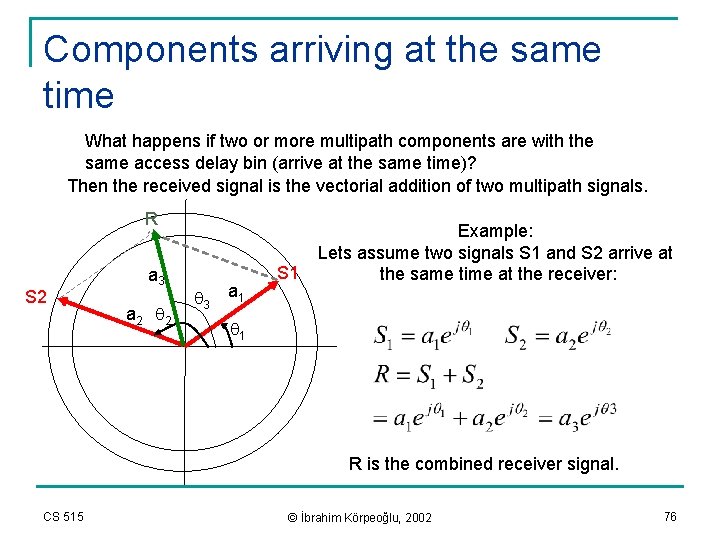
Components arriving at the same time What happens if two or more multipath components are with the same access delay bin (arrive at the same time)? Then the received signal is the vectorial addition of two multipath signals. R S 2 a 3 a 2 q 3 a 1 S 1 Example: Lets assume two signals S 1 and S 2 arrive at the same time at the receiver: q 1 R is the combined receiver signal. CS 515 © İbrahim Körpeoğlu, 2002 76
Components arriving at the same time The amplitude and phase of the combined signal (R) depends on the amplitudes and phases of the two components. Depending on the values of the phases of the components, the combined affect may weaken or strengthen the amplitude of the combined signal. It is possible that the two signals may totally cancel each other depending on their relative phases on their amplitudes. CS 515 © İbrahim Körpeoğlu, 2002 77
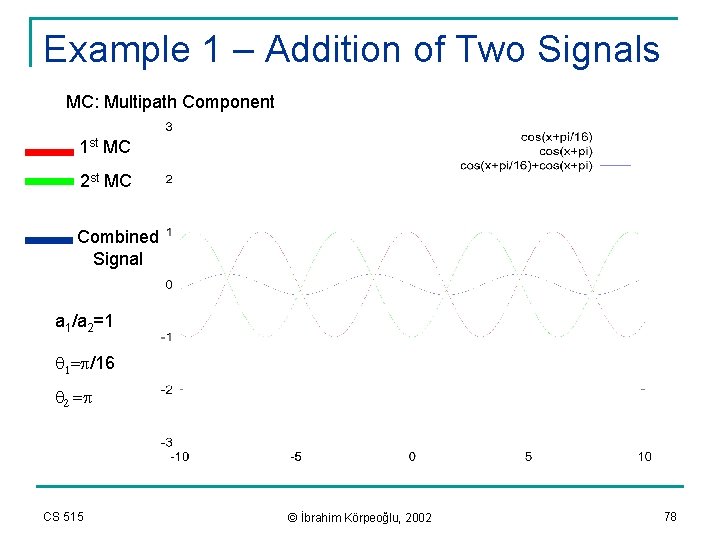
Example 1 – Addition of Two Signals MC: Multipath Component 1 st MC 2 st MC Combined Signal a 1/a 2=1 q 1=p/16 q 2 =p CS 515 © İbrahim Körpeoğlu, 2002 78
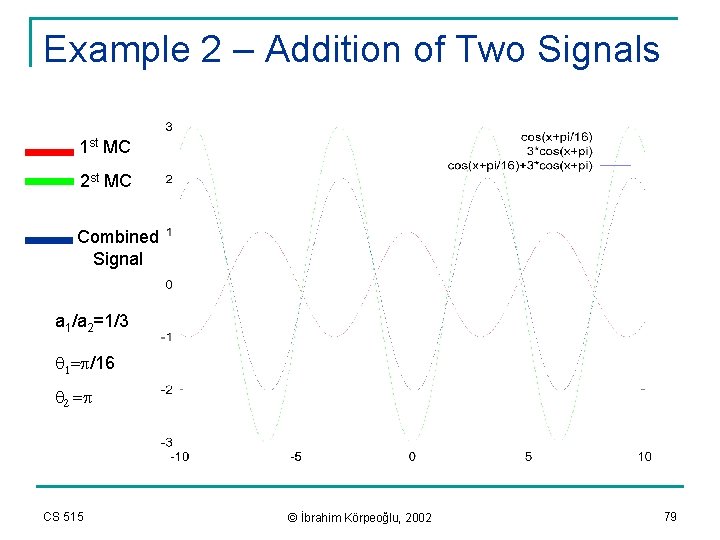
Example 2 – Addition of Two Signals 1 st MC 2 st MC Combined Signal a 1/a 2=1/3 q 1=p/16 q 2 =p CS 515 © İbrahim Körpeoğlu, 2002 79
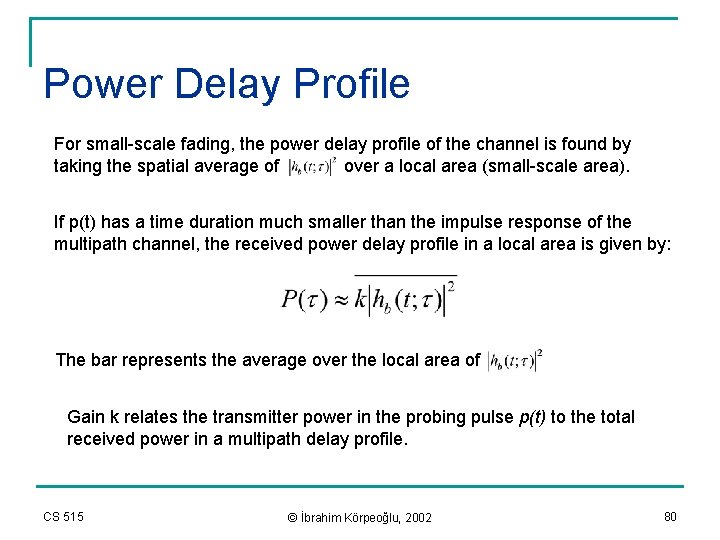
Power Delay Profile For small-scale fading, the power delay profile of the channel is found by taking the spatial average of over a local area (small-scale area). If p(t) has a time duration much smaller than the impulse response of the multipath channel, the received power delay profile in a local area is given by: The bar represents the average over the local area of Gain k relates the transmitter power in the probing pulse p(t) to the total received power in a multipath delay profile. CS 515 © İbrahim Körpeoğlu, 2002 80
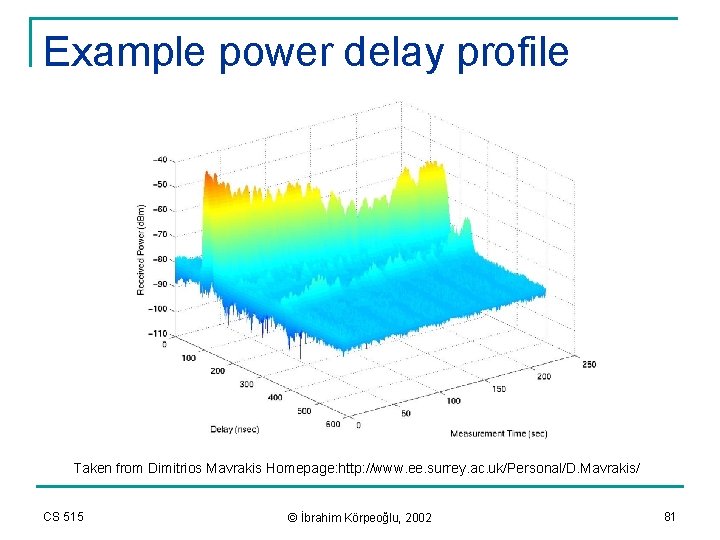
Example power delay profile Taken from Dimitrios Mavrakis Homepage: http: //www. ee. surrey. ac. uk/Personal/D. Mavrakis/ CS 515 © İbrahim Körpeoğlu, 2002 81

Appendix: Basic Filter Concept (Simple Analog Filters) 82
Filters n Filter: A device that transmits only part of the incident energy and may thereby change the spectral distribution of energy: q q CS 515 (a) high-pass filters transmit energy above a certain frequency (pass higher frequencies); (b) low-pass filters transmit energy below a certain frequency (pass lower frequencies); (c) bandpass filters transmit energy of a certain bandwidth; (d) band-stop filters transmit energy outside a specific frequency band. © İbrahim Körpeoğlu, 2002 83

Low-pass Filter R 1 (k ) Vin V(t) C 1 (n. F) Vout A simple RC low-pass filter Cutoff (or turnower) freqeuncy: Voltage gain: CS 515 Voltage Gain compares Vout with Vin © İbrahim Körpeoğlu, 2002 84
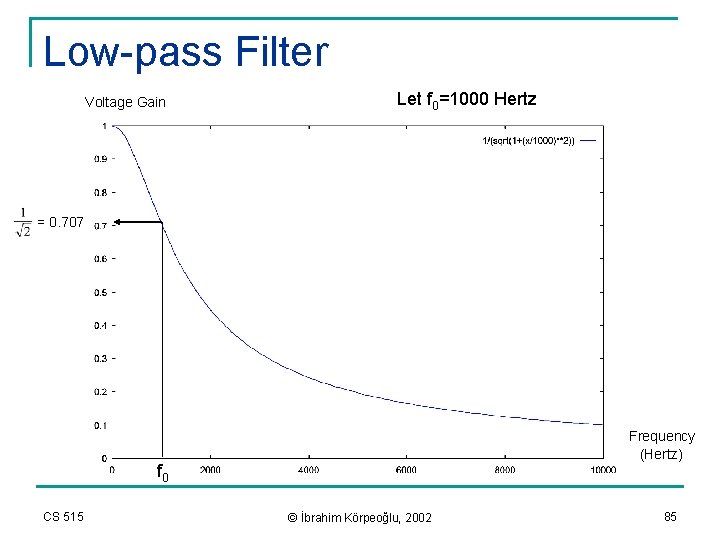
Low-pass Filter Voltage Gain Let f 0=1000 Hertz = 0. 707 Frequency (Hertz) f 0 CS 515 © İbrahim Körpeoğlu, 2002 85
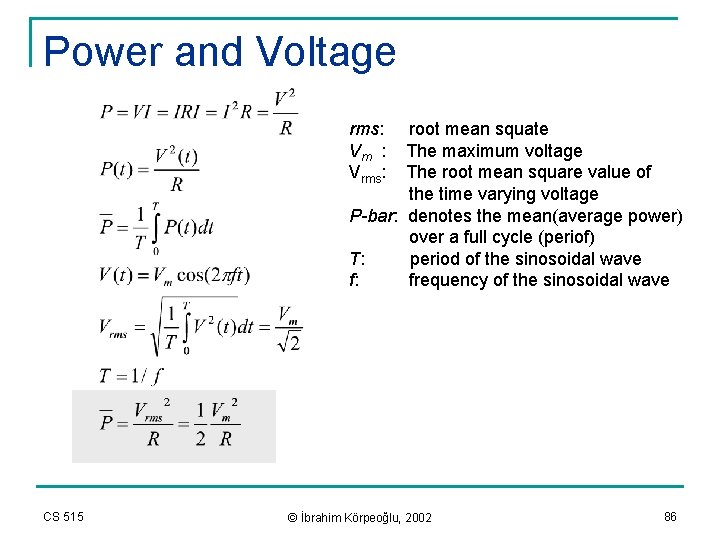
Power and Voltage rms: Vm : Vrms: root mean squate The maximum voltage The root mean square value of the time varying voltage P-bar: denotes the mean(average power) over a full cycle (periof) T: period of the sinosoidal wave f: frequency of the sinosoidal wave CS 515 © İbrahim Körpeoğlu, 2002 86
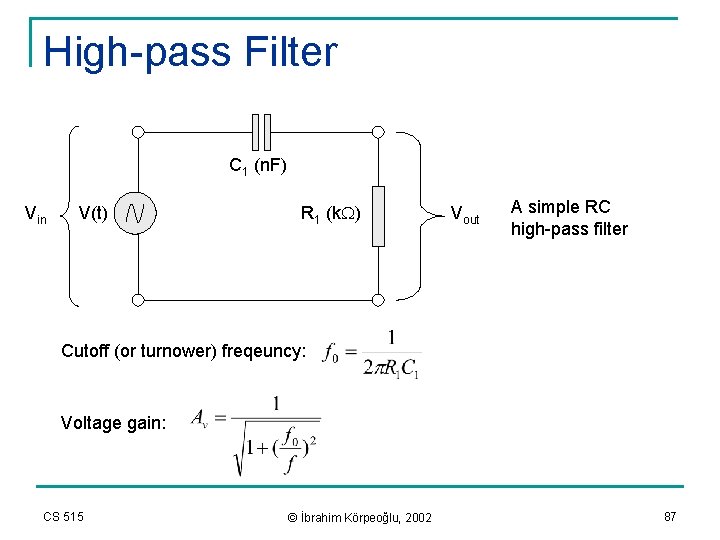
High-pass Filter C 1 (n. F) Vin V(t) R 1 (k ) Vout A simple RC high-pass filter Cutoff (or turnower) freqeuncy: Voltage gain: CS 515 © İbrahim Körpeoğlu, 2002 87
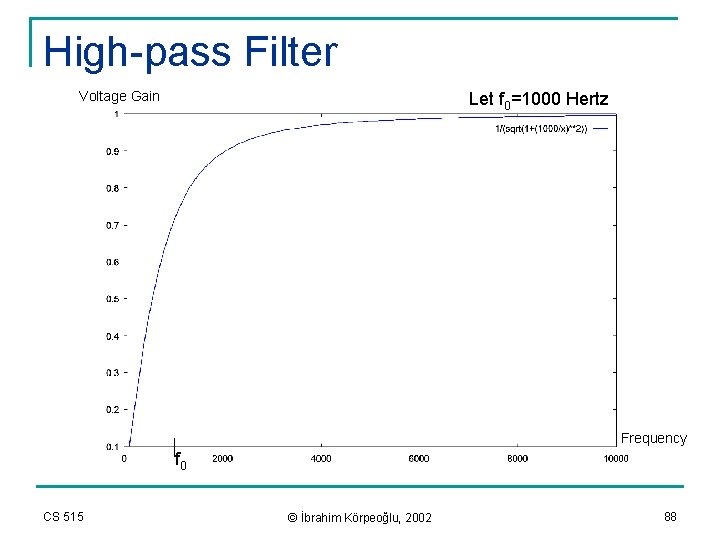
High-pass Filter Voltage Gain Let f 0=1000 Hertz Frequency f 0 CS 515 © İbrahim Körpeoğlu, 2002 88
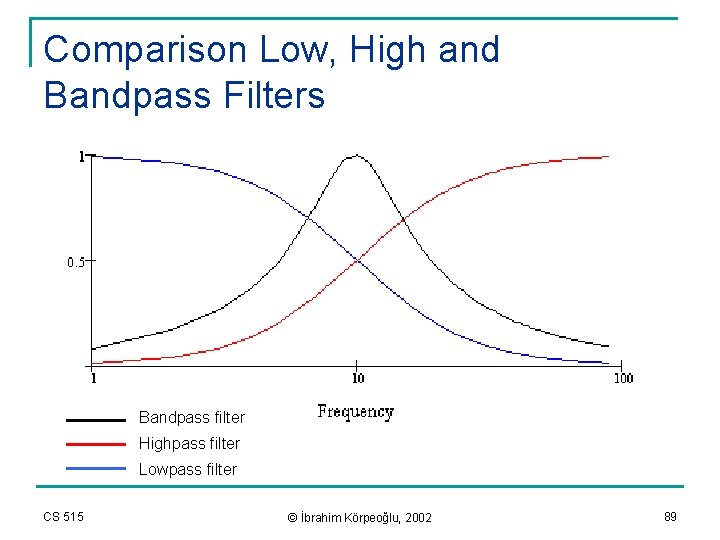
Comparison Low, High and Bandpass Filters Bandpass filter Highpass filter Lowpass filter CS 515 © İbrahim Körpeoğlu, 2002 89
Appendix: Continues Time Sinusoidal Signals 90
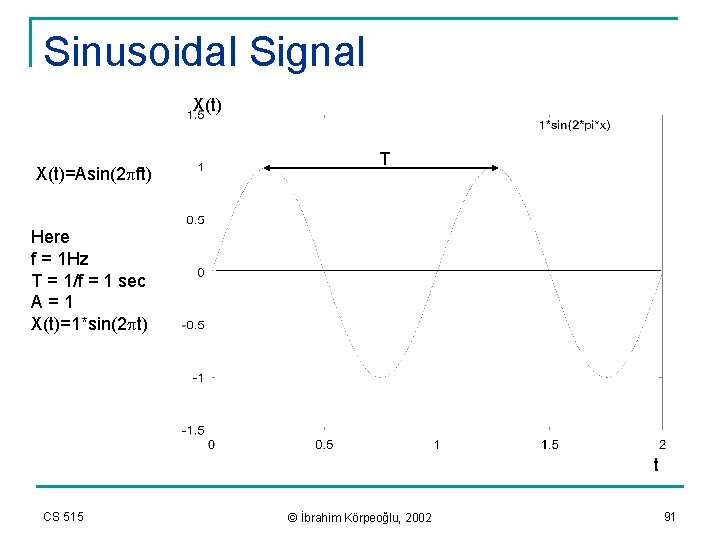
Sinusoidal Signal X(t)=Asin(2 pft) T Here f = 1 Hz T = 1/f = 1 sec A=1 X(t)=1*sin(2 pt) t CS 515 © İbrahim Körpeoğlu, 2002 91
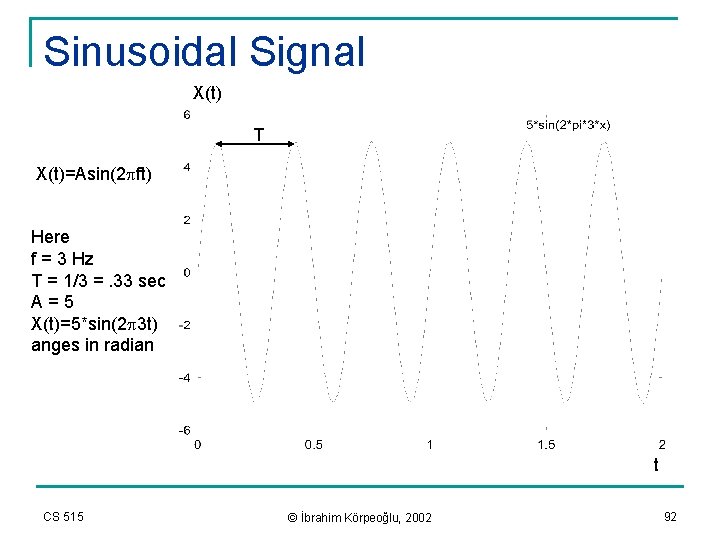
Sinusoidal Signal X(t) T X(t)=Asin(2 pft) Here f = 3 Hz T = 1/3 =. 33 sec A=5 X(t)=5*sin(2 p 3 t) anges in radian t CS 515 © İbrahim Körpeoğlu, 2002 92
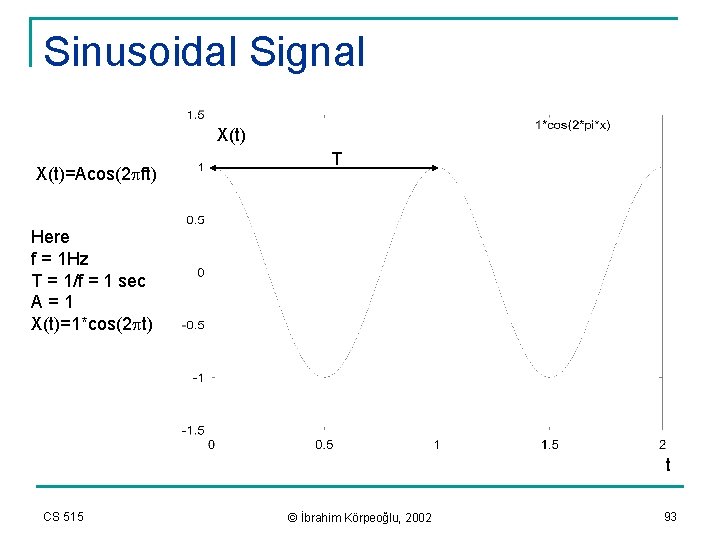
Sinusoidal Signal X(t)=Acos(2 pft) T Here f = 1 Hz T = 1/f = 1 sec A=1 X(t)=1*cos(2 pt) t CS 515 © İbrahim Körpeoğlu, 2002 93
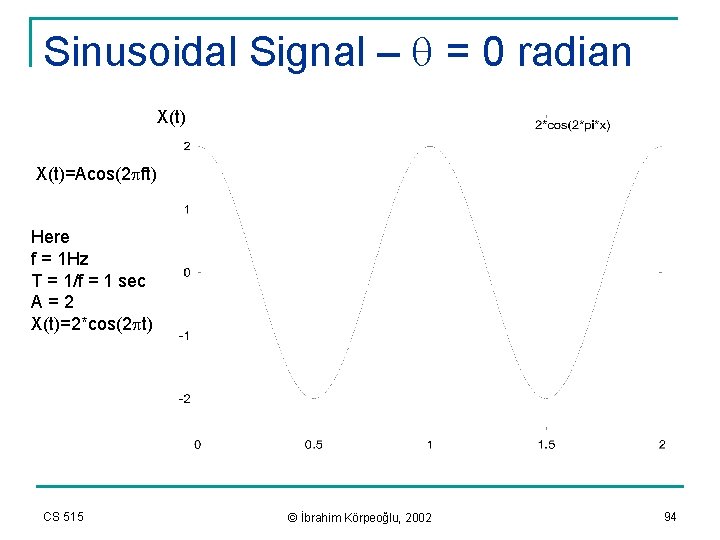
Sinusoidal Signal – q = 0 radian X(t)=Acos(2 pft) Here f = 1 Hz T = 1/f = 1 sec A=2 X(t)=2*cos(2 pt) CS 515 © İbrahim Körpeoğlu, 2002 94
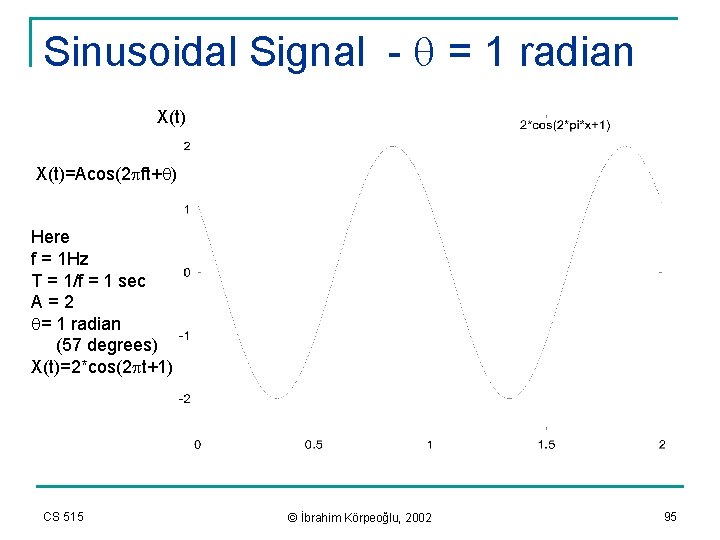
Sinusoidal Signal - q = 1 radian X(t)=Acos(2 pft+q) Here f = 1 Hz T = 1/f = 1 sec A=2 q= 1 radian (57 degrees) X(t)=2*cos(2 pt+1) CS 515 © İbrahim Körpeoğlu, 2002 95
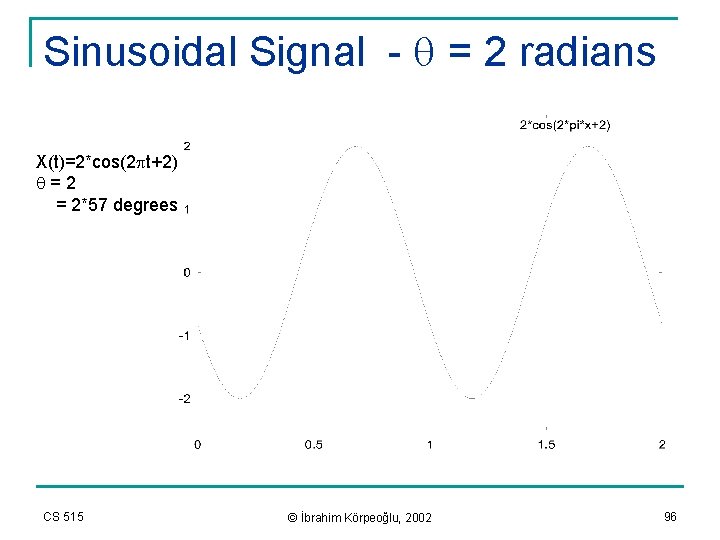
Sinusoidal Signal - q = 2 radians X(t)=2*cos(2 pt+2) q=2 = 2*57 degrees CS 515 © İbrahim Körpeoğlu, 2002 96
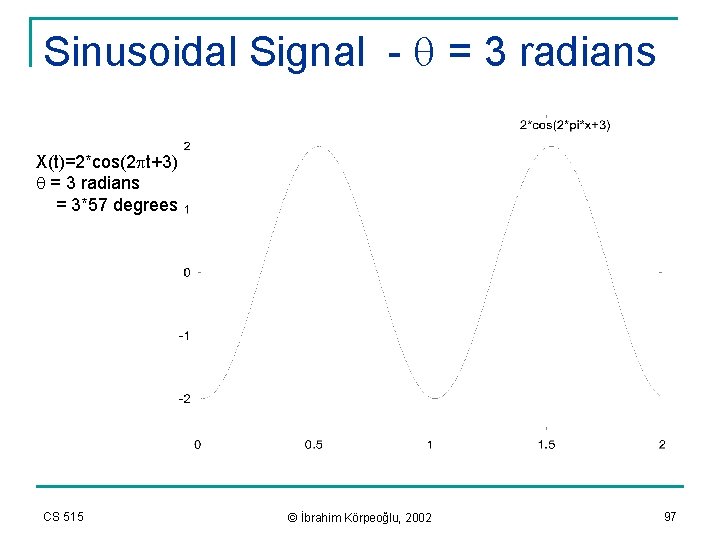
Sinusoidal Signal - q = 3 radians X(t)=2*cos(2 pt+3) q = 3 radians = 3*57 degrees CS 515 © İbrahim Körpeoğlu, 2002 97
Appendix: Complex or Exponential Form Representation of Sinusoidal Signals 98
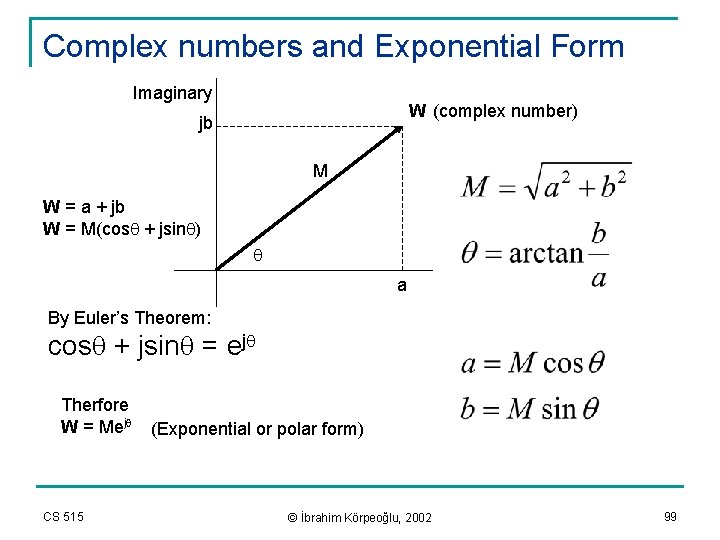
Complex numbers and Exponential Form Imaginary W (complex number) jb M W = a + jb W = M(cosq + jsinq) q a By Euler’s Theorem: cosq + jsinq = ejq Therfore W = Mejq CS 515 (Exponential or polar form) © İbrahim Körpeoğlu, 2002 99
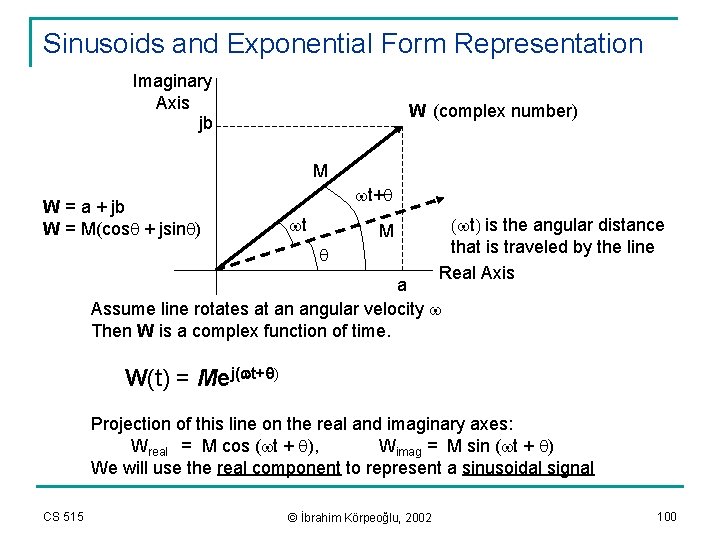
Sinusoids and Exponential Form Representation Imaginary Axis jb W (complex number) M W = a + jb W = M(cosq + jsinq) wt+q wt M q (wt) is the angular distance that is traveled by the line Real Axis a Assume line rotates at an angular velocity w Then W is a complex function of time. W(t) = Mej(wt+q) Projection of this line on the real and imaginary axes: Wreal = M cos (wt + q), Wimag = M sin (wt + q) We will use the real component to represent a sinusoidal signal CS 515 © İbrahim Körpeoğlu, 2002 100
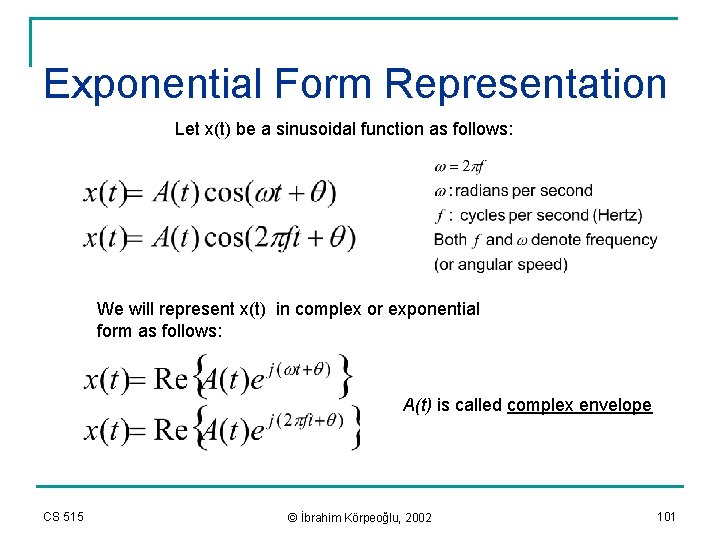
Exponential Form Representation Let x(t) be a sinusoidal function as follows: We will represent x(t) in complex or exponential form as follows: A(t) is called complex envelope CS 515 © İbrahim Körpeoğlu, 2002 101
- Slides: 101