
Mobile Phone technology Martijn Tennekes THE CONTRACTOR IS
Mobile Phone technology Martijn Tennekes THE CONTRACTOR IS ACTING UNDER A FRAMEWORK CONTRACT CONCLUDED WITH THE COMMISSION Eurostat
Outline • • Technologies prior to mobile phones Working of a cell-phone network Mobile phone generations Mobile phone data 2 Eurostat
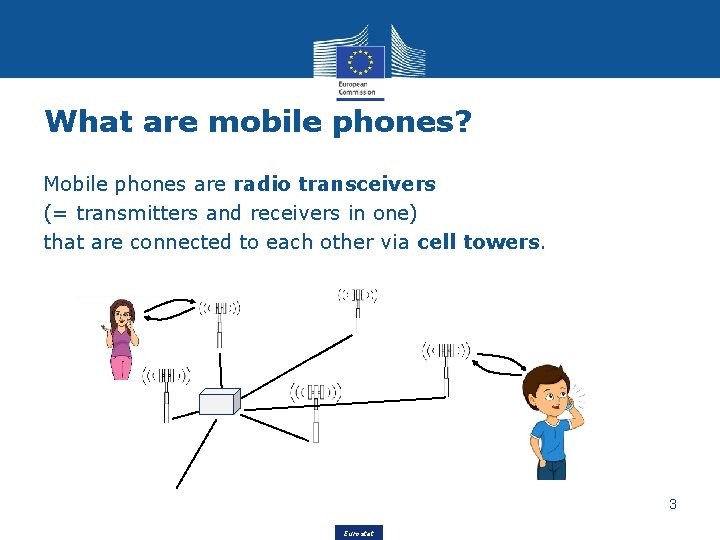
What are mobile phones? Mobile phones are radio transceivers (= transmitters and receivers in one) that are connected to each other via cell towers. 3 Eurostat
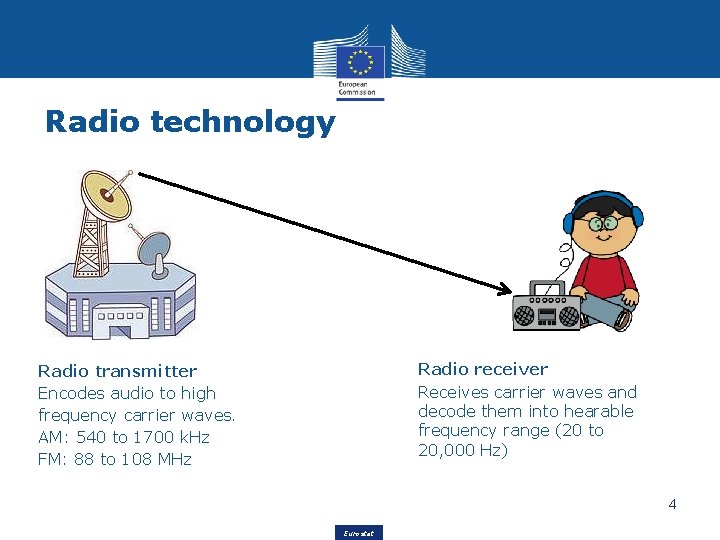
Radio technology Radio receiver Receives carrier waves and decode them into hearable frequency range (20 to 20, 000 Hz) Radio transmitter Encodes audio to high frequency carrier waves. AM: 540 to 1700 k. Hz FM: 88 to 108 MHz 4 Eurostat
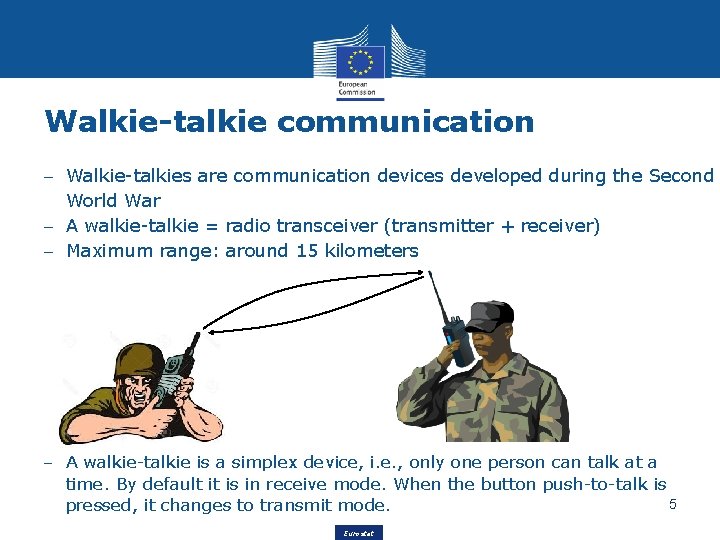
Walkie-talkie communication – Walkie-talkies are communication devices developed during the Second World War – A walkie-talkie = radio transceiver (transmitter + receiver) – Maximum range: around 15 kilometers – A walkie-talkie is a simplex device, i. e. , only one person can talk at a time. By default it is in receive mode. When the button push-to-talk is 5 pressed, it changes to transmit mode. Eurostat
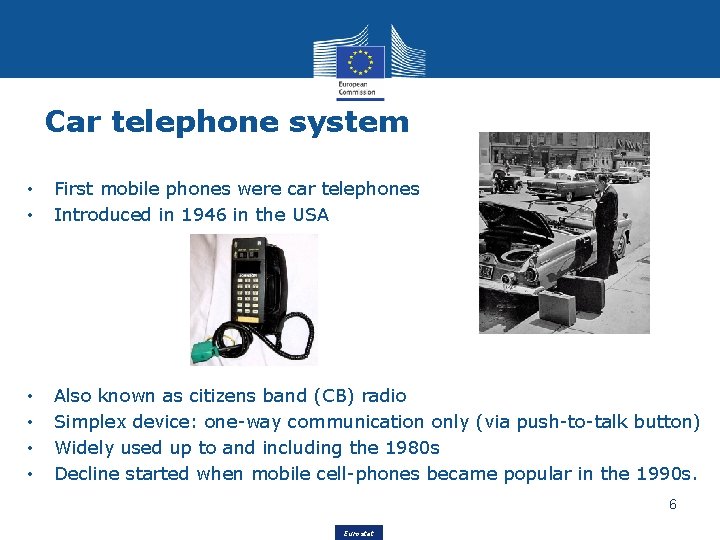
Car telephone system • • First mobile phones were car telephones Introduced in 1946 in the USA • • Also known as citizens band (CB) radio Simplex device: one-way communication only (via push-to-talk button) Widely used up to and including the 1980 s Decline started when mobile cell-phones became popular in the 1990 s. 6 Eurostat
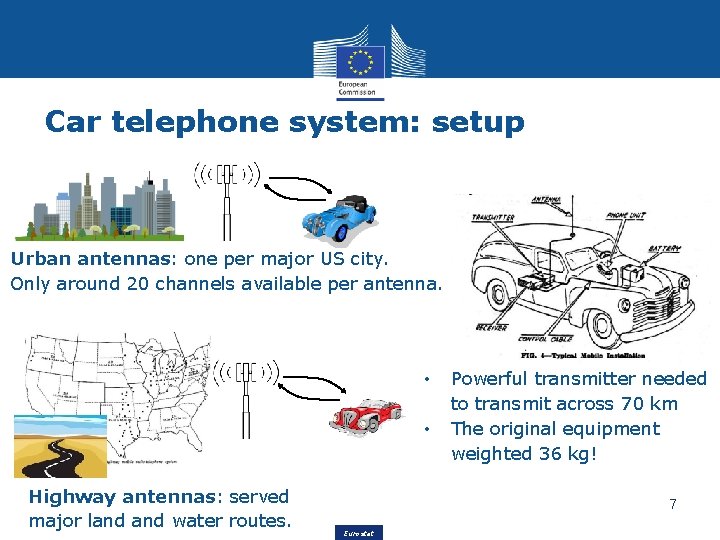
Car telephone system: setup Urban antennas: one per major US city. Only around 20 channels available per antenna. • • Highway antennas: served major land water routes. Powerful transmitter needed to transmit across 70 km The original equipment weighted 36 kg! 7 Eurostat
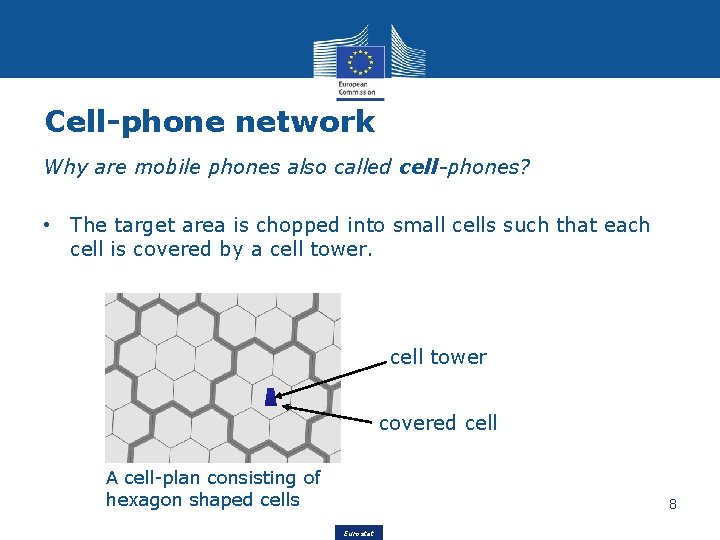
Cell-phone network Why are mobile phones also called cell-phones? • The target area is chopped into small cells such that each cell is covered by a cell tower covered cell A cell-plan consisting of hexagon shaped cells 8 Eurostat
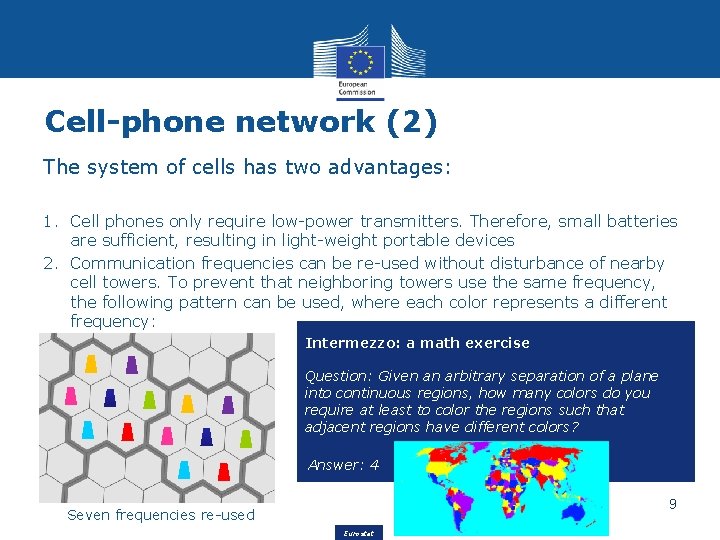
Cell-phone network (2) The system of cells has two advantages: 1. Cell phones only require low-power transmitters. Therefore, small batteries are sufficient, resulting in light-weight portable devices 2. Communication frequencies can be re-used without disturbance of nearby cell towers. To prevent that neighboring towers use the same frequency, the following pattern can be used, where each color represents a different frequency: Intermezzo: a math exercise Question: Given an arbitrary separation of a plane into continuous regions, how many colors do you require at least to color the regions such that adjacent regions have different colors? Answer: 4 9 Seven frequencies re-used Eurostat
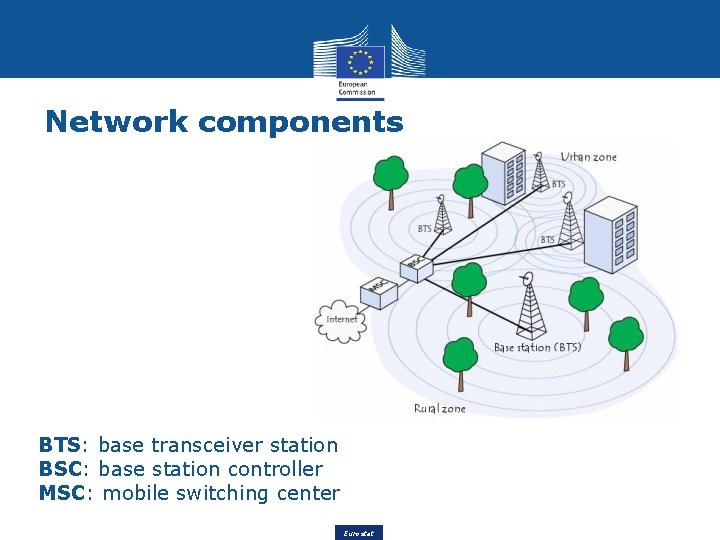
Network components BTS: base transceiver station BSC: base station controller MSC: mobile switching center Eurostat
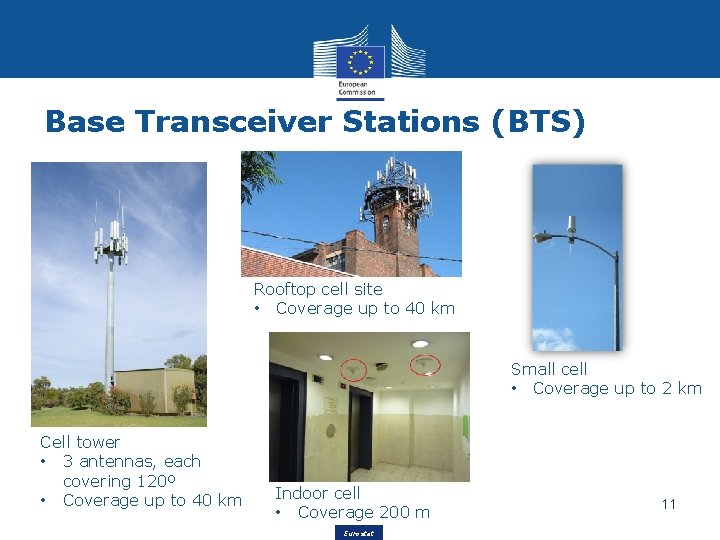
Base Transceiver Stations (BTS) Rooftop cell site • Coverage up to 40 km Small cell • Coverage up to 2 km Cell tower • 3 antennas, each covering 120º • Coverage up to 40 km Indoor cell • Coverage 200 m Eurostat 11
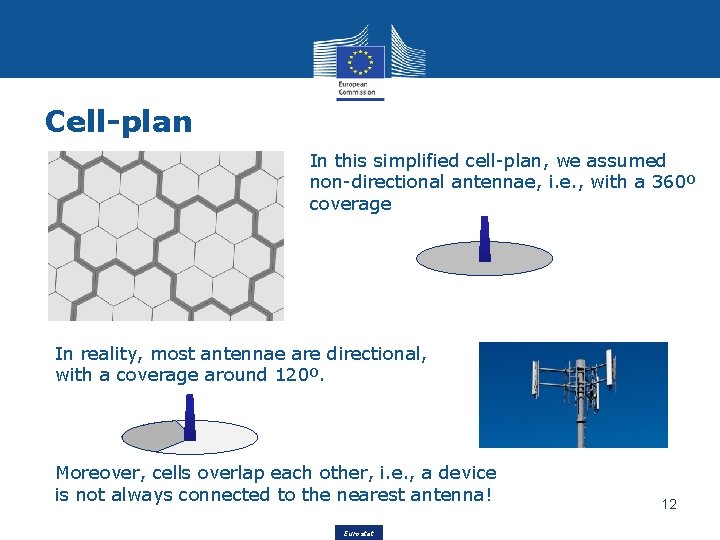
Cell-plan In this simplified cell-plan, we assumed non-directional antennae, i. e. , with a 360º coverage In reality, most antennae are directional, with a coverage around 120º. Moreover, cells overlap each other, i. e. , a device is not always connected to the nearest antenna! Eurostat 12
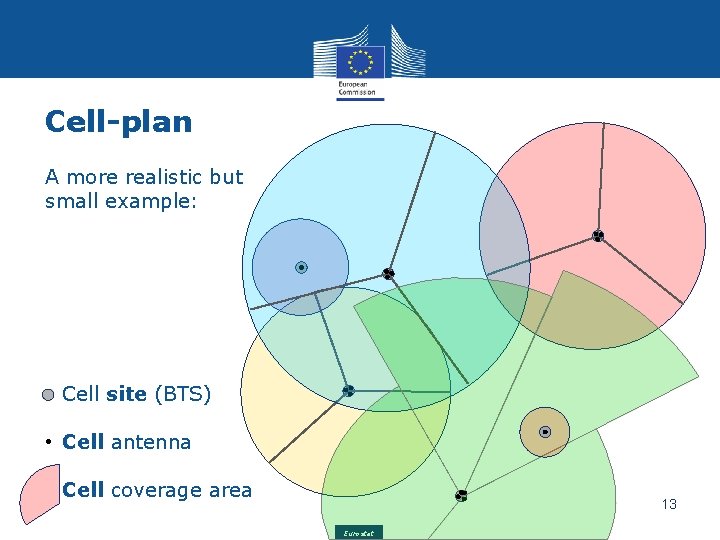
Cell-plan A more realistic but small example: Cell site (BTS) Cell antenna Cell coverage area 13 Eurostat
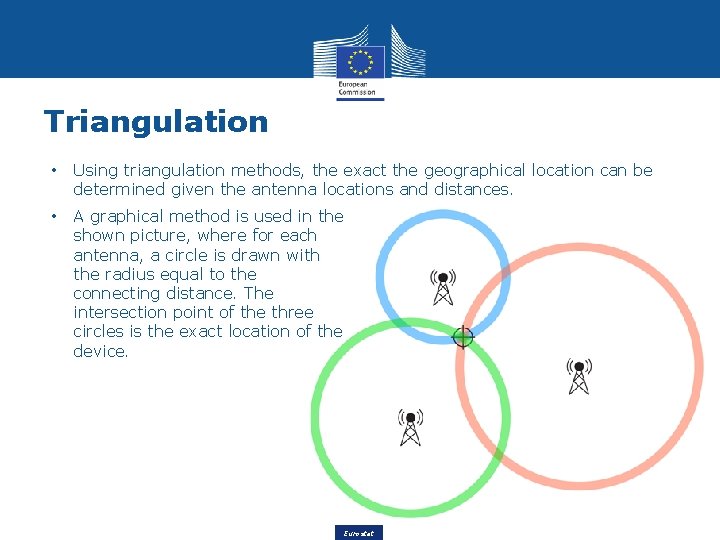
Triangulation • Using triangulation methods, the exact the geographical location can be determined given the antenna locations and distances. • A graphical method is used in the shown picture, where for each antenna, a circle is drawn with the radius equal to the connecting distance. The intersection point of the three circles is the exact location of the device. 14 Eurostat
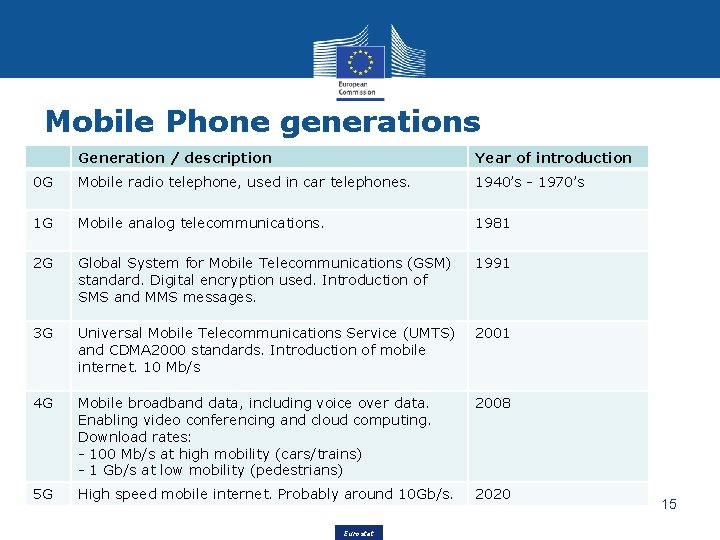
Mobile Phone generations Generation / description Year of introduction 0 G Mobile radio telephone, used in car telephones. 1940’s - 1970’s 1 G Mobile analog telecommunications. 1981 2 G Global System for Mobile Telecommunications (GSM) standard. Digital encryption used. Introduction of SMS and MMS messages. 1991 3 G Universal Mobile Telecommunications Service (UMTS) and CDMA 2000 standards. Introduction of mobile internet. 10 Mb/s 2001 4 G Mobile broadband data, including voice over data. Enabling video conferencing and cloud computing. Download rates: - 100 Mb/s at high mobility (cars/trains) - 1 Gb/s at low mobility (pedestrians) 2008 5 G High speed mobile internet. Probably around 10 Gb/s. 2020 Eurostat 15
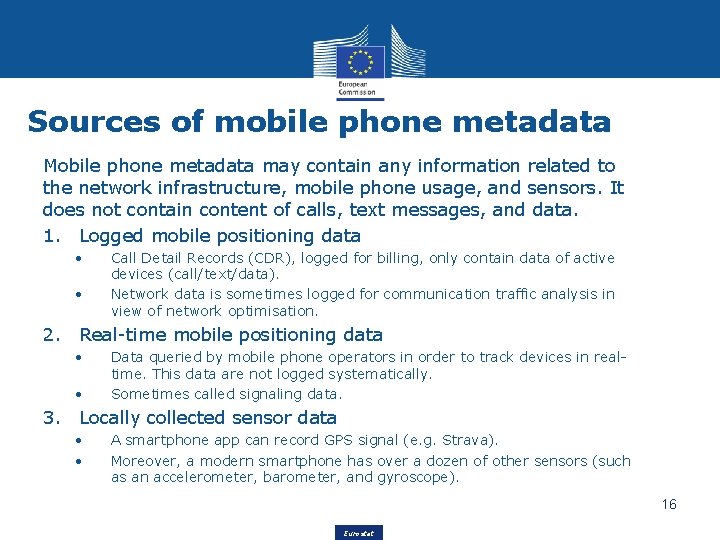
Sources of mobile phone metadata Mobile phone metadata may contain any information related to the network infrastructure, mobile phone usage, and sensors. It does not contain content of calls, text messages, and data. 1. Logged mobile positioning data • • Call Detail Records (CDR), logged for billing, only contain data of active devices (call/text/data). Network data is sometimes logged for communication traffic analysis in view of network optimisation. 2. Real-time mobile positioning data • • Data queried by mobile phone operators in order to track devices in realtime. This data are not logged systematically. Sometimes called signaling data. 3. Locally collected sensor data • • A smartphone app can record GPS signal (e. g. Strava). Moreover, a modern smartphone has over a dozen of other sensors (such as an accelerometer, barometer, and gyroscope). 16 Eurostat
Call Detail Records (CDR) • Calls, text messages, and data usage are being logged for billing • Also called Event Detail Records (EDR) • It does not contain the communication content of the logged events. • The CDR format has an international standard. This enables providers to exchange these data, and therefore charge foreigners for using mobile phones abroad. 17 Eurostat
Events logged by CDR • Events that are logged: • Call (both outgoing and incoming) • SMS (both outgoing and incoming) • Data (depends on provider, e. g. once every x minutes, once per x MB used) • A modern smartphone (using 4 G) may have over a 100 events a day, mostly data related. 18 Eurostat
CDR record description A record in a CDR file contains: • event type (call, SMS, data) • the starting time of the event (date and time) • the event duration • Mobile Country Code (MCC) • Mobile Network Code (MNC) • for the originating party (e. g. caller): • • • International Mobile Subscriber Identity (IMSI), which identifies a phone number International Mobile Equipment Identity (IMEI), which identifies a device ID of the site (base transceiver station) at the start of the event ID of the cell (antenna) at the start of the event for the receiving party (e. g. called person): the same data as for the originating party The latest development is that the exact location, derived by triangulation, is 19 included instead of the site and cell ID. See Jiang et al (2016). Eurostat
Real-time mobile positioning data • Detailed network information is needed to track devices in real-time. • This information is necessary for the network infrastructure to track and trace a device in order to support communication. • Since these data are usually very large, they are usually not stored/logged by mobile phone operators. • Logged mobile positioning data are obtained by specific queries on these data with specific purposes in mind (e. g. billing or network analysis). 20 Eurostat
Mobile Network Operators (MNO) • A mobile network operator is a provider of mobile phone communication that controls the necessary network infrastructure and processes the billing. • A country typically has 3 or 4 operators. Each of them has its own network and its own customers. • For instance, in the Netherlands there are 4 operators: KPN (45%), Vodafone (33%), T-Mobile (21%) and Tele 2 (1%) 21 Eurostat
Locally collected sensor data • • • A modern smartphone has over a dozen of sensors. A sensor is a piece of hardware to feed in data from the physical world. Sensors are needed to make a smartphone smart. For instance, how does my phone know when I change from portrait to landscape orientation? By its gyroscope. The sensors are used by the mobile operating system (Android, i. OS, Windows Mobile), and by apps to do various things. Sensors are usually divided into 3 groups: motion/position, environmental, and location. 22 Eurostat
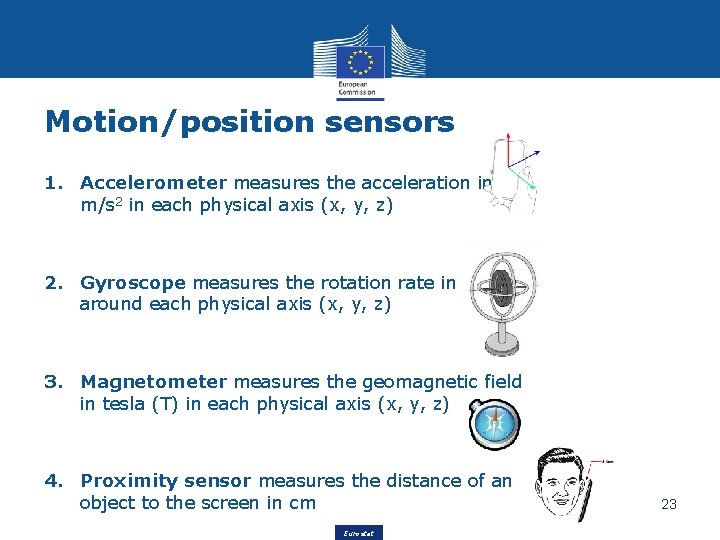
Motion/position sensors 1. Accelerometer measures the acceleration in m/s 2 in each physical axis (x, y, z) 2. Gyroscope measures the rotation rate in rad/s around each physical axis (x, y, z) 3. Magnetometer measures the geomagnetic field in tesla (T) in each physical axis (x, y, z) 4. Proximity sensor measures the distance of an object to the screen in cm Eurostat 23
Derived motion/position measurements From these motion/position sensors, other measurements are derived: • • Gravity Linear acceleration Rotation Orientation 24 Eurostat
Environmental sensors 1. Light sensor measure the ambient light level (illumination) in lx 2. Barometer measures atmospheric pressure in h. Pa or mbar 3. Thermometer measures air temperature in degrees Celsius 4. Air humidity sensor measures the relative humidity in percent 5. Camera measures sight 6. Microphone measures sound 25 Note that sensors 2, 3, and 4 are only available in high-end smartphones. Eurostat
Location sensors 1. Global Positioning System (GPS) determines geographic location from GPS satellites 2. Wi-Fi positioning system (WPS) determines geographic location from Wi-Fi network information 3. Mobile phone network data determines geographic location from mobile phone network from cell tower triangulation 4. Assisted GPS (A-GPS) (derived) determines the geographic location from GPS signal assisted with network information 26 Eurostat
Summary • Mobile phone technology has evolved from walkie talkies and car phone systems. • Until recently, voice was the main mode of communication. Today, it’s all about data: voice has become just a data format. • Call Detail Records (CDR) are logged network data used for billing. • Modern mobile phones contain over a dozen of sensors. 27 Eurostat
Literature • • Fors, G. (2016) The Mobile Telephone in Bell System Service, 1946 -1993. URL: http: //www. wb 6 nvh. com/Carphone. htm Jiang, S. , Yang, Y. , Gupta, S. , Veneziano, D. , Athavale, S. , Gonzalez, M. C. (2016) Time. Geo: a spatiotemporal framework for modeling urban mobility without surveys, PNAS 2016 113 (37) Mobile Networks: What they are and how they work (2013) Mobile Operators Association URL: http: //www. mobilemastinfo. com/images/stories/documents/pdf/Mobile_Networks_What_They_Are__How_They_Work__-_Final_Revised_-22 -08 -13. pdf Gustafsson, F. and Gunnarsson, F. (2005) Position Location Technologies for Wireless Systems, IEEE Signal Processing Magazine, vol. 22, issue 4, pp. 41 -53 University of California (2016) The Cell Phone Technology URL: http: //www. mat. ucsb. edu/~g. legrady/academic/courses/03 w 200 a/projects/wireless/cell_technolog y. htm Woodford, C. (2016) How cellphones work URL: http: //www. explainthatstuff. com/cellphones. html Wikipedia (2016) Cellular Network URL: https: //en. wikipedia. org/wiki/Cellular_network Wikipedia (2016) Mobile Phone Tracking URL: https: //en. wikipedia. org/wiki/Mobile_phone_tracking 28 Eurostat
- Slides: 28