
Mobile Payment in China Concepts Current Situation and
Mobile Payment in China —— Concepts, Current Situation and the Future Fang Senior Strategy Analyst Shanghai Pudong Development Bank fangf 01@spdb. com. cn
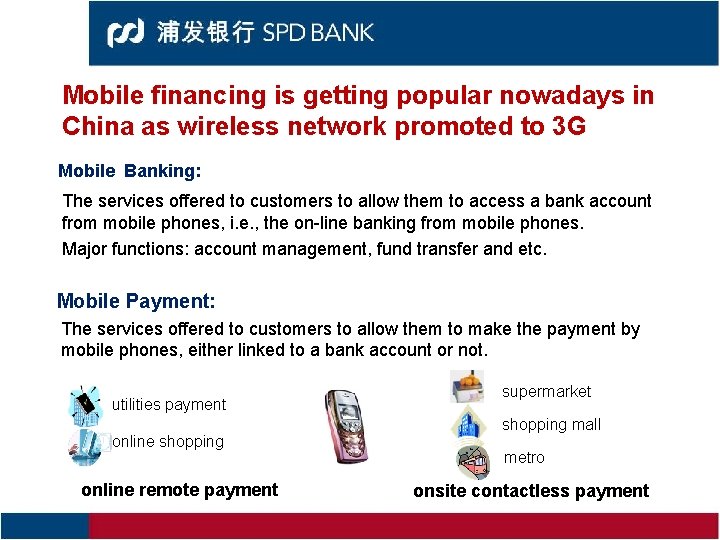
Mobile financing is getting popular nowadays in China as wireless network promoted to 3 G Mobile Banking: The services offered to customers to allow them to access a bank account from mobile phones, i. e. , the on-line banking from mobile phones. Major functions: account management, fund transfer and etc. Mobile Payment: The services offered to customers to allow them to make the payment by mobile phones, either linked to a bank account or not. utilities payment online shopping online remote payment supermarket shopping mall metro onsite contactless payment
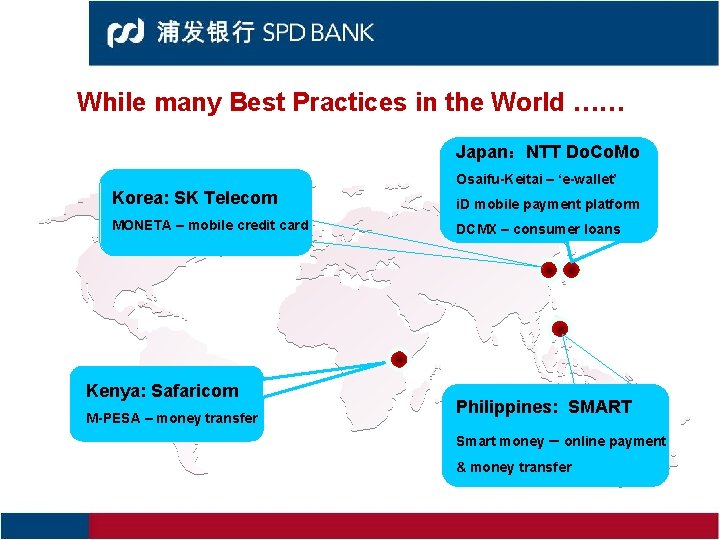
While many Best Practices in the World …… Japan:NTT Do. Co. Mo Osaifu-Keitai – ‘e-wallet’ Korea: SK Telecom i. D mobile payment platform MONETA – mobile credit card DCMX – consumer loans Kenya: Safaricom M-PESA – money transfer Philippines: SMART Smart money – online payment & money transfer
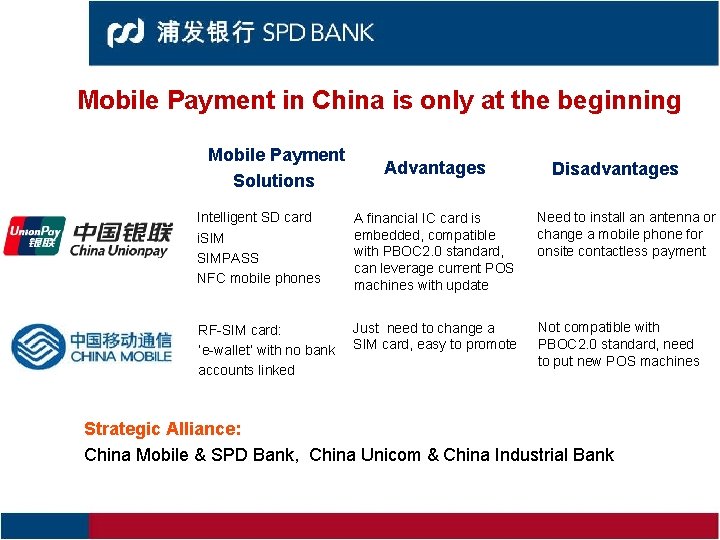
Mobile Payment in China is only at the beginning Mobile Payment Solutions Advantages Disadvantages Intelligent SD card i. SIMPASS NFC mobile phones A financial IC card is embedded, compatible with PBOC 2. 0 standard, can leverage current POS machines with update Need to install an antenna or change a mobile phone for onsite contactless payment RF-SIM card: ‘e-wallet’ with no bank accounts linked Just need to change a SIM card, easy to promote Not compatible with PBOC 2. 0 standard, need to put new POS machines Strategic Alliance: China Mobile & SPD Bank, China Unicom & China Industrial Bank
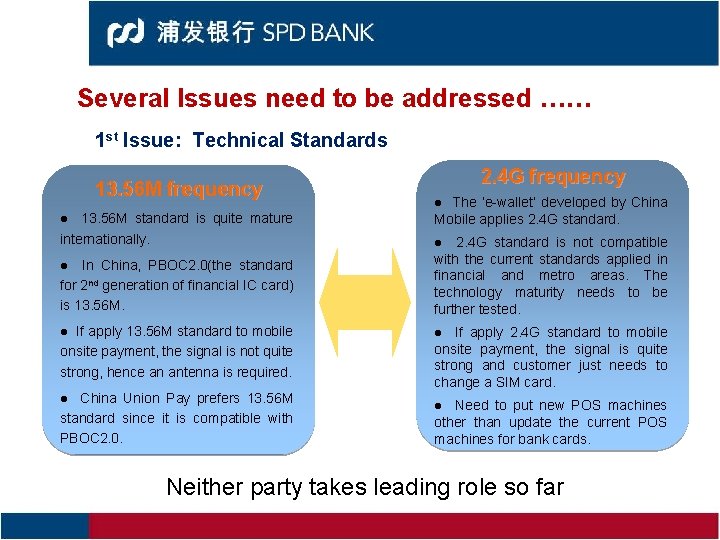
Several Issues need to be addressed …… 1 st Issue: Technical Standards 13. 56 M frequency 13. 56 M standard is quite mature internationally. l In China, PBOC 2. 0(the standard for 2 nd generation of financial IC card) is 13. 56 M. l If apply 13. 56 M standard to mobile onsite payment, the signal is not quite strong, hence an antenna is required. l China Union Pay prefers 13. 56 M standard since it is compatible with PBOC 2. 0. l 2. 4 G frequency The ‘e-wallet’ developed by China Mobile applies 2. 4 G standard. l 2. 4 G standard is not compatible with the current standards applied in financial and metro areas. The technology maturity needs to be further tested. l If apply 2. 4 G standard to mobile onsite payment, the signal is quite strong and customer just needs to change a SIM card. l Need to put new POS machines other than update the current POS machines for bank cards. l Neither party takes leading role so far

2 nd Issue: Business Model bank-lead customer->bank->merchants wireless service Low bank involvement High cooperative model bank customer-> ->merchants operator wireless operator involvement 3 rd party-lead operator-lead customer->3 rd party->merchants accounts & wireless service customer->operator->merchants bank accounts service Low There is no answer for the best model High
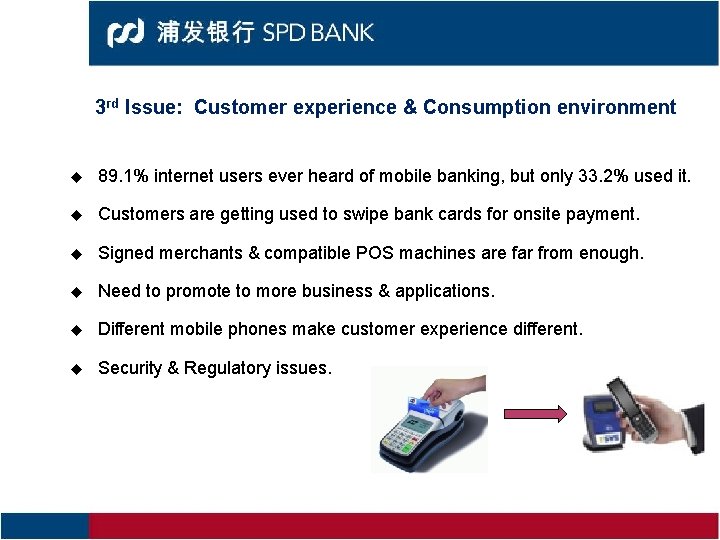
3 rd Issue: Customer experience & Consumption environment u 89. 1% internet users ever heard of mobile banking, but only 33. 2% used it. u Customers are getting used to swipe bank cards for onsite payment. u Signed merchants & compatible POS machines are far from enough. u Need to promote to more business & applications. u Different mobile phones make customer experience different. u Security & Regulatory issues.
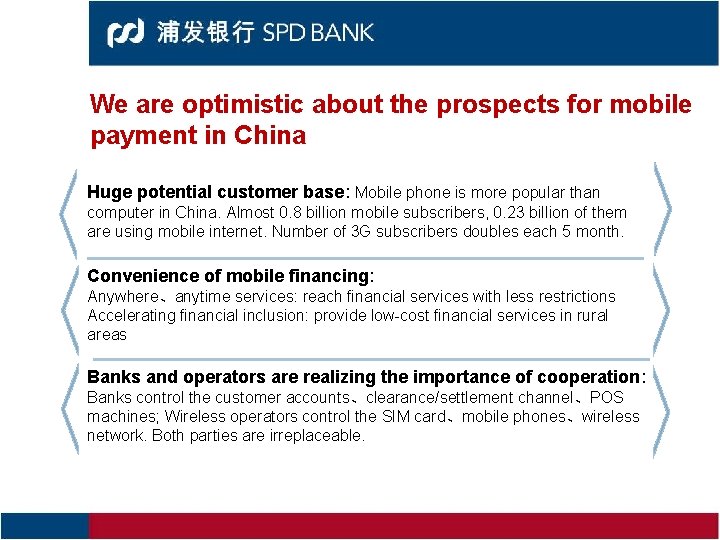
We are optimistic about the prospects for mobile payment in China Huge potential customer base: Mobile phone is more popular than computer in China. Almost 0. 8 billion mobile subscribers, 0. 23 billion of them are using mobile internet. Number of 3 G subscribers doubles each 5 month. Convenience of mobile financing: Anywhere、anytime services: reach financial services with less restrictions Accelerating financial inclusion: provide low-cost financial services in rural areas Banks and operators are realizing the importance of cooperation: Banks control the customer accounts、clearance/settlement channel、POS machines; Wireless operators control the SIM card、mobile phones、wireless network. Both parties are irreplaceable.
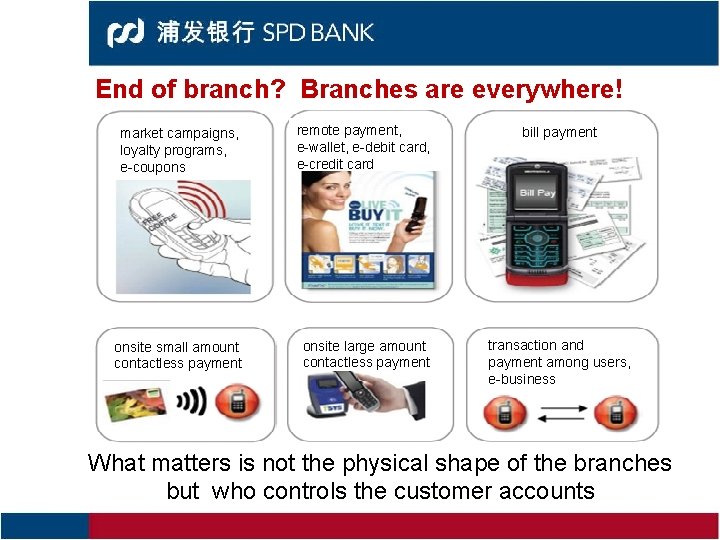
End of branch? Branches are everywhere! market campaigns, loyalty programs, e-coupons remote payment, e-wallet, e-debit card, e-credit card bill payment onsite small amount contactless payment onsite large amount contactless payment transaction and payment among users, e-business What matters is not the physical shape of the branches but who controls the customer accounts
Thank you!
- Slides: 10