
Mobile Digital TV Technology for the Terminal Dave
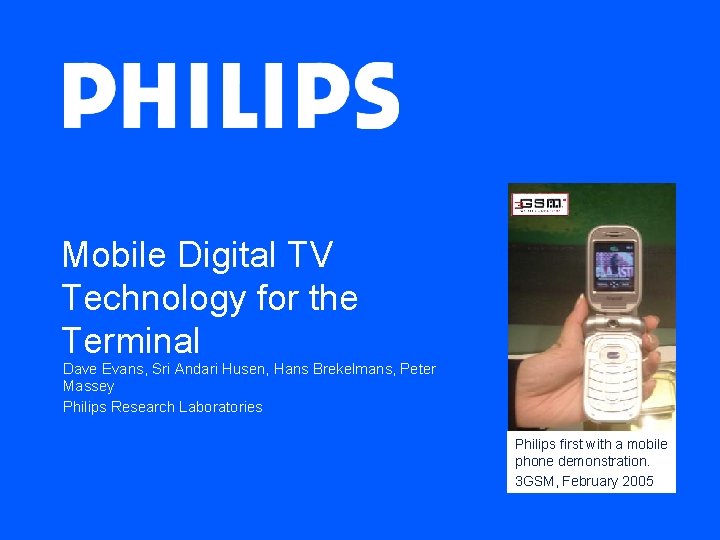
Mobile Digital TV Technology for the Terminal Dave Evans, Sri Andari Husen, Hans Brekelmans, Peter Massey Philips Research Laboratories Philips first with a mobile phone demonstration. 3 GSM, February 2005
Technology for the Terminal • • Technical challenge RF Tuner Antenna TV coexistence in the phone Channel decoding – dealing with Doppler What next? Conclusion Philips Research Laboratories 2
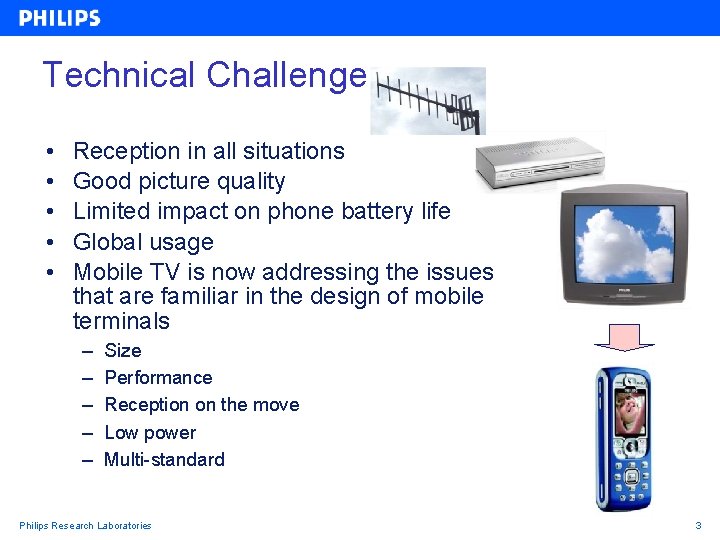
Technical Challenge • • • Reception in all situations Good picture quality Limited impact on phone battery life Global usage Mobile TV is now addressing the issues that are familiar in the design of mobile terminals – – – Size Performance Reception on the move Low power Multi-standard Philips Research Laboratories 3
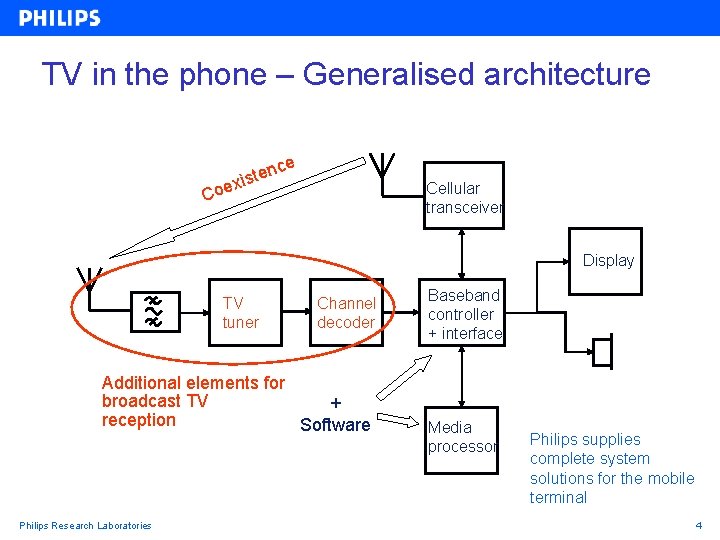
TV in the phone – Generalised architecture ce n e t xis e o C Cellular transceiver Display TV tuner Channel decoder Additional elements for broadcast TV + reception Software Philips Research Laboratories Baseband controller + interface Media processor Philips supplies complete system solutions for the mobile terminal 4
RF Tuner • Major challenge was power consumption – Starting point ~500 m. W • Now >100 m. W (>5% with DVB-H time slicing) • Low/zero IF design • Minimal off-chip components • 470 to 860 MHz operation – Separate on chip LNA for 1452 to 1675 MHz operation • On-going work to improve performance Philips Research Laboratories 5
Mobile DTV Antenna • Two issues: – Close proximity between mobile DTV and GSM antennas – Common ground plane • Coupling between them disturbs the GSM antenna and affects its performance • Co-design of the GSM and Mobile DTV antennas is essential • Signal coupling from GSM to mobile DTV antenna is high – Need to incorporate GSM signal blocking • Ideally continuous operation from 470 to above 700 MHz – Limited to ~700 MHz to assist GSM coexistence Philips Research Laboratories 6
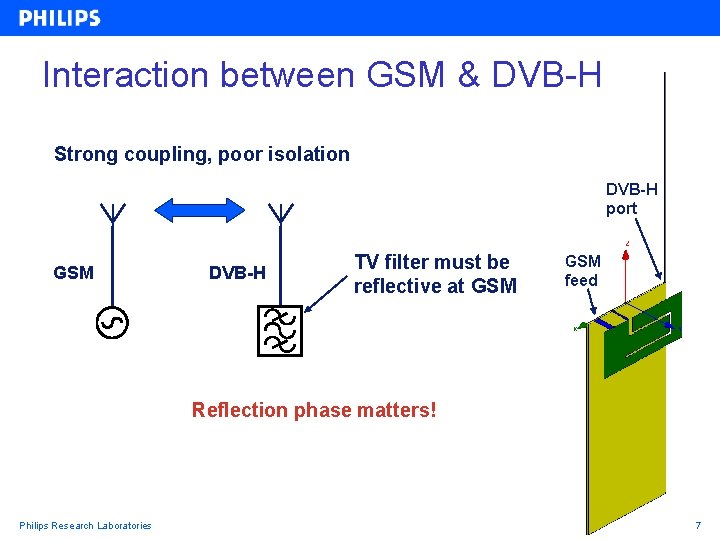
Interaction between GSM & DVB-H Strong coupling, poor isolation DVB-H port GSM DVB-H TV filter must be reflective at GSM feed Reflection phase matters! Philips Research Laboratories 7
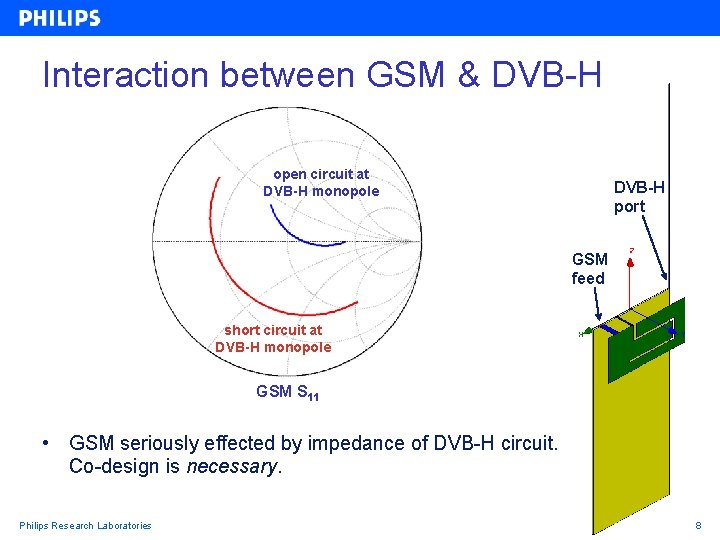
Interaction between GSM & DVB-H open circuit at DVB-H monopole DVB-H port GSM feed short circuit at DVB-H monopole GSM S 11 • GSM seriously effected by impedance of DVB-H circuit. Co-design is necessary. Philips Research Laboratories 8
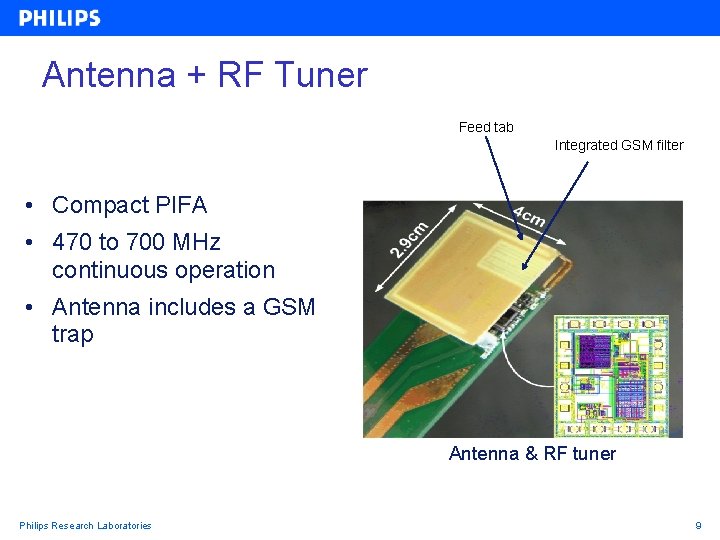
Antenna + RF Tuner Feed tab Integrated GSM filter • Compact PIFA • 470 to 700 MHz continuous operation • Antenna includes a GSM trap Antenna & RF tuner Philips Research Laboratories 9
TV Coexistence in the Phone • Interference from GSM 900 transmissions due to very close co-location – DTV receiver blocking – 58 d. B isolation between GSM TX and mobile DTV receiver is required • Potential solutions – Isolation between antennas – limited to between 6 to 10 d. B – Can be improved by use of GSM trap within mobile DTV antenna, ~20 d. B – Managing GSM transmission at the terminal – limited scope – Managing DVB-H transmissions – not possible – Power cancellation – not very promising – Receiver filter, good solution but requires frequency separation – restricts channel usage. TV channel 50 (~700 MHz) OK, extending this to 54/55 desired • Coexistence best achieved by filter before TV RX + antenna with GSM trap Philips Research Laboratories 10
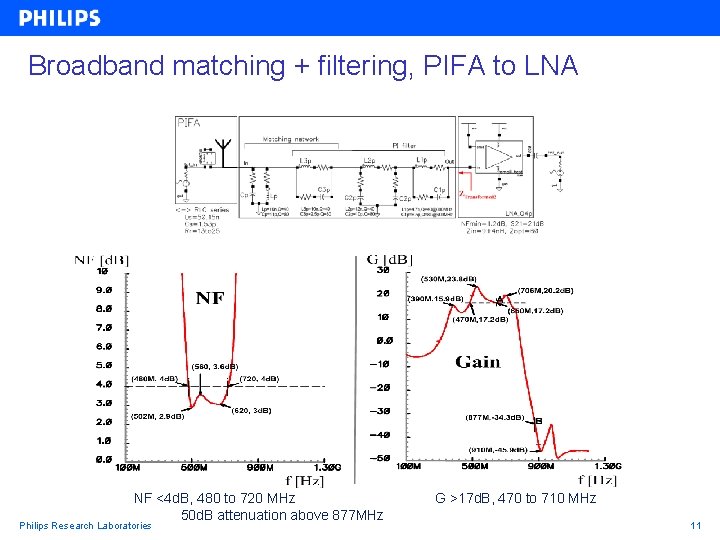
Broadband matching + filtering, PIFA to LNA NF <4 d. B, 480 to 720 MHz 50 d. B attenuation above 877 MHz Philips Research Laboratories G >17 d. B, 470 to 710 MHz 11
Channel Decoding • Key issue for mobile TV – Reception at high vehicle speed • Problem – Impact of Doppler effects on OFDM – Channel changes during symbol period – Inter carrier interference (ICI) • 150 kph equates to typically 100 Hz Doppler • 8 k DVB-T mode has 1. 1 k. Hz subcarrier spacing • Solution – Channel estimation and Doppler compensation – ICI cancellation Philips Research Laboratories 12
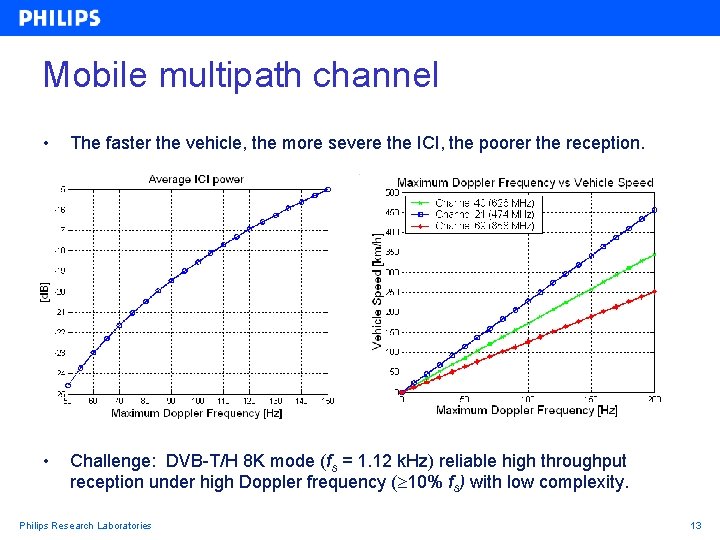
Mobile multipath channel • The faster the vehicle, the more severe the ICI, the poorer the reception. • Challenge: DVB-T/H 8 K mode (fs = 1. 12 k. Hz) reliable high throughput reception under high Doppler frequency ( 10% fs) with low complexity. Philips Research Laboratories 13
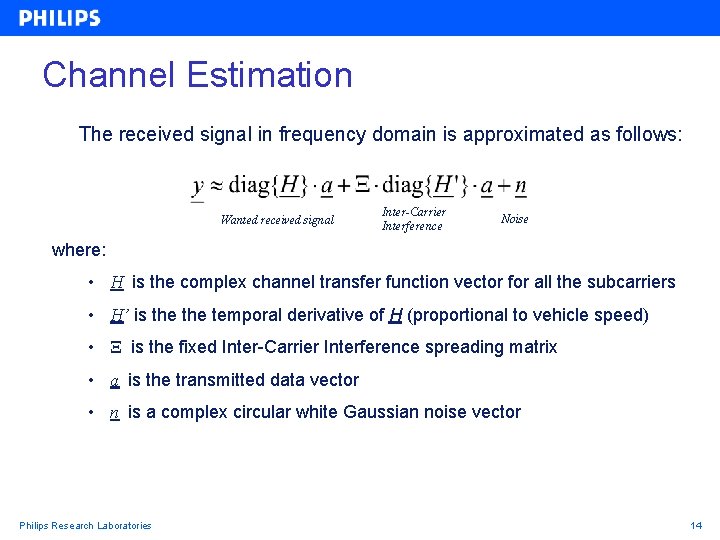
Channel Estimation The received signal in frequency domain is approximated as follows: Wanted received signal Inter-Carrier Interference Noise where: • H is the complex channel transfer function vector for all the subcarriers • H’ is the temporal derivative of H (proportional to vehicle speed) • Ξ is the fixed Inter-Carrier Interference spreading matrix • a is the transmitted data vector • n is a complex circular white Gaussian noise vector Philips Research Laboratories 14
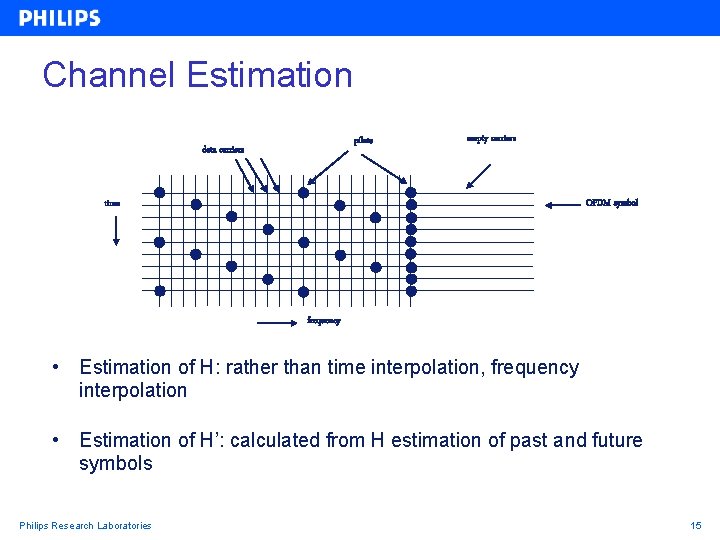
Channel Estimation pilots data carriers empty carriers OFDM symbol time frequency • Estimation of H: rather than time interpolation, frequency interpolation • Estimation of H’: calculated from H estimation of past and future symbols Philips Research Laboratories 15
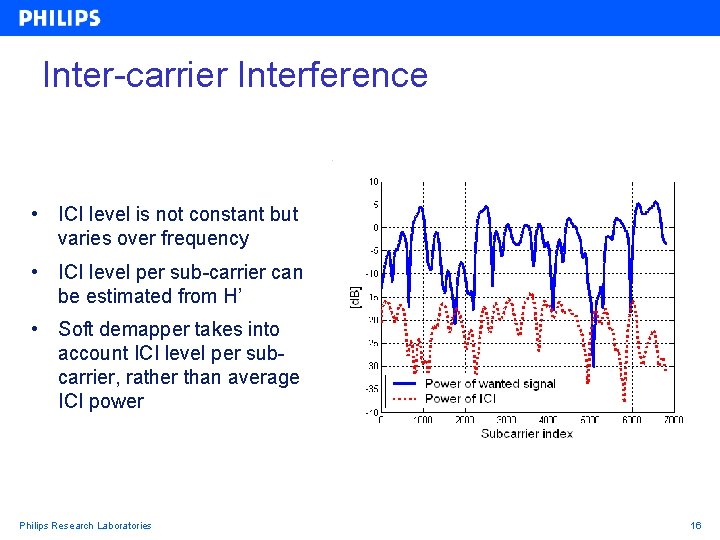
Inter-carrier Interference • ICI level is not constant but varies over frequency • ICI level per sub-carrier can be estimated from H’ • Soft demapper takes into account ICI level per subcarrier, rather than average ICI power Philips Research Laboratories 16
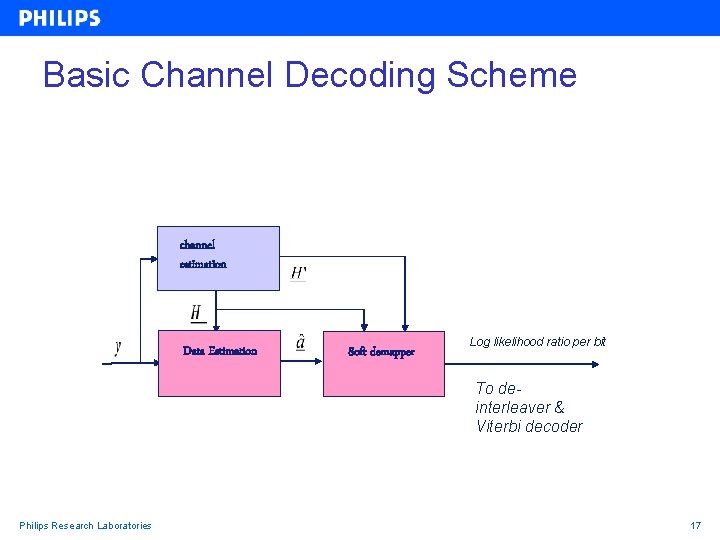
Basic Channel Decoding Scheme channel estimation Data Estimation Soft demapper Log likelihood ratio per bit To deinterleaver & Viterbi decoder Philips Research Laboratories 17
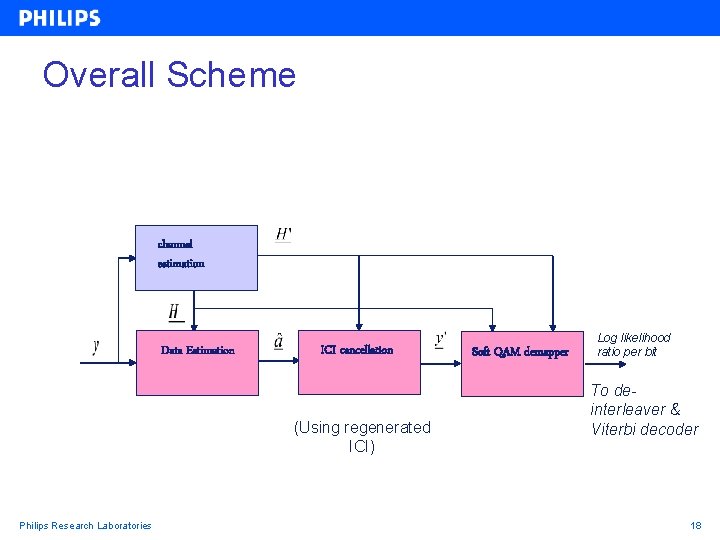
Overall Scheme channel estimation Data Estimation ICI cancellation (Using regenerated ICI) Philips Research Laboratories Soft QAM demapper Log likelihood ratio per bit To deinterleaver & Viterbi decoder 18
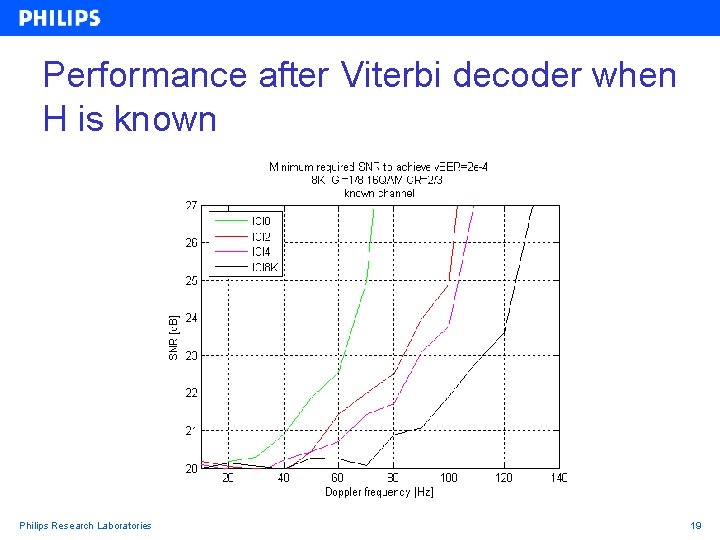
Performance after Viterbi decoder when H is known Philips Research Laboratories 19
Final points on channel decoding • Channel model – MBRAI specification defines the use of COST 207 TU 6 profile – Modeling of the Doppler spectrum is not defined • System performance is very sensitive to model parameters – No conformance tests are defined in for the complete channel model – Caution needs when comparing performance Philips Research Laboratories 20
What next? • On-going work to improve performance – Further reductions in power consumption – Move to a CMOS architecture • Single chip solution that includes channel decoder – Emerging RF filter technologies including MEMS – Antenna diversity, extra d. Bs are very useful – gain of a few d. Bs? • Technology will evolve to meet that in the terminal, convergence! • Multi-standard solutions – Needed now to support multi-standard multi-band cellular requirements – Also required for WLAN/BT, mobile DTV and GPS – Reconfigurable, highly digitised radios • Coexistence in the phone – Exploitation of multiple radios to assist mobile DTV reception - diversity Philips Research Laboratories 21
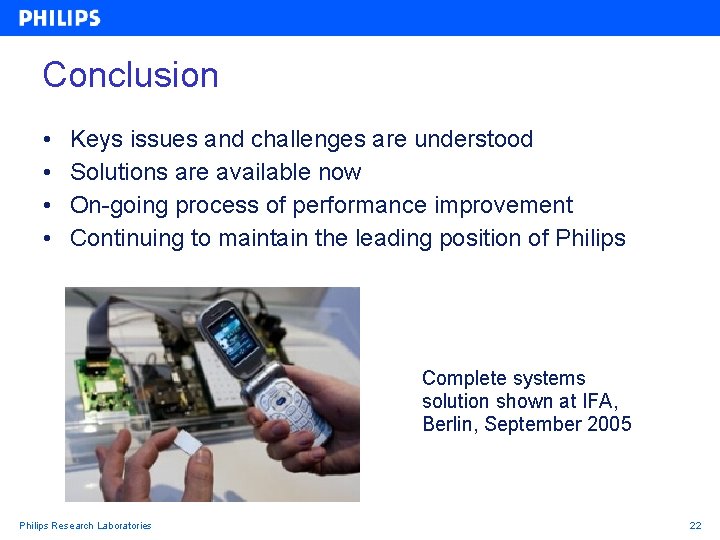
Conclusion • • Keys issues and challenges are understood Solutions are available now On-going process of performance improvement Continuing to maintain the leading position of Philips Complete systems solution shown at IFA, Berlin, September 2005 Philips Research Laboratories 22

- Slides: 23