
MOBILE COMPUTING D 10 K7 D 02 MC
MOBILE COMPUTING D 10 K-7 D 02 MC 00: Pengantar Mata Kuliah Dr. Setiawan Hadi, M. Sc. CS. Program Studi S-1 Teknik Informatika FMIPA Universitas Padjadjaran
Outline • Introduction on mobile computing • Past of mobile computing • Present of mobile computing – – – – – Wireless LAN GSM/GPRS/CDMA Bluetooth Mobile IP Mobile Ad Hoc Network (MANET) PDA/Smart. Phone/Laptop Sensor/Zigbee Mesh RFID Security • Future of mobile computing Mobile Computing Teknik Informatika-Semester Ganjil 2015 -2016
What is mobile computing? • Mobile computing is to describe technologies that – enable people to access network services anyplace, anytime, and anywhere, – with portable and wireless computing and communication devices. --(where is this referenced? Provide citation!) • Aspects of mobility – User mobility • • Between different geographical locations Between different networks Between different communication devices Between different applications – Device portability • Between different geographical locations • Between different networks Mobile Computing Teknik Informatika-Semester Ganjil 2015 -2016
Mobile Computing vs. Ubiquitous Computing/Pervasive Computing • Mobile Computing is a generic term describing the application of small, portable, and wireless computing and communication devices. This includes devices like laptops with wireless LAN technology, mobile phones, wearable computers and Personal Digital Assistants (PDAs) with Bluetooth or IRDA interfaces, and USB flash drives. • Ubiquitous computing (ubicomp, or sometimes ubiqcomp) integrates computation into the environment, rather than having computers which are distinct objects. Another term for ubiquitous computing is pervasive computing. Promoters of this idea hope that embedding computation into the environment would enable people to move around and interact with computers more naturally than they currently do. 4 Mobile Computing Teknik Informatika-Semester Ganjil 2015 -2016
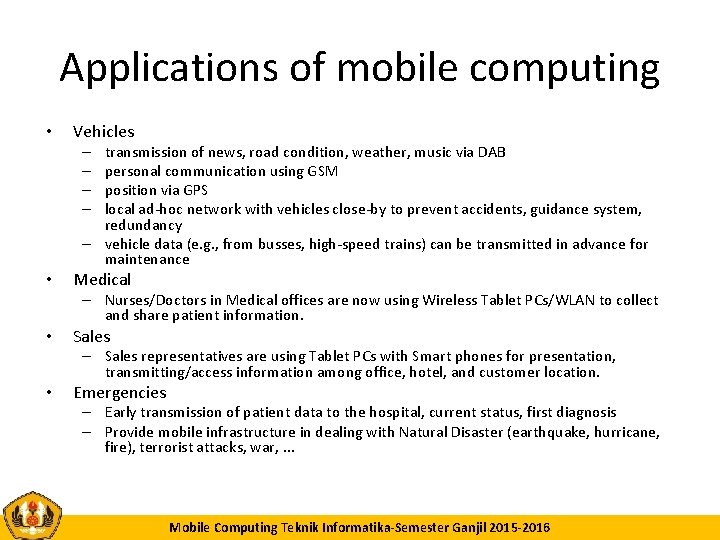
Applications of mobile computing • Vehicles transmission of news, road condition, weather, music via DAB personal communication using GSM position via GPS local ad-hoc network with vehicles close-by to prevent accidents, guidance system, redundancy – vehicle data (e. g. , from busses, high-speed trains) can be transmitted in advance for maintenance – – • Medical – Nurses/Doctors in Medical offices are now using Wireless Tablet PCs/WLAN to collect and share patient information. • Sales – Sales representatives are using Tablet PCs with Smart phones for presentation, transmitting/access information among office, hotel, and customer location. • Emergencies – Early transmission of patient data to the hospital, current status, first diagnosis – Provide mobile infrastructure in dealing with Natural Disaster (earthquake, hurricane, fire), terrorist attacks, war, . . . Mobile Computing Teknik Informatika-Semester Ganjil 2015 -2016
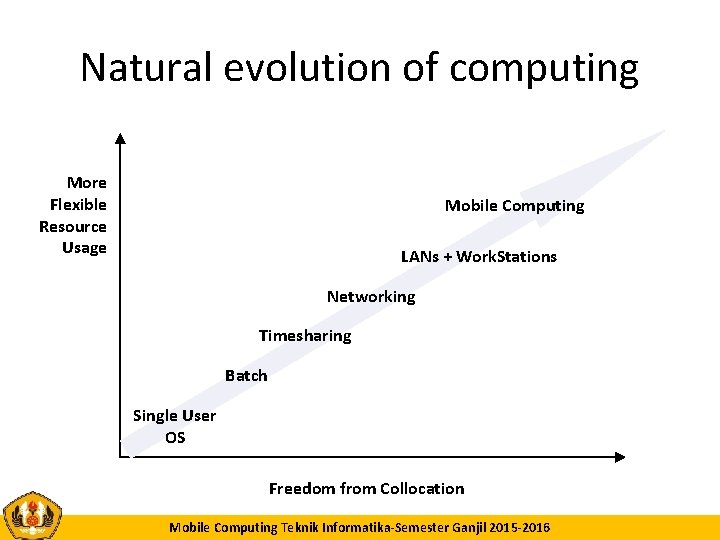
Natural evolution of computing More Flexible Resource Usage Mobile Computing LANs + Work. Stations Networking Timesharing Batch Single User OS Freedom from Collocation Mobile Computing Teknik Informatika-Semester Ganjil 2015 -2016

Challenges in mobile computing • Mobility means changes • Hardware – Lighter, smaller, energy management, user interface • Low bandwidth, high bandwidth variability – Kbit/s to Mbit/s, bandwidth fluctuation • Security risk – Devices more vulnerable, endpoint authentication harder • Heterogeneous network – Different devices, interfaces and protocols • Location awareness – Locality adaptation • Higher loss-rates, higher delays, more jitter – Connection setup time, hand-off • Restrictive regulations of frequencies – Frequencies have to be coordinated Mobile Computing Teknik Informatika-Semester Ganjil 2015 -2016
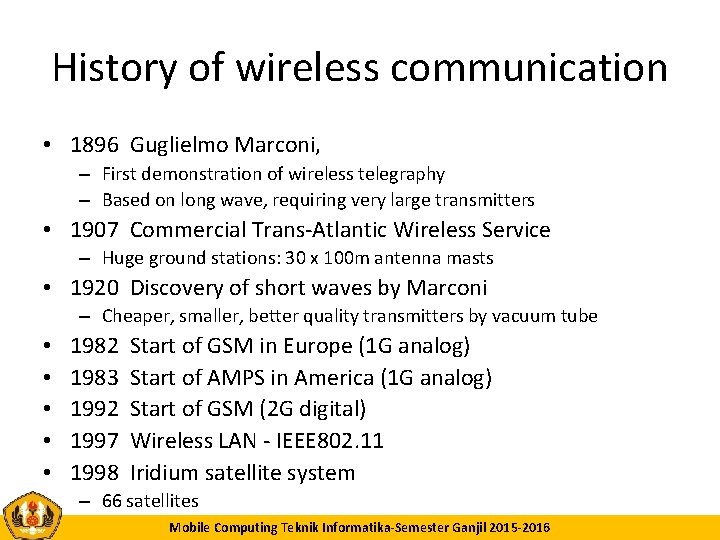
History of wireless communication • 1896 Guglielmo Marconi, – First demonstration of wireless telegraphy – Based on long wave, requiring very large transmitters • 1907 Commercial Trans-Atlantic Wireless Service – Huge ground stations: 30 x 100 m antenna masts • 1920 Discovery of short waves by Marconi – Cheaper, smaller, better quality transmitters by vacuum tube • • • 1982 1983 1992 1997 1998 Start of GSM in Europe (1 G analog) Start of AMPS in America (1 G analog) Start of GSM (2 G digital) Wireless LAN - IEEE 802. 11 Iridium satellite system – 66 satellites Mobile Computing Teknik Informatika-Semester Ganjil 2015 -2016
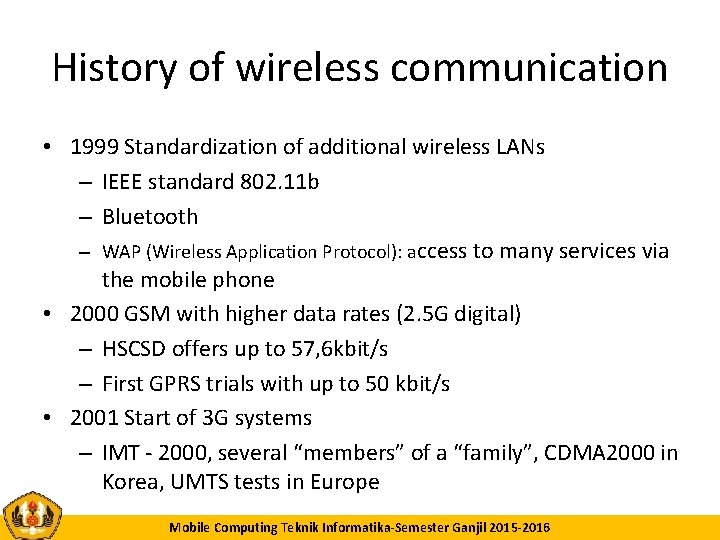
History of wireless communication • 1999 Standardization of additional wireless LANs – IEEE standard 802. 11 b – Bluetooth – WAP (Wireless Application Protocol): access to many services via the mobile phone • 2000 GSM with higher data rates (2. 5 G digital) – HSCSD offers up to 57, 6 kbit/s – First GPRS trials with up to 50 kbit/s • 2001 Start of 3 G systems – IMT - 2000, several “members” of a “family”, CDMA 2000 in Korea, UMTS tests in Europe Mobile Computing Teknik Informatika-Semester Ganjil 2015 -2016
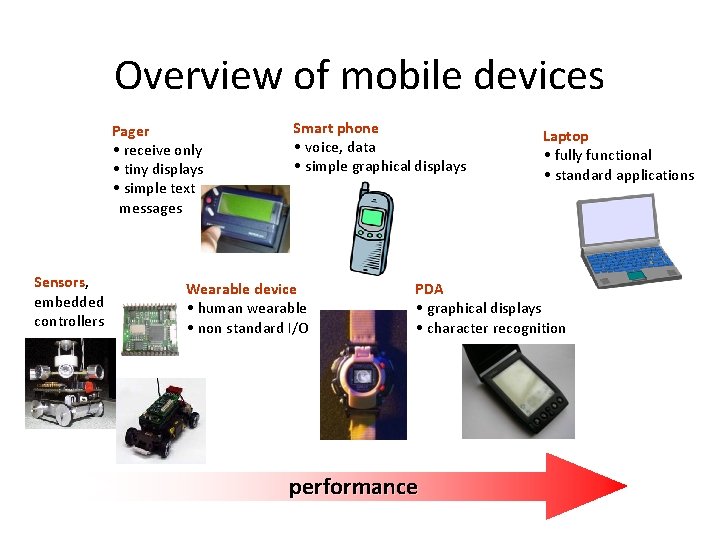
Overview of mobile devices Pager • receive only • tiny displays • simple text messages Sensors, embedded controllers Smart phone • voice, data • simple graphical displays Wearable device • human wearable • non standard I/O Laptop • fully functional • standard applications PDA • graphical displays • character recognition performance
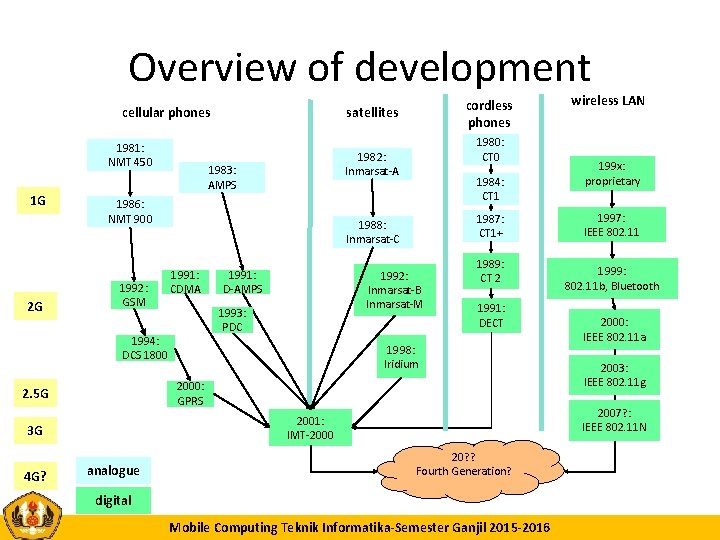
Overview of development cellular phones 1981: NMT 450 1 G 2 G 1984: CT 1 1987: CT 1+ 1988: Inmarsat-C 1991: CDMA 1991: D-AMPS 1992: Inmarsat-B Inmarsat-M 1993: PDC 1994: DCS 1800 1989: CT 2 1991: DECT 1998: Iridium 2000: GPRS 2. 5 G analogue wireless LAN 199 x: proprietary 1997: IEEE 802. 11 1999: 802. 11 b, Bluetooth 2000: IEEE 802. 11 a 2003: IEEE 802. 11 g 2007? : IEEE 802. 11 N 2001: IMT-2000 3 G 4 G? 1980: CT 0 1982: Inmarsat-A 1983: AMPS 1986: NMT 900 1992: GSM cordless phones satellites 20? ? Fourth Generation? digital Mobile Computing Teknik Informatika-Semester Ganjil 2015 -2016
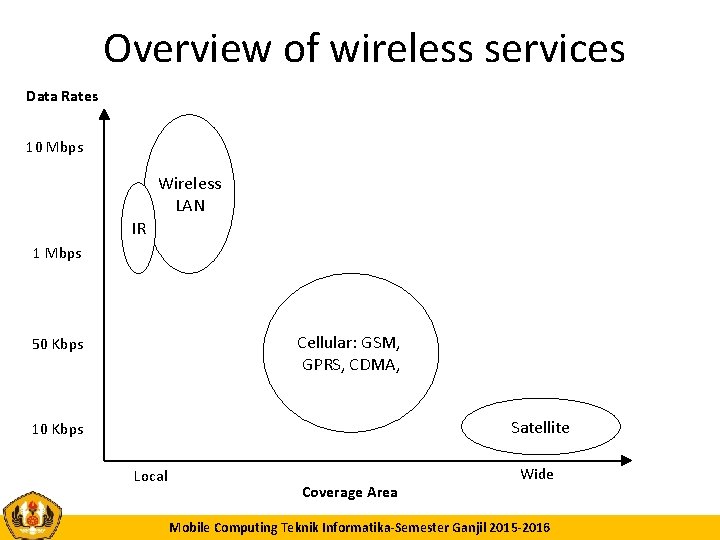
Overview of wireless services Data Rates 10 Mbps Wireless LAN IR 1 Mbps Cellular: GSM, GPRS, CDMA, 50 Kbps Satellite 10 Kbps Local Coverage Area Wide Mobile Computing Teknik Informatika-Semester Ganjil 2015 -2016
Wireless LAN • IEEE 802. 11 standard: a family of specifications for wireless LAN technology. The IEEE accepted the specification in 1997. • 802. 11 specifies an over-the-air interface between a wireless client and a base station or between two wireless clients. – – 802. 11: up to 2 Mbps in the 2. 4 GHz band. 802. 11 b: up to 11 Mbps in the 2. 4 GHz band. 802. 11 a/g: up to 54 Mbps in the 5/2. 4 GHz band. 802. 11 n: up to 220+ Mbps in the 2. 4/5 GHz band (two proposals not approved yet). Vendors already selling 802. 11 pre-n devices. • 802. 11 promises true vendor interoperability. Every vendor must have a viable 802. 11 product strategy. Mobile Computing Teknik Informatika-Semester Ganjil 2015 -2016
Wireless LAN Security • WEP: Wired Equivalent Privacy. – A basic wireless LAN security mechanism. – Easy to set up, commonly used. – Don’t rely on WEP for wireless security. There a number of flaws in the WEP. • Many wireless home networks don’t even use WEP, which makes bad situation worse. • MAC address based access control mechanism doesn’t work. • Use other security mechanisms such as VPN, PEAP and TTLS. – Research project on PEAP / TTLS in our research group in University of Colorado. Mobile Computing Teknik Informatika-Semester Ganjil 2015 -2016
Wireless Ad Hoc Network • Wireless Ad Hoc Network (peer to peer) – A collection of autonomous nodes that communicate with each other by forming a multi-hop radio network in a decentralized manner. – No infrastructure, no default router available – “every” node needs to be a router • Mobile Ad Hoc Networks (MANET) – Host movement frequent – Topology change frequent • Wireless Ad Hoc Sensor Networks – A number of sensors spread across a geographical area. – Limited resources on sensors Mobile Computing Teknik Informatika-Semester Ganjil 2015 -2016
Mobile IP • Mobile IP is designed to allow mobile device users to move from one network to another while maintaining their permanent IP address. • Motivation: – Changing the IP address is not desired when host moves. – However, traditional scheme requires to change IP address when host moves between networks. • Mobile IP provides an efficient, scalable mechanism for node mobility within the Internet. Mobile IP allows moving devices to maintain transport and higher-layer connections while moving. • Applications: – Mobile IP is most often found in wireless WAN environments where users need to carry their mobile devices across multiple LANs with different IP addresses. Mobile Computing Teknik Informatika-Semester Ganjil 2015 -2016
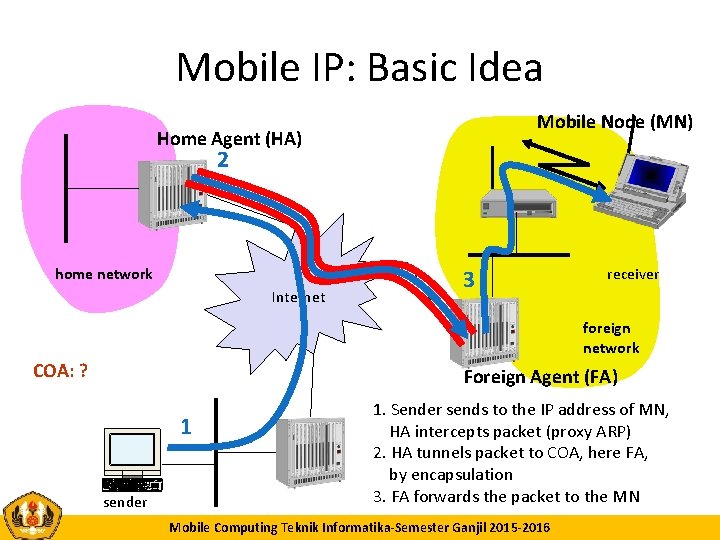
Mobile IP: Basic Idea Mobile Node (MN) Home Agent (HA) 2 home network Internet 3 receiver foreign network COA: ? Foreign Agent (FA) 1 sender 1. Sender sends to the IP address of MN, HA intercepts packet (proxy ARP) 2. HA tunnels packet to COA, here FA, by encapsulation 3. FA forwards the packet to the MN Mobile Computing Teknik Informatika-Semester Ganjil 2015 -2016
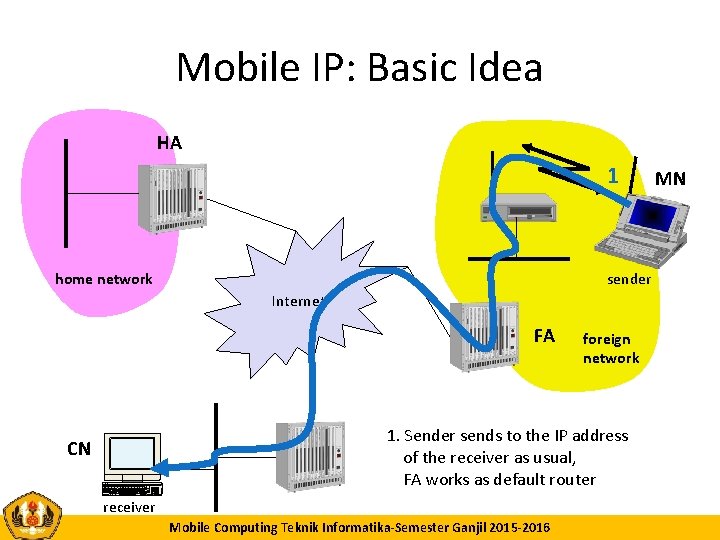
Mobile IP: Basic Idea HA 1 home network sender Internet FA foreign network 1. Sender sends to the IP address of the receiver as usual, FA works as default router CN receiver Mobile Computing Teknik Informatika-Semester Ganjil 2015 -2016 MN
Bluetooth • Bluetooth is used to connect and exchange information between devices like PDAs, mobile phones, laptops, PCs, printers and digital cameras wirelessly. • Named after a Denmark king Harold Bluetooth, who is known for his unification of previously warring tribes. • Low-cost, short range (up to 10 m), low power consumption, license-free 2. 45 GHz band. • Using the same frequency range, Bluetooth differs from Wi-Fi in that – Different multiplexing schemes. – Wi-Fi with higher throughput, greater distances, more expensive hardware, and higher power consumption. • Applications: – Wireless mouse, wireless headset Mobile Computing Teknik Informatika-Semester Ganjil 2015 -2016
RFID: Radio Frequency Identification • RFID is a method of remotely storing and retrieving data using devices called RFID tags. – An RFID tag is a small object, such as an adhesive sticker, that can be attached to or incorporated into a product. – RFID tags contain antennas to enable them to receive and respond to radio-frequency queries from an RFID transceiver. – No line-of sight required (compared to laser scanners) – Withstand difficult environmental conditions (cold, frost etc. ) • Categories: – Active RFID: battery powered, distances up to 100 m – Passive RFID: operating power comes from the reader over the air, distances up to 6 m • Applications: – Automated toll collection: RFIDs mounted in windshields allow commuters to drive through toll plazas without stopping Mobile Computing Teknik Informatika-Semester Ganjil 2015 -2016
GSM • One of the most popular standards for mobile phones in the world. – Formerly: Groupe Spéciale Mobile (founded 1982) – Now: Global System for Mobile Communication – European standard, moving to North America • More than one billion people use GSM phones as of 2005, making GSM the dominant mobile phone system worldwide with about 70% of the world's market. • GSM is a cellular network, which means that mobile phones connect to it by searching for cells in the immediate vicinity. • One of the key features of GSM is the Subscriber Identity Module (SIM), commonly known as a SIM card. The SIM is a detachable smartcard containing the user's subscription information and phonebook. Mobile Computing Teknik Informatika-Semester Ganjil 2015 -2016
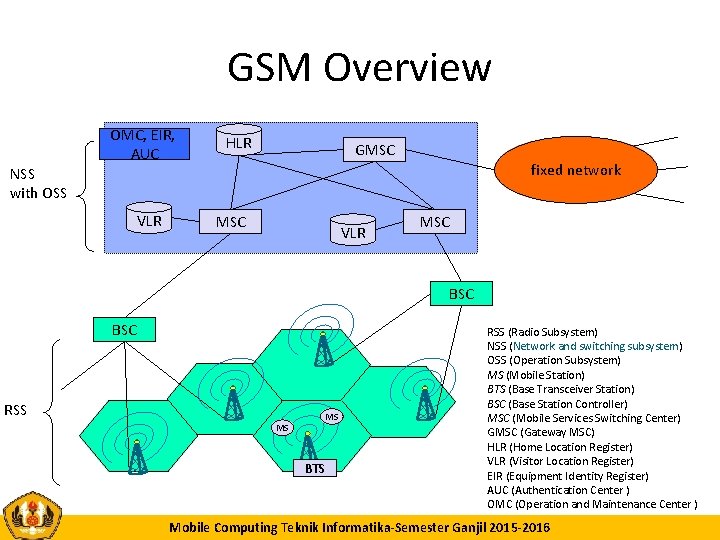
GSM Overview OMC, EIR, AUC HLR GMSC fixed network NSS with OSS VLR MSC BSC RSS MS MS BTS RSS (Radio Subsystem) NSS (Network and switching subsystem) OSS (Operation Subsystem) MS (Mobile Station) BTS (Base Transceiver Station) BSC (Base Station Controller) MSC (Mobile Services Switching Center) GMSC (Gateway MSC) HLR (Home Location Register) VLR (Visitor Location Register) EIR (Equipment Identity Register) AUC (Authentication Center ) OMC (Operation and Maintenance Center ) Mobile Computing Teknik Informatika-Semester Ganjil 2015 -2016
GPRS • GPRS: General Packet Radio Service • It is a mobile data service available to users of GSM mobile phones. It is often described as "2. 5 G“. • GPRS is packet-switched which means that multiple users share the same transmission channel, only transmitting when they have data to send. • GPRS provides moderate speed data transfer, by allocating unused cell bandwidth to transmit data. – Poor bit rate in busy cells – Usually, GPRS data is billed per kilobytes of information transceived • In 3 G mobile systems like UMTS (Universal Mobile Telecommunication System), voice and data services will be mixed in a normal communication. Mobile Computing Teknik Informatika-Semester Ganjil 2015 -2016
PDA • Personal digital assistants (PDAs or palmtops) – handheld devices that were originally designed as personal organizers, but became much more versatile over the years. – A basic PDA usually includes a clock, date book, address book, task list, memo pad and a simple calculator. – One major advantage of using PDAs is their ability to synchronize data with desktop, notebook and desknote computers. • The currently major PDA operating systems are: – – Palm OS by Palm. Source, Inc Windows Mobile (Windows CE) by Microsoft Black. Berry by Research In Motion Symbian by a group of companies • According to a Gartner market study, the overall market for PDAs shrunk by 5% in the first quarter (Q 1) of 2004, compared to Q 1 2003. Yu Cai/MTU Talk Mobile Computing Teknik Informatika-Semester Ganjil 2015 -2016 24 6/2/2005
Satellite Systems • Like cellular systems, except that the base stations (i. e. , satellites) move as will as mobile devices • Satellite coverage attractive for areas of world not well served by existing terrestrial infrastructure: ocean areas, developing countries • IRIDIUM – Motorola – Voice, Data (2. 4 kbps), Fax, Location Services – 66 satellites in 6 polar orbits (780 km) – Failed project Mobile Computing Teknik Informatika-Semester Ganjil 2015 -2016
Future mobile and wireless networks • Shift industrial paradigm from piecewise solutions to end-toend information systems • Improved radio technology and antennas – smart antennas, beam forming, multiple-input multiple-output (MIMO) 802. 11 N – dynamic spectrum allocation • Core network convergence – IP-based, quality of service, mobile IP • Ad-hoc technologies – spontaneous communication, power saving, redundancy • Simple and open service platform – intelligence at the edge, not in the network (as with IN) – more service providers, not network operators only Mobile Computing Teknik Informatika-Semester Ganjil 2015 -2016
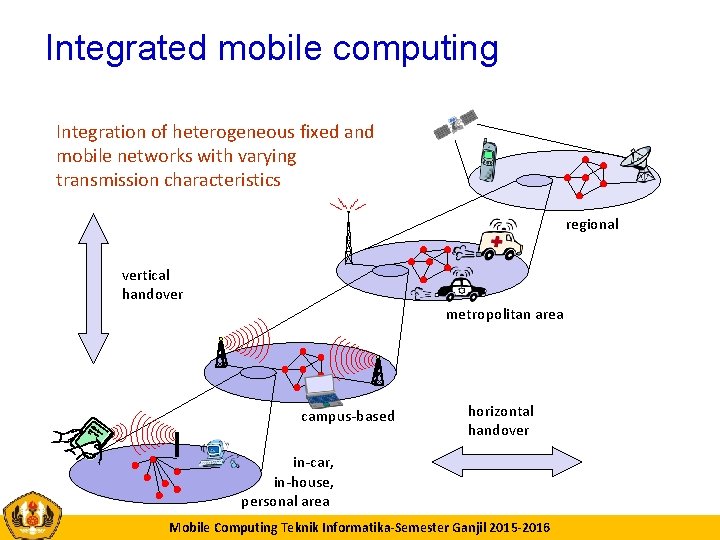
Integrated mobile computing Integration of heterogeneous fixed and mobile networks with varying transmission characteristics regional vertical handover metropolitan area campus-based horizontal handover in-car, in-house, personal area Mobile Computing Teknik Informatika-Semester Ganjil 2015 -2016
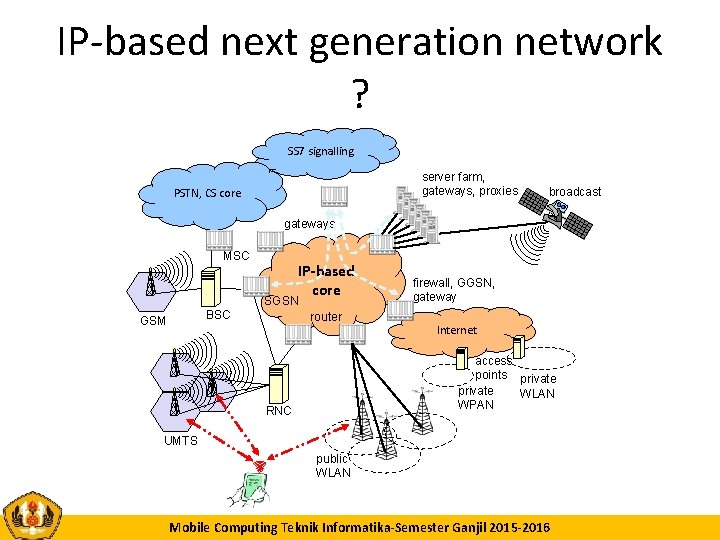
IP-based next generation network ? SS 7 signalling server farm, gateways, proxies PSTN, CS core broadcast gateways MSC BSC GSM IP-based core SGSN router firewall, GGSN, gateway Internet access points private WLAN WPAN RNC UMTS public WLAN Mobile Computing Teknik Informatika-Semester Ganjil 2015 -2016
- Slides: 28