
Mobile Computing COE 446 Wireless Multiple Access Tarek
Mobile Computing COE 446 Wireless Multiple Access Tarek Sheltami KFUPM CCSE COE hthttp: //faculty. kfupm. edu. sa/coe/tarek/coe 446. htm Principles of Wireless Networks K. Pahlavan and P. Krishnamurth 10/31/2021 1
Outline n n n CSMA/CA BTMA DSMA 10/31/2021 2
IEEE 802. 11 Wireless LAN n 802. 11 b n 2. 4 -5 GHz unlicensed radio spectrum n up to 11 Mbps n direct sequence spread spectrum (DSSS) in physical layer n all hosts use same chipping code n widely deployed, using base stations 10/31/2021 n n 802. 11 a n 5 -6 GHz range n up to 54 Mbps 802. 11 g n 2. 4 -5 GHz range n up to 54 Mbps All use CSMA/CA for multiple access All have base-station and adhoc network versions 3
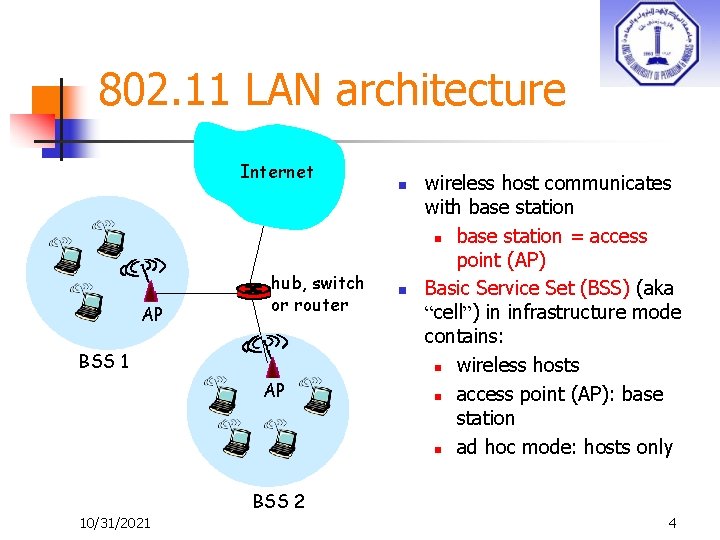
802. 11 LAN architecture Internet AP hub, switch or router BSS 1 AP n n wireless host communicates with base station n base station = access point (AP) Basic Service Set (BSS) (aka “cell”) in infrastructure mode contains: n wireless hosts n access point (AP): base station n ad hoc mode: hosts only BSS 2 10/31/2021 4

802. 11: Channels, association n n 802. 11 b: 2. 4 GHz-2. 485 GHz spectrum divided into 11 channels at different frequencies n AP admin chooses frequency for AP n interference possible: channel can be same as that chosen by neighboring AP! host: must associate with an AP n scans channels, listening for beacon frames containing AP’s name (SSID) and MAC address n selects AP to associate with n may perform authentication n will typically run DHCP to get IP address in AP’s subnet 10/31/2021 5

IEEE 802. 11 MAC Protocol CSMA/CA n n n Listen Before Talk (LBT) MT 1 senses the channel first and then sends a packet During the second transmission of MT 1, MT 2 senses the channel and discovers that another terminal is using the medium MT 2 delays the transmission using a pack-off algorithm CSMA reduces packet collision probability significantly compared with ALOHA The longer the propagation time, the less the efficient the CSMA 10/31/2021 6
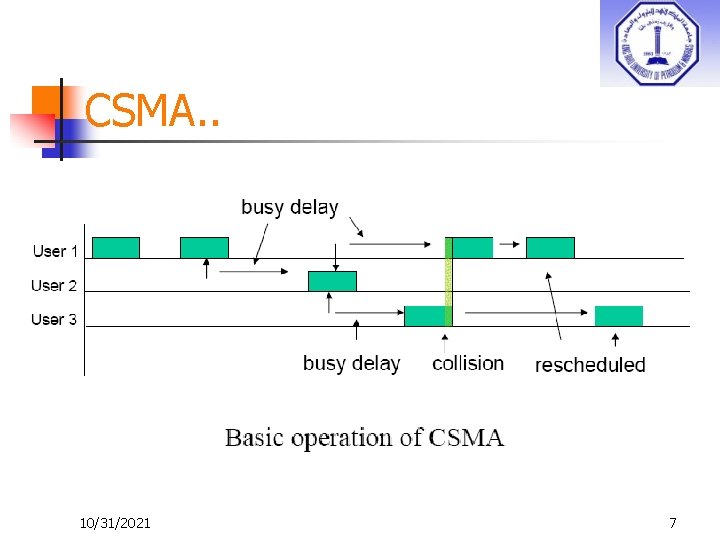
CSMA. . 10/31/2021 7
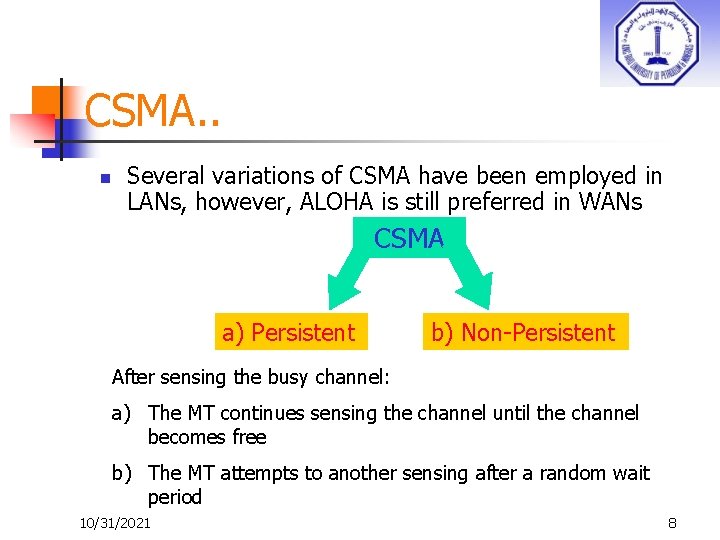
CSMA. . n Several variations of CSMA have been employed in LANs, however, ALOHA is still preferred in WANs CSMA a) Persistent b) Non-Persistent After sensing the busy channel: a) The MT continues sensing the channel until the channel becomes free b) The MT attempts to another sensing after a random wait period 10/31/2021 8
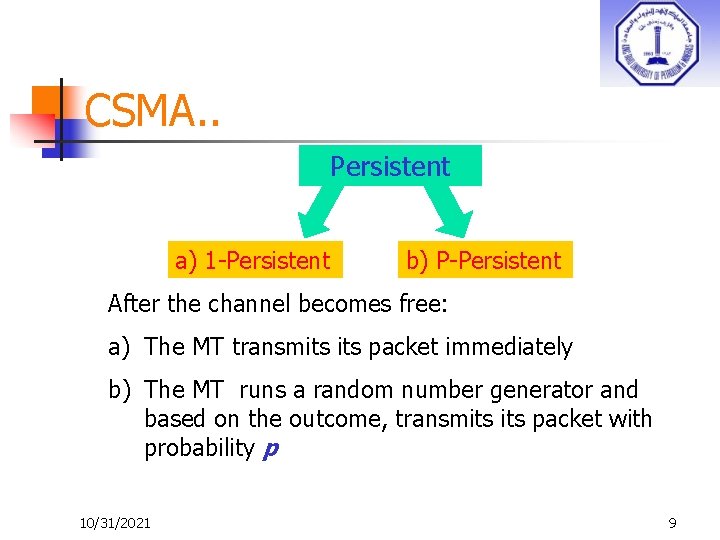
CSMA. . Persistent a) 1 -Persistent b) P-Persistent After the channel becomes free: a) The MT transmits packet immediately b) The MT runs a random number generator and based on the outcome, transmits packet with probability p 10/31/2021 9
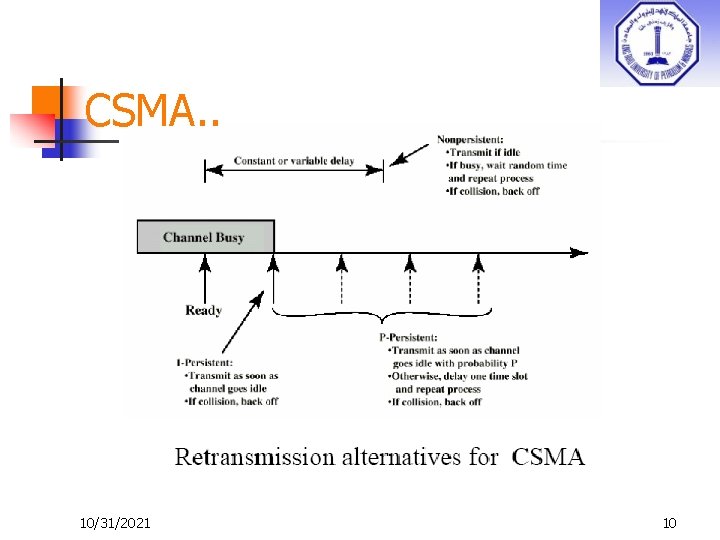
CSMA. . 10/31/2021 10
CSMA. . n Hidden Terminal Problem: n n Two terminal within the range of intended third node, but of range of each other Busy Tone Multiple Access (BTMA) (for Ad hoc) n n 10/31/2021 BW is divided into two channels, message channel and busy channel Whenever an MT sends signal on the message channel, it transmits a simple busy tone signal on its busy tone channel When any MT senses the busy tone signal, it runs on its own busy tone channel An MT with packet ready to send, first senses the busy tone channel to determine if the network is occupied 11
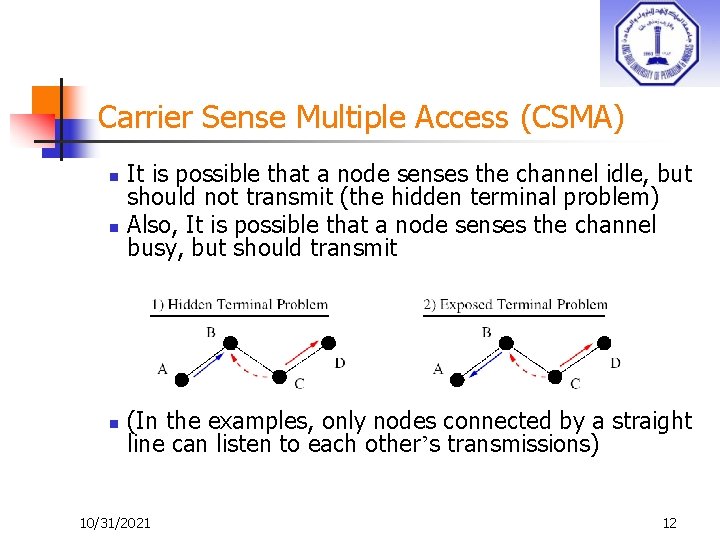
Carrier Sense Multiple Access (CSMA) n n n It is possible that a node senses the channel idle, but should not transmit (the hidden terminal problem) Also, It is possible that a node senses the channel busy, but should transmit (In the examples, only nodes connected by a straight line can listen to each other’s transmissions) 10/31/2021 12
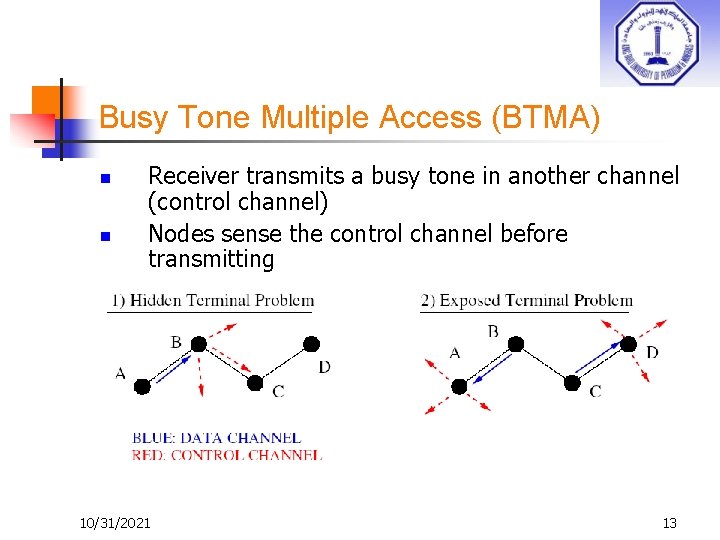
Busy Tone Multiple Access (BTMA) n n Receiver transmits a busy tone in another channel (control channel) Nodes sense the control channel before transmitting 10/31/2021 13
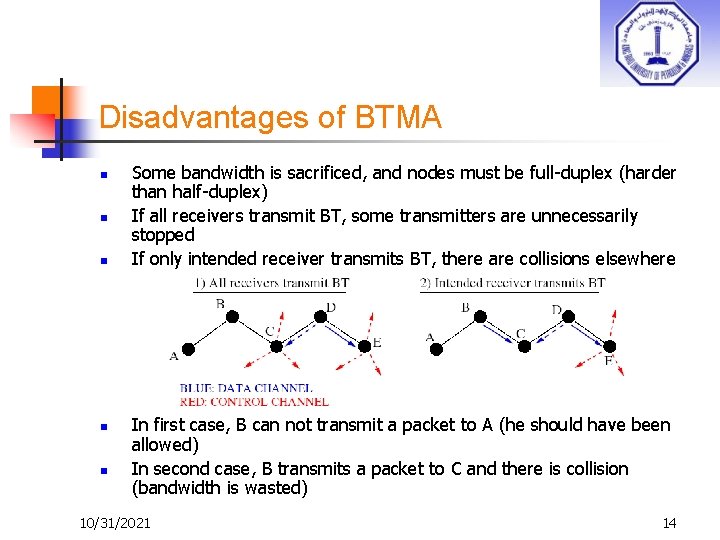
Disadvantages of BTMA n n n Some bandwidth is sacrificed, and nodes must be full-duplex (harder than half-duplex) If all receivers transmit BT, some transmitters are unnecessarily stopped If only intended receiver transmits BT, there are collisions elsewhere In first case, B can not transmit a packet to A (he should have been allowed) In second case, B transmits a packet to C and there is collision (bandwidth is wasted) 10/31/2021 14
CSMA. . n n Most cellular mobile data use different frequencies for downlink and uplink The BS is not hidden from MTs, whereas MTs may be hidden from on another In this situation, one may use the downlink channel to announce the availability of the MT This concept is used in a protocol referred to as digital or data sense multiple access (DSMA) 10/31/2021 15
CSMA. . n DSMA n n 10/31/2021 Widely used in mobile networks The downlink broadcasts a periodic busy-idle bit announcing availability of downlink channel for data transmission of its packet An MT checks the busy-idle bit prior to transmission of its packet As soon as the MT starts the transmission of its packet, BS changes the busy-idle bit to the busystate to prevent other MTs from transmission 16
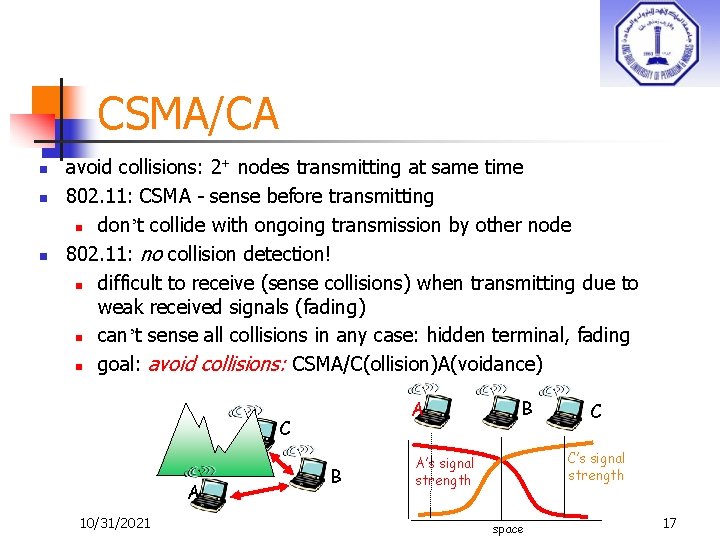
CSMA/CA n n n avoid collisions: 2+ nodes transmitting at same time 802. 11: CSMA - sense before transmitting n don’t collide with ongoing transmission by other node 802. 11: no collision detection! n difficult to receive (sense collisions) when transmitting due to weak received signals (fading) n can’t sense all collisions in any case: hidden terminal, fading n goal: avoid collisions: CSMA/C(ollision)A(voidance) A C A 10/31/2021 B B C C’s signal strength A’s signal strength space 17
Carrier Sense Multiple Access Collision Avoidance (CSMA/CA) 10/31/2021 18
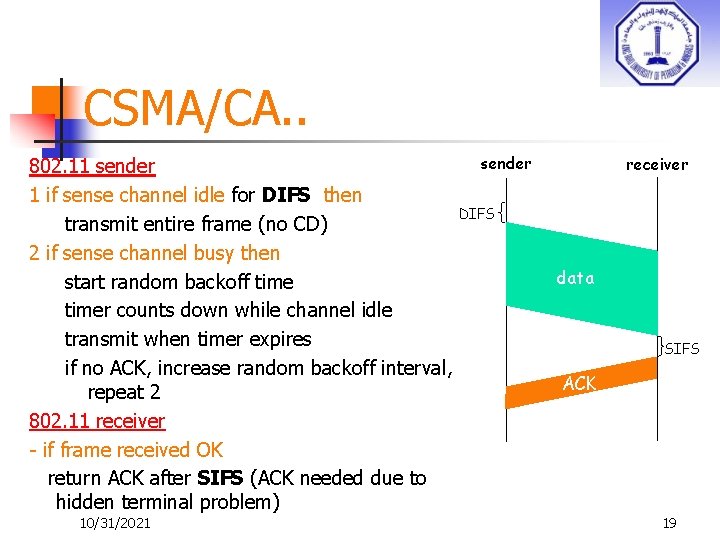
CSMA/CA. . 802. 11 sender 1 if sense channel idle for DIFS then transmit entire frame (no CD) 2 if sense channel busy then start random backoff timer counts down while channel idle transmit when timer expires if no ACK, increase random backoff interval, repeat 2 802. 11 receiver - if frame received OK return ACK after SIFS (ACK needed due to hidden terminal problem) 10/31/2021 sender receiver DIFS data SIFS ACK 19
CSMA/CA. . 10/31/2021 20
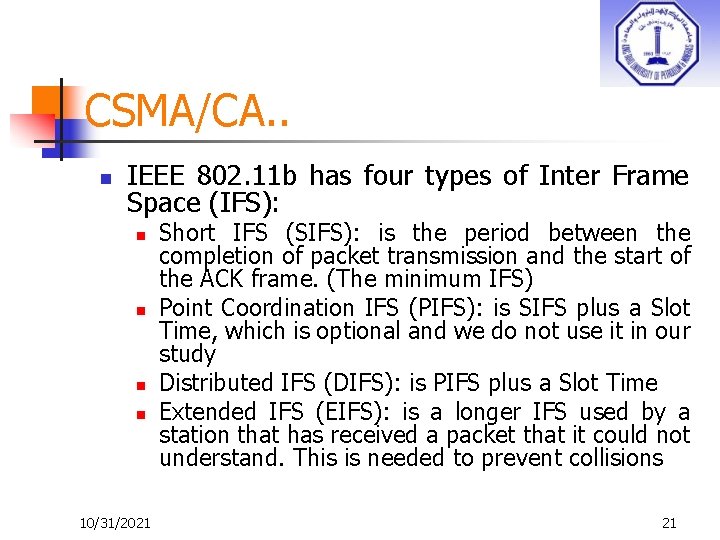
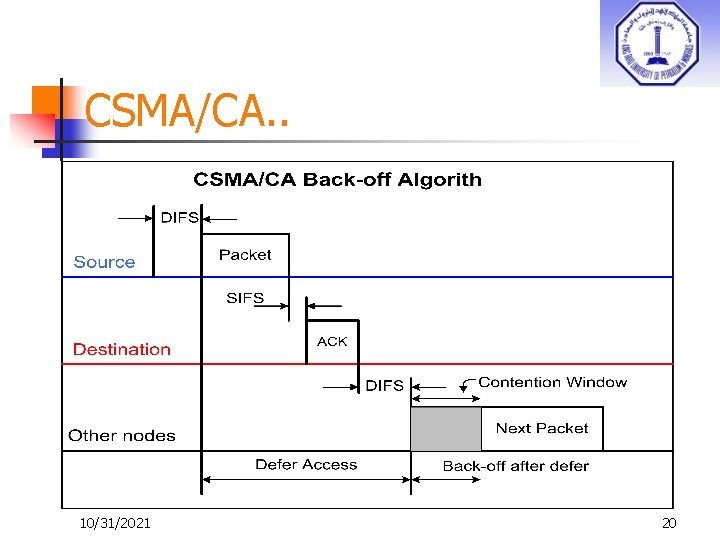
CSMA/CA. . n IEEE 802. 11 b has four types of Inter Frame Space (IFS): n n 10/31/2021 Short IFS (SIFS): is the period between the completion of packet transmission and the start of the ACK frame. (The minimum IFS) Point Coordination IFS (PIFS): is SIFS plus a Slot Time, which is optional and we do not use it in our study Distributed IFS (DIFS): is PIFS plus a Slot Time Extended IFS (EIFS): is a longer IFS used by a station that has received a packet that it could not understand. This is needed to prevent collisions 21
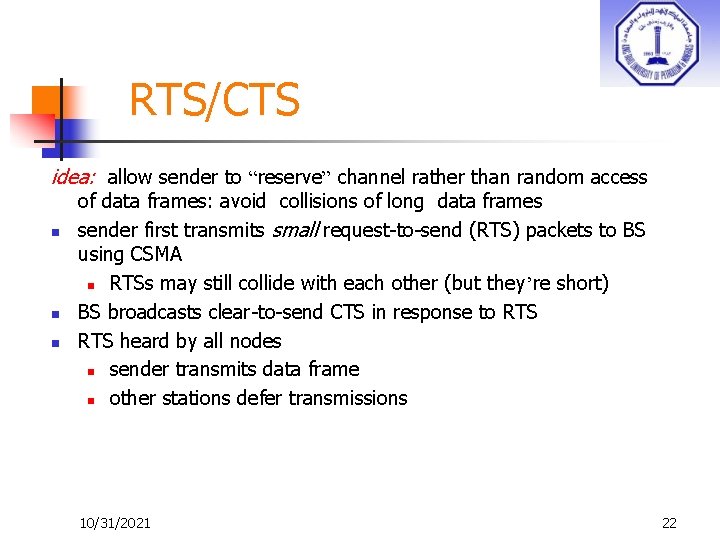
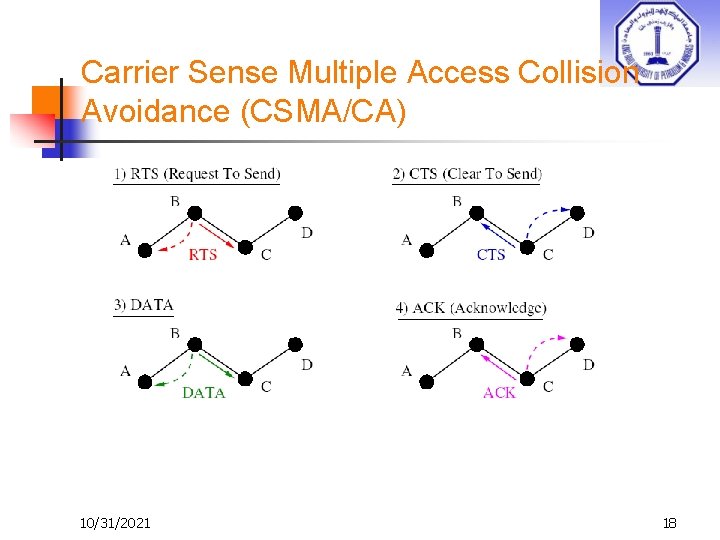
RTS/CTS idea: allow sender to “reserve” channel rather than random access n n n of data frames: avoid collisions of long data frames sender first transmits small request-to-send (RTS) packets to BS using CSMA n RTSs may still collide with each other (but they’re short) BS broadcasts clear-to-send CTS in response to RTS heard by all nodes n sender transmits data frame n other stations defer transmissions 10/31/2021 22
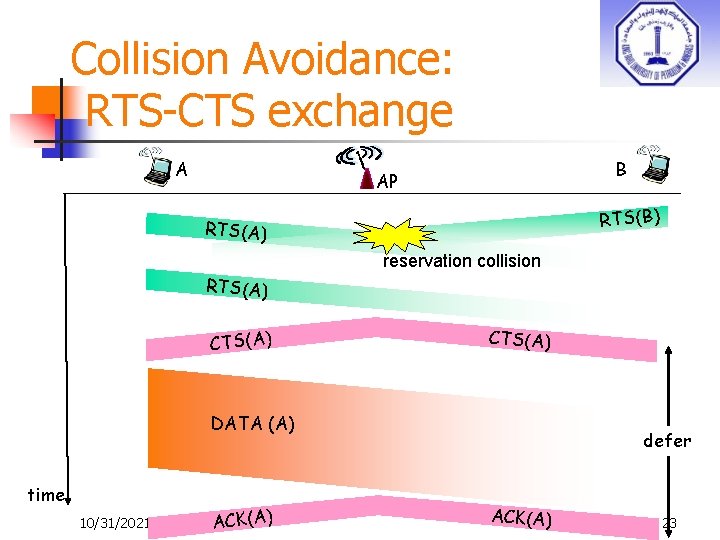
Collision Avoidance: RTS-CTS exchange A B AP RTS(B) RTS(A) reservation collision RTS(A) CTS(A) DATA (A) time 10/31/2021 ACK(A) defer ACK(A) 23
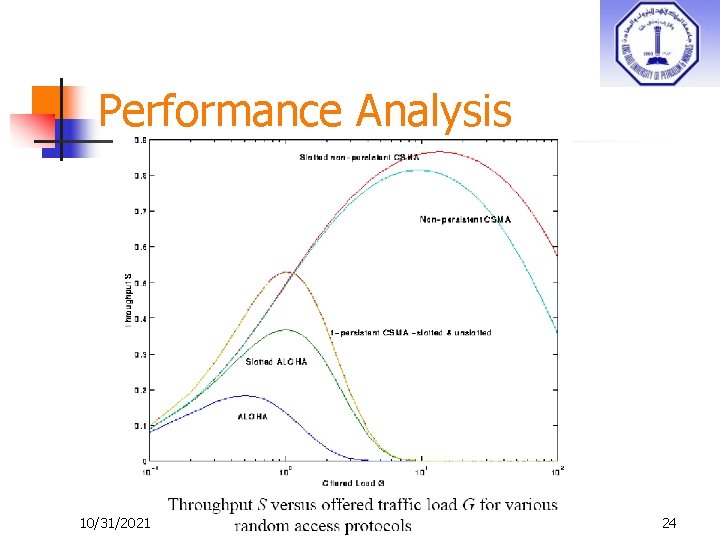
Performance Analysis 10/31/2021 24
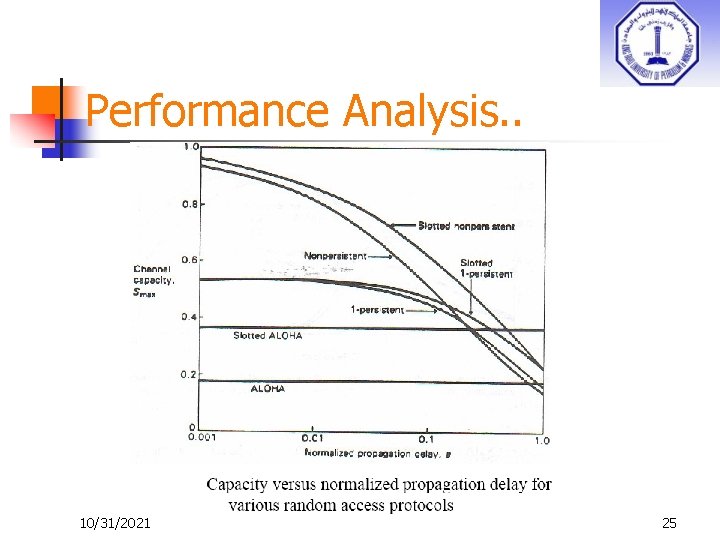
Performance Analysis. . 10/31/2021 25
- Slides: 25