
Mobile Communications and National Broadband Strategies Issues Challenges
Mobile Communications and National Broadband Strategies: Issues, Challenges and Lessons Dr. Prabir Neogi, Carleton University, Canada Prof. Rekha Jain, IIMA, India March 3, 2014 IIM Ahmedabad
“Every day we are moving closer to having almost as many mobile subscriptions as people on earth…The mobile revolution is mpowering people in developing countries by delivering ICT applications in education, health, government, banking, environment and business. Let us all celebrate this mobile miracle that I have no doubt will hasten our pace towards sustainable development. ” - Brahima Sanou, Director, ITU Telecommunications Bureau, “The World in 2013: ICT Facts and Figures” • In the last 10 years, the use of the increasingly intelligent mobile phone has exploded. It has become the most widely used communications device in the world, and the device of choice in developing countries 2
Outline • • Overall Trends Experience from USA Experience from Mexico Experience from India – Wireless • Spectrum (Auctions, unlicensed) – Wired (NOFN, BBNL) • Lessons • Way Forward 3
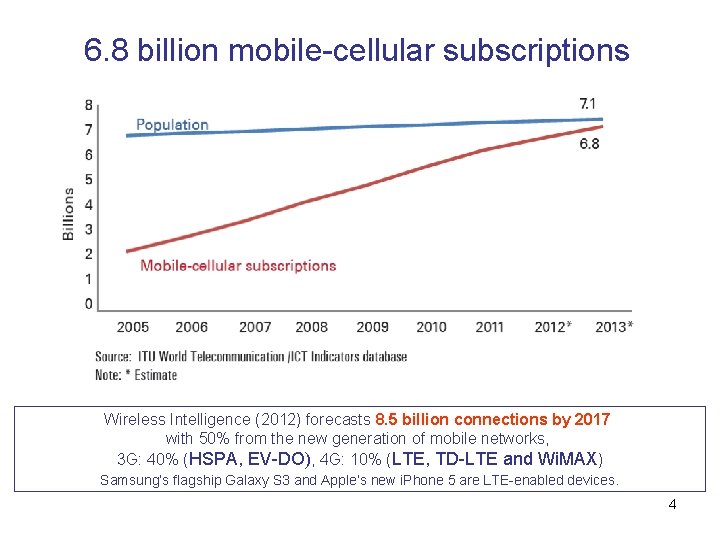
6. 8 billion mobile-cellular subscriptions Wireless Intelligence (2012) forecasts 8. 5 billion connections by 2017 with 50% from the new generation of mobile networks, 3 G: 40% (HSPA, EV-DO), 4 G: 10% (LTE, TD-LTE and Wi. MAX) Samsung’s flagship Galaxy S 3 and Apple’s new i. Phone 5 are LTE-enabled devices. 4
Characteristics of the Mobile Revolution • The new mobile technology, used in combination with the existing ICTenabled infrastructure, increases economic efficiency and enables innovation across all sectors of the economy, creating jobs and increasing prosperity • The continued progress of the mobile revolution depends on continuing advances in semiconductors (“Moore’s Law”), signal processing, software and spectrum availability • From a Public Policy perspective, the most important of these inputs is spectrum - its availability is the lifeblood of the wireless industry and wireless broadband services 5
Broadband is both wired and wireless • Mobile communications requires the use of Last-Mile wireless networks, combined with Middle-Mile and Core wireline networks • Should mobile broadband issues and challenges be explicitly addressed in national broadband plans? • What is the appropriate role for governments and regulators in fostering more competitive mobile broadband markets? – How to improve affordability, choice, service innovation? – How to leverage existing investments in fixed line infrastructure to improve mobile connectivity? 6
The United States • Developed Key Technologies • Mobile-Aware National Broadband Plan – Called for 300 + 200 MHz New Spectrum • Licensed Mobile and Other uses – Invented “Incentive Auction” to speed reassignment • TV White Spaces – Authorization Database controls unlicensed use – Intermediate System between Licensed and Unlicensed 7
The United States • What U. S. Did Right in Mobile Policy – Spectrum Auctions: First nation to sell property rights for RF transmission to the highest bidder – Technology Freedom: • No mandate attaching specific technologies to spectrum licenses • No “net neutrality” restriction for wireless networks – Competitive Market: Lower HHI than any EU state • What U. S. Did Wrong in Mobile Policy – OTA TV has 10 Hz/user, Mobile has 1 Hz/user – Military and other Government Systems Over-Assigned – Continuing Practice of Application-Oriented Assignment • MBAN – Implicitly Granted Spectrum Rights to GPS that were never purchased. • No concept of “Reception Rights” 8
The United States • Pressing Issues for Incentive Auction: – – Market Concentration Unlicensed TV Channel Re-packing International Coordination • Other Issues: – Device Interoperability – Device Unlocking – Mobile Privacy • Geo-Location – New Towers: EMF Radiation 9
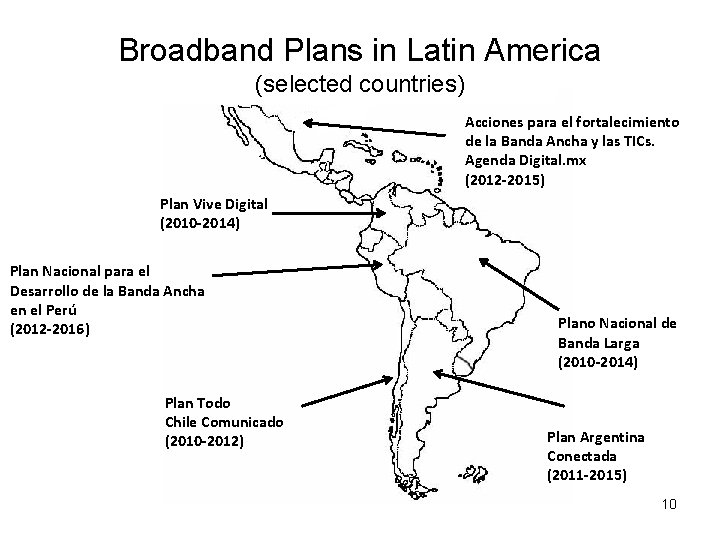
Broadband Plans in Latin America (selected countries) Acciones para el fortalecimiento de la Banda Ancha y las TICs. Agenda Digital. mx (2012 -2015) Plan Vive Digital (2010 -2014) Plan Nacional para el Desarrollo de la Banda Ancha en el Perú (2012 -2016) Plan Todo Chile Comunicado (2010 -2012) Plano Nacional de Banda Larga (2010 -2014) Plan Argentina Conectada (2011 -2015) 10
Role of mobile broadband in Mexican Reform: “The State Back In” Mandate to build a government led wholesale network for the provision of LTE 4 G services using entire 700 Mhz band (digital dividend) through PPP (Public Private Partnership) Risks associated: • High opportunity cost of a spectrum set-aside, given the high demand by existing networks for additional spectrum bandwidth; • Complicated nature of coordinating a nationwide, publicprivate network utilizing a business model that features many moving parts controlled by decentralized players. 11
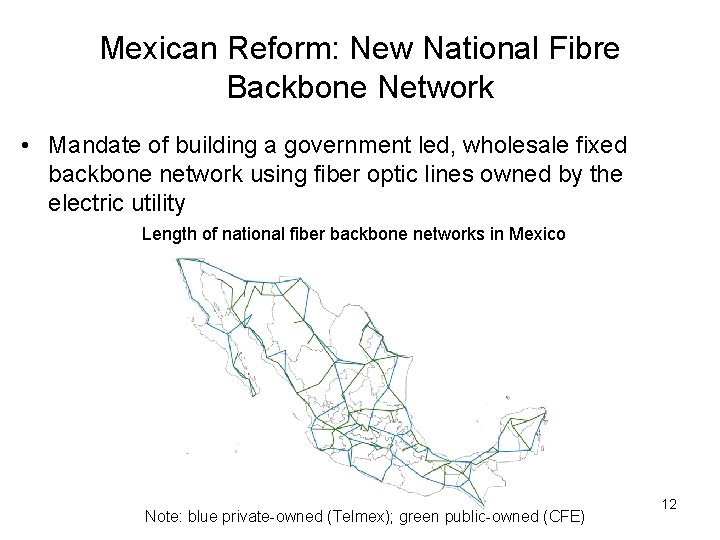
Mexican Reform: New National Fibre Backbone Network • Mandate of building a government led, wholesale fixed backbone network using fiber optic lines owned by the electric utility Length of national fiber backbone networks in Mexico Note: blue private-owned (Telmex); green public-owned (CFE) 12
Indian Telecommunications Sector • As of December 2013 – Telephone subscribers – 915. 19 mn – Wireless tele-density – 71. 69% , Overall tele-density – 74. 02% • As of October 2013 Internet subscribers – 205 mn (of which mobile internet subscribers - 110 mn). (Source: IAMAI and IMRB Report 2013) • As per an industry report* (by the end of March 2012), − Cable TV households in India - 94 mn − DTH households in India – 54. 5 mn • Sector contributed 7% of the total FDI inflows amounting to US$ 12. 9 billion during April 2000 to March 2013. *Media Partners Asia report: Asia Pacific Pay TV and Broadband Market 2012 13
The Licensing Framework • Recently completed 900 Mhz and 1800 Mhz auctions for spectrum that would come up on expiry of the license period – Options included: • Hold back some • Put all in the pool • Continue status quo. • Yielded bids totaling over INR 61, 000 crores. • SUC (Spectrum Usage Charge) – Guidelines, including proposed 5% SUC on gross revenues for use of new spectrum. 14
Newer Frequency Bands • 800 MHz…? • 700 MHz…? • TVWS – Only 10% of the TV spectrum in the 500 -600 MHz range is occupied in India. 15
Broadband over TV Networks • Digital Dividend from Conversion of TV Broadcasting – The Ministry of I&B notified on Nov 11, 2011 setting Mar 31, 2015 as the deadline for complete shift from analogue to digital systems (DTT). – Process of digitization of cable TV networks (transmission network and/or Customer Access Module) has been completed across metros, first and second tier cities. 16
Role of Wired Broadband • • • National Optical Fibre Network (NOFN) Funded through USOF Publicly provided: BSNL, Railtel, PGCIL Connectivity up to 2, 50, 000 Gram Panchayats NOFN to provide the “additional” connectivity, where required • Bharat Broadband Networks Limited (BBNL) set up to own and manage the network • Last mile connectivity? 17
Last Mile Connectivity • Role of wireless connectivity in the last mile – Cost to cover last mile – Availability of mobiles (smart phones) • Spectrum – Licensed – Unlicensed • Integrating wired telecommunications with other infrastructures (water, sanitation, electricity). 18
Urban Areas • 4 G, LTE – Devices (availability, price) • Municipal Wi-Fi Networks • Mandating duct provisioning in future buildings 19
Appropriate Roles for Governments • Broad consensus that traditional role in setting the market framework rules needs to continue – regulatory oversight, where required – ensuring a competitive marketplace – consumer protection • Also broad consensus that efficient spectrum management and allocation/reallocation of spectrum frequencies is a key task – spectrum availability is the lifeblood of the wireless industry and wireless broadband services (fixed and mobile) • Support for infrastructure deployment – options – targeted tax incentives for private sector network suppliers – “pave the dirt roads”, i. e. fund the deployment of broadband infrastructures in high cost rural/remote areas, or – “help build a digital Interstate Highway system” e. g. Australian National Broadband Network Initiative • Promotion of adoption and effective use of ICTs, especially by – small businesses, to fully reap productivity and competitiveness gains – Disadvantaged groups, to improve social inclusion 20
Newer Instruments for Spectrum Allocation • Trading and Other Market Mechanisms – To create a secondary market in spectrum availability for operators who are not the primary licensees. 21
Theme When it comes to national strategies for the promotion of mobile communications One size DOES NOT fit all 22
Lessons and Way Forward • Spectrum roadmap • For efficient roll out, need to identify role of public and private sector • Integration of wired and wireless policies • Support the last mile access through enabling policies – Unlicensed spectrum bands: greater availability – Integrating with new infrastructure, leverage investments 23
Contacts • Dr. Prabir Neogi (prabir. neogi@carleton. ca ) • Prof. Rekha Jain (rekha@iimahd. ernet. in ) 24

Thank you Any Questions? ? ? 25
Focus Questions (I) • What role does wireless access and mobile broadband play in your national/regional broadband strategy, and how is it integrated with the wireline component? • In addition to efficient and forward looking spectrum management, what other roles can governments and regulators play in enabling the continued growth of mobile communications? • Could/should revenues derived from spectrum auctions and be used for targeted demand or supply side initiatives to promote the growth and use of mobile communications? • Is there a need for interconnection and open access rules, both for wireless networks and customer devices, similar to those for wireline networks? • Are new regulations necessary if the mobile phone is increasingly being used as a device for making transactions and/or payments? 26
Some Wireless Statistics and Forecasts • • The ITU estimated that in 2013: – There were some 6. 8 billion mobile service subscriptions worldwide, a 96% overall penetration for a population of 7. 1 billion – Mobile-cellular penetration is estimated at 128% in developed countries and 89% in developing countries. Growth rates have begun to fall as penetration approaches 100% and market saturation is reached – Mobile broadband subscriptions grew at an average annual growth rate of 40% between 2007 and 2013, from 268 M to 2. 1 B – There are now almost three times as many mobile broadband subscriptions (2. 1 B) as fixed ones (700 M) The Boston Consulting Group, in its 2011 report The 4. 2 Trillion Opportunity, forecast that by 2016 mobile devices such as smartphones and tablet computers could account for four out of five broadband connections A 2012 Ericsson report predicted that : – Total global mobile subscriptions would stand at 6. 6 billion by end of 2012, and could hit some 9. 3 billion by 2018 – LTE subscriber numbers will hit 1. 6 billion by end of 2018 – Mobile data traffic will grow at a CAGR of 50% between 2012 and 2018 Cisco forecasts Mobile Data Traffic per month will increase from 0. 9 Exa -bytes in 2012 to 11. 2 Exa-bytes by 2017 – a 66% CAGR for 2012 – 2017 (2013 VNI Mobile Forecast) 27
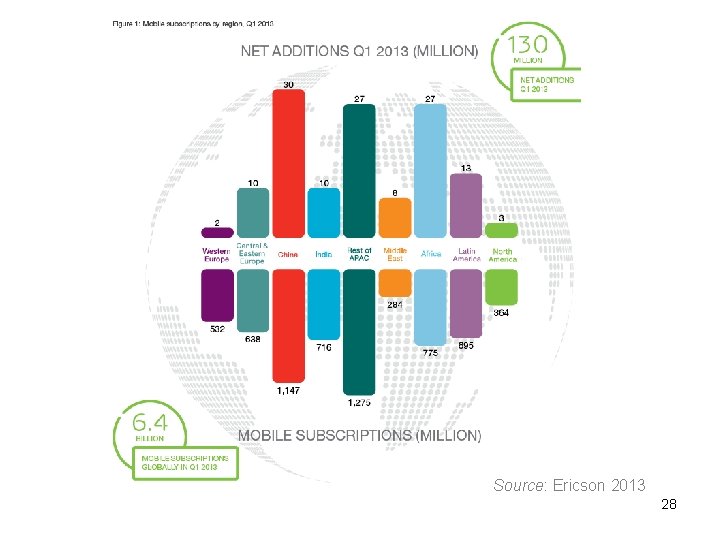
Source: Ericson 2013 28
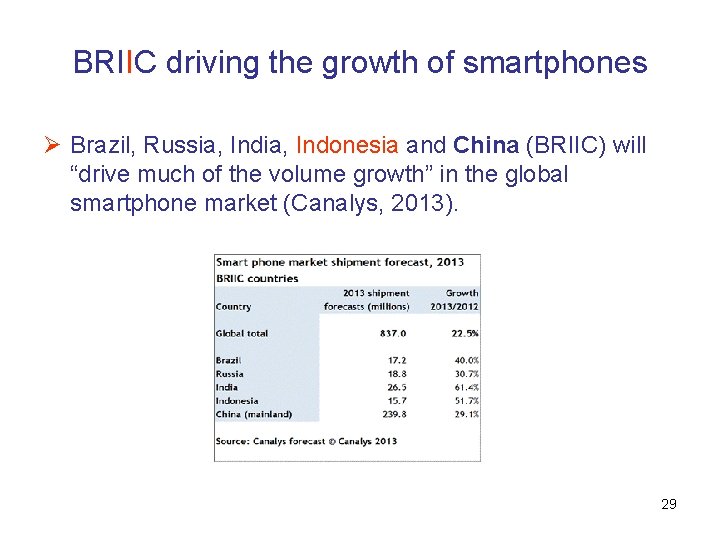
BRIIC driving the growth of smartphones Ø Brazil, Russia, Indonesia and China (BRIIC) will “drive much of the volume growth” in the global smartphone market (Canalys, 2013). 29
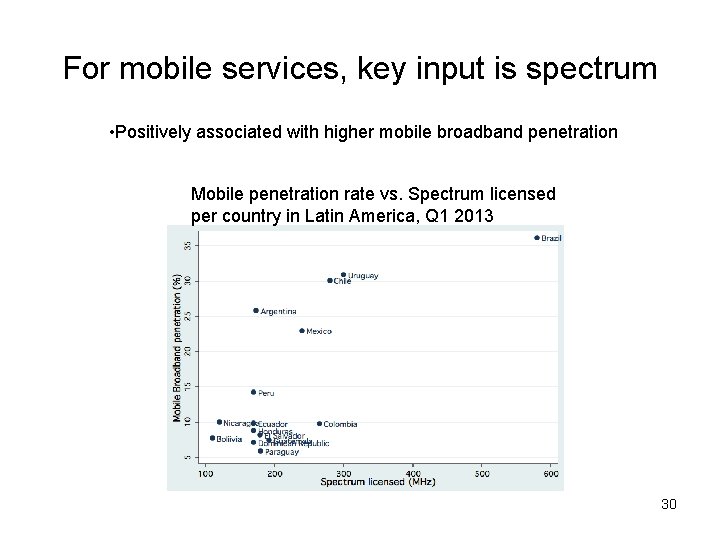
For mobile services, key input is spectrum • Positively associated with higher mobile broadband penetration Mobile penetration rate vs. Spectrum licensed per country in Latin America, Q 1 2013 30
2013 Mexican Constitutional Amendments Institutional Transformation (Cofetel to Ifetel): • Regulatory agency was transformed into a Constitutionally Autonomous Entity • Convergent mission: Telecom & Broadcasting • Commissioners had to comply with numerous prerequisites: including no association with private ICT firms in the past 3 years, knowledge of the sector that was evaluated through a rigorous exam. Initial pool of 400 applicants • Congress selected 7 Commissioners that were proposed by the Executive 31
Theme When it comes to national strategies for the promotion of mobile communications One size DOES NOT fit all 32
Expectations from mobile broadband (Not required) • Connectivity: – access to information, communications, commerce, entertainment, etc. – benefits of broadband access should not be limited just to fixed locations • Convenience: – ubiquitous access from and on device(s) of choice, seamless ‘roaming’ from fixed to mobile and back again 33
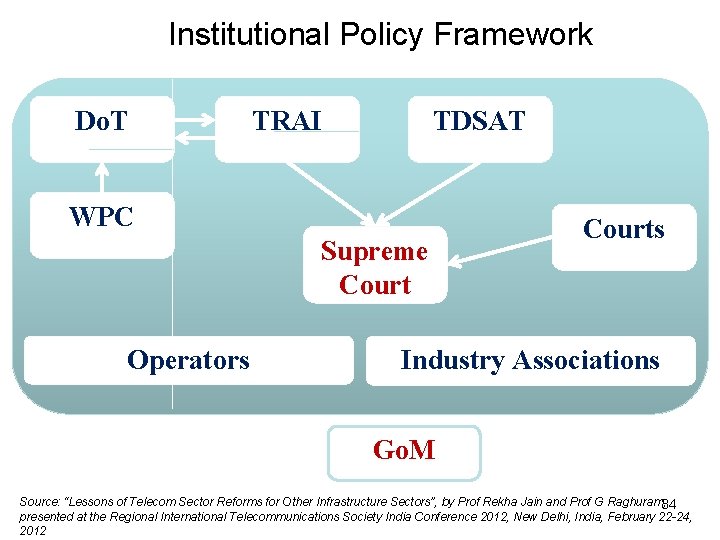
Institutional Policy Framework Do. T TRAI TDSAT WPC Supreme Court Operators Courts Industry Associations Go. M Source: “Lessons of Telecom Sector Reforms for Other Infrastructure Sectors”, by Prof Rekha Jain and Prof G Raghuram, 34 presented at the Regional International Telecommunications Society India Conference 2012, New Delhi, India, February 22 -24, 2012
The Licensing Framework • The government categorized its existing 22 administrative units, called circles, into metros (Chennai, Delhi, Mumbai and Kolkata), A, B, or C. • Auctions in 900 MHz, 1800 MHz provided for start-up spectrum of 2 x 4. 4 MHz and 2*6. 2 MHz • (we do not require this) Additional spectrum on FCFS (First Come First Served) basis – SLC – SUC (was earlier based on amount of spectrum + technology) (GSM Vs. CDMA operators) 35
Current Spectrum Management • (we do not require this) WPC, Do. T set policies • (we do not require this) Bandwidth allocation through Auctions (Start up + more), which realize substantial revenues. • Recently completed 900 Mhz and 1800 Mhz auctions for spectrum that would come up on expiry of the license period – Options included: • Hold back some • Put all in the pool • Continue status quo. • Yielded bids totaling over INR 61, 000 crores. • SUC (Spectrum Usage Charge) – Guidelines, including proposed 5% SUC on gross revenues for use of new spectrum. 36
Newer Instruments for Spectrum Allocation • (we do not require this) Re-farming the 900 MHz band after license expiry. Options include: – Hold back some – Put all in the pool – Continue status quo. • (This should come as the way forward) Trading and Other Market Mechanisms – To create a secondary market in spectrum availability for operators who are not the primary licensees. 37
Newer Frequency Bands • 800 MHz…? • 700 MHz…? • TVWS – VHF range in We do not require this Band I (41 – 68 MHz) and We do not require this Band III (174 – 230 MHz) We do not require this – (12 channels). – UHF range in We do not require this Band IV (470 – 582 MHz), Band V (585 – 806 MHz) – We do not require this (49 channels). – Only 10% of the TV spectrum in the 500 -600 MHz range is occupied in India. 38
Provision of mobile broadband • Convergence: – services, even voice, moving to IP (Skype, Viber…) – mobile data will become more important than voice services, demand for data only options • Licensed and license-exempt services • Choice in business models – multiple providers 39
The EU and Mobile Broadband Ø The EU single Market proposals Ø Harmonizing spectrum for mobile broadband a difficult case Ø Roaming and broadband Ø Quick conclusion 40
The Single Market proposals Ø EC DG Connect is preparing a “Regulation to complete the European single market for electronic communications” § Formal draft regulation is expected in September 2013. Ø So as to stimulate the provision of cross-border European services, § by requiring a single European authorisation (EU passport), § mandating a standard EU wholesale broadband access product, § and harmonising spectrum authorisation procedures. Ø To enhance the protection of consumers § by strengthening transparency requirements, § cutting back mobile roaming charges, § and introducing a form of net neutrality. Ø The draft regulation would § expand regulation to hitherto unregulated markets (international calls), § increase Commission oversight on national spectrum management. 41
Spectrum: the 2013 EU Action plan Ø Commission ‘action plan on wireless communications for a connected Europe’: possibly October 2013. Ø Neelie Kroes, commissioner for the Digital Agenda, said the 27 EU states needed to align their approach on mobile spectrum and fibre broadband, creating a genuine single market (Barcelona’s Global Mobile Congress on 26 February). § Kroes described Europe’s poor efforts to release broadband spectrum as resembling “a bowl of spaghetti”. Ø Brussels' ambitious plan to usher in a single market for telecoms is designed to harmonize spectrum policy. Ø A move member states are likely to resist. § Spectrum is often classified by member states as a matter of national security, and therefore off-limits to the EU executive, § Despite member states agreeing to a January 1, 2013 deadline for assigning the 800 MHz spectrum so far only 11 member states have done so. 42
Roaming: Towards a roaming-free Europe by 2015? Ø On May 30, 2013, Neelie Kroes, commissioner for the Digital Agenda, called for the adoption of measures, by April 2014, to end international mobile roaming charges. Ø The EC plans to cut back mobile roaming charges drastically. Ø The draft regulations propose to reduce § wholesale caps by about 40 per cent for voice calls (to about € 0. 03 per minute), § and 70 per cent for data (to € 0. 015 per megabyte). Ø The European Parliament’s Industry, Research and Energy committee unanimously adopted a resolution on July 9, 2013 calling for roaming charges inside the EU to be abolished by 2015. 43
Roaming: tough measures/ hot debates Ø Commissioner Kroes’ hardline approach on EU roaming is triggering strong reactions from the industry Ø Operators raise alarm that: § a dramatic lowering of wholesale rates could heat up competition: open up an enormous arbitrage opportunity for opportunistic wholesalers ü Up to £ 7 billion a year, according to one telecoms executive § and hinder network investment much to the detriment of the deployment of mobile broadband. Ø The EU digital commissioner claims there is no truth in the argument that network investment will suffer as a result of her proposed cuts. 44
Focus Questions (I) • What are the most important national/regional conditions and factors affecting the design and implementation of fixed (wireline and wireless) and mobile broadband policies in your country/region? • Does your country/region have an explicit Broadband Strategy at the national and/or regional levels? – If yes, what is the scale ($$, Targets), scope (Demand side initiatives as well as Supply side ones) and duration (short, medium or long term)? – What are the roles of the government and the private sector, with respect to funding and implementation? 45
- Slides: 45