
MOBILE COMMUNICATION SYSTEMS 2 SIMPLIFIED 3 GPP WLAN
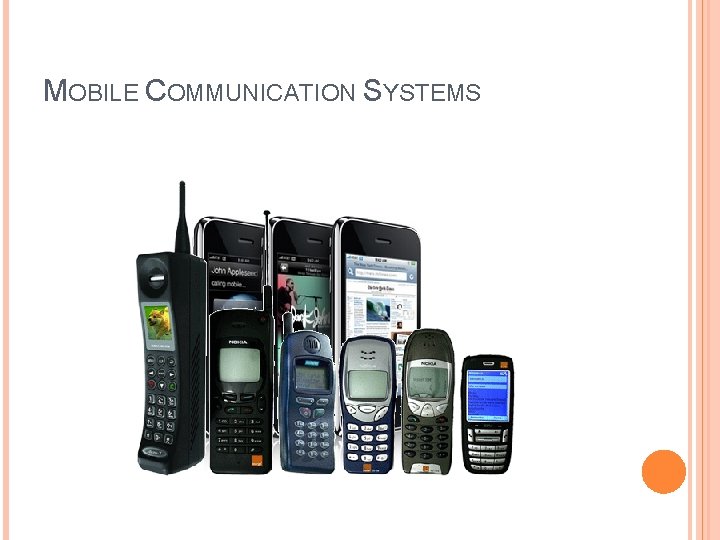
MOBILE COMMUNICATION SYSTEMS
2
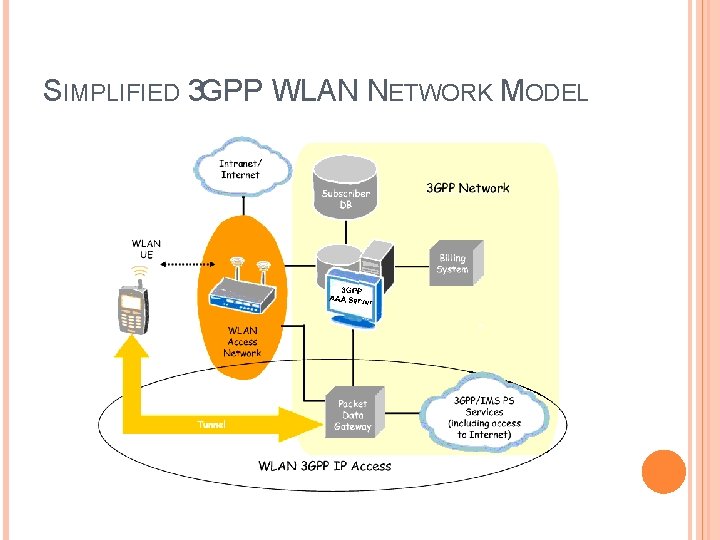
SIMPLIFIED 3 GPP WLAN NETWORK MODEL
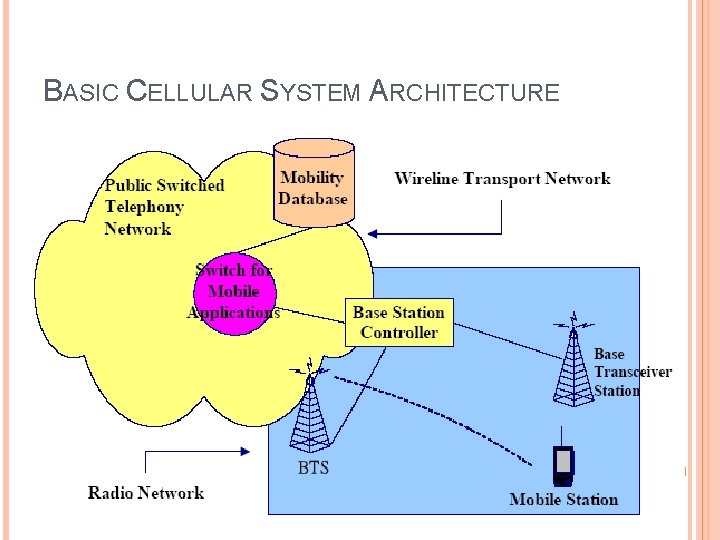
BASIC CELLULAR SYSTEM ARCHITECTURE
MOBILE COMMUNICATION SYSTEMS Low tier wireless systems High tier cellular telephony
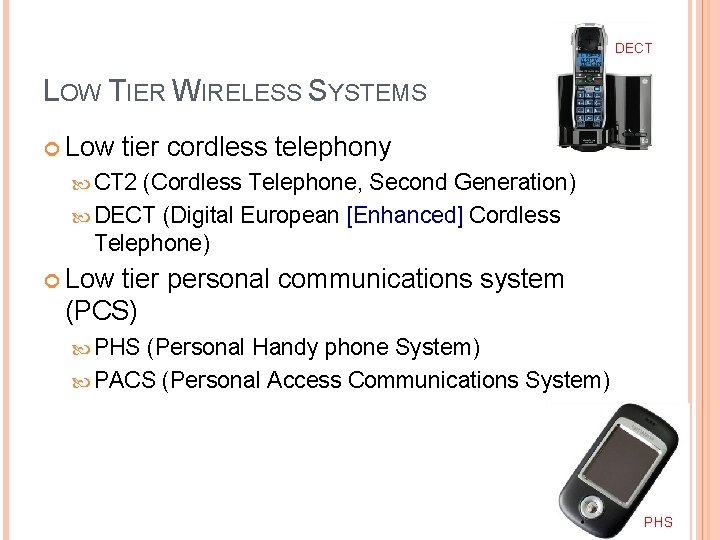
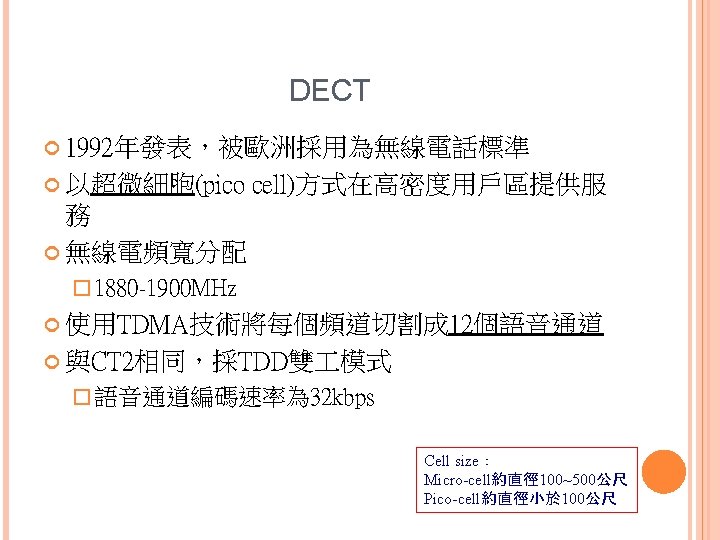
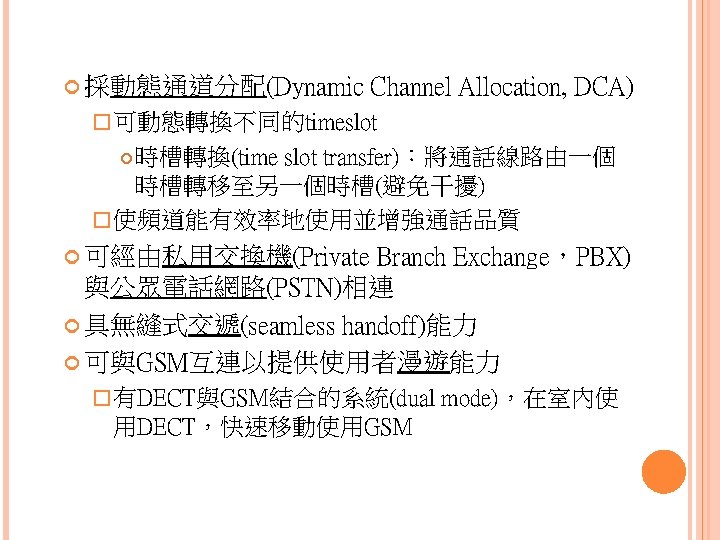
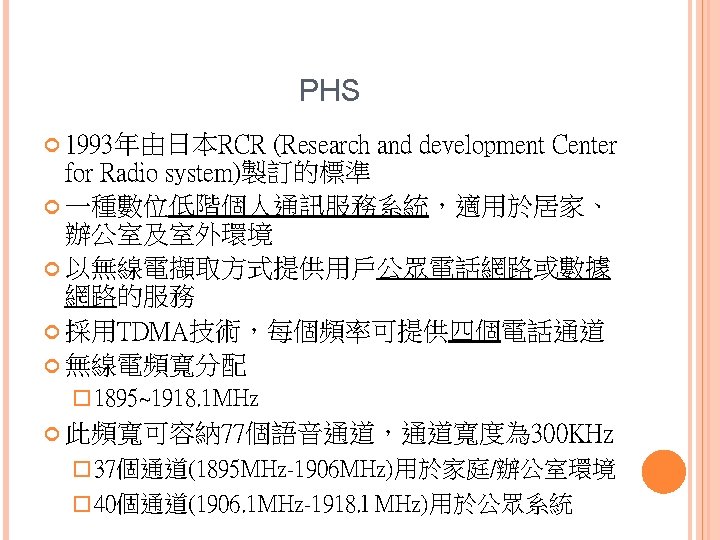
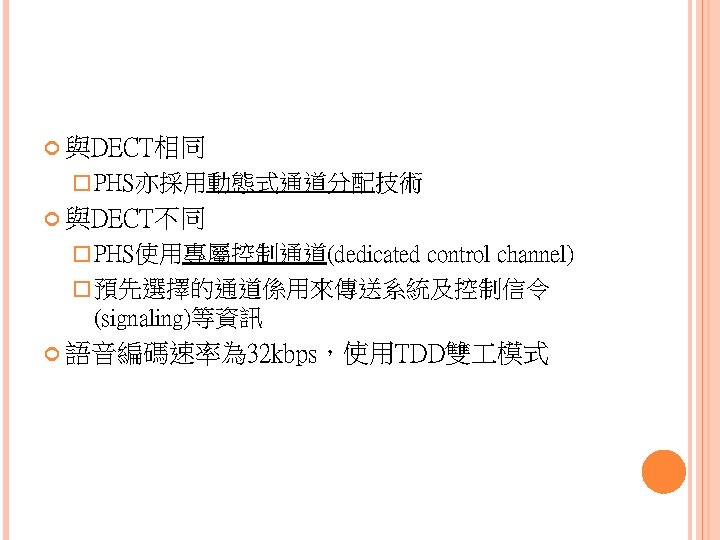
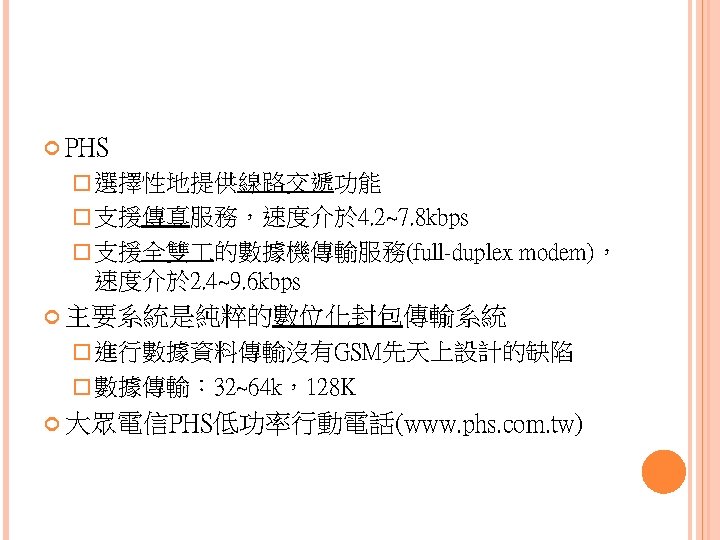
DECT LOW TIER WIRELESS SYSTEMS Low tier cordless telephony CT 2 (Cordless Telephone, Second Generation) DECT (Digital European [Enhanced] Cordless Telephone) Low tier personal communications system (PCS) PHS (Personal Handy phone System) PACS (Personal Access Communications System) PHS
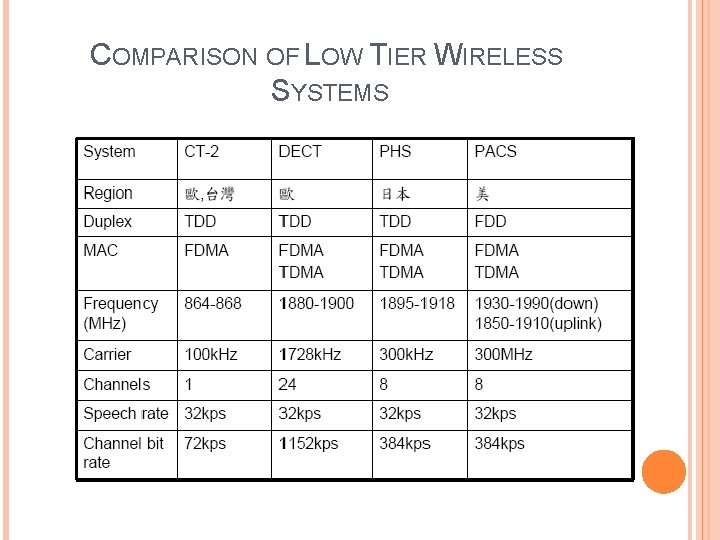
COMPARISON OF LOW TIER WIRELESS SYSTEMS
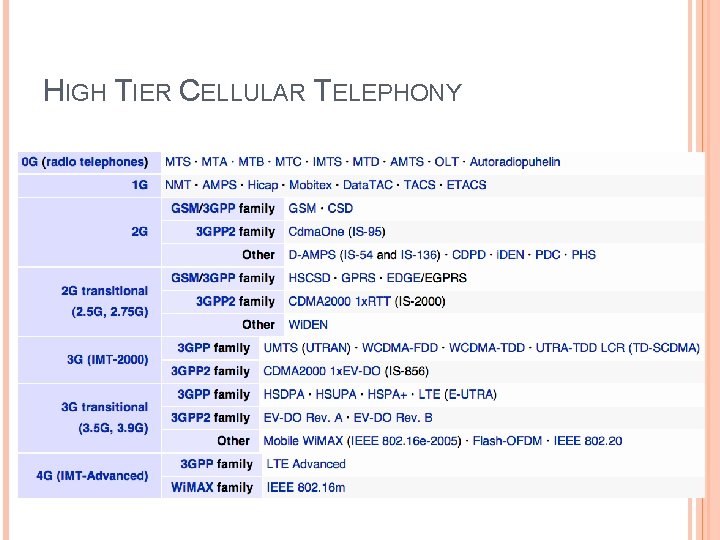
HIGH TIER CELLULAR TELEPHONY
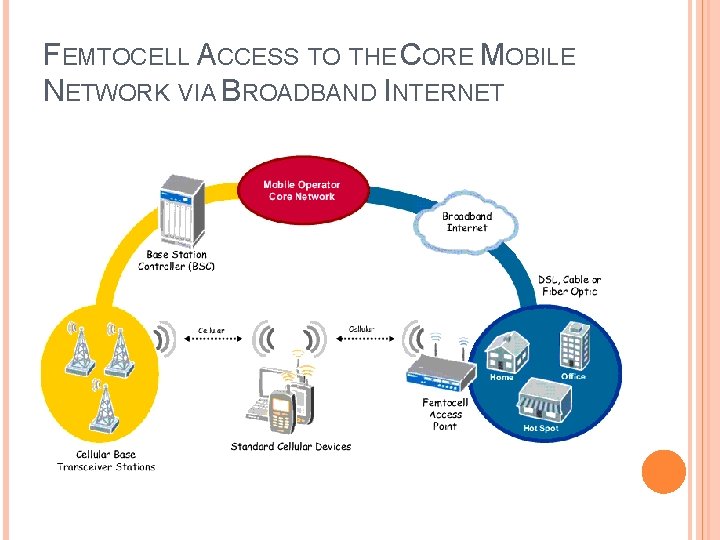
FEMTOCELL ACCESS TO THE CORE MOBILE NETWORK VIA BROADBAND INTERNET
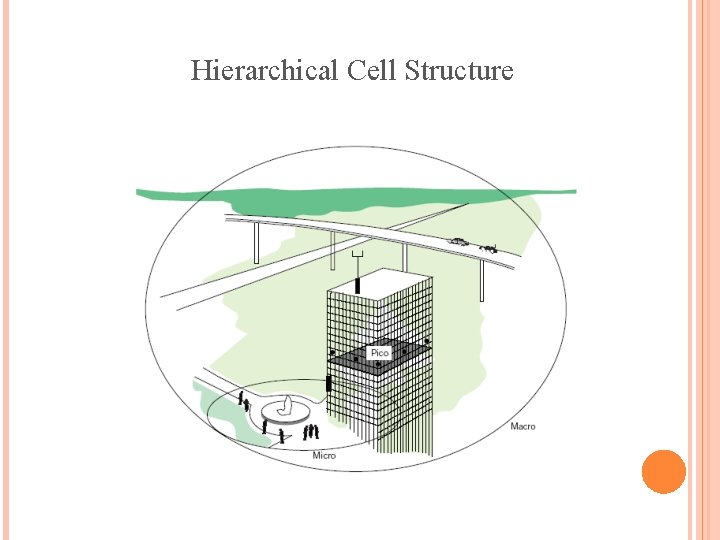
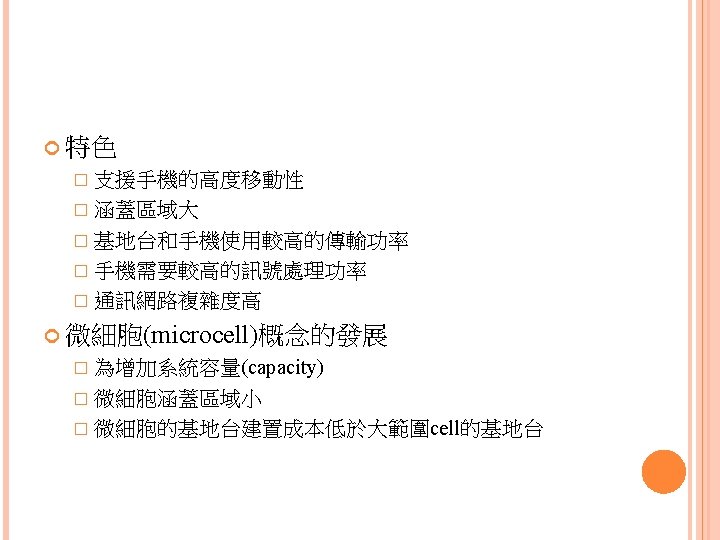
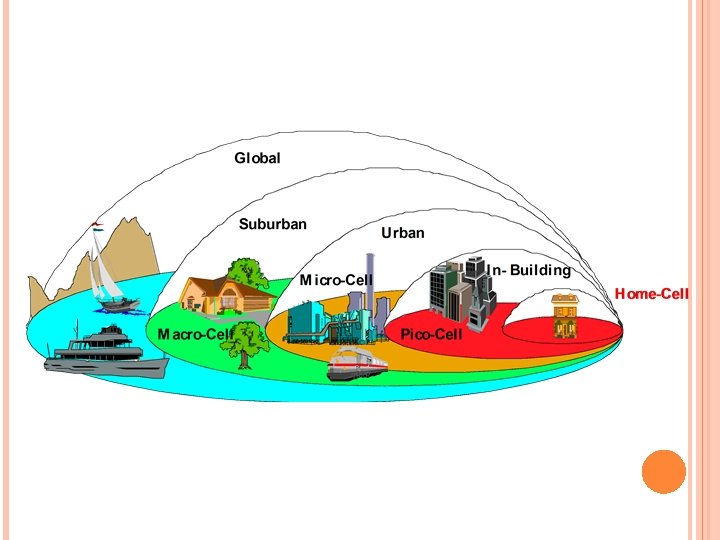
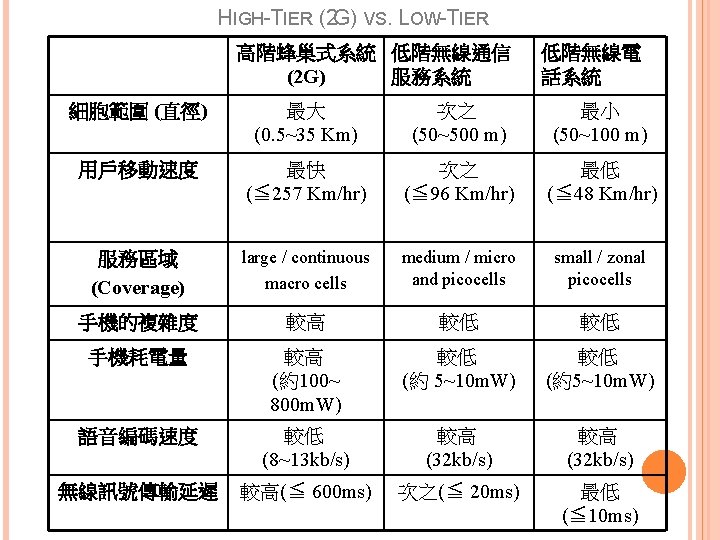
Hierarchical Cell Structure
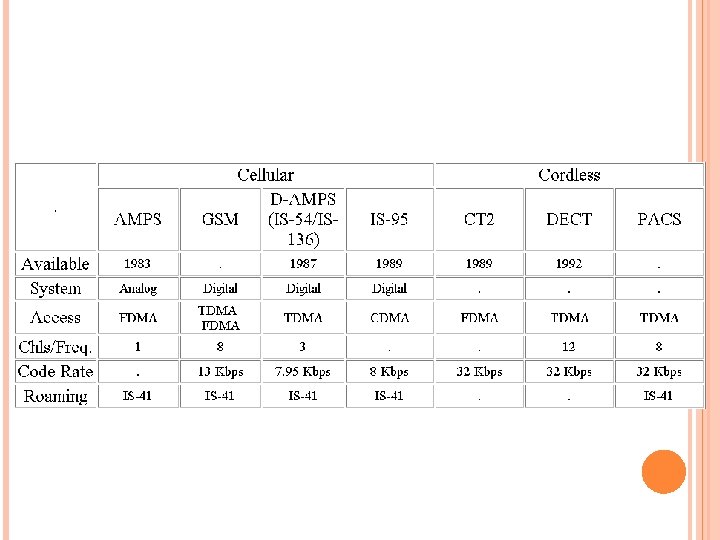
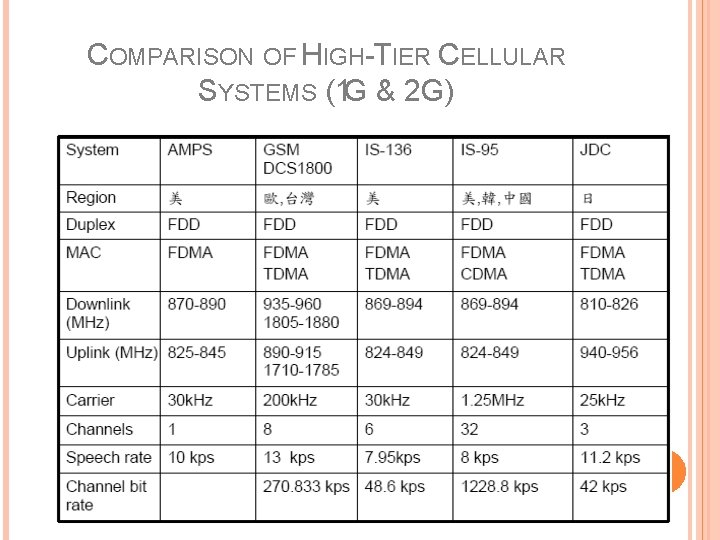
COMPARISON OF HIGH-TIER CELLULAR SYSTEMS (1 G & 2 G)
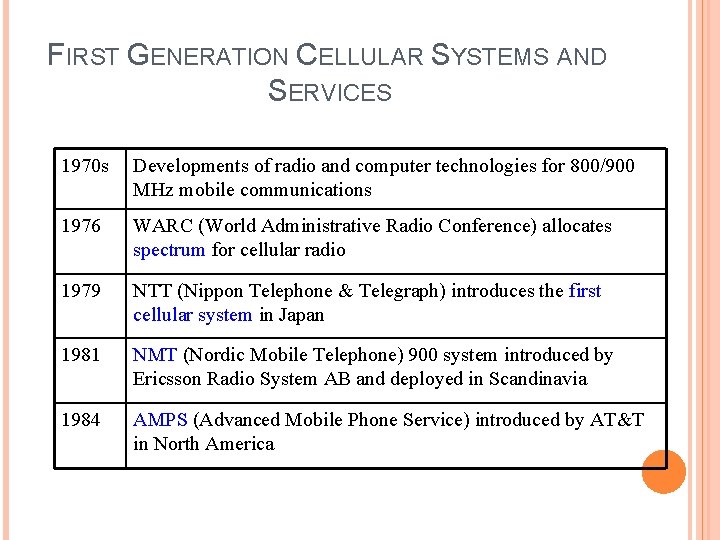
FIRST GENERATION CELLULAR SYSTEMS AND SERVICES 1970 s Developments of radio and computer technologies for 800/900 MHz mobile communications 1976 WARC (World Administrative Radio Conference) allocates spectrum for cellular radio 1979 NTT (Nippon Telephone & Telegraph) introduces the first cellular system in Japan 1981 NMT (Nordic Mobile Telephone) 900 system introduced by Ericsson Radio System AB and deployed in Scandinavia 1984 AMPS (Advanced Mobile Phone Service) introduced by AT&T in North America
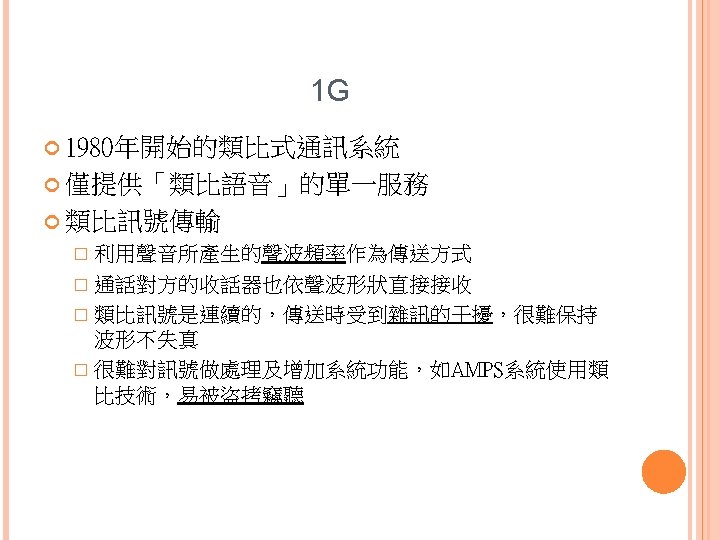
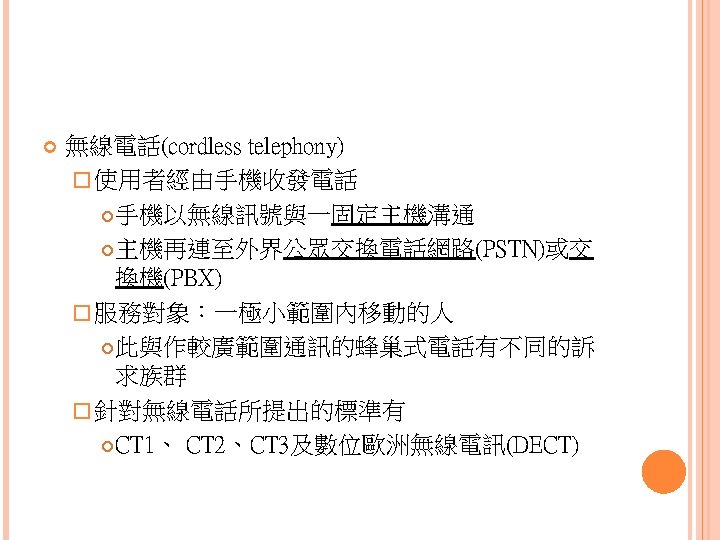
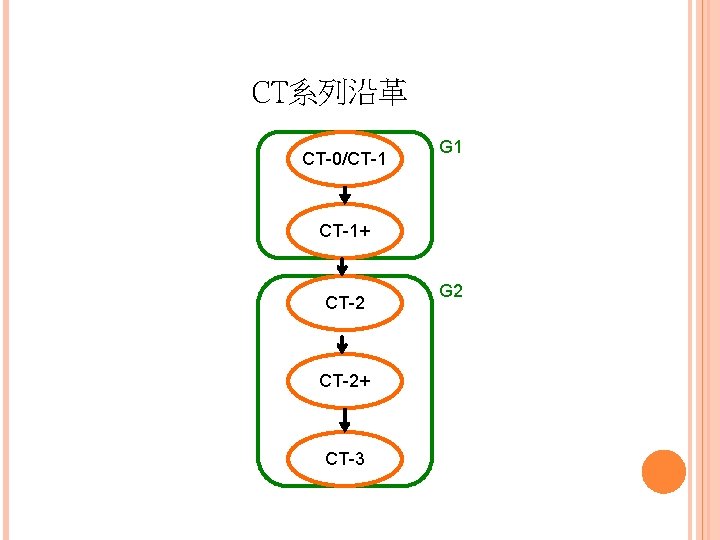
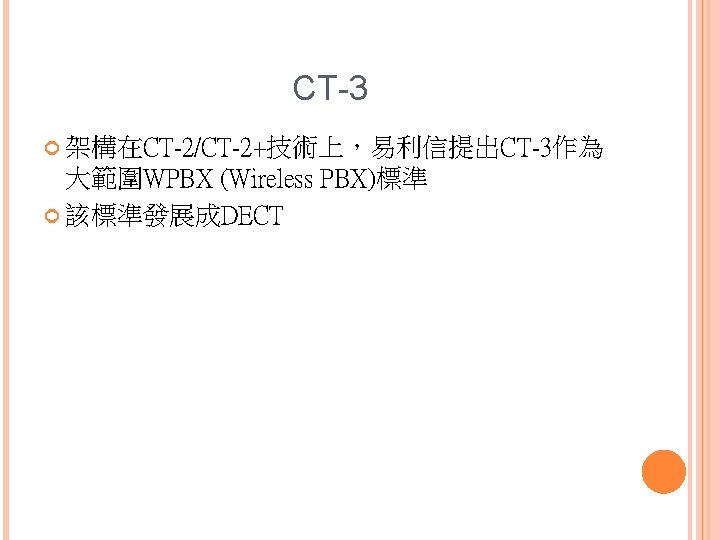
CT系列沿革 CT-0/CT-1 G 1 CT-1+ CT-2+ CT-3 G 2
CT-1 CEPT (Conference Europeenne des Postes et Telecommunications,歐洲郵電會議)對於高要求而 發展 900 MHz analog FM CT-1 使用FDMA/FDD技術 適於家用場合
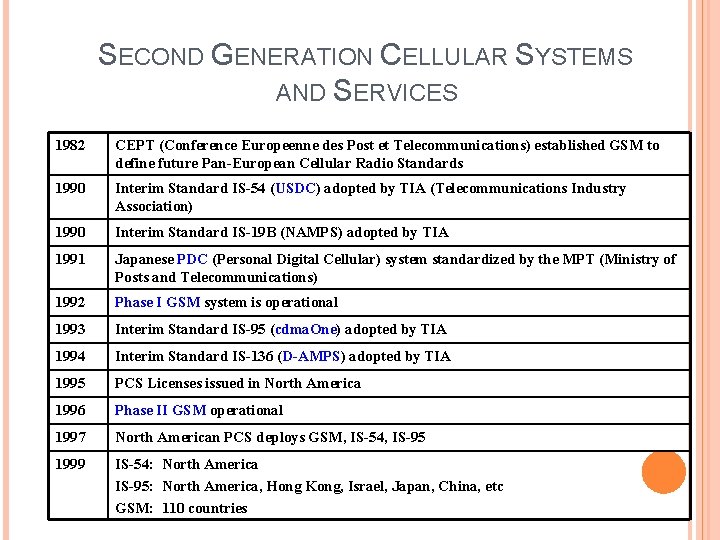
SECOND GENERATION CELLULAR SYSTEMS AND SERVICES 1982 CEPT (Conference Europeenne des Post et Telecommunications) established GSM to define future Pan-European Cellular Radio Standards 1990 Interim Standard IS-54 (USDC) adopted by TIA (Telecommunications Industry Association) 1990 Interim Standard IS-19 B (NAMPS) adopted by TIA 1991 Japanese PDC (Personal Digital Cellular) system standardized by the MPT (Ministry of Posts and Telecommunications) 1992 Phase I GSM system is operational 1993 Interim Standard IS-95 (cdma. One) adopted by TIA 1994 Interim Standard IS-136 (D-AMPS) adopted by TIA 1995 PCS Licenses issued in North America 1996 Phase II GSM operational 1997 North American PCS deploys GSM, IS-54, IS-95 1999 IS-54: North America IS-95: North America, Hong Kong, Israel, Japan, China, etc GSM: 110 countries
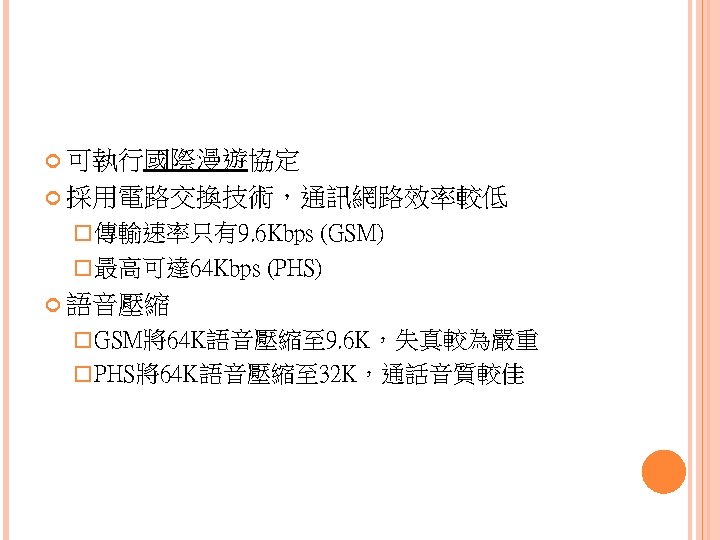
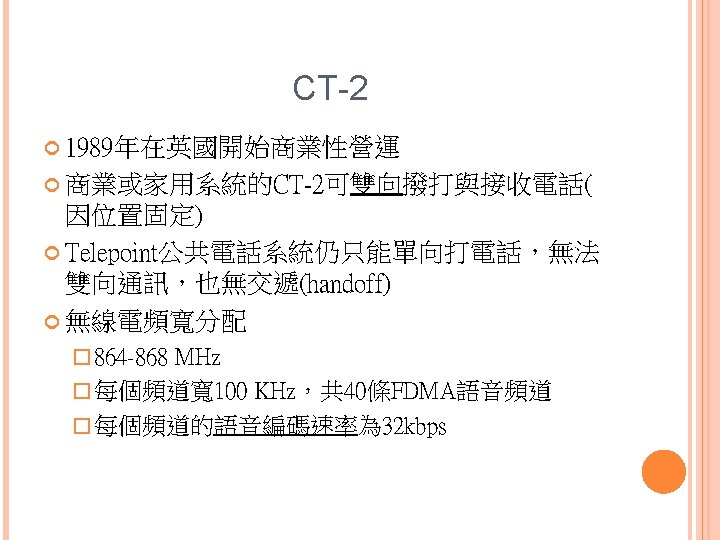
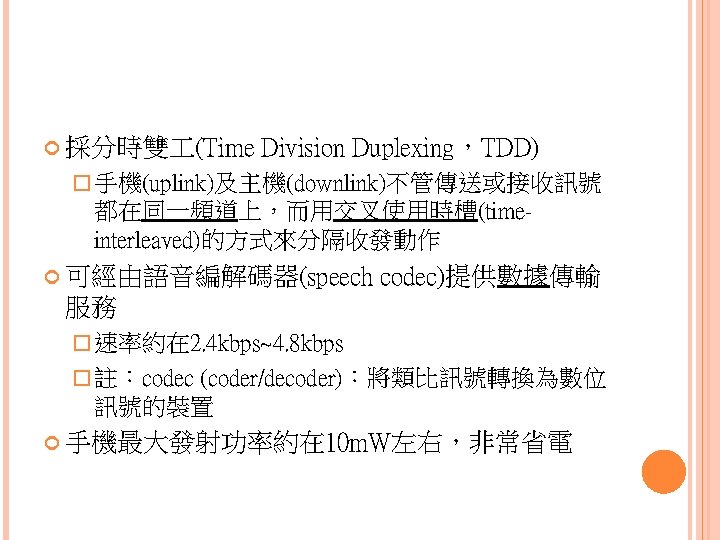
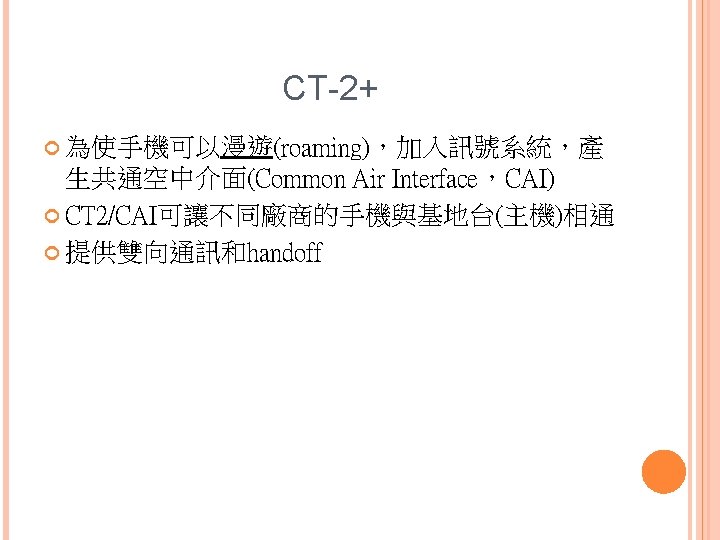
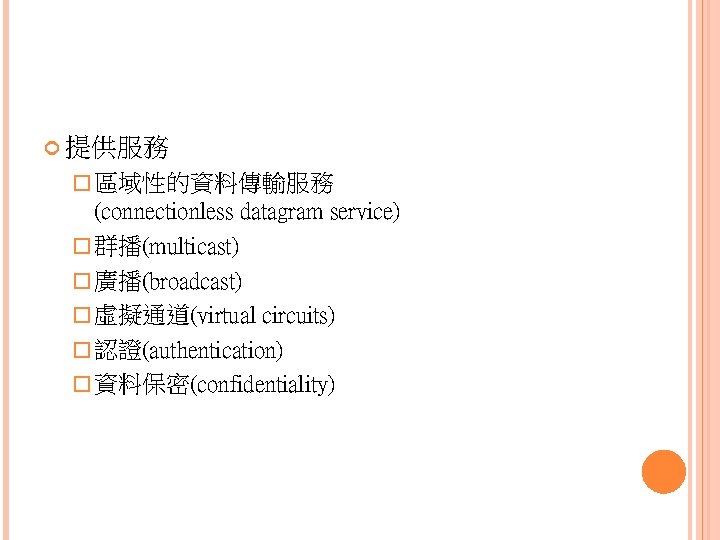
提供服務 � 區域性的資料傳輸服務 (connectionless datagram service) � 群播(multicast) � 廣播(broadcast) � 虛擬通道(virtual circuits) � 認證(authentication) � 資料保密(confidentiality)
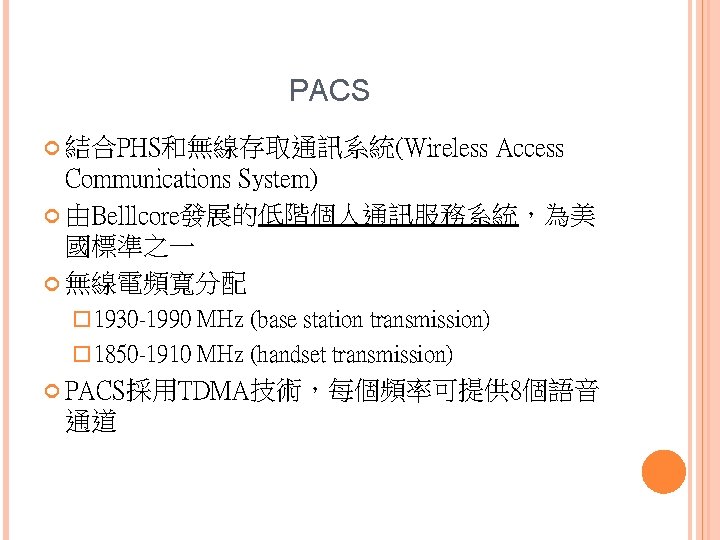
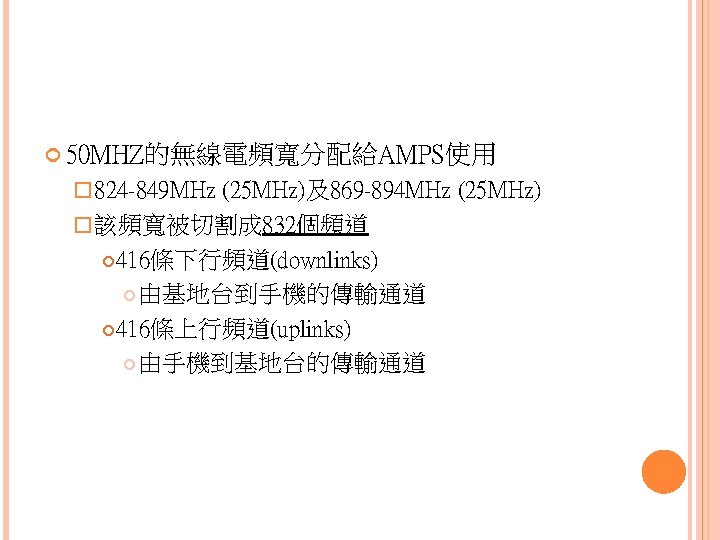
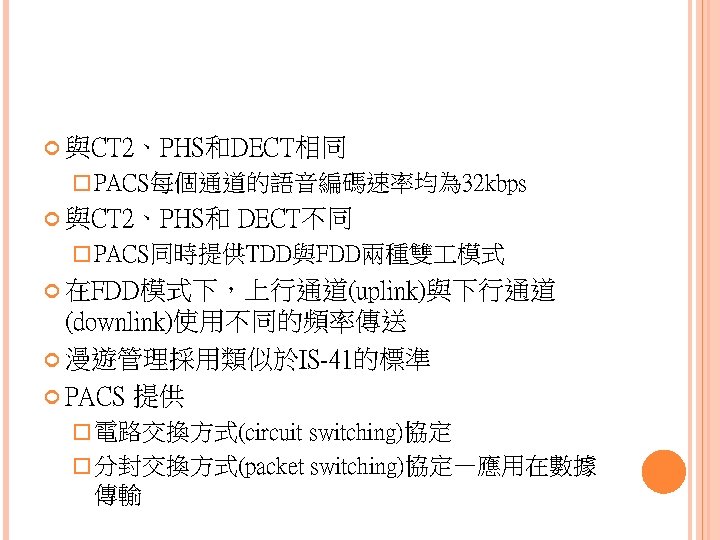
PACS 結合PHS和無線存取通訊系統(Wireless Access Communications System) 由Belllcore發展的低階個人通訊服務系統,為美 國標準之一 無線電頻寬分配 � 1930 -1990 MHz (base station transmission) � 1850 -1910 MHz (handset transmission) PACS採用TDMA技術,每個頻率可提供 8個語音 通道
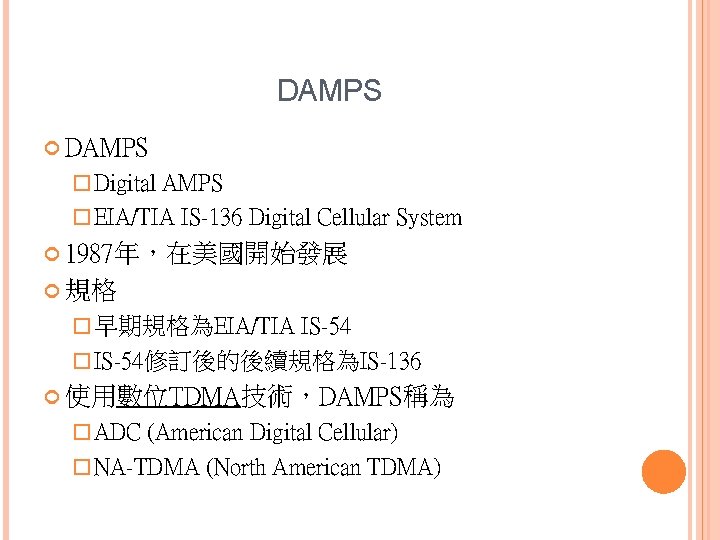
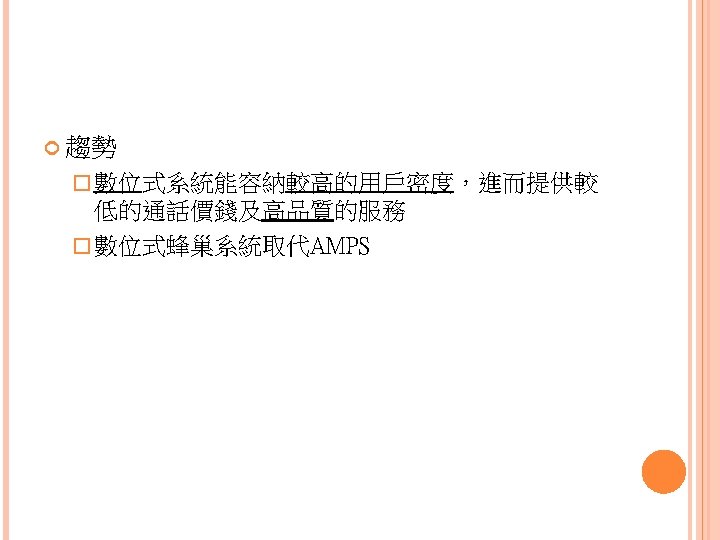
DAMPS � Digital AMPS � EIA/TIA IS-136 Digital Cellular System 1987年,在美國開始發展 規格 � 早期規格為EIA/TIA IS-54 � IS-54修訂後的後續規格為IS-136 使用數位TDMA技術,DAMPS稱為 � ADC (American Digital Cellular) � NA-TDMA (North American TDMA)
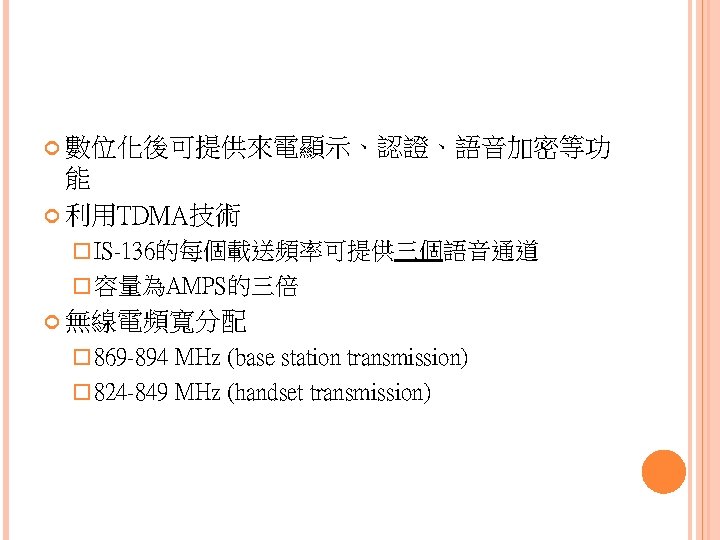
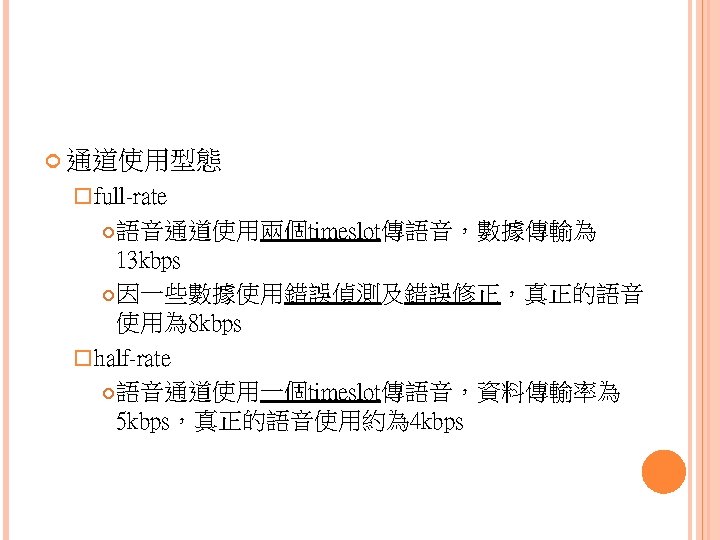
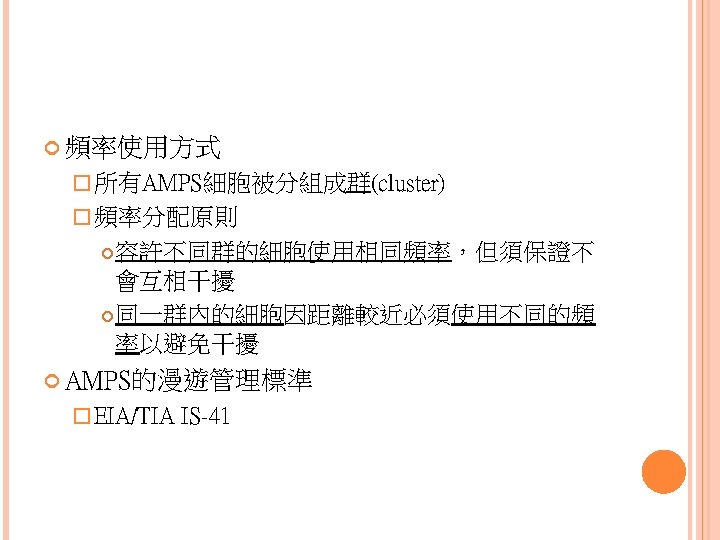
IS-136使用與AMPS相同的頻段 IS-136的其它特性 � 點對點的短訊服務(point-to-point � 廣播訊息(broadcast short messaging) � 群組定址(group addressing) � 私人用戶群(private user group) � 階層式細胞架構(hierarchical cell structure)
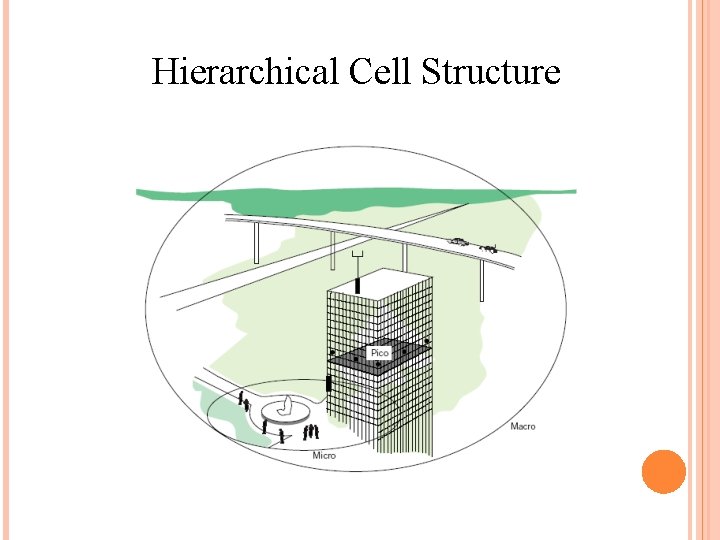
Hierarchical Cell Structure
IS-95之core network漫遊管理標準的演進 � cdma. One採用IS-41 → cdma 2000 採用IS-41+Simple IP → cdma 2000 1 x. EV(cdma MC FDD) 採用IS-41+Mobile IP
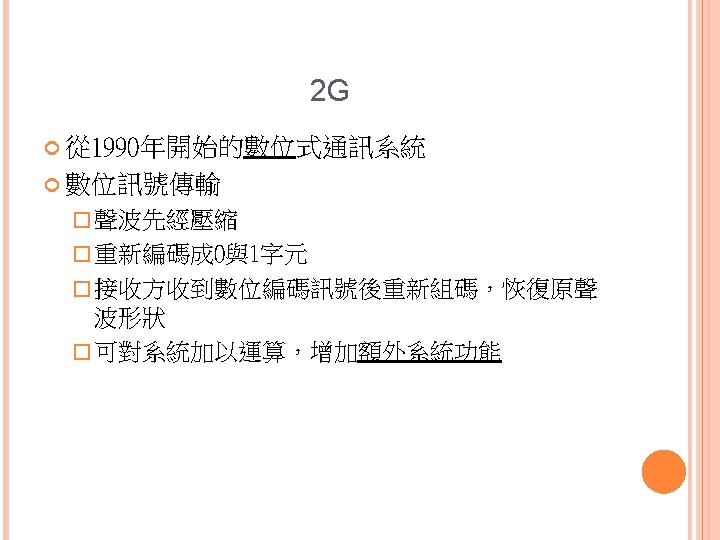
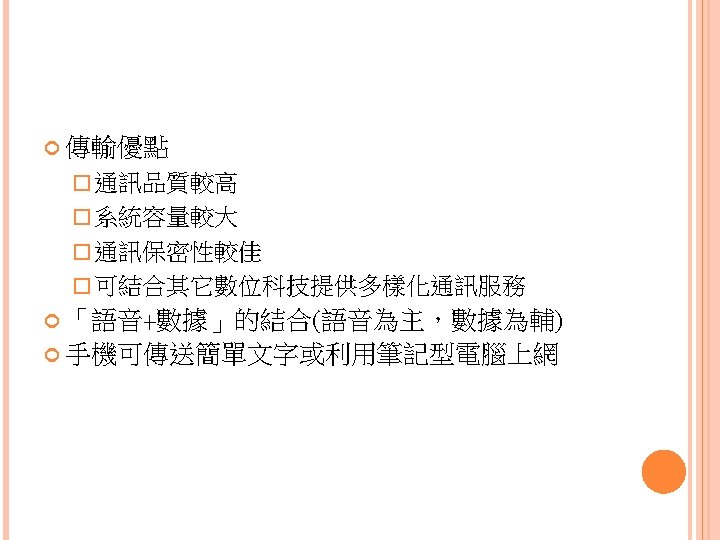
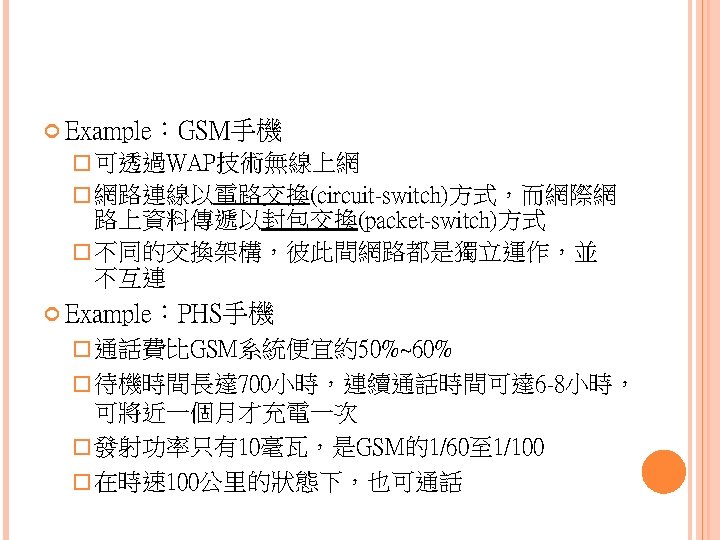
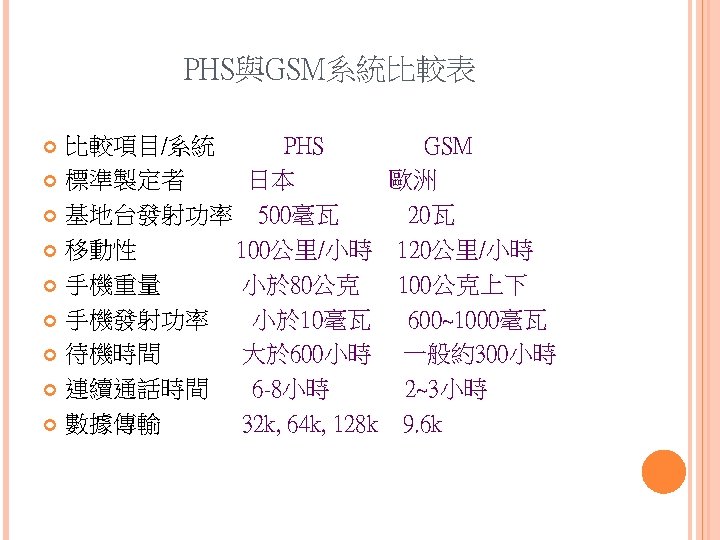
GSM (Global System for Mobile Communications) 數位蜂巢式行動電話系統 由歐洲郵政電信組織(Conference Europeenne des Postes et Telecommunications, CEPT)及其後繼者 歐洲電信標準協會(European Telecommunications Standard Institute, ETSI)於 1983年開始發展 目標:提供一套橫跨歐洲國家的相容性行動電話 服務
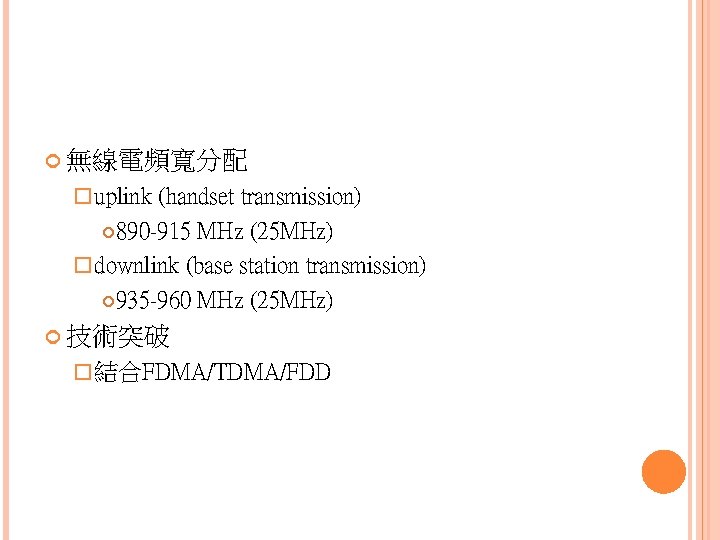
無線電頻寬分配 � uplink (handset transmission) 890 -915 MHz (25 MHz) � downlink (base station transmission) 935 -960 MHz (25 MHz) 技術突破 � 結合FDMA/TDMA/FDD
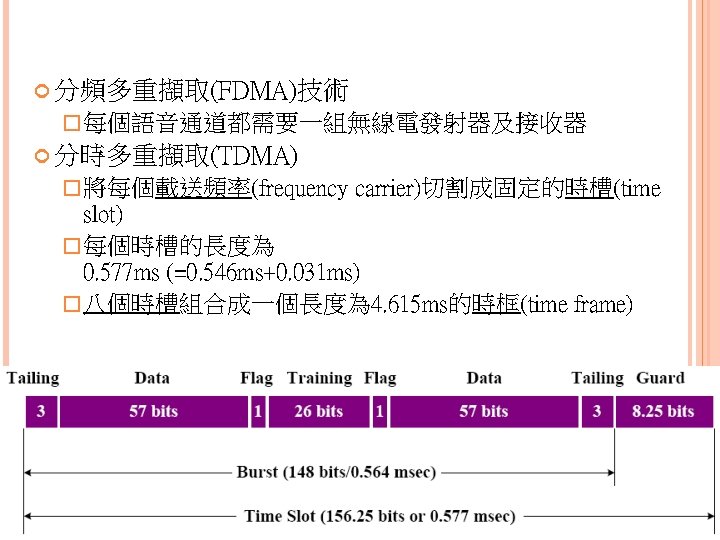
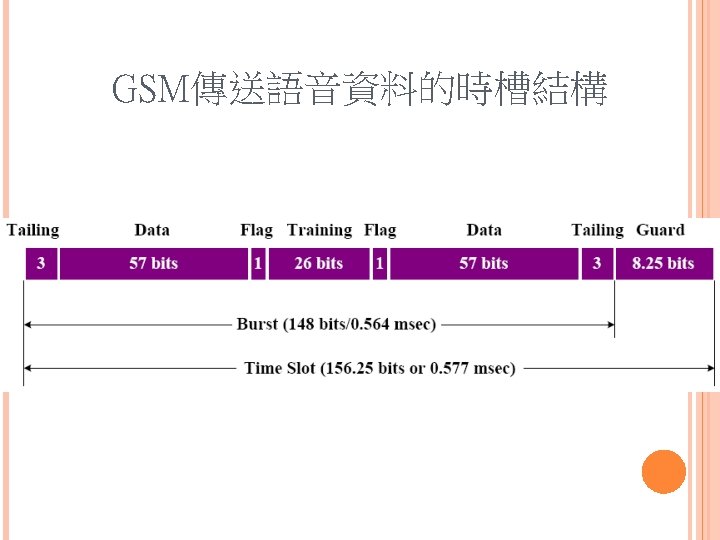
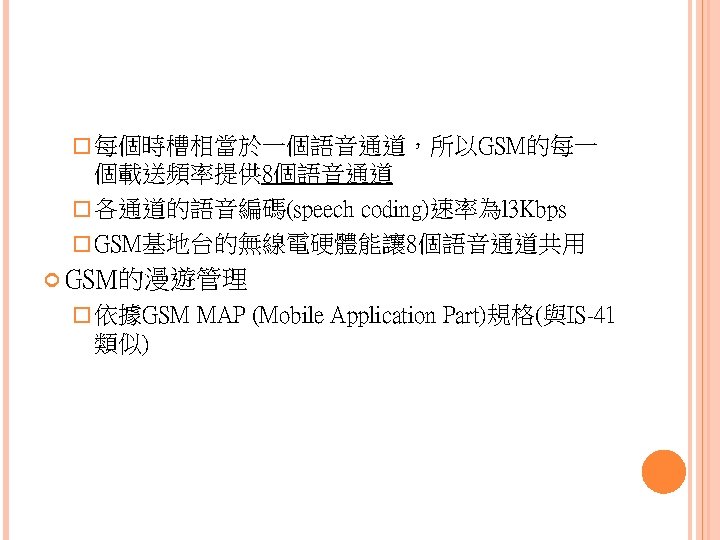
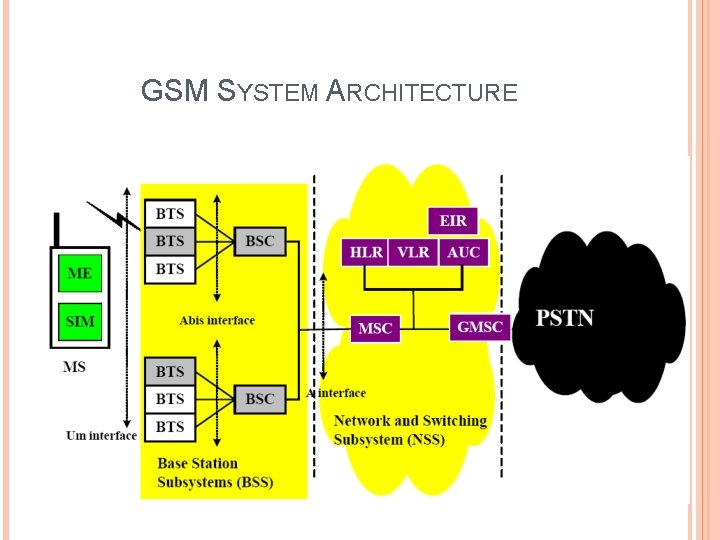
GSM SYSTEM ARCHITECTURE
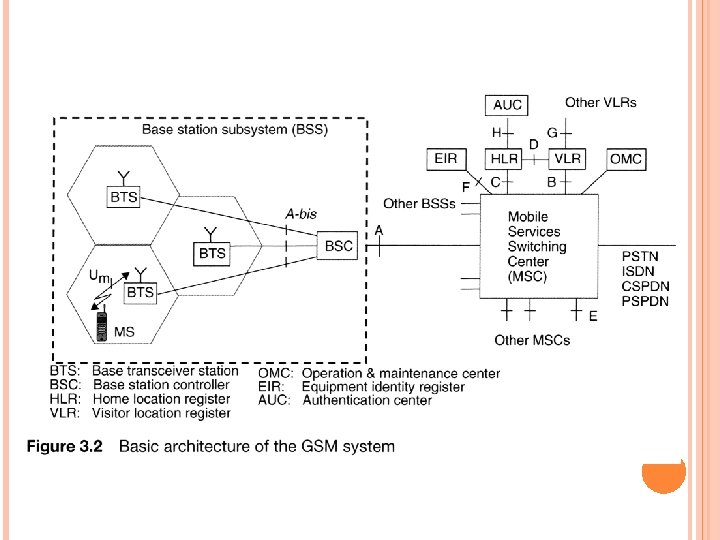
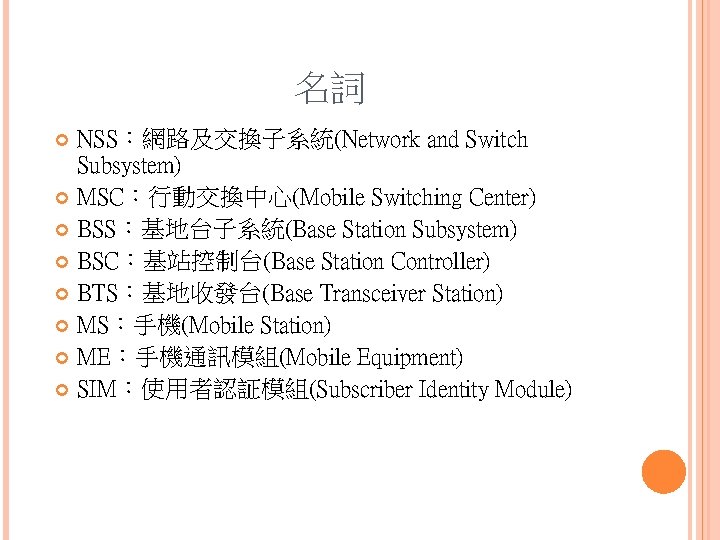
名詞 NSS:網路及交換子系統(Network and Switch Subsystem) MSC:行動交換中心(Mobile Switching Center) BSS:基地台子系統(Base Station Subsystem) BSC:基站控制台(Base Station Controller) BTS:基地收發台(Base Transceiver Station) MS:手機(Mobile Station) ME:手機通訊模組(Mobile Equipment) SIM:使用者認証模組(Subscriber Identity Module)
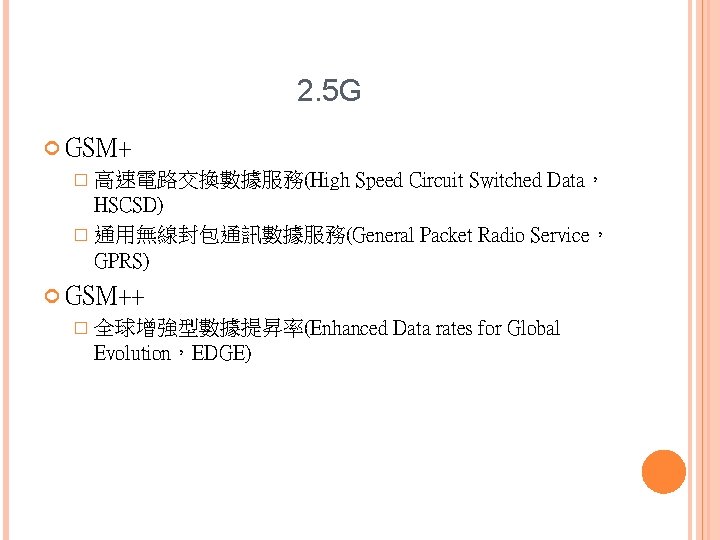
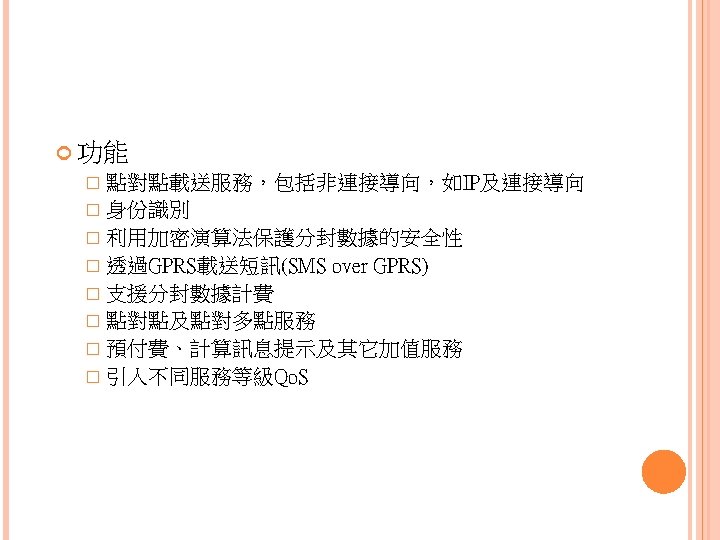
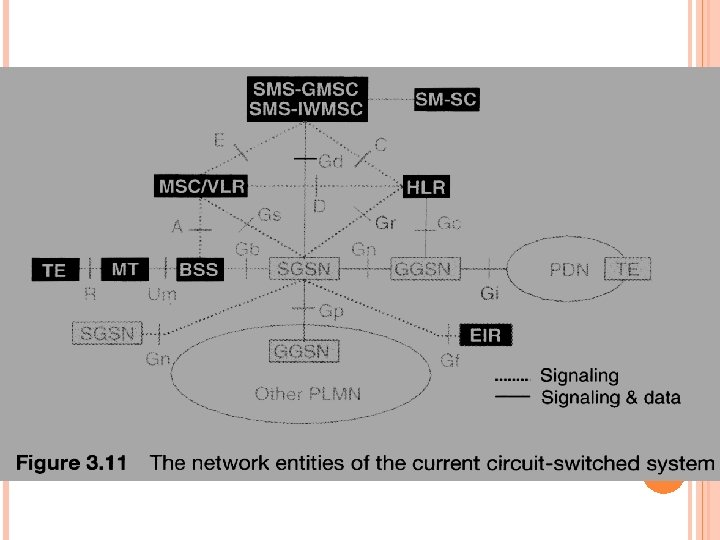
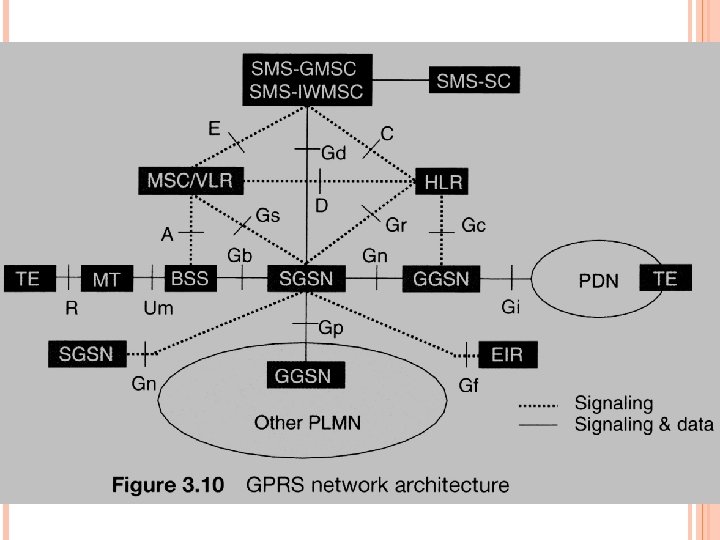
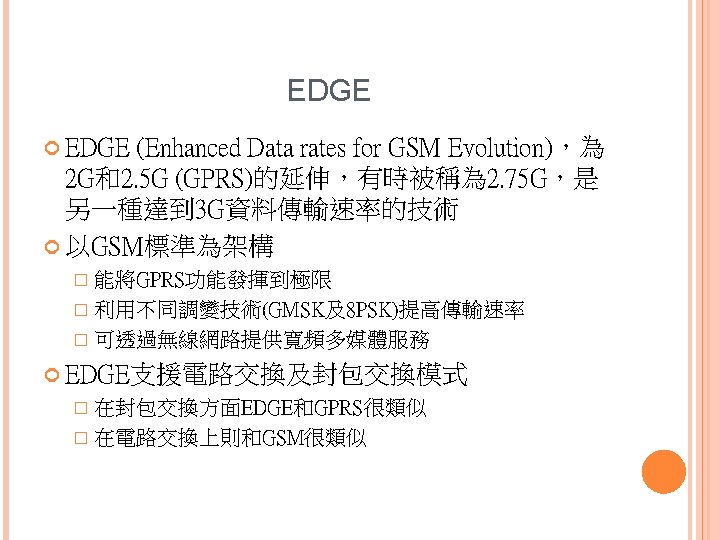
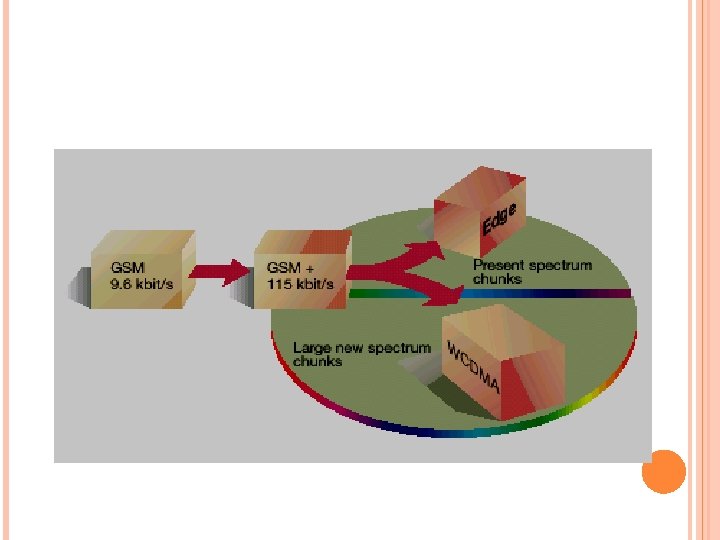
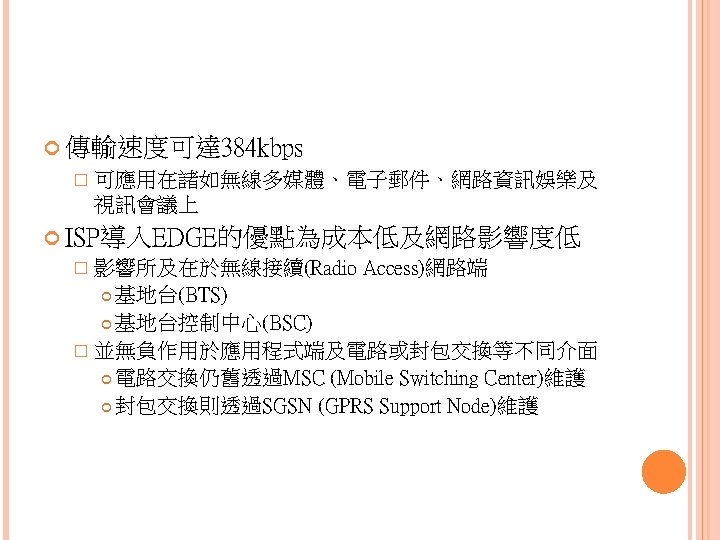
2. 5 G GSM+ � 高速電路交換數據服務(High Speed Circuit Switched Data, HSCSD) � 通用無線封包通訊數據服務(General Packet Radio Service, GPRS) GSM++ � 全球增強型數據提昇率(Enhanced Evolution,EDGE) Data rates for Global
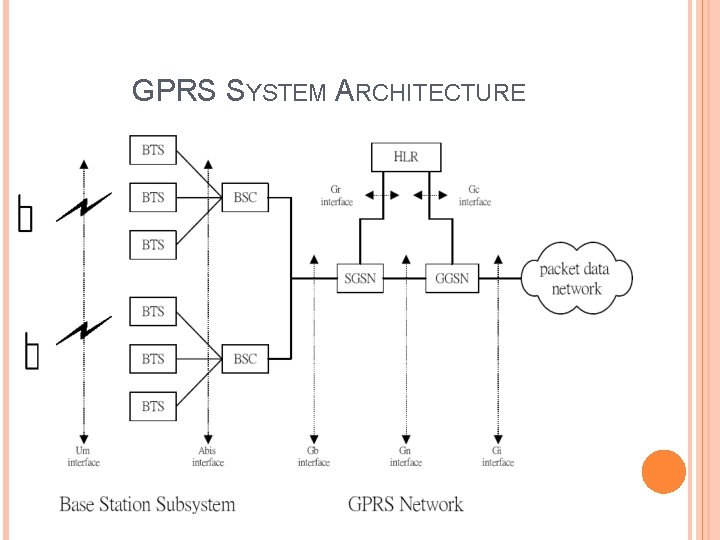
GPRS SYSTEM ARCHITECTURE
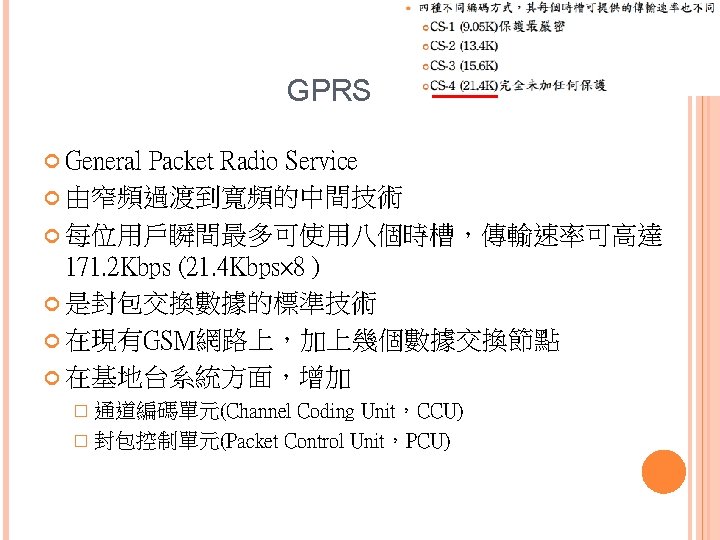
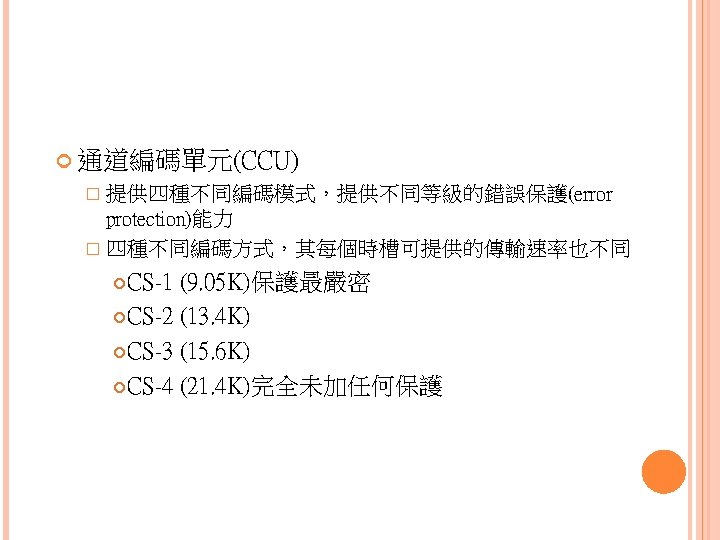
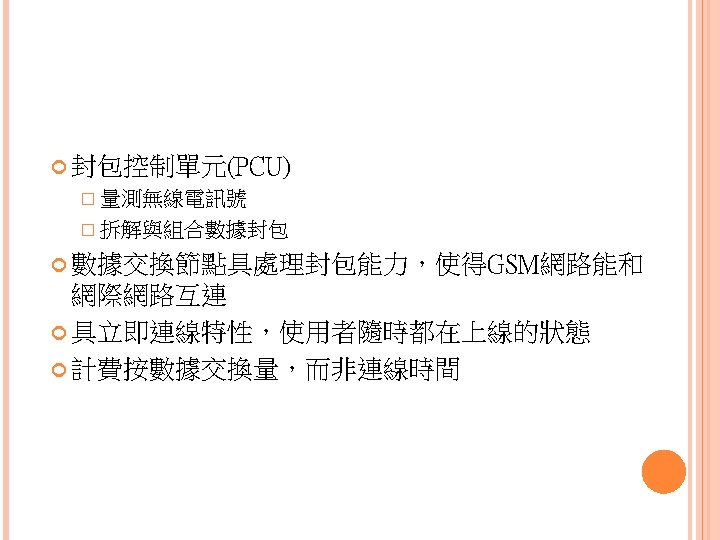
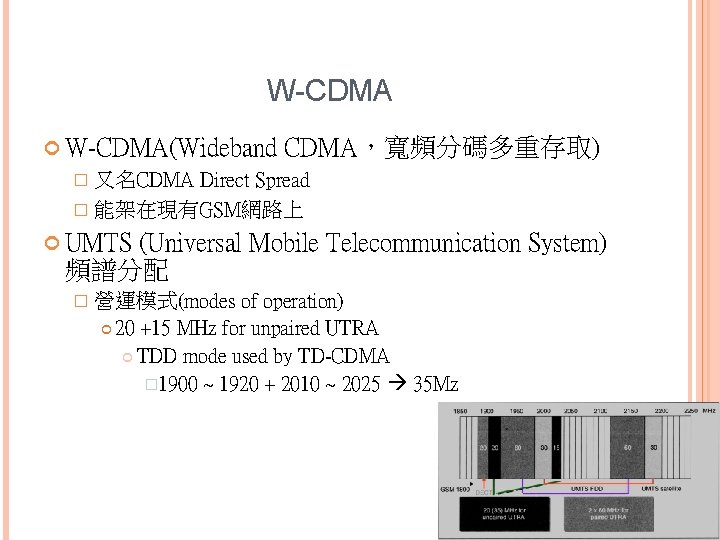
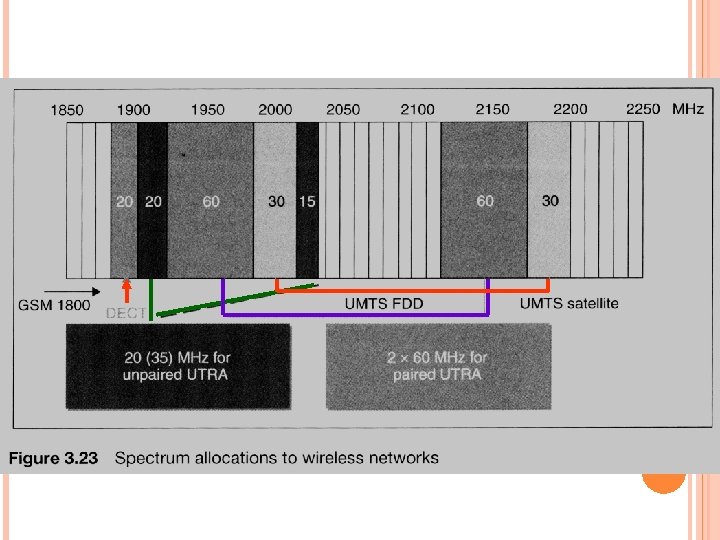
W-CDMA W-CDMA(Wideband CDMA,寬頻分碼多重存取) � 又名CDMA Direct Spread � 能架在現有GSM網路上 UMTS (Universal Mobile Telecommunication System) 頻譜分配 � 營運模式(modes of operation) 20 +15 MHz for unpaired UTRA TDD mode used by TD-CDMA � 1900 ~ 1920 + 2010 ~ 2025 35 Mz
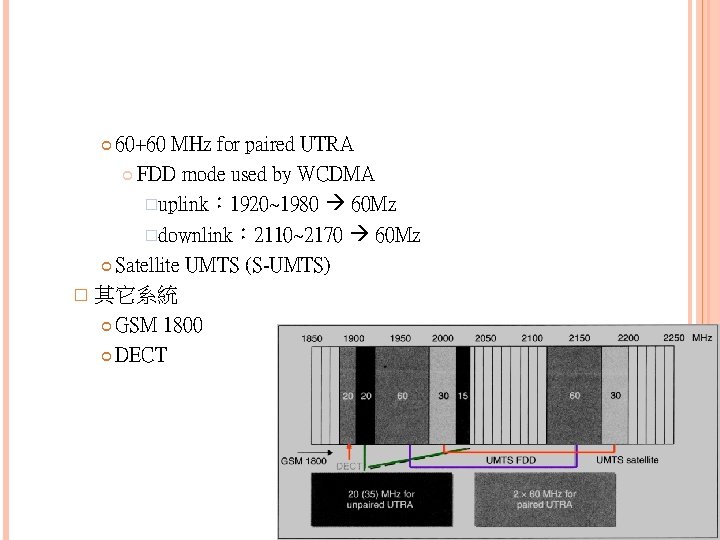
60+60 MHz for paired UTRA FDD mode used by WCDMA �uplink: 1920~1980 60 Mz �downlink: 2110~2170 60 Mz Satellite UMTS (S-UMTS) � 其它系統 GSM 1800 DECT
CDMA 2000 � 又名CDMA Multi-Carrier � 為CDMA開發組織CDG (CDMA Development Group)所發展 出的第三代行動電話標準 � 從窄頻cdma. One (IS-95)標準衍生而出
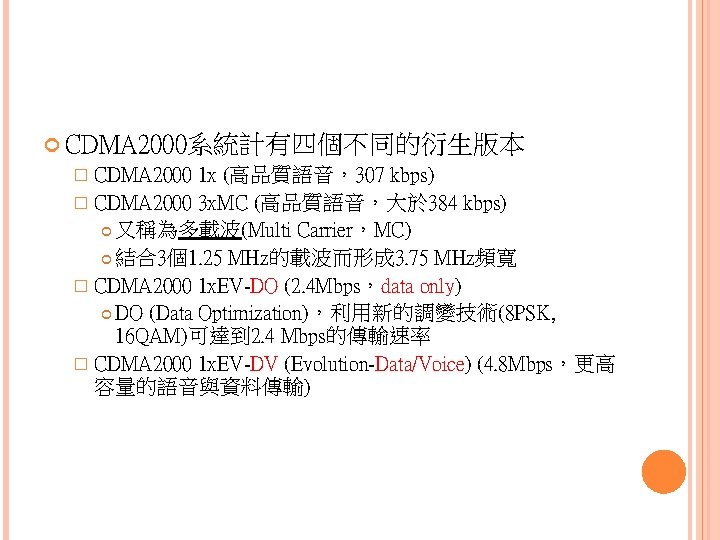
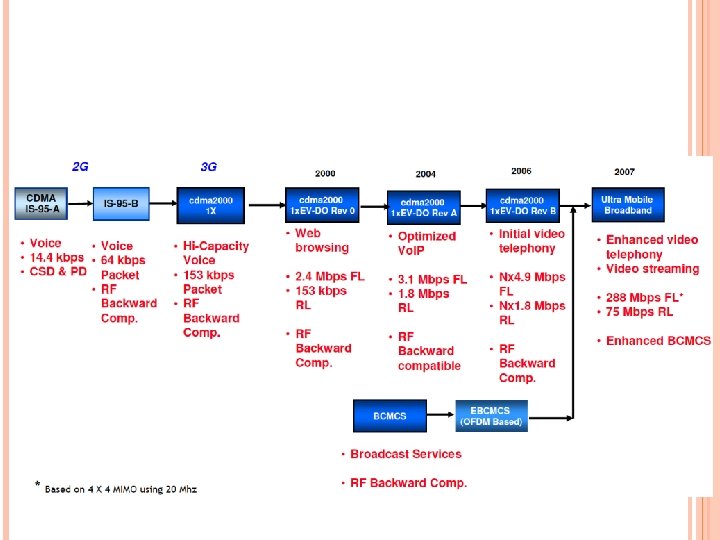
CDMA 2000系統計有四個不同的衍生版本 � CDMA 2000 1 x (高品質語音,307 kbps) � CDMA 2000 3 x. MC (高品質語音,大於 384 kbps) 又稱為多載波(Multi Carrier,MC) 結合3個1. 25 MHz的載波而形成 3. 75 MHz頻寬 � CDMA 2000 1 x. EV-DO (2. 4 Mbps,data only) DO (Data Optimization),利用新的調變技術(8 PSK, 16 QAM)可達到 2. 4 Mbps的傳輸速率 � CDMA 2000 1 x. EV-DV (Evolution-Data/Voice) (4. 8 Mbps,更高 容量的語音與資料傳輸)
TD-SCDMA (Time Division Synchronous CDMA) � 規格是由CWTS (China Wireless Telecommunication Standards)所制定 � 技術開發主要由CATT (China Academy of Telecommunication Technology)和西門子(Siemens)所負責
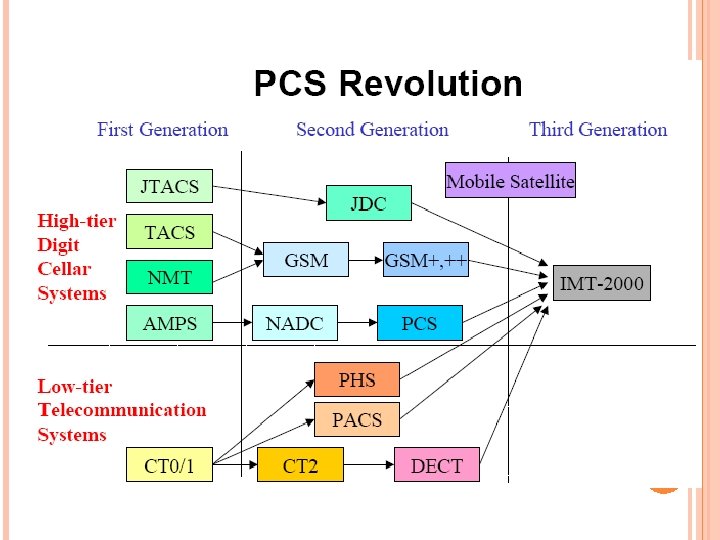
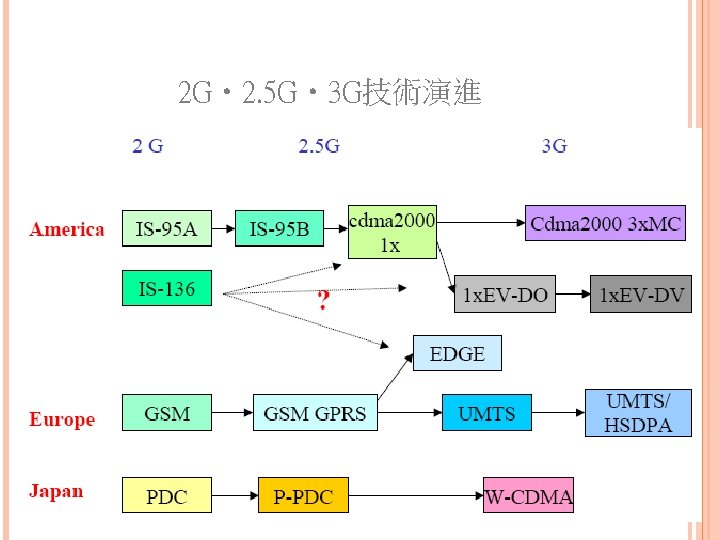
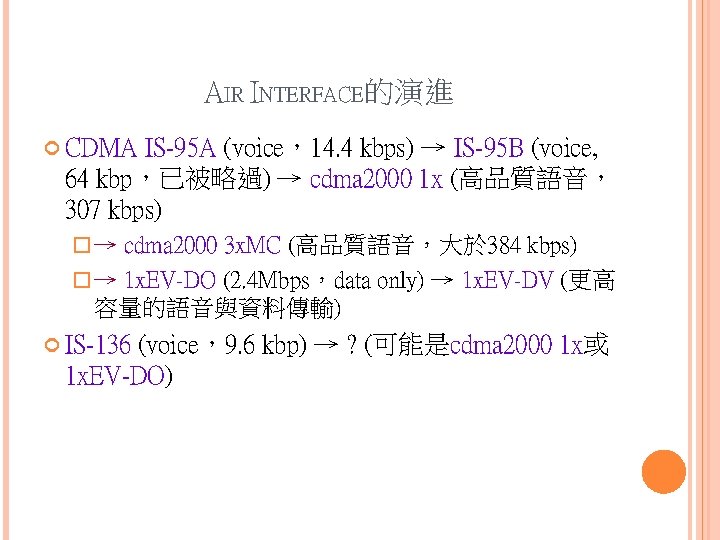
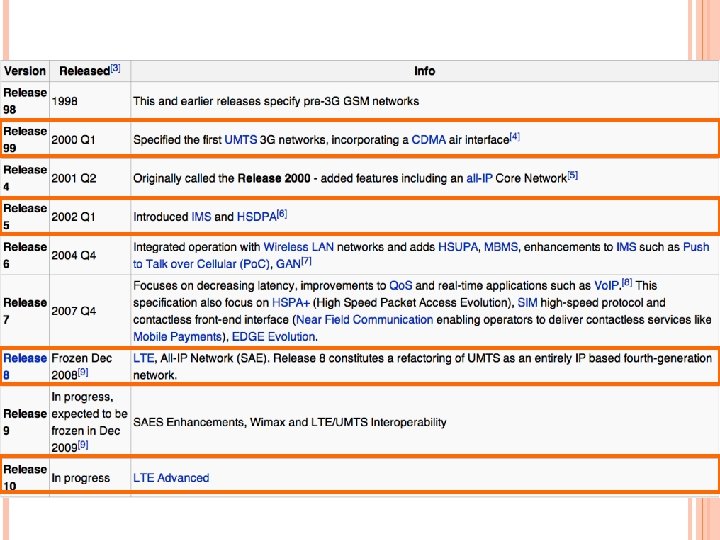
AIR INTERFACE的演進 CDMA IS-95 A (voice,14. 4 kbps) → IS-95 B (voice, 64 kbp,已被略過) → cdma 2000 1 x (高品質語音, 307 kbps) �→ cdma 2000 3 x. MC (高品質語音,大於 384 kbps) � → 1 x. EV-DO (2. 4 Mbps,data only) → 1 x. EV-DV (更高 容量的語音與資料傳輸) IS-136 (voice,9. 6 kbp) → ? (可能是cdma 2000 1 x或 1 x. EV-DO)
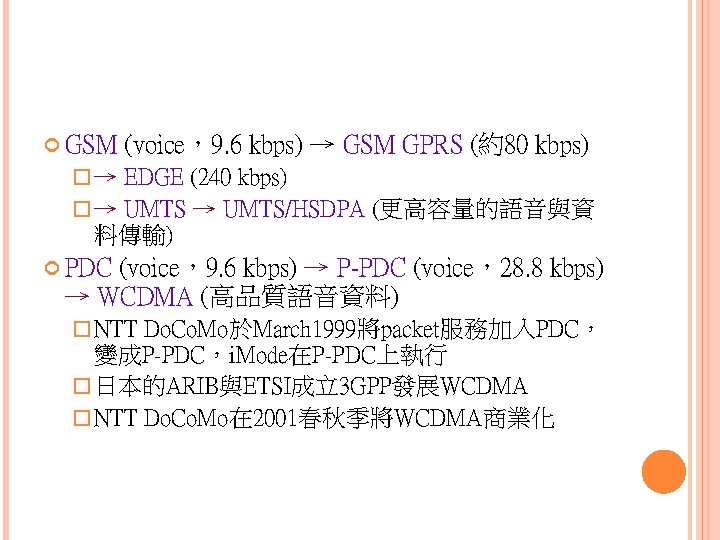
GSM (voice,9. 6 kbps) → GSM GPRS (約80 kbps) �→ EDGE (240 kbps) � → UMTS/HSDPA (更高容量的語音與資 料傳輸) PDC (voice,9. 6 kbps) → P-PDC (voice,28. 8 kbps) → WCDMA (高品質語音資料) � NTT Do. Co. Mo於March 1999將packet服務加入PDC, 變成P-PDC,i. Mode在P-PDC上執行 � 日本的ARIB與ETSI成立3 GPP發展WCDMA � NTT Do. Co. Mo在 2001春秋季將WCDMA商業化
3 GPP (THE 3 RD GENERATION PARTNERSHIP PROJECT) A collaboration between groups of telecommunications associations Make a globally applicable third generation (3 G) mobile phone system specification within the scope of the International Mobile Telecommunications-2000 (IMT 2000) project of the International Telecommunication Union (ITU) 3 GPP specifications are based on evolved Global System for Mobile Communications (GSM) specifications 3 GPP standardization encompasses Radio, Core Network and Service architecture
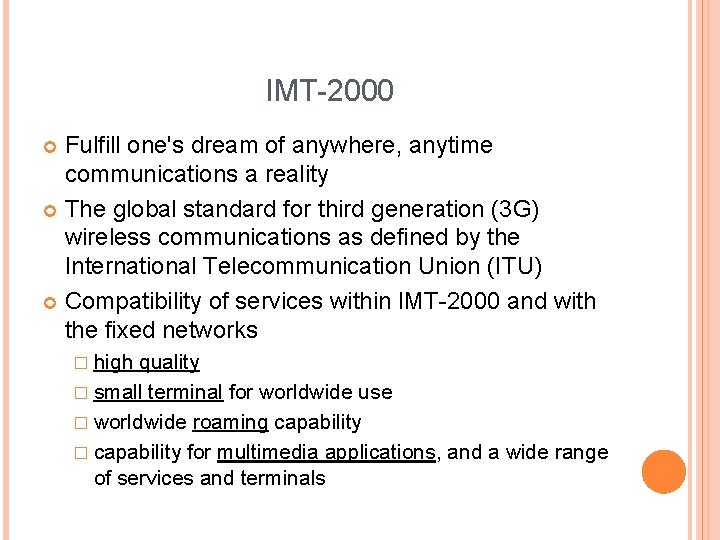
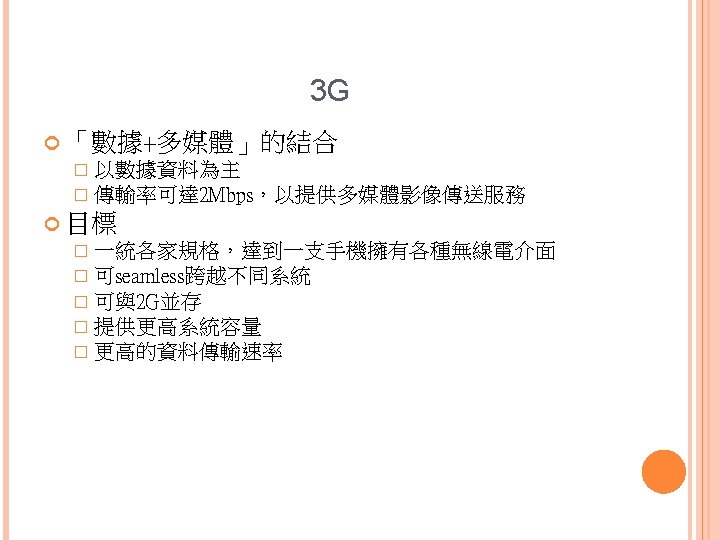
IMT-2000 Fulfill one's dream of anywhere, anytime communications a reality The global standard for third generation (3 G) wireless communications as defined by the International Telecommunication Union (ITU) Compatibility of services within IMT-2000 and with the fixed networks � high quality � small terminal for worldwide use � worldwide roaming capability � capability for multimedia applications, and a wide range of services and terminals
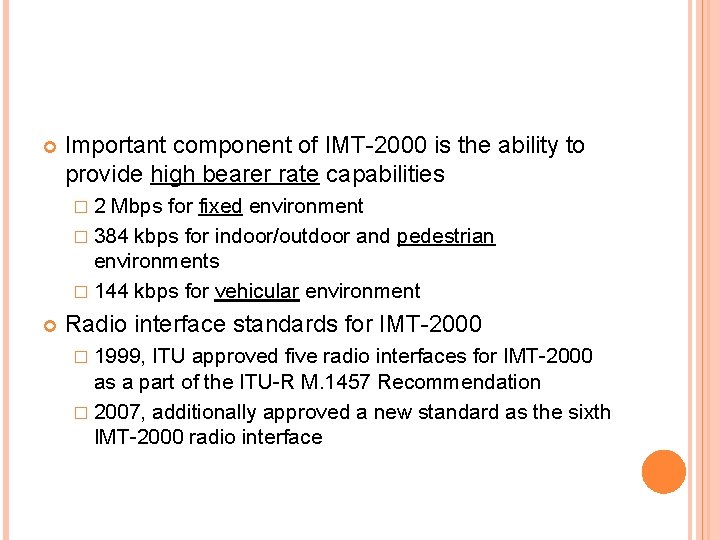
Important component of IMT-2000 is the ability to provide high bearer rate capabilities � 2 Mbps for fixed environment � 384 kbps for indoor/outdoor and pedestrian environments � 144 kbps for vehicular environment Radio interface standards for IMT-2000 � 1999, ITU approved five radio interfaces for IMT-2000 as a part of the ITU-R M. 1457 Recommendation � 2007, additionally approved a new standard as the sixth IMT-2000 radio interface
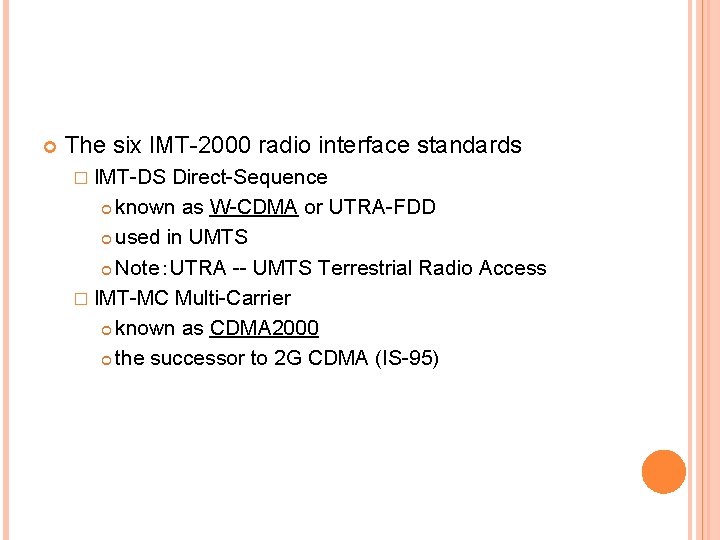
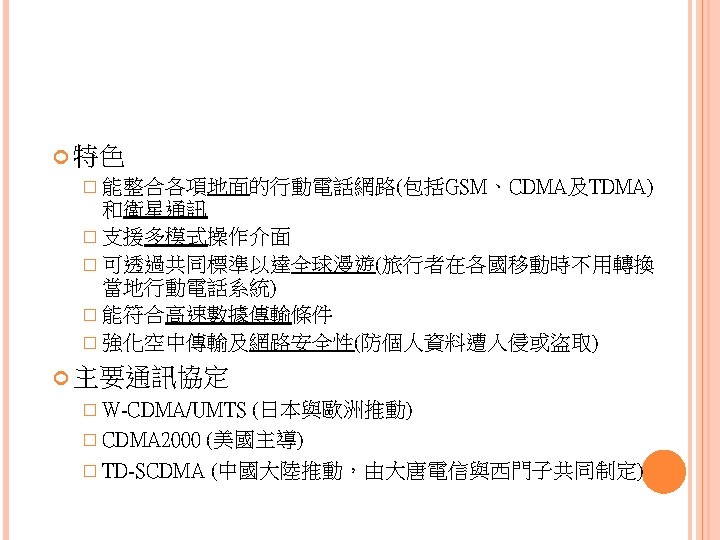
The six IMT-2000 radio interface standards � IMT-DS Direct-Sequence known as W-CDMA or UTRA-FDD used in UMTS Note:UTRA -- UMTS Terrestrial Radio Access � IMT-MC Multi-Carrier known as CDMA 2000 the successor to 2 G CDMA (IS-95)
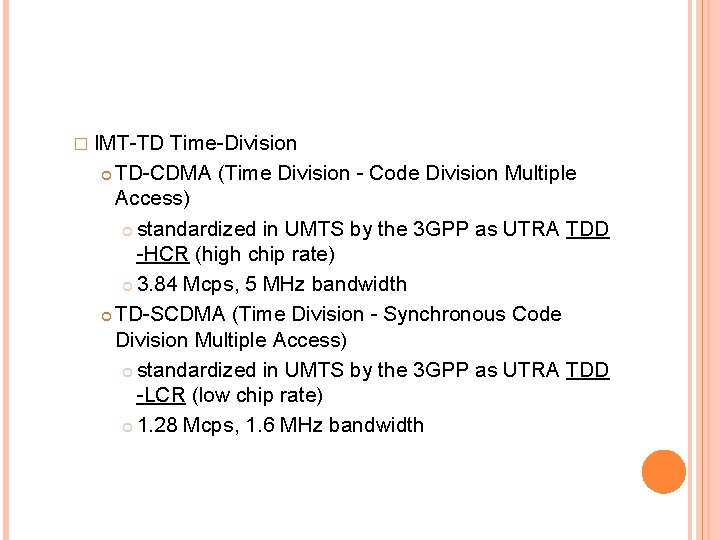
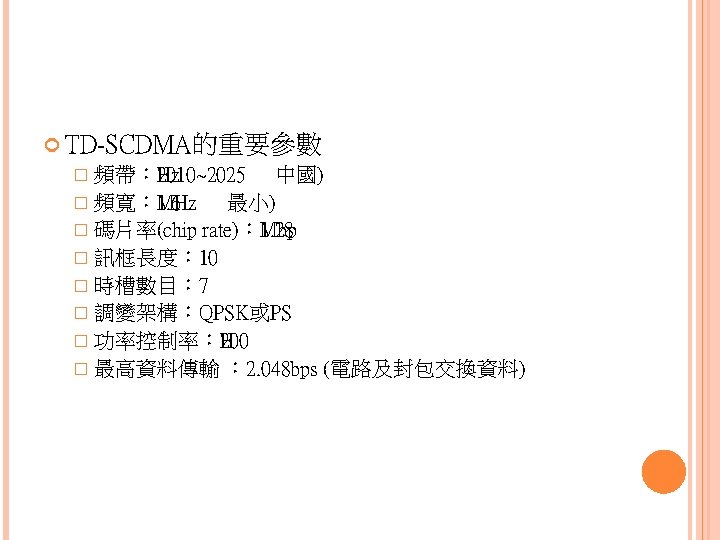
� IMT-TD Time-Division TD-CDMA (Time Division - Code Division Multiple Access) standardized in UMTS by the 3 GPP as UTRA TDD -HCR (high chip rate) 3. 84 Mcps, 5 MHz bandwidth TD-SCDMA (Time Division - Synchronous Code Division Multiple Access) standardized in UMTS by the 3 GPP as UTRA TDD -LCR (low chip rate) 1. 28 Mcps, 1. 6 MHz bandwidth
� IMT-SC Single Carrier known as EDGE (Enhanced Data rates for GSM Evolution) EDGE Evolution, added in Release 7 of the 3 GPP standard, provides reduced latency and potential speeds of 1 Mbps by using even more complex coding functions � IMT-OFDMA TDD WMAN better known as Wi. MAX
� IMT-FT Frequency Time known as DECT (Digital Enhanced Cordless Telecommunications) DECT IMT-2000: up to 2. 5 Mbps user data rate (1999) Beyond IMT-2000: up to 15 Mbps (single and wide carrier 64 -QAM modulation)
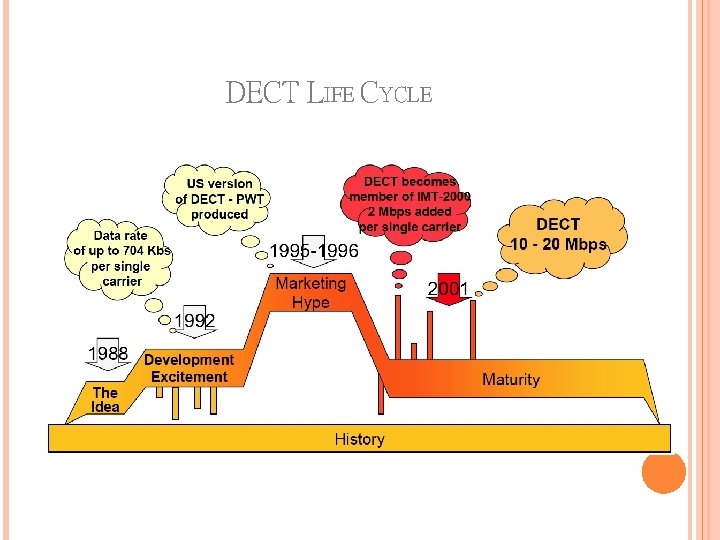
DECT LIFE CYCLE
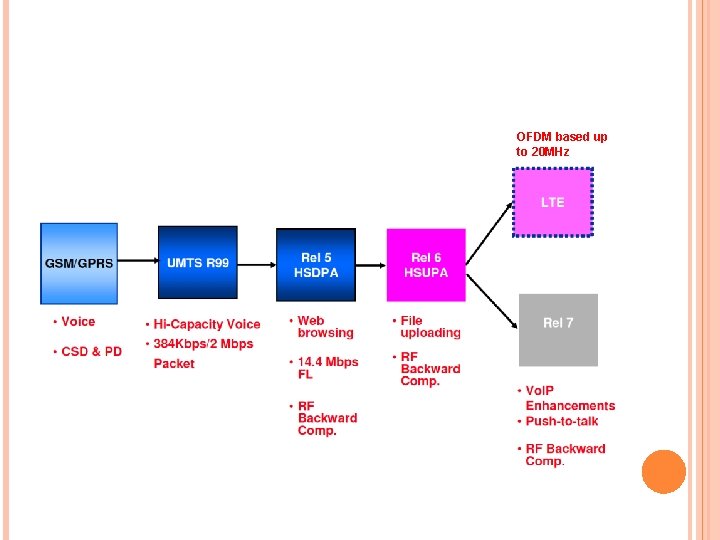
OFDM based up to 20 MHz
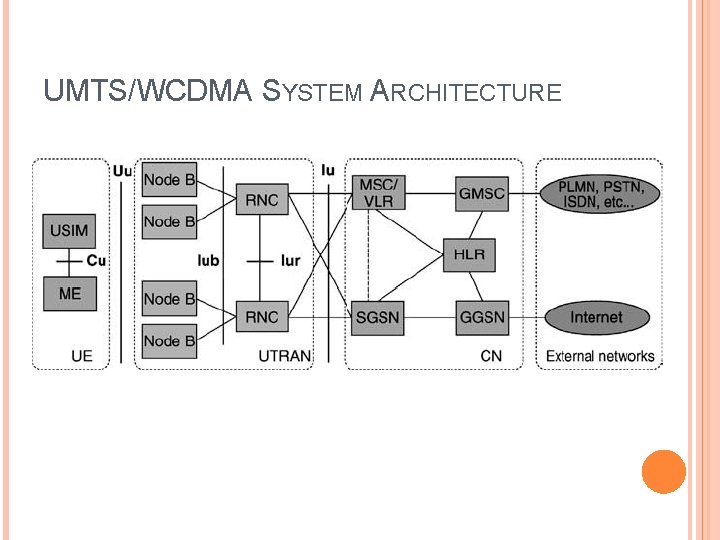
UMTS/WCDMA SYSTEM ARCHITECTURE
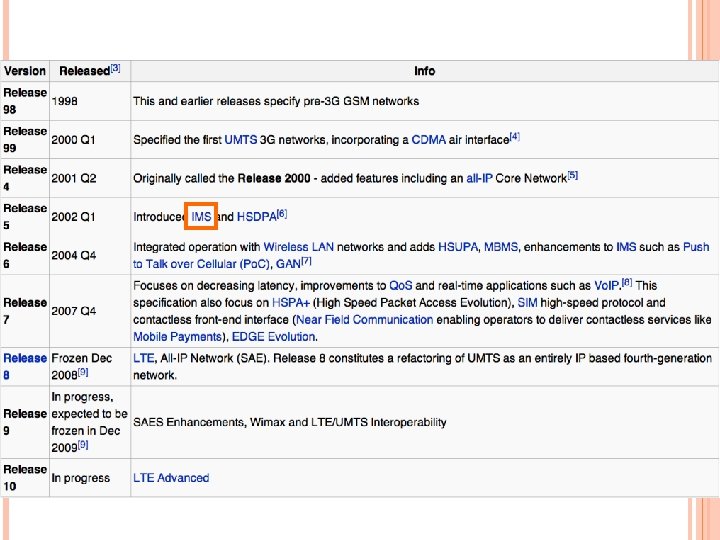
IP MULTIMEDIA SUBSYSTEM (IMS) An architectural framework for delivering Internet Protocol (IP) multimedia services Originally designed by the wireless standards body 3 rd Generation Partnership Project (3 GPP), as a part of the vision for evolving mobile networks beyond GSM Its original formulation (3 GPP R 5) represented an approach to delivering "Internet services" over GPRS � this vision was later updated by 3 GPP, 3 GPP 2 and TISPAN by requiring support of networks other than GPRS, such as Wireless LAN, CDMA 2000 and fixed line
To ease the integration with the Internet, IMS uses IETF protocols wherever possible, e. g. Session Initiation Protocol (SIP) According to the 3 GPP, IMS is not intended to standardize applications but rather to aid the access of multimedia and voice applications from wireless and wireline terminals, i. e. create a form of Fixed Mobile Convergence (FMC) This is done by having a horizontal control layer that isolates the access network from the service layer From a logical architecture perspective, services need not have their own control functions, as the control layer is a common horizontal layer
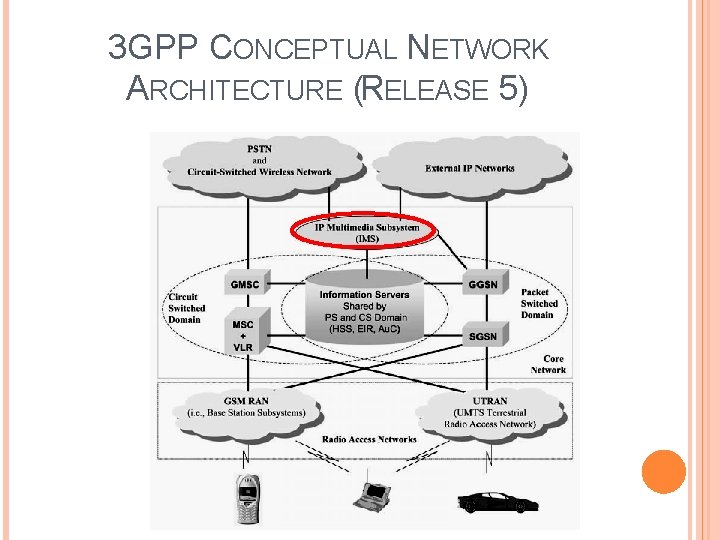
3 GPP CONCEPTUAL NETWORK ARCHITECTURE (RELEASE 5)
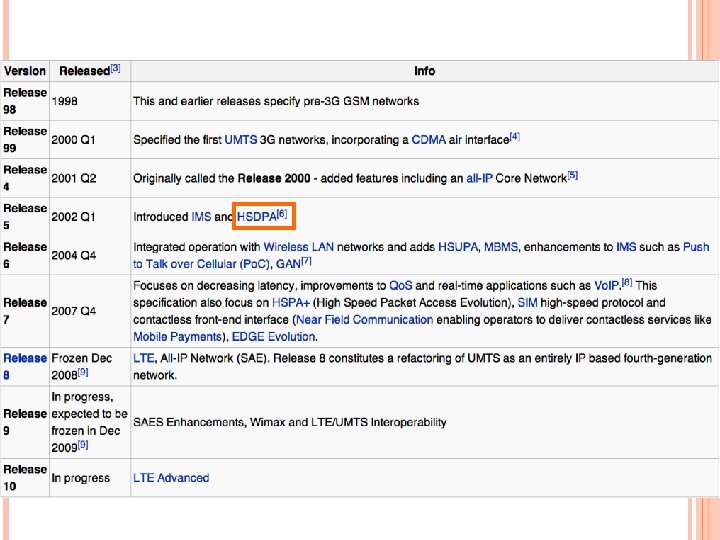
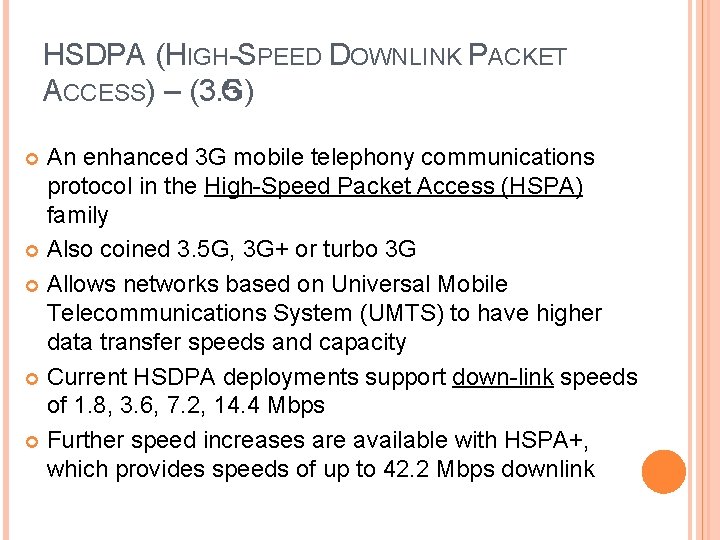
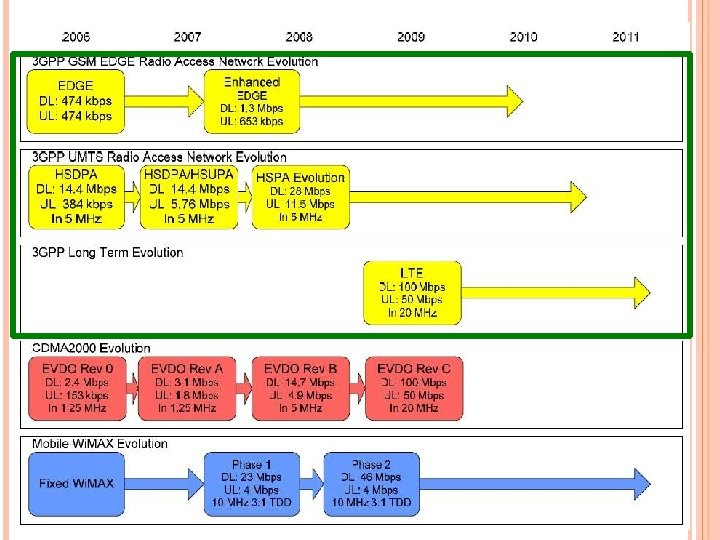
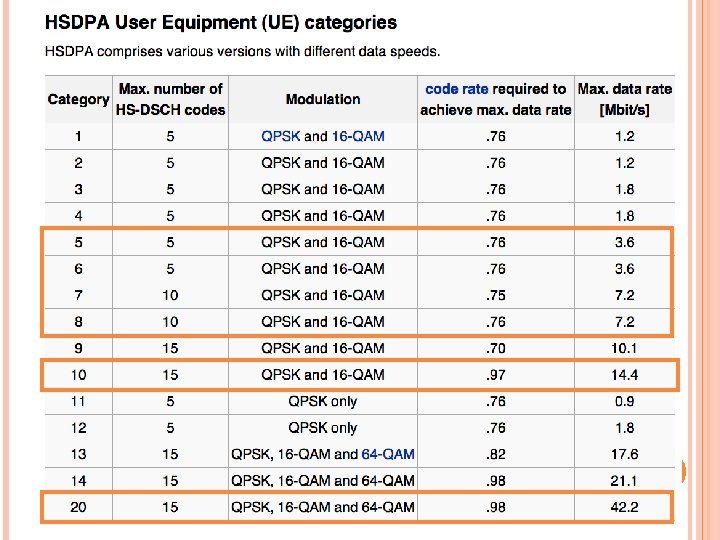
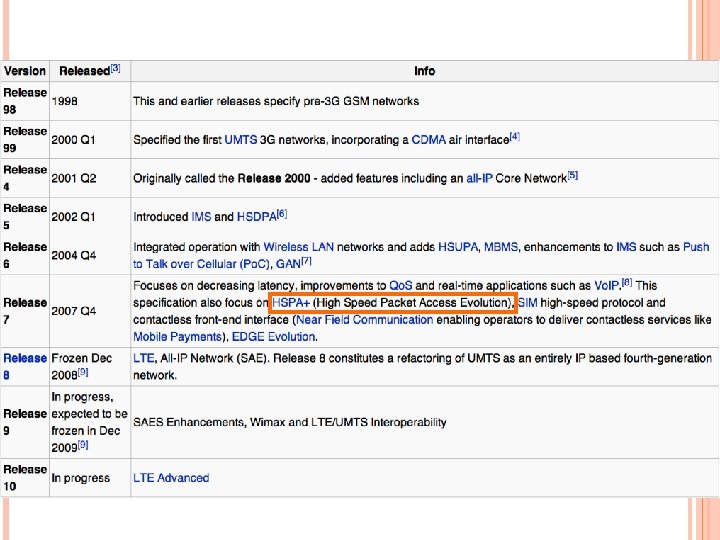
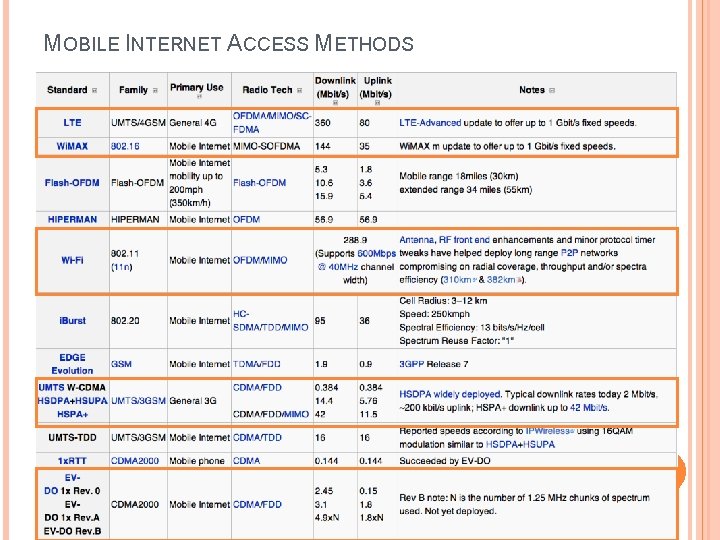
HSDPA (HIGH-SPEED DOWNLINK PACKET ACCESS) – (3. 5 G) An enhanced 3 G mobile telephony communications protocol in the High-Speed Packet Access (HSPA) family Also coined 3. 5 G, 3 G+ or turbo 3 G Allows networks based on Universal Mobile Telecommunications System (UMTS) to have higher data transfer speeds and capacity Current HSDPA deployments support down-link speeds of 1. 8, 3. 6, 7. 2, 14. 4 Mbps Further speed increases are available with HSPA+, which provides speeds of up to 42. 2 Mbps downlink
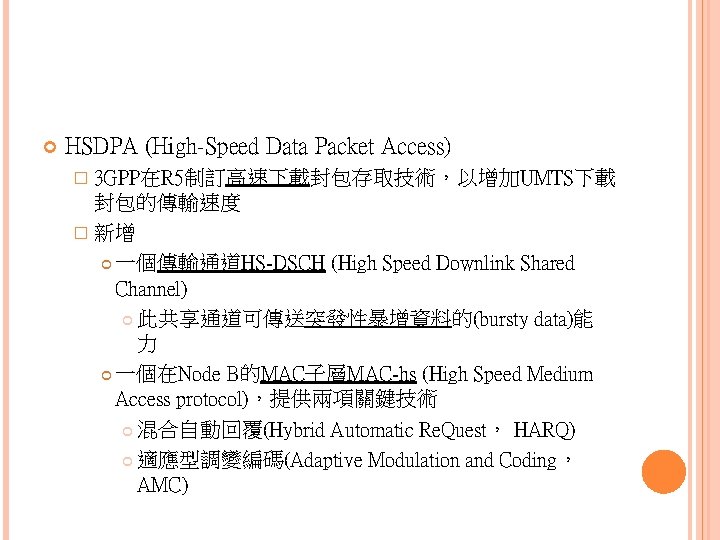
HSDPA (High-Speed Data Packet Access) � 3 GPP在R 5制訂高速下載封包存取技術,以增加UMTS下載 封包的傳輸速度 � 新增 一個傳輸通道HS-DSCH (High Speed Downlink Shared Channel) 此共享通道可傳送突發性暴增資料的(bursty data)能 力 一個在Node B的MAC子層MAC-hs (High Speed Medium Access protocol),提供兩項關鍵技術 混合自動回覆(Hybrid Automatic Re. Quest, HARQ) 適應型調變編碼(Adaptive Modulation and Coding, AMC)
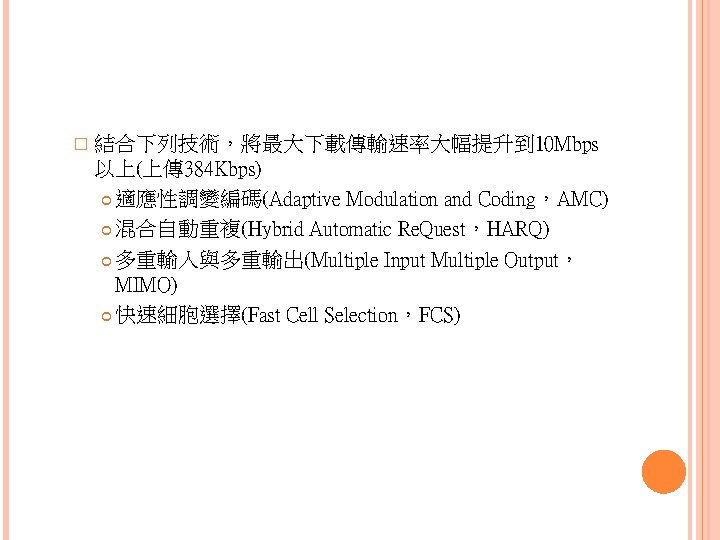
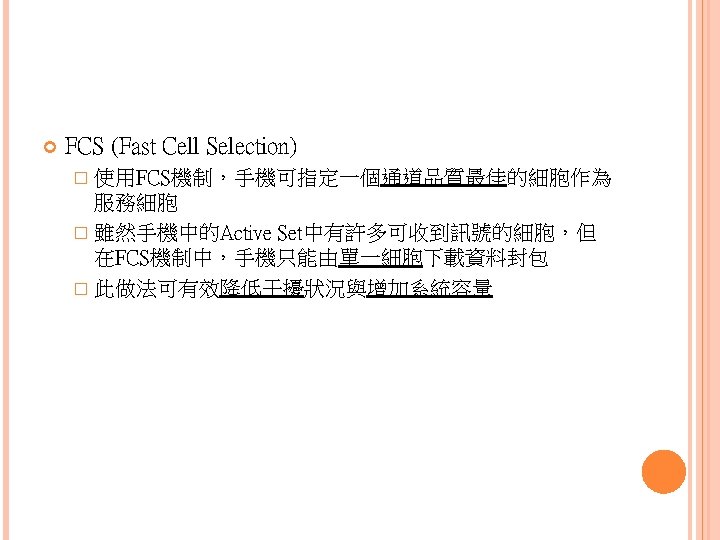
� 結合下列技術,將最大下載傳輸速率大幅提升到 10 Mbps 以上(上傳 384 Kbps) 適應性調變編碼(Adaptive Modulation and Coding,AMC) 混合自動重複(Hybrid Automatic Re. Quest,HARQ) 多重輸入與多重輸出(Multiple Input Multiple Output, MIMO) 快速細胞選擇(Fast Cell Selection,FCS)
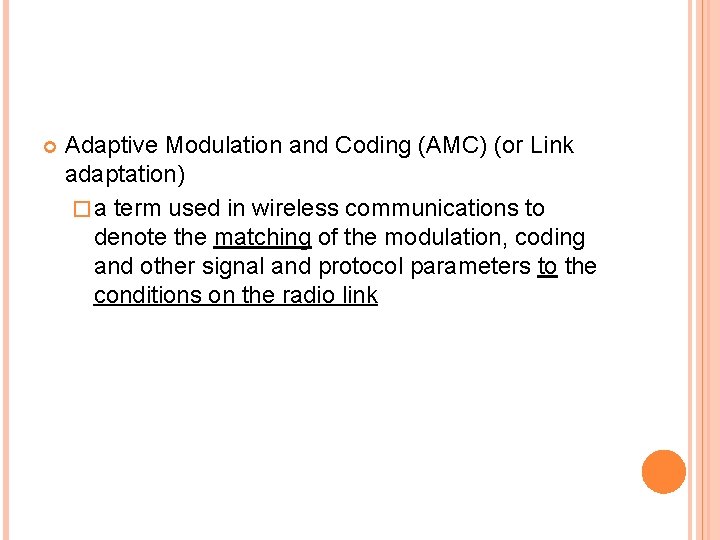
Adaptive Modulation and Coding (AMC) (or Link adaptation) � a term used in wireless communications to denote the matching of the modulation, coding and other signal and protocol parameters to the conditions on the radio link
� the signal and protocol parameters change as the radio link conditions change, e. g. the pathloss the interference due to signals coming from other transmitters the sensitivity of the receiver the available transmitter power margin, etc. � in HSDPA of UMTS this can take place every 2 ms
Hybrid ARQ (HARQ) �a variation of the ARQ error control method � Standard ARQ error-detection (ED) information bits are added to data to be transmitted (such as cyclic redundancy check,CRC) � Hybrid ARQ forward error correction (FEC) bits are also added to the existing error detection (ED) bits
� Hybrid ARQ performs better than ordinary ARQ in poor signal conditions, but in its simplest form this comes at the expense of significantly lower throughput in good signal conditions � there is typically a signal quality cross-over point below which simple Hybrid ARQ is better, and above which basic ARQ is better
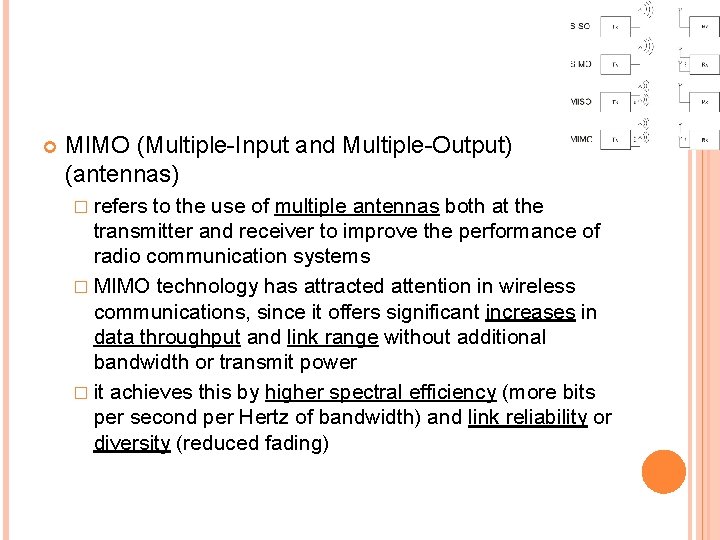
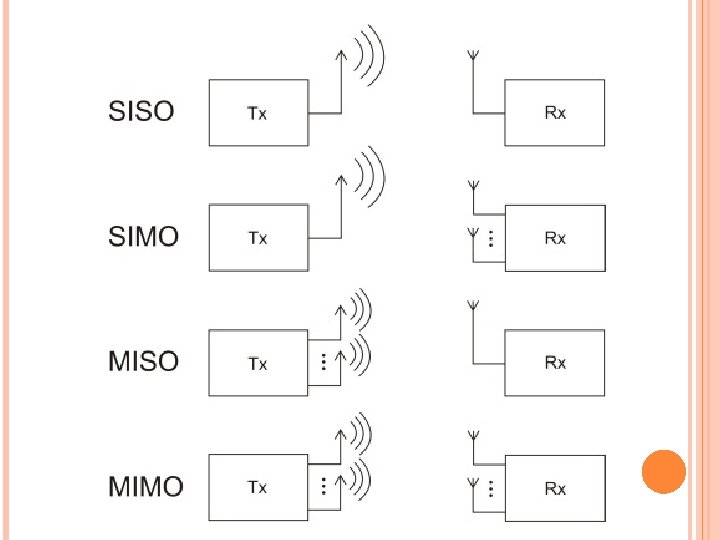
MIMO (Multiple-Input and Multiple-Output) (antennas) � refers to the use of multiple antennas both at the transmitter and receiver to improve the performance of radio communication systems � MIMO technology has attracted attention in wireless communications, since it offers significant increases in data throughput and link range without additional bandwidth or transmit power � it achieves this by higher spectral efficiency (more bits per second per Hertz of bandwidth) and link reliability or diversity (reduced fading)
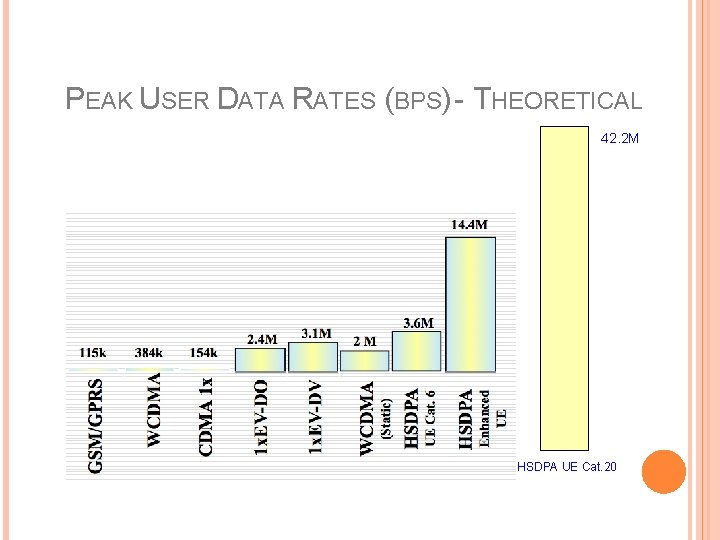
PEAK USER DATA RATES (BPS) - THEORETICAL 42. 2 M HSDPA UE Cat. 20
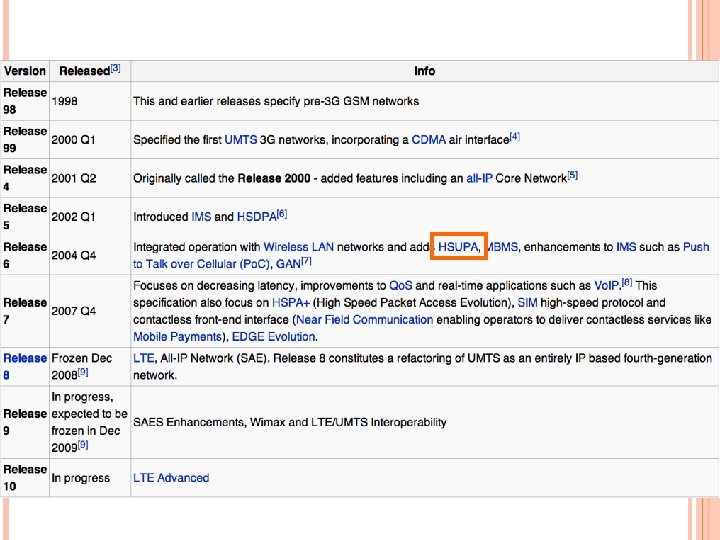
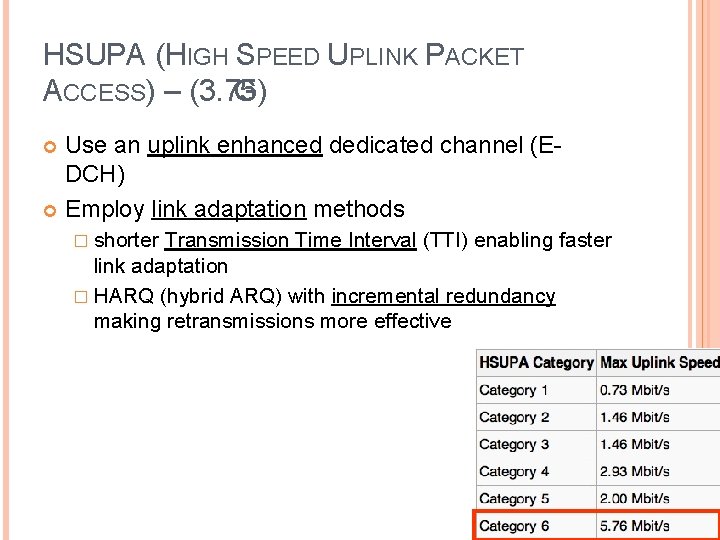
HSUPA (HIGH SPEED UPLINK PACKET ACCESS) – (3. 75 G) Use an uplink enhanced dedicated channel (EDCH) Employ link adaptation methods � shorter Transmission Time Interval (TTI) enabling faster link adaptation � HARQ (hybrid ARQ) with incremental redundancy making retransmissions more effective
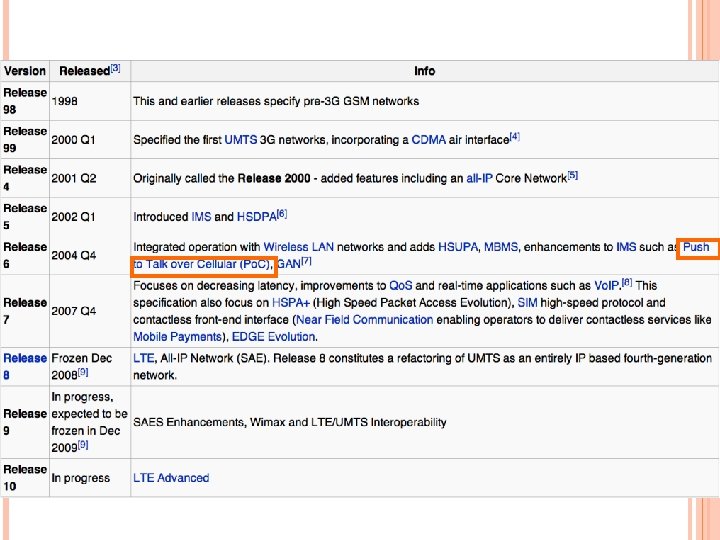
PTT (PUSH-TO-TALK) Also known as Press-To-Transmit A method of conversing on half-duplex communication lines, including two-way radio Using a momentary button to switch from voice reception mode to transmit mode
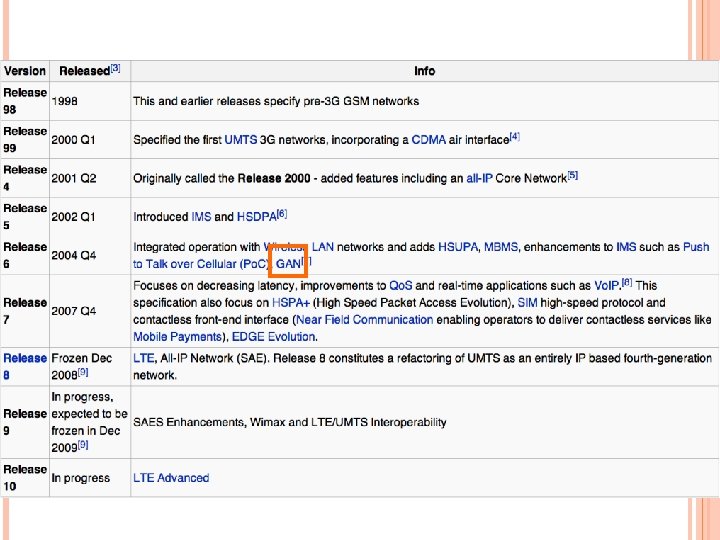
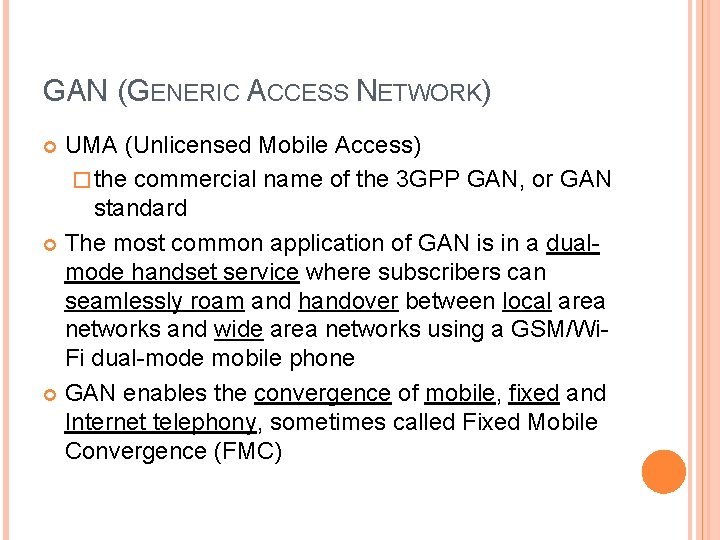
GAN (GENERIC ACCESS NETWORK) UMA (Unlicensed Mobile Access) � the commercial name of the 3 GPP GAN, or GAN standard The most common application of GAN is in a dualmode handset service where subscribers can seamlessly roam and handover between local area networks and wide area networks using a GSM/Wi. Fi dual-mode mobile phone GAN enables the convergence of mobile, fixed and Internet telephony, sometimes called Fixed Mobile Convergence (FMC)
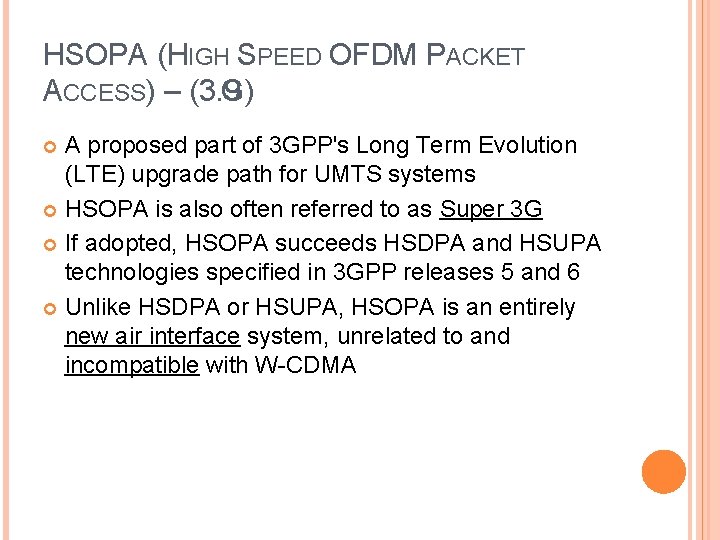
HSOPA (HIGH SPEED OFDM PACKET ACCESS) – (3. 9 G) A proposed part of 3 GPP's Long Term Evolution (LTE) upgrade path for UMTS systems HSOPA is also often referred to as Super 3 G If adopted, HSOPA succeeds HSDPA and HSUPA technologies specified in 3 GPP releases 5 and 6 Unlike HSDPA or HSUPA, HSOPA is an entirely new air interface system, unrelated to and incompatible with W-CDMA
HSOPA features � flexible bandwidth usage with 1. 25 MHz to 20 MHz bandwidths by comparison, W-CDMA uses fixed size 5 MHz chunks of spectrum � increased spectral efficiency at 2 -4 times more than that in 3 GPP release 6, peak transfer rates of 100 Mbps for downlink and 50 Mbps for uplink
� latency times of around 20 ms for round trip time from user terminal to RAN, approximately the same as a combined HSDPA/HSUPA system, but much better than "classic" W-CDMA � uses Orthogonal Frequency Division Multiplexing (OFDM) and multiple-input multiple-output (MIMO) antenna technology to support up to 10 times as many users as W-CDMA based systems, with lower processing power required on each handset
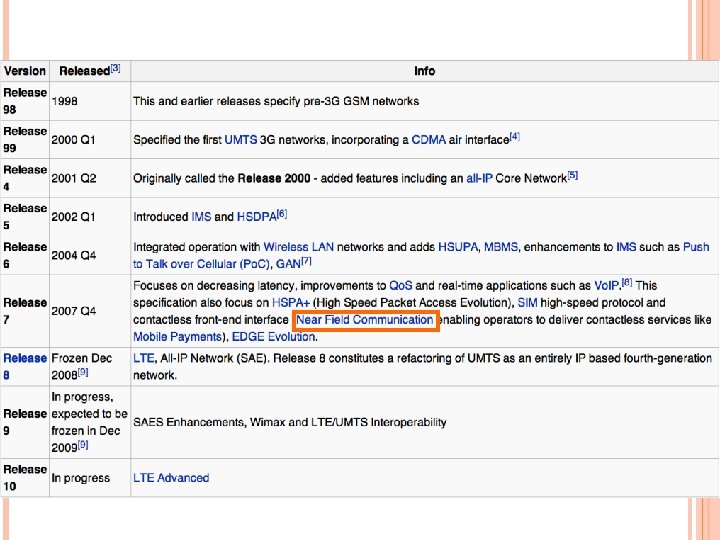
NFC (NEAR FIELD COMMUNICATION) A short-range high frequency wireless communication technology which enables the exchange of data between devices over about a 10 centimeter (around 4 inches) distance The technology is a simple extension of the ISO 14443 proximity-card standard (contactless card, RFID) that combines the interface of a smartcard and a reader into a single device
an NFC device can communicate with both existing ISO 14443 smartcards and readers, as well as with other NFC devices, and is thereby compatible with existing contactless infrastructure already in use for public transportation and payment NFC is primarily aimed at usage in mobile phones
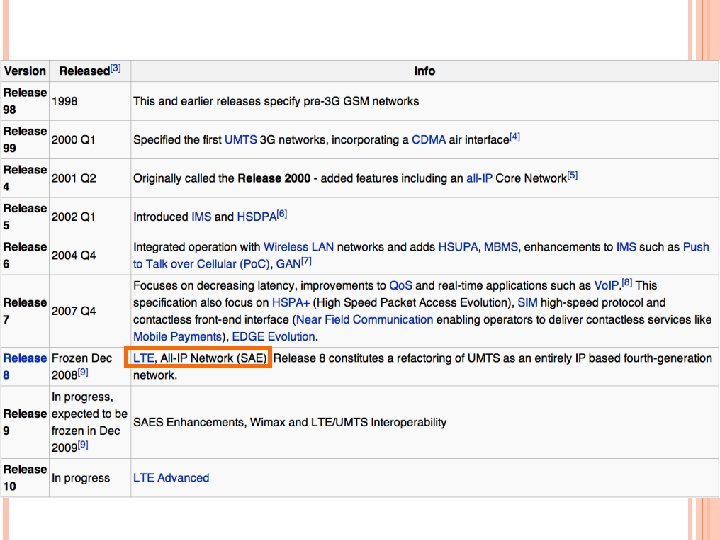
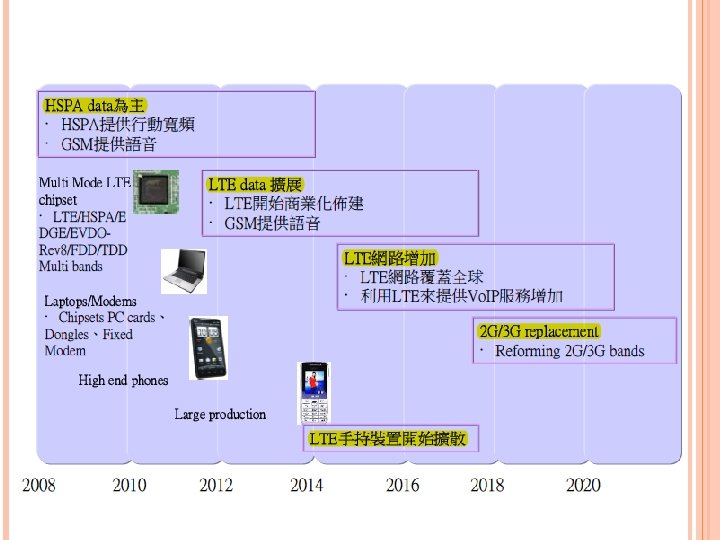
LTE (LONG TERM EVOLUTION) LTE meets key requirements of next generation networks � downlink peak rates: at least 100 Mbit/s � uplink peak rates: 50 Mbit/s � RAN (Radio Access Network) round-trip times: less than 10 ms
Goals � improve spectral efficiency � lower costs � improve services � make use of new spectrum � better integration with other open standards
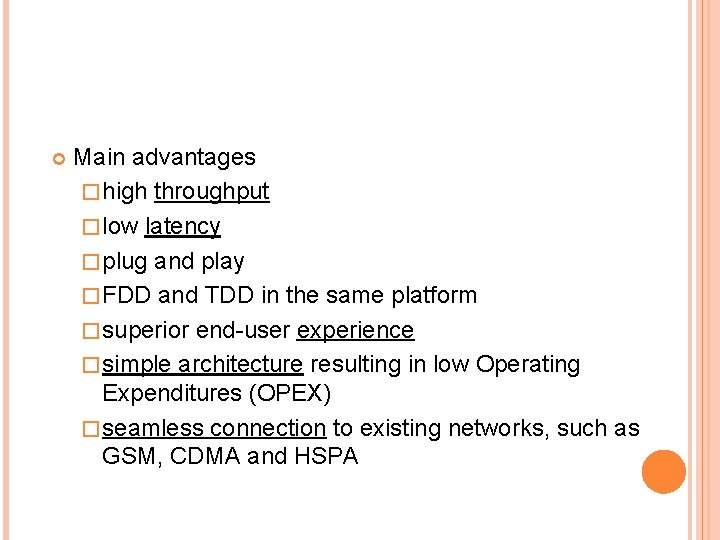
Main advantages � high throughput � low latency � plug and play � FDD and TDD in the same platform � superior end-user experience � simple architecture resulting in low Operating Expenditures (OPEX) � seamless connection to existing networks, such as GSM, CDMA and HSPA
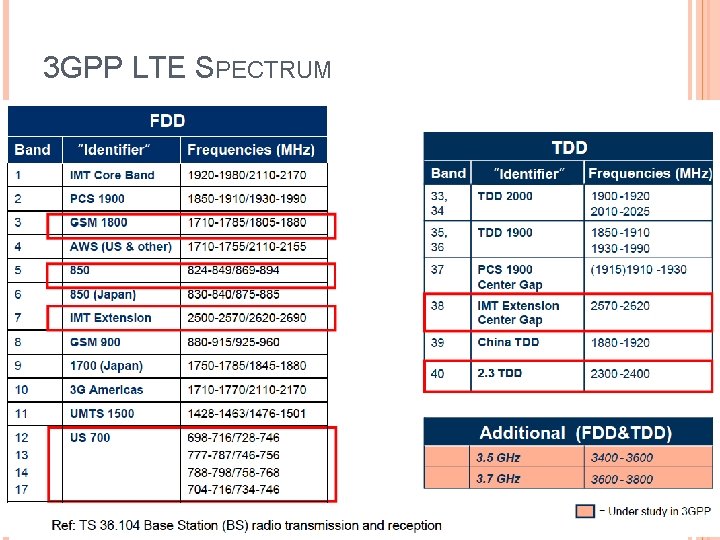
3 GPP LTE SPECTRUM
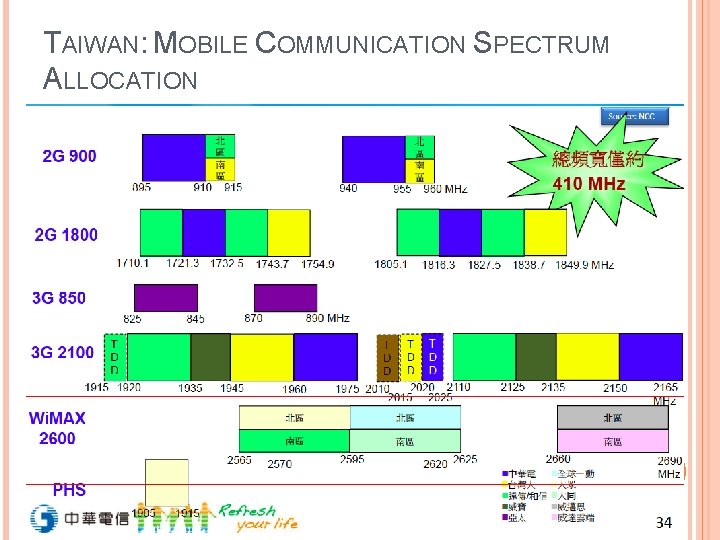
TAIWAN: MOBILE COMMUNICATION SPECTRUM ALLOCATION
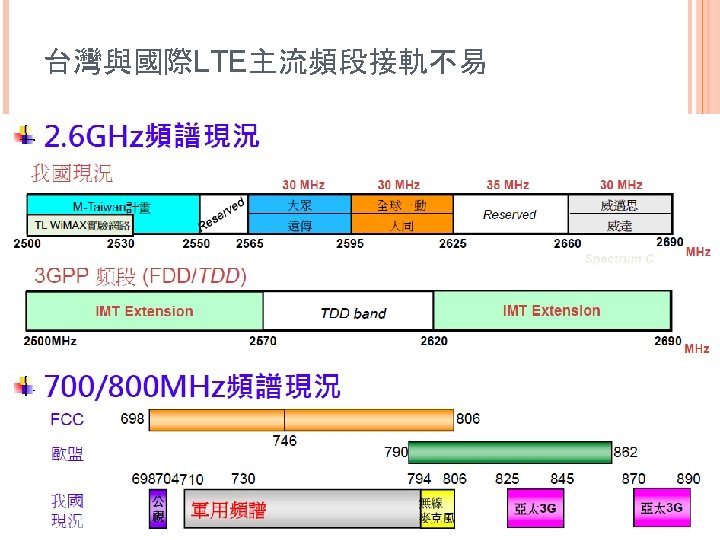
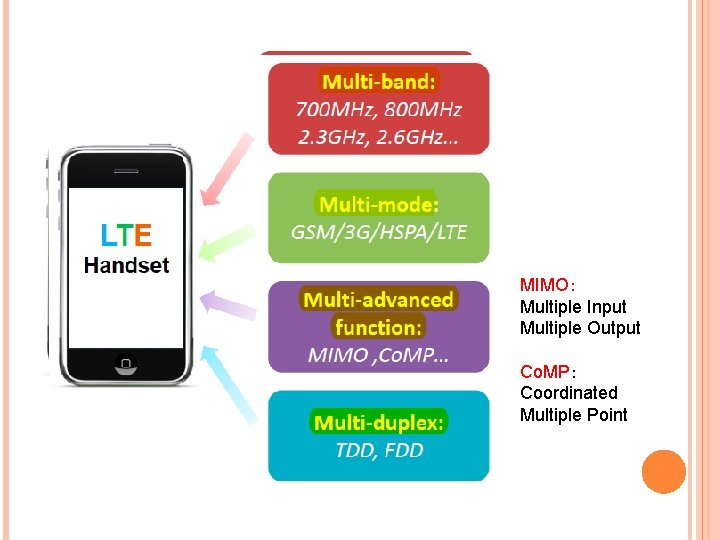
MIMO: Multiple Input Multiple Output Co. MP: Coordinated Multiple Point
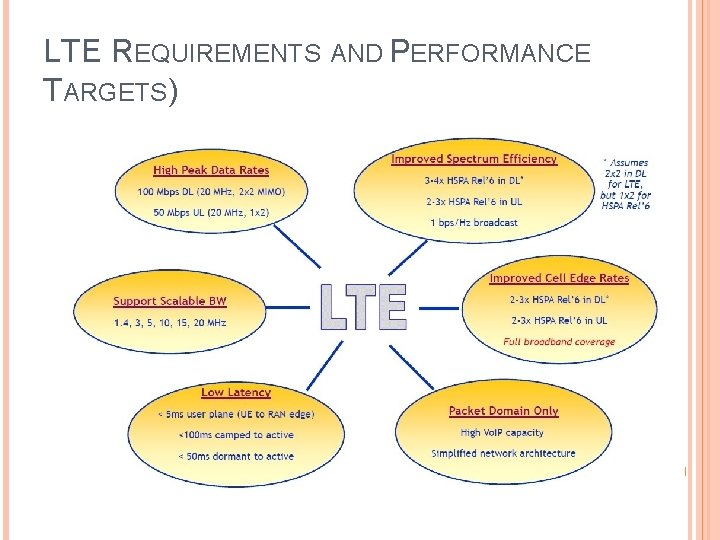
LTE REQUIREMENTS AND PERFORMANCE TARGETS)
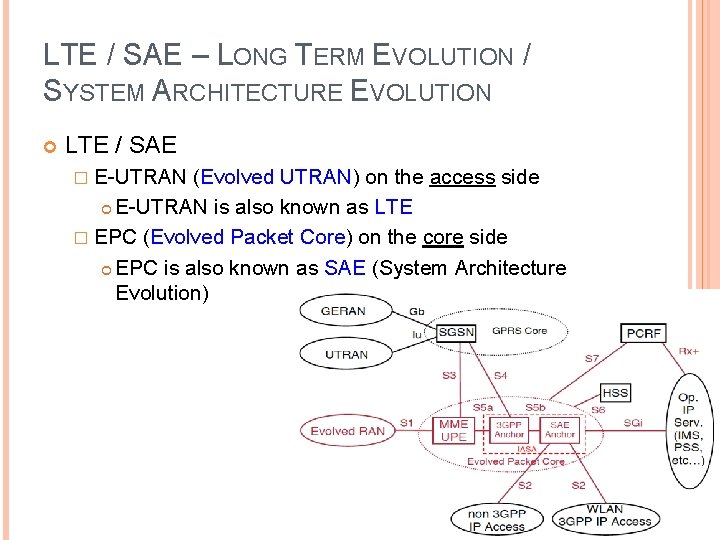
LTE / SAE – LONG TERM EVOLUTION / SYSTEM ARCHITECTURE EVOLUTION LTE / SAE � E-UTRAN (Evolved UTRAN) on the access side E-UTRAN is also known as LTE � EPC (Evolved Packet Core) on the core side EPC is also known as SAE (System Architecture Evolution)
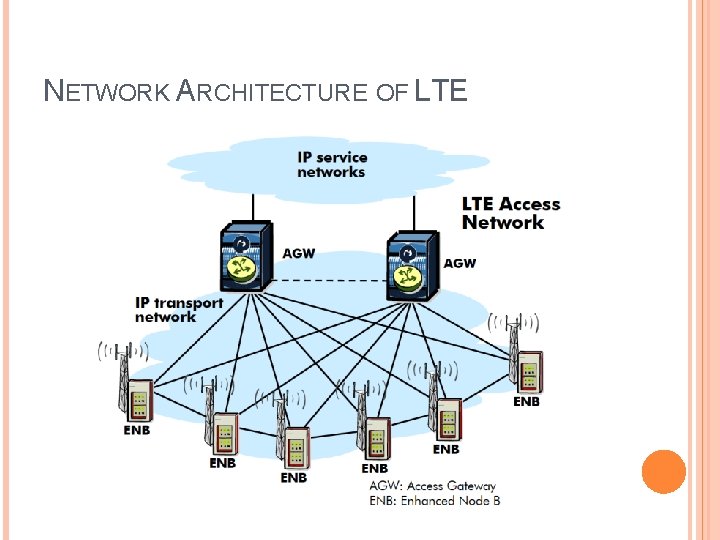
NETWORK ARCHITECTURE OF LTE
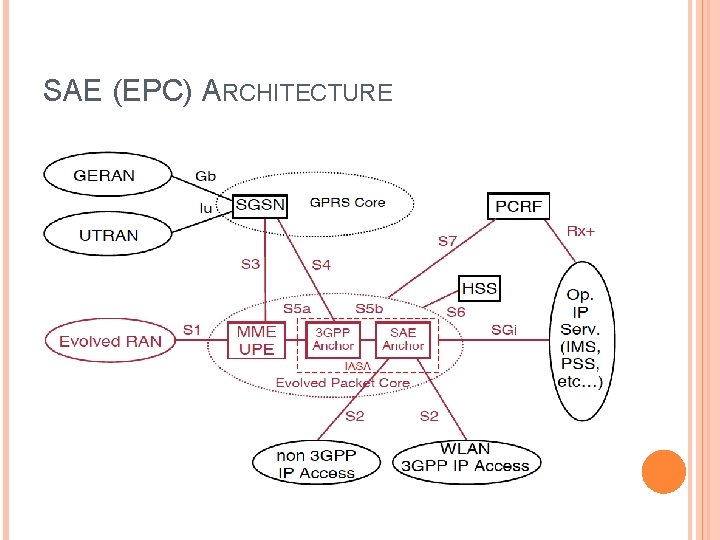
SAE (EPC) ARCHITECTURE
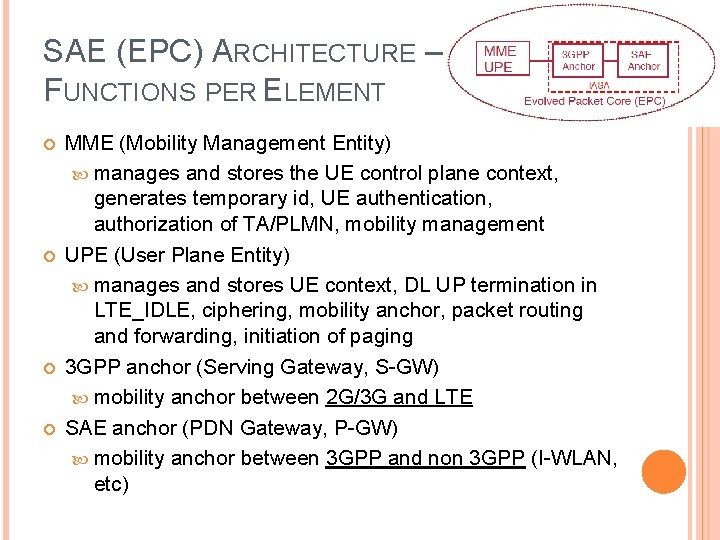
SAE (EPC) ARCHITECTURE – FUNCTIONS PER ELEMENT MME (Mobility Management Entity) manages and stores the UE control plane context, generates temporary id, UE authentication, authorization of TA/PLMN, mobility management UPE (User Plane Entity) manages and stores UE context, DL UP termination in LTE_IDLE, ciphering, mobility anchor, packet routing and forwarding, initiation of paging 3 GPP anchor (Serving Gateway, S-GW) mobility anchor between 2 G/3 G and LTE SAE anchor (PDN Gateway, P-GW) mobility anchor between 3 GPP and non 3 GPP (I-WLAN, etc)
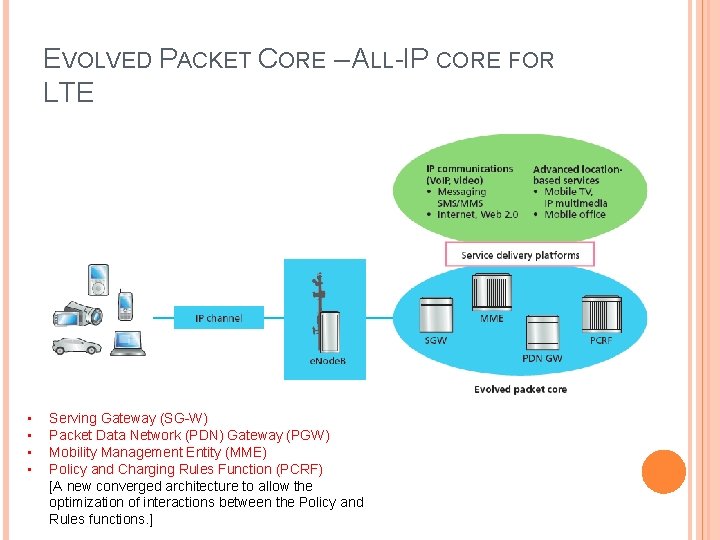
EVOLVED PACKET CORE – ALL-IP CORE FOR LTE • • Serving Gateway (SG-W) Packet Data Network (PDN) Gateway (PGW) Mobility Management Entity (MME) Policy and Charging Rules Function (PCRF) [A new converged architecture to allow the optimization of interactions between the Policy and Rules functions. ]
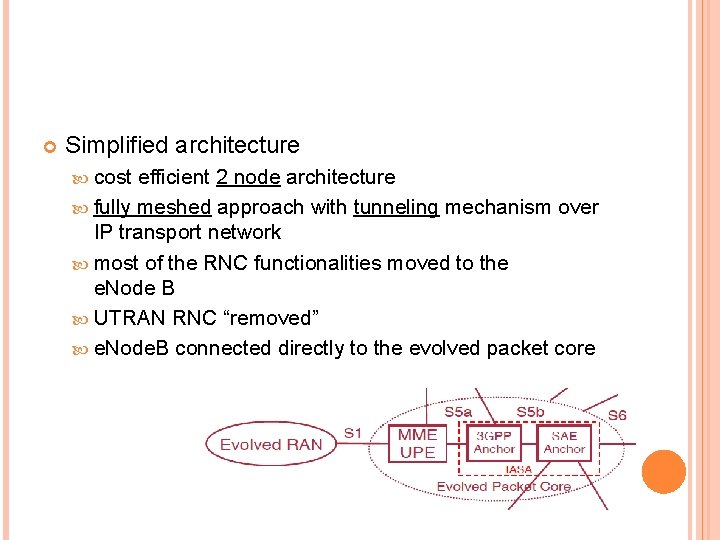
Simplified architecture cost efficient 2 node architecture fully meshed approach with tunneling mechanism over IP transport network most of the RNC functionalities moved to the e. Node B UTRAN RNC “removed” e. Node. B connected directly to the evolved packet core
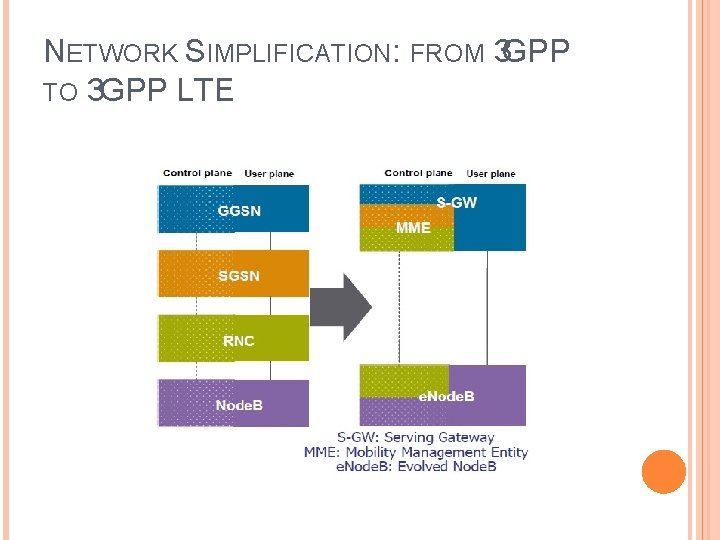
NETWORK SIMPLIFICATION: FROM 3 GPP TO 3 GPP LTE
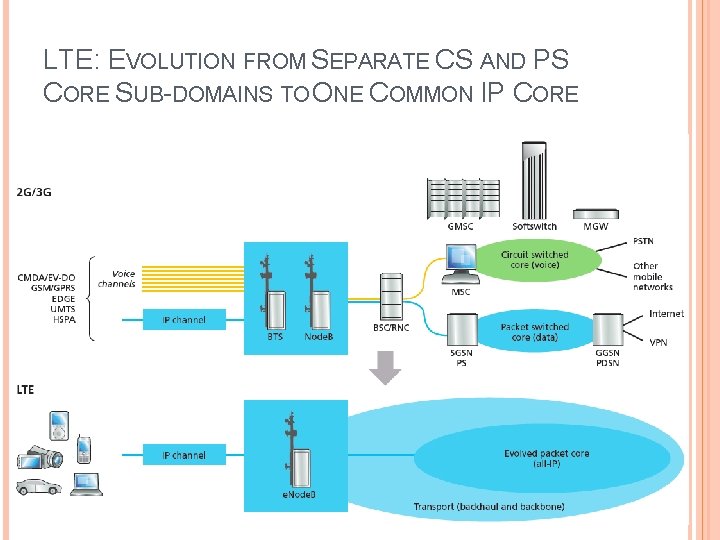
LTE: EVOLUTION FROM SEPARATE CS AND PS CORE SUB-DOMAINS TO ONE COMMON IP CORE
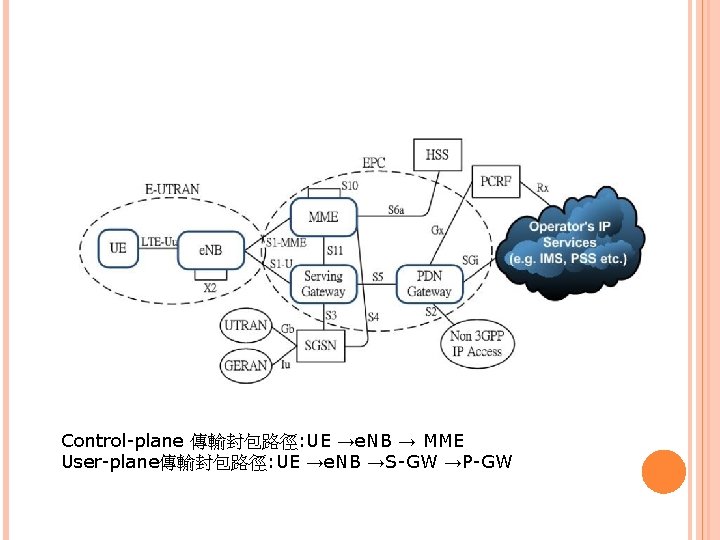
Control-plane 傳輸封包路徑: UE →e. NB → MME User-plane傳輸封包路徑: UE →e. NB →S-GW →P-GW
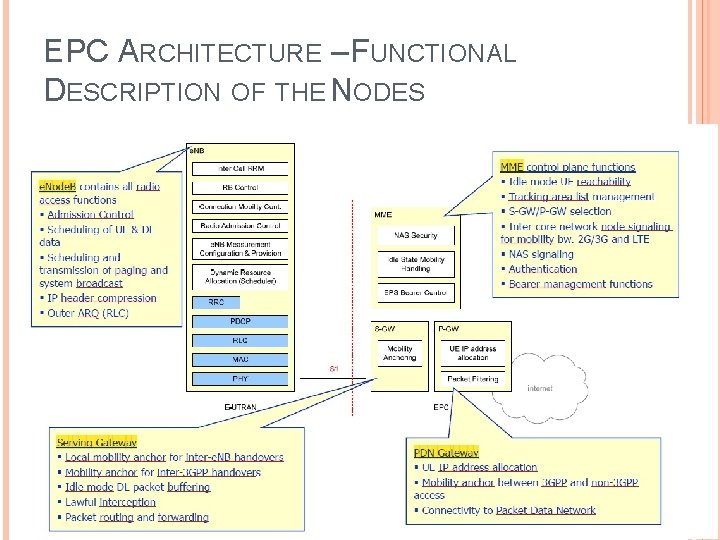
EPC ARCHITECTURE – FUNCTIONAL DESCRIPTION OF THE NODES
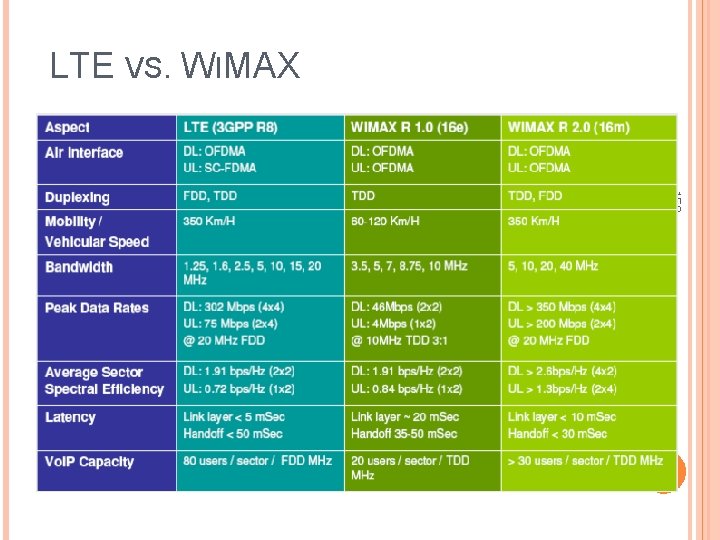
LTE VS. WIMAX 150
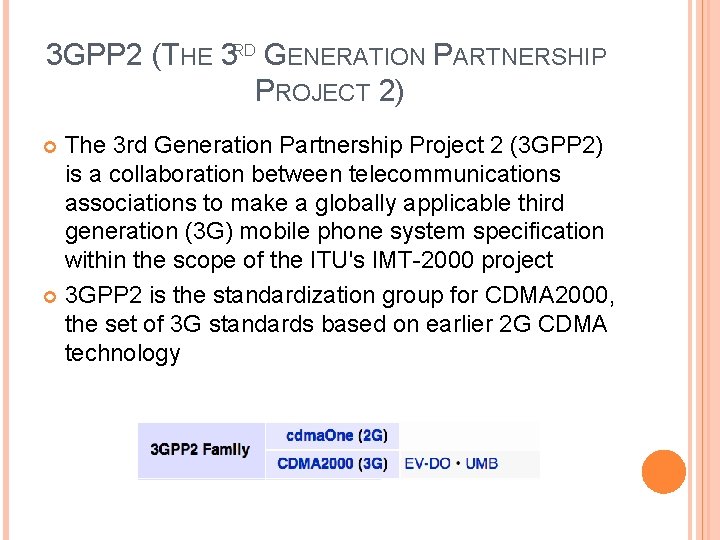
3 GPP 2 (THE 3 RD GENERATION PARTNERSHIP PROJECT 2) The 3 rd Generation Partnership Project 2 (3 GPP 2) is a collaboration between telecommunications associations to make a globally applicable third generation (3 G) mobile phone system specification within the scope of the ITU's IMT-2000 project 3 GPP 2 is the standardization group for CDMA 2000, the set of 3 G standards based on earlier 2 G CDMA technology
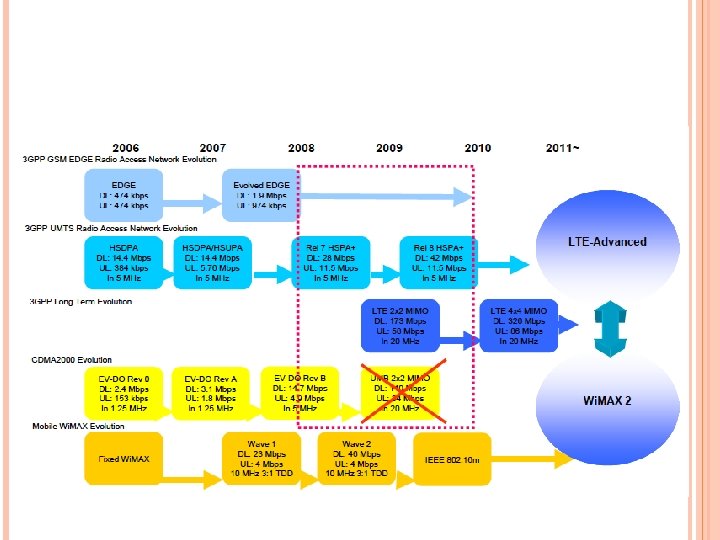
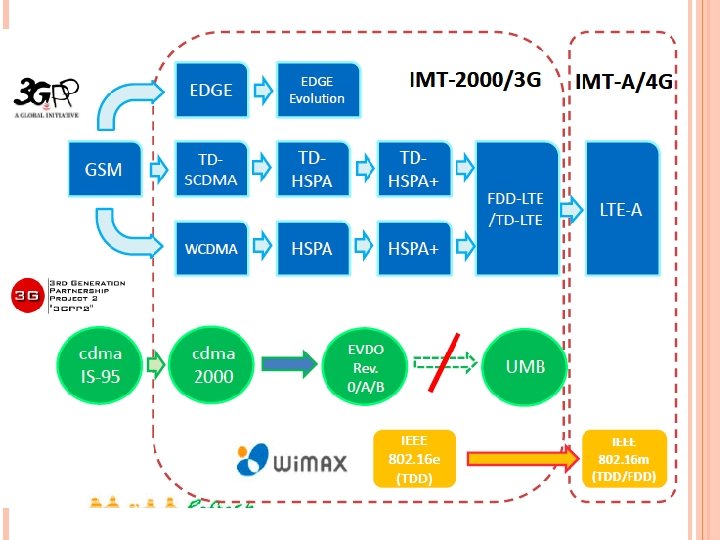
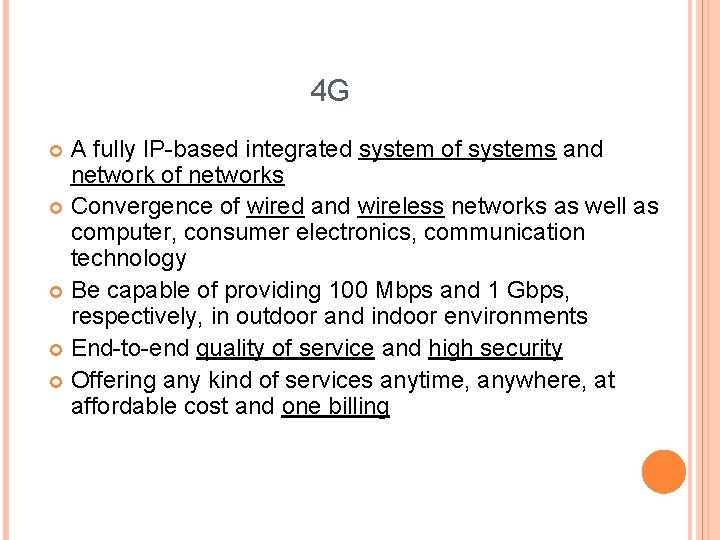
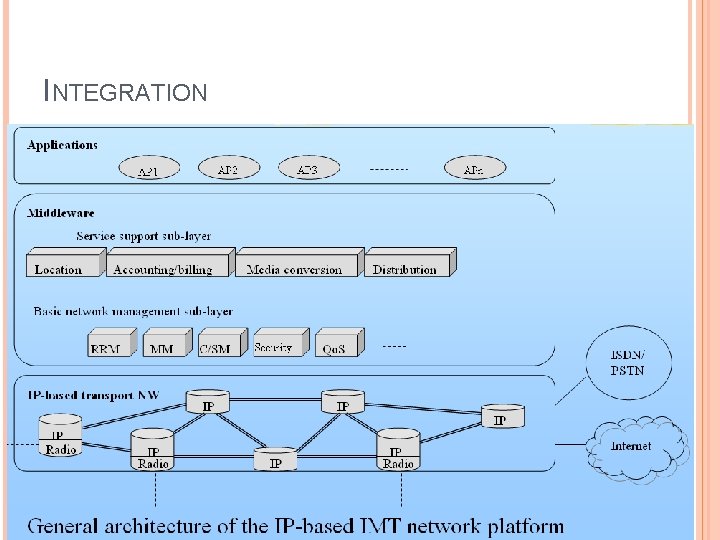
4 G A fully IP-based integrated system of systems and network of networks Convergence of wired and wireless networks as well as computer, consumer electronics, communication technology Be capable of providing 100 Mbps and 1 Gbps, respectively, in outdoor and indoor environments End-to-end quality of service and high security Offering any kind of services anytime, anywhere, at affordable cost and one billing
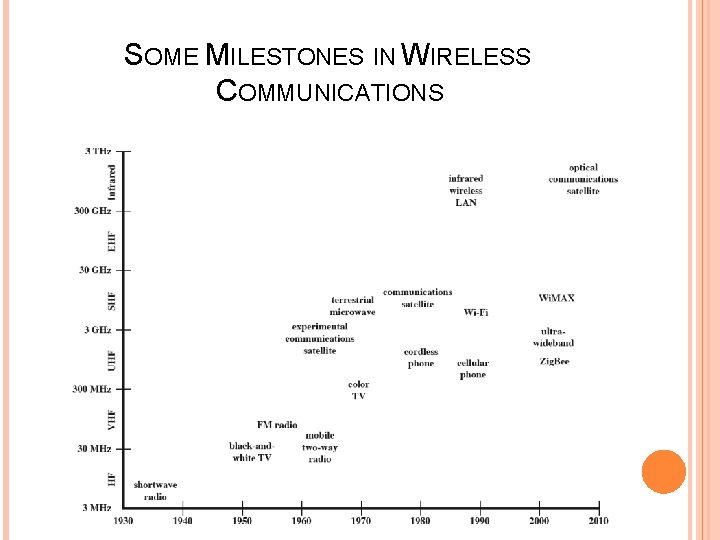
SOME MILESTONES IN WIRELESS COMMUNICATIONS
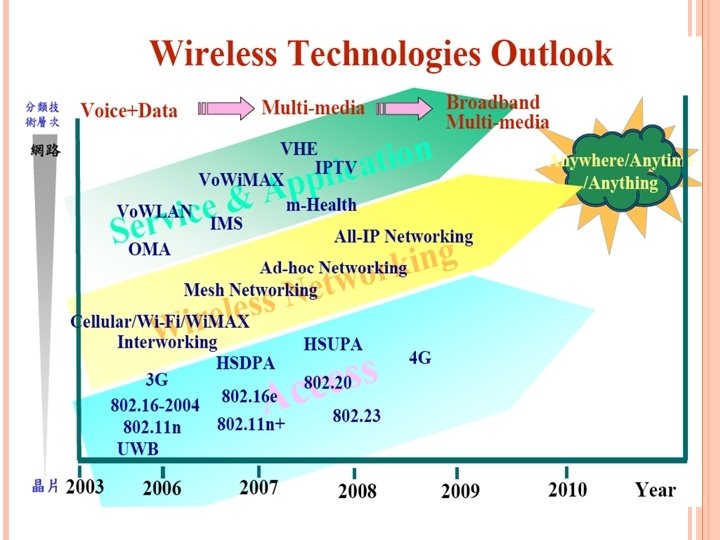
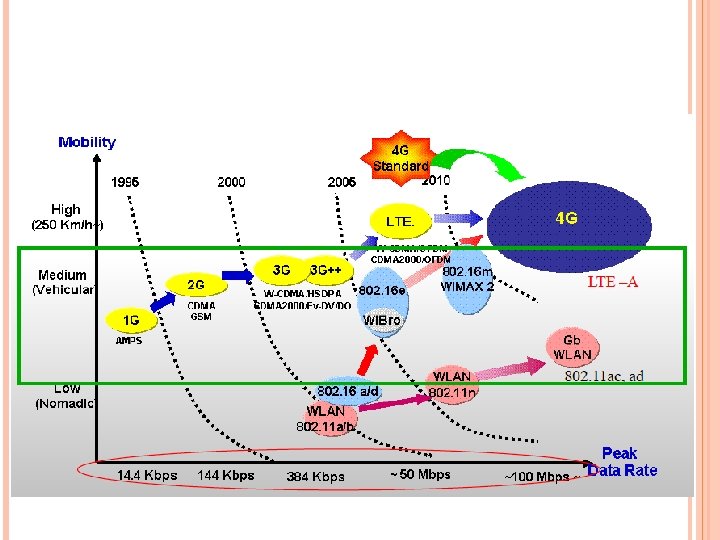
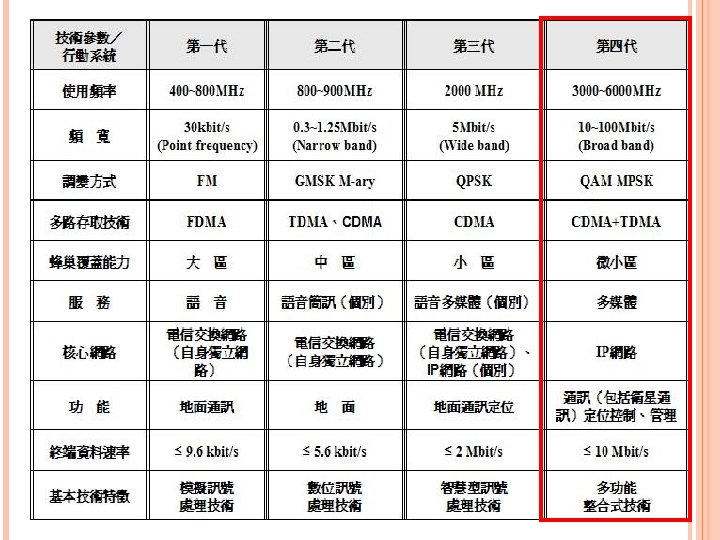
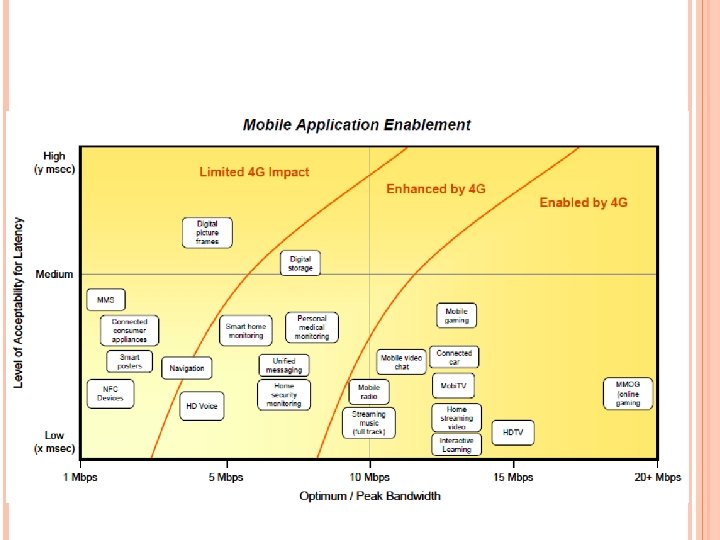
4 G is being developed to accommodate the quality of service (Qo. S) and rate requirements set by forthcoming applications like � wireless broadband access � Multimedia Messaging Service (MMS) � video chat � mobile TV � HDTV content � Digital Video Broadcasting (DVB) � minimal service like voice and data other streaming services for “anytime-anywhere”
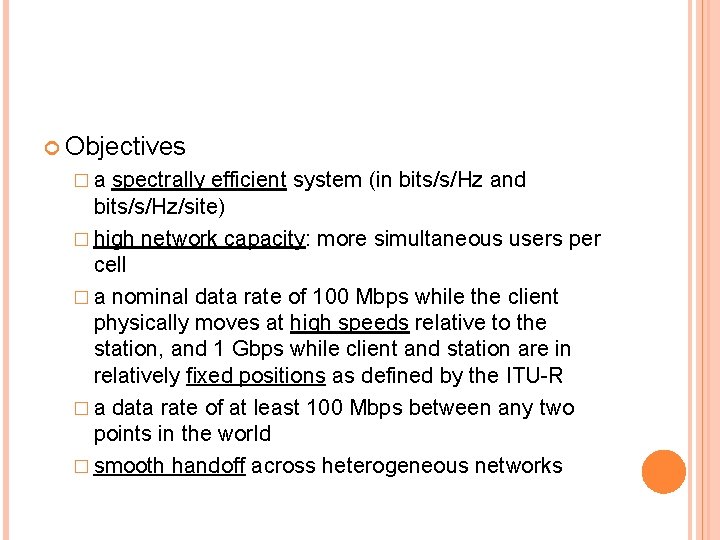
Objectives �a spectrally efficient system (in bits/s/Hz and bits/s/Hz/site) � high network capacity: more simultaneous users per cell � a nominal data rate of 100 Mbps while the client physically moves at high speeds relative to the station, and 1 Gbps while client and station are in relatively fixed positions as defined by the ITU-R � a data rate of at least 100 Mbps between any two points in the world � smooth handoff across heterogeneous networks
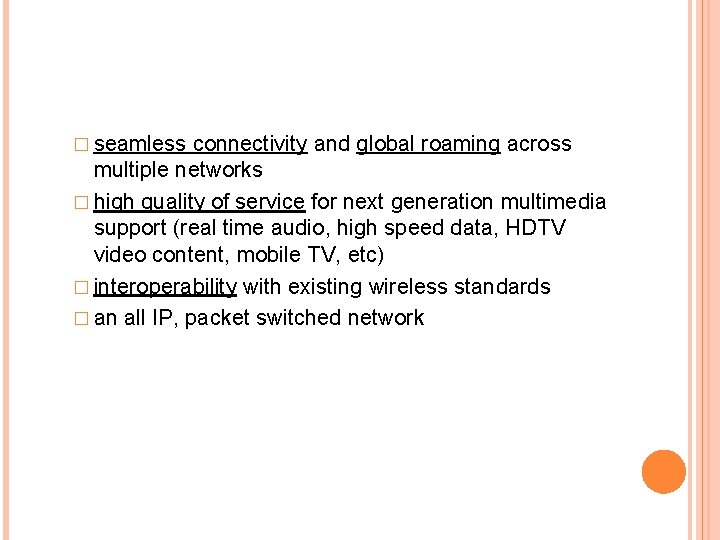
� seamless connectivity and global roaming across multiple networks � high quality of service for next generation multimedia support (real time audio, high speed data, HDTV video content, mobile TV, etc) � interoperability with existing wireless standards � an all IP, packet switched network
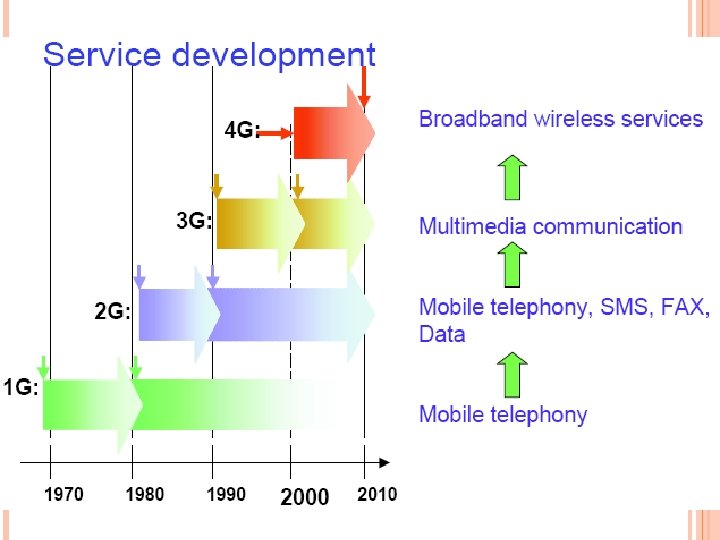
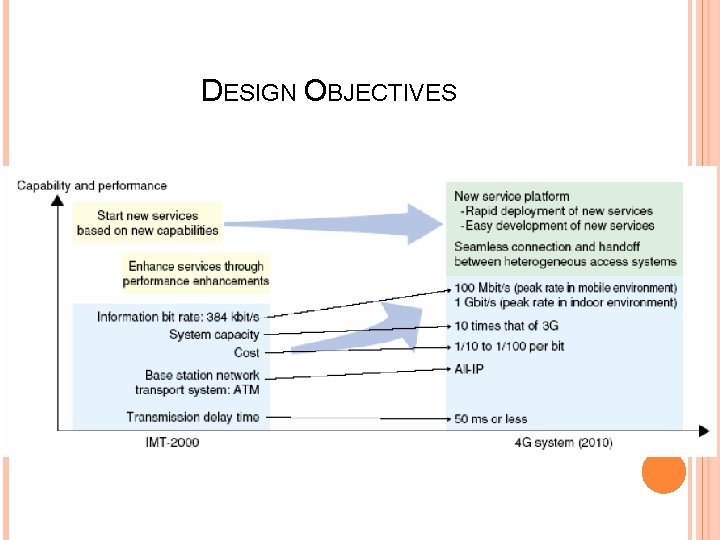
DESIGN OBJECTIVES
4 G concept � supports user driven, user controlled services and context-aware applications User controlled services � user has freedom and flexibility to select any desired service with reasonable Qo. S and affordable price, anytime, anywhere
Context-aware � the applications behavior of the application adapts itself to user context changes � user context includes user profile and preferences user terminal and network capabilities user environment and mobility
Network level concepts � interworking / integration / convergence (cell & WLAN, cell & broadcast) of all existing and emerging fixed and mobile (wired and wireless) networks including broadcast
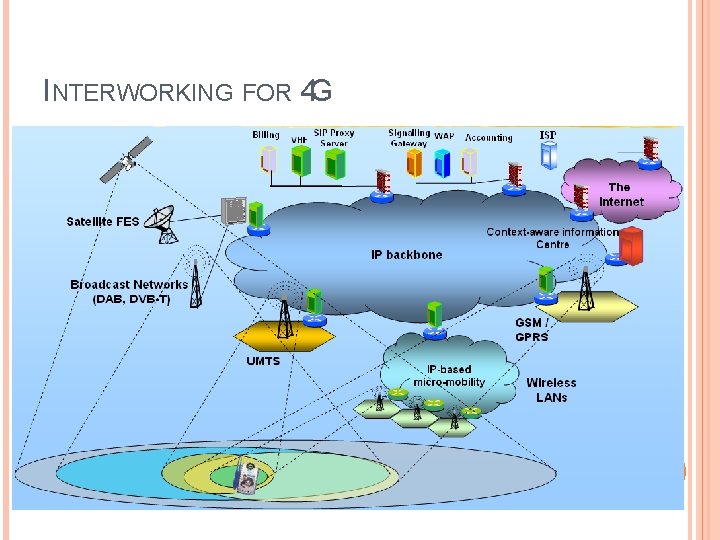
INTERWORKING FOR 4 G
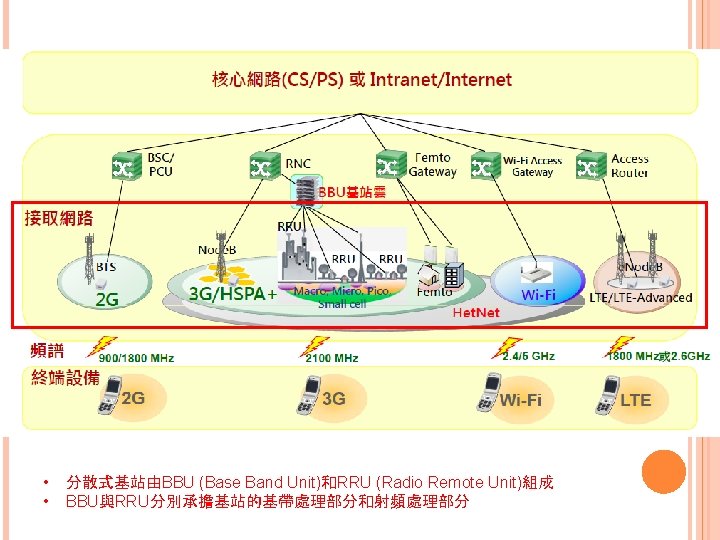
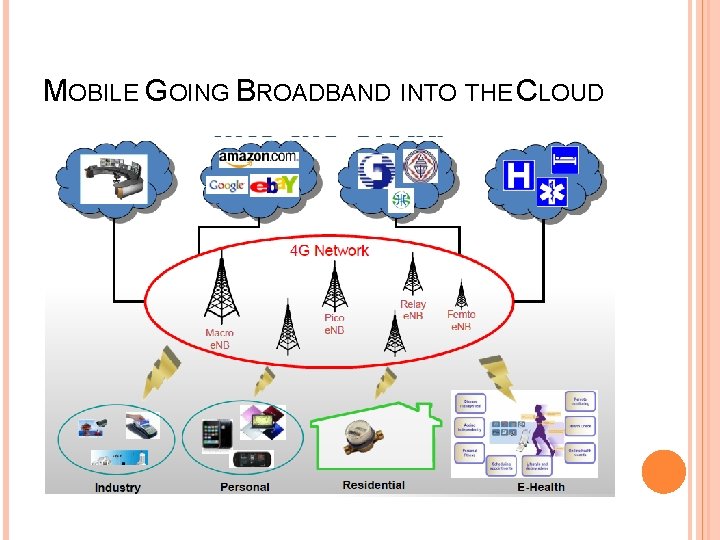
MOBILE GOING BROADBAND INTO THE CLOUD
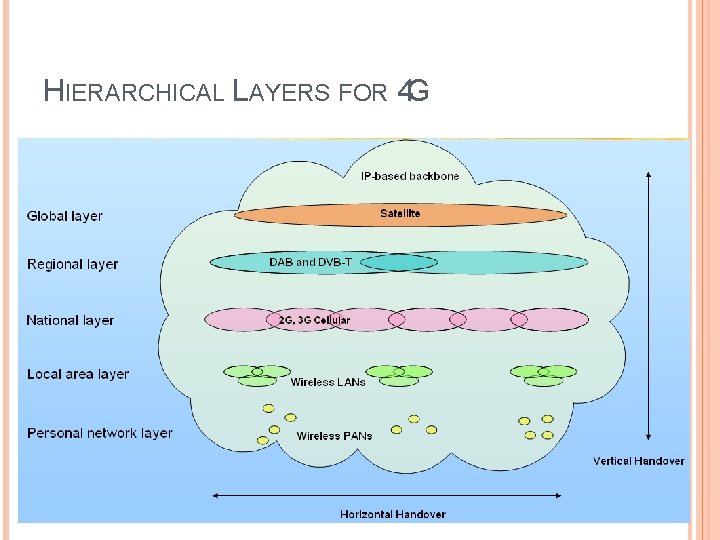
HIERARCHICAL LAYERS FOR 4 G
INTEGRATION
MOBILE INTERNET ACCESS METHODS
- Slides: 174