
Mobile Banking Banks and MNOs partnering to increase
Mobile Banking Banks and MNO’s partnering to increase financial access while reducing costs’ October 2012
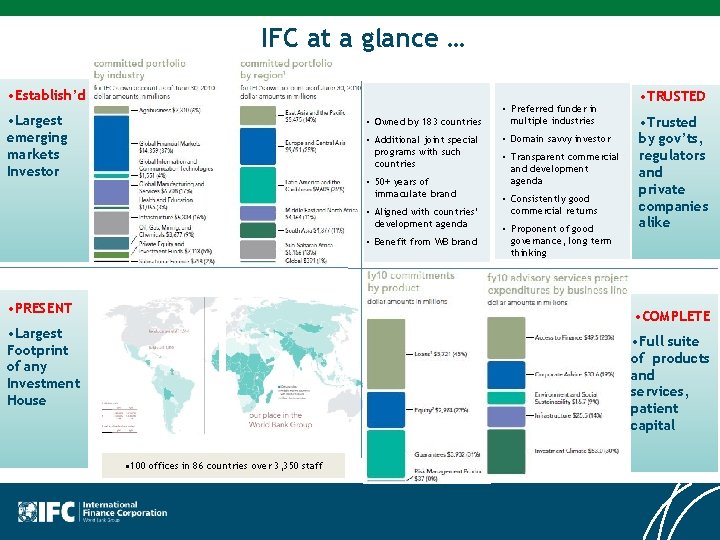
IFC at a glance … • Establish’d • Largest emerging markets Investor • Owned by 183 countries • Additional joint special programs with such countries • 50+ years of immaculate brand • Aligned with countries’ development agenda • Benefit from WB brand • PRESENT • Preferred funder in multiple industries • Domain savvy investor • Transparent commercial and development agenda • Consistently good commercial returns • Proponent of good governance, long term thinking • TRUSTED • Trusted by gov’ts, regulators and private companies alike • COMPLETE • Largest Footprint of any Investment House • Full suite of products and services, patient capital • 100 offices in 86 countries over 3, 350 staff

Definitions • E-banking facilitates the flow of money from one party to another using a communications infrastructure that already connects billions of customers around the world and provides for widespread, low-cost distribution of banking services and products. • The opportunity in E-banking in emerging markets is in mobile banking since mobile phone penetration has far outpaced traditional banking and internet penetration. • ELECTRONIC (E) • E-Money • An electronic alternative to cash which is used for making transactions. • E-Banking • Banking transactions conducted through computerized systems intended to speed operations and reduce costs. It allows bank customers to obtain information and carry out most retail banking services via computer, television, mobile phone or other electronic means. • MOBILE (M) • M-Money • A subset of E-money referring to financial services and transactions made on a mobile phone (may or may not be tied directly to a personal bank account). • M-Banking • Usually involves the connection between a mobile phone and a personal or business bank account. Mobile banking allows customers to use their mobile phones as an alternative channel for banking services such as deposits, withdrawals, account transfers, bill payments and balance inquiry. 3
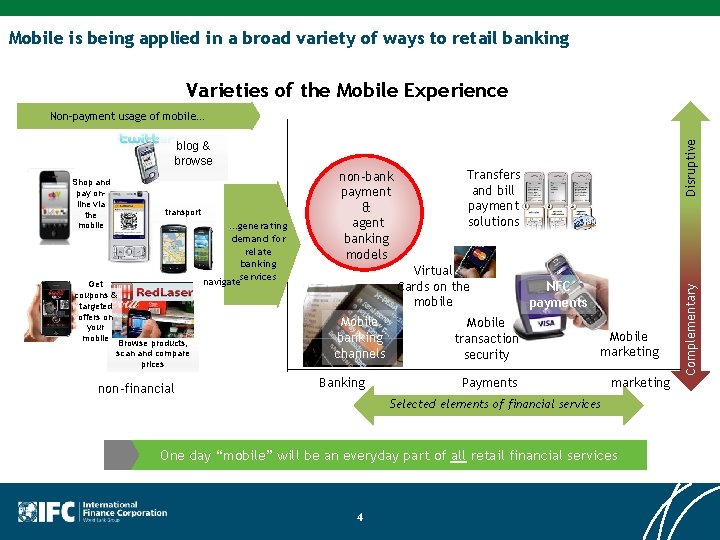
Mobile is being applied in a broad variety of ways to retail banking Varieties of the Mobile Experience Shop and pay online via the mobile transport …generating demand for relate banking services navigate Get coupons & targeted offers on your mobile Browse products, scan and compare prices non-financial non-bank payment & agent banking models Transfers and bill payment solutions Virtual Cards on the mobile Mobile banking channels Banking Mobile transaction security NFC payments Mobile marketing Payments marketing Selected elements of financial services One day “mobile” will be an everyday part of all retail financial services 4 Complementary blog & browse Disruptive Non-payment usage of mobile…

The M-Banking Ecosystem & Products Why are banks and not MNOs central to the MBanking ecosystem? (i) M-Banking is a core activity for banks and not a value added service as it is for MNOs; • Banks (ii) M-Banking offers increased revenue potential for banks but not necessarily for MNOs since they are focused on payments only; and • Regulators (iii) Regulation does not add to the cost structure for banks since it is part of the operating model while MNOs would have to spend large sums of money for regulatory compliance. • MNOs Customers Areas of strategic opportunity for banks include: • Payment Service Providers (a) mobile banking insurance); • Agents/Reta il Networks (credit, savings, (b) mobile commerce (merchant and supply chain payments); and (c) mobile money transfers (P 2 P, remittances, G 2 P, salary payments, bill payments). 5
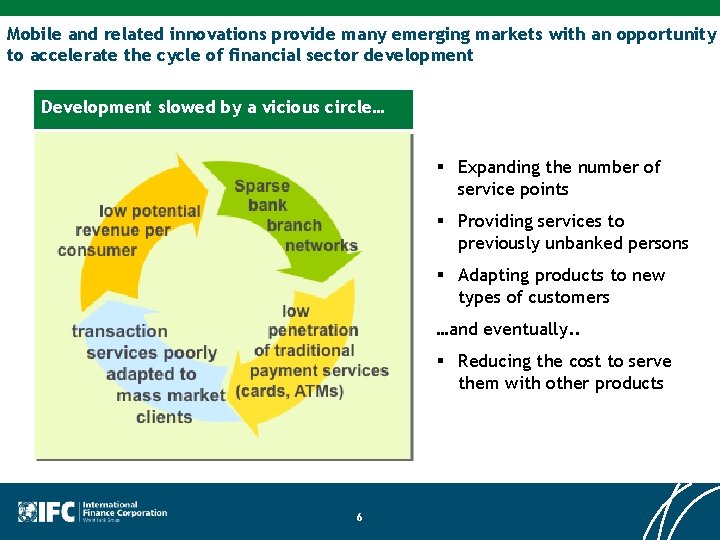
Mobile and related innovations provide many emerging markets with an opportunity to accelerate the cycle of financial sector development Development slowed by a vicious circle… § Expanding the number of service points § Providing services to previously unbanked persons § Adapting products to new types of customers …and eventually. . § Reducing the cost to serve them with other products 6
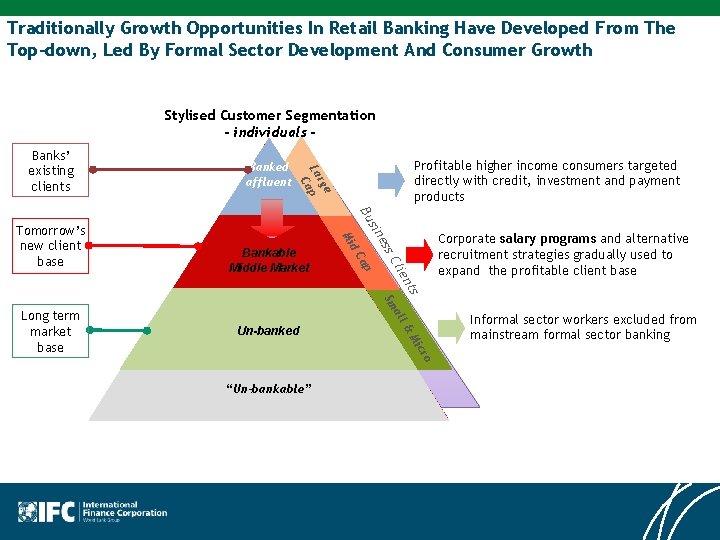
Traditionally Growth Opportunities In Retail Banking Have Developed From The Top-down, Led By Formal Sector Development And Consumer Growth Stylised Customer Segmentation - individuals - ss o cr Mi ts & en all Cli Sm “Un-bankable” ap Un-banked d. C Bankable Middle Market ne si Bu Long term market base Profitable higher income consumers targeted directly with credit, investment and payment products Mi Tomorrow’s new client base Banked affluent e rg La ap C Banks’ existing clients Corporate salary programs and alternative recruitment strategies gradually used to expand the profitable client base Informal sector workers excluded from mainstream formal sector banking
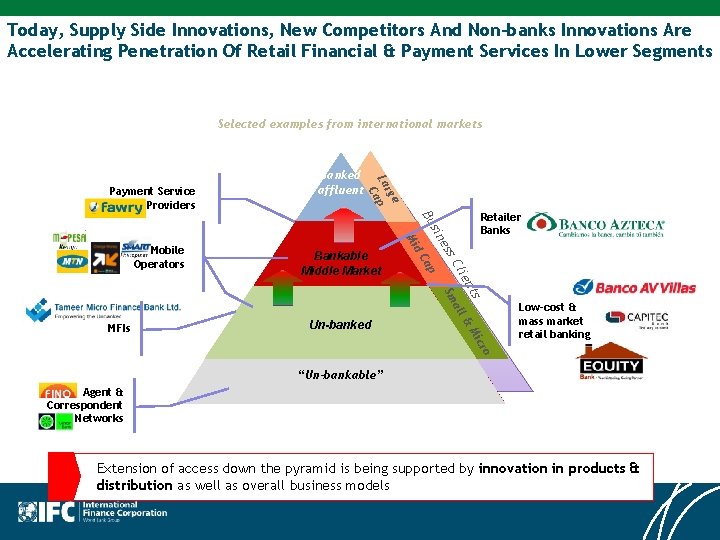
Today, Supply Side Innovations, New Competitors And Non-banks Innovations Are Accelerating Penetration Of Retail Financial & Payment Services In Lower Segments Selected examples from international markets e rg La ap C Payment Service Providers Banked affluent all Sm ts en Cli ap Bankable Middle Market d. C Mi Mobile Operators ss ne si Bu Retailer Banks o cr Mi Un-banked & MFIs Low-cost & mass market retail banking “Un-bankable” Agent & Correspondent Networks Extension of access down the pyramid is being supported by innovation in products & distribution as well as overall business models
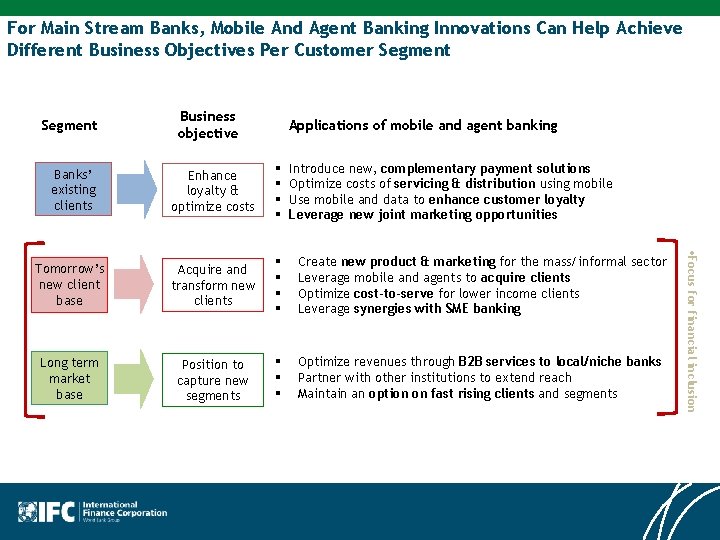
For Main Stream Banks, Mobile And Agent Banking Innovations Can Help Achieve Different Business Objectives Per Customer Segment Business objective Applications of mobile and agent banking Introduce new, complementary payment solutions Optimize costs of servicing & distribution using mobile Use mobile and data to enhance customer loyalty Leverage new joint marketing opportunities Enhance loyalty & optimize costs § § Tomorrow’s new client base Acquire and transform new clients § § Create new product & marketing for the mass/informal sector Leverage mobile and agents to acquire clients Optimize cost-to-serve for lower income clients Leverage synergies with SME banking Long term market base Position to capture new segments § § § Optimize revenues through B 2 B services to local/niche banks Partner with other institutions to extend reach Maintain an option on fast rising clients and segments • Focus for financial inclusion Banks’ existing clients
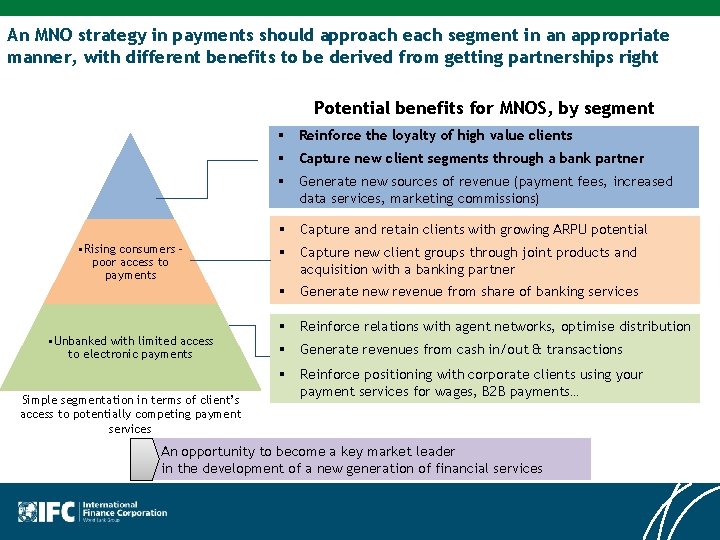
An MNO strategy in payments should approach each segment in an appropriate manner, with different benefits to be derived from getting partnerships right Potential benefits for MNOS, by segment § Reinforce the loyalty of high value clients § Capture new client segments through a bank partner § Generate new sources of revenue (payment fees, increased data services, marketing commissions) § Capture and retain clients with growing ARPU potential • Rising consumers – poor access to • Affluent payments • & banked • Unbanked with limited access to electronic payments Simple segmentation in terms of client’s access to potentially competing payment services § Capture new client groups through joint products and acquisition with a banking partner § Generate new revenue from share of banking services § Reinforce relations with agent networks, optimise distribution § Generate revenues from cash in/out & transactions § Reinforce positioning with corporate clients using your payment services for wages, B 2 B payments… An opportunity to become a key market leader in the development of a new generation of financial services
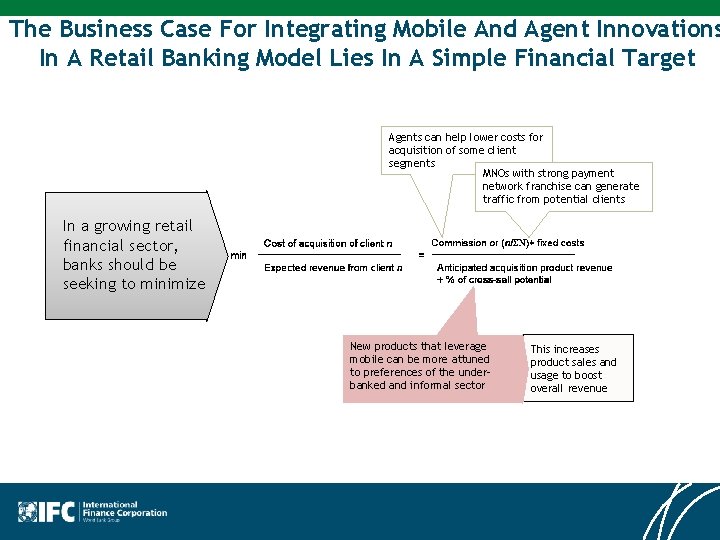
The Business Case For Integrating Mobile And Agent Innovations In A Retail Banking Model Lies In A Simple Financial Target Agents can help lower costs for acquisition of some client segments MNOs with strong payment network franchise can generate traffic from potential clients In a growing retail financial sector, banks should be seeking to minimize New products that leverage mobile can be more attuned to preferences of the underbanked and informal sector This increases product sales and usage to boost overall revenue
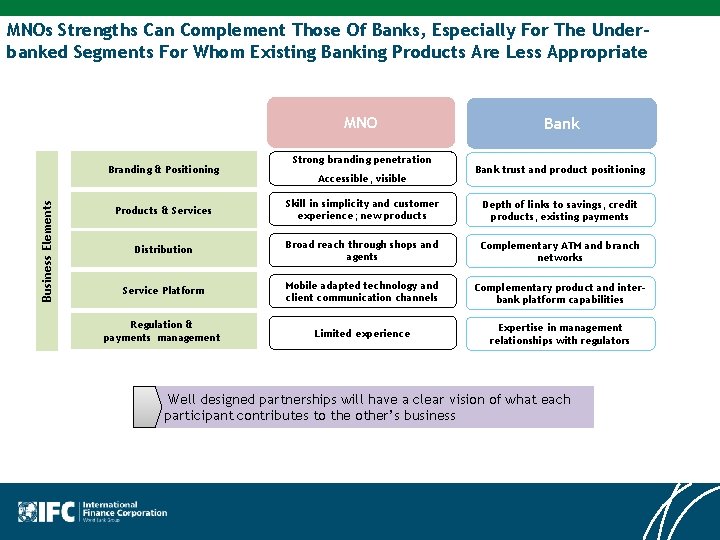
MNOs Strengths Can Complement Those Of Banks, Especially For The Underbanked Segments For Whom Existing Banking Products Are Less Appropriate MNO Business Elements Branding & Positioning Strong branding penetration Accessible, visible Bank trust and product positioning Products & Services Skill in simplicity and customer experience; new products Depth of links to savings, credit products, existing payments Distribution Broad reach through shops and agents Complementary ATM and branch networks Service Platform Mobile adapted technology and client communication channels Complementary product and interbank platform capabilities Regulation & payments management Limited experience Expertise in management relationships with regulators Well designed partnerships will have a clear vision of what each participant contributes to the other’s business
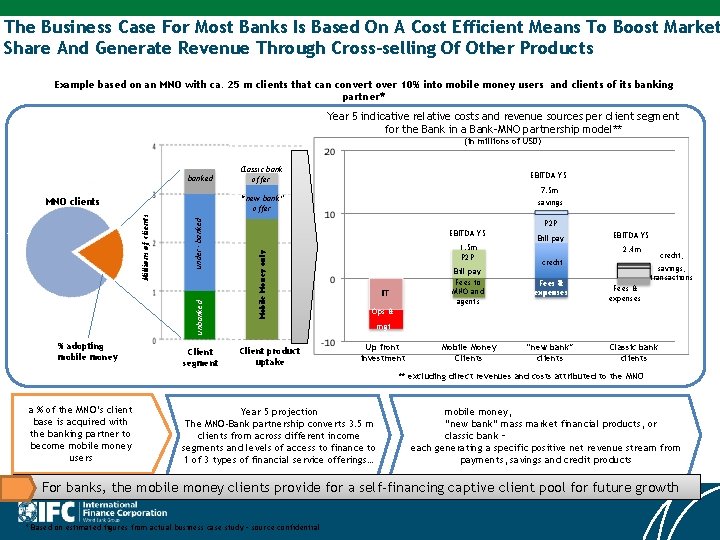
The Business Case For Most Banks Is Based On A Cost Efficient Means To Boost Market Share And Generate Revenue Through Cross-selling Of Other Products Example based on an MNO with ca. 25 m clients that can convert over 10% into mobile money users and clients of its banking partner* Year 5 indicative relative costs and revenue sources per client segment for the Bank in a Bank-MNO partnership model** (in millions of USD) banked EBITDA Y 5 Int’l remit “new bank” offer Client segment EBITDA Y 5 Mobile Money only under- banked unbanked Millions of clients MNO clients % adopting mobile money Classic bank offer 1. 5 m P 2 P IT 7. 5 m savings P 2 P Bill pay EBITDA Y 5 2. 4 m credit Bill pay Fees to MNO and agents Fees & expenses Mobile Money Clients “new bank” clients credit, savings, transactions Fees & expenses Ops & mgt Client product uptake Up front investment Classic bank clients ** excluding direct revenues and costs attributed to the MNO a % of the MNO’s client base is acquired with the banking partner to become mobile money users Year 5 projection The MNO-Bank partnership converts 3. 5 m clients from across different income segments and levels of access to finance to 1 of 3 types of financial service offerings… mobile money, “new bank” mass market financial products, or classic bank – each generating a specific positive net revenue stream from payments, savings and credit products For banks, the mobile money clients provide for a self-financing captive client pool for future growth * Based on estimated figures from actual business case study – source confidential
Contacts Margarete Biallas Global Lead Retail, Payment & Innovation International Finance Corporation Email: mbiallas@ifc. org Liliana Pozzo Senior Operations Officer IFC, Advisory Services in Latin America and the Caribbean International Finance Corporation Email: lpozzo@ifc. org 14
- Slides: 14