
Mobile Azalea Trail History of the Azalea Trail
Mobile Azalea Trail

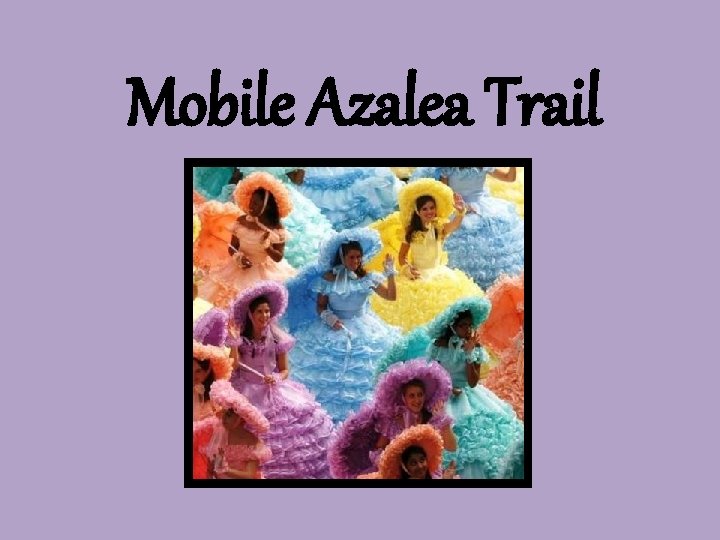
History of the Azalea Trail • The Azalea Trail began in 1929…. It’s an actual trail. • The Mobile Junior Chamber of Commerce (Jaycees) was trying to encourage the citizens of Mobile to plant azalea plants along the streets as a city-wide beautification project. • The lined streets became known as the Azalea Trail. It was originally 37 miles long and was marked by the “Pink Line. ” • People from all over the nation were invited to the cutting of the ribbon which officially opened the trail in February 1929.

What are Azalea Trail Maids? • Originally, the Azalea Trail Maid Court consisted of 10 girls that gathered for only 3 days. • Originally, the Maids could come from anywhere, not just Mobile. This led to the founding of the America’s Junior Miss program in 1958. • Now, the court consists of 50 girls from throughout Mobile County who appear in local and nation wide events throughout a year. • Azalea Trail Maids are considered to be the prime example of southern charm and hospitality. They are the ambassadors of the city.
Mobile History **The name Mobile derives from Mauvila, an Native American tribe that once lived here. ** • 1702 - Mobile was founded by brothers Pierre Le Moyne d’Iberville and Jean-Baptiste Le Moyne de Bienville as Fort Louis de la Louisiane and became French Louisiana’s capital at Twenty. Seven Mile Bluff. • 1711 -Mobile moved to its present location due to flooding. • 1720 - Capital of French Louisiana was moved to Biloxi.
• 1717 -Fort Condé built for settlement and defense • 1763 - The Treaty of Paris signed giving the Louisiana territory to the British • 1780 - In the Battle of Fort Chaplott, the Spanish took control of Mobile. • 1813 - U. S. General James Wilkinson seized Mobile during the War of 1812. • 1814 - Alabama became a state.
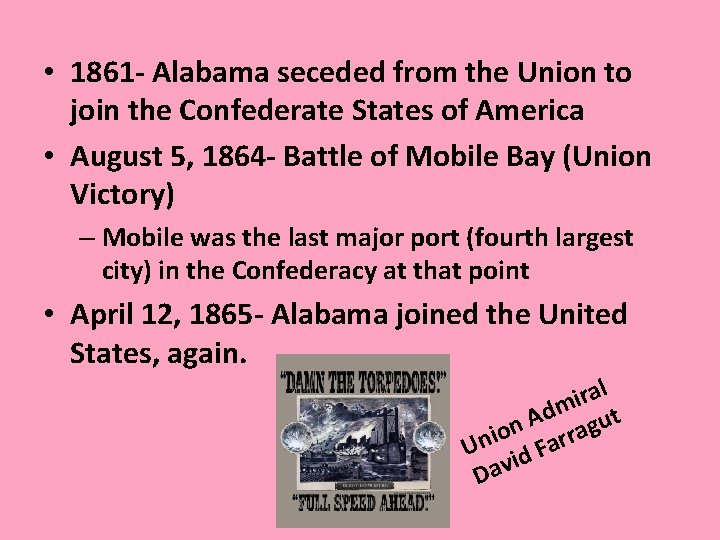
• 1861 - Alabama seceded from the Union to join the Confederate States of America • August 5, 1864 - Battle of Mobile Bay (Union Victory) – Mobile was the last major port (fourth largest city) in the Confederacy at that point • April 12, 1865 - Alabama joined the United States, again. al r i dm ut A n rrag o i Un id Fa Dav
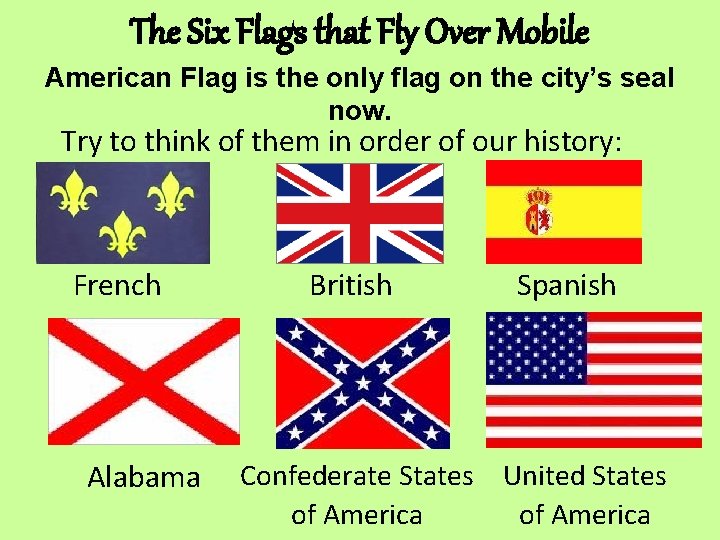
The Six Flags that Fly Over Mobile American Flag is the only flag on the city’s seal now. Try to think of them in order of our history: French Alabama British Spanish Confederate States United States of America

State Emblems State bird– Yellow hammer State flower—Camellia State tree– Longleaf pine State nut—Pecan State motto– “We Dare Defend Our Rights” State song– “Alabama” (from a poem written by Julia Tutwiler in 1931) (unofficially “Sweet Home Alabama” by Lynard Skynard) • Capital—Montgomery • Helen Keller was featured on the Alabama coin in 2003. • • •
• January Mobile’s Schedule of Events – Dollar General Bowl – Reese’s Senior Bowl • February – Mardi Gras • March – Azalea Trail Run – Historic Homes Tour – Festival of Flowers • April – Dauphin Island Regatta • July – Grand Bay Watermelon Festival – Alabama Deep Sea Fishing Rodeo • October – Greater Gulf State Fair • November – International Festival – Greek. Fest – Pecan Festival • December – • May – – Blessing of the Fleet – – LPGA Tournament – • June – – Distinguished Young Woman Finals Candlelight Christmas at Oakleigh Christmas at Richard’s DAR House Bellingrath’s Magic Christmas in Lights Riverside Ice Moonpie over Mobile (New Year’s Eve)
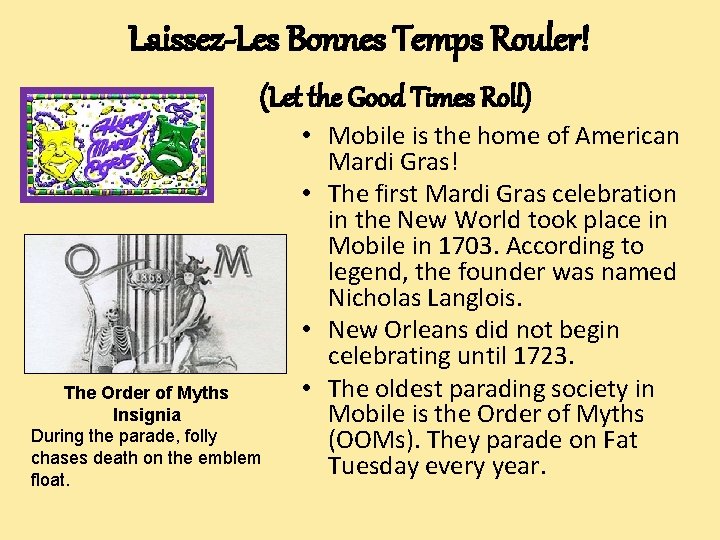
Laissez-Les Bonnes Temps Rouler! (Let the Good Times Roll) The Order of Myths Insignia During the parade, folly chases death on the emblem float. • Mobile is the home of American Mardi Gras! • The first Mardi Gras celebration in the New World took place in Mobile in 1703. According to legend, the founder was named Nicholas Langlois. • New Orleans did not begin celebrating until 1723. • The oldest parading society in Mobile is the Order of Myths (OOMs). They parade on Fat Tuesday every year.
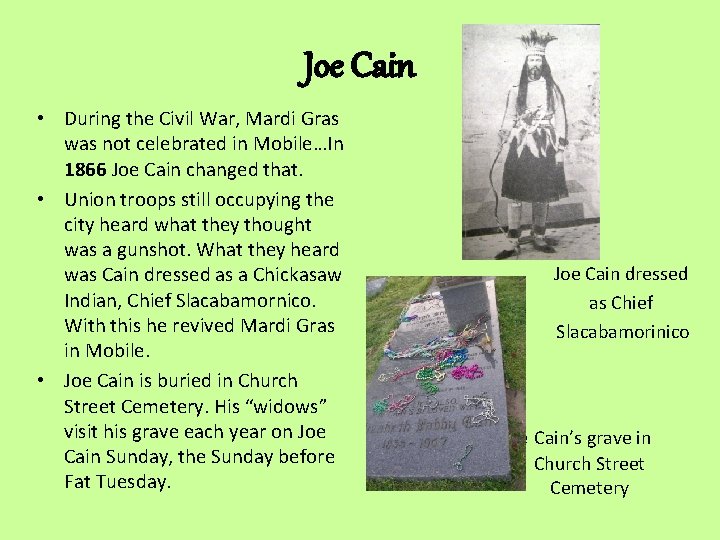
Joe Cain • During the Civil War, Mardi Gras was not celebrated in Mobile…In 1866 Joe Cain changed that. • Union troops still occupying the city heard what they thought was a gunshot. What they heard was Cain dressed as a Chickasaw Indian, Chief Slacabamornico. With this he revived Mardi Gras in Mobile. • Joe Cain is buried in Church Street Cemetery. His “widows” visit his grave each year on Joe Cain Sunday, the Sunday before Fat Tuesday. Joe Cain dressed as Chief Slacabamorinico Joe Cain’s grave in Church Street Cemetery

Mobile’s Historic Districts • Oakleigh Garden District: Lies along and south of Government Street; One of the largest historic districts, it includes the following: – Washington Square Park – Many homes built in the late 1800 – Oakleigh Period House Museum Complex • Old Dauphin Way Historic District: Covers a large area of midtown bounded by Springhill Avenue, Houston, Broad, and Government Streets • Campground Historic District: Located in the vicinity of Dr. Martin Luther King, Jr. Avenue and Rylands Lane; the most recent to be designated a historic district
Districts continued… • Leinkauf Historic District: Bounded by Government, Eslava, Lamar, and Monterey Streets; The centerpiece is Leinkauf Elementary School (1904) • Ashland Place Historic District: Bounded by Springhill Avenue, Ryan and Levert Avenues, and Old Shell Road; Includes Ashland Place fire station and the Visitation Monastery Convent (1855) • Midtown Historic District: Roughly bounded by Springhil Avenue, Houston, Florida, and Government Streets; Includes Murphy High School • De. Tonti Square Historic District: Located in the northern part of downtown near Water Street; Many of the structures show intricate iron-work on balconies, including the Richards-DAR House
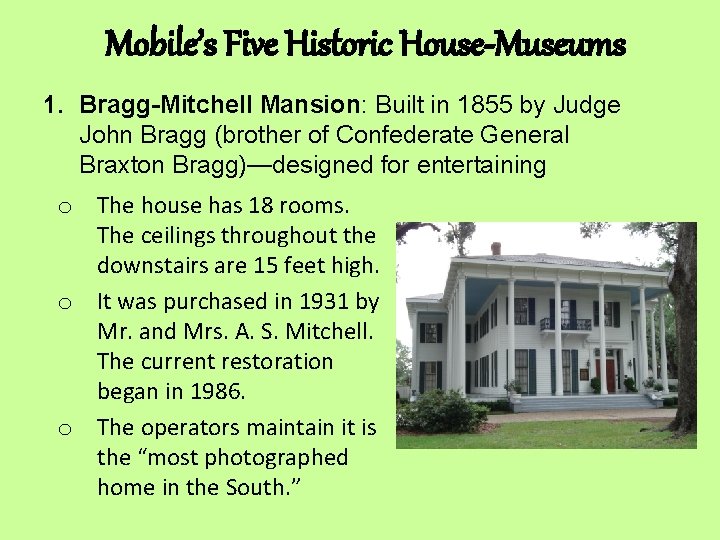
Mobile’s Five Historic House-Museums 1. Bragg-Mitchell Mansion: Built in 1855 by Judge John Bragg (brother of Confederate General Braxton Bragg)—designed for entertaining o The house has 18 rooms. The ceilings throughout the downstairs are 15 feet high. o It was purchased in 1931 by Mr. and Mrs. A. S. Mitchell. The current restoration began in 1986. o The operators maintain it is the “most photographed home in the South. ”
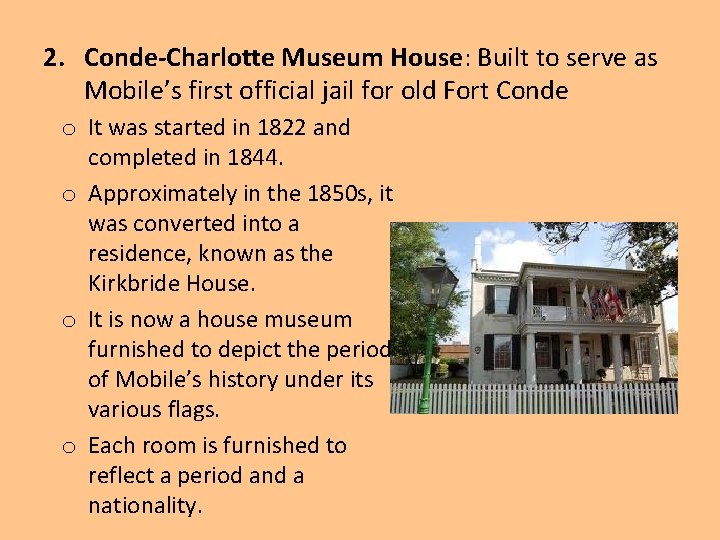
2. Conde-Charlotte Museum House: Built to serve as Mobile’s first official jail for old Fort Conde o It was started in 1822 and completed in 1844. o Approximately in the 1850 s, it was converted into a residence, known as the Kirkbride House. o It is now a house museum furnished to depict the periods of Mobile’s history under its various flags. o Each room is furnished to reflect a period and a nationality.
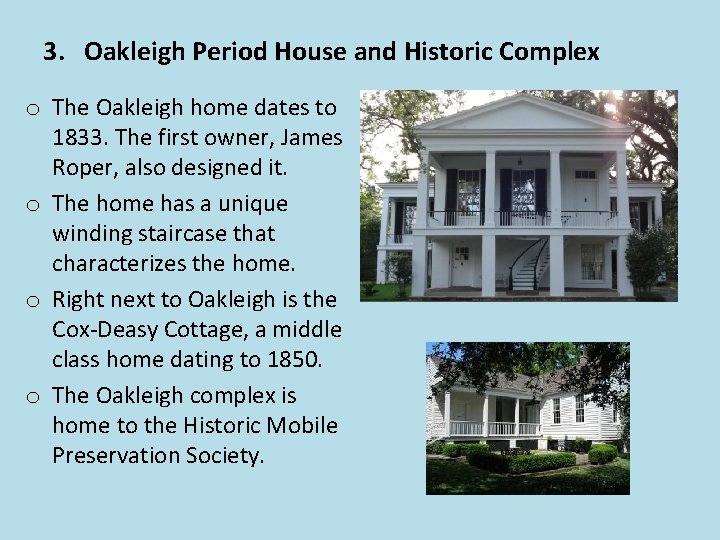
3. Oakleigh Period House and Historic Complex o The Oakleigh home dates to 1833. The first owner, James Roper, also designed it. o The home has a unique winding staircase that characterizes the home. o Right next to Oakleigh is the Cox-Deasy Cottage, a middle class home dating to 1850. o The Oakleigh complex is home to the Historic Mobile Preservation Society.
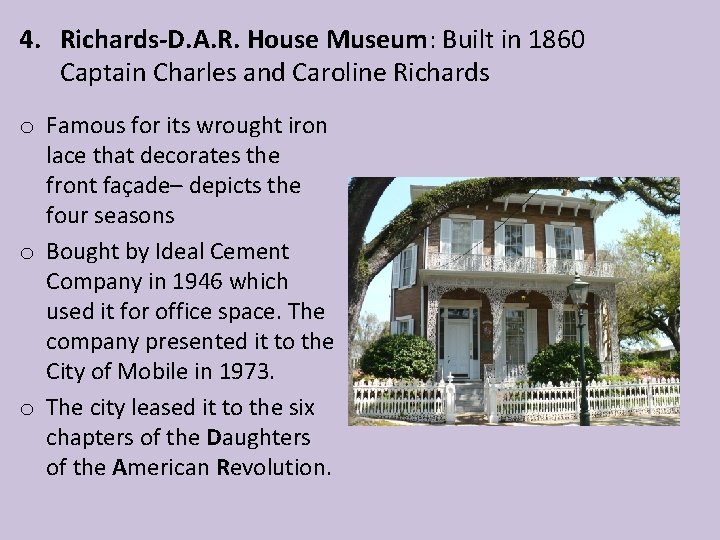
4. Richards-D. A. R. House Museum: Built in 1860 Captain Charles and Caroline Richards o Famous for its wrought iron lace that decorates the front façade– depicts the four seasons o Bought by Ideal Cement Company in 1946 which used it for office space. The company presented it to the City of Mobile in 1973. o The city leased it to the six chapters of the Daughters of the American Revolution.

5. Carlen House Museum: Located on the campus of Murphy High School o 19 th century rural farmhouse o Depicts a “simpler time” in its displays of period furnishings, tools, clothing, toiletries, table-settings, and other mementoes from the period
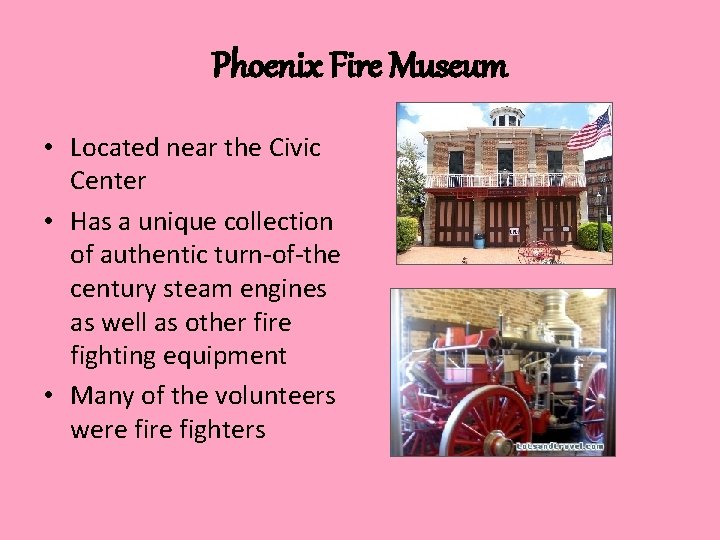
Phoenix Fire Museum • Located near the Civic Center • Has a unique collection of authentic turn-of-the century steam engines as well as other fire fighting equipment • Many of the volunteers were fighters
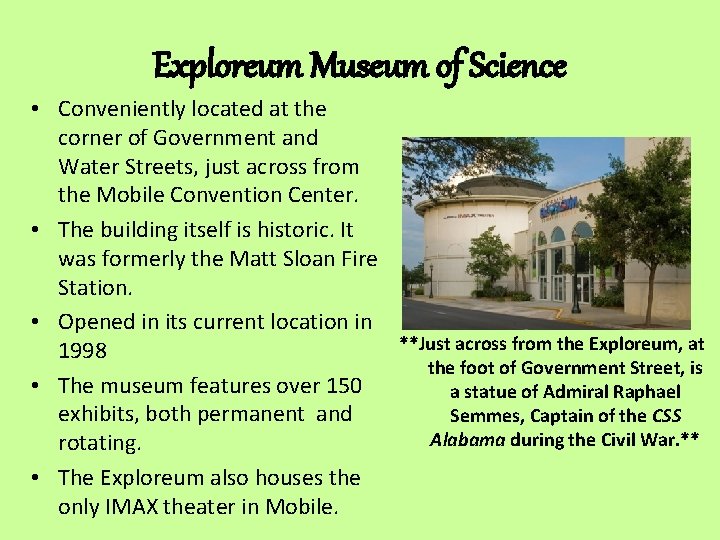
Exploreum Museum of Science • Conveniently located at the corner of Government and Water Streets, just across from the Mobile Convention Center. • The building itself is historic. It was formerly the Matt Sloan Fire Station. • Opened in its current location in **Just across from the Exploreum, at 1998 the foot of Government Street, is • The museum features over 150 a statue of Admiral Raphael exhibits, both permanent and Semmes, Captain of the CSS Alabama during the Civil War. ** rotating. • The Exploreum also houses the only IMAX theater in Mobile.
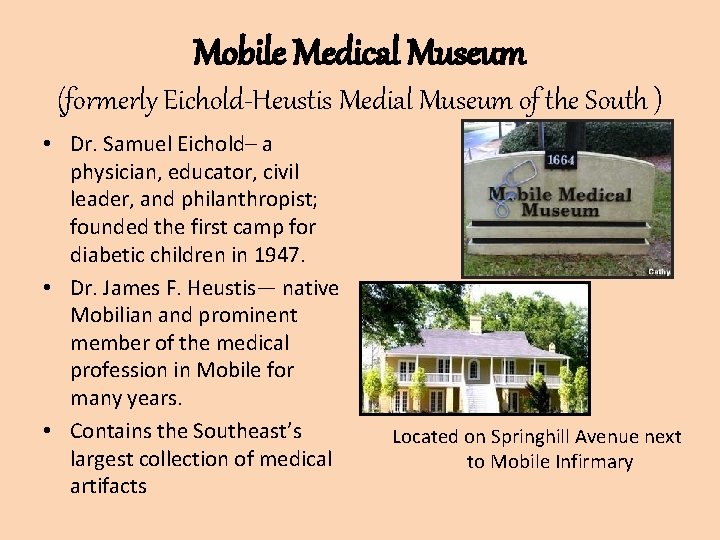
Mobile Medical Museum (formerly Eichold-Heustis Medial Museum of the South ) • Dr. Samuel Eichold– a physician, educator, civil leader, and philanthropist; founded the first camp for diabetic children in 1947. • Dr. James F. Heustis— native Mobilian and prominent member of the medical profession in Mobile for many years. • Contains the Southeast’s largest collection of medical artifacts Located on Springhill Avenue next to Mobile Infirmary
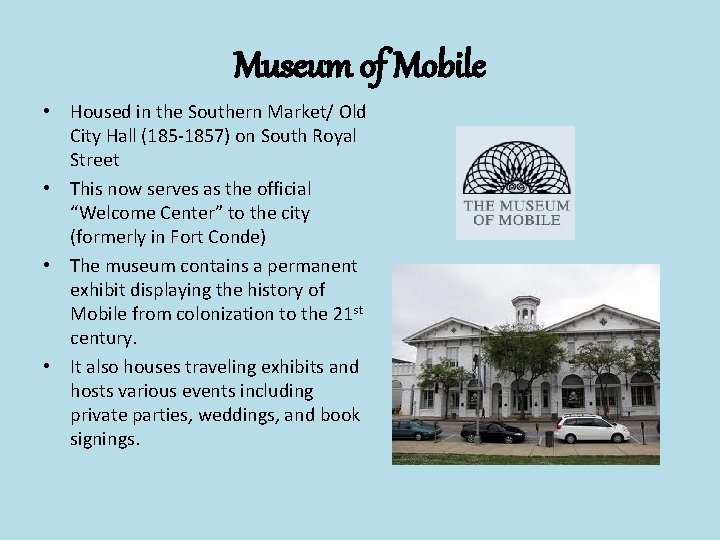
Museum of Mobile • Housed in the Southern Market/ Old City Hall (185 -1857) on South Royal Street • This now serves as the official “Welcome Center” to the city (formerly in Fort Conde) • The museum contains a permanent exhibit displaying the history of Mobile from colonization to the 21 st century. • It also houses traveling exhibits and hosts various events including private parties, weddings, and book signings.

Mobile Carnival Museum • Opened in 2005 • Located on Government Boulevard in the historic Bernstein-Bush home. • The museum has three levels and features 14 gallery rooms, a pictorial hallway, theater, gathering den, and gift shop. • The museum displays various monarchs’ gowns, costumes, crowns, and scepters. It also features videos on costume design, coronations, float construction, and past parades.
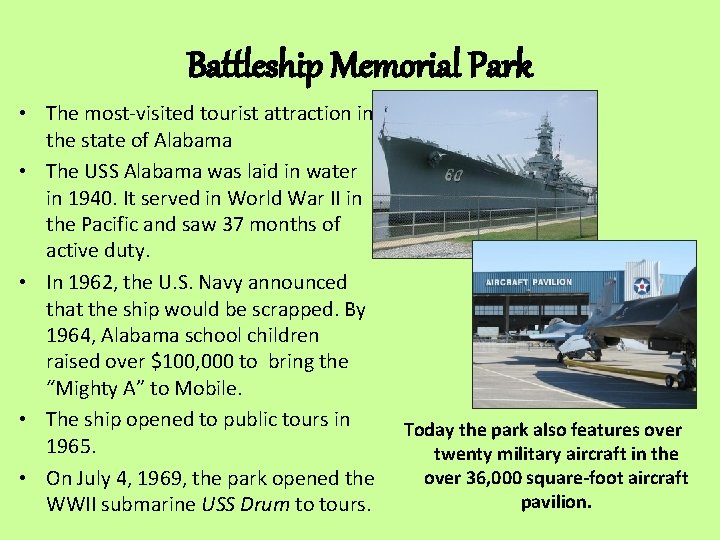
Battleship Memorial Park • The most-visited tourist attraction in the state of Alabama • The USS Alabama was laid in water in 1940. It served in World War II in the Pacific and saw 37 months of active duty. • In 1962, the U. S. Navy announced that the ship would be scrapped. By 1964, Alabama school children raised over $100, 000 to bring the “Mighty A” to Mobile. • The ship opened to public tours in 1965. • On July 4, 1969, the park opened the WWII submarine USS Drum to tours. Today the park also features over twenty military aircraft in the over 36, 000 square-foot aircraft pavilion.

Mobile Museum of Art • Opened on September 6, 2002 • Largest art museum along the Gulf Coast from New Orleans to Tampa • Overlooks Mobile’s Langan Park, across the street from the Playhouse in the Park • Home to the Pallette Cafe
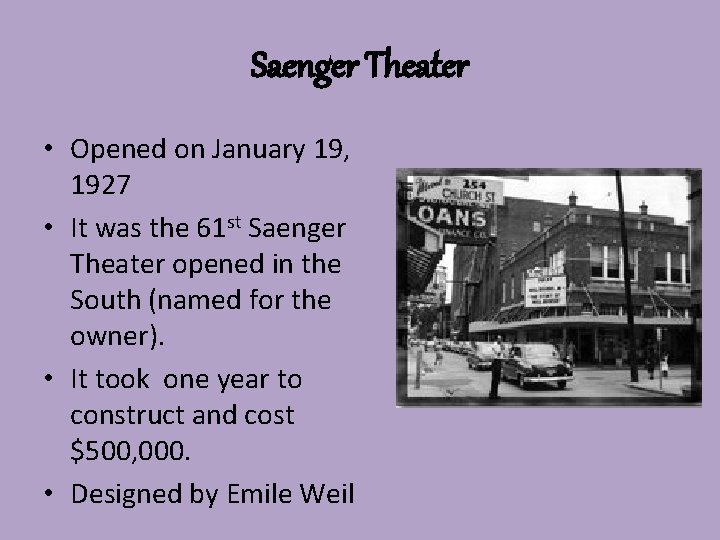
Saenger Theater • Opened on January 19, 1927 • It was the 61 st Saenger Theater opened in the South (named for the owner). • It took one year to construct and cost $500, 000. • Designed by Emile Weil
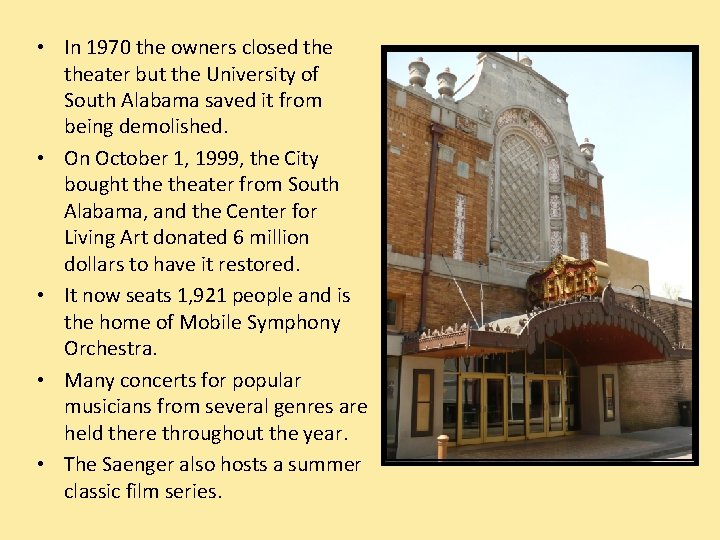
• In 1970 the owners closed theater but the University of South Alabama saved it from being demolished. • On October 1, 1999, the City bought theater from South Alabama, and the Center for Living Art donated 6 million dollars to have it restored. • It now seats 1, 921 people and is the home of Mobile Symphony Orchestra. • Many concerts for popular musicians from several genres are held there throughout the year. • The Saenger also hosts a summer classic film series.
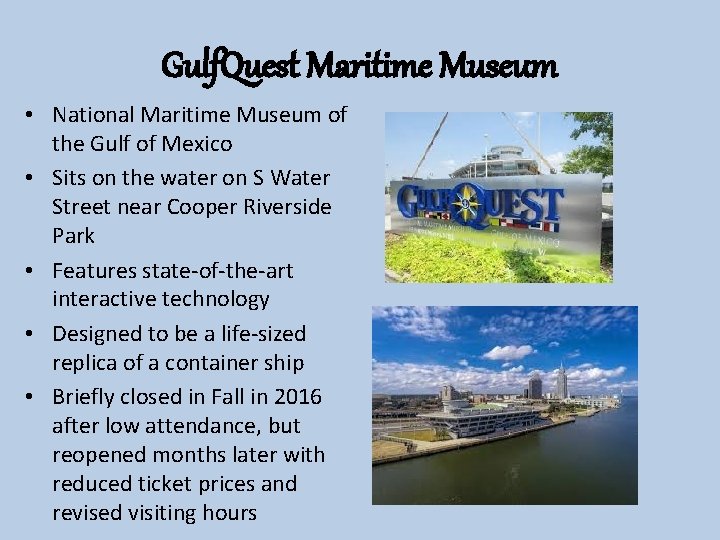
Gulf. Quest Maritime Museum • National Maritime Museum of the Gulf of Mexico • Sits on the water on S Water Street near Cooper Riverside Park • Features state-of-the-art interactive technology • Designed to be a life-sized replica of a container ship • Briefly closed in Fall in 2016 after low attendance, but reopened months later with reduced ticket prices and revised visiting hours

Mardi Gras Park • • Opened in November 2016 Located at the corner of Royal and Church Streets Currently open grassy area; Phase II of the project will bring a large pavilion for markets Statues that surround the park: – MCA King and Queen (Church Street Side) – MAMGA King and Queen (Government Street Side) – Chief Slacabamorinco (Corner of Royal and Church Streets) – Pair of Jesters (Royal Street Entrance) – A trumpeter (Corner of Government and Royal Streets)

Education in Mobile Colleges in Mobile Include Bishop State Community College Capp’s College Faulkner University Southeast College of Technology Spring Hill College University of Mobile University of South Alabama Barton Academy Building on Government Street Built in the 1830 s, Barton Academy was the first public school in Alabama. It also served as the facilities for the Mobile County School System school board until 2007. Mobile has over 100 school buildings and has 398, 000 students enrolled in public school.
Mobile’s Sister Cities • • Havana, Cuba Cockburn, Australia Pau, France Worms, Germany Gaeta, Italy Ichihara, Japan Veracruz, Mexico Malaga, Spain • • Gianjin, China Bolinao, Phillippines Katowice, Poland Constanta, Romania Košice, Slovakia King Shaka, South Africa Pyeongtaek, South Korea
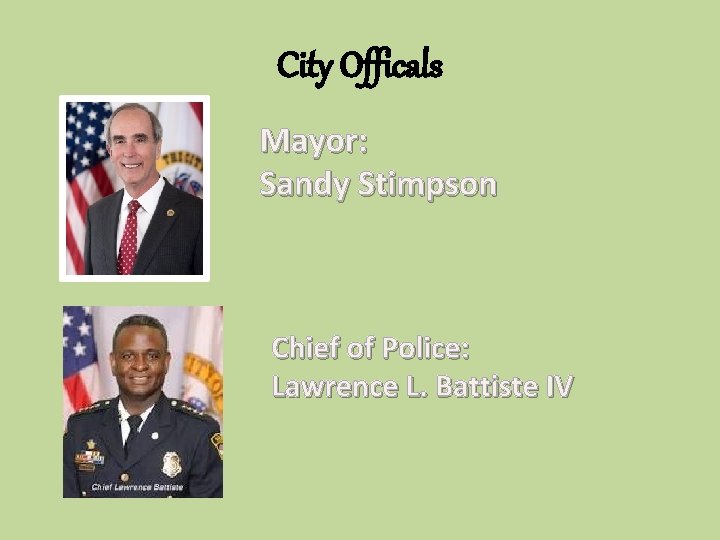
City Officals Mayor: Sandy Stimpson Chief of Police: Lawrence L. Battiste IV
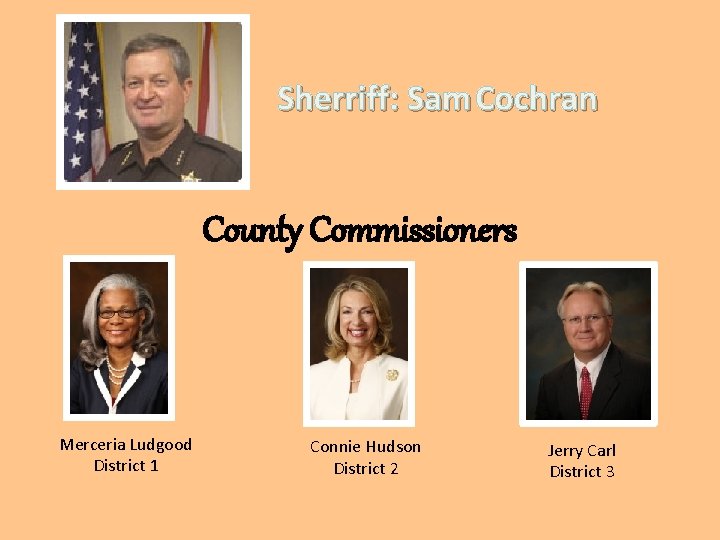
Sherriff: Sam Cochran County Commissioners Merceria Ludgood District 1 Connie Hudson District 2 Jerry Carl District 3
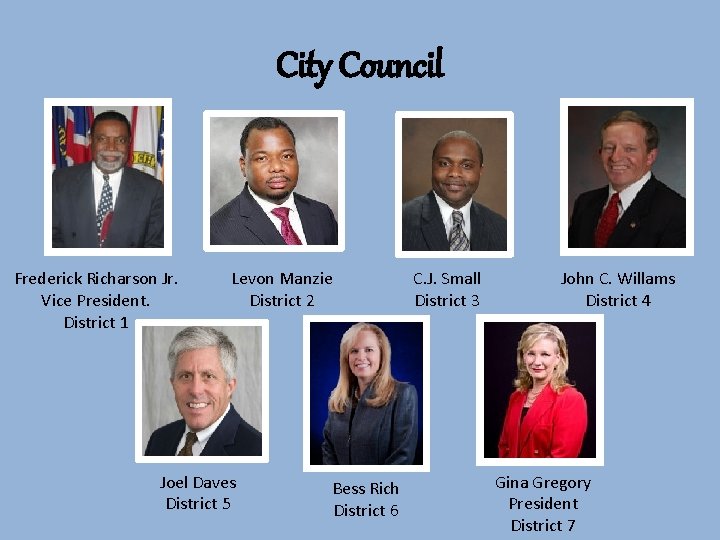
City Council Frederick Richarson Jr. Vice President. District 1 Levon Manzie District 2 Joel Daves District 5 Bess Rich District 6 C. J. Small District 3 John C. Willams District 4 Gina Gregory President District 7
City of Mobile Mission Statement We respect the dignity and worth of our citizens and value the diversity of culture, heritage, and history within our community. We pledge to strive to improve the quality of life and opportunity for economic prosperity of all our residents by working to attract more visitors and industries and assuring all of our citizens a clean, safe, economically viable and progressive city that is responsive to changing needs.
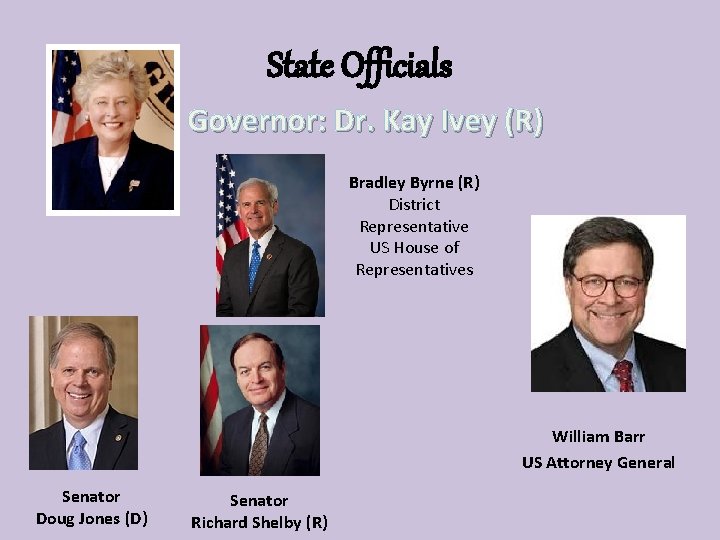
State Officials Governor: Dr. Kay Ivey (R) Bradley Byrne (R) District Representative US House of Representatives William Barr US Attorney General Senator Doug Jones (D) Senator Richard Shelby (R)

National Political Officials Donald Trump 45 th US President Mike Pompeo Secretary of State Mike Pence Vice President Nancy Pelosi Speaker of the House
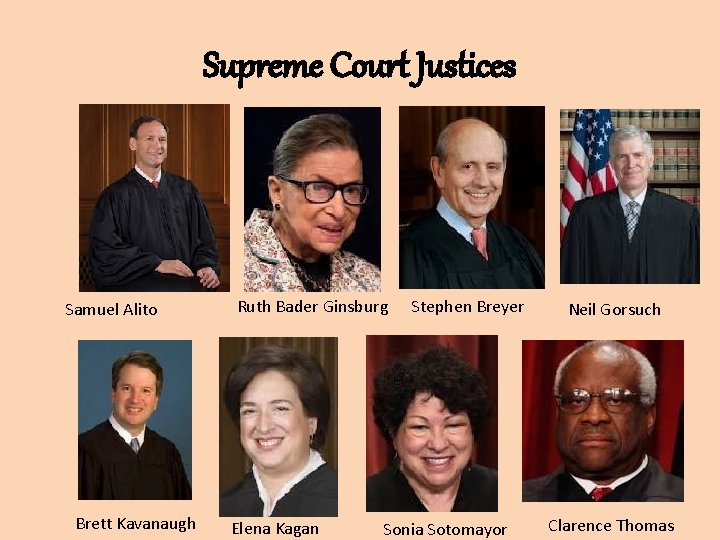
Supreme Court Justices Samuel Alito Brett Kavanaugh Ruth Bader Ginsburg Elena Kagan Stephen Breyer Sonia Sotomayor Neil Gorsuch Clarence Thomas
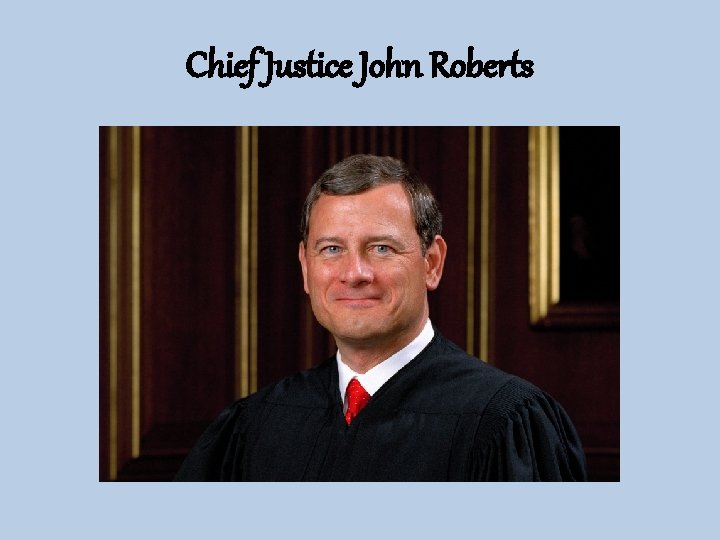
Chief Justice John Roberts
- Slides: 39