
Mobile and Pervasive Computing 7 Internet of Things
Mobile and Pervasive Computing - 7 Internet of Things in 5 G Presented by: Dr. Adeel Akram University of Engineering and Technology, Taxila, Pakistan http: //web. uettaxila. edu. pk/CMS/AUT 2015/te. MPCms
Outline Wireless Communication Standardization Forums 5 G Standardization 5 G Promises 5 G Requirements User Experience System Performance Device Requirements Enhanced Services Business Model Management & Operation Internet of Things From Research and Innovation to Market Deployment References 2
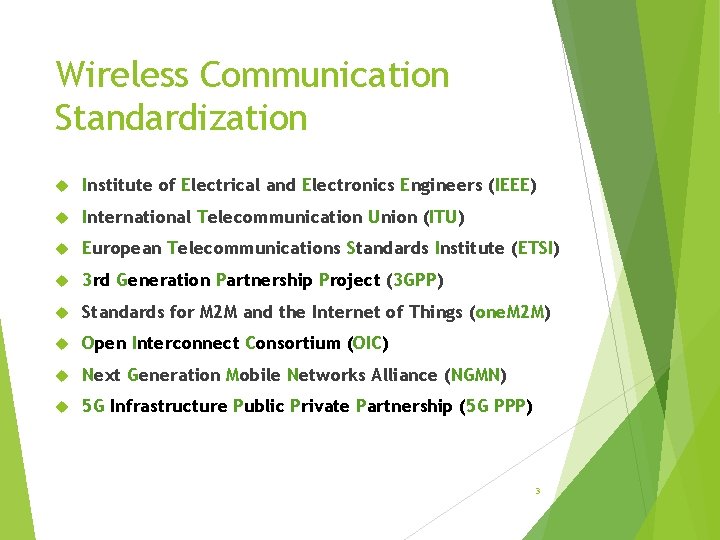
Wireless Communication Standardization Institute of Electrical and Electronics Engineers (IEEE) International Telecommunication Union (ITU) European Telecommunications Standards Institute (ETSI) 3 rd Generation Partnership Project (3 GPP) Standards for M 2 M and the Internet of Things (one. M 2 M) Open Interconnect Consortium (OIC) Next Generation Mobile Networks Alliance (NGMN) 5 G Infrastructure Public Private Partnership (5 G PPP) 3
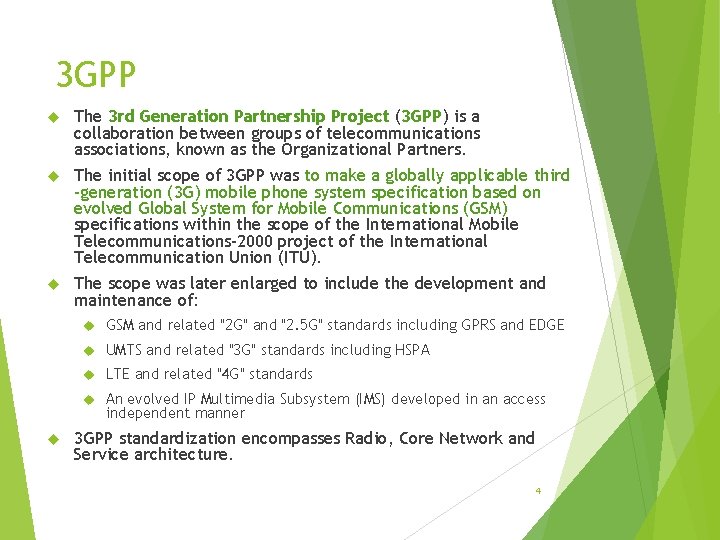
3 GPP The 3 rd Generation Partnership Project (3 GPP) is a collaboration between groups of telecommunications associations, known as the Organizational Partners. The initial scope of 3 GPP was to make a globally applicable third -generation (3 G) mobile phone system specification based on evolved Global System for Mobile Communications (GSM) specifications within the scope of the International Mobile Telecommunications-2000 project of the International Telecommunication Union (ITU). The scope was later enlarged to include the development and maintenance of: GSM and related "2 G" and "2. 5 G" standards including GPRS and EDGE UMTS and related "3 G" standards including HSPA LTE and related "4 G" standards An evolved IP Multimedia Subsystem (IMS) developed in an access independent manner 3 GPP standardization encompasses Radio, Core Network and Service architecture. 4
5 G Standardization 5 G White Paper by NGMA Alliance v. 1. 0 released on 17 -February-2015 Endorsed by the NGMN Board Members 5 G Vision Requirements Technology and Architecture Spectrum Intellectual Property Rights (IPR) Way Forward “ 5 G is an end-to-end ecosystem to enable a fully mobile and connected society. It empowers value creation towards customers and partners, through existing and emerging use cases, delivered with consistent experience, and enabled by sustainable business models. ” Next Generation Mobile Networks 5
5 G Promises… 5 G (5 th Generation mobile networks or 5 th Generation wireless systems) denotes the next major phase of telecommunications standards aiming to provide: Data rates of several tens of megabits per second for tens of thousands of users 1 Gigabit per second to be offered simultaneously to tens of workers on the same office floor Several hundreds of thousands of simultaneous connections to be supported for massive sensor deployments Spectral efficiency should be significantly enhanced compared to 4 G Coverage should be improved Signaling efficiency should be enhanced Latency should be reduced significantly compared to LTE 6
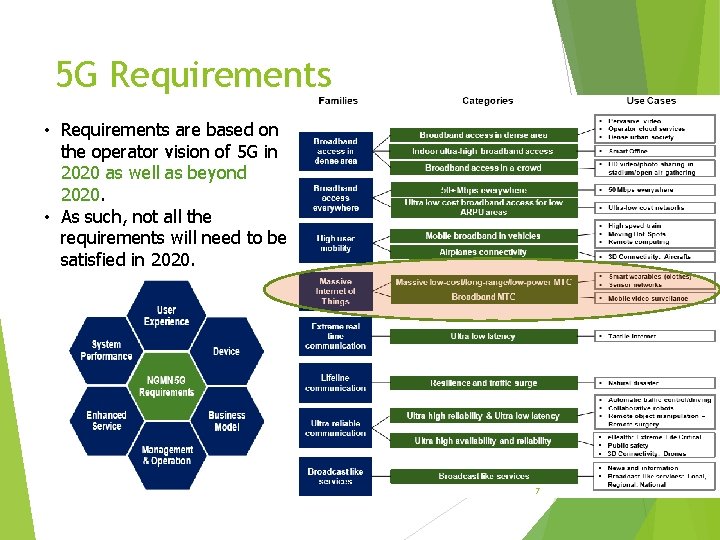
5 G Requirements • Requirements are based on the operator vision of 5 G in 2020 as well as beyond 2020. • As such, not all the requirements will need to be satisfied in 2020. 7
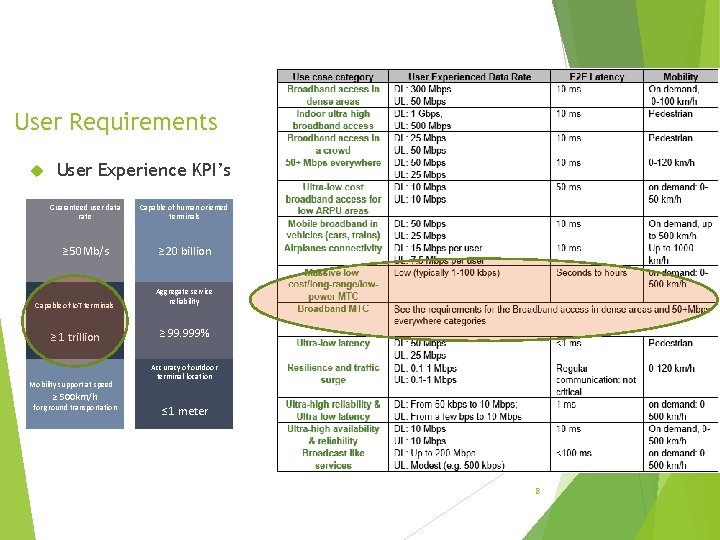
User Requirements User Experience KPI’s Guaranteed user data rate ≥ 50 Mb/s ≥ 20 billion Capable of Io. T terminals ≥ 500 km/h for ground transportation Aggregate service reliability ≥ 99. 999% ≥ 1 trillion Mobility support at speed Capable of human oriented terminals Accuracy of outdoor terminal location ≤ 1 meter 8
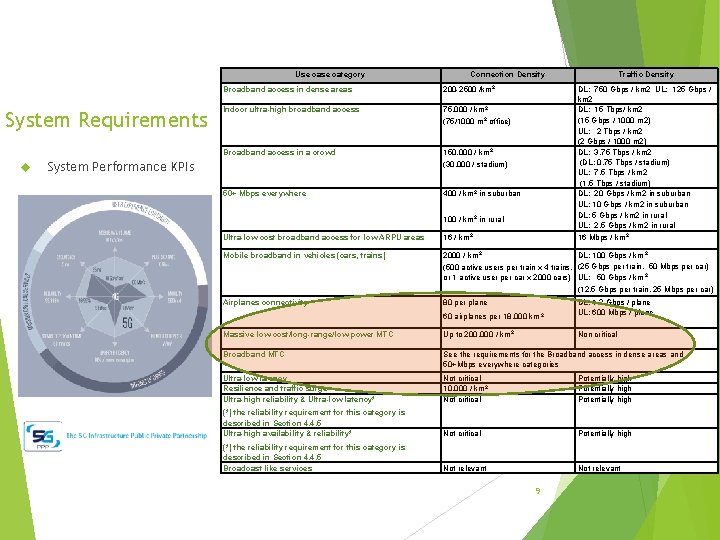
Use category System Requirements Connection Density Broadband access in dense areas 200 -2500 /km 2 Indoor ultra-high broadband access 75, 000 / km 2 (75/1000 m 2 office) Broadband access in a crowd 150, 000 / km 2 System Performance KPIs (30. 000 / stadium) 50+ Mbps everywhere 400 / km 2 in suburban 100 / km 2 in rural Ultra-low cost broadband access for low ARPU areas 16 / km 2 Mobile broadband in vehicles (cars, trains) 2000 / km 2 Airplanes connectivity 80 per plane Traffic Density DL: 750 Gbps / km 2 UL: 125 Gbps / km 2 DL: 15 Tbps/ km 2 (15 Gbps / 1000 m 2) UL: 2 Tbps / km 2 (2 Gbps / 1000 m 2) DL: 3. 75 Tbps / km 2 (DL: 0. 75 Tbps / stadium) UL: 7. 5 Tbps / km 2 (1. 5 Tbps / stadium) DL: 20 Gbps / km 2 in suburban UL: 10 Gbps / km 2 in suburban DL: 5 Gbps / km 2 in rural UL: 2. 5 Gbps / km 2 in rural 16 Mbps / km 2 DL: 100 Gbps / km 2 (500 active users per train x 4 trains, (25 Gbps per train, 50 Mbps per car) or 1 active user per car x 2000 cars) UL: 50 Gbps / km 2 (12. 5 Gbps per train, 25 Mbps per car) 60 airplanes per 18, 000 km 2 DL: 1. 2 Gbps / plane UL: 600 Mbps / plane Massive low-cost/long-range/low-power MTC Up to 200, 000 / km 2 Non critical Broadband MTC See the requirements for the Broadband access in dense areas and 50+Mbps everywhere categories Ultra-low latency Resilience and traffic surge Ultra-high reliability & Ultra-low latency* Not critical 10, 000 / km 2 Not critical Potentially high (*) the reliability requirement for this category is described in Section 4. 4. 5 Ultra-high availability & reliability* Not critical Potentially high (*) the reliability requirement for this category is described in Section 4. 4. 5 Broadcast like services Not relevant 9
Device Requirements Smart devices in the 5 G era will grow in capability and complexity as both the hardware and software, and particularly the operating system will continue to evolve. They may also in some cases become active relays to other devices, or support network controlled device-todevice communication. Greater Operator Controlled Capabilities on Devices Multi-Band-Multi-Mode Support in Devices (with global roaming capability) Device Power Efficiency (3 days for a smartphone, and up to 15 years for MTC) Greater Resource and Signaling Efficiency 10
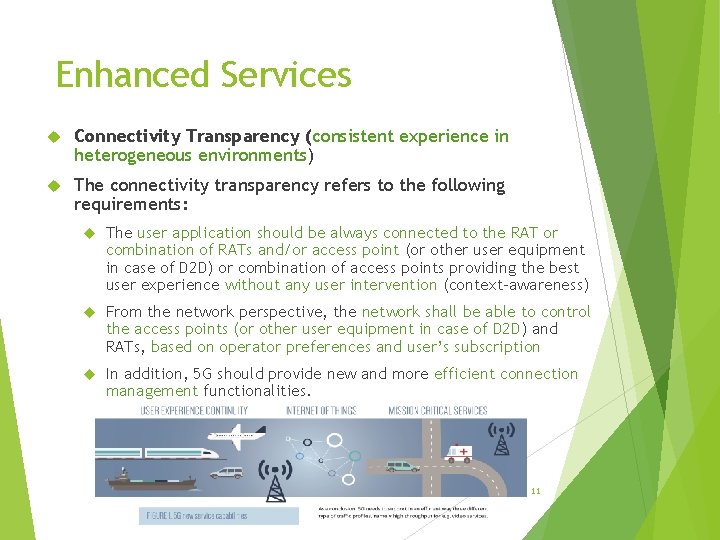
Enhanced Services Connectivity Transparency (consistent experience in heterogeneous environments) The connectivity transparency refers to the following requirements: The user application should be always connected to the RAT or combination of RATs and/or access point (or other user equipment in case of D 2 D) or combination of access points providing the best user experience without any user intervention (context-awareness) From the network perspective, the network shall be able to control the access points (or other user equipment in case of D 2 D) and RATs, based on operator preferences and user’s subscription In addition, 5 G should provide new and more efficient connection management functionalities. 11
Enhanced Services: Location Contextual information is important for delivering instant and personalized services. Location is one of the most important contextual attributes. In 5 G, network based positioning in three-dimensional space should be supported, with accuracy from 10 m to <1 m at 80% of occasions, and better (<1 m) for indoor deployments. Tracking of high speed devices will be required to provide this location accuracy in a real-time. 5 G network based localization should be able to cooperate with other/external techniques (e. g. with capability to pull data from partner sources) to further improve accuracy. The overall cost of network-assisted localization should be comparable to or lower than the current external means (e. g. satellite systems) or 4 G solutions to acquire the location information. On top of the accuracy requirement, the 5 G system should enable the exposure of location information by the definition of an 12 API that can be used for the development of location based services.
Enhanced Services: Security has been one of the fundamental capabilities operators provide to their customers. 5 G will support a wide range of applications and environments, from human-based to machine-based communication, and thus it should be able to deal with a huge amount of sensitive data that need to be protected against unauthorized access, use, disruption, modification, inspection, attack, etc. Moreover, since 5 G should be capable to offer services for critical sectors such as Public Safety, e. Health, and utilities, the importance of providing a comprehensive set of features guaranteeing a high level of security beyond what is available in today’s mobile systems. Subscriber Authentication User Privacy Network Security 13
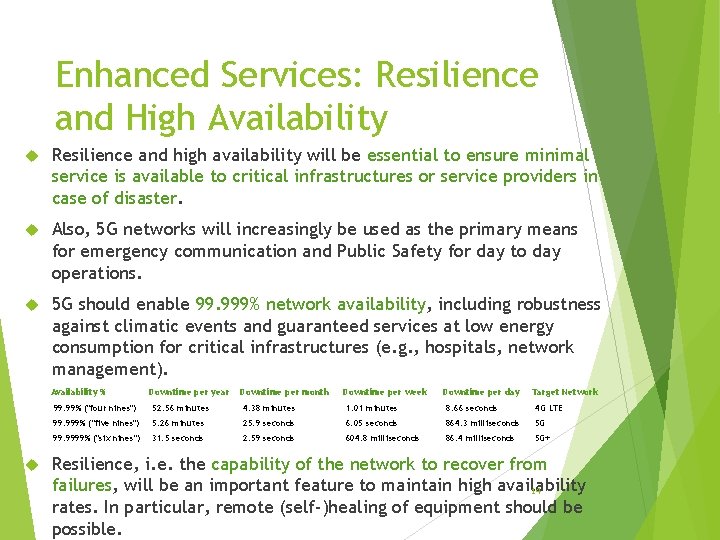
Enhanced Services: Resilience and High Availability Resilience and high availability will be essential to ensure minimal service is available to critical infrastructures or service providers in case of disaster. Also, 5 G networks will increasingly be used as the primary means for emergency communication and Public Safety for day to day operations. 5 G should enable 99. 999% network availability, including robustness against climatic events and guaranteed services at low energy consumption for critical infrastructures (e. g. , hospitals, network management). Availability % Downtime per year Downtime per month Downtime per week Downtime per day Target Network 99. 99% ("four nines") 52. 56 minutes 4. 38 minutes 1. 01 minutes 8. 66 seconds 4 G LTE 99. 999% ("five nines") 5. 26 minutes 25. 9 seconds 6. 05 seconds 864. 3 milliseconds 5 G 99. 9999% ("six nines") 31. 5 seconds 2. 59 seconds 604. 8 milliseconds 86. 4 milliseconds 5 G+ Resilience, i. e. the capability of the network to recover from failures, will be an important feature to maintain high availability 14 rates. In particular, remote (self-)healing of equipment should be possible.
Enhanced Services: Reliability It is the amount of sent packets successfully delivered to the destination within the time constraint required by the targeted service, divided by the total number of sent packets. Note that the reliability rate is evaluated only when the network is available. The reliability rate depends on the service and use case. The 5 G technology should allow high reliability rates of 99. 999%, or higher for the use cases that demand it, in particular those under the ultra-high reliability and ultralow latency use cases category. For use cases for which reliability may be less an issue, e. g. some non-delay critical MTC use cases, the reliability rate may be 99% or even lower depending on the associated trade-off needs. 15
Business Model It is an essential requirement that 5 G provides a futureproof technology platform allowing the evolution of existing business models in both retail and wholesale offerings. Furthermore, it should open up opportunities to create completely new business models without having an impact on network architecture. Using 5 G networks, third party service providers should be able to offer their services in a very short time-to-market manner and based on mutual service level agreements, where the network will be delivering data using agreed network functions, capabilities and attributes. 5 G should be designed from the beginning such that the network operator is able to create a large variety of relationships between its network infrastructure and the customer/service provider. 16
Management & Operations Simplify operations and management – Expanded network capabilities and flexible function allocation should not imply increased complexity on operations and management. Procedures should be automated as far as possible, with well-defined open interfaces to mitigate multi-vendor interworking problems as well as interoperability (roaming) issues. Use of dedicated monitoring tools should be avoided and network functions (software) should be embedded with monitoring capabilities. Big data analysis should drive network management from reactive to a predictive and proactive mode of operation. Carrier-grade network cloud orchestration is needed to ensure network availability and reliability. 17
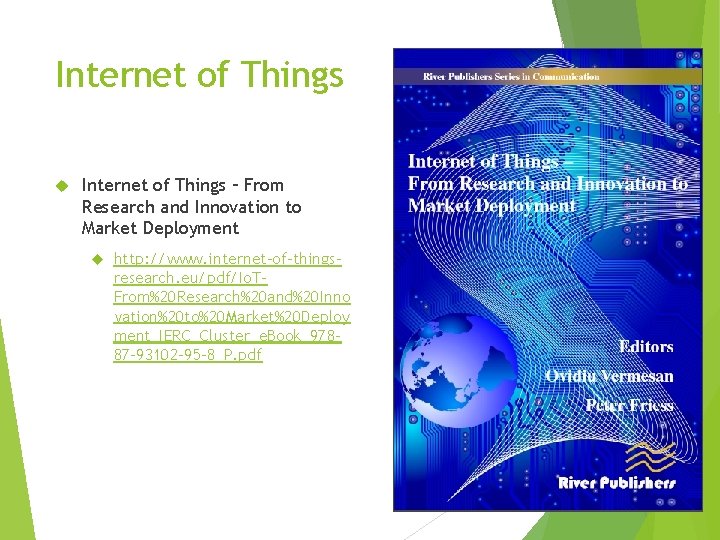
Internet of Things – From Research and Innovation to Market Deployment http: //www. internet-of-thingsresearch. eu/pdf/Io. TFrom%20 Research%20 and%20 Inno vation%20 to%20 Market%20 Deploy ment_IERC_Cluster_e. Book_97887 -93102 -95 -8_P. pdf
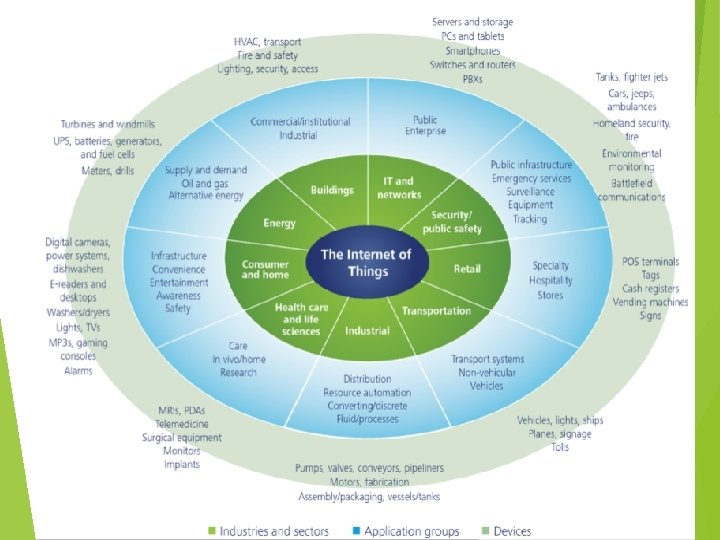
Internet of Things – Connected Devices across industries
References Next Generation Mobile Networks http: //www. crew-project. eu/ http: //www. ni. com/pdf/company/en/Trend_W atch_5 G. pdf http: //networks. nokia. com/be/portfolio/latestlaunches/5 g-and-internet-of-things 5 G Technology Elements for Future Internet of Things (Intel) https: //community. broadcom. com/community/wicedwifi 5 G and Internet of Things (NOKIA) 5 G: The Internet for Everyone and Everything (NI) http: //www. evarilos. eu/index. php CREW EU Project https: //www. metis 2020. com EVARILOS EU Project http: //www. broadcom. com/application/internet_ of_things. php Broadcom WICED Forum The METIS 2020 Project – Laying the foundation of 5 G http: //www. broadcom. com/blog/wirelesstechnology/video-demo-5 g-wifi-enables-real-timesports-location-tracking/ Internet of Things at Broadcom https: //en. wikipedia. org/wiki/High_availa bility Broadcom Real-time Sports Location Tracking Demo http: //www. ngmn. org/fileadmin/ngmn/co ntent/images/news/ngmn_news/NGMN_5 G _White_Paper_V 1_0. pdf High Availability on Wikipedia http: //www. iotsworkshop. com/slides/GC_2014_Io. TS_Workshop_Wu. pdf Io. Tivity Open Source Io. T Framework https: //www. iotivity. org/ How 5 G will Power the Future Internet of Things - i. Q by Intel http: //iq. intel. com/how-5 g-will-power-thefuture-internet-of-things/ 20

Questions? ? ?
Assignment#4 Group Project From Slide 19 select an industry/service sector and identify hardware/sensors required to fulfil the application requirements Each group will give 15 min presentation each on their topic in next class
- Slides: 22