
Mobile Adhoc Networks MANET z Adhoc network y
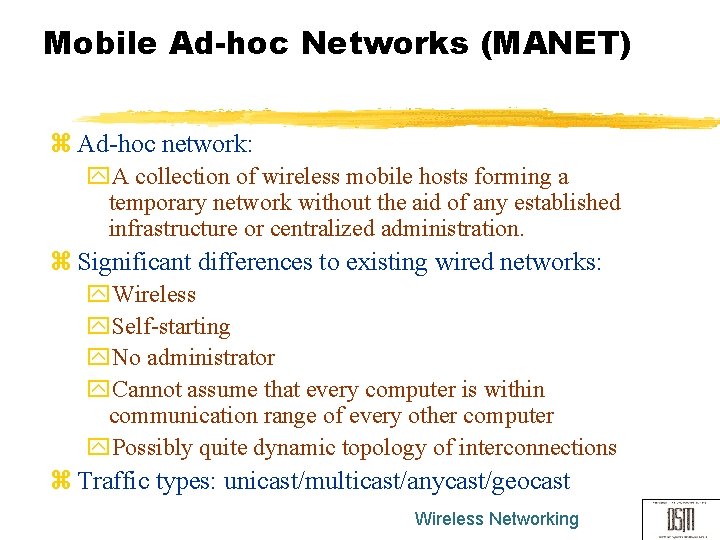
Mobile Ad-hoc Networks (MANET) z Ad-hoc network: y. A collection of wireless mobile hosts forming a temporary network without the aid of any established infrastructure or centralized administration. z Significant differences to existing wired networks: y. Wireless y. Self-starting y. No administrator y. Cannot assume that every computer is within communication range of every other computer y. Possibly quite dynamic topology of interconnections z Traffic types: unicast/multicast/anycast/geocast Wireless Networking 1
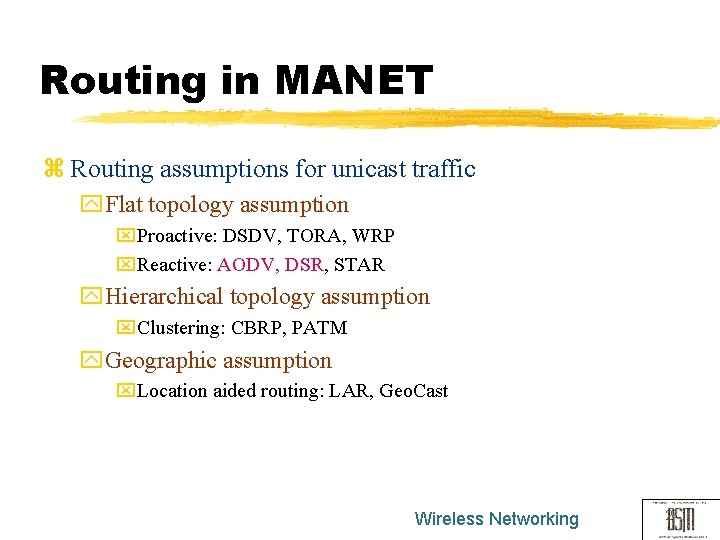
Routing in MANET z Routing assumptions for unicast traffic y. Flat topology assumption x. Proactive: DSDV, TORA, WRP x. Reactive: AODV, DSR, STAR y. Hierarchical topology assumption x. Clustering: CBRP, PATM y. Geographic assumption x. Location aided routing: LAR, Geo. Cast Wireless Networking 2
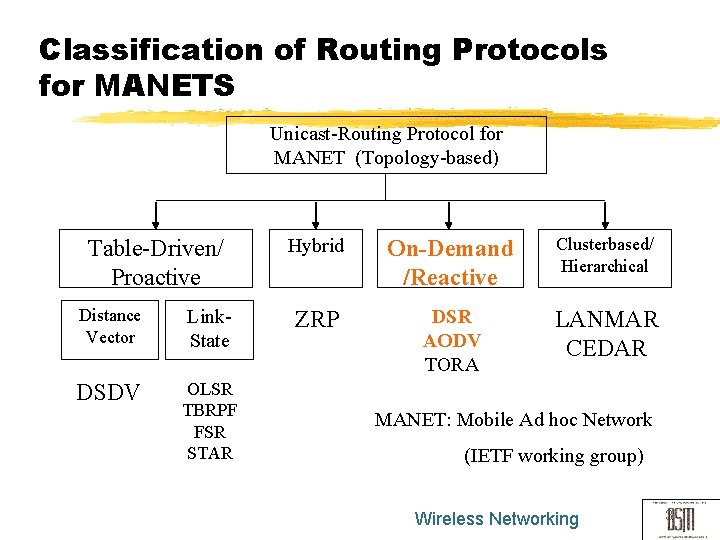
Classification of Routing Protocols for MANETS Unicast-Routing Protocol for MANET (Topology-based) Table-Driven/ Proactive Distance Vector Link. State DSDV OLSR TBRPF FSR STAR Hybrid On-Demand /Reactive Clusterbased/ Hierarchical ZRP DSR AODV TORA LANMAR CEDAR MANET: Mobile Ad hoc Network (IETF working group) Wireless Networking 3
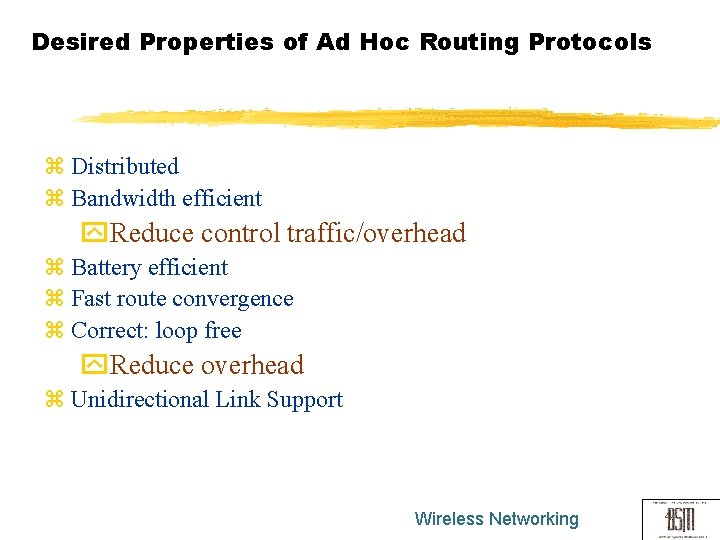
Desired Properties of Ad Hoc Routing Protocols z Distributed z Bandwidth efficient y. Reduce control traffic/overhead z Battery efficient z Fast route convergence z Correct: loop free y. Reduce overhead z Unidirectional Link Support Wireless Networking 4
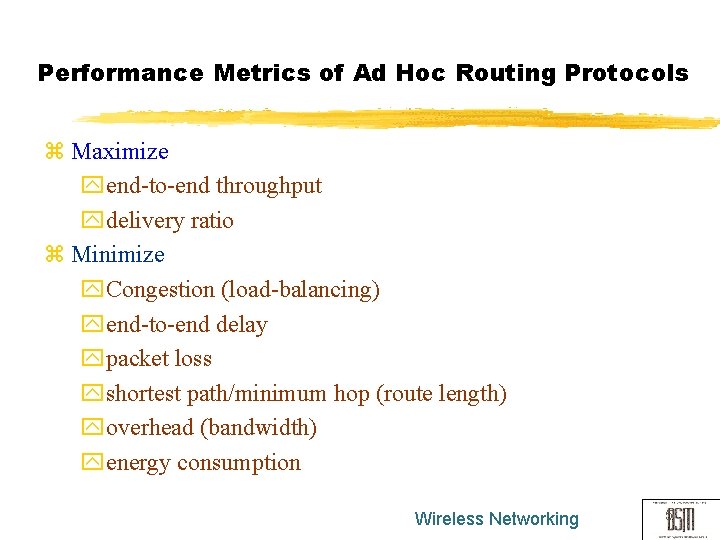
Performance Metrics of Ad Hoc Routing Protocols z Maximize yend-to-end throughput ydelivery ratio z Minimize y. Congestion (load-balancing) yend-to-end delay ypacket loss yshortest path/minimum hop (route length) yoverhead (bandwidth) yenergy consumption Wireless Networking 5
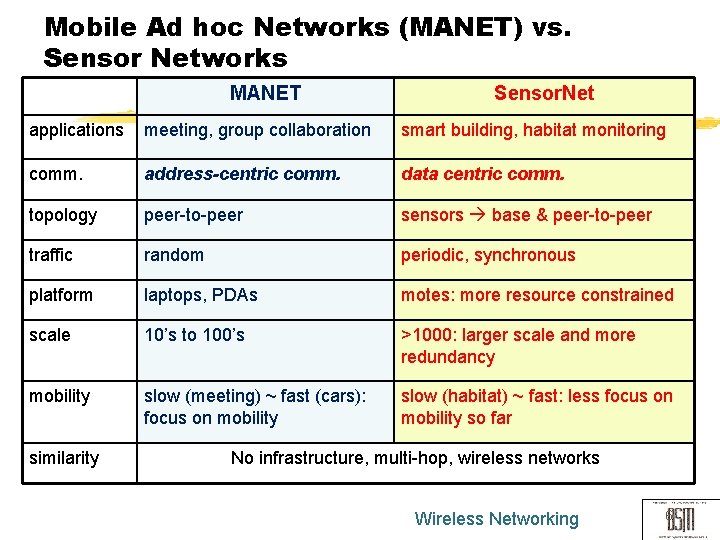
Mobile Ad hoc Networks (MANET) vs. Sensor Networks MANET Sensor. Net applications meeting, group collaboration smart building, habitat monitoring comm. address-centric comm. data centric comm. topology peer-to-peer sensors base & peer-to-peer traffic random periodic, synchronous platform laptops, PDAs motes: more resource constrained scale 10’s to 100’s >1000: larger scale and more redundancy mobility slow (meeting) ~ fast (cars): focus on mobility slow (habitat) ~ fast: less focus on mobility so far similarity No infrastructure, multi-hop, wireless networks Wireless Networking 6
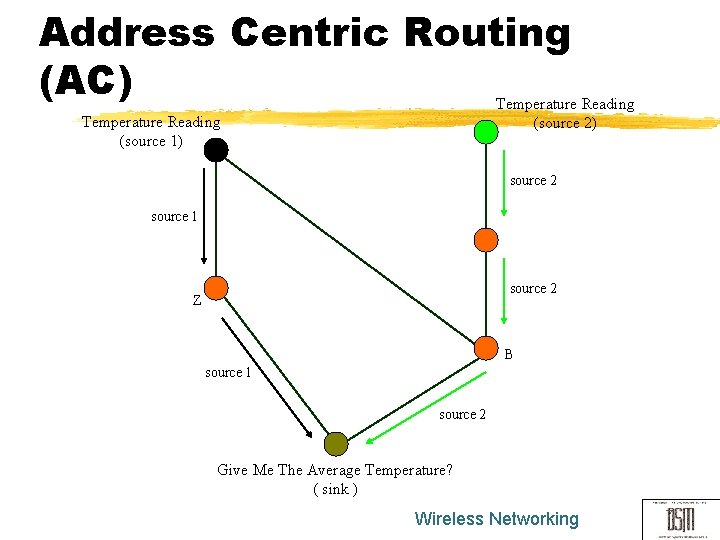
Address Centric Routing (AC) Temperature Reading (source 2) Temperature Reading (source 1) source 2 source 1 source 2 Z B source 1 source 2 Give Me The Average Temperature? ( sink ) Wireless Networking 7
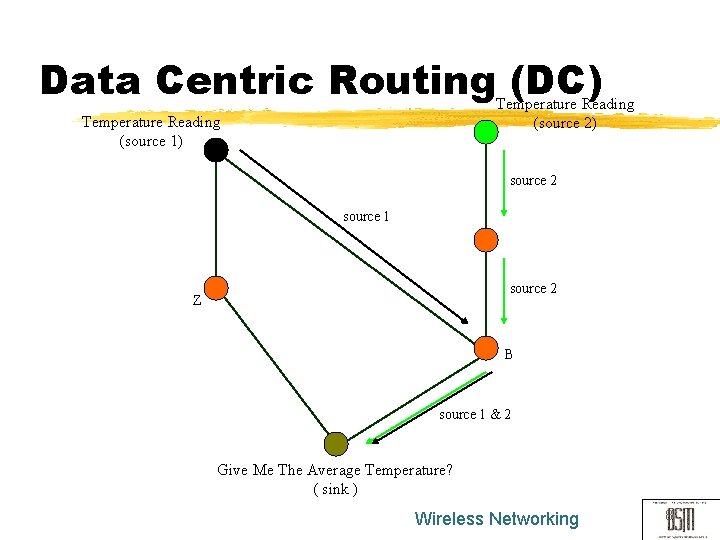
Data Centric Routing (DC) Temperature Reading (source 2) Temperature Reading (source 1) source 2 source 1 source 2 Z B source 1 & 2 Give Me The Average Temperature? ( sink ) Wireless Networking 8
![Dynamic Source Routing (DSR) [Johnson 96] z. When node S wants to send a](http://slidetodoc.com/presentation_image/eddfd5cbb8bc397c4c6faf55f66a5e52/image-9.jpg "Dynamic Source Routing (DSR) [Johnson 96] z. When node S wants to send a")
Dynamic Source Routing (DSR) [Johnson 96] z. When node S wants to send a packet to node D, but does not know a route to D, node S initiates a route discovery using Route Request (RREQ) z. Each node appends own identifier when forwarding RREQ z. Promiscuous mode Wireless Networking 9
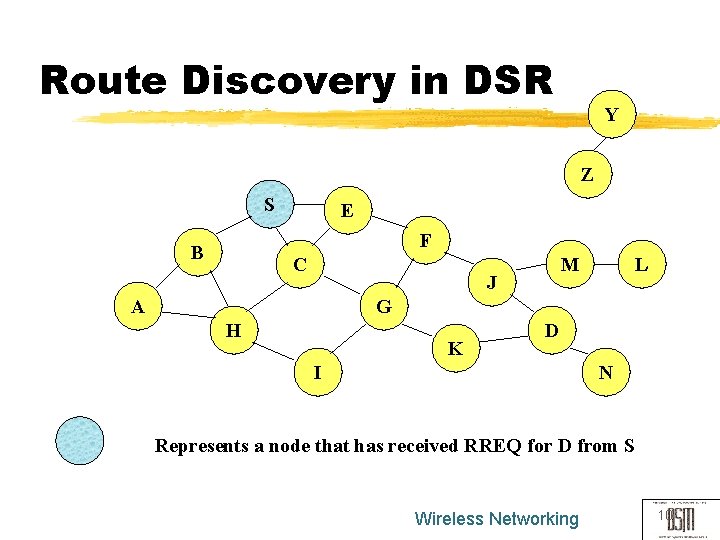
Route Discovery in DSR Y Z S E F B C M J A L G H K D I N Represents a node that has received RREQ for D from S Wireless Networking 10
![Route Discovery in DSR Y Broadcast transmission [S] S Z E F B C](http://slidetodoc.com/presentation_image/eddfd5cbb8bc397c4c6faf55f66a5e52/image-11.jpg "Route Discovery in DSR Y Broadcast transmission [S] S Z E F B C")
Route Discovery in DSR Y Broadcast transmission [S] S Z E F B C M J A L G H K D I N Represents transmission of RREQ [X, Y] Represents list of identifiers appended to RREQ Wireless Networking 11
![Route Discovery in DSR S E Y Z [S, E] F B C J](http://slidetodoc.com/presentation_image/eddfd5cbb8bc397c4c6faf55f66a5e52/image-12.jpg "Route Discovery in DSR S E Y Z [S, E] F B C J")
Route Discovery in DSR S E Y Z [S, E] F B C J [S, C] A M H L G K D I N • Node H receives packet RREQ from two neighbors: potential for collision Wireless Networking 12
![Route Discovery in DSR Y Z S E F B [S, E, F] C](http://slidetodoc.com/presentation_image/eddfd5cbb8bc397c4c6faf55f66a5e52/image-13.jpg "Route Discovery in DSR Y Z S E F B [S, E, F] C")
Route Discovery in DSR Y Z S E F B [S, E, F] C M J A L G H I [S, C, G] K D N • Node C receives RREQ from G and H, but does not forward it again, because node C has already forwarded RREQ once Wireless Networking 13
![Route Discovery in DSR Y Z S E [S, E, F, J] F B](http://slidetodoc.com/presentation_image/eddfd5cbb8bc397c4c6faf55f66a5e52/image-14.jpg "Route Discovery in DSR Y Z S E [S, E, F, J] F B")
Route Discovery in DSR Y Z S E [S, E, F, J] F B C M J A L G H K I D [S, C, G, K] N • Nodes J and K both broadcast RREQ to node D • Caveat: Since nodes J and K are hidden from each other, their transmissions may collide Wireless Networking 14
Route Discovery in DSR z. Broadcast storm prevention y Drop previously seen messages z. Loop prevention y Host drops messages with its address in route record (like BGP) Wireless Networking 15
Route Discovery in DSR z. Destination D on receiving the first RREQ, sends a Route Reply (RREP) y RREP is sent on a route obtained by reversing the route appended to received RREQ x. Not always the case, sometimes need new route request y RREP includes the route from S to D on which RREQ was received by node D Wireless Networking 16
![Route Reply in DSR S E Y Z RREP [S, E, F, J, D]](http://slidetodoc.com/presentation_image/eddfd5cbb8bc397c4c6faf55f66a5e52/image-17.jpg "Route Reply in DSR S E Y Z RREP [S, E, F, J, D]")
Route Reply in DSR S E Y Z RREP [S, E, F, J, D] F B C M J A L G H K D I N Represents RREP control message Wireless Networking 17
Dynamic Source Routing (DSR) z Node S on receiving RREP, caches the route included in the RREP z When node S sends a data packet to D, the entire route is included in the packet header yhence the name source routing z Intermediate nodes use the source route included in a packet to determine to whom a packet should be forwarded Wireless Networking 18
![Data Delivery in DSR Y DATA [S, E, F, J, D] S Z E](http://slidetodoc.com/presentation_image/eddfd5cbb8bc397c4c6faf55f66a5e52/image-19.jpg "Data Delivery in DSR Y DATA [S, E, F, J, D] S Z E")
Data Delivery in DSR Y DATA [S, E, F, J, D] S Z E F B C M J A L G H K D I N Packet header size grows with route length Wireless Networking 19
Data Delivery in DSR z Send route error packet if next hop cannot be reached z Delete route from the cache when receiving error packet z Passive acknowledgement: y. When node overhears next hop forwarding message. Wireless Networking 20
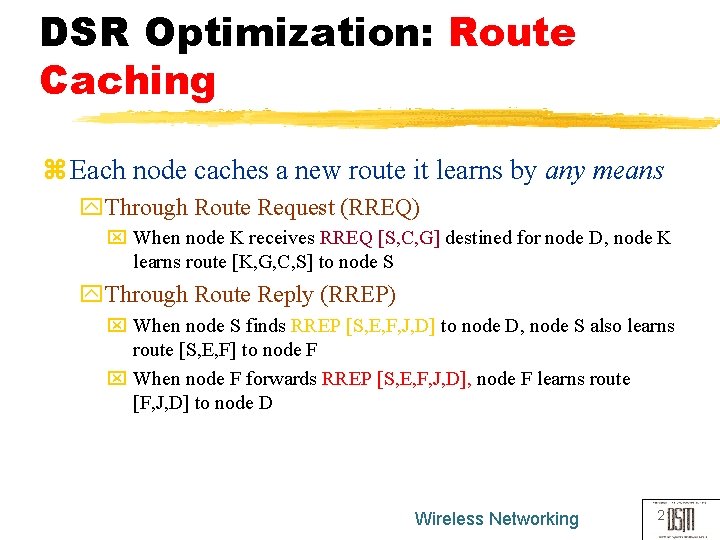
DSR Optimization: Route Caching z Each node caches a new route it learns by any means y. Through Route Request (RREQ) x When node K receives RREQ [S, C, G] destined for node D, node K learns route [K, G, C, S] to node S y. Through Route Reply (RREP) x When node S finds RREP [S, E, F, J, D] to node D, node S also learns route [S, E, F] to node F x When node F forwards RREP [S, E, F, J, D], node F learns route [F, J, D] to node D Wireless Networking 21
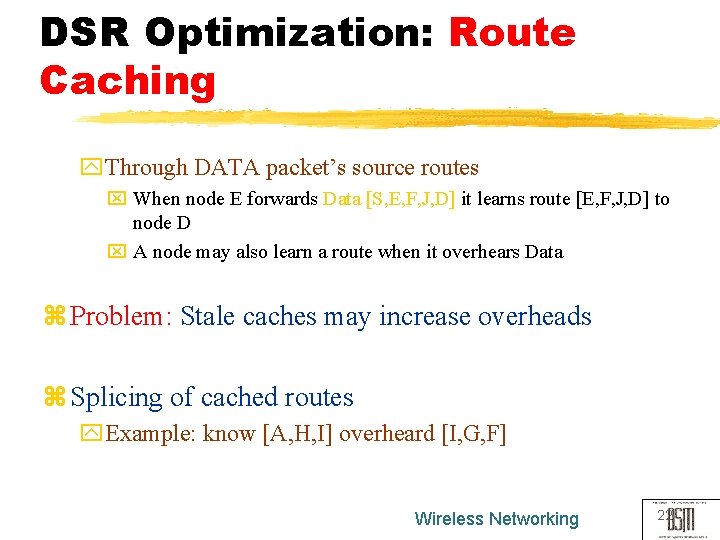
DSR Optimization: Route Caching y. Through DATA packet’s source routes x When node E forwards Data [S, E, F, J, D] it learns route [E, F, J, D] to node D x A node may also learn a route when it overhears Data z Problem: Stale caches may increase overheads z Splicing of cached routes y. Example: know [A, H, I] overheard [I, G, F] Wireless Networking 22
DSR Optimization: Piggybacking z. Possible to piggyback route reply on new route requests z. Also small data y. TCP handshake z. Host must forward piggybacked data when replying to request with cached routes Wireless Networking 23
DSR Optimization: Error Handling z. Disconnected network leads to repeated route requests y. Addressed through exponential backoff z. Eavesdropping on route error packets z. Temporarily mark invalid route y. Other nodes may reply with invalid cached routes Wireless Networking 24
Dynamic Source Routing: Advantages z. Routes maintained only between nodes who need to communicate yreduces overhead of route table maintenance z. Routing cache can further reduce route discovery overhead z. A single route discovery may yield many routes to the destination, due to intermediate nodes replying from local caches Wireless Networking 25
Dynamic Source Routing: Disadvantages z. Packet header size grows with route length due to source routing z. Flooding of route requests may potentially reach all nodes in the network z. Stale caches will lead to increased overhead Wireless Networking 26
Distance-Vector routing z Each node maintains a routing table containing y Number of hops to each destination y Next hop to reach destination y list of all destinations z The succession of next hops leads to a destination z Each node periodically broadcasts its current estimate of the shortest distance to each available destination to all of its neighbors z Typical representative: Distributed Bellman-Ford (DBF) Wireless Networking 27
AODV (Ad Hoc On-Demand Distance Vector) z AODV is based on the DSDV (Destination-Sequenced Distance Vector) algorithm y. Distance vector y. Different sequence numbers for each destination. z Creation of routes on a demand basis – traffic reactive z Nodes that are not on a selected path do not maintain routing information or participate in routing table exchanges! z Goal: Minimize broadcast overhead and transmission latency Wireless Networking 28
Route Sequence Numbers z Unique counter for each destination y. Symbolizes the “freshness” of a route y. Source specifies the most recently known route during route establishment z Updated occasionally y. Link failure y. Destination moves y. Intermediate nodes move Wireless Networking 29
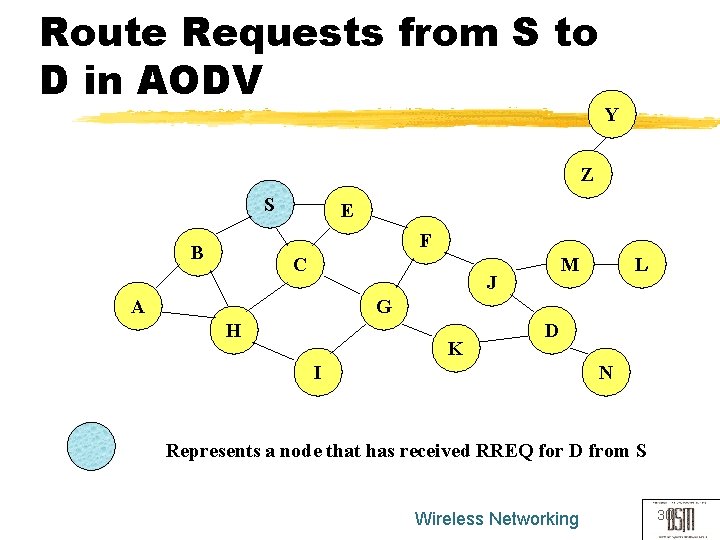
Route Requests from S to D in AODV Y Z S E F B C M J A L G H K D I N Represents a node that has received RREQ for D from S Wireless Networking 30
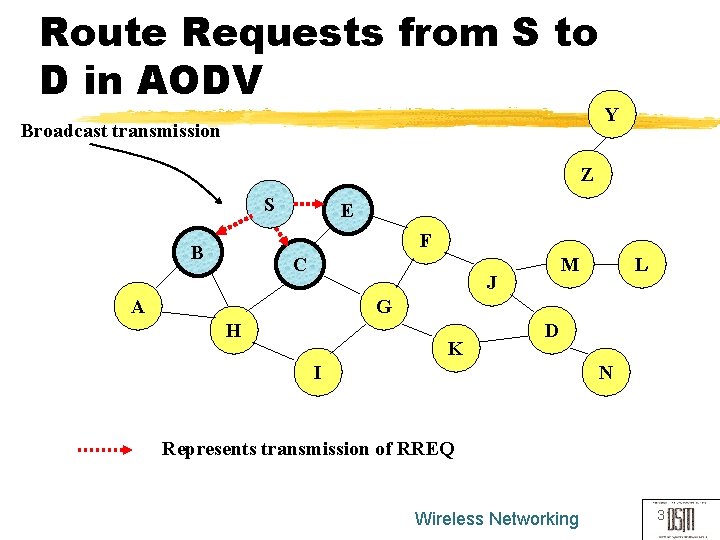
Route Requests from S to D in AODV Broadcast transmission Y Z S E F B C M J A L G H K D I N Represents transmission of RREQ Wireless Networking 31
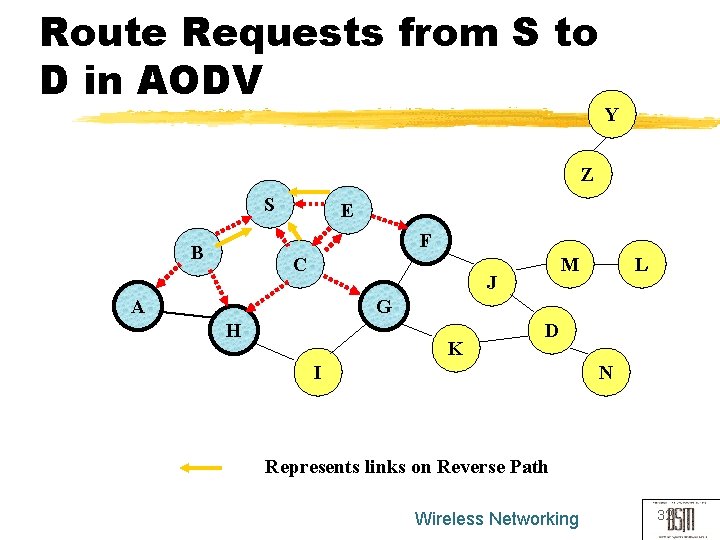
Route Requests from S to D in AODV Y Z S E F B C M J A L G H K D I N Represents links on Reverse Path Wireless Networking 32
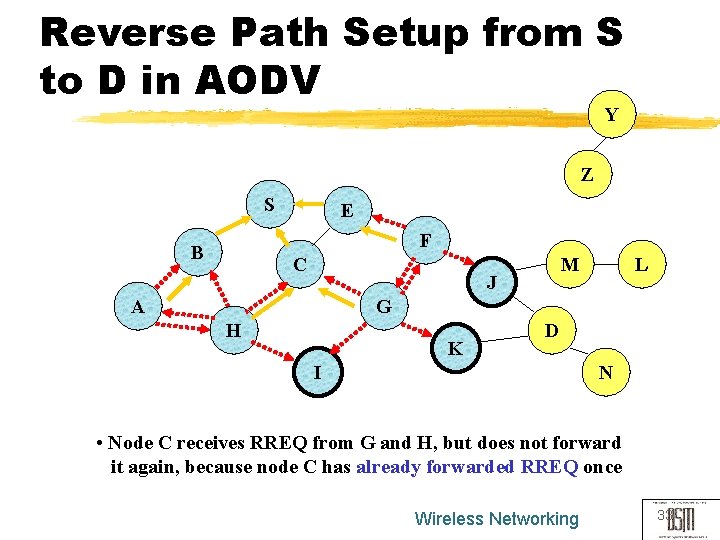
Reverse Path Setup from S to D in AODV Y Z S E F B C M J A L G H K D I N • Node C receives RREQ from G and H, but does not forward it again, because node C has already forwarded RREQ once Wireless Networking 33
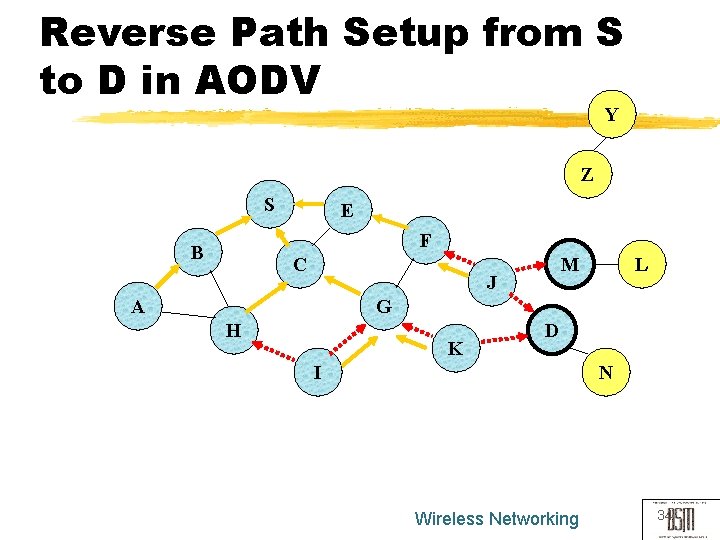
Reverse Path Setup from S to D in AODV Y Z S E F B C M J A L G H K D I N Wireless Networking 34
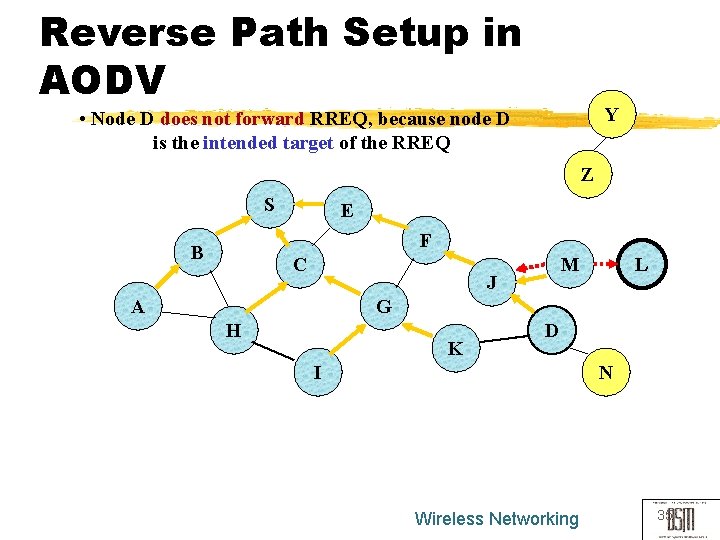
Reverse Path Setup in AODV Y • Node D does not forward RREQ, because node D is the intended target of the RREQ Z S E F B C M J A L G H K D I N Wireless Networking 35
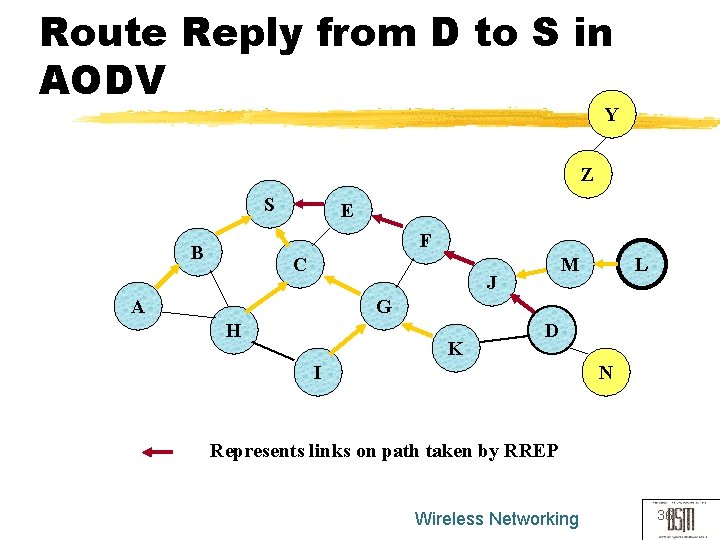
Route Reply from D to S in AODV Y Z S E F B C M J A L G H K D I N Represents links on path taken by RREP Wireless Networking 36
Route Reply in AODV z Intermediate node may also send a Route Reply (RREP) provided that it knows a more recent path than the one previously known to sender S y Recent path means higher sequence number z The likelihood that an intermediate node will send a RREP not as high as DSR y. An intermediate node which knows a route, but with a smaller sequence number, cannot send Route Reply Wireless Networking 37
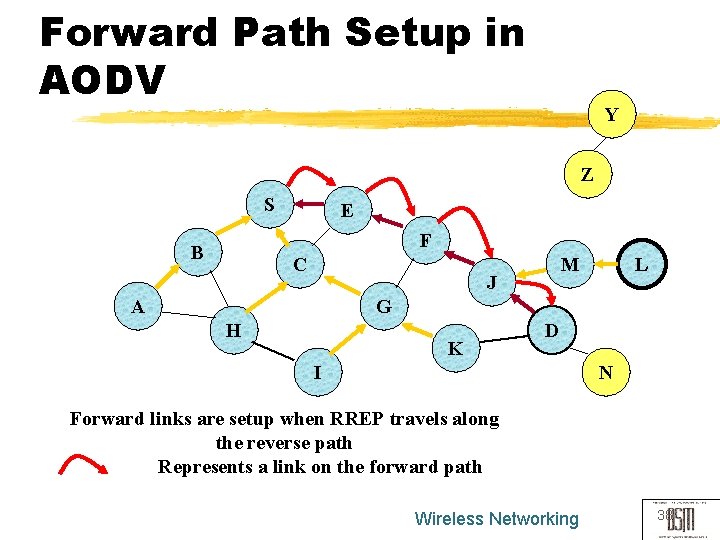
Forward Path Setup in AODV Y Z S E F B C M J A L G H K D I N Forward links are setup when RREP travels along the reverse path Represents a link on the forward path Wireless Networking 38
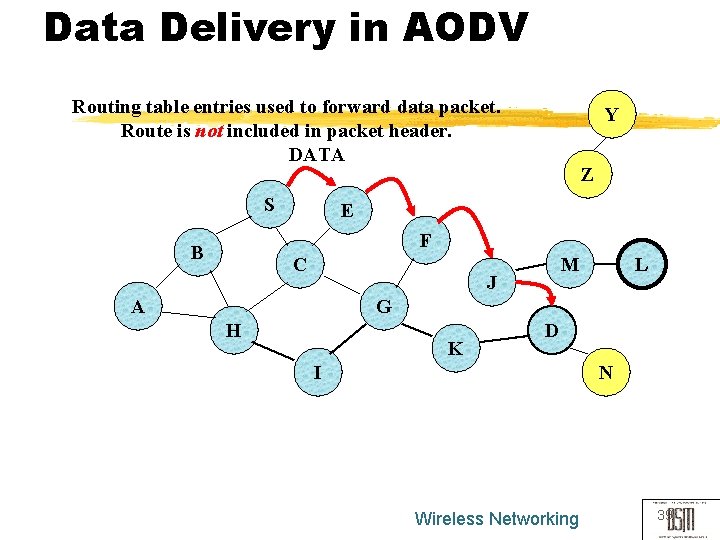
Data Delivery in AODV Routing table entries used to forward data packet. Route is not included in packet header. DATA S Y Z E F B C M J A L G H K D I N Wireless Networking 39
Local Link Maintenance z Periodic “hello” messages broadcast to immediate neighbors y Failing to receive hello messages indicates a link failure z Link failure notifications sent to source nodes y. Sources rediscover new route to destination Wireless Networking 40
AODV Key Advantages z “Partial” routing tables are constructed reactively y Entries are updated only when a node sends to an unreachable node y No periodic global updates y Node not on active paths maintain no routing entries Reduce packet overhead z Routing table y No source routing needed reduce bit overhead y “Route caching” reduce establishment latency y Sequence number override stale routes y source based broadcast id loop freedom z Push link failure to relevant nodes Reduce establishment latency Wireless Networking 41
AODV and DSR : Disadvantages z. Common problems for both AODV and DSR y Potential collisions between route requests propagated by neighboring nodes x Insertion of random delays before forwarding RREQ y Increased contention if too many route replies come back due to nodes replying using their local cache Route Reply Storm problem x Random delays + carrier sensing Wireless Networking 42
- Slides: 42