
Mobile Ad Hoc Networks Network Coding and Xors
Mobile Ad Hoc Networks Network Coding and Xors in the Air 7 th Week 06. -09. 06. 2007 Christian Schindelhauer University of Freiburg Computer Networks and Telematics Prof. Christian Schindelhauer 1
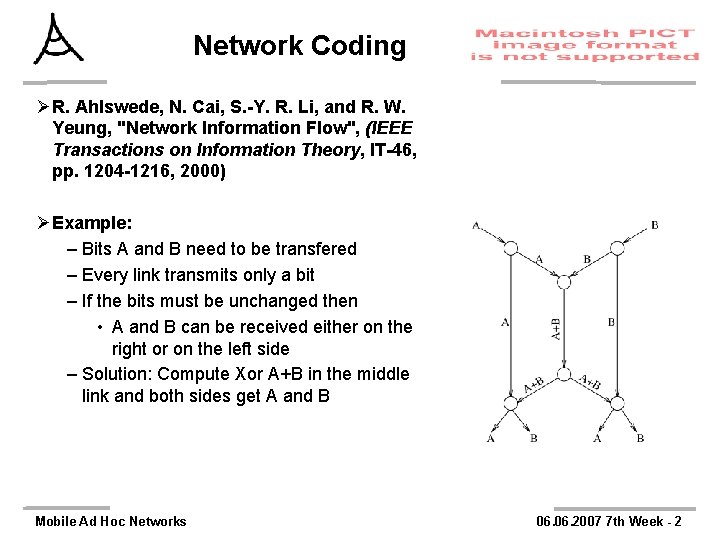
Network Coding ØR. Ahlswede, N. Cai, S. -Y. R. Li, and R. W. Yeung, "Network Information Flow", (IEEE Transactions on Information Theory, IT-46, pp. 1204 -1216, 2000) ØExample: – Bits A and B need to be transfered – Every link transmits only a bit – If the bits must be unchanged then • A and B can be received either on the right or on the left side – Solution: Compute Xor A+B in the middle link and both sides get A and B Mobile Ad Hoc Networks 06. 2007 7 th Week - 2
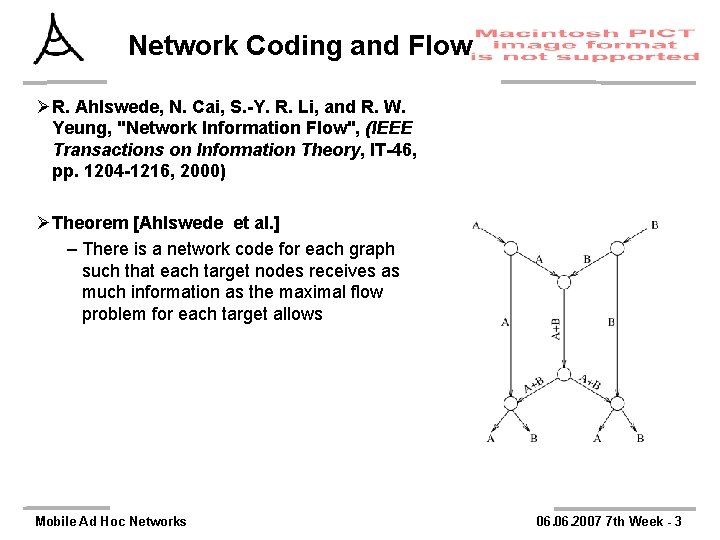
Network Coding and Flow ØR. Ahlswede, N. Cai, S. -Y. R. Li, and R. W. Yeung, "Network Information Flow", (IEEE Transactions on Information Theory, IT-46, pp. 1204 -1216, 2000) ØTheorem [Ahlswede et al. ] – There is a network code for each graph such that each target nodes receives as much information as the maximal flow problem for each target allows Mobile Ad Hoc Networks 06. 2007 7 th Week - 3
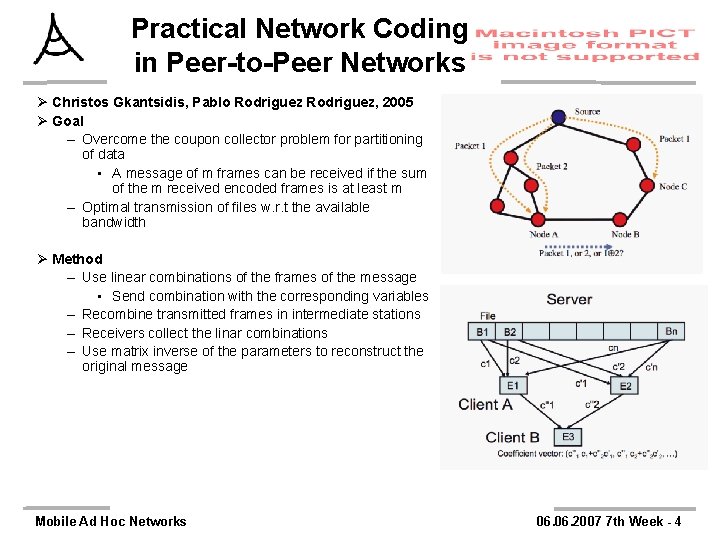
Practical Network Coding in Peer-to-Peer Networks Ø Christos Gkantsidis, Pablo Rodriguez, 2005 Ø Goal – Overcome the coupon collector problem for partitioning of data • A message of m frames can be received if the sum of the m received encoded frames is at least m – Optimal transmission of files w. r. t the available bandwidth Ø Method – Use linear combinations of the frames of the message • Send combination with the corresponding variables – Recombine transmitted frames in intermediate stations – Receivers collect the linar combinations – Use matrix inverse of the parameters to reconstruct the original message Mobile Ad Hoc Networks 06. 2007 7 th Week - 4
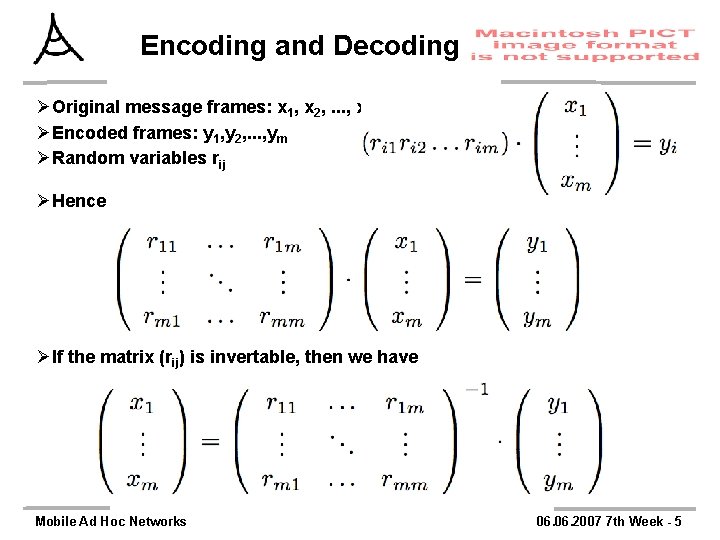
Encoding and Decoding ØOriginal message frames: x 1, x 2, . . . , xm ØEncoded frames: y 1, y 2, . . . , ym ØRandom variables rij ØHence ØIf the matrix (rij) is invertable, then we have Mobile Ad Hoc Networks 06. 2007 7 th Week - 5
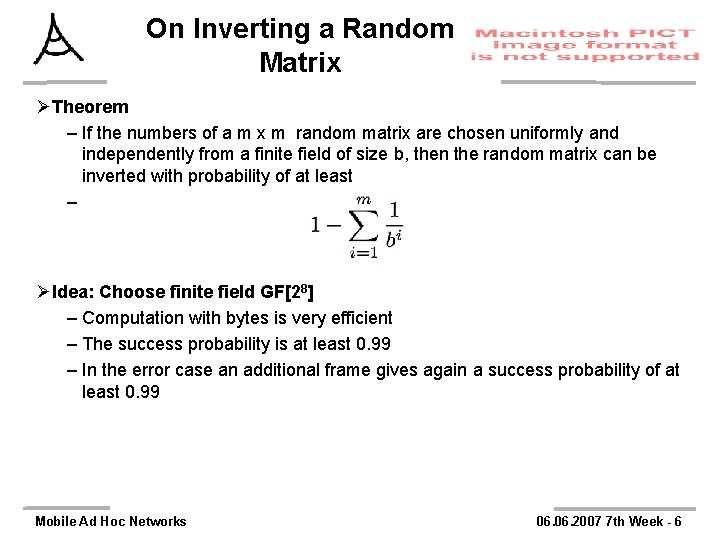
On Inverting a Random Matrix ØTheorem – If the numbers of a m x m random matrix are chosen uniformly and independently from a finite field of size b, then the random matrix can be inverted with probability of at least – ØIdea: Choose finite field GF[28] – Computation with bytes is very efficient – The success probability is at least 0. 99 – In the error case an additional frame gives again a success probability of at least 0. 99 Mobile Ad Hoc Networks 06. 2007 7 th Week - 6
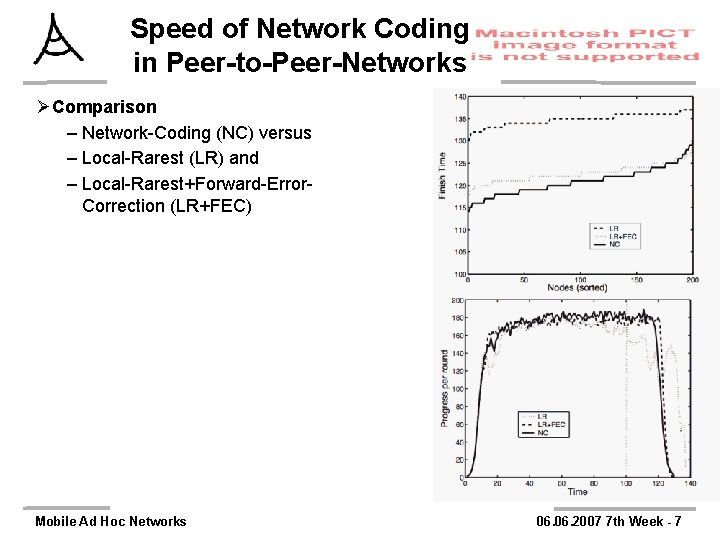
Speed of Network Coding in Peer-to-Peer-Networks ØComparison – Network-Coding (NC) versus – Local-Rarest (LR) and – Local-Rarest+Forward-Error. Correction (LR+FEC) Mobile Ad Hoc Networks 06. 2007 7 th Week - 7
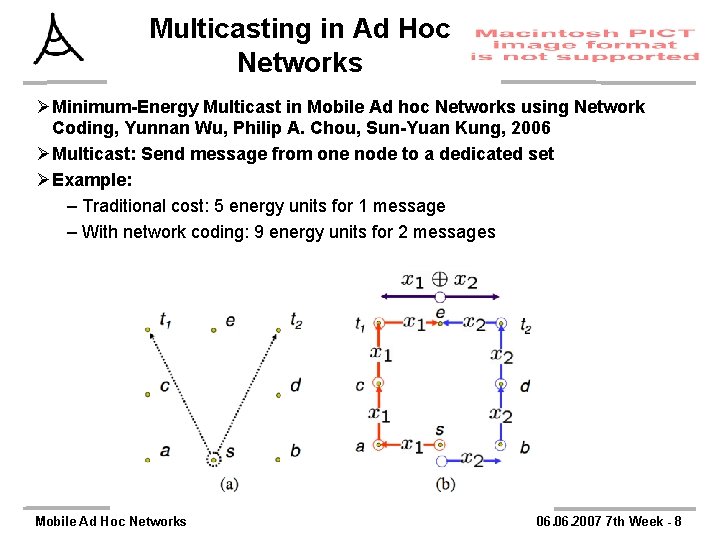
Multicasting in Ad Hoc Networks ØMinimum-Energy Multicast in Mobile Ad hoc Networks using Network Coding, Yunnan Wu, Philip A. Chou, Sun-Yuan Kung, 2006 ØMulticast: Send message from one node to a dedicated set ØExample: – Traditional cost: 5 energy units for 1 message – With network coding: 9 energy units for 2 messages Mobile Ad Hoc Networks 06. 2007 7 th Week - 8
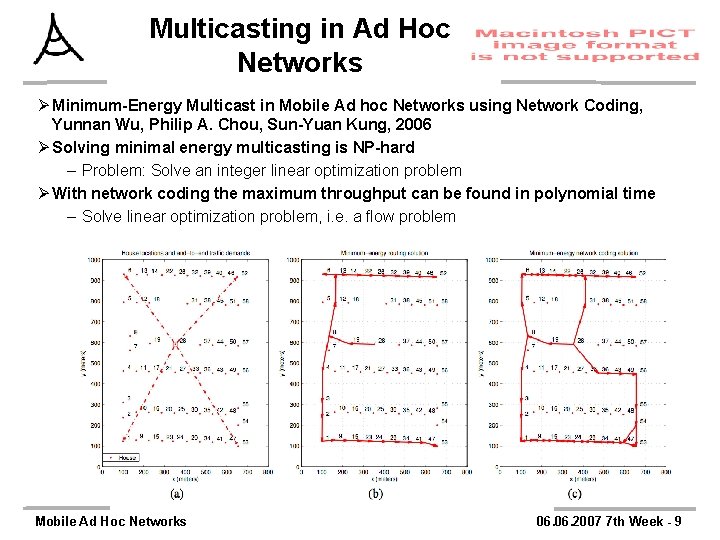
Multicasting in Ad Hoc Networks Ø Minimum-Energy Multicast in Mobile Ad hoc Networks using Network Coding, Yunnan Wu, Philip A. Chou, Sun-Yuan Kung, 2006 Ø Solving minimal energy multicasting is NP-hard – Problem: Solve an integer linear optimization problem Ø With network coding the maximum throughput can be found in polynomial time – Solve linear optimization problem, i. e. a flow problem Mobile Ad Hoc Networks 06. 2007 7 th Week - 9
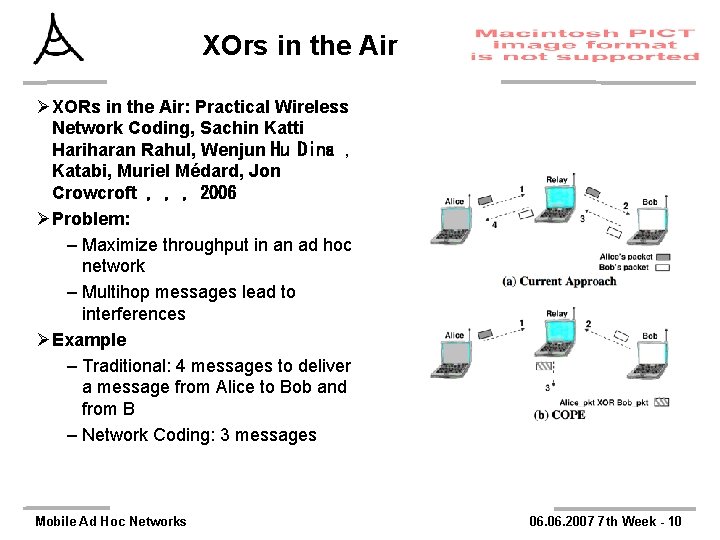
XOrs in the Air ØXORs in the Air: Practical Wireless Network Coding, Sachin Katti Hariharan Rahul, Wenjun Hu Dina , Katabi, Muriel Médard, Jon Crowcroft , , , 2006 ØProblem: – Maximize throughput in an ad hoc network – Multihop messages lead to interferences ØExample – Traditional: 4 messages to deliver a message from Alice to Bob and from B – Network Coding: 3 messages Mobile Ad Hoc Networks 06. 2007 7 th Week - 10
Components of COPE ØOpportunistic Listening – Get maximum context for decoding messages ØOpportunistic Coding – „The key question is what packets to code together to maximize throughput. A node may have multiple options, but it should aim to maximize the number of native packets delivered in a single transmission, while ensuring that each intended nexthop has enough information to decode its native packet. “ ØLearning Neighbor State – Each node announces the packets it has received – Each node also guesses the packets a neighbor could have received Mobile Ad Hoc Networks 06. 2007 7 th Week - 11
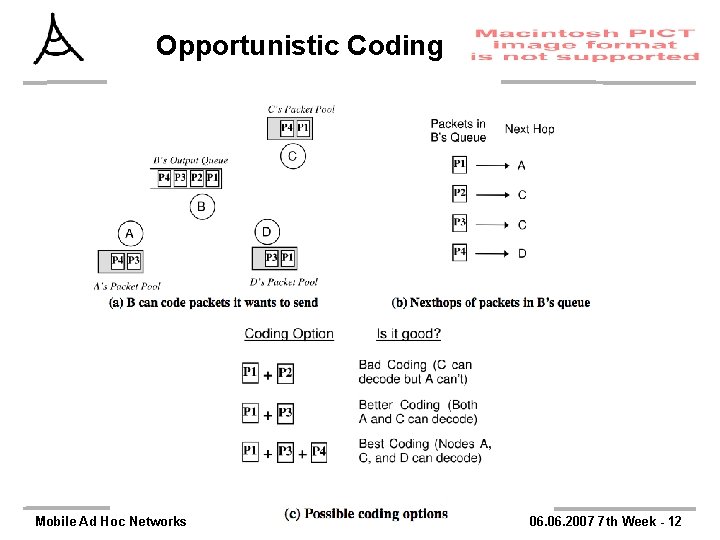
Opportunistic Coding Mobile Ad Hoc Networks 06. 2007 7 th Week - 12
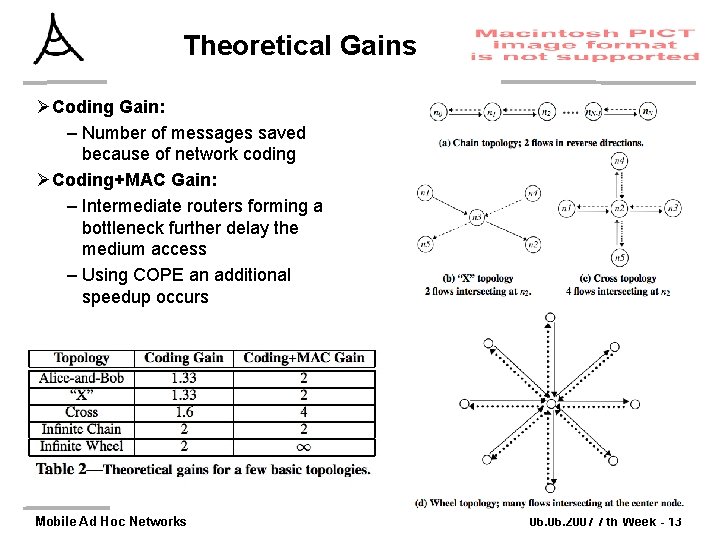
Theoretical Gains ØCoding Gain: – Number of messages saved because of network coding ØCoding+MAC Gain: – Intermediate routers forming a bottleneck further delay the medium access – Using COPE an additional speedup occurs Mobile Ad Hoc Networks 06. 2007 7 th Week - 13
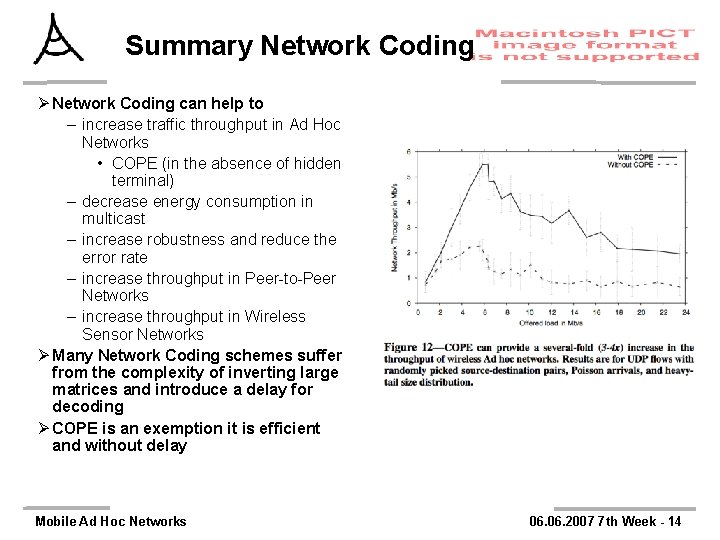
Summary Network Coding Ø Network Coding can help to – increase traffic throughput in Ad Hoc Networks • COPE (in the absence of hidden terminal) – decrease energy consumption in multicast – increase robustness and reduce the error rate – increase throughput in Peer-to-Peer Networks – increase throughput in Wireless Sensor Networks Ø Many Network Coding schemes suffer from the complexity of inverting large matrices and introduce a delay for decoding Ø COPE is an exemption it is efficient and without delay Mobile Ad Hoc Networks 06. 2007 7 th Week - 14

Thank you! Mobile Ad Hoc Networks Christian Schindelhauer University of Freiburg Computer Networks and Telematics Prof. Christian Schindelhauer 7 th Week 06. 2007 15
- Slides: 15