
MMT Encoder Upgrade D Clark February 2010 Motivation
MMT Encoder Upgrade D. Clark February 2010
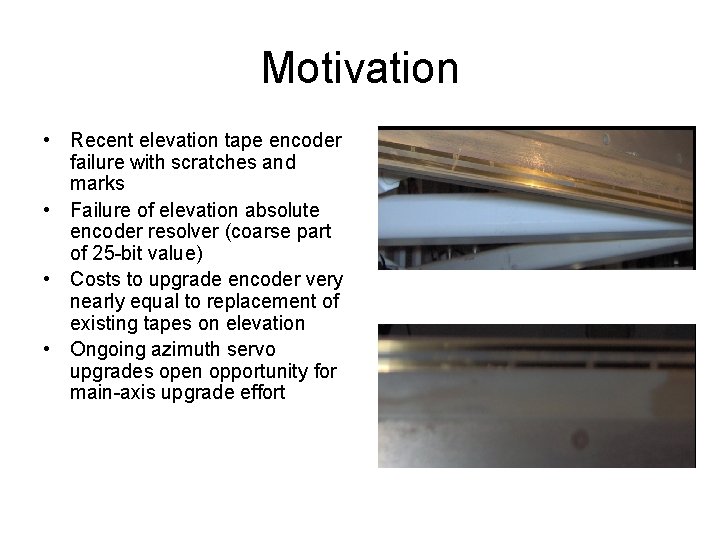
Motivation • Recent elevation tape encoder failure with scratches and marks • Failure of elevation absolute encoder resolver (coarse part of 25 -bit value) • Costs to upgrade encoder very nearly equal to replacement of existing tapes on elevation • Ongoing azimuth servo upgrades open opportunity for main-axis upgrade effort
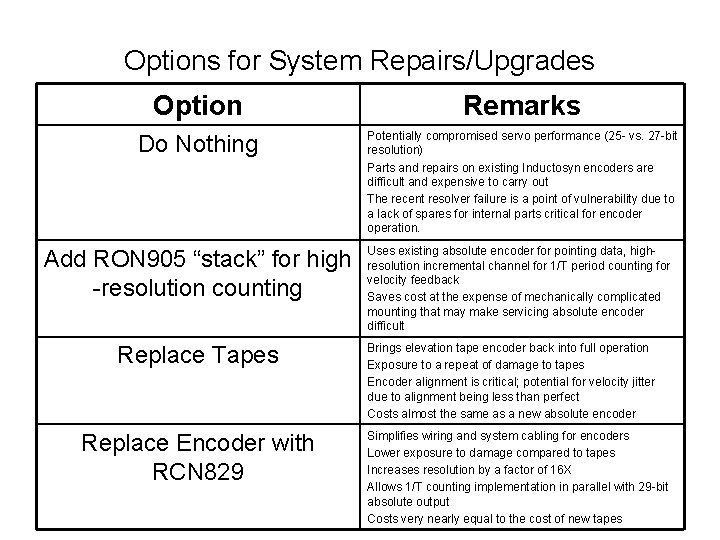
Options for System Repairs/Upgrades Option Remarks Do Nothing Potentially compromised servo performance (25 - vs. 27 -bit resolution) Parts and repairs on existing Inductosyn encoders are difficult and expensive to carry out The recent resolver failure is a point of vulnerability due to a lack of spares for internal parts critical for encoder operation. Add RON 905 “stack” for high -resolution counting Replace Tapes Replace Encoder with RCN 829 Uses existing absolute encoder for pointing data, highresolution incremental channel for 1/T period counting for velocity feedback Saves cost at the expense of mechanically complicated mounting that may make servicing absolute encoder difficult Brings elevation tape encoder back into full operation Exposure to a repeat of damage to tapes Encoder alignment is critical; potential for velocity jitter due to alignment being less than perfect Costs almost the same as a new absolute encoder Simplifies wiring and system cabling for encoders Lower exposure to damage compared to tapes Increases resolution by a factor of 16 X Allows 1/T counting implementation in parallel with 29 -bit absolute output Costs very nearly equal to the cost of new tapes
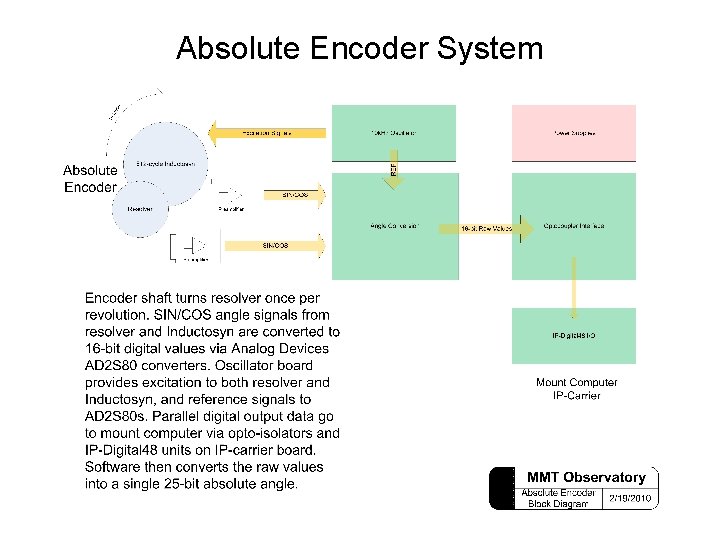
Absolute Encoder System
Problems with Absolute Encoders • 512 - and 1024 -cycle/rev error terms in Inductosyn • Null error at cardinal angles of resolver and Inductosyn electrical cycle • Low-frequency spatial error from resolver outputs • Complex analog signal-processing hardware produce error terms, some of which are subject to aging and drift • 25 -bit resolution lower than tapes OR absolute encoder offerings • Velocity estimation noise considerably higher compared to using tapes or RCN 829 • IP-Digital 48 is end-of-life and not easily replaceable • Internal encoder parts are extremely difficult to repair or replace as the recent resolver failure shows
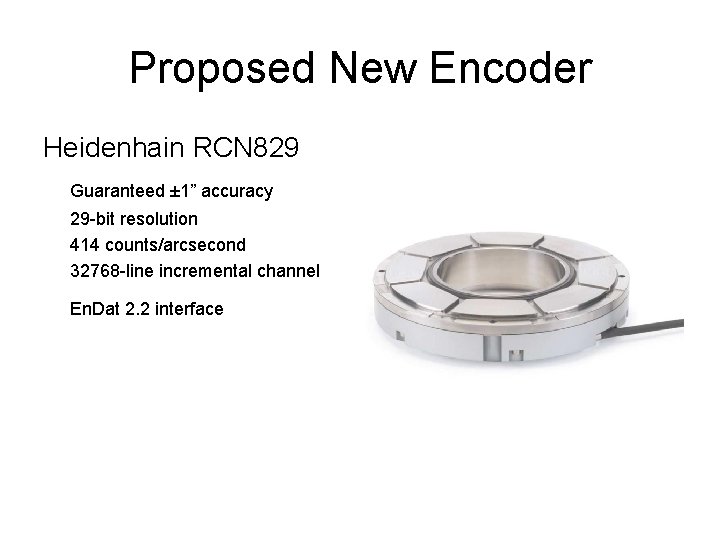
Proposed New Encoder Heidenhain RCN 829 Guaranteed ± 1” accuracy 29 -bit resolution 414 counts/arcsecond 32768 -line incremental channel En. Dat 2. 2 interface
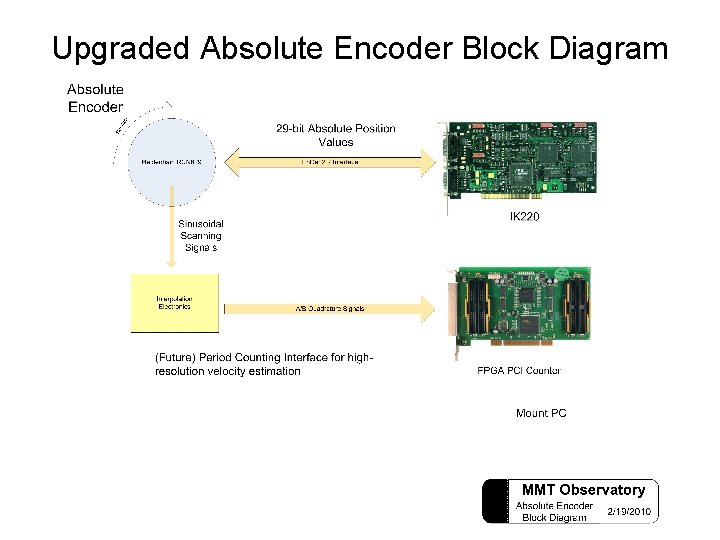
Upgraded Absolute Encoder Block Diagram
Considerations for Encoder Replacement • Mechanical – Can the RCN 829 be mounted to achieve full accuracy? • Electrical – Can the RCN 829 be cabled and powered for correct operation? • Environmental – Does it work at 2. 5 km altitude over -10 to 30 C, and is it ozone-resistant? • Integration – Can the RCN 829 and associated IK 220 readout board be used in the existing mount control system software? • Performance – What performance in pointing and tracking can be expected, and is it sufficiently higher than the existing system to justify it? • Cost – How does the cost compare to replacing the tape encoders or improving the performance (e. g. RON 905 stack) of the existing encoder system? • Time – What is the lead time? How long to complete the replacement? • Staffing – How many people and how much effort will be needed?
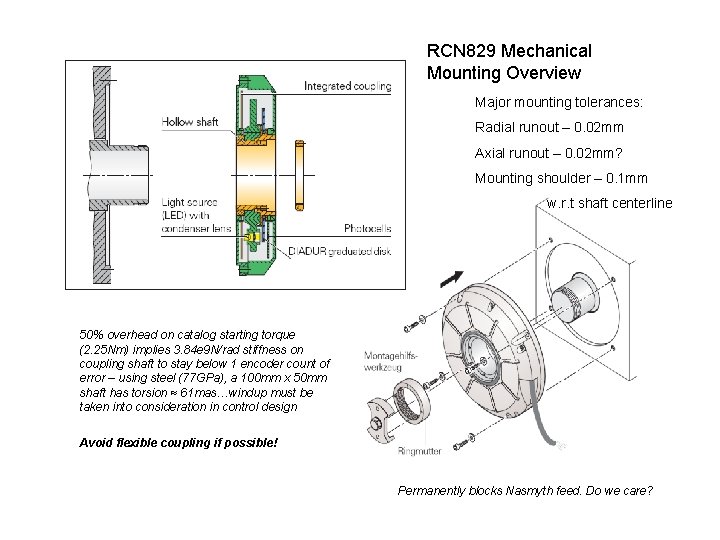
RCN 829 Mechanical Mounting Overview Major mounting tolerances: Radial runout – 0. 02 mm Axial runout – 0. 02 mm? Mounting shoulder – 0. 1 mm w. r. t shaft centerline 50% overhead on catalog starting torque (2. 25 Nm) implies 3. 84 e 9 N/rad stiffness on coupling shaft to stay below 1 encoder count of error – using steel (77 GPa), a 100 mm x 50 mm shaft has torsion ≈ 61 mas…windup must be taken into consideration in control design Avoid flexible coupling if possible! Permanently blocks Nasmyth feed. Do we care?
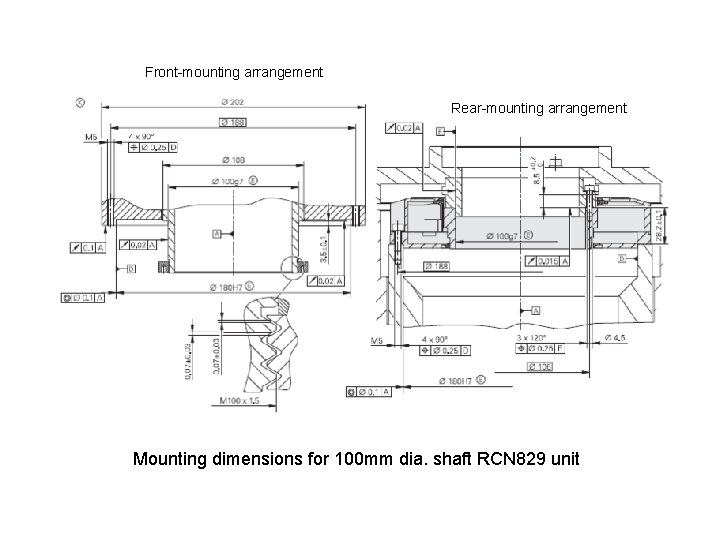
Front-mounting arrangement Rear-mounting arrangement Mounting dimensions for 100 mm dia. shaft RCN 829 unit
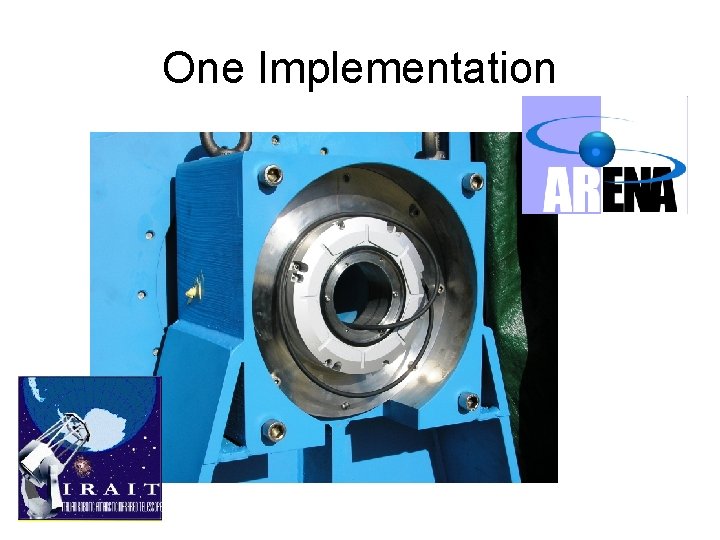
One Implementation
Electrical • One M 23 coupling cable is required for connection to encoder • Max cable length is 150 m for En. Dat 02 option, MMT can easily use 25 m cables • Power required is 3. 6 -5. 25 V @ 350 m. A • For implementation of period counting, intermediate connection is required to split out incremental signals for separate interpolation • Initial deployment simply connects directly to the IK 220 board for both power and signals
Environmental • Viton seals are supplied, ozone resistance is very good • -10 C will stiffen the bearing grease and seals a bit, and testing in Perugia showed self-heating is sufficient to keep the encoder working (in Antarctica…) • Altitude is also within the operating tolerance • Clean dry air can be supplied to the unit to reduce contamination (recommended!) • Unknown what to do for lightning protection; connection to PC via IK 220 is technically a violation of long-standing electrical isolation policy for mount control systems
Integration Issues • Mount computer has no available PCI slots; we are ordering new passive-backplane PCI system to address this problem for other reasons • IK 220 board needs to have a driver developed for use with Vx. Works and x. PC Target for testing and operations • Software using the new readout electronics and control design needs to be validated • Removal of existing encoder is a potentially unrecoverable change in terms of re-acquiring the original position should installation of RCN 829 fail and require changing back • New pointing coefficients must be gathered, requiring a scheduled night (or two) for this activity
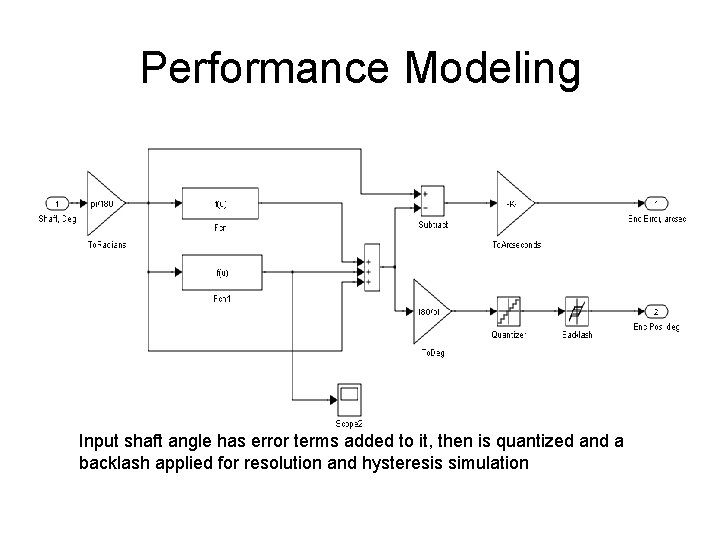
Performance Modeling Input shaft angle has error terms added to it, then is quantized and a backlash applied for resolution and hysteresis simulation
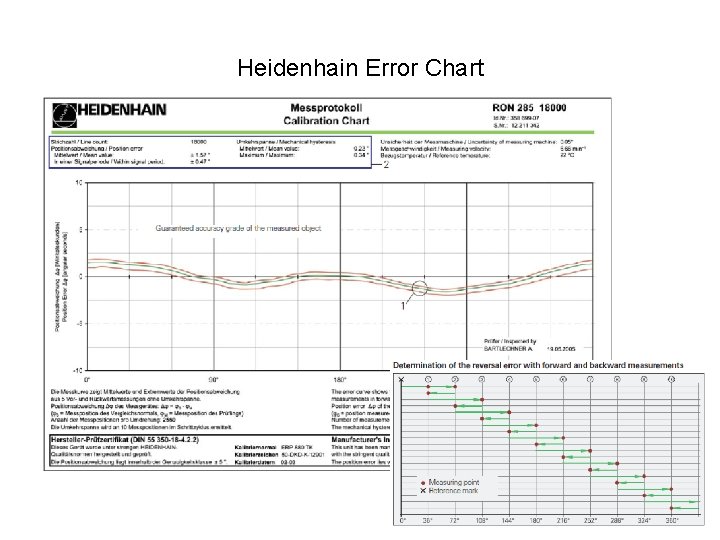
Heidenhain Error Chart
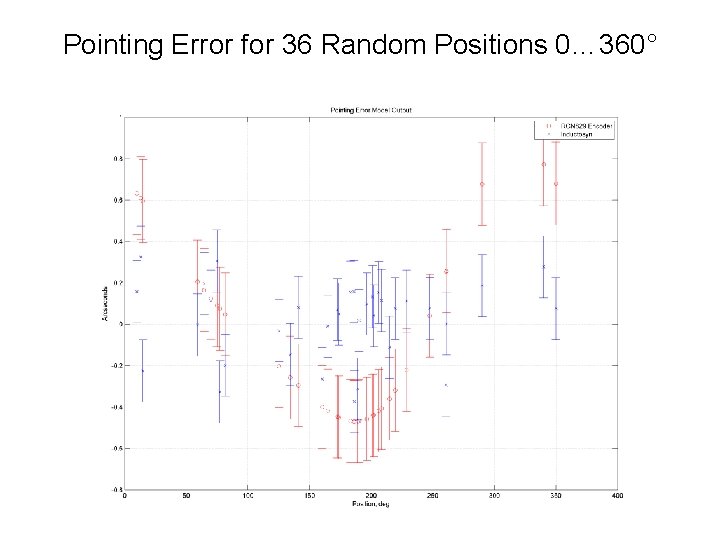
Pointing Error for 36 Random Positions 0… 360°
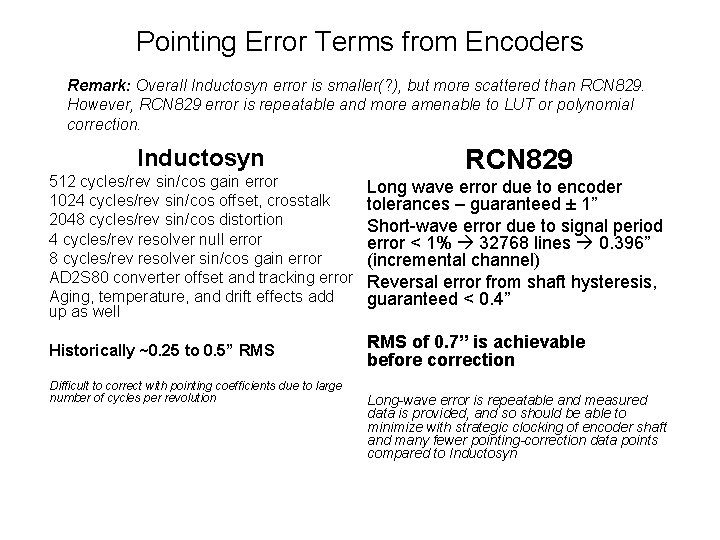
Pointing Error Terms from Encoders Remark: Overall Inductosyn error is smaller(? ), but more scattered than RCN 829. However, RCN 829 error is repeatable and more amenable to LUT or polynomial correction. Inductosyn RCN 829 512 cycles/rev sin/cos gain error 1024 cycles/rev sin/cos offset, crosstalk 2048 cycles/rev sin/cos distortion 4 cycles/rev resolver null error 8 cycles/rev resolver sin/cos gain error AD 2 S 80 converter offset and tracking error Aging, temperature, and drift effects add up as well Long wave error due to encoder tolerances – guaranteed ± 1” Short-wave error due to signal period error < 1% 32768 lines 0. 396” (incremental channel) Reversal error from shaft hysteresis, guaranteed < 0. 4” Historically ~0. 25 to 0. 5” RMS of 0. 7” is achievable before correction Difficult to correct with pointing coefficients due to large number of cycles per revolution Long-wave error is repeatable and measured data is provided, and so should be able to minimize with strategic clocking of encoder shaft and many fewer pointing-correction data points compared to Inductosyn
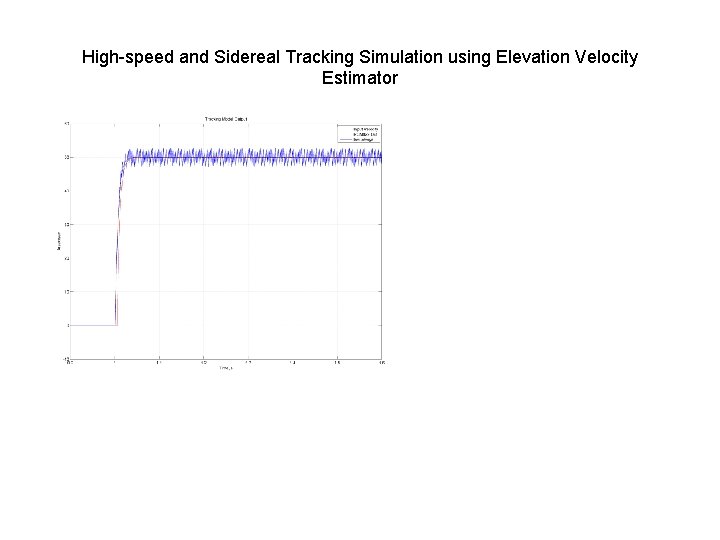
High-speed and Sidereal Tracking Simulation using Elevation Velocity Estimator
Comparison of 25 - and 29 -bit Position Error and Velocity Error at 1”/sec
Velocity Estimation Remarks • • In every case, higher resolution gives finer velocity estimation outputs (5. 6” p-p vs. 0. 35” p-p, 16 X as expected) Estimation jitter frequency linearly related to quantization noise and proportional to velocity (Fjitter ≈ (1. 7 * velocity) + 28) (at 25 bits) Jitter noise gets amplified in controller’s forward path – minimize wherever possible But: –Shaft windup can be an issue; a high-quality coupling is absolutely necessary –Velocity jitter as was experienced with tape encoders may be encountered; fix with velocity-jitter estimator(? ) –Modeling period counting may tell us more about what to expect Finally, generally speaking, the higher the resolution and less noisy velocity estimation, the higher the velocity loop gain can be increased for tracking stiffness; simulation studies can determine this quantitatively
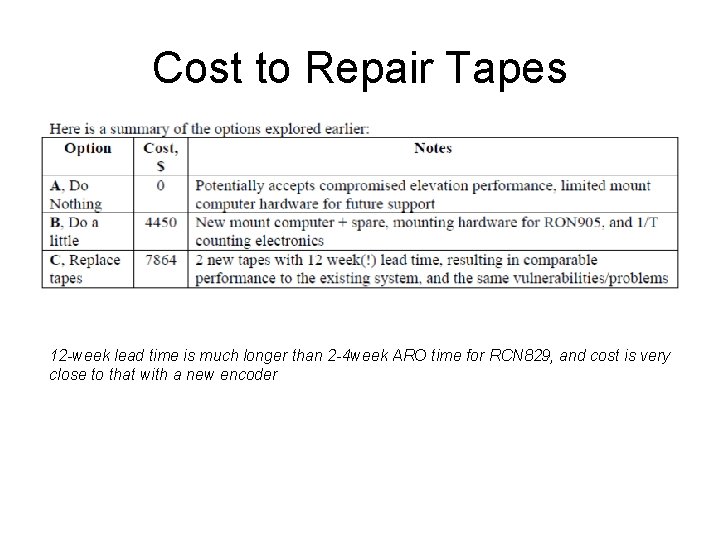
Cost to Repair Tapes 12 -week lead time is much longer than 2 -4 week ARO time for RCN 829, and cost is very close to that with a new encoder
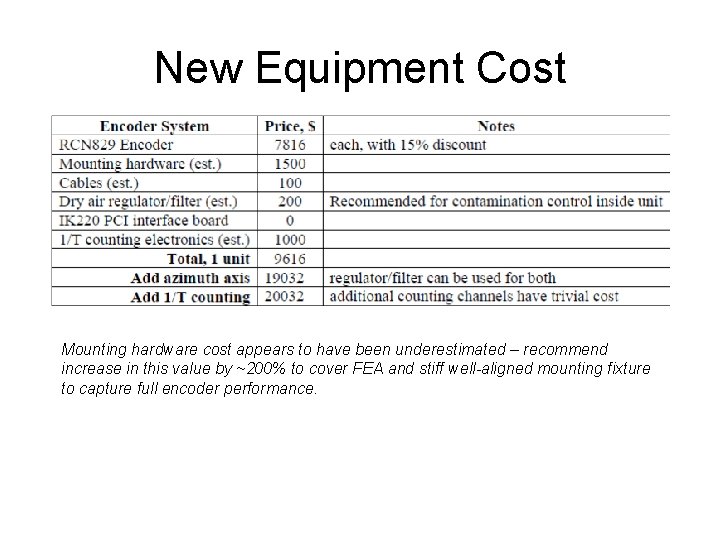
New Equipment Cost Mounting hardware cost appears to have been underestimated – recommend increase in this value by ~200% to cover FEA and stiff well-aligned mounting fixture to capture full encoder performance.
Time, People and Operations • Lead time for RCN 829 is 4 weeks ARO, 12 weeks for replacement tapes • Already working on IK 220 readout board drivers to support other encoders • New mechanical mount needed, design should start very soon if this course is taken • Encoder repairs have been effected, but we are currently running essentially without spares for encoders • Already working on upgrading azimuth servo, opportunity exists to do parallel development to support • Need 2 mechanical (1 designer, 1 drafter), 1 electrical, 2 software people to complete work by 2011
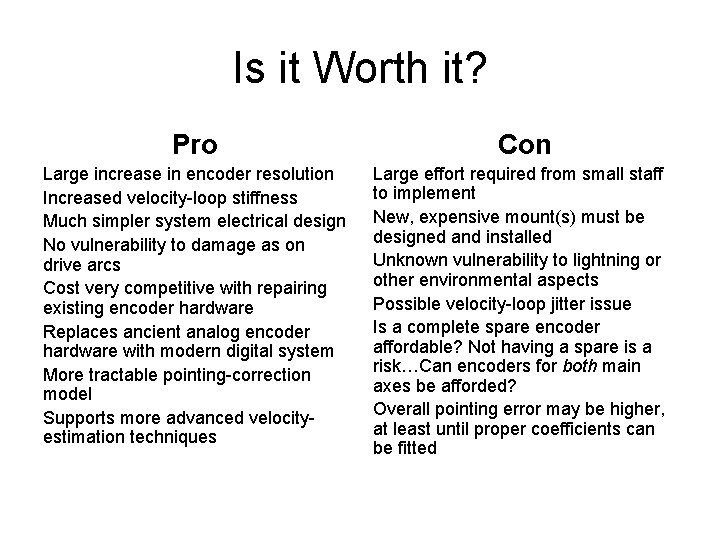
Is it Worth it? Pro Large increase in encoder resolution Increased velocity-loop stiffness Much simpler system electrical design No vulnerability to damage as on drive arcs Cost very competitive with repairing existing encoder hardware Replaces ancient analog encoder hardware with modern digital system More tractable pointing-correction model Supports more advanced velocityestimation techniques Con Large effort required from small staff to implement New, expensive mount(s) must be designed and installed Unknown vulnerability to lightning or other environmental aspects Possible velocity-loop jitter issue Is a complete spare encoder affordable? Not having a spare is a risk…Can encoders for both main axes be afforded? Overall pointing error may be higher, at least until proper coefficients can be fitted
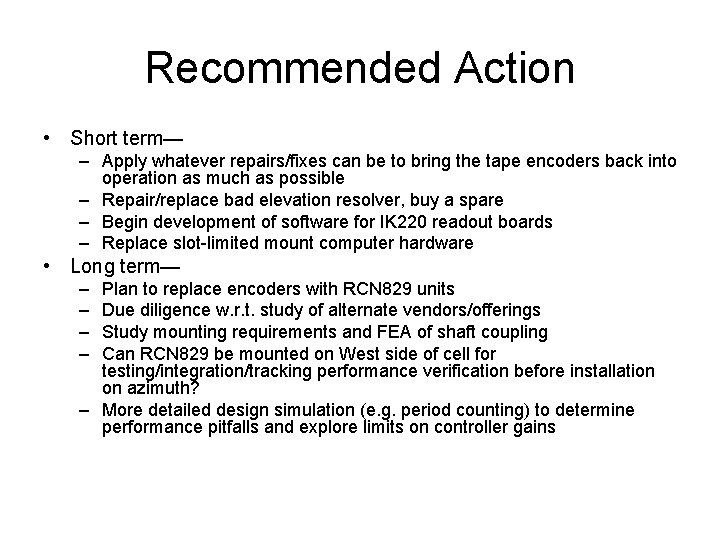
Recommended Action • Short term— – Apply whatever repairs/fixes can be to bring the tape encoders back into operation as much as possible – Repair/replace bad elevation resolver, buy a spare – Begin development of software for IK 220 readout boards – Replace slot-limited mount computer hardware • Long term— – – Plan to replace encoders with RCN 829 units Due diligence w. r. t. study of alternate vendors/offerings Study mounting requirements and FEA of shaft coupling Can RCN 829 be mounted on West side of cell for testing/integration/tracking performance verification before installation on azimuth? – More detailed design simulation (e. g. period counting) to determine performance pitfalls and explore limits on controller gains
- Slides: 26