
MMPTCP A Multipath Transport Protocol for Data Centres

- Slides: 22
MMPTCP: A Multipath Transport Protocol for Data Centres Morteza Kheirkhah University of Edinburgh, UK Ian Wakeman and George Parisis University of Sussex, UK IEEE INFOCOM 2016 1
Data Centre Importance • Support diverse applications with diverse communication patterns and requirements – Some apps are bandwidth hungry (online file storage) – Other apps are latency sensitive (online search) • The DC Performance is directly impacted the revenue of many companies – Amazon sales dropped by 1% by adding 100 ms latency – Online brokers could lose 4 M US dollars per millisecond if they fall 5 ms behind their competitors 2
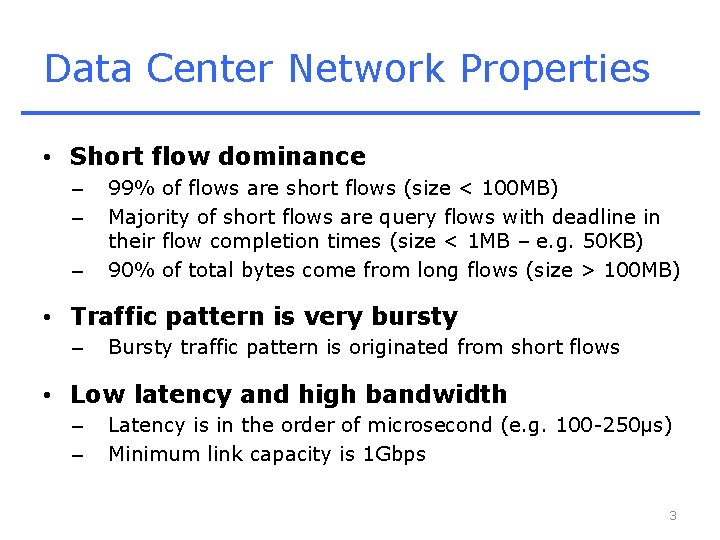
Data Center Network Properties • Short flow dominance – – – 99% of flows are short flows (size < 100 MB) Majority of short flows are query flows with deadline in their flow completion times (size < 1 MB – e. g. 50 KB) 90% of total bytes come from long flows (size > 100 MB) • Traffic pattern is very bursty – Bursty traffic pattern is originated from short flows • Low latency and high bandwidth – – Latency is in the order of microsecond (e. g. 100 -250μs) Minimum link capacity is 1 Gbps 3
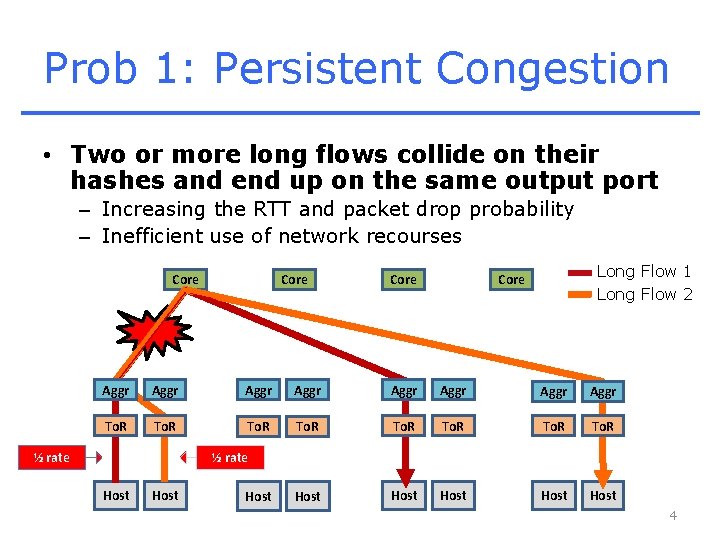
Prob 1: Persistent Congestion • Two or more long flows collide on their hashes and end up on the same output port – Increasing the RTT and packet drop probability – Inefficient use of network recourses Core Long Flow 1 Long Flow 2 Core Aggr Aggr To. R To. R Host Host ½ rate Host 4
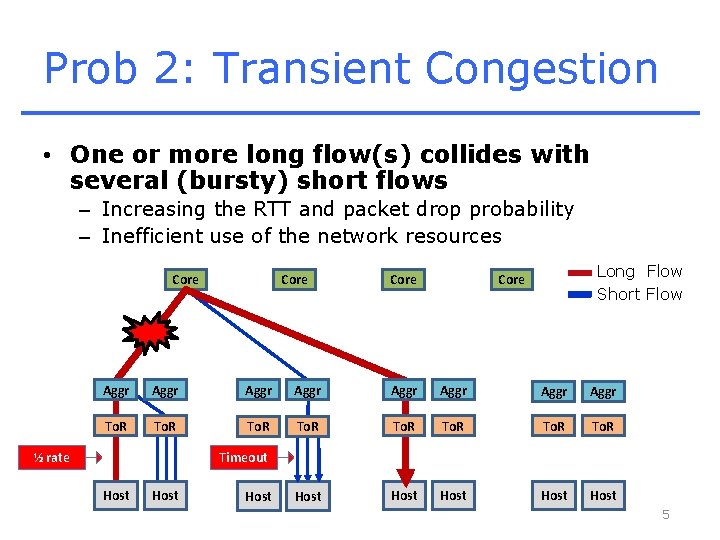
Prob 2: Transient Congestion • One or more long flow(s) collides with several (bursty) short flows – Increasing the RTT and packet drop probability – Inefficient use of the network resources Core Long Flow Short Flow Core Aggr Aggr To. R To. R Host Host ½ rate Timeout Host 5
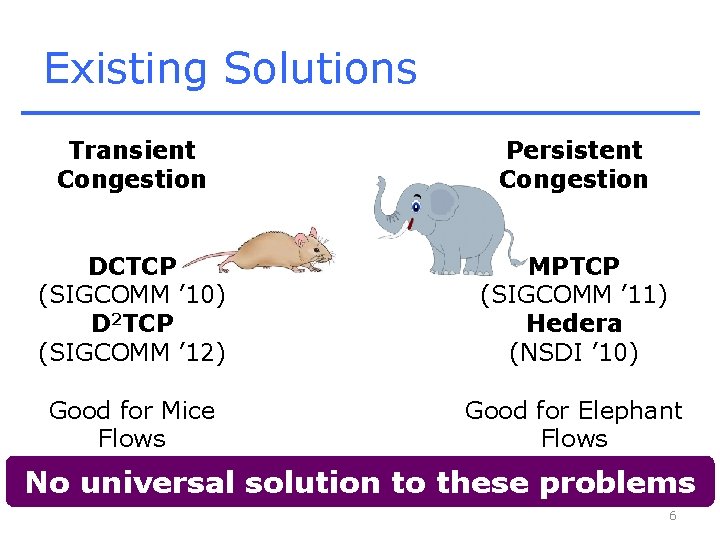
Existing Solutions Transient Congestion Persistent Congestion DCTCP (SIGCOMM ’ 10) D 2 TCP (SIGCOMM ’ 12) MPTCP (SIGCOMM ’ 11) Hedera (NSDI ’ 10) Good for Mice Flows Good for Elephant Flows No universal solution to these problems 6
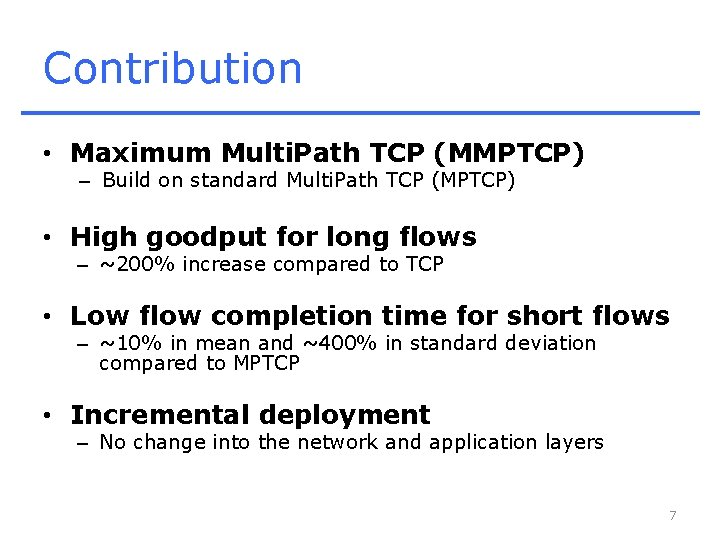
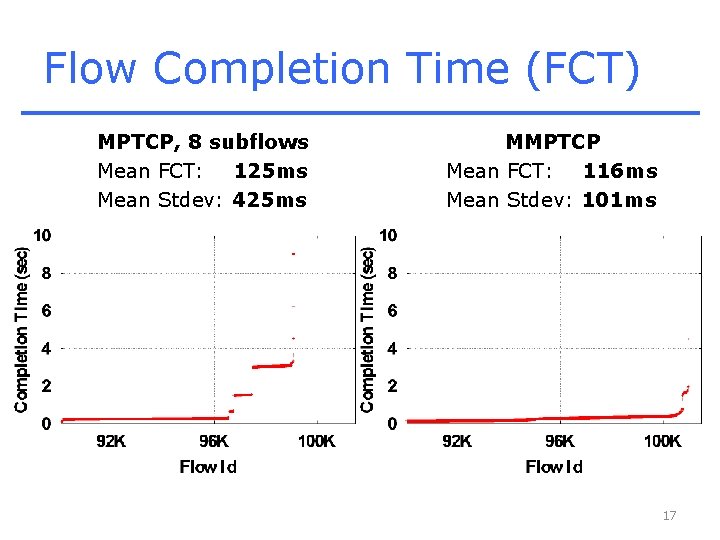
Contribution • Maximum Multi. Path TCP (MMPTCP) – Build on standard Multi. Path TCP (MPTCP) • High goodput for long flows – ~200% increase compared to TCP • Low flow completion time for short flows – ~10% in mean and ~400% in standard deviation compared to MPTCP • Incremental deployment – No change into the network and application layers 7
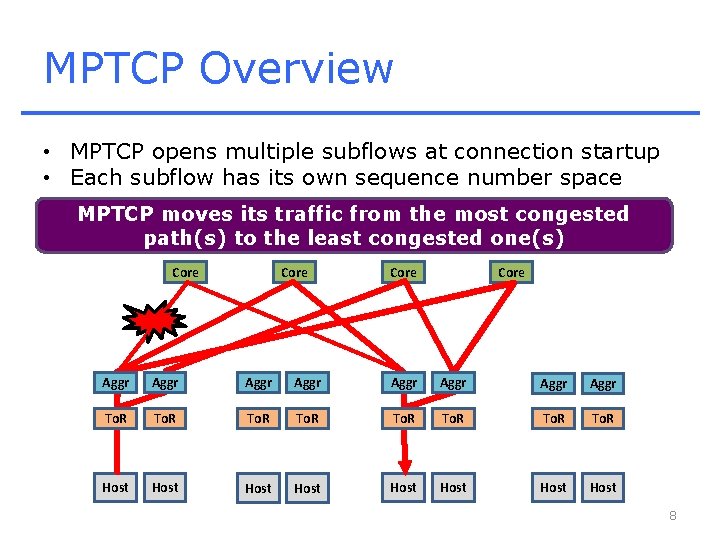
MPTCP Overview • MPTCP opens multiple subflows at connection startup • Each subflow has its own sequence number space MPTCP moves its traffic from the most congested path(s) to the least congested one(s) Core Aggr Aggr To. R To. R Host Host 8
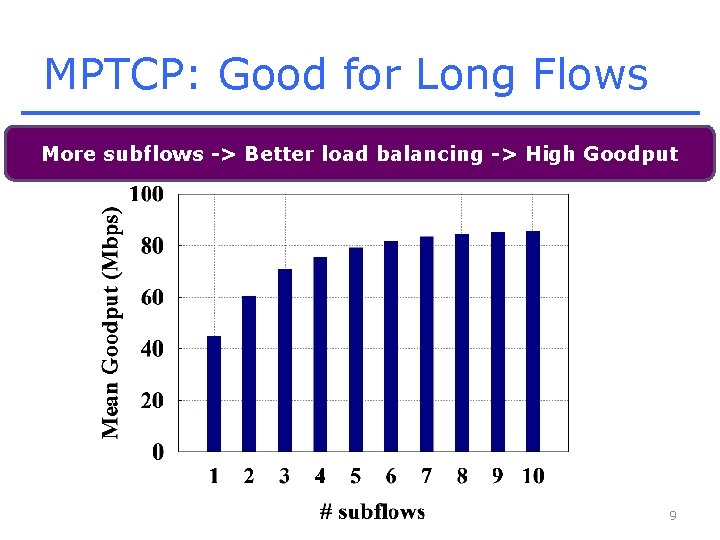
MPTCP: Good for Long Flows More subflows -> Better load balancing -> High Goodput 9
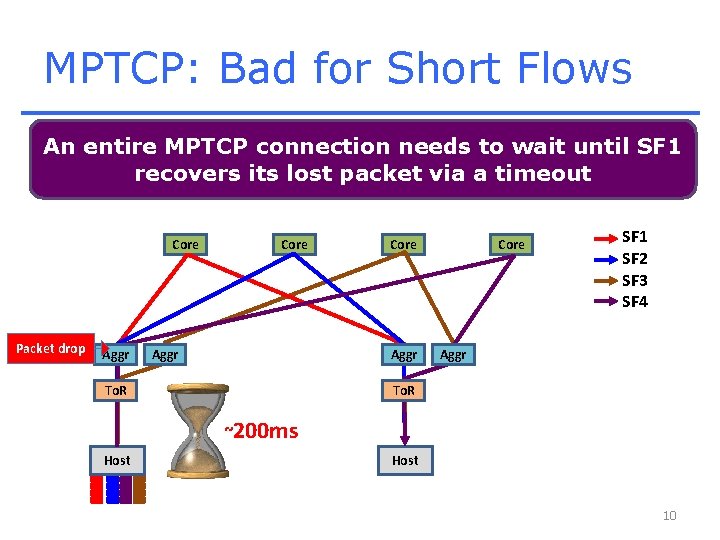
MPTCP: Bad for Short Flows An entire MPTCP connection needs to wait until SF 1 recovers its lost packet via a timeout Core Packet drop Aggr Core Aggr To. R Core SF 1 SF 2 SF 3 SF 4 Aggr To. R ~200 ms Host 10
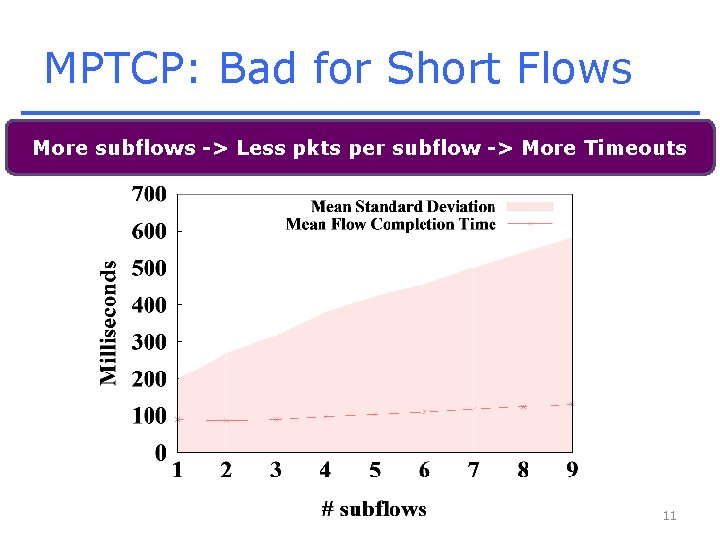
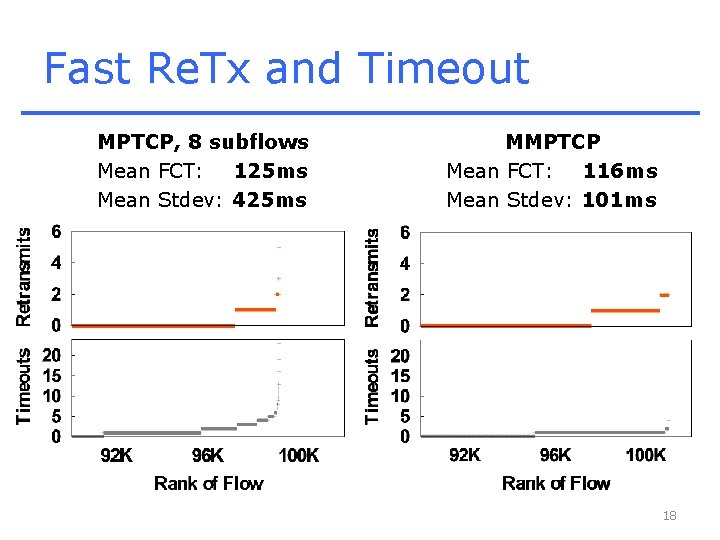
MPTCP: Bad for Short Flows More subflows -> Less pkts per subflow -> More Timeouts 11
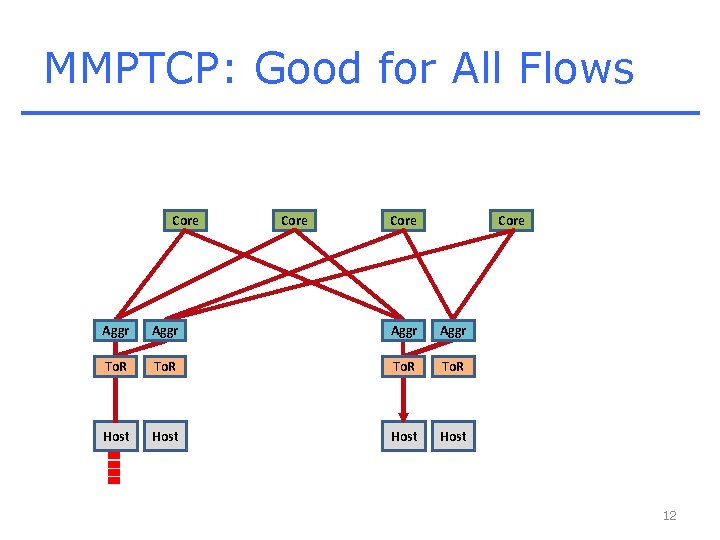
MMPTCP: Good for All Flows Core Aggr To. R Host 12
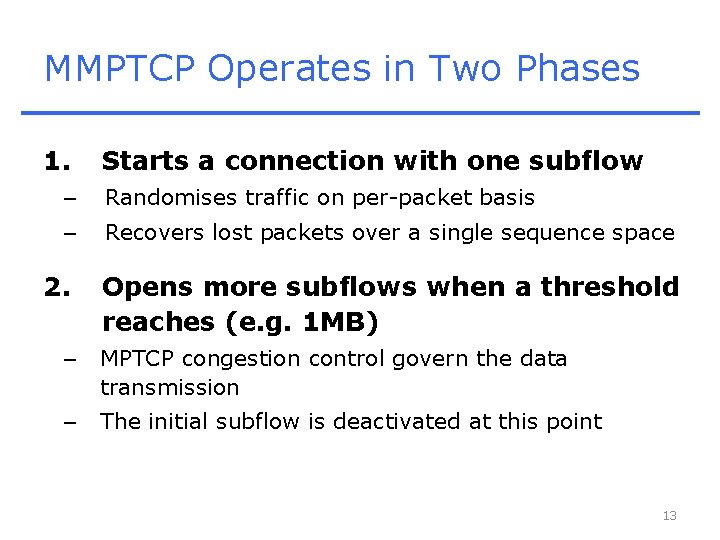
MMPTCP Operates in Two Phases 1. Starts a connection with one subflow – Randomises traffic on per-packet basis – Recovers lost packets over a single sequence space 2. Opens more subflows when a threshold reaches (e. g. 1 MB) – MPTCP congestion control govern the data transmission – The initial subflow is deactivated at this point 13
MMPTCP Key Features • Handles bursty traffic patterns gracefully • Decreases the flow completion time of short flows compared to MPTCP • Increases the throughput of long flows • Incrementally deployable MMPTCP achieves its goals by exploiting all parallel paths in the data centre faric 14
Packet Reordering in Phase 1 • Spurious retransmissions may occur due to out-of-order packets – Existing solutions: RR-TCP, Eifel and so on – Not sufficient for latency sensitive short flows • Our solution – Increase the dupack threshold based on the number of parallel paths between a src-dst pair – Perfectly works for VL 2 and Fat. Tree 15
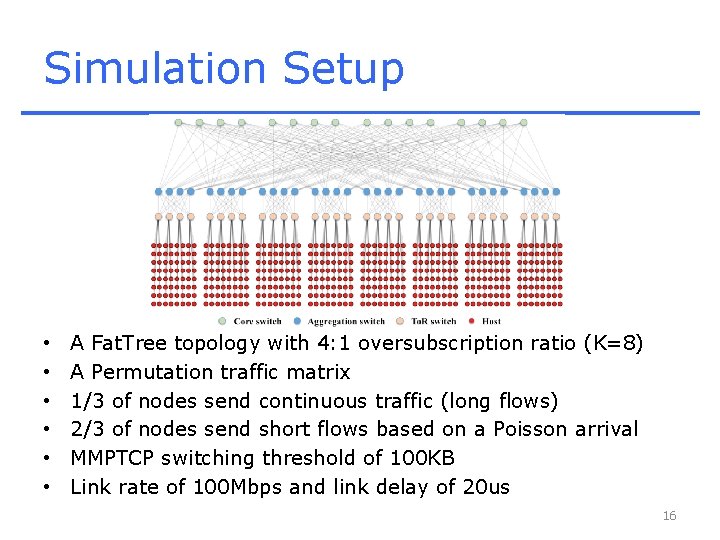
Simulation Setup • • • A Fat. Tree topology with 4: 1 oversubscription ratio (K=8) A Permutation traffic matrix 1/3 of nodes send continuous traffic (long flows) 2/3 of nodes send short flows based on a Poisson arrival MMPTCP switching threshold of 100 KB Link rate of 100 Mbps and link delay of 20 us 16
Flow Completion Time (FCT) MPTCP, 8 subflows Mean FCT: 125 ms Mean Stdev: 425 ms MMPTCP Mean FCT: 116 ms Mean Stdev: 101 ms 17
Fast Re. Tx and Timeout MPTCP, 8 subflows Mean FCT: 125 ms Mean Stdev: 425 ms MMPTCP Mean FCT: 116 ms Mean Stdev: 101 ms 18
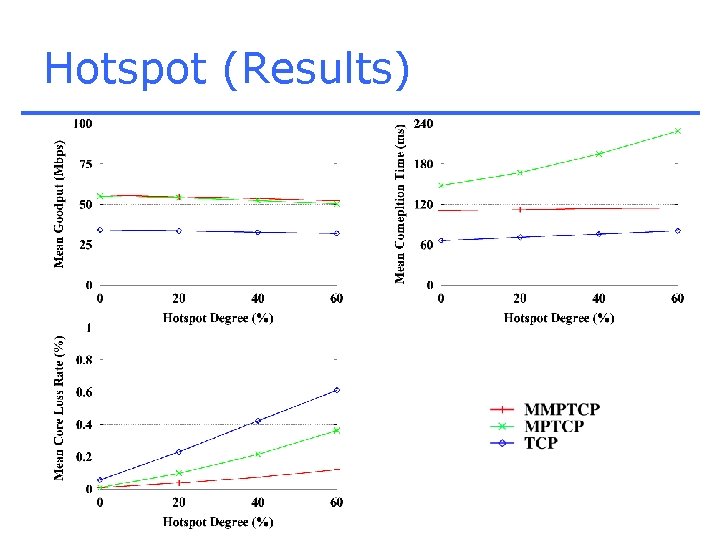
Hotspot • Hotspots occur for several reasons: – Contention between traffic flowing from the Internet to data centres (and vice versa) – Hardware failures or cable faults • Simulation Setup: – Mean Short flow arrival rate of 2560/sec (Poisson) – Transport protocols under examination: ² MMPTCP ² TCP 19
Hotspot (Results)
Final Remarks • MMPTCP is an extension of MPTCP – High burst tolerance – Low latency for short flows – High throughput for long flows – Incremental deployment 21
Thank You! 22