
MMET 370 LAB 3 Properties of Pure Substances

MMET 370 LAB 3: Properties of Pure Substances MMET 370 PROF. ALVARADO 1

Pure Substances MMET 370 Substances with fixed chemical composition Homogenous mixture of various components Examples: Water, Hydrogen, Nitrogen Examples: Air (combination of oxygen, nitrogen etc. ) PROF. ALVARADO 2
Pure Substances • They can exist in three different phases: solid, liquid, gas • Under certain conditions, two phases can co-exist • Ex: liquid and gas co-existing in the evaporator and condenser of a refrigerator MMET 370 PROF. ALVARADO 3
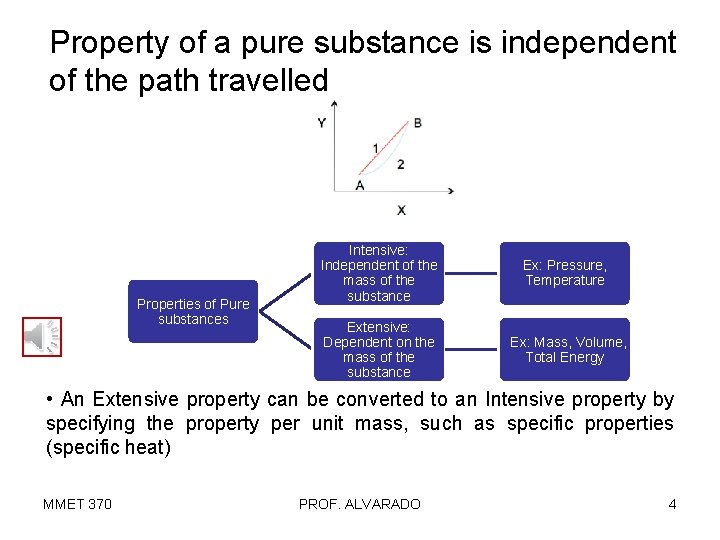
Property of a pure substance is independent of the path travelled Properties of Pure substances Intensive: Independent of the mass of the substance Ex: Pressure, Temperature Extensive: Dependent on the mass of the substance Ex: Mass, Volume, Total Energy • An Extensive property can be converted to an Intensive property by specifying the property per unit mass, such as specific properties (specific heat) MMET 370 PROF. ALVARADO 4
Pure Substances • A state of a pure substance can be specified by two independent properties • In single phase, pressure and temperature are the two common independent properties • In two phase, pressure and temperature are no longer independent. In this case we have to use another independent property (mostly “quality or X”) along with pressure or temperature to determine the state of the substance. MMET 370 PROF. ALVARADO 5
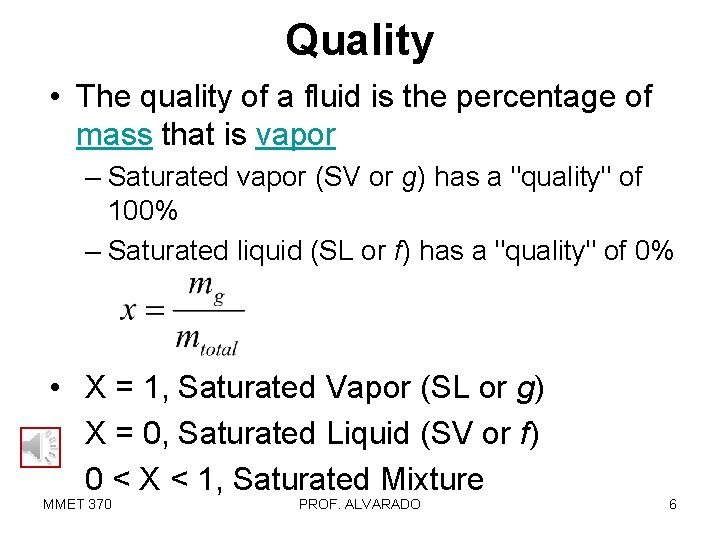
Quality • The quality of a fluid is the percentage of mass that is vapor – Saturated vapor (SV or g) has a "quality" of 100% – Saturated liquid (SL or f) has a "quality" of 0% • X = 1, Saturated Vapor (SL or g) X = 0, Saturated Liquid (SV or f) 0 < X < 1, Saturated Mixture MMET 370 PROF. ALVARADO 6
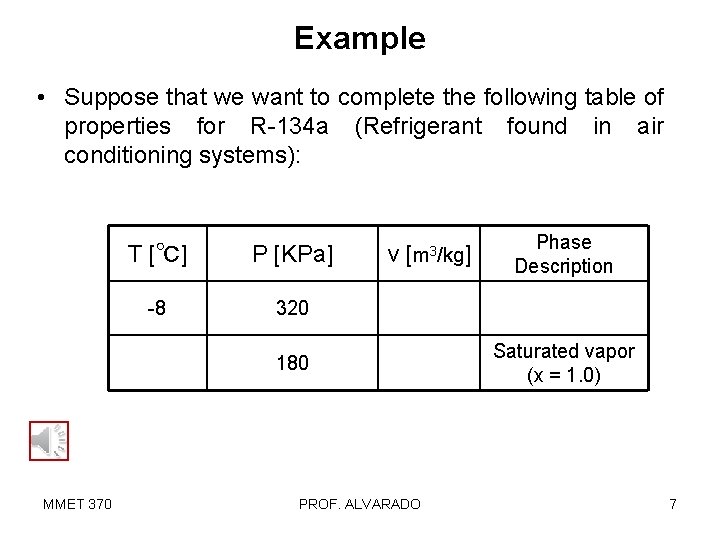
Example • Suppose that we want to complete the following table of properties for R-134 a (Refrigerant found in air conditioning systems): T [℃] P [KPa] -8 320 v [m 3/kg] 180 MMET 370 PROF. ALVARADO Phase Description Saturated vapor (x = 1. 0) 7
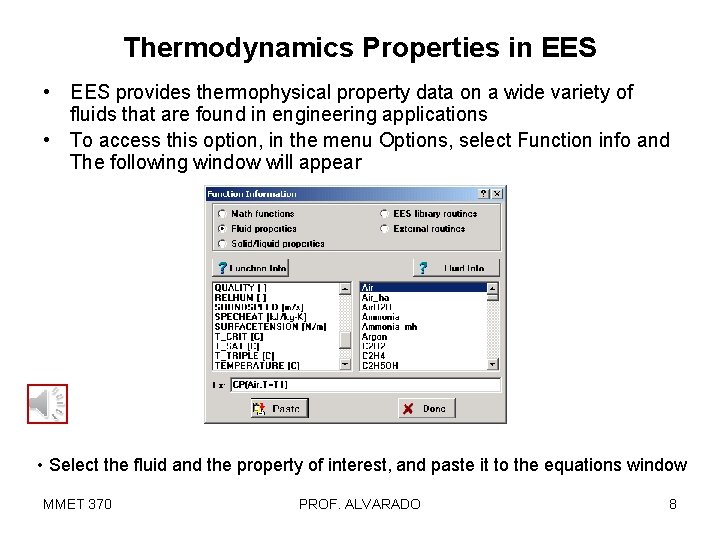
Thermodynamics Properties in EES • EES provides thermophysical property data on a wide variety of fluids that are found in engineering applications • To access this option, in the menu Options, select Function info and The following window will appear • Select the fluid and the property of interest, and paste it to the equations window MMET 370 PROF. ALVARADO 8
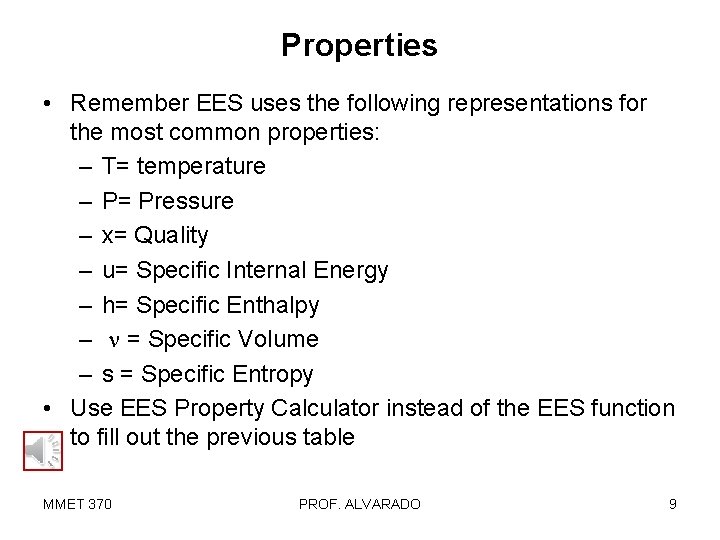
Properties • Remember EES uses the following representations for the most common properties: – T= temperature – P= Pressure – x= Quality – u= Specific Internal Energy – h= Specific Enthalpy – n = Specific Volume – s = Specific Entropy • Use EES Property Calculator instead of the EES function to fill out the previous table MMET 370 PROF. ALVARADO 9
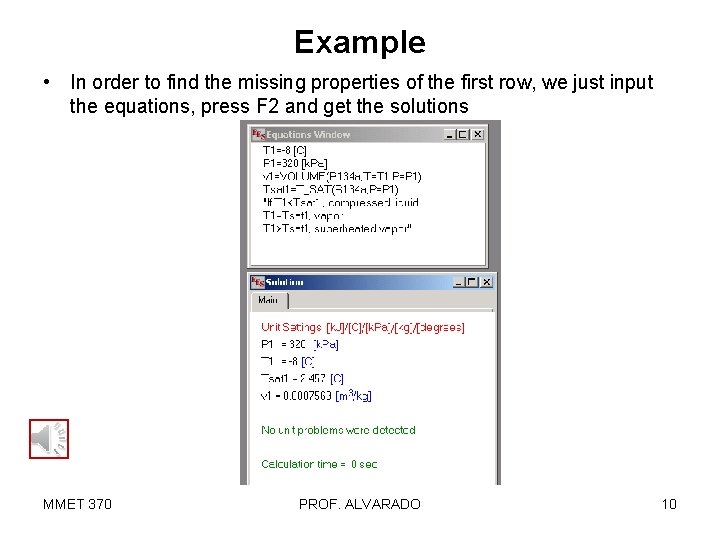
Example • In order to find the missing properties of the first row, we just input the equations, press F 2 and get the solutions MMET 370 PROF. ALVARADO 10
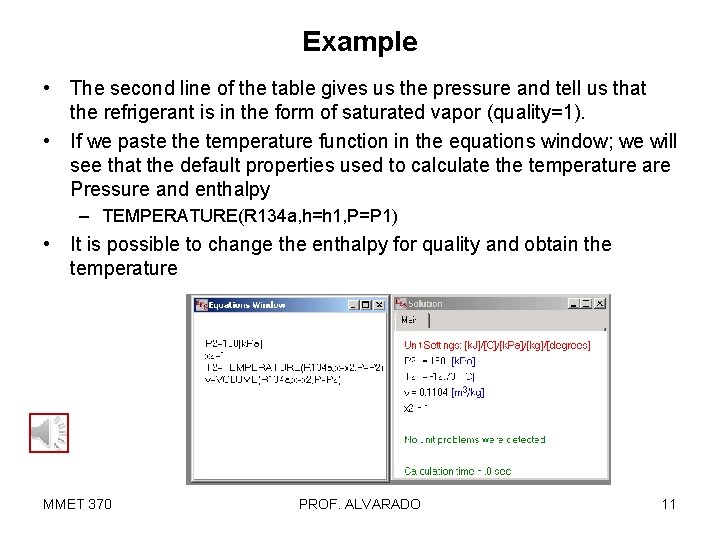
Example • The second line of the table gives us the pressure and tell us that the refrigerant is in the form of saturated vapor (quality=1). • If we paste the temperature function in the equations window; we will see that the default properties used to calculate the temperature are Pressure and enthalpy – TEMPERATURE(R 134 a, h=h 1, P=P 1) • It is possible to change the enthalpy for quality and obtain the temperature MMET 370 PROF. ALVARADO 11
![Example • The completed table looks like this: T [°C] P [k. Pa] V](http://slidetodoc.com/presentation_image_h2/00c47981a12529717b17dede1339f429/image-12.jpg "Example • The completed table looks like this: T [°C] P [k. Pa] V")
Example • The completed table looks like this: T [°C] P [k. Pa] V [m 3/kg] Phase Description -8 320 7. 569 * 10 -4 Compressed Liquid -12. 73 180 0. 1105 Saturated vapor MMET 370 PROF. ALVARADO 12
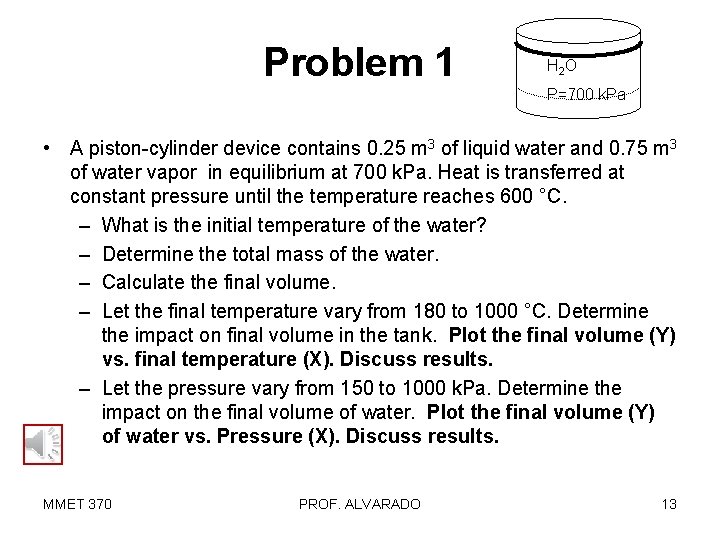
Problem 1 H 2 O P=700 k. Pa • A piston-cylinder device contains 0. 25 m 3 of liquid water and 0. 75 m 3 of water vapor in equilibrium at 700 k. Pa. Heat is transferred at constant pressure until the temperature reaches 600 °C. – What is the initial temperature of the water? – Determine the total mass of the water. – Calculate the final volume. – Let the final temperature vary from 180 to 1000 °C. Determine the impact on final volume in the tank. Plot the final volume (Y) vs. final temperature (X). Discuss results. – Let the pressure vary from 150 to 1000 k. Pa. Determine the impact on the final volume of water. Plot the final volume (Y) of water vs. Pressure (X). Discuss results. MMET 370 PROF. ALVARADO 13
- Slides: 13