MLS 570 Critical Thinking Reading Notes for Fogelin
- Slides: 21
MLS 570 Critical Thinking Reading Notes for Fogelin: Propositional Logic Fall Term 2006 North Central College
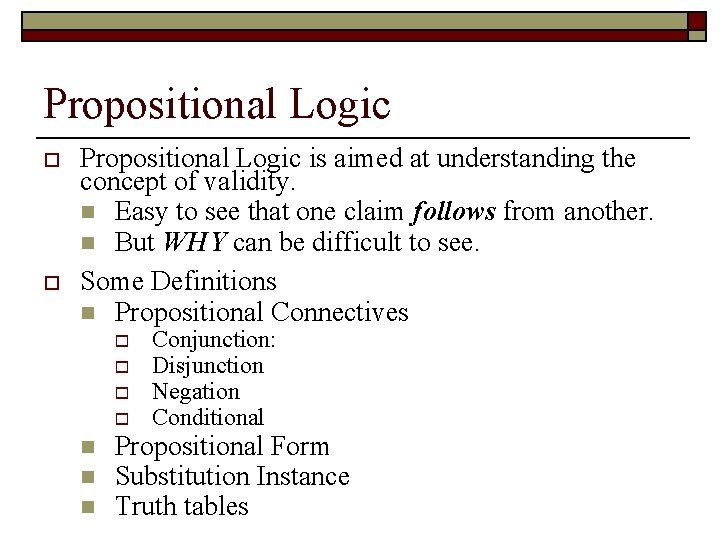
Propositional Logic o . o Propositional Logic is aimed at understanding the concept of validity. n Easy to see that one claim follows from another. n But WHY can be difficult to see. Some Definitions n Propositional Connectives o o n n n Conjunction: Disjunction Negation Conditional Propositional Form Substitution Instance Truth tables
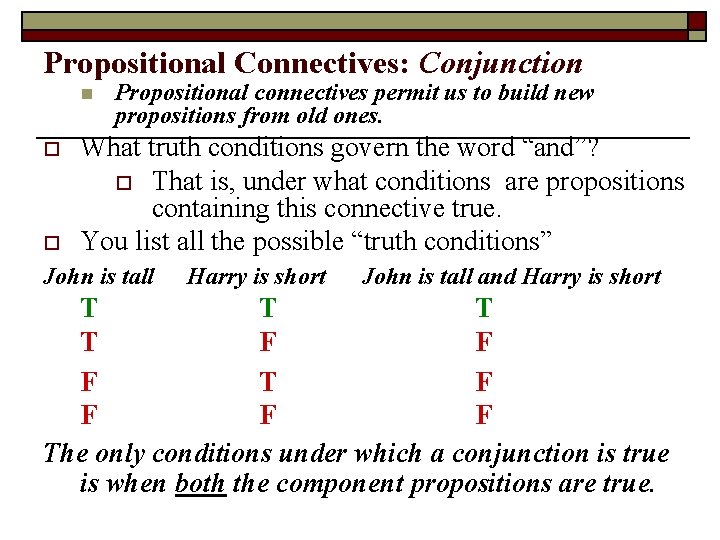
Propositional Connectives: Conjunction n o o Propositional connectives permit us to build new propositions from old ones. What truth conditions govern the word “and”? o That is, under what conditions are propositions containing this connective true. You list all the possible “truth conditions” John is tall Harry is short John is tall and Harry is short T T F F F The only conditions under which a conjunction is true is when both the component propositions are true.
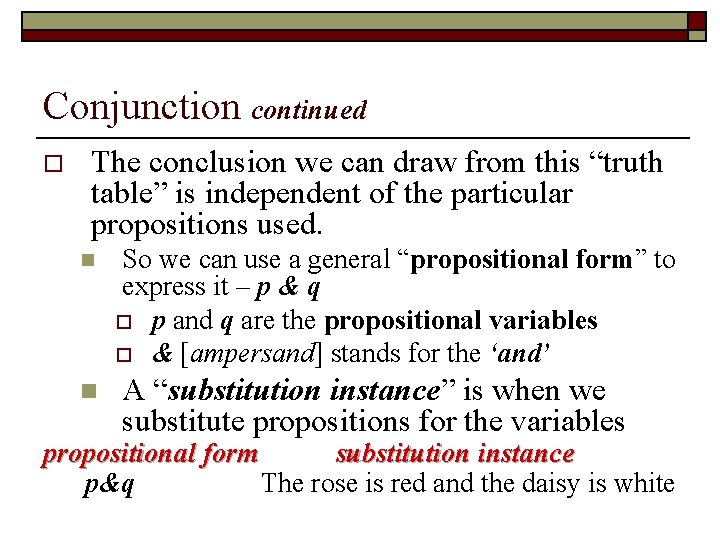
Conjunction continued o The conclusion we can draw from this “truth table” is independent of the particular propositions used. n n So we can use a general “propositional form” to express it – p & q o p and q are the propositional variables o & [ampersand] stands for the ‘and’ A “substitution instance” is when we substitute propositions for the variables propositional form substitution instance p&q The rose is red and the daisy is white
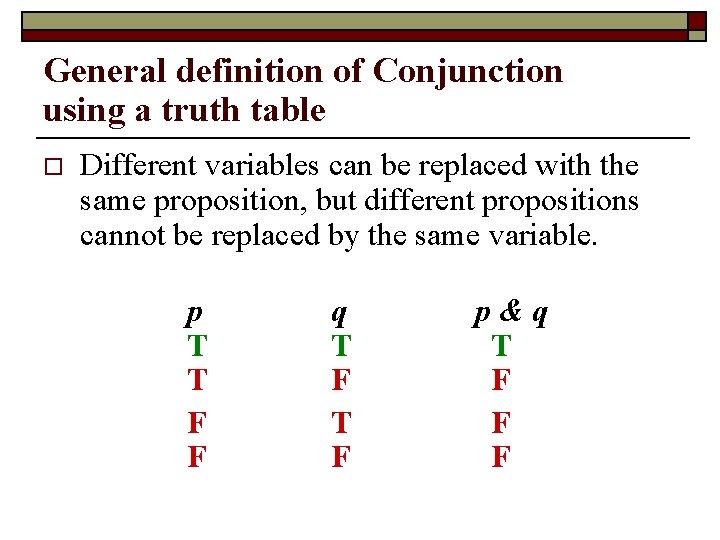
General definition of Conjunction using a truth table o Different variables can be replaced with the same proposition, but different propositions cannot be replaced by the same variable. p T T F F q T F p&q T F F F
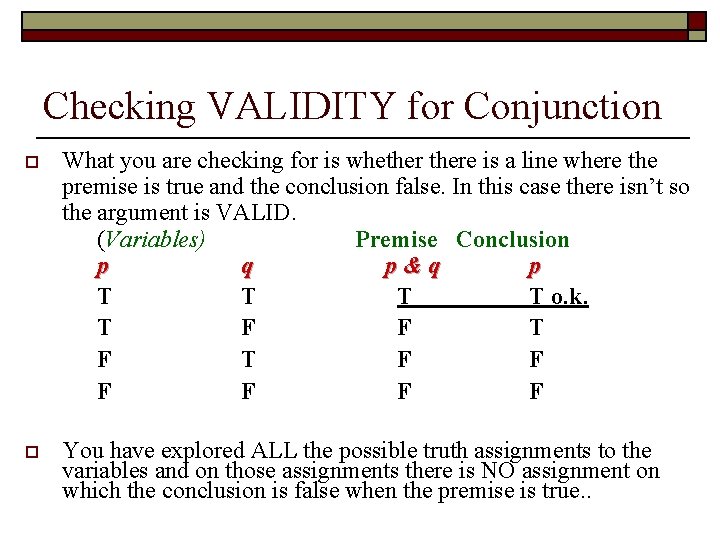
Checking VALIDITY for Conjunction o What you are checking for is whethere is a line where the premise is true and the conclusion false. In this case there isn’t so the argument is VALID. (Variables) Premise Conclusion p q p&q p T T o. k. T F F F o You have explored ALL the possible truth assignments to the variables and on those assignments there is NO assignment on which the conclusion is false when the premise is true. .
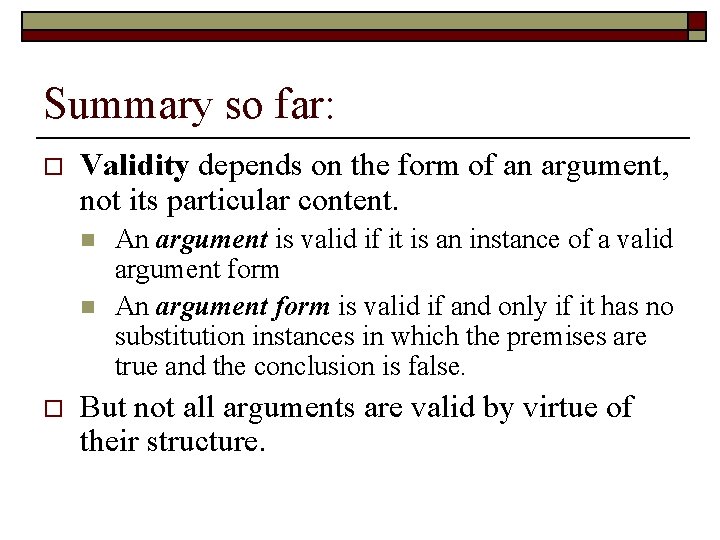
Summary so far: o Validity depends on the form of an argument, not its particular content. n n o An argument is valid if it is an instance of a valid argument form An argument form is valid if and only if it has no substitution instances in which the premises are true and the conclusion is false. But not all arguments are valid by virtue of their structure.
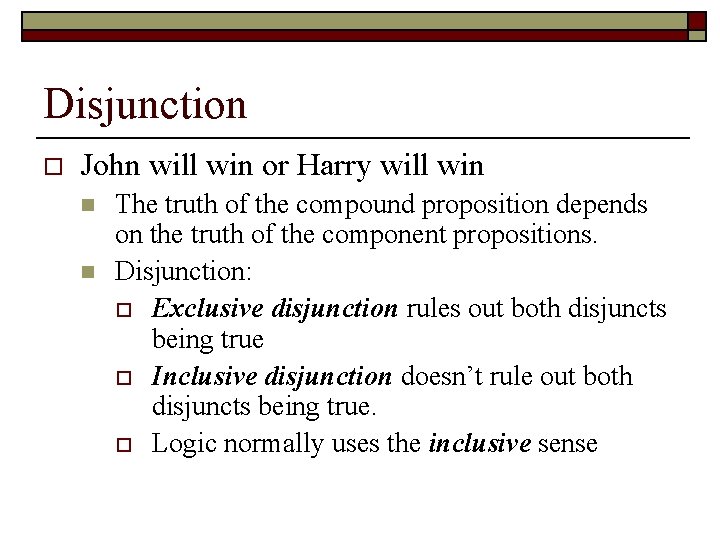
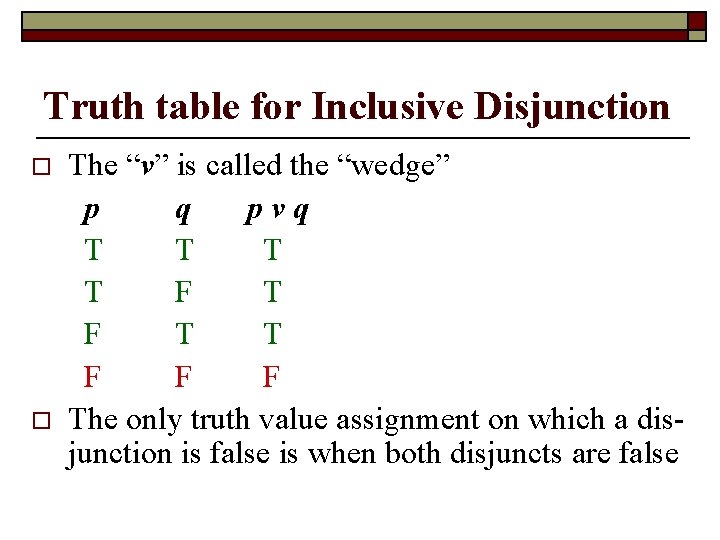
Disjunction o John will win or Harry will win n n The truth of the compound proposition depends on the truth of the component propositions. Disjunction: o Exclusive disjunction rules out both disjuncts being true o Inclusive disjunction doesn’t rule out both disjuncts being true. o Logic normally uses the inclusive sense
Truth table for Inclusive Disjunction o o The “v” is called the “wedge” p q pvq T T F F F The only truth value assignment on which a disjunction is false is when both disjuncts are false
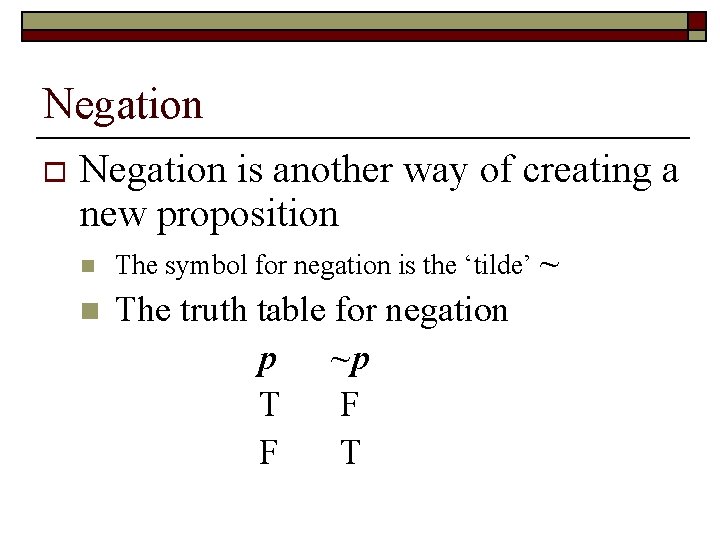
Negation o Negation is another way of creating a new proposition n n The symbol for negation is the ‘tilde’ ~ The truth table for negation p ~p T F F T
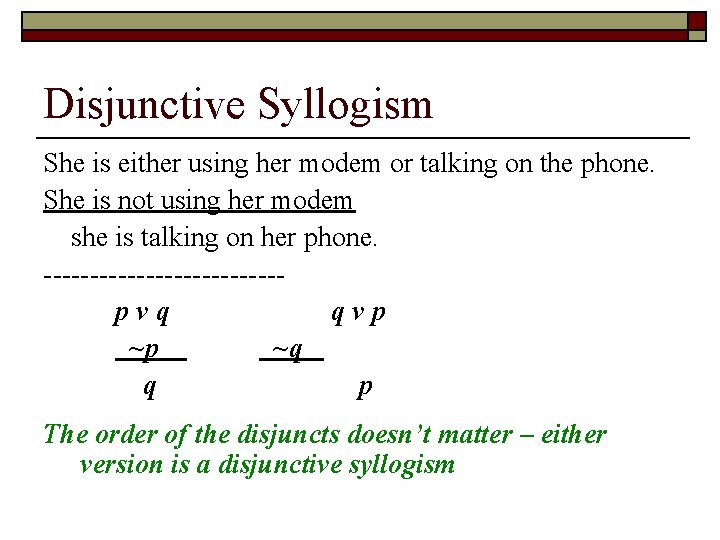
Disjunctive Syllogism She is either using her modem or talking on the phone. She is not using her modem she is talking on her phone. -------------pvq qvp ~p ~q. q p. The order of the disjuncts doesn’t matter – either version is a disjunctive syllogism
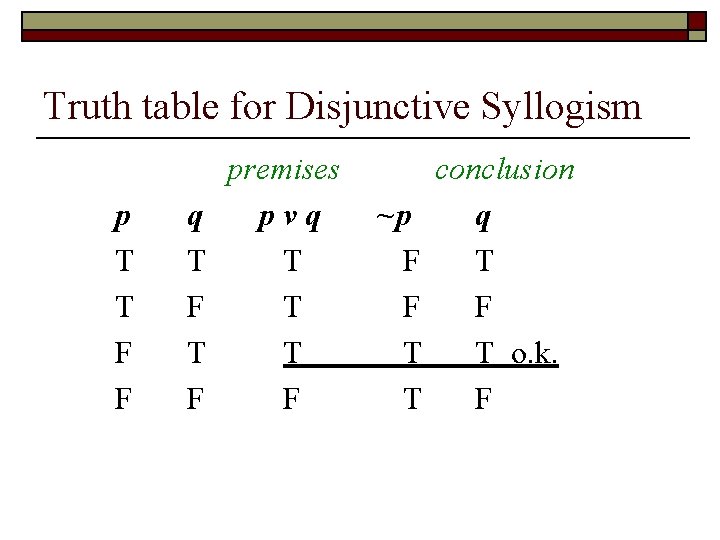
Truth table for Disjunctive Syllogism p T T F F q T F premises pvq T T T F ~p F F T T conclusion q T F T o. k. F
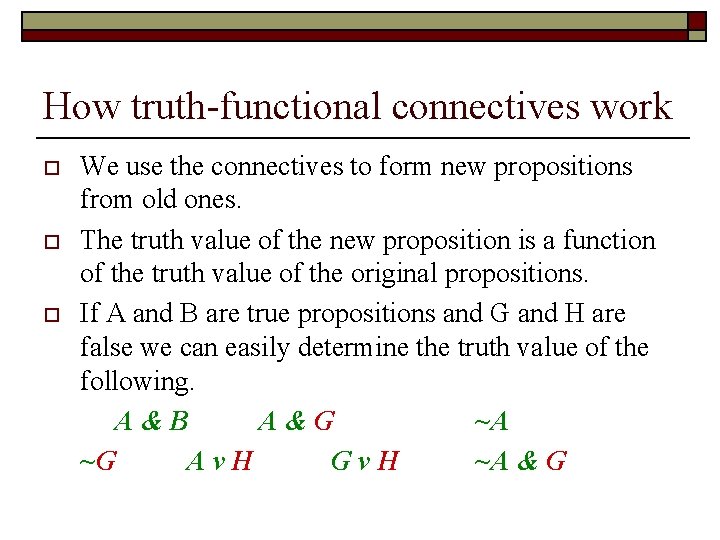
How truth-functional connectives work o o o We use the connectives to form new propositions from old ones. The truth value of the new proposition is a function of the truth value of the original propositions. If A and B are true propositions and G and H are false we can easily determine the truth value of the following. A&B A&G ~A ~G Av. H Gv. H ~A & G
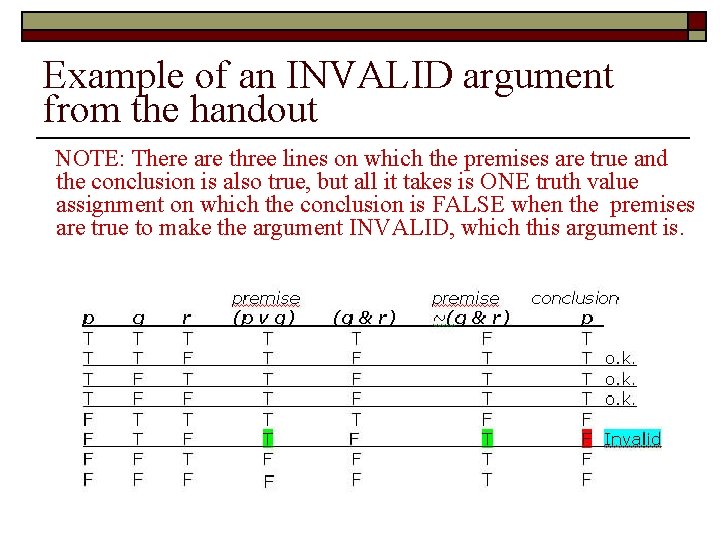
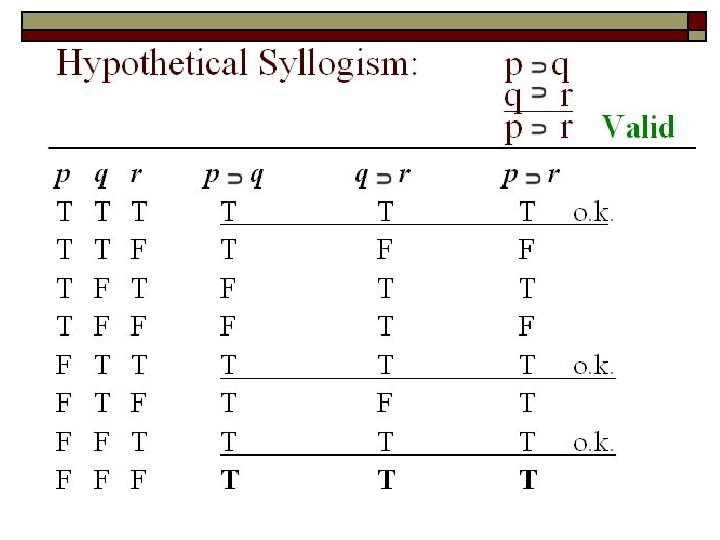
Testing for Validity o o For an argument to be valid there can never be an instance [in its truth table] in which the premises are true and the conclusion false. In a truth table you lay out all the possible truth value assignments for the variables [such as p, q, r, s] in columns and then, for each line [instance], determine the truth of the premises and the conclusion based on those truth value assignments.
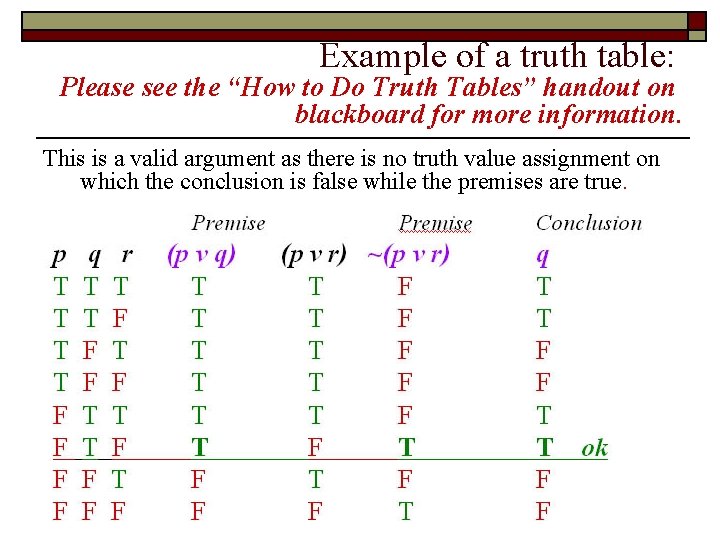
Example of a truth table: Please see the “How to Do Truth Tables” handout on blackboard for more information. This is a valid argument as there is no truth value assignment on which the conclusion is false while the premises are true.
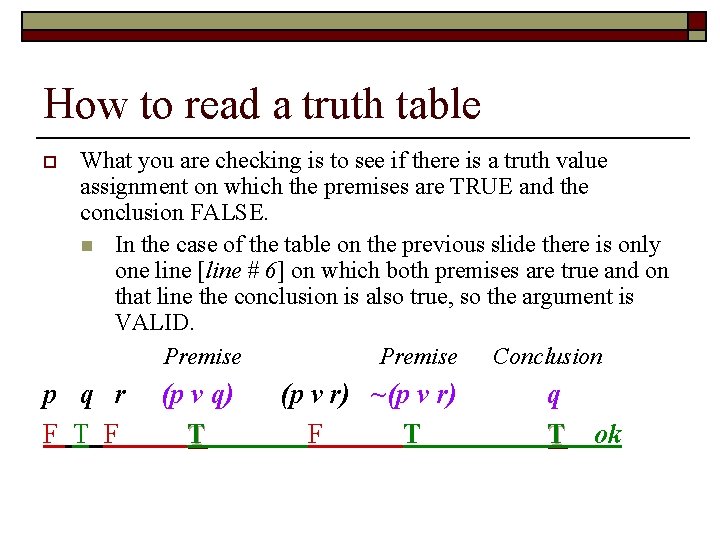
How to read a truth table o What you are checking is to see if there is a truth value assignment on which the premises are TRUE and the conclusion FALSE. n In the case of the table on the previous slide there is only one line [line # 6] on which both premises are true and on that line the conclusion is also true, so the argument is VALID. Premise Conclusion p q r F T F (p v q) T (p v r) ~(p v r) F T q T ok
Example of an INVALID argument from the handout NOTE: There are three lines on which the premises are true and the conclusion is also true, but all it takes is ONE truth value assignment on which the conclusion is FALSE when the premises are true to make the argument INVALID, which this argument is.
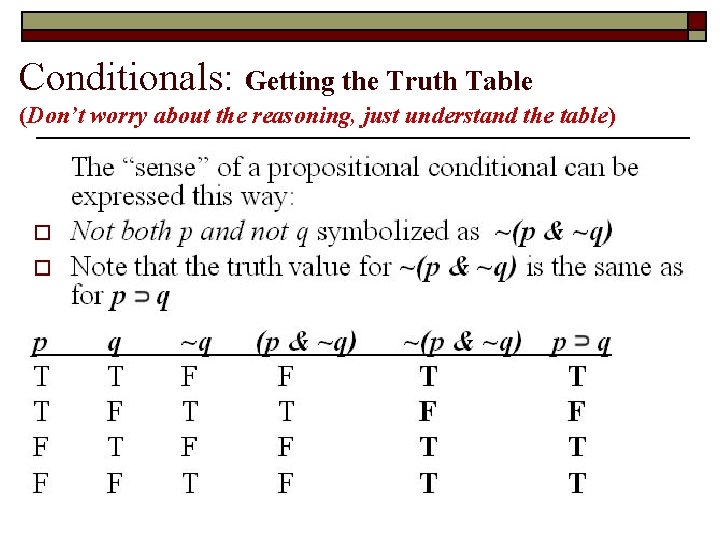
Conditionals: Getting the Truth Table (Don’t worry about the reasoning, just understand the table)
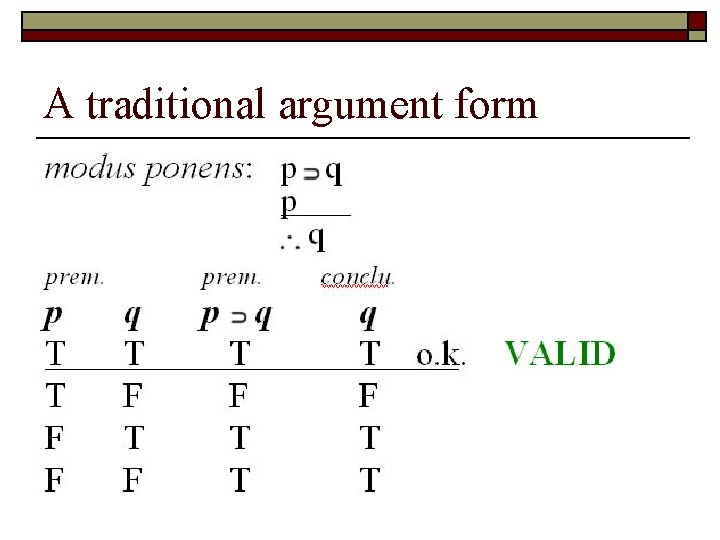
A traditional argument form
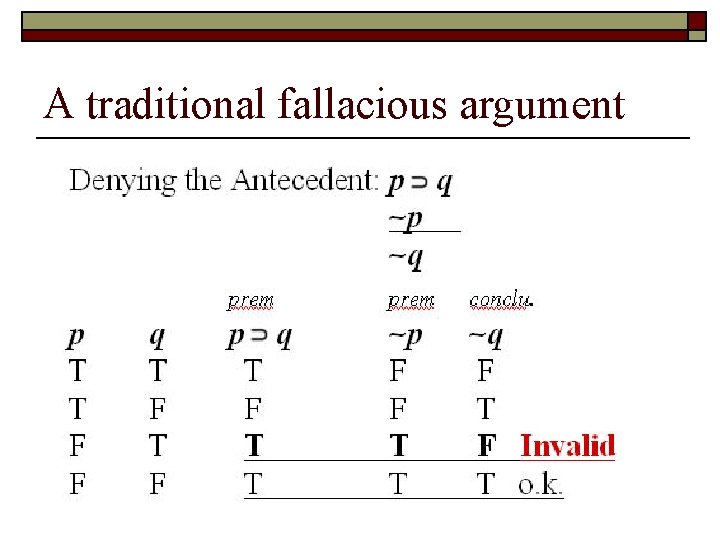
A traditional fallacious argument