
MLS 306 ANTISERA POTENCY TITRATION AND AVIDITY AKINBO
MLS 306 ANTISERA POTENCY, TITRATION AND AVIDITY AKINBO D. B. Lecture Series
Antisera potency and specificity • An antiserum must be specific for the antigen to be detected under the test conditions. • The specificity of an antiserum can be established by testing equal volumes of serum against 5% red cells suspension. • An agglutination reaction would only occur when reacted with the corresponding cells. • The serum to be employed for grouping must have sufficient titre against the corresponding cells in use as this determines the potency of the antisera.
Antisera Titration Avidity • Avidity refers to the ability of a serum to react very quickly and strongly with its corresponding antigen. • Avidity is based on affinity, specificity and strength of the serum; affinity refers to strength of binding of single epitope to single antigen binding site. • A suitable antisera should readily produce complete agglutination in 30 seconds when mixed with its corresponding cell suspension. • The avidity of the anti-A is of clinical relevance in the detection of weak subgroups of A.
Test for avidity ü If anti-A is reacted against A cells, agglutination occurs in 10 secs. ü If anti-B is reacted against B cells, agglutination occurs in 10 secs. ü If anti-A+B is reacted against A cells, agglutination occurs in 10 secs. ü If anti-A+B is reacted against B cells, agglutination occurs in 20 secs. NB. “A” cells react quicker and stronger with AB serum than “B” cells because the “A” component of the antiserum A+B is stronger than the “B” component.

Antisera titration • The stronger the antibody, the greater the ability of the serum to pick the weakest antigen. Tube No. 1 2 3 4 Dilution (antisera) 5 6 7 8 9 10 11 N ½ ¼ 1/8 1/16 1/32 1/64 1/128 1/256 1/512 1/1024 Anti-A vs 2 -5% A cells C C # # ++ + +/- Anti-AB vs 2 -5% A cells C C # # ++ + +/- Anti-A+B vs 2 -5% B cells C C C # # ++ + +/- -
Human Sources of Antisera • For human donors, selection is carried out by picking out the choice of antiserum from the specific blood group. Ø Collection of Group A blood yields anti-B Ø Collection of Group B blood yields anti-A Ø Collection of Group O blood yields anti-A+B • A potent anti-A serum for use as a good diagnostic reagent should have a titre of 512 when titrated against A cells. • Anti B should have a titre of 256 with B cells. • Anti-A+B should also give titre of 512 and 256 when titrated with A and B cells respectively.
Absorption of Antisera • Adsorption: Unwanted, cold and atypical agglutinins are adsorbed by mixing a volume of the serum with 1 volume of 10 -20% pooled O “Rh” positive cell suspension. • This is then kept at 4 C overnight for the removal of unwanted, non-specific cold reacting antibodies. • The sera are centrifuged and separated on the following day with the separated serum kept at 56 C to remove complements and lysins.
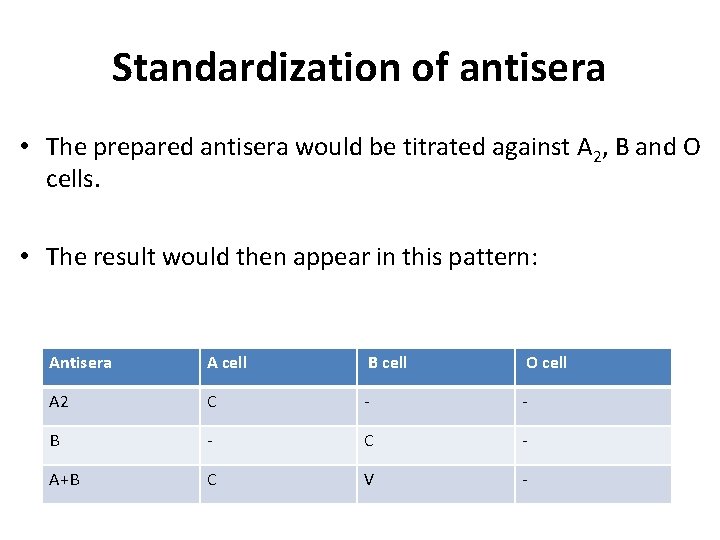
Standardization of antisera • The prepared antisera would be titrated against A 2, B and O cells. • The result would then appear in this pattern: Antisera A cell B cell O cell A 2 C - - B - C - A+B C V -
Antisera Preparation. . • Dispense the prepared antisera into aliquots of about 510 mls. • Preservation: Add a drop of sodium azide. • Coloration: *Add methylene blue to the prepared anti-A to give a blue color. *Add Eosin to the prepared anti-B to give a yellow color
- Slides: 9