MLD University Setif 2 Faculty of Letters and

- Slides: 13
MLD University -Setif 2 Faculty of Letters and Language Department of English language and literature Module: English for Specific Purposes Level: Master I/Semester II Chapter: ESP Course Design Section I: Curriculum Vs Syllabus Lecturer: Mrs. Somia BOUDINAR
Curriculum Vs Syllabus • Allen (1984, in Nunan 1988, p. 6) defines curriculum as “a very general concept which involves consideration of the whole complex of philosophical, philosophica social and administrative factors which contribute to the planning of an educational program. ” • Dubin and Olshtain (1991, pp. 34 -35) argue that “a curriculum contains a broad description of general goals by indicating an overall educational cultural philosophy which applies across subjects together with a theoretical orientation to language and language learning with respect to the subject matter at hand. ”
• Syllabi are the specification of what is to be included in a language course; they act as a guide for both teacher and learner by providing the goals to be attained. • Hutchinson and Waters (1987, p. 80) define “syllabus” as “a document which says what will (or at least what should) be learnt. ” • For Robinson (1991, p. 34), it is “a plan of work and is thus essentially for the teacher, as a guideline and context of class content”. These statements indicate that the syllabus first concerns the teacher, and that it helps her/him plan courses.
• Nunan (1988, p. 8) explains that ““Curriculum” is concerned with the planning, implementation, evaluation, management and administration of education programmes, [whereas] “Syllabus”, “Syllabus” on the other hand focuses more narrowly on the selection and grading of content. ” • Dubin & Olshtain (1991: 35) also try to clarify the difference between the two terms arguing that: “a single curriculum can be the basis for developing a variety of specific syllabuses which are concerned with locally defined audiences, particular needs, and intermediate objectives. ”
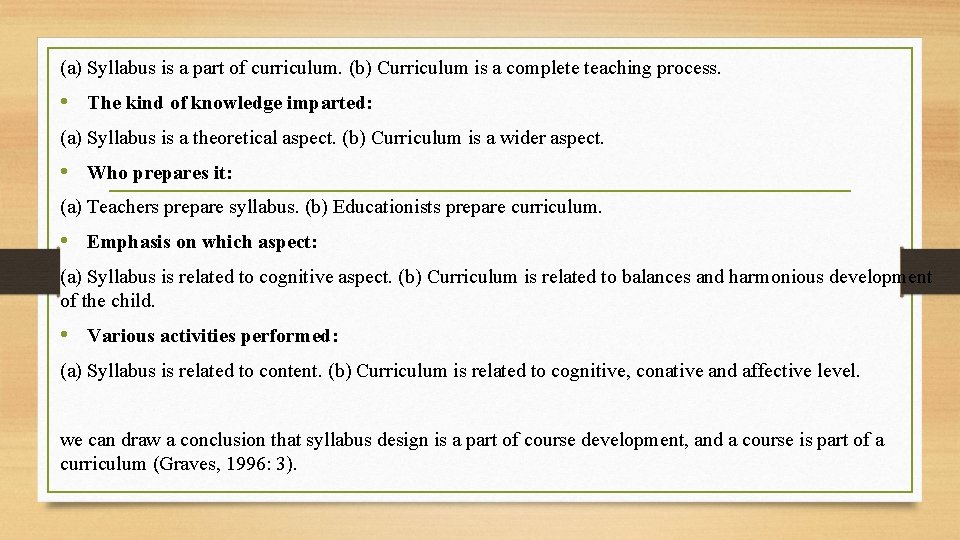
(a) Syllabus is a part of curriculum. (b) Curriculum is a complete teaching process. • The kind of knowledge imparted: (a) Syllabus is a theoretical aspect. (b) Curriculum is a wider aspect. • Who prepares it: (a) Teachers prepare syllabus. (b) Educationists prepare curriculum. • Emphasis on which aspect: (a) Syllabus is related to cognitive aspect. (b) Curriculum is related to balances and harmonious development of the child. • Various activities performed: (a) Syllabus is related to content. (b) Curriculum is related to cognitive, conative and affective level. we can draw a conclusion that syllabus design is a part of course development, and a course is part of a curriculum (Graves, 1996: 3).
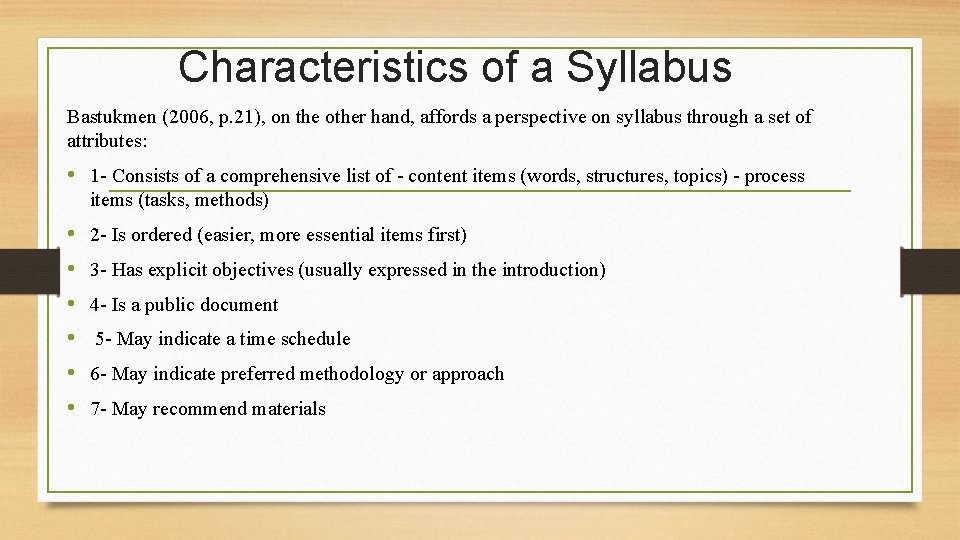
Characteristics of a Syllabus Bastukmen (2006, p. 21), on the other hand, affords a perspective on syllabus through a set of attributes: • 1 - Consists of a comprehensive list of - content items (words, structures, topics) - process items (tasks, methods) • • • 2 - Is ordered (easier, more essential items first) 3 - Has explicit objectives (usually expressed in the introduction) 4 - Is a public document 5 - May indicate a time schedule 6 - May indicate preferred methodology or approach 7 - May recommend materials
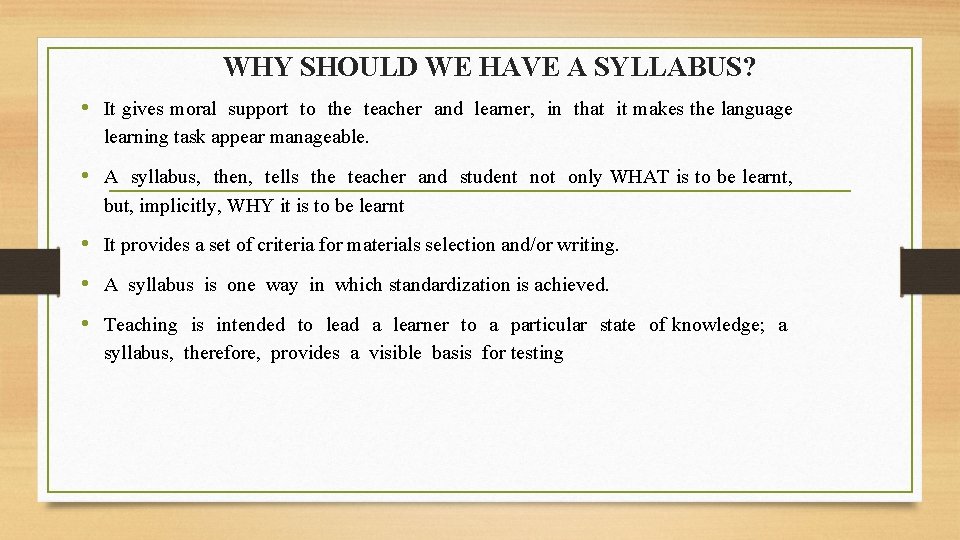
WHY SHOULD WE HAVE A SYLLABUS? • It gives moral support to the teacher and learner, in that it makes the language learning task appear manageable. • A syllabus, then, tells the teacher and student not only WHAT is to be learnt, but, implicitly, WHY it is to be learnt • It provides a set of criteria for materials selection and/or writing. • A syllabus is one way in which standardization is achieved. • Teaching is intended to lead a learner to a particular state of knowledge; a syllabus, therefore, provides a visible basis for testing
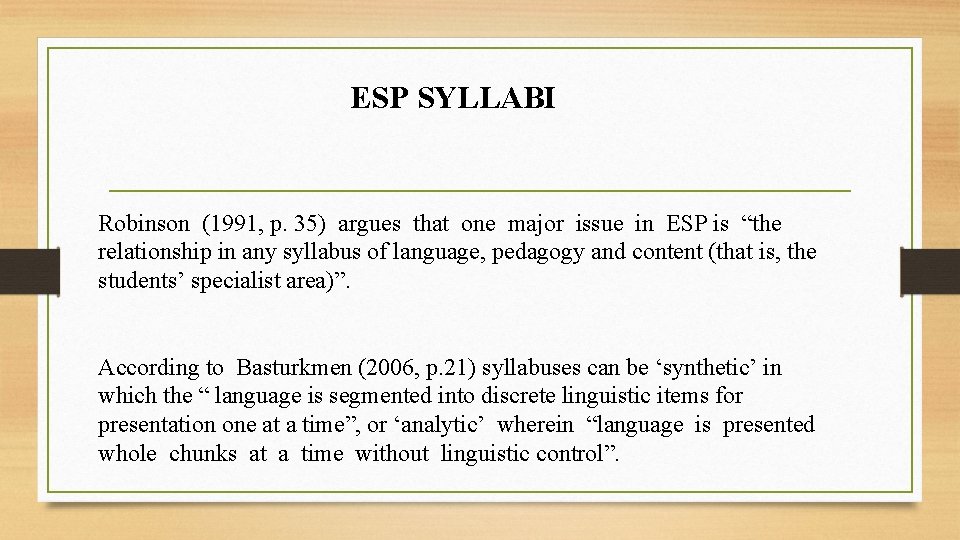
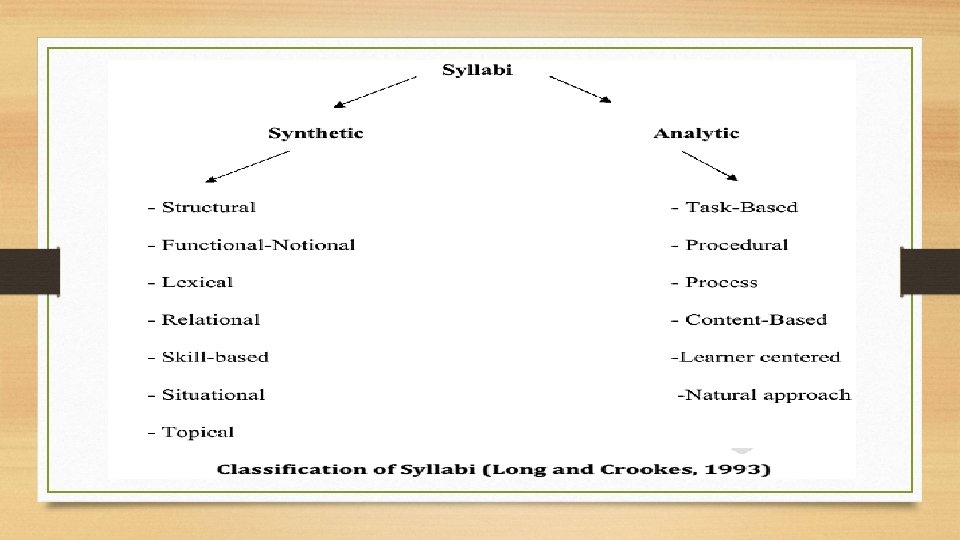
ESP SYLLABI Robinson (1991, p. 35) argues that one major issue in ESP is “the relationship in any syllabus of language, pedagogy and content (that is, the students’ specialist area)”. According to Basturkmen (2006, p. 21) syllabuses can be ‘synthetic’ in which the “ language is segmented into discrete linguistic items for presentation one at a time”, or ‘analytic’ wherein “language is presented whole chunks at a time without linguistic control”.
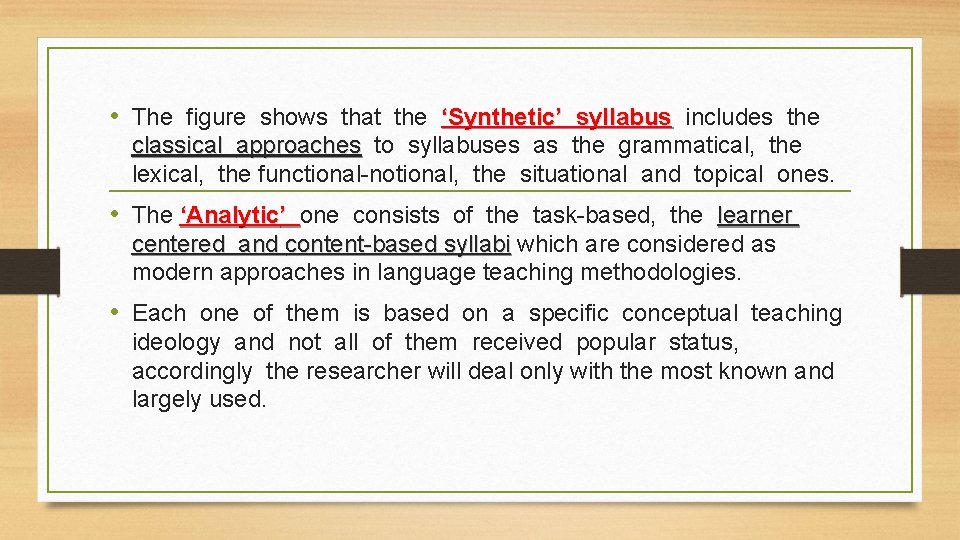
• The figure shows that the ‘Synthetic’ syllabus includes the classical approaches to syllabuses as the grammatical, the lexical, the functional-notional, the situational and topical ones. • The ‘Analytic’ one consists of the task-based, the learner centered and content-based syllabi which are considered as modern approaches in language teaching methodologies. • Each one of them is based on a specific conceptual teaching ideology and not all of them received popular status, accordingly the researcher will deal only with the most known and largely used.
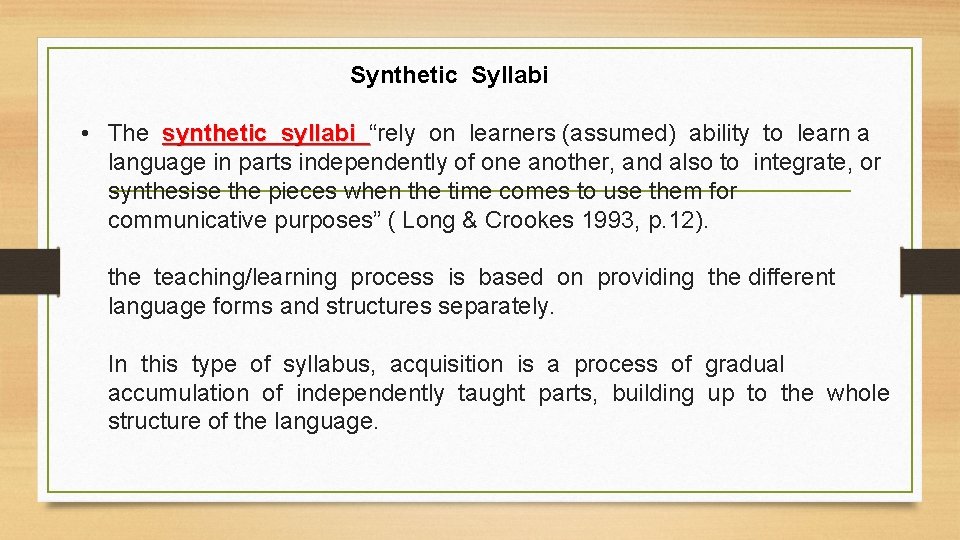
Synthetic Syllabi • The synthetic syllabi “rely on learners (assumed) ability to learn a language in parts independently of one another, and also to integrate, or synthesise the pieces when the time comes to use them for communicative purposes” ( Long & Crookes 1993, p. 12). the teaching/learning process is based on providing the different language forms and structures separately. In this type of syllabus, acquisition is a process of gradual accumulation of independently taught parts, building up to the whole structure of the language.
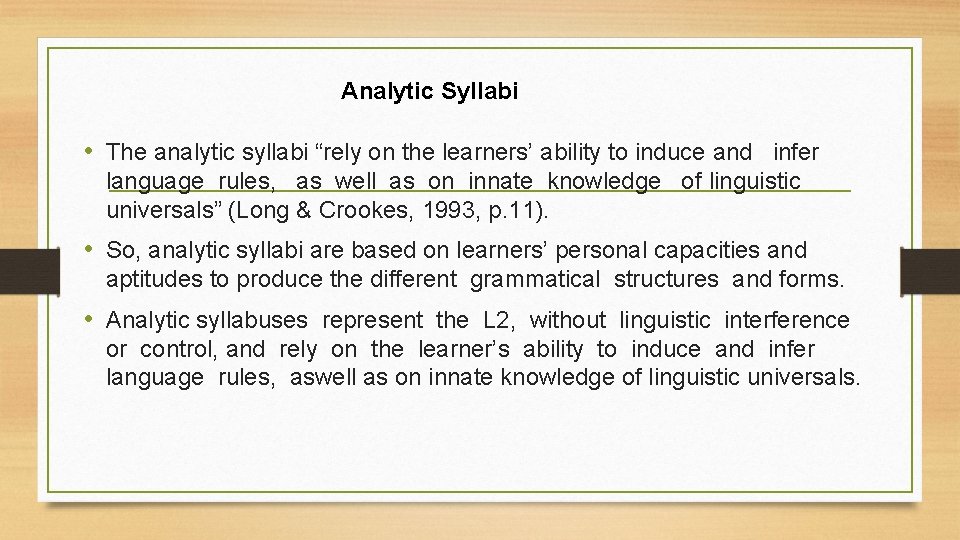
Analytic Syllabi • The analytic syllabi “rely on the learners’ ability to induce and infer language rules, as well as on innate knowledge of linguistic universals” (Long & Crookes, 1993, p. 11). • So, analytic syllabi are based on learners’ personal capacities and aptitudes to produce the different grammatical structures and forms. • Analytic syllabuses represent the L 2, without linguistic interference or control, and rely on the learner’s ability to induce and infer language rules, aswell as on innate knowledge of linguistic universals.
Conclusion Designing an ESP syllabus is not an easy task to perform because of its significant and complex role. However, it obviously satisfies a lot of needs since it has a multi-functional purpose. Thus, syllabus designers need to be aware of the different functions the syllabus fulfils so that it can be designed and used most appropriately. In ESP, the nature of the content is extracted from real life situations in which the syllabus designers have to select the most relevant language discourses that will supply for learners target requirements.