
MLA Citation and Avoiding Plagiarism MLA CitationFormat MLA
- Slides: 20
MLA Citation and Avoiding Plagiarism
MLA Citation/Format • MLA Format is a system for • giving credit to the sources that you use (by direct quote OR paraphrase) in your essays and papers. • You MUST give credit to your sources in order to avoid plagiarism. PROTIP: Build your MLA works cited as you research. NOTHING is as much of a pain in the butt as attempting to find all your sources and cite them properly AFTER you have put them in your paper. Vocab Word: “Paraphrase” means saying something someone else said, but putting it in your own words.
MLA Citation has two main parts: 1. Parenthetical citations: (Anderson 3) – Are in the body (main text) of your essay. – Come aftereach paraphrase or quote that you did not write or think of yourself, you must indicate which source you are using in order to avoid plagiarism. Consult a handbook or the handout on moodle for more detail. 2. A Works Cited page: – – – On its own page at the end of your essay Lists every source you used in alphabetical order by the last name of the author. Each works cited entry must contain specific information in a specific order. Consult a handbook or the handout on moodle for more details.
Three Basic Rules for Avoiding Plagiarism 1. Make sure all word-for-word quotes have quote marks showing where they begin and end. Also, make sure to make the difference between your ideas and your sources’ ideas clear when paraphrasing. 2. Identify where each quote OR paraphrased idea came from in the body of your paper using in-text citations. 3. Make sure that each source you quote or paraphrase in your paper is correctly listed on your Works Cited page. Pass out the MLA Handout
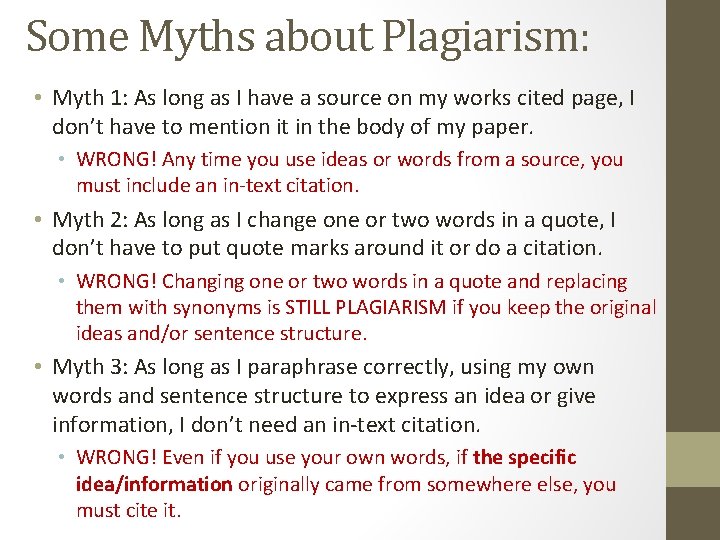
Some Myths about Plagiarism: • Myth 1: As long as I have a source on my works cited page, I don’t have to mention it in the body of my paper. • WRONG! Any time you use ideas or words from a source, you must include an in-text citation. • Myth 2: As long as I change one or two words in a quote, I don’t have to put quote marks around it or do a citation. • WRONG! Changing one or two words in a quote and replacing them with synonyms is STILL PLAGIARISM if you keep the original ideas and/or sentence structure. • Myth 3: As long as I paraphrase correctly, using my own words and sentence structure to express an idea or give information, I don’t need an in-text citation. • WRONG! Even if you use your own words, if the specific idea/information originally came from somewhere else, you must cite it.
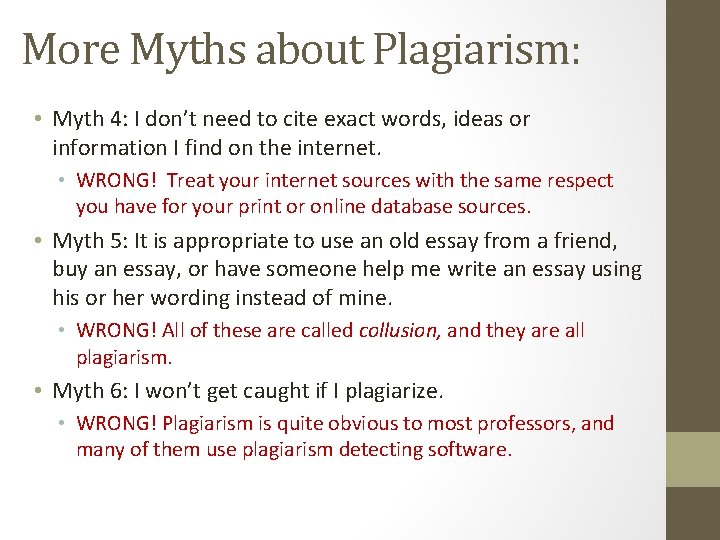
More Myths about Plagiarism: • Myth 4: I don’t need to cite exact words, ideas or information I find on the internet. • WRONG! Treat your internet sources with the same respect you have for your print or online database sources. • Myth 5: It is appropriate to use an old essay from a friend, buy an essay, or have someone help me write an essay using his or her wording instead of mine. • WRONG! All of these are called collusion, and they are all plagiarism. • Myth 6: I won’t get caught if I plagiarize. • WRONG! Plagiarism is quite obvious to most professors, and many of them use plagiarism detecting software.
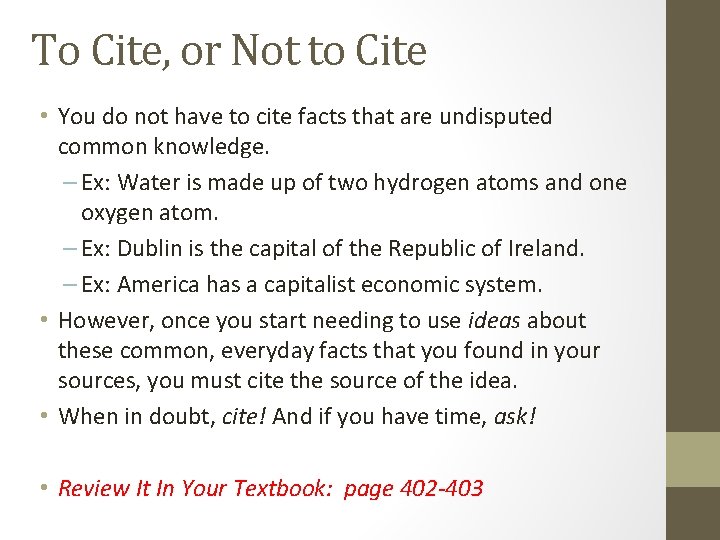
To Cite, or Not to Cite • You do not have to cite facts that are undisputed common knowledge. – Ex: Water is made up of two hydrogen atoms and one oxygen atom. – Ex: Dublin is the capital of the Republic of Ireland. – Ex: America has a capitalist economic system. • However, once you start needing to use ideas about these common, everyday facts that you found in your sources, you must cite the source of the idea. • When in doubt, cite! And if you have time, ask! • Review It In Your Textbook: page 402 -403
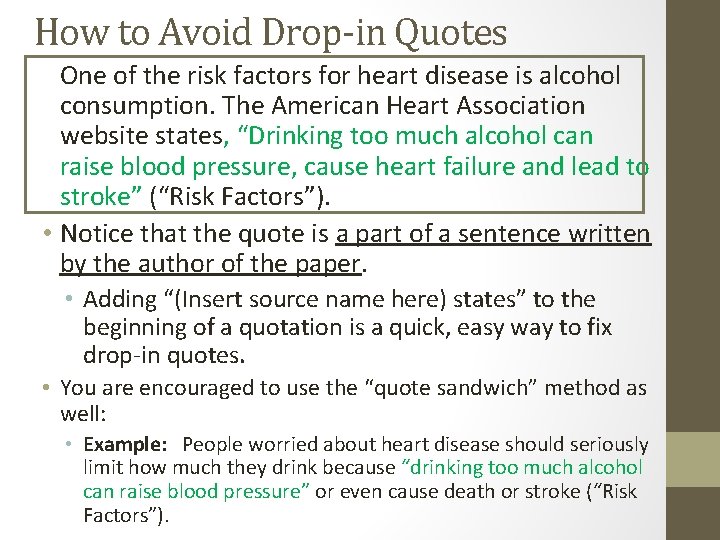
How to Avoid Drop-in Quotes One of the risk factors for heart disease is alcohol consumption. The American Heart Association website states, “Drinking too much alcohol can raise blood pressure, cause heart failure and lead to stroke” (“Risk Factors”). • Notice that the quote is a part of a sentence written by the author of the paper. • Adding “(Insert source name here) states” to the beginning of a quotation is a quick, easy way to fix drop-in quotes. • You are encouraged to use the “quote sandwich” method as well: • Example: People worried about heart disease should seriously limit how much they drink because “drinking too much alcohol can raise blood pressure” or even cause death or stroke (“Risk Factors”).
Quotation, Summary, and Paraphrase • Pass out the Incorporating Sources Handout. • Review it in your Textbook: • In-Text Citations: page 410 -415 • A Guide to how to cite your sources in-text using MLA Style • Paraphrasing: aka “putting it in my own words” • In Your Textbook: Page 394 -395 • Read aloud and listen to the difference between the plagiarized versions and acceptable summaries/paraphrase.
The “Quote Sandwich” • This is a way to integrate quotes into your paper smoothly and avoid drop-in quotes. • The first piece of “bread” • Introduce quote, possibly mention author, connect quote to what you were saying before. • The “Meat” • Your quote, correctly cited with in-text citation. • The second piece of “bread” • Interpretation/explanation of quote (NOT simply rewording the quote), connect quote to what you will say next.
Online Examples of Quote Sandwiches • http: //www. csun. edu/~hflrc 006/quote. html • https: //sites. google. com/site/sasamtani/quote_sandwich 003. jpg • Notice that both of these examples make the quote a part of a sentence the essay author wrote, and notice that both examples give credit to the source’s author.
Discussing Counterargument
Offering a Counterargument • Addressing the claims of the opposition is an important component in building a convincing argument. • It demonstrates your credibility as a writer--you have researched multiple sides of the argument and have come to an informed decision. • It shows you have considered other points of view - that other points of view are valid and reasonable.
Offering a Counterargument • Counterarguments may be located at various locations within your body paragraphs. • You may choose to • build each of your main points as a contrast to oppositional claims. • offer a counterargument after you have articulated your main claims.
Effective Counterarguments • Consider your audience when you offer your counterargument. • Conceding to some of your opposition’s concerns can demonstrate respect for their opinions. • Remain tactful yet firm. • Using rude or deprecating language can cause your audience to reject your position without carefully considering your claims.
Transitions for counterargument: • • • Some people believe I will admit Certainly, Of course, I will concede Admittedly, Obviously, In contrast, As Joe Schmo point out in his article “On the Other Hand”,
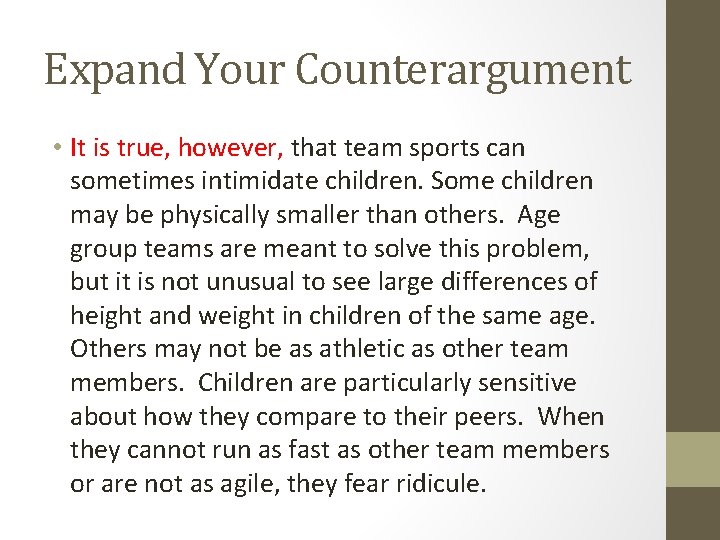
Expand Your Counterargument • It is true, however, that team sports can sometimes intimidate children. Some children may be physically smaller than others. Age group teams are meant to solve this problem, but it is not unusual to see large differences of height and weight in children of the same age. Others may not be as athletic as other team members. Children are particularly sensitive about how they compare to their peers. When they cannot run as fast as other team members or are not as agile, they fear ridicule.
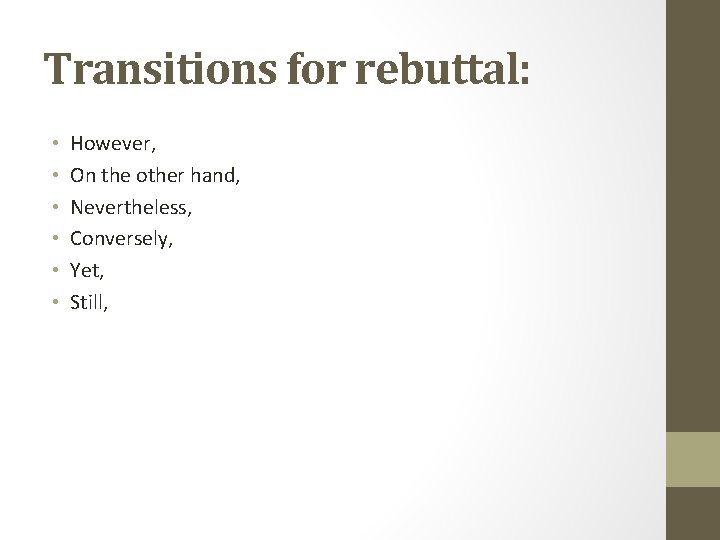
Transitions for rebuttal: • • • However, On the other hand, Nevertheless, Conversely, Yet, Still,
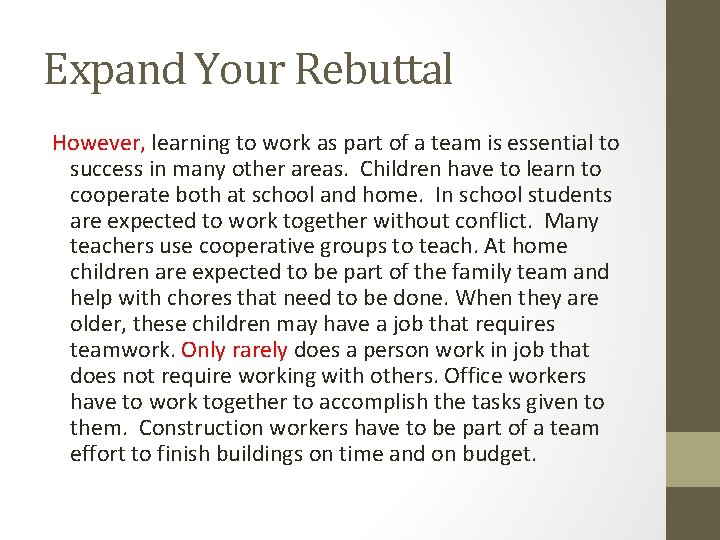
Expand Your Rebuttal However, learning to work as part of a team is essential to success in many other areas. Children have to learn to cooperate both at school and home. In school students are expected to work together without conflict. Many teachers use cooperative groups to teach. At home children are expected to be part of the family team and help with chores that need to be done. When they are older, these children may have a job that requires teamwork. Only rarely does a person work in job that does not require working with others. Office workers have to work together to accomplish the tasks given to them. Construction workers have to be part of a team effort to finish buildings on time and on budget.
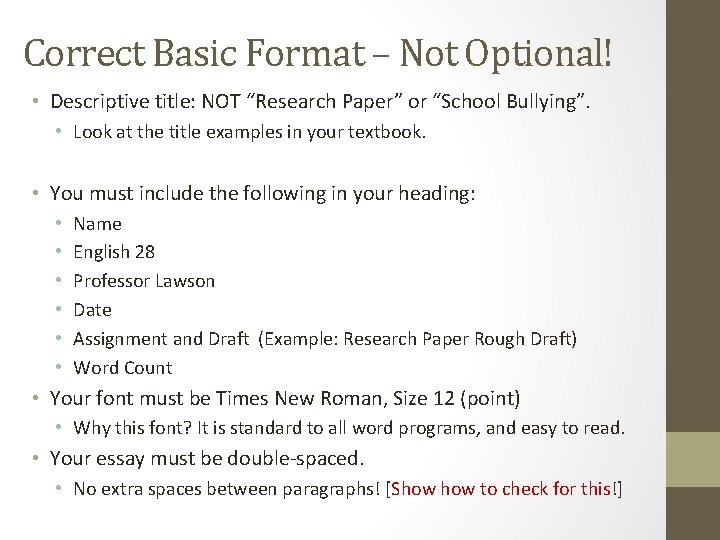
Correct Basic Format – Not Optional! • Descriptive title: NOT “Research Paper” or “School Bullying”. • Look at the title examples in your textbook. • You must include the following in your heading: • • • Name English 28 Professor Lawson Date Assignment and Draft (Example: Research Paper Rough Draft) Word Count • Your font must be Times New Roman, Size 12 (point) • Why this font? It is standard to all word programs, and easy to read. • Your essay must be double-spaced. • No extra spaces between paragraphs! [Show to check for this!]