
MKTG Principles Of Marketing Twelfth Edition Chapter 12
- Slides: 32
MKTG Principles Of Marketing Twelfth Edition Chapter 12 Services and Nonprofit Organization Marketing © 2019 Cengage. All rights reserved.
Learning Outcomes 12 -1 Discuss the importance of services to the economy 12 -2 Discuss the differences between services and goods 12 -3 Describe the components of service quality and the gap model of service quality 12 -4 Develop marketing mixes for services 12 -5 Discuss relationship marketing in services 12 -6 Explain internal marketing in services 12 -7 Describe nonprofit organization marketing 12 -8 Discuss global issues in services marketing © 2019 Cengage. All rights reserved.
Services • Service: the result of applying human or mechanical efforts to people or objects – Involve a deed, a performance, or an effort that cannot be physically possessed • Service-oriented industries that contribute to the U. S. economy – Technology, financial services, health care, and retail © 2019 Cengage. All rights reserved.
How Services Differ from Goods • Characteristics of services: – Intangibility – Inseparability – Heterogeneity – Perishability © 2019 Cengage. All rights reserved.
Intangibility • Intangibility: the inability of services to be touched, seen, tasted, heard, or felt in the same manner that goods can be sensed • Evaluating the quality of services – Search quality: a characteristic that can be easily assessed before purchase – Experience quality: a characteristic that can be assessed only after use – Credence quality: a characteristic that can be difficult to assess even after purchase as customers lack necessary knowledge or experience © 2019 Cengage. All rights reserved.
Inseparability • Inseparability: the inability of the production and consumption of a service to be separated; consumers must be present during the production – Makes consumers involved in the production of services they buy – Services can not be produced in a centralized location and consumed in decentralized locations, as goods typically are © 2019 Cengage. All rights reserved.
Heterogeneity • Heterogeneity: the variability of the inputs and outputs of services, which causes services to tend to be less standardized and uniform than goods – Standardization and training help increase consistency and reliability © 2019 Cengage. All rights reserved.
Perishability • Perishability: the inability of services to be stored, warehoused, or inventoried – Service providers need to find ways to synchronize supply and demand © 2019 Cengage. All rights reserved.
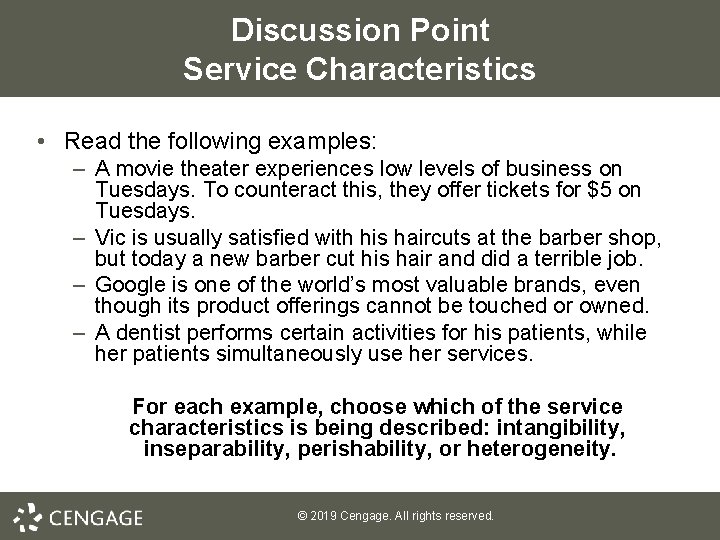
Discussion Point Service Characteristics • Read the following examples: – A movie theater experiences low levels of business on Tuesdays. To counteract this, they offer tickets for $5 on Tuesdays. – Vic is usually satisfied with his haircuts at the barber shop, but today a new barber cut his hair and did a terrible job. – Google is one of the world’s most valuable brands, even though its product offerings cannot be touched or owned. – A dentist performs certain activities for his patients, while her patients simultaneously use her services. For each example, choose which of the service characteristics is being described: intangibility, inseparability, perishability, or heterogeneity. © 2019 Cengage. All rights reserved.
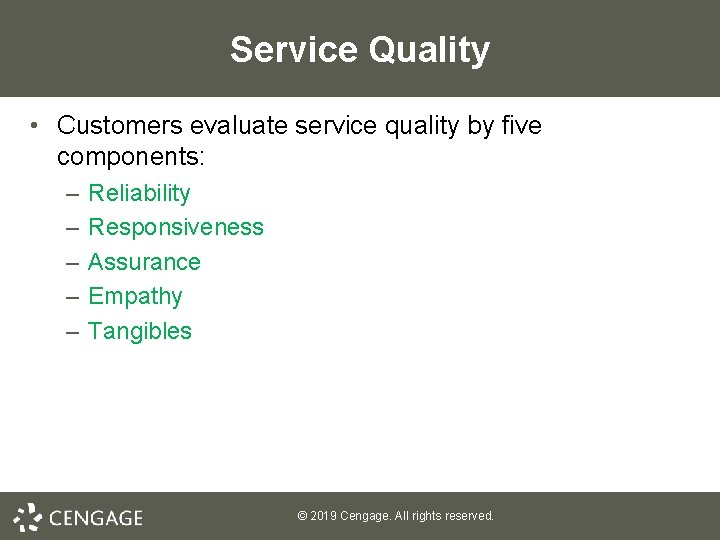
Service Quality • Customers evaluate service quality by five components: – – – Reliability Responsiveness Assurance Empathy Tangibles © 2019 Cengage. All rights reserved.
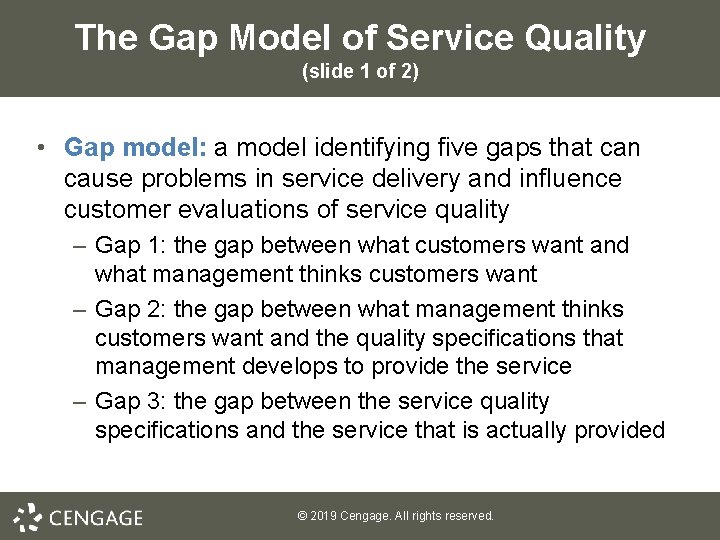
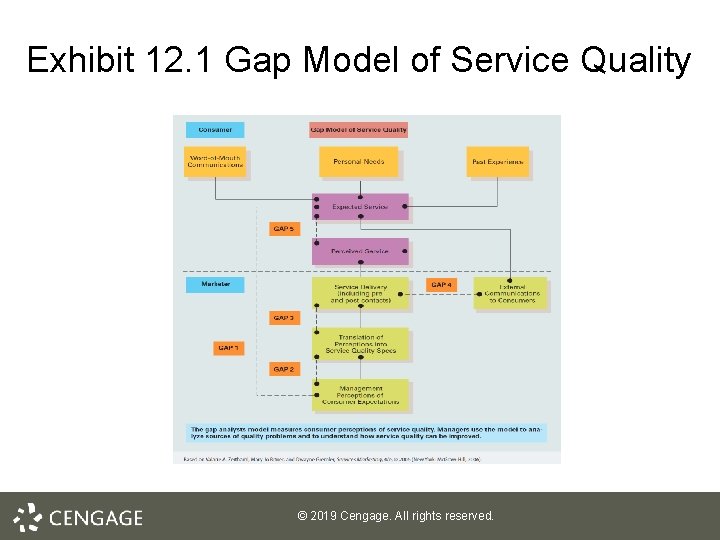
The Gap Model of Service Quality (slide 1 of 2) • Gap model: a model identifying five gaps that can cause problems in service delivery and influence customer evaluations of service quality – Gap 1: the gap between what customers want and what management thinks customers want – Gap 2: the gap between what management thinks customers want and the quality specifications that management develops to provide the service – Gap 3: the gap between the service quality specifications and the service that is actually provided © 2019 Cengage. All rights reserved.
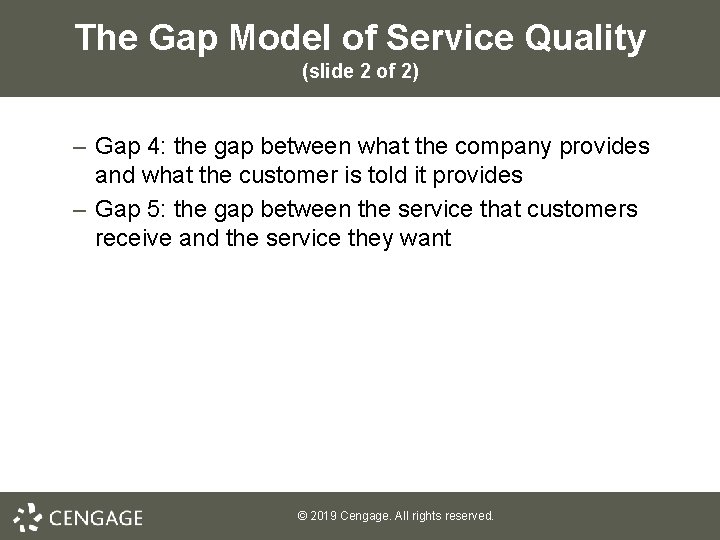
The Gap Model of Service Quality (slide 2 of 2) – Gap 4: the gap between what the company provides and what the customer is told it provides – Gap 5: the gap between the service that customers receive and the service they want © 2019 Cengage. All rights reserved.
Exhibit 12. 1 Gap Model of Service Quality © 2019 Cengage. All rights reserved.
Product (Service) Strategy • Service as a process – – People processing Possession processing Mental stimulus processing Information processing © 2019 Cengage. All rights reserved.
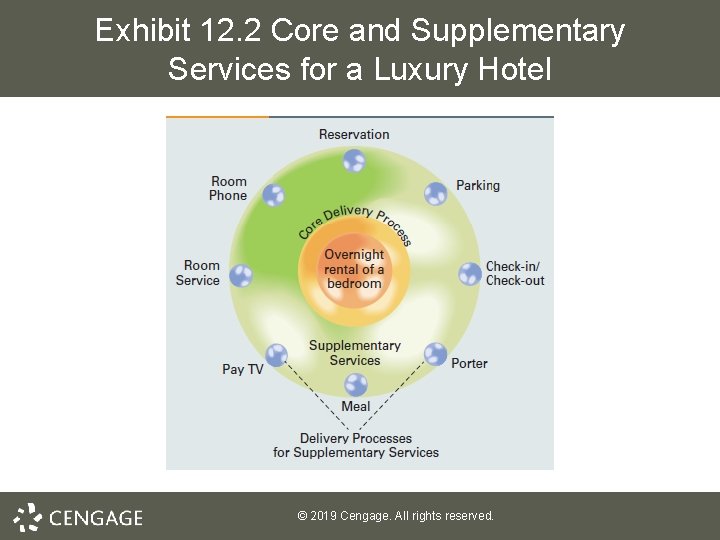
Core and Supplementary Service Products • Core service: the most basic benefit the customer is buying • Supplementary service: a group of services that support or enhance the core service – Firms usually emphasize supplementary services to create a competitive advantage © 2019 Cengage. All rights reserved.
Discussion Point Core and Supplementary Services • Think of service providers and discuss their core and supplementary services. © 2019 Cengage. All rights reserved.
Exhibit 12. 2 Core and Supplementary Services for a Luxury Hotel © 2019 Cengage. All rights reserved.
Customization/Standardization • Customized services are more flexible, respond to individual customers’ needs, and can command a higher price • Standardized services are more efficient and cost less • Mass customization: a strategy that uses technology to deliver customized services on a mass basis © 2019 Cengage. All rights reserved.
The Service Mix • Each organization’s service mix represents a set of opportunities, risks, and challenges • Service strategy decisions – What new services to introduce to which target market – What existing services to maintain – What services to eliminate © 2019 Cengage. All rights reserved.
Place (Distribution) Strategy • A key factor in influencing the selection of a service provider is convenience • Service firms must also determine the number of outlets to use • Direct or indirect distribution • Location of a service reveals the relationship between its target market and distribution strategy • For time-dependent service providers, scheduling is an important factor © 2019 Cengage. All rights reserved.
Promotion Strategy • Promotion strategies for services: – – Stressing tangible cues Using personal information sources Creating a strong organizational image Engaging in postpurchase communication © 2019 Cengage. All rights reserved.
Price Strategy • Services present two pricing challenges: – Should pricing be based on a specific task or be time-based – For services composed of multiple elements, should pricing be based on a bundle or each element priced separately • Three categories of pricing objectives – Revenue-oriented pricing – Operations-oriented pricing – Patronage-oriented pricing © 2019 Cengage. All rights reserved.
Relationship Marketing in Services • Relationship marketing can be practiced at four levels: – Level 1: Financial – Level 2: Social – Level 3: Customization – Level 4: Structural © 2019 Cengage. All rights reserved.
Internal Marketing in Service Firms • Internal marketing: treating employees as customers and developing systems and benefits that satisfy their needs • Critical in service firms – Employees deliver the brand promise directly to customers © 2019 Cengage. All rights reserved.
Nonprofit Organization Marketing • Nonprofit organization: an organization that exists to achieve some goal other than the usual business goals of profit, market share, or return on investment – Governments, private museums, theatres, schools, and churches © 2019 Cengage. All rights reserved.
What Is Nonprofit Organization Marketing? • Nonprofit organization marketing: the effort by nonprofit organizations to bring about mutually satisfying exchanges with target markets – Identifying desired customers – Specifying objectives explicitly or implicitly – Developing, managing, and eliminating programs and services – Deciding on prices – Scheduling events or programs – Communicating their availability © 2019 Cengage. All rights reserved.
Unique Aspects of Nonprofit Organization Marketing Strategies (slide 1 of 3) • Objectives: – To generate enough funds to cover expenses – To provide equitable, effective, and efficient services • Issues related to target markets: – Apathetic or strongly opposed targets – Pressure to adopt undifferentiated segmentation strategies – Complementary positioning © 2019 Cengage. All rights reserved.
Unique Aspects of Nonprofit Organization Marketing Strategies (slide 2 of 3) • Product decisions – Benefit complexity – Benefit strength – Involvement • Place (distribution) decisions – Success is determined by a nonprofit organization’s ability to distribute its service offerings when and where customers want them © 2019 Cengage. All rights reserved.
Unique Aspects of Nonprofit Organization Marketing Strategies (slide 3 of 3) • Promotion decisions – Professional volunteers – Sales promotion activities – Public service advertising (PSA): an announcement that promotes a program of a federal, state, or local government or of a nonprofit organization • Pricing decisions – Pricing objective – Nonfinancial prices – Indirect payment – Separation between payers and users – Below-cost pricing © 2019 Cengage. All rights reserved.
Global Issues in Services Marketing • Many U. S. service industries have been able to enter the global marketplace because of competitive advantages • To be successful in the global marketplace, firms must: – Determine the nature of their core product – Design marketing mix that reflects each country’s cultural, technological, and political environment © 2019 Cengage. All rights reserved.
Key Terms (slide 1 of 2) • • • Service Intangibility Search quality Experience quality Credence quality Inseparability Heterogeneity Perishability Reliability Responsiveness © 2019 Cengage. All rights reserved.
Key Terms (slide 2 of 2) • • • Assurance Empathy Tangibles Gap model Core service Supplementary services Mass customization Internal marketing Nonprofit organization marketing Public service advertisement (PSA) © 2019 Cengage. All rights reserved.