
MKTG Principles Of Marketing Eleventh Edition Chapter 6
- Slides: 55
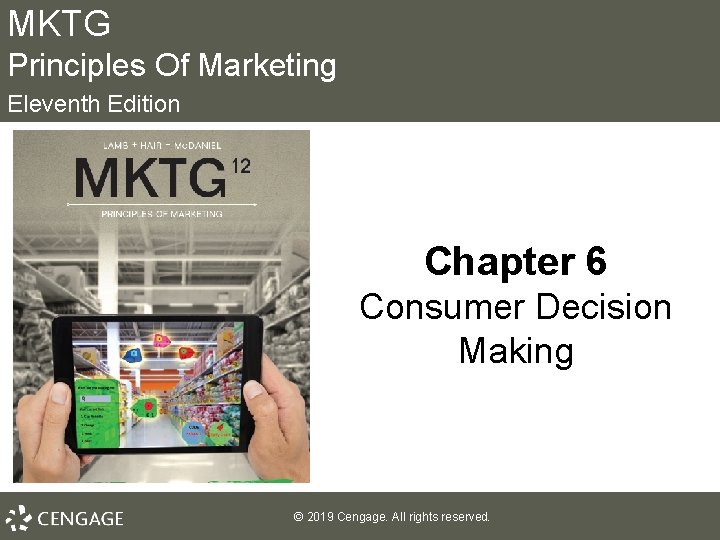
MKTG Principles Of Marketing Eleventh Edition Chapter 6 Consumer Decision Making © 2019 Cengage. All rights reserved.
Learning Outcomes (slide 1 of 2) 6 -1 6 -2 6 -3 6 -4 6 -5 Explain why marketing managers should understand consumer behavior Analyze the components of the consumer decisionmaking process Explain the consumer’s postpurchase evaluation process Identify the types of consumer buying decisions and discuss the significance of consumer involvement Describe how some marketers are reconceptualizing the consumer decision-making process © 2019 Cengage. All rights reserved.
Learning Outcomes (slide 2 of 2) 6 -6 6 -7 6 -8 6 -9 Identify and understand the cultural factors that affect consumer buying decisions Identify and understand the social factors that affect consumer buying decisions Identify and understand the individual factors that affect consumer buying decisions Identify and understand the psychological factors that affect consumer buying decisions © 2019 Cengage. All rights reserved.
The Importance of Understanding Consumer Behavior • Consumers’ product and service preferences are constantly changing • Consumer behavior: processes a consumer uses to make purchase decisions, as well as to use and dispose of purchased goods or services; also includes factors that influence purchase decisions and product use © 2019 Cengage. All rights reserved.
Value • • Value: a personal assessment of the net worth one obtains from making a purchase, or the enduring belief that a specific mode of conduct is personally or socially preferable to another mode of conduct Perceived value: the value a consumer expects to obtain from a purchase Utilitarian value: a value derived from a product or service that helps the consumer solve problems and accomplish tasks Hedonic value: a value that acts as an end in itself rather than as a means to an end © 2019 Cengage. All rights reserved.
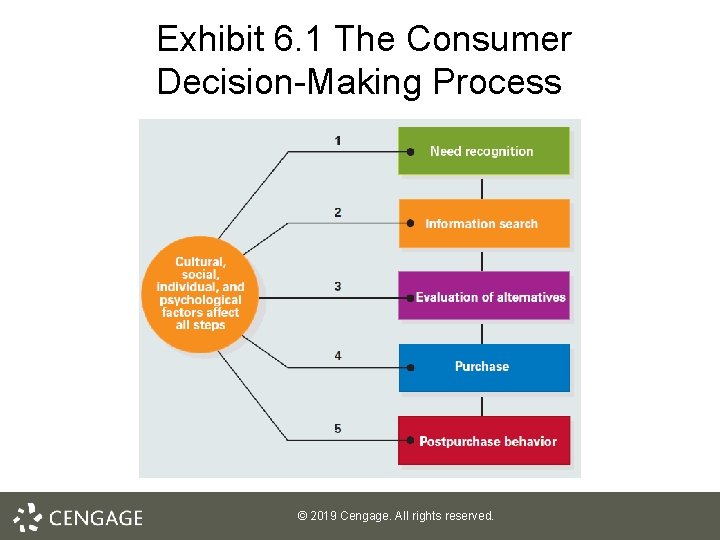
The Traditional Consumer Decision-Making Process • Consumer decision-making process: a five-step process used by consumers when buying goods or services • The steps include: (1) need recognition, (2) information search, (3) evaluation of alternatives, (4) purchase, and (5) postpurchase behavior • These five steps represent the traditional buying process, which can be used as a guide for studying how consumers make decisions © 2019 Cengage. All rights reserved.
Exhibit 6. 1 The Consumer Decision-Making Process © 2019 Cengage. All rights reserved.
Need Recognition • Need recognition: the result of an imbalance between actual and desired states – First stage in the decision-making process • Want: recognition of an unfulfilled need and a product that will satisfy it – Wants can be viewed in terms of four goals: economizing, sustaining, treating, and rewarding • Stimulus: any unit of input affecting one or more of the five senses: sight, smell, taste, touch, hearing – Internal vs. external stimuli • Want-got gap: imbalance between actual and desired states © 2019 Cengage. All rights reserved.
Discussion Point Need Recognition • List some products and services that students have purchased recently • Examples: – Laptop – Coffee – Gasoline – Sandwich What types of internal and/or external stimuli influenced the purchase decisions? © 2019 Cengage. All rights reserved.
Information Search • Internal information search: the process of recalling past information stored in the memory • External information search: the process of seeking information in the outside environment – Nonmarketing-controlled information source: a product information source that is not associated with promotion – Marketing-controlled information source: a product information source that originates with marketers promoting the product • Evoked set (consideration set): a group of brands resulting from an information search from which a buyer can choose © 2019 Cengage. All rights reserved.
Evaluation of Alternatives and Purchase (slide 1 of 3) • Consumers evaluate and compare alternatives with the help of: – Environment – Internal information – External information • Categorization – Brand extensions © 2019 Cengage. All rights reserved.
Evaluation of Alternatives and Purchase (slide 2 of 3) • Consumers have to make the following decisions: – – Whether to buy When to buy What to buy (product type and brand) Where to buy (type of retailer, specific retailer, online or in store) – How to pay © 2019 Cengage. All rights reserved.
Evaluation of Alternatives and Purchase (slide 3 of 3) • Planned versus impulse purchase – Partially planned purchase: Made by consumers when they know the product category they want to buy but wait until they get to the store or go online – Unplanned purchase: Made by consumers on an impulse • Psychological ownership – Consumers sometimes develop feelings of ownership without even owning the good, service, or brand © 2019 Cengage. All rights reserved.
Discussion Point Evoked Set • Ask students to think back to a purchase they recently made that required an extended information search. • Describe the evoked set derived from that information search. What were the characteristics that made these products the preferred alternatives? © 2019 Cengage. All rights reserved.
Postpurchase Behavior • Cognitive dissonance: inner tension that a consumer experiences after recognizing an inconsistency between behavior and values or opinions • Consumers reduce dissonance by: – Seeking information that reinforces the purchase decision – Avoiding information that contradicts the purchase decision – Revoking the original decision by returning the product © 2019 Cengage. All rights reserved.
Discussion Point Cognitive Dissonance • Discuss any of your purchases that generated cognitive dissonance and what was done to address the situation. What role, if any, did marketing play in minimizing cognitive dissonance? What was the outcome? Discuss ways in which the provider of the products/services might have reduced this inner tension. © 2019 Cengage. All rights reserved.
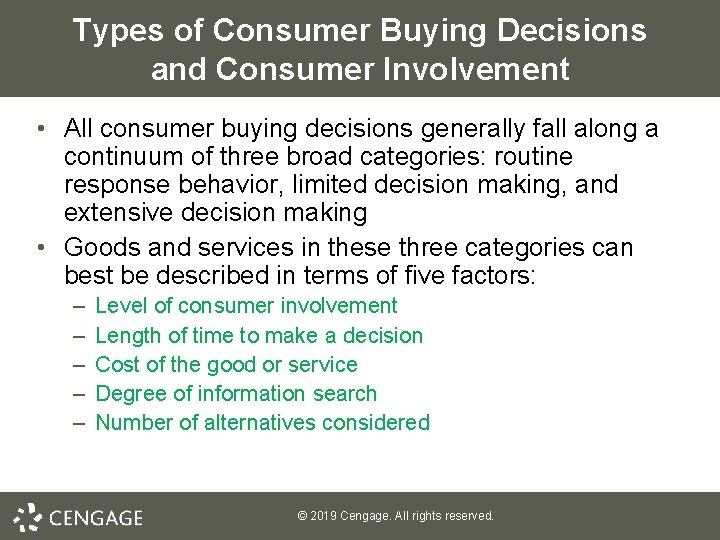
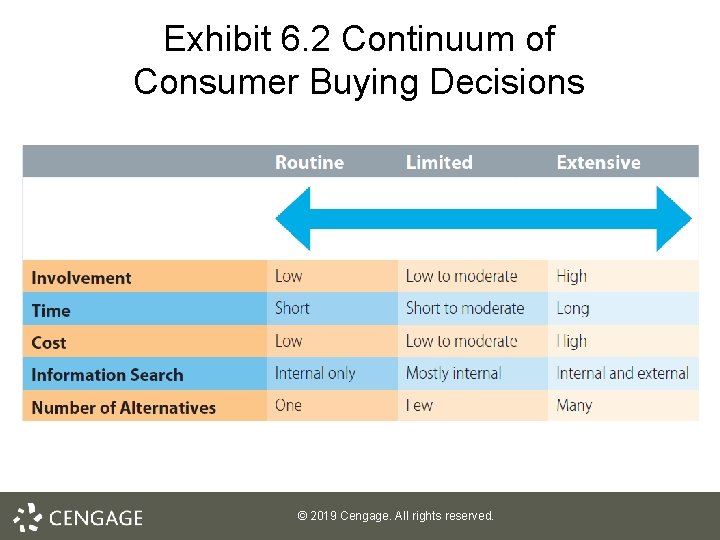
Types of Consumer Buying Decisions and Consumer Involvement • All consumer buying decisions generally fall along a continuum of three broad categories: routine response behavior, limited decision making, and extensive decision making • Goods and services in these three categories can best be described in terms of five factors: – – – Level of consumer involvement Length of time to make a decision Cost of the good or service Degree of information search Number of alternatives considered © 2019 Cengage. All rights reserved.
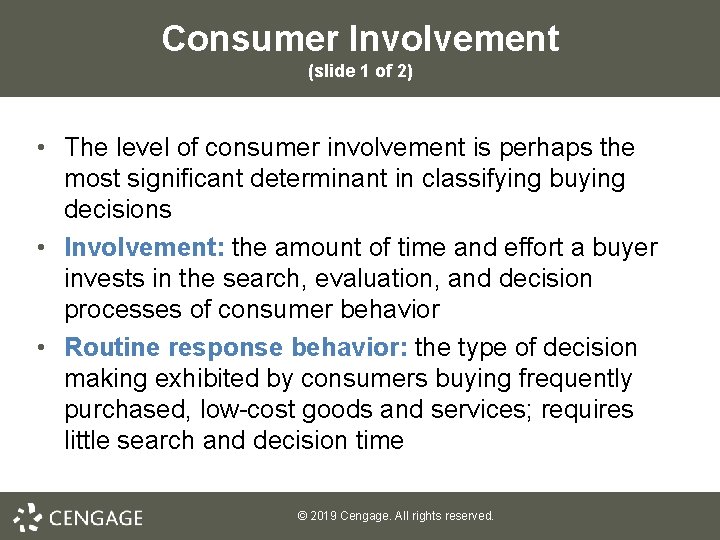
Consumer Involvement (slide 1 of 2) • The level of consumer involvement is perhaps the most significant determinant in classifying buying decisions • Involvement: the amount of time and effort a buyer invests in the search, evaluation, and decision processes of consumer behavior • Routine response behavior: the type of decision making exhibited by consumers buying frequently purchased, low-cost goods and services; requires little search and decision time © 2019 Cengage. All rights reserved.
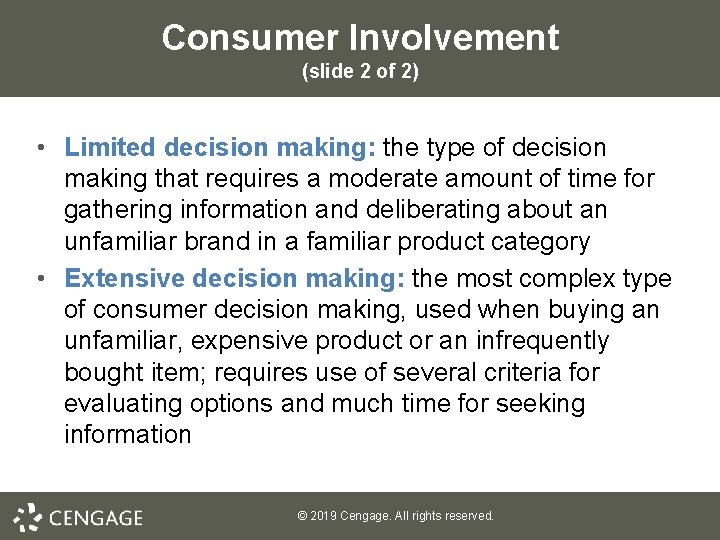
Consumer Involvement (slide 2 of 2) • Limited decision making: the type of decision making that requires a moderate amount of time for gathering information and deliberating about an unfamiliar brand in a familiar product category • Extensive decision making: the most complex type of consumer decision making, used when buying an unfamiliar, expensive product or an infrequently bought item; requires use of several criteria for evaluating options and much time for seeking information © 2019 Cengage. All rights reserved.
Exhibit 6. 2 Continuum of Consumer Buying Decisions © 2019 Cengage. All rights reserved.
Factors Determining the Level of Consumer Involvement (slide 1 of 2) • The level of involvement in the purchase depends on the following factors: – – Previous experience Interest Perceived risk of negative consequences Social visibility © 2019 Cengage. All rights reserved.
Factors Determining the Level of Consumer Involvement (slide 2 of 2) • High involvement can take a number of different forms: – Product involvement – Situational involvement – Shopping involvement § Showrooming: the practice of examining merchandise in a physical retail location without purchasing it, and then shopping online for a better deal on the same item – Enduring involvement – Emotional involvement © 2019 Cengage. All rights reserved.
Marketing Implications of Involvement • High-involvement purchases: – Require extensive and informative promotion to the target market • Low-involvement purchases: – Require in-store promotion, eye-catching package design, and good displays – Coupons and two-for-one offers promote low-involvement items – Limited availability © 2019 Cengage. All rights reserved.
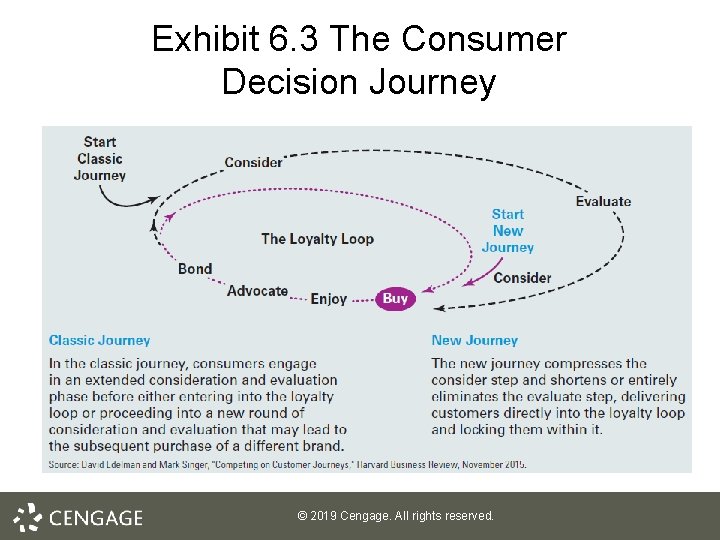
Reconceptualizing the Consumer Decision-Making Process (slide 1 of 2) • The consumer decision journey explains how marketers are trying to regain control from consumers by streamlining the decision-making process • In order to minimize (or eliminate) the “consider and evaluate” phases of the consumer journey, a company must have four distinct but interconnected capabilities: – – Automation Proactive personalization Contextual interaction Journey innovation © 2019 Cengage. All rights reserved.
Reconceptualizing the Consumer Decision-Making Process (slide 2 of 2) • Automated reordering can also keep customers in the loyalty loop • Two loyalty levels among customers: – Satisfied – Committed © 2019 Cengage. All rights reserved.
Exhibit 6. 3 The Consumer Decision Journey © 2019 Cengage. All rights reserved.
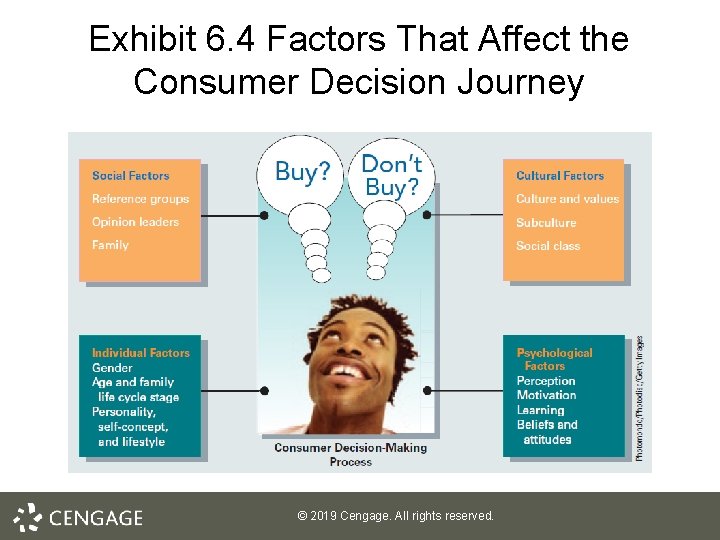
Factors Affecting Consumer Decision Making • Consumer decision making does not occur in a vacuum – – Cultural factors Social factors Individual factors Psychological factors © 2019 Cengage. All rights reserved.
Factors Affecting Consumer Decision Making (2 of 2) • Social factors sum up the social interactions between a consumer and influential groups of people, such as reference groups, opinion leaders, and family members. • Individual factors, which include gender, age, family life cycle stage, personality, self-concept, and lifestyle, are unique to each individual and play a major role in the type of products and services consumers want. © 2019 Cengage. All rights reserved.
Exhibit 6. 4 Factors That Affect the Consumer Decision Journey © 2019 Cengage. All rights reserved.
Cultural Influences on Consumer Buying Decisions • Culture: the set of values, norms, attitudes, and other meaningful symbols that shape human behavior and the artifacts, or products, of that behavior as they are transmitted from one generation to the next • Characteristics: – – Pervasive Functional Learned Dynamic © 2019 Cengage. All rights reserved.
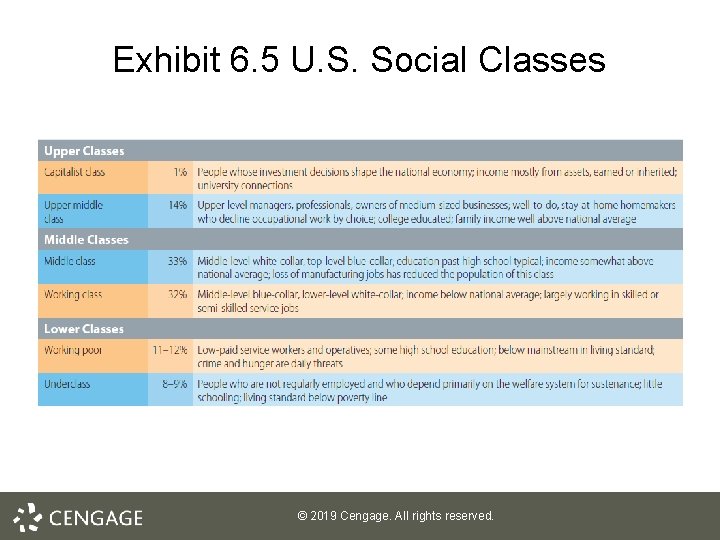
Subculture and Social Class • Subculture: a homogeneous group of people who share elements of the overall culture as well as cultural elements unique to their own group • Social class: a group of people in a society who are considered nearly equal in status or community esteem, who regularly socialize among themselves both formally and informally, and who share behavioral norms © 2019 Cengage. All rights reserved.
Exhibit 6. 5 U. S. Social Classes © 2019 Cengage. All rights reserved.
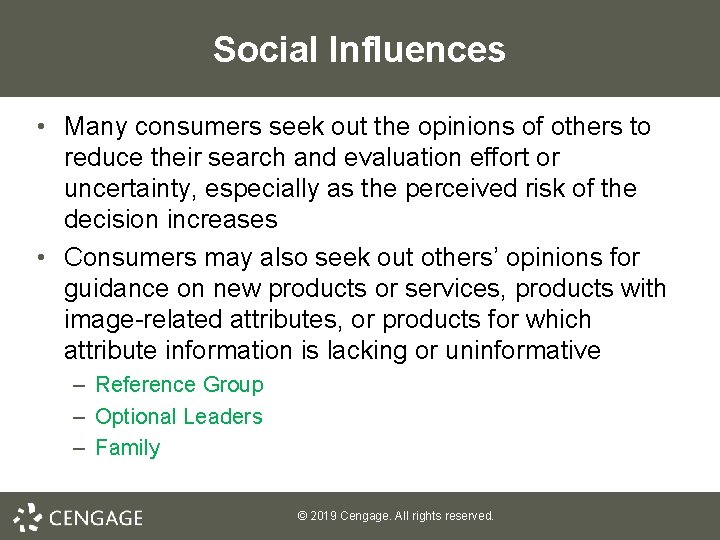
Social Influences • Many consumers seek out the opinions of others to reduce their search and evaluation effort or uncertainty, especially as the perceived risk of the decision increases • Consumers may also seek out others’ opinions for guidance on new products or services, products with image-related attributes, or products for which attribute information is lacking or uninformative – Reference Group – Optional Leaders – Family © 2019 Cengage. All rights reserved.
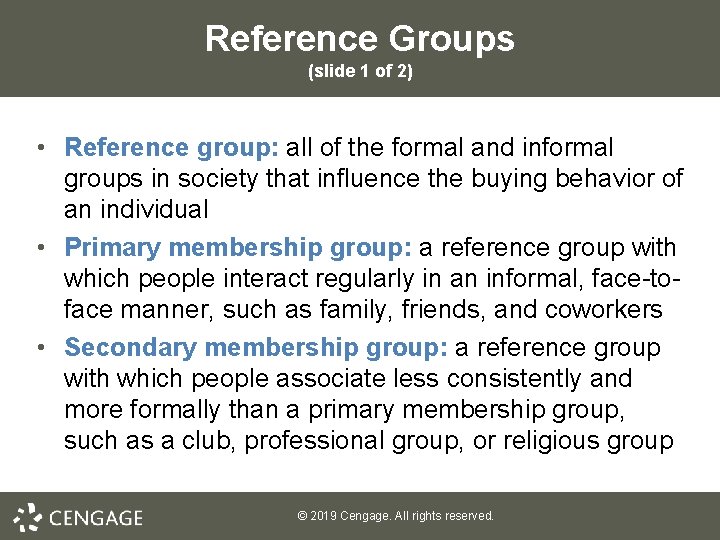
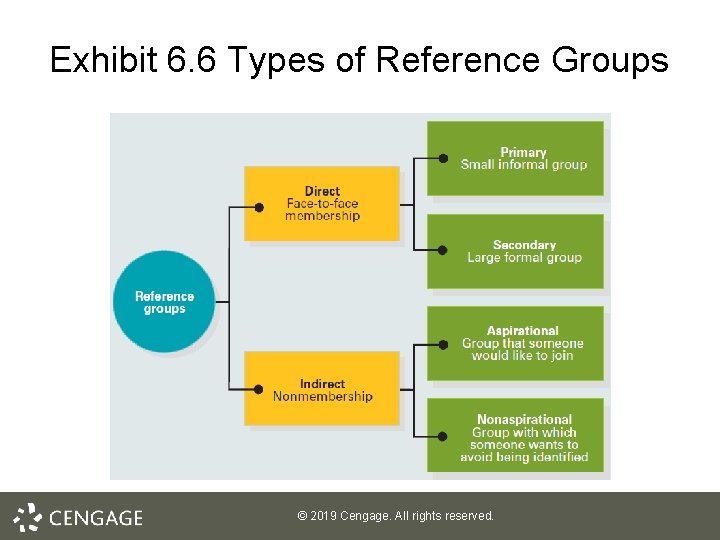
Reference Groups (slide 1 of 2) • Reference group: all of the formal and informal groups in society that influence the buying behavior of an individual • Primary membership group: a reference group with which people interact regularly in an informal, face-toface manner, such as family, friends, and coworkers • Secondary membership group: a reference group with which people associate less consistently and more formally than a primary membership group, such as a club, professional group, or religious group © 2019 Cengage. All rights reserved.
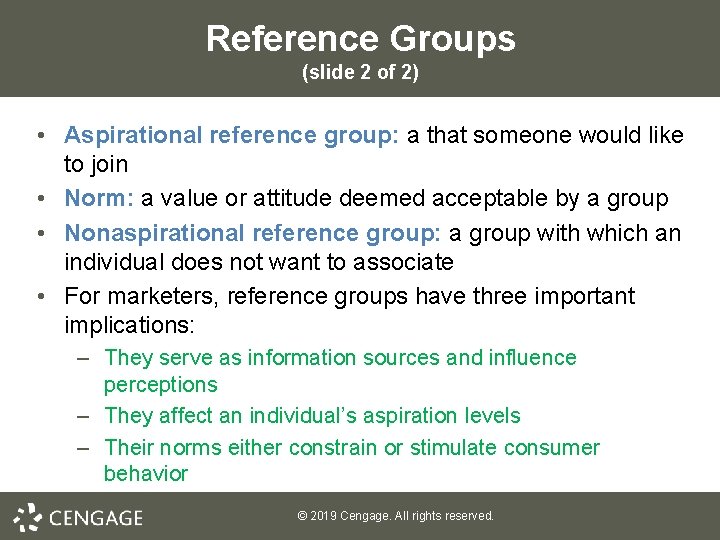
Reference Groups (slide 2 of 2) • Aspirational reference group: a that someone would like to join • Norm: a value or attitude deemed acceptable by a group • Nonaspirational reference group: a group with which an individual does not want to associate • For marketers, reference groups have three important implications: – They serve as information sources and influence perceptions – They affect an individual’s aspiration levels – Their norms either constrain or stimulate consumer behavior © 2019 Cengage. All rights reserved.
Exhibit 6. 6 Types of Reference Groups © 2019 Cengage. All rights reserved.
Opinion Leaders • Opinion leader: an individual who influences the opinions of others – Influential, informed, plugged-in, and vocal members of society • Marketers try to create opinion leaders • Marketers are looking to social media to find opinion leaders, but the sheer volume of posts and platforms makes determining true opinion leaders challenging © 2019 Cengage. All rights reserved.
Family • The family is the most important social institution for many consumers, strongly influencing values, attitudes, selfconcept, and buying behavior • Socialization process: how cultural values and norms are passed down to children • Family members assume a variety of roles in the purchase process – – – Initiators Influencers Decision maker Purchaser Consumer © 2019 Cengage. All rights reserved.
Individual Differences in Susceptibility to Social Influences • Not all persons are equally influenced in their purchase decisions • Consumers differ in their feelings of connectedness to other consumers – Separated self-schema: a perspective whereby a consumer sees himself or herself as distinct and separate from others – Connected self-schema: a perspective whereby a consumer sees himself or herself as an integral part of a group © 2019 Cengage. All rights reserved.
Individual Influences on Consumer Buying Decisions • While individuality impacts a person’s susceptibility to social influences, factors such as gender, age, life cycle stage, personality, self-concept, and lifestyle also play important roles in consumer decision making • Individual characteristics are generally sable over the course of one’s life © 2019 Cengage. All rights reserved.
Gender • Physiological differences between men and women result in many different needs, such as with health and beauty products • Just as important are the distinct cultural, social, and economic roles played by men and women and the effects that these have on their decision-making processes © 2019 Cengage. All rights reserved.
Age and Family Life Cycle Stage • A consumer’s age and family life cycle stage can have a significant impact on his or her behavior • Family life cycle is an orderly series of stages through which consumers’ attitudes and behavioral tendencies evolve through maturity, experience, and changing income and status – Nontraditional life cycles – Single parents – Life events © 2019 Cengage. All rights reserved.
Personality, Self-Concept, and Lifestyle • Personality: a way of organizing and grouping the consistencies of an individual’s reactions to situations • Self-concept: or self-perception, is how consumers perceive themselves in terms of attitudes, perceptions, beliefs, and self-evaluations • Self-concept combines: – Ideal self-image: the way an individual would like to be perceived – Real self-image the way an individual actually perceives himself or herself © 2019 Cengage. All rights reserved.
Psychological Influences • An individual’s buying decisions are further influenced by psychological factors: perception, motivation, and learning • Unlike the other three influences on consumer behavior, psychological influences can be affected by a person’s environment because they are applied on specific occasions © 2019 Cengage. All rights reserved.
Perception • Perception: the process by which people select, organize, and interpret stimuli into a meaningful and coherent picture • Selective exposure: a process whereby a consumer notices certain stimuli and ignores others – Selective distortion: a process whereby a consumer changes or distorts information that conflicts with his or her feelings or beliefs – Selective retention: a process whereby a consumer remembers only that information that supports his or her personal beliefs © 2019 Cengage. All rights reserved.
Marketing Implications of Perception • Marketers use perception to identify important attributes: – – Price Brand names Quality and reliability Threshold level of perception • Changes in product or repositioning of a product • Awareness of foreign consumers' perception is required when expanding to global markets © 2019 Cengage. All rights reserved.
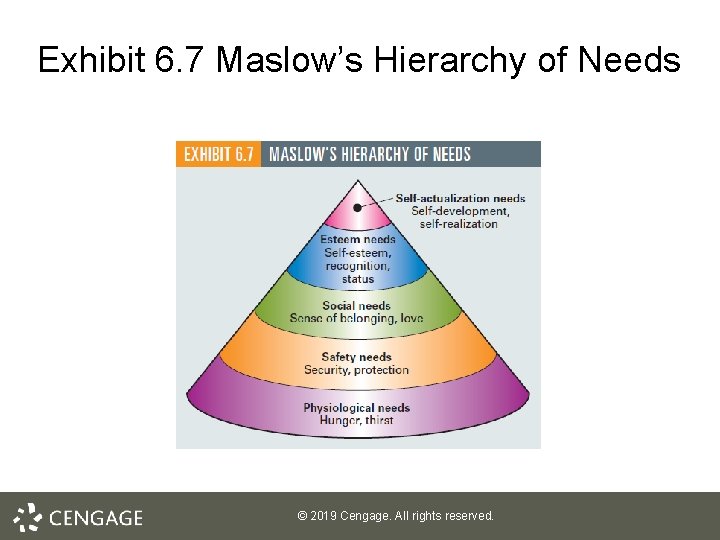
Motivation • Motive: a driving force that causes a person to take action to satisfy specific needs • Maslow’s hierarchy of needs: a method of classifying human needs and motivations into five categories in ascending order of importance: physiological, safety, social, self-esteem, and selfactualization © 2019 Cengage. All rights reserved.
Exhibit 6. 7 Maslow’s Hierarchy of Needs © 2019 Cengage. All rights reserved.
Discussion Point Maslow’s Hierarchy of Needs • Consider the following products: – – – – Home security system Mc. Donald’s hamburger Rolex watch Insurance policy Jewelry BMW American Express “black card” Which level in Maslow’s hierarchy are these products meant to satisfy: physiological, safety, social, esteem, or self-actualization? © 2019 Cengage. All rights reserved.
Learning (slide 1 of 2) • Learning: a process that creates changes in behavior, immediate or expected, through experience and practice • Types: – Experiential: occurs when an experience changes behavior – Conceptual: not learned through direct experience but based upon reasoning • Reinforcement and repetition boost learning © 2019 Cengage. All rights reserved.
Learning (slide 2 of 2) • Stimulus generalization: a form of learning that occurs when one response is extended to a second stimulus similar to the first • Stimulus discrimination: a learned ability to differentiate among similar products © 2019 Cengage. All rights reserved.
Key Terms (slide 1 of 4) • • • Consumer behavior Value Perceived value Utilitarian value Hedonic value Consumer decision-making process Need recognition Want Stimulus Internal information search External information search Nonmarketing-controlled information source © 2019 Cengage. All rights reserved.
Key Terms (slide 2 of 4) • • • Marketing-controlled information source Evoked set (consideration set) Cognitive dissonance Involvement Routine response behavior Limited decision making Extensive decision making Showrooming Culture Subculture © 2019 Cengage. All rights reserved.
Key Terms (slide 3 of 4) • • • Social class Reference group Primary membership group Secondary membership group Aspirational reference group Norm Nonaspirational reference group Opinion leader Socialization process Separated self-schema Connected self-schema Personality © 2019 Cengage. All rights reserved.
Key Terms (slide 4 of 4) • • • Self-concept Ideal self-image Real self-image Perception Selective exposure Selective distortion Selective retention Motive Maslow’s hierarchy of needs Learning Stimulus generalization Stimulus discrimination © 2019 Cengage. All rights reserved.