
Mixtures of Gases Daltons law of partial pressure


- Slides: 26
Mixtures of Gases • Dalton's law of partial pressure states: – the total pressure of a mixture of gases is equal to the sum of the partial pressures of the component gases.
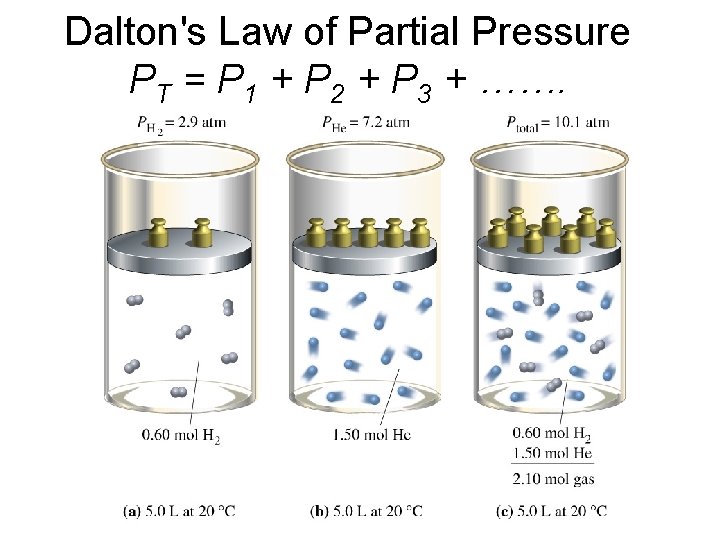
Dalton's Law of Partial Pressure PT = P 1 + P 2 + P 3 + …….
Partial Pressure in terms of mole fraction OR XA Ptotal = PA (XA = mole fraction of A and PA = partial pressure of gas A)
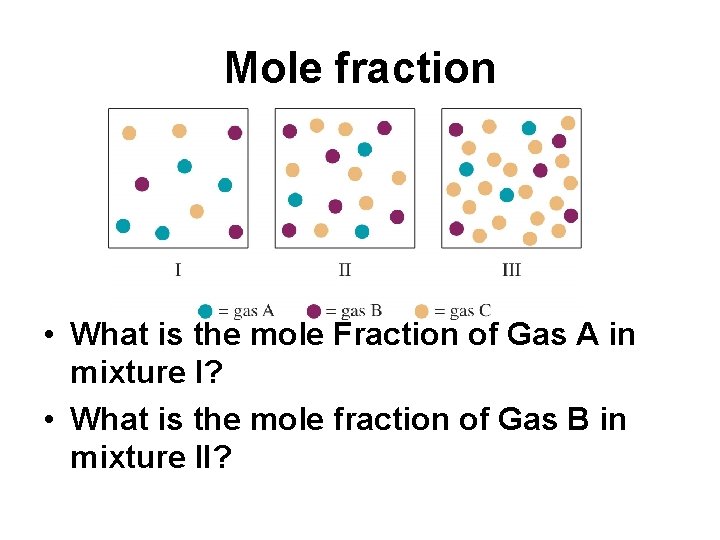
Mole fraction • What is the mole Fraction of Gas A in mixture I? • What is the mole fraction of Gas B in mixture II?
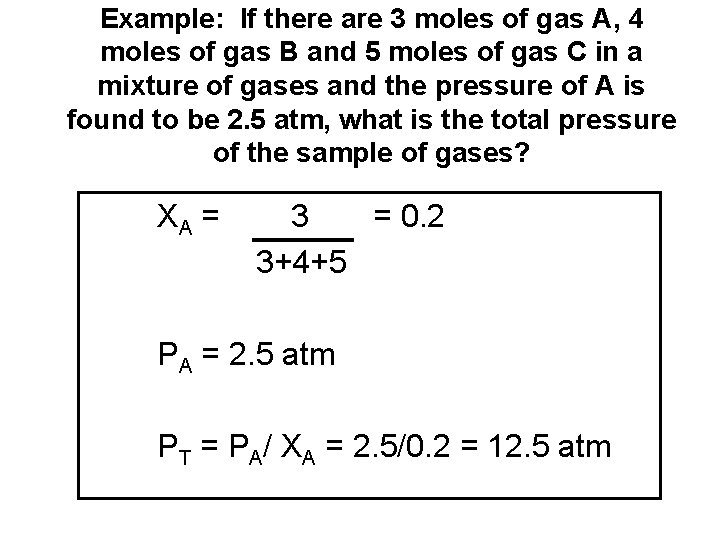
Example: If there are 3 moles of gas A, 4 moles of gas B and 5 moles of gas C in a mixture of gases and the pressure of A is found to be 2. 5 atm, what is the total pressure of the sample of gases? XA = 3 = 0. 2 3+4+5 PA = 2. 5 atm PT = PA/ XA = 2. 5/0. 2 = 12. 5 atm
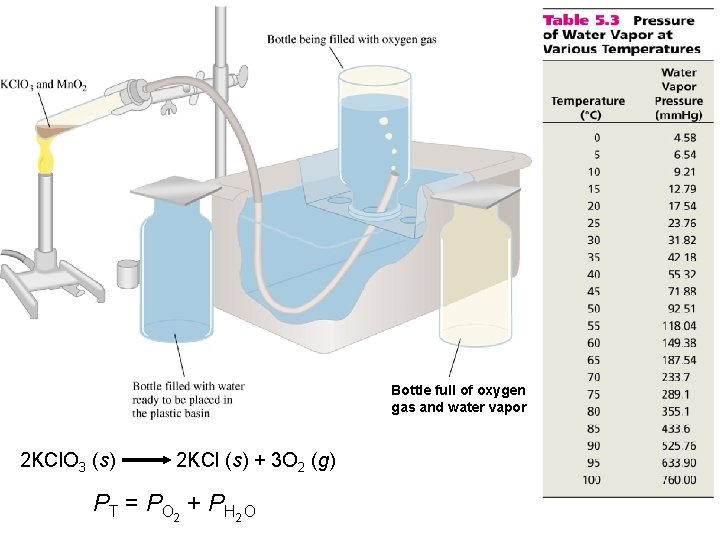
Bottle full of oxygen gas and water vapor 2 KCl. O 3 (s) 2 KCl (s) + 3 O 2 (g) PT = PO 2 + PH 2 O
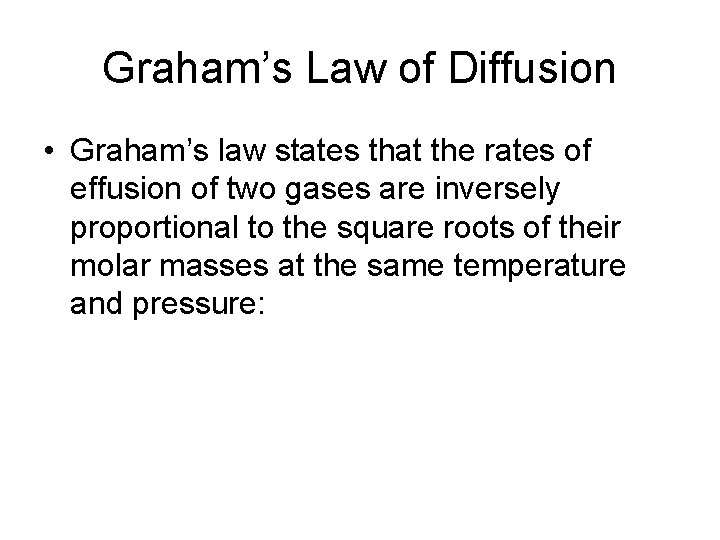
Graham’s Law of Diffusion • Graham’s law states that the rates of effusion of two gases are inversely proportional to the square roots of their molar masses at the same temperature and pressure:
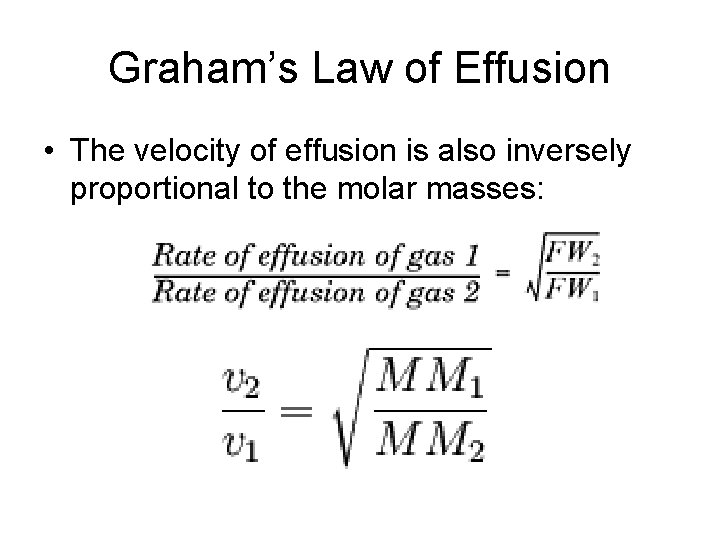
Graham’s Law of Effusion • The velocity of effusion is also inversely proportional to the molar masses:
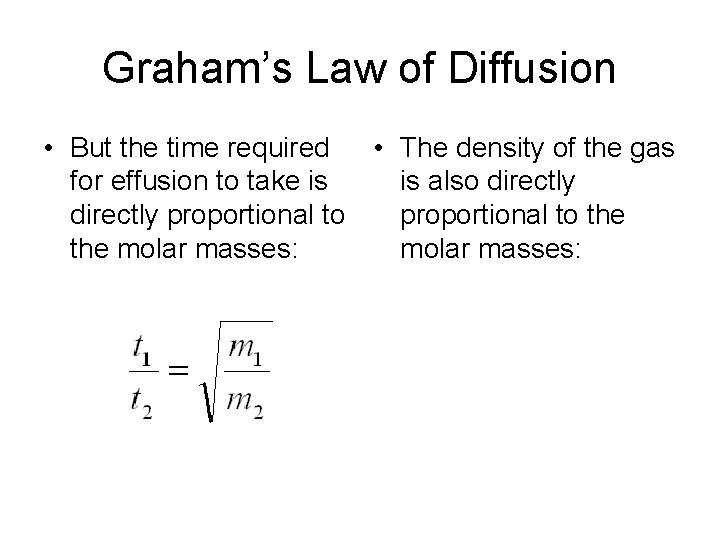
Graham’s Law of Diffusion • But the time required • The density of the gas for effusion to take is is also directly proportional to the molar masses:
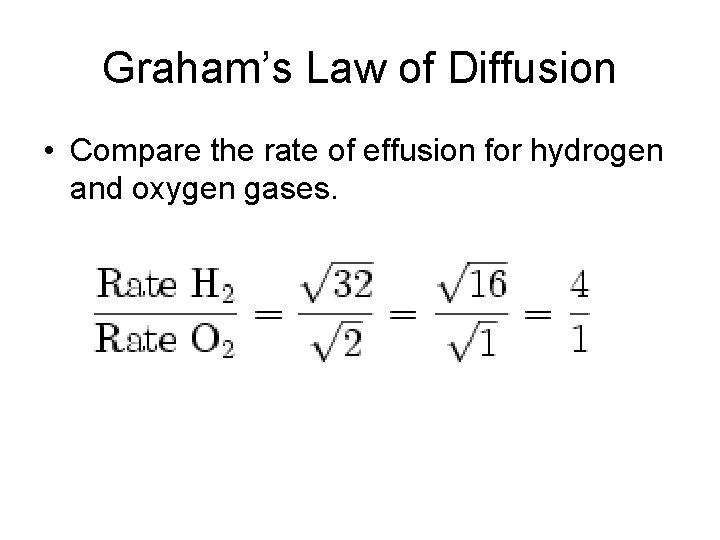
Graham’s Law of Diffusion • Compare the rate of effusion for hydrogen and oxygen gases.
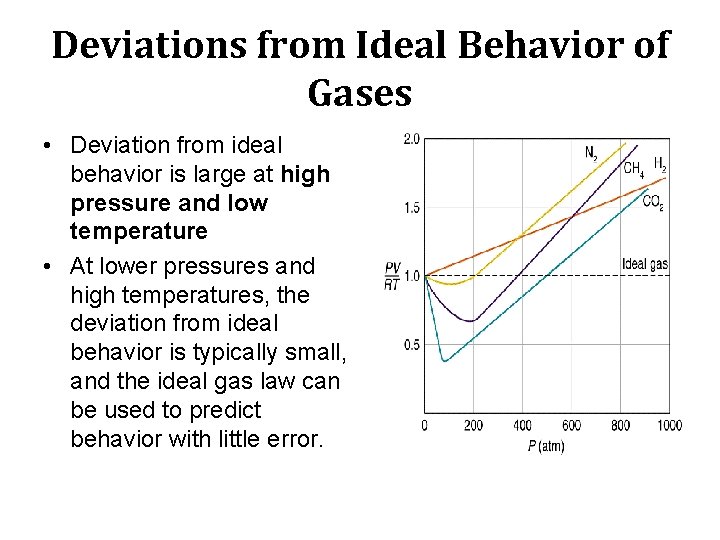
Deviations from Ideal Behavior of Gases • Deviation from ideal behavior is large at high pressure and low temperature • At lower pressures and high temperatures, the deviation from ideal behavior is typically small, and the ideal gas law can be used to predict behavior with little error.
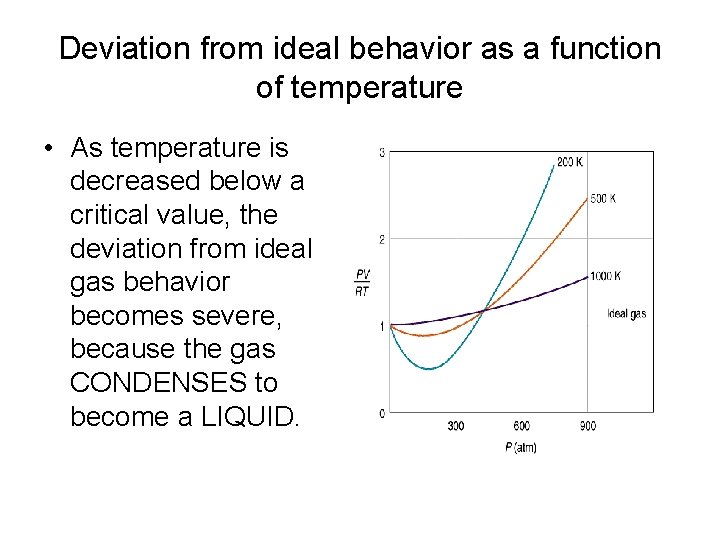
Deviation from ideal behavior as a function of temperature • As temperature is decreased below a critical value, the deviation from ideal gas behavior becomes severe, because the gas CONDENSES to become a LIQUID.
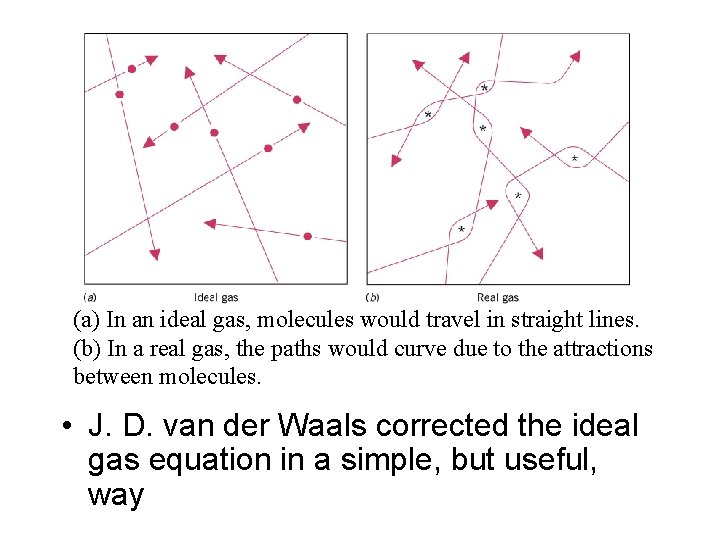
(a) In an ideal gas, molecules would travel in straight lines. (b) In a real gas, the paths would curve due to the attractions between molecules. • J. D. van der Waals corrected the ideal gas equation in a simple, but useful, way
Real Gases • No such thing as an ideal gas • Real gases begin to behave like ideal gases under ideal conditions. – at low pressures – At high temperatures
Real Gases • Look at real gas behavior – Graph of PV/n. RT vs P – For ideal gases, PV / n. RT = 1 at any pressure – For real gases, PV / n. RT approaches 1 at very low pressures (below 1 atm)
Real Gases • What is the effect of temperature when plotting PV / n. RT vs. P? – PV / n. RT approaches 1 at low pressure and at high temperatures
Real Gases • Johannes van Der Waals – Developed an equation for real gases – Received a Nobel prize for his work
Ideal Gases vs. Real Gases • Volumeless • Do not interact with each other • Finite volumes • Particles do take up space • Volume of the gas is actually less than the volume of the container • Particles do attract each other
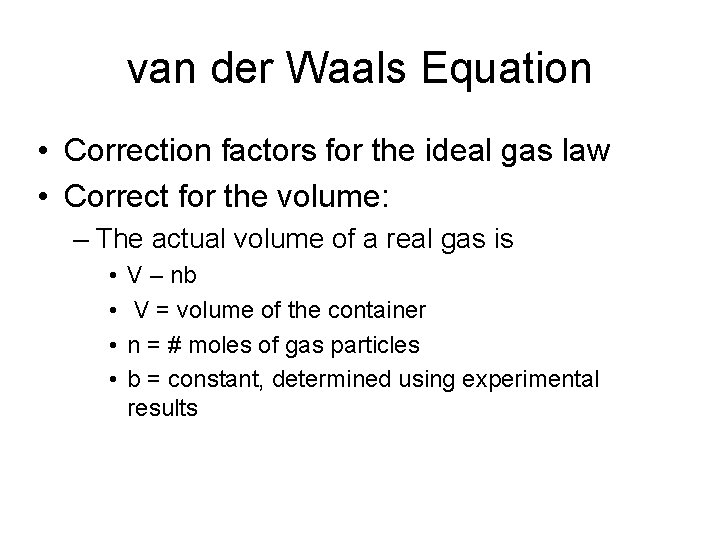
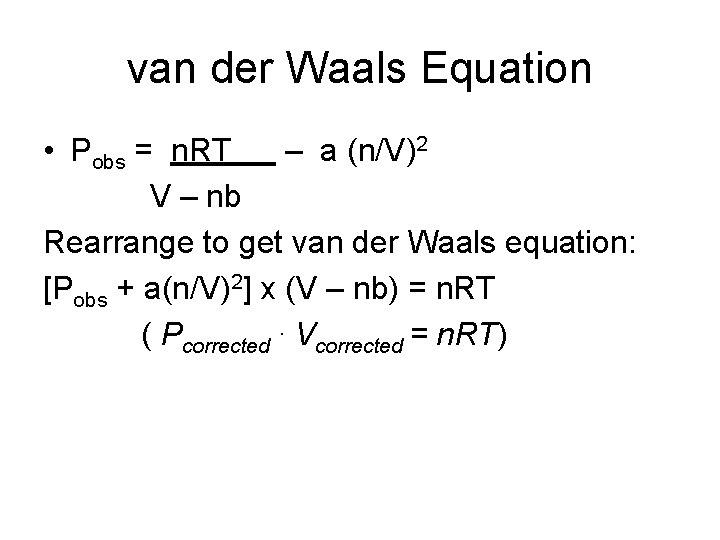
van der Waals Equation • Correction factors for the ideal gas law • Correct for the volume: – The actual volume of a real gas is • • V – nb V = volume of the container n = # moles of gas particles b = constant, determined using experimental results
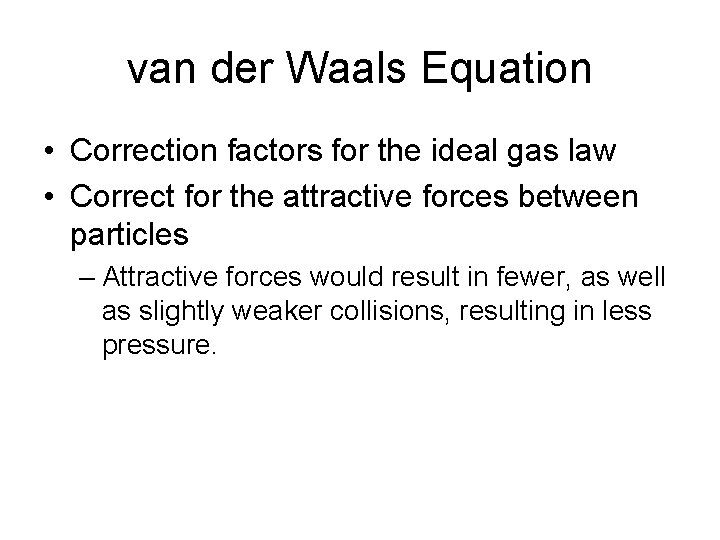
van der Waals Equation • Correction factors for the ideal gas law • Correct for the attractive forces between particles – Attractive forces would result in fewer, as well as slightly weaker collisions, resulting in less pressure.
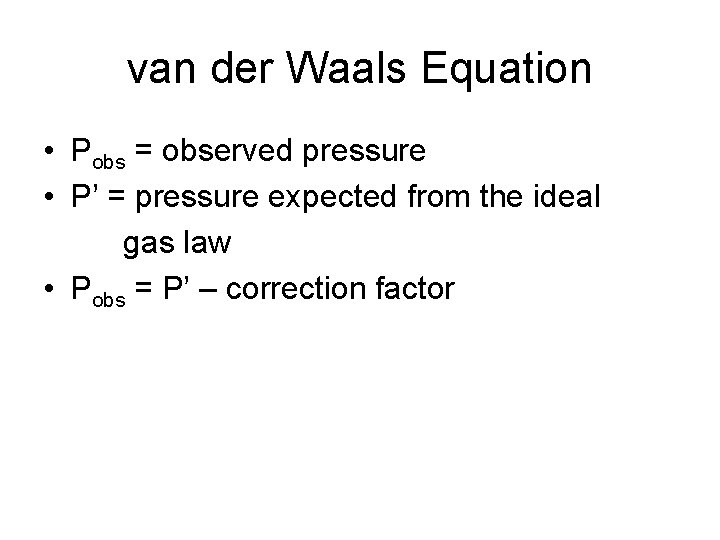
van der Waals Equation • Pobs = observed pressure • P’ = pressure expected from the ideal gas law • Pobs = P’ – correction factor
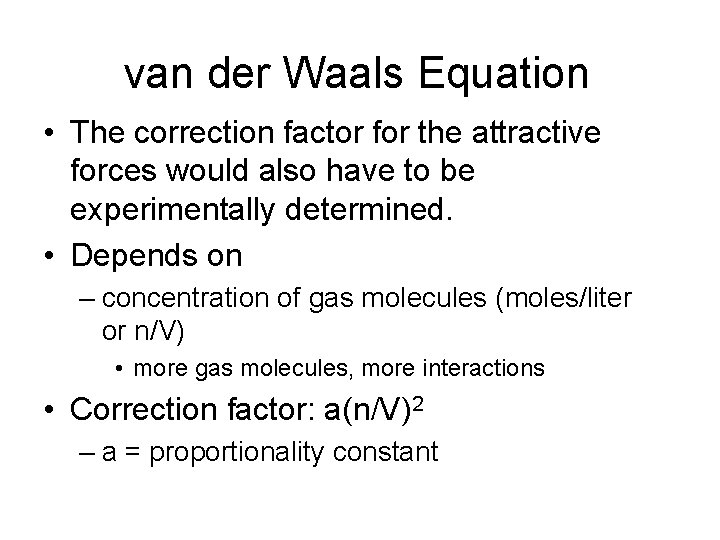
van der Waals Equation • The correction factor for the attractive forces would also have to be experimentally determined. • Depends on – concentration of gas molecules (moles/liter or n/V) • more gas molecules, more interactions • Correction factor: a(n/V)2 – a = proportionality constant
van der Waals Equation • Pobs = n. RT – a (n/V)2 V – nb Rearrange to get van der Waals equation: [Pobs + a(n/V)2] x (V – nb) = n. RT ( Pcorrected. Vcorrected = n. RT)
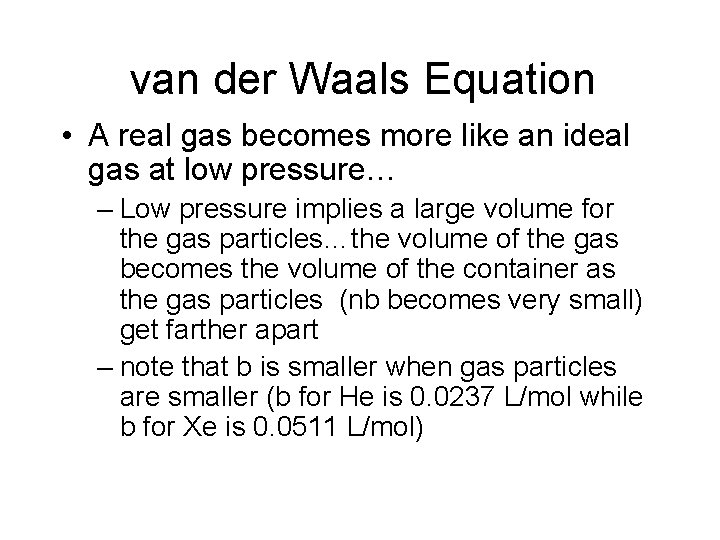
van der Waals Equation • A real gas becomes more like an ideal gas at low pressure… – Low pressure implies a large volume for the gas particles…the volume of the gas becomes the volume of the container as the gas particles (nb becomes very small) get farther apart – note that b is smaller when gas particles are smaller (b for He is 0. 0237 L/mol while b for Xe is 0. 0511 L/mol)
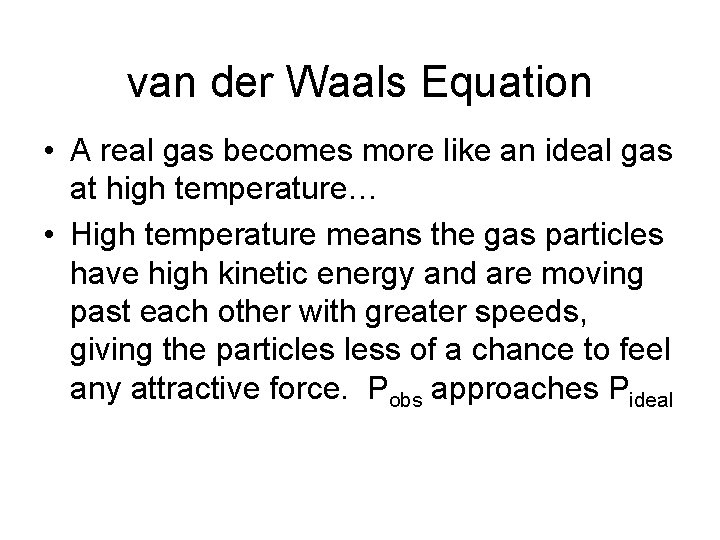
van der Waals Equation • A real gas becomes more like an ideal gas at high temperature… • High temperature means the gas particles have high kinetic energy and are moving past each other with greater speeds, giving the particles less of a chance to feel any attractive force. Pobs approaches Pideal
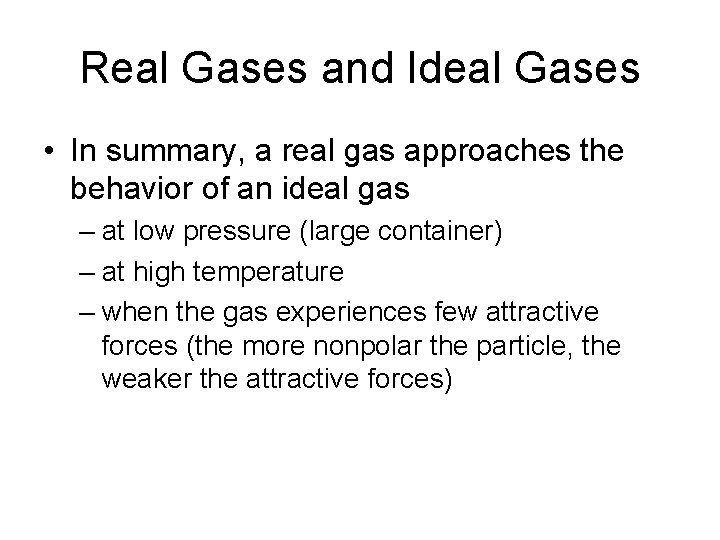
Real Gases and Ideal Gases • In summary, a real gas approaches the behavior of an ideal gas – at low pressure (large container) – at high temperature – when the gas experiences few attractive forces (the more nonpolar the particle, the weaker the attractive forces)