
Mixture DOE Neural Algorithm Applications on Car Racing




- Slides: 18
Mixture DOE & Neural Algorithm Applications on Car Racing Gaming Analytics Mason Chen Stanford Online High School
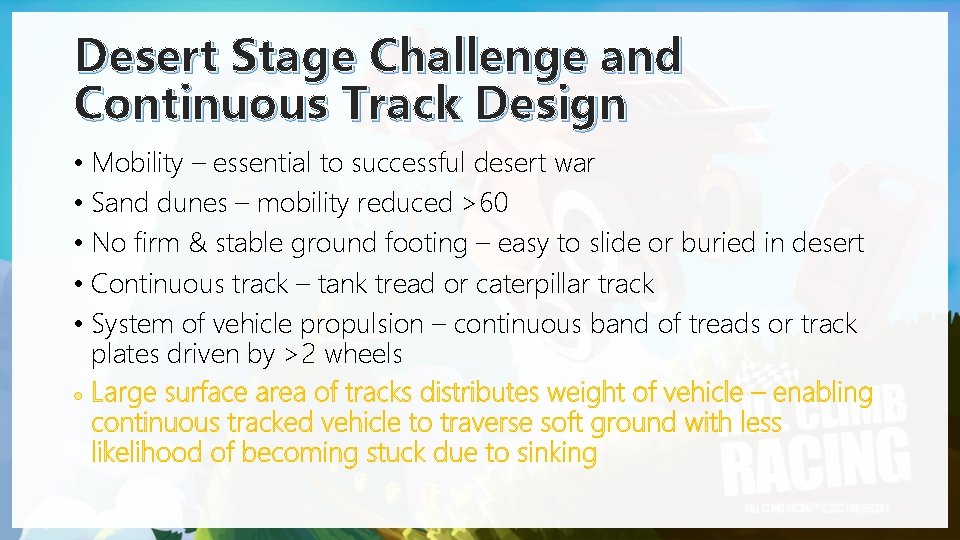
Desert Stage Challenge and Continuous Track Design • Mobility – essential to successful desert war • Sand dunes – mobility reduced >60 • No firm & stable ground footing – easy to slide or buried in desert • Continuous track – tank tread or caterpillar track • System of vehicle propulsion – continuous band of treads or track plates driven by >2 wheels
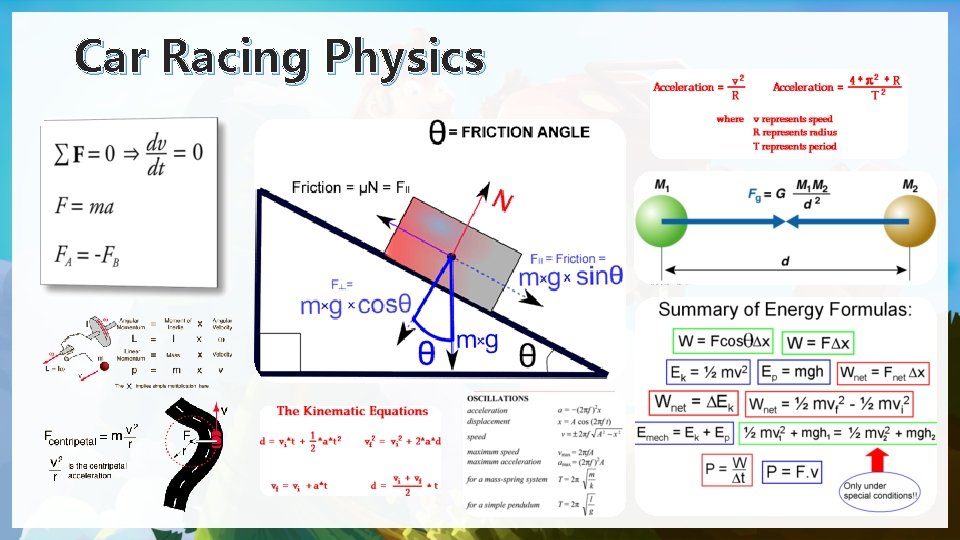
Car Racing Physics
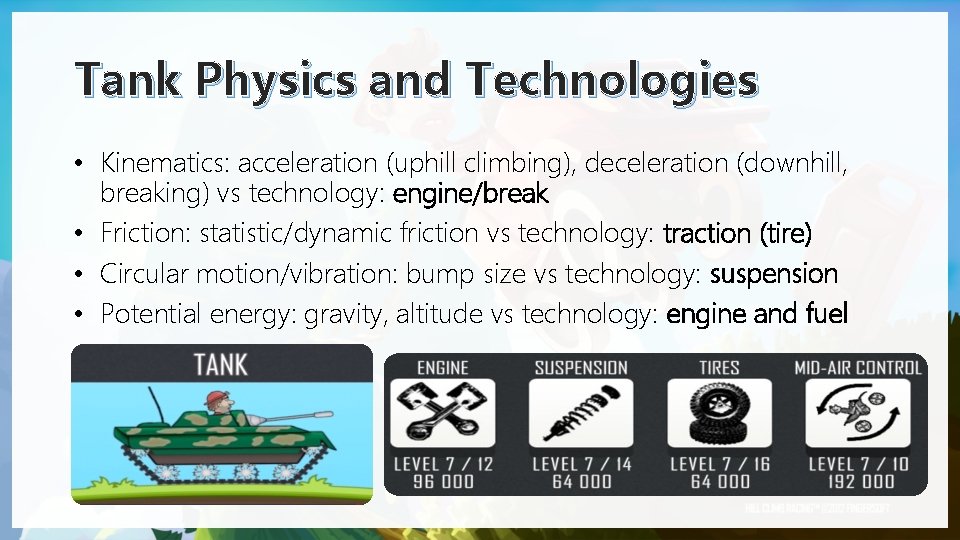
Tank Physics and Technologies • Kinematics: acceleration (uphill climbing), deceleration (downhill, breaking) vs technology: engine/break • Friction: statistic/dynamic friction vs technology: traction (tire) • Circular motion/vibration: bump size vs technology: suspension • Potential energy: gravity, altitude vs technology: engine and fuel
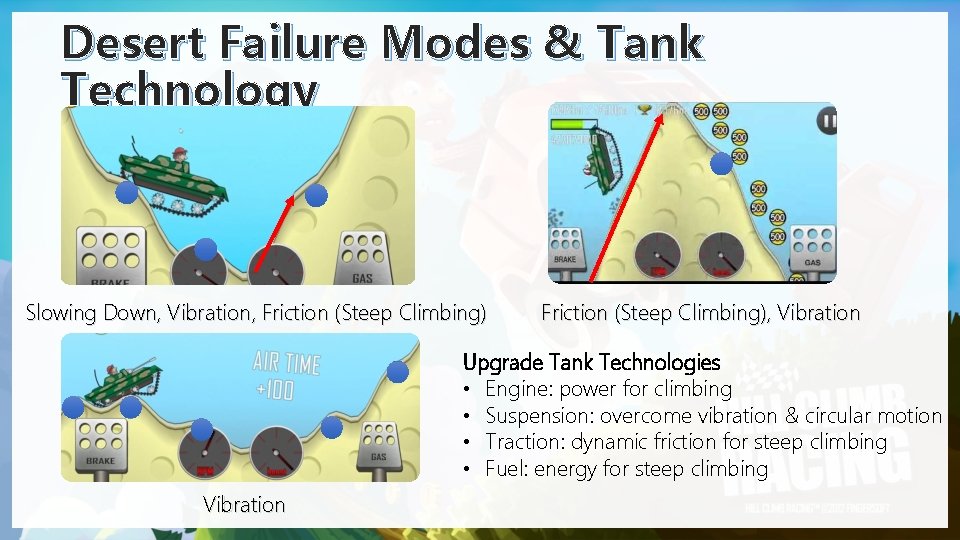
Desert Failure Modes & Tank Technology Slowing Down, Vibration, Friction (Steep Climbing), Vibration Upgrade Tank Technologies • Engine: power for climbing • Suspension: overcome vibration & circular motion • Traction: dynamic friction for steep climbing • Fuel: energy for steep climbing Vibration
Desert/Tank Upgrading Mixture DOE • Further improve ROI of tank technology upgrading on the desert stage, special Mixture DOE was designed • Properties of mixture DOE are a function of the relative proportions of the technologies rather than their absolute levels • Because the proportions sum to one, mixture designs have an interesting simplex geometry: triangle-shaped slice
Mixture Optimal Design Diagnostics • Mixture DOE different from full/fractional factorial DOEs: • Power >80% • Confounding: mild resolution II & severe resolution III Confounding across all main & interaction effects • Interaction terms fully confounding with quadratic terms (missed in Model) • Design Space Uniformity: near Uniform Design • The severe confounding is due to the mixture dependency and constraint (all components added together up to 100%)
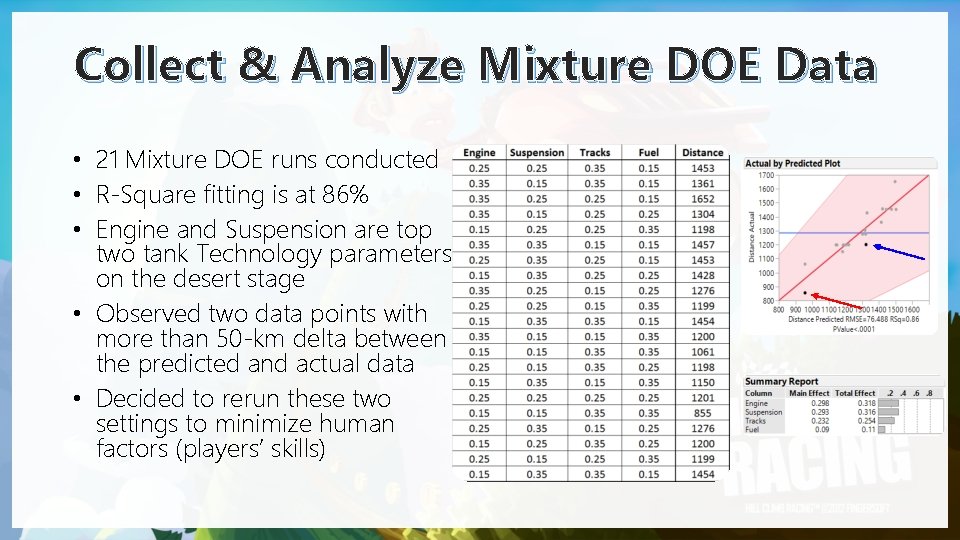
Collect & Analyze Mixture DOE Data • 21 Mixture DOE runs conducted • R-Square fitting is at 86% • Engine and Suspension are top two tank Technology parameters on the desert stage • Observed two data points with more than 50 -km delta between the predicted and actual data • Decided to rerun these two settings to minimize human factors (players’ skills)
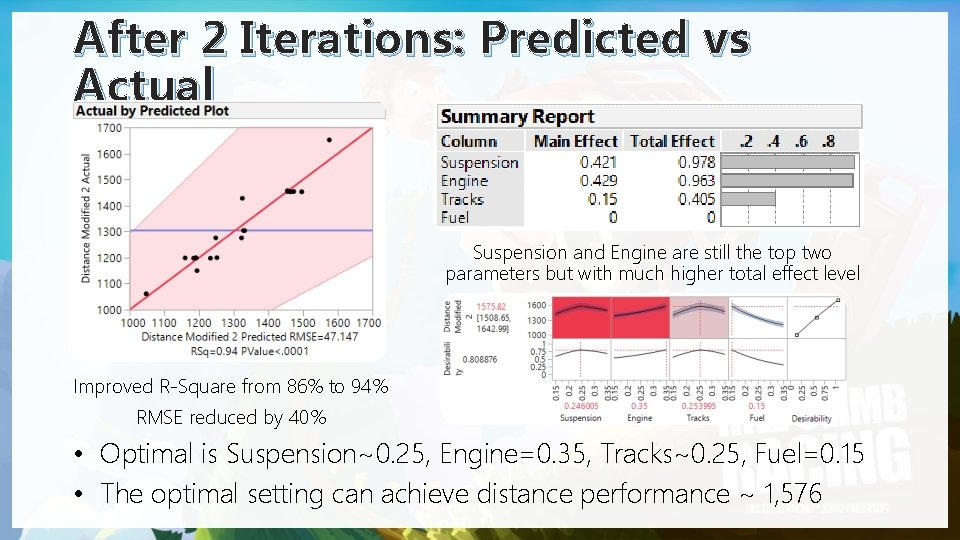
After 2 Iterations: Predicted vs Actual Suspension and Engine are still the top two parameters but with much higher total effect level Improved R-Square from 86% to 94% RMSE reduced by 40% • Optimal is Suspension~0. 25, Engine=0. 35, Tracks~0. 25, Fuel=0. 15 • The optimal setting can achieve distance performance ~ 1, 576
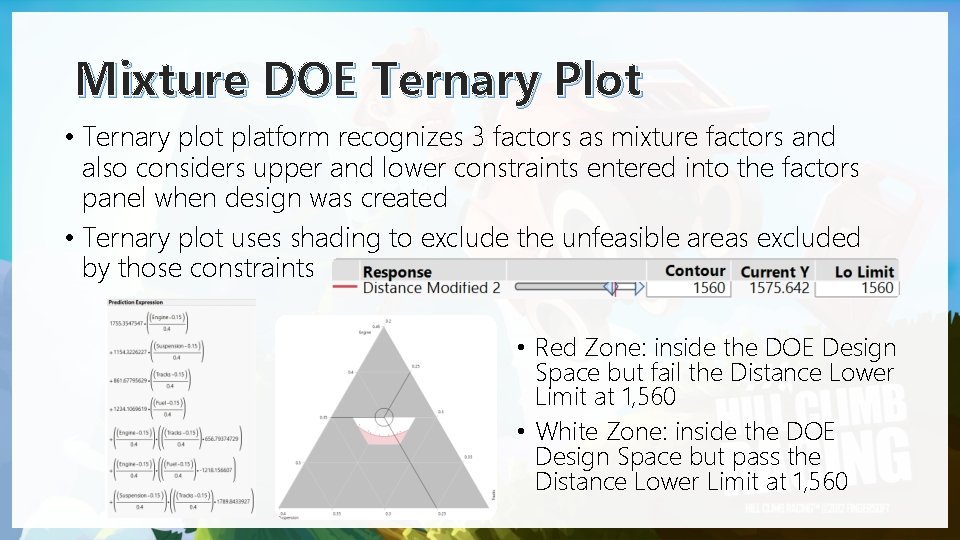
Mixture DOE Ternary Plot • Ternary plot platform recognizes 3 factors as mixture factors and also considers upper and lower constraints entered into the factors panel when design was created • Ternary plot uses shading to exclude the unfeasible areas excluded by those constraints • Red Zone: inside the DOE Design Space but fail the Distance Lower Limit at 1, 560 • White Zone: inside the DOE Design Space but pass the Distance Lower Limit at 1, 560
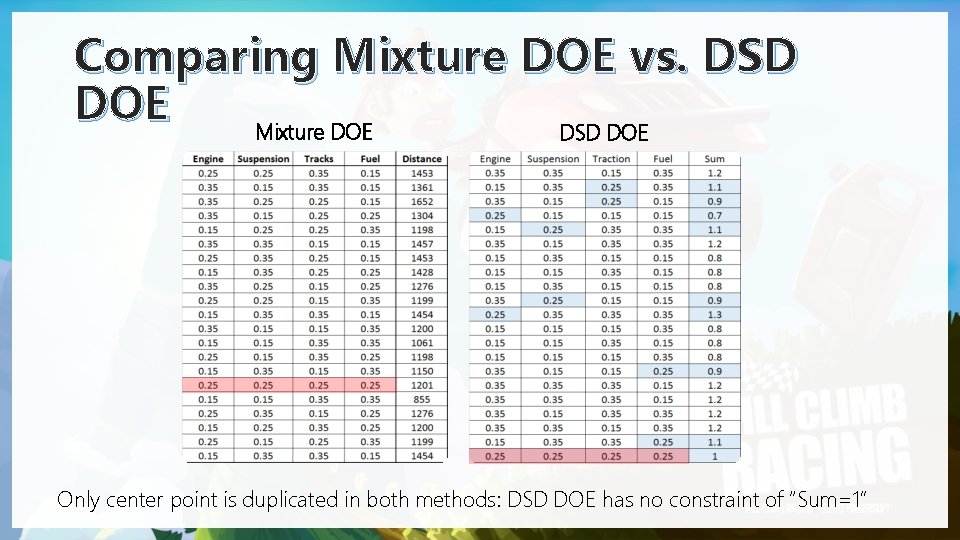
Comparing Mixture DOE vs. DSD DOE Mixture DOE DSD DOE Only center point is duplicated in both methods: DSD DOE has no constraint of “Sum=1”
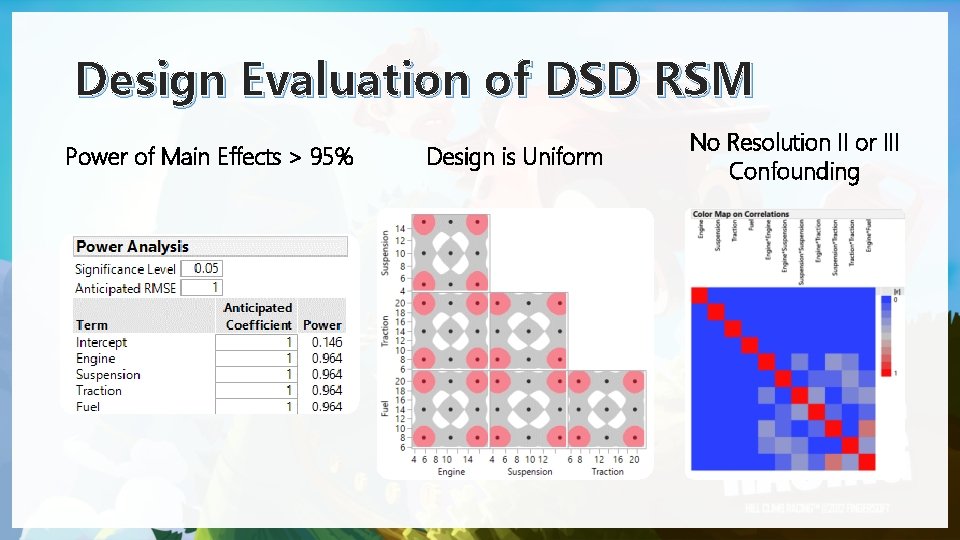
Design Evaluation of DSD RSM Power of Main Effects > 95% Design is Uniform No Resolution II or III Confounding
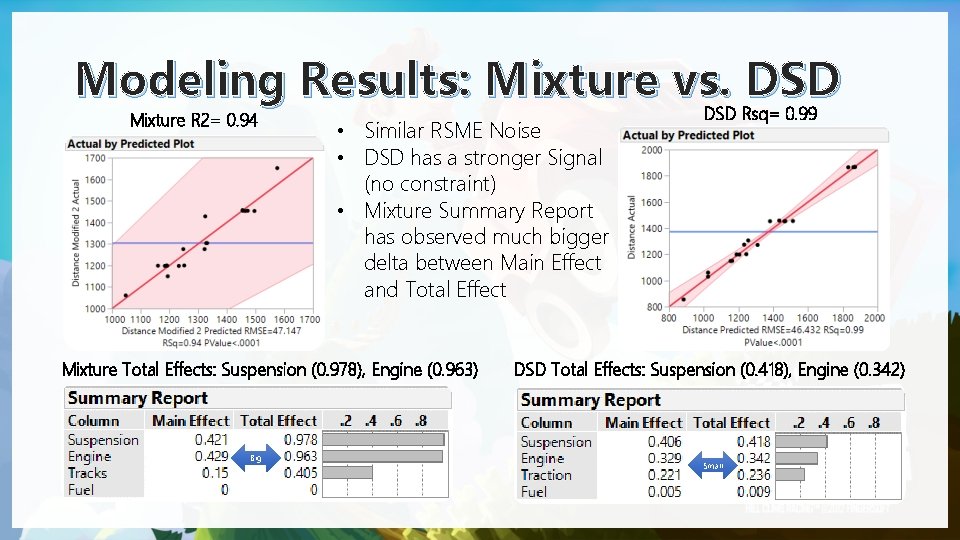
Modeling Results: Mixture vs. DSD Mixture R 2= 0. 94 • Similar RSME Noise • DSD has a stronger Signal (no constraint) • Mixture Summary Report has observed much bigger delta between Main Effect and Total Effect Mixture Total Effects: Suspension (0. 978), Engine (0. 963) Big DSD Rsq= 0. 99 DSD Total Effects: Suspension (0. 418), Engine (0. 342) Small
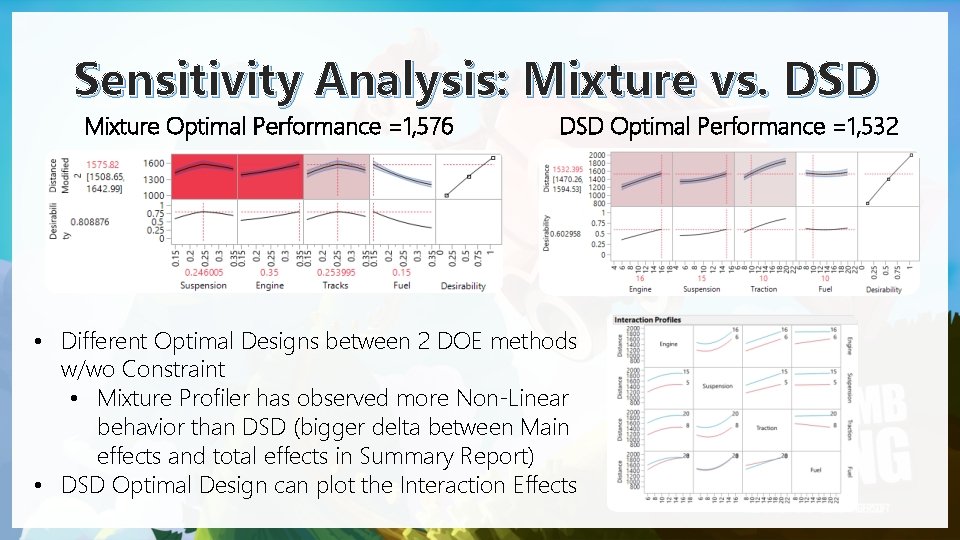
Sensitivity Analysis: Mixture vs. DSD Mixture Optimal Performance =1, 576 DSD Optimal Performance =1, 532 • Different Optimal Designs between 2 DOE methods w/wo Constraint • Mixture Profiler has observed more Non-Linear behavior than DSD (bigger delta between Main effects and total effects in Summary Report) • DSD Optimal Design can plot the Interaction Effects
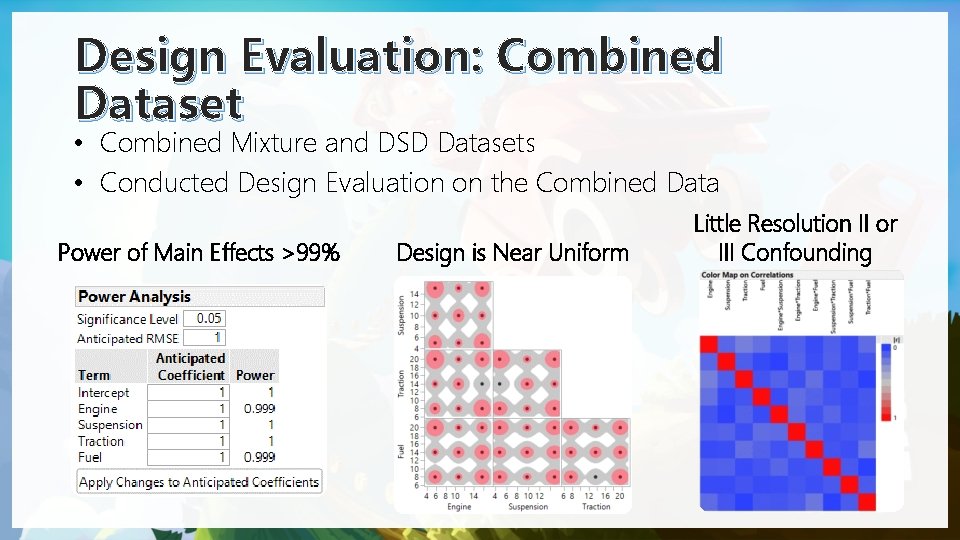
Design Evaluation: Combined Dataset • Combined Mixture and DSD Datasets • Conducted Design Evaluation on the Combined Data Power of Main Effects >99% Design is Near Uniform Little Resolution II or III Confounding
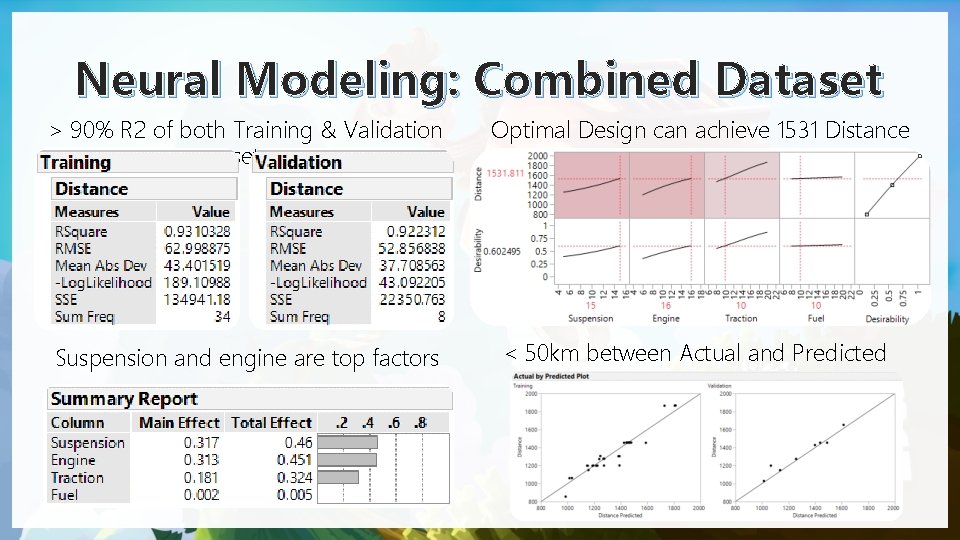
Neural Modeling: Combined Dataset > 90% R 2 of both Training & Validation set Optimal Design can achieve 1531 Distance Suspension and engine are top factors < 50 km between Actual and Predicted
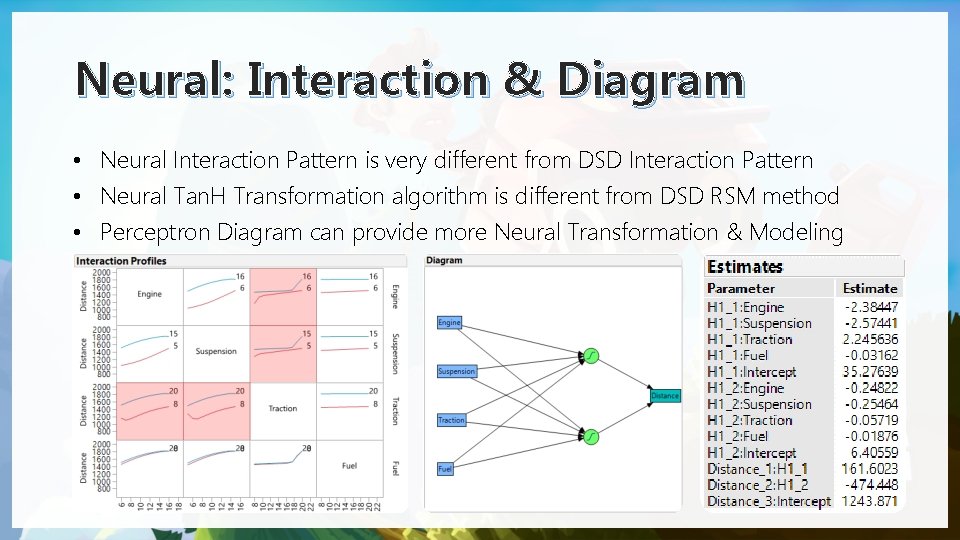
Neural: Interaction & Diagram • Neural Interaction Pattern is very different from DSD Interaction Pattern • Neural Tan. H Transformation algorithm is different from DSD RSM method • Perceptron Diagram can provide more Neural Transformation & Modeling
Model Comparison Summary