
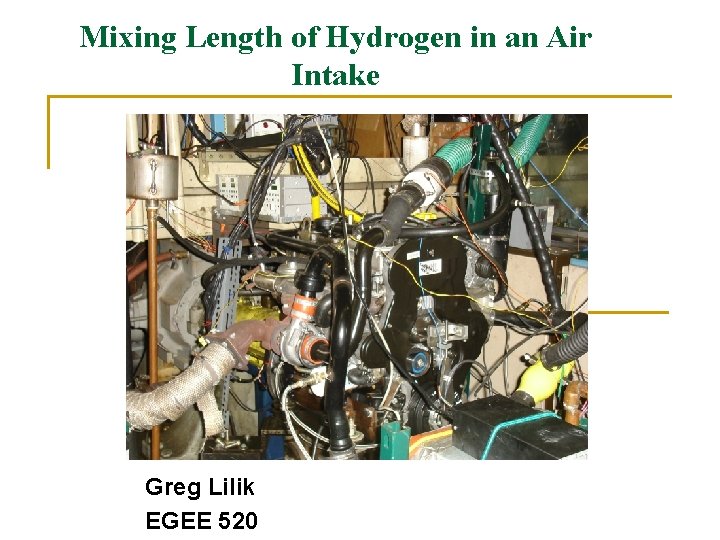
Mixing Length of Hydrogen in an Air Intake
![Solution Surface plot – Concentration [mol/m 3]. Line plot- concentration [mol/m 3] vs. length](https://slidetodoc.com/presentation_image_h/22860e405e1c0e7e0adf4e216414ca6e/image-6.jpg "Solution Surface plot – Concentration [mol/m 3]. Line plot- concentration [mol/m 3] vs. length")
![Solution Surface plot – Turbulent kinetics energy [m 2/s 2]. Surface plot – Pressure](https://slidetodoc.com/presentation_image_h/22860e405e1c0e7e0adf4e216414ca6e/image-7.jpg "Solution Surface plot – Turbulent kinetics energy [m 2/s 2]. Surface plot – Pressure")
![Solution Arrow plot – Velocity field [m/s].](https://slidetodoc.com/presentation_image_h/22860e405e1c0e7e0adf4e216414ca6e/image-8.jpg "Solution Arrow plot – Velocity field [m/s].")
![Validation Flow side view. Smith et al. Surface plot – Velocity field [m/s]](https://slidetodoc.com/presentation_image_h/22860e405e1c0e7e0adf4e216414ca6e/image-10.jpg "Validation Flow side view. Smith et al. Surface plot – Velocity field [m/s]")
- Slides: 12
Mixing Length of Hydrogen in an Air Intake Greg Lilik EGEE 520
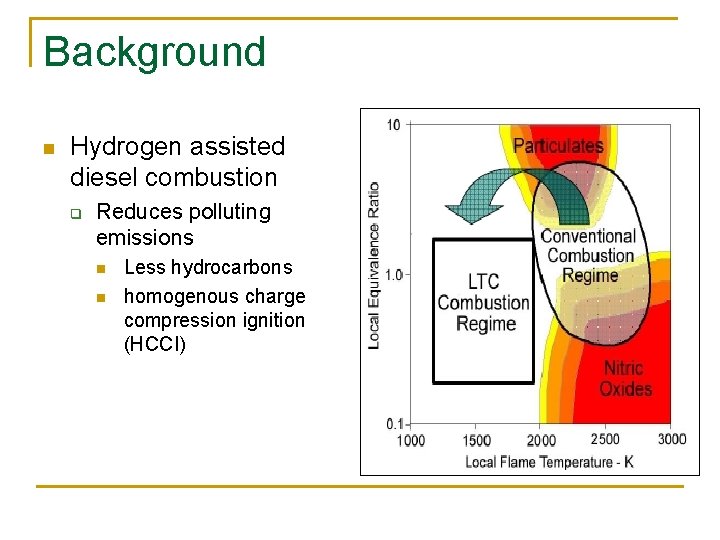
Background n Hydrogen assisted diesel combustion q Reduces polluting emissions n n Less hydrocarbons homogenous charge compression ignition (HCCI)
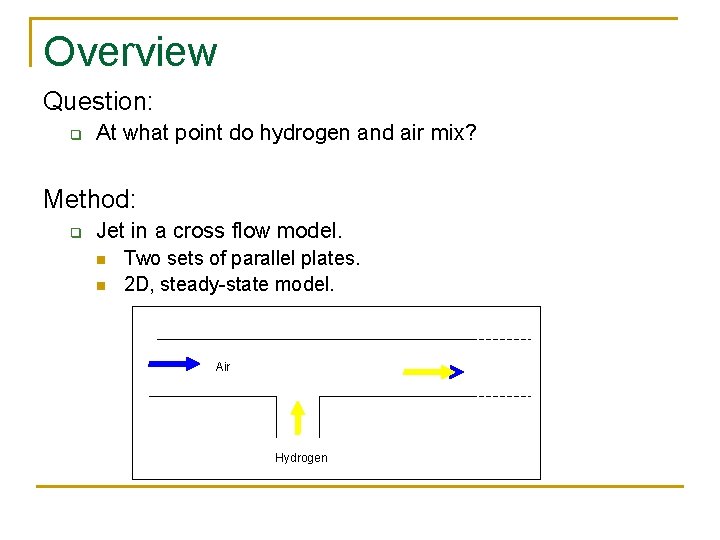
Overview Question: q At what point do hydrogen and air mix? Method: q Jet in a cross flow model. n n Two sets of parallel plates. 2 D, steady-state model. Air Hydrogen
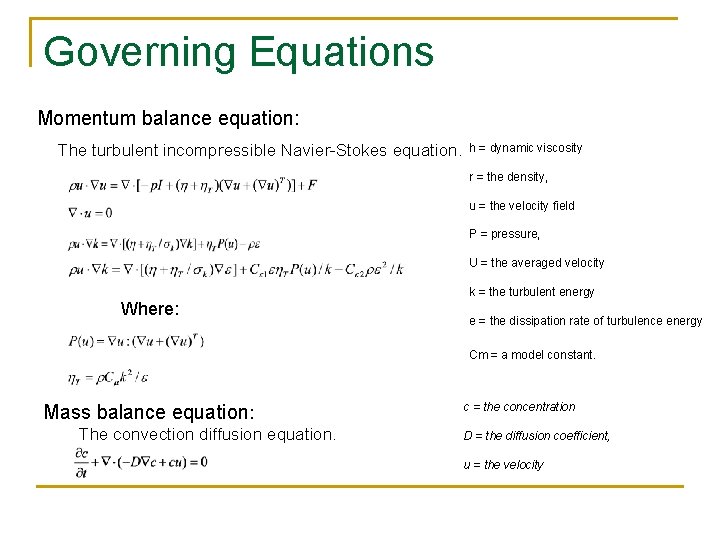
Governing Equations Momentum balance equation: The turbulent incompressible Navier-Stokes equation. h = dynamic viscosity r = the density, u = the velocity field P = pressure, U = the averaged velocity k = the turbulent energy Where: e = the dissipation rate of turbulence energy Cm = a model constant. Mass balance equation: The convection diffusion equation. c = the concentration D = the diffusion coefficient, u = the velocity
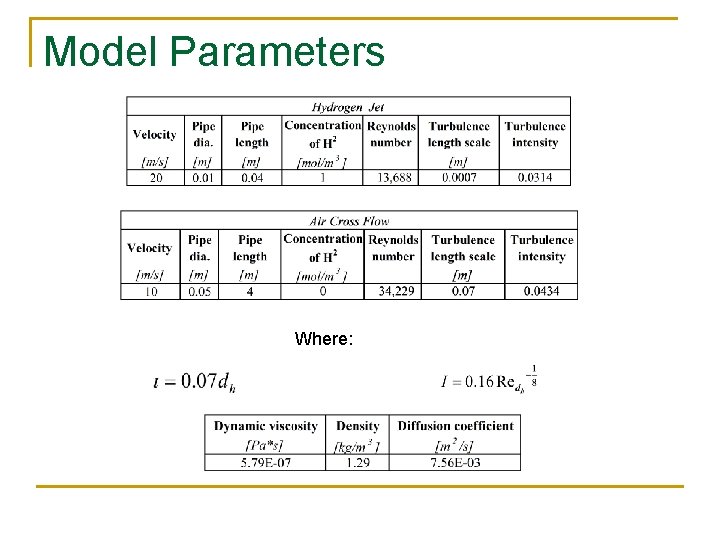
Model Parameters Where:
Solution Surface plot – Concentration [mol/m 3]. Line plot- concentration [mol/m 3] vs. length [m]
Solution Surface plot – Turbulent kinetics energy [m 2/s 2]. Surface plot – Pressure [Pa].
Solution Arrow plot – Velocity field [m/s].
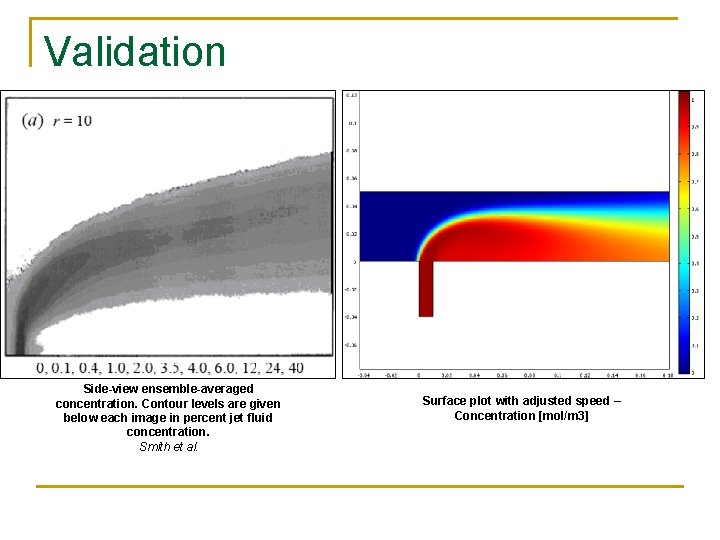
Validation Side-view ensemble-averaged concentration. Contour levels are given below each image in percent jet fluid concentration. Smith et al. Surface plot with adjusted speed – Concentration [mol/m 3]
Validation Flow side view. Smith et al. Surface plot – Velocity field [m/s]
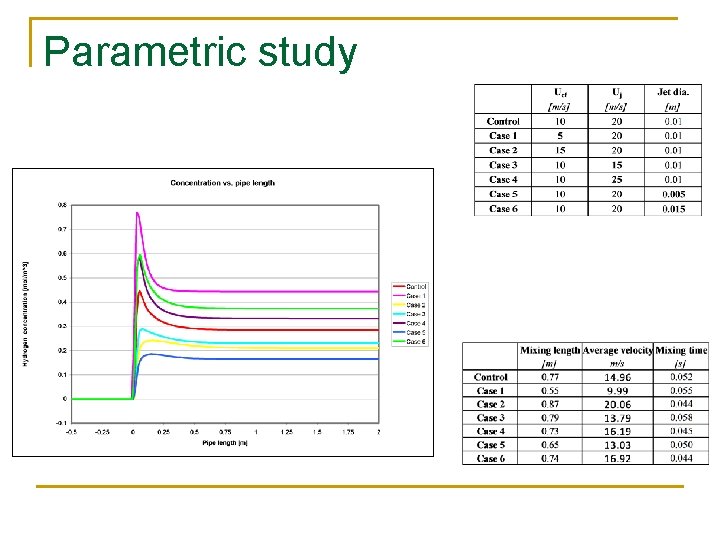
Parametric study
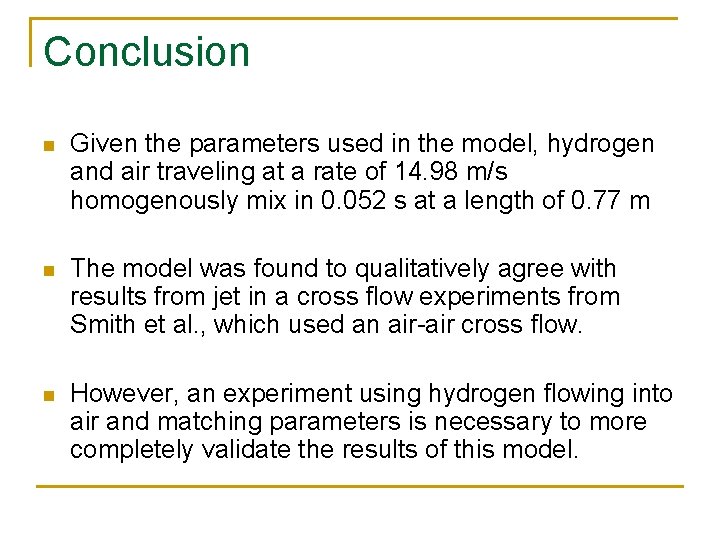
Conclusion n Given the parameters used in the model, hydrogen and air traveling at a rate of 14. 98 m/s homogenously mix in 0. 052 s at a length of 0. 77 m n The model was found to qualitatively agree with results from jet in a cross flow experiments from Smith et al. , which used an air-air cross flow. n However, an experiment using hydrogen flowing into air and matching parameters is necessary to more completely validate the results of this model.