
Mixing it all together The combination of object
Mixing it all together! • The combination of object Pronouns
Faites Attention! • Now that you have learned the direct object pronouns, the indirect object pronouns, and the pronouns “y” and “en, ” you are going to learn today that you can mix them all up. • The questions are: How do you do this? Is there a specific word order? Is it difficult to do? Why do the French do this? Are they trying to drive us crazy on purpose?
Word Order • First of all, the use of object pronouns makes a conversation less repetitive. They replace important information that needs to be restated throughout a conversation. • There is a specific word order when using all these pronouns. We normally refer to the use of them as “using double object pronouns. ” When you need to use more than one pronoun in a statement (NOT A COMMAND), you must place them in the correct order in relation to one another. The table on the next slide presents the correct sequence of pronouns within a sentence.
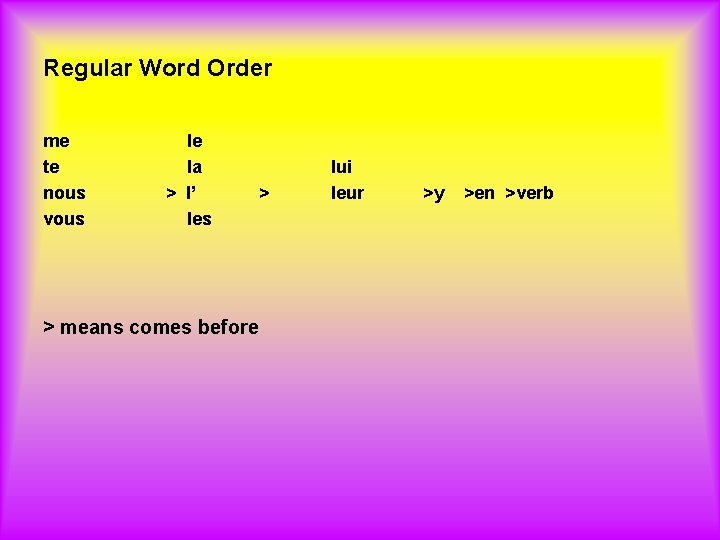
Regular Word Order me te nous vous le la > l’ les > > means comes before lui leur >y >en >verb
Par exemple: • Tu achètes des B. D. pour ton frère? Are you buying some comics for your brother? Tu lui en achètes? Are you buying some for him? • Vous envoyez le cadeau à Bruxelles? Are you sending the gift to Brussells? Vous l’y envoyez? Are you sending it there? • Je parle toujours de mes B. D. préférées à Marie et Louise. I always talk about my favorite comics to Mary and Louise. Je leur en parle toujours. I always speak to them about them.
Encore un exemple: • Je dois demander la permission à mes parents. I need to ask permission from my parents. Je dois la leur demander.
Word order after a positive command (telling someone what to do): • Pronouns are found in this order connected by a hyphen in a positive command: • Verb + --le --moi --la > --toi >--y >--en --l’ --lui --les --nous --vous --leur -- means hyphen > means comes before
Par exemple: • Donnez le livre à Paul! Donnez-le-lui! • Montrez la nouvelle voiture à nous! nous Montrez-la-nous! • Apporte de la salade au picnic! picnic Apporte-y-en! NOW TRY TO MAKE THESE 3 COMMANDS NEGATIVE! 1. Ne le lui donnez pas! 2. Ne nous la montrez pas! 3. Ne y en apporte pas!
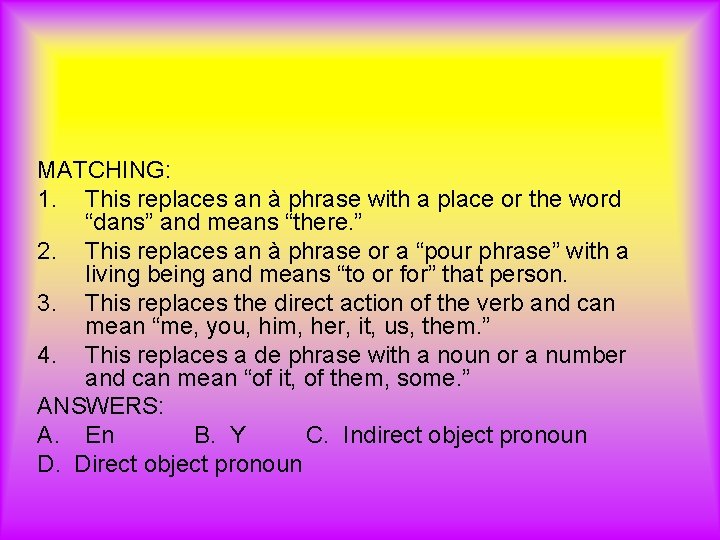
MATCHING: 1. This replaces an à phrase with a place or the word “dans” and means “there. ” 2. This replaces an à phrase or a “pour phrase” with a living being and means “to or for” that person. 3. This replaces the direct action of the verb and can mean “me, you, him, her, it, us, them. ” 4. This replaces a de phrase with a noun or a number and can mean “of it, of them, some. ” ANSWERS: A. En B. Y C. Indirect object pronoun D. Direct object pronoun
- Slides: 9