
Mixed Use Overlay Zoning District ByLaw Planning Board
Mixed Use Overlay Zoning District By-Law Planning Board Public Hearing
How Did We Get To This Point? The Planned Unit Development Overlay Zoning District (PUD) along with the designation of properties to be included within the Overlay District was adopted through Town Meeting. Since that adoption, there have been concerns and questions raised, particularly by the Planning Board, pertaining to the District and whether it achieved the goals for the areas. This prompted the Planning Board Chair, to utilize the Smart Growth Committee to review the existing PUD By-Law and revise the By-Law to address the goals and vision for the area. Since Fall Town Meeting, the Smart Growth Committee has held many public meetings, a Community Forum, and developed a survey to gain public input pertaining to the goals and vision for the Boston Road Corridor and the revisions necessary to develop a By-Law to meet those goals and vision
What Did the Committee Determine? The Committee determined two fundamental changes that would be necessary to address the vision for the Corridor and they are as follows: Revising the existing PUD By-Law would not create a usable By-Law to address the vision for the Corridor, thus a new by-law, the Mixed Use Overlay District, would be developed. Removing the PUD-R in its entirety was necessary, as the PUD-R was not contributing to the overall vision.
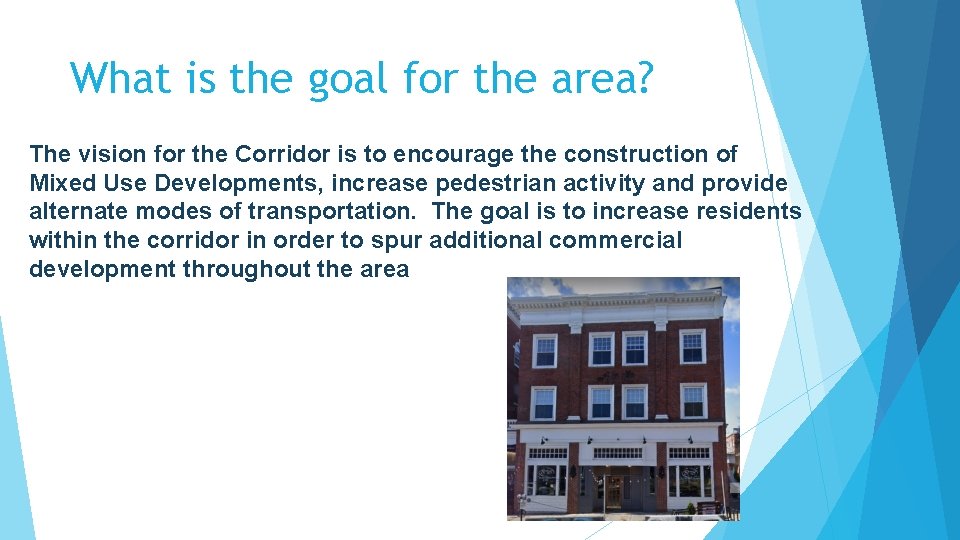
What is the goal for the area? The vision for the Corridor is to encourage the construction of Mixed Use Developments, increase pedestrian activity and provide alternate modes of transportation. The goal is to increase residents within the corridor in order to spur additional commercial development throughout the area

Sub-Zones The Mixed Use Overlay District will create two sub-zones, as there may be different requirements for each sub-zone to meet the goals of the sub-zone. The two sub-zones will act as anchors to the Boston Road Corridor to increase commercial development options within and between the zones.
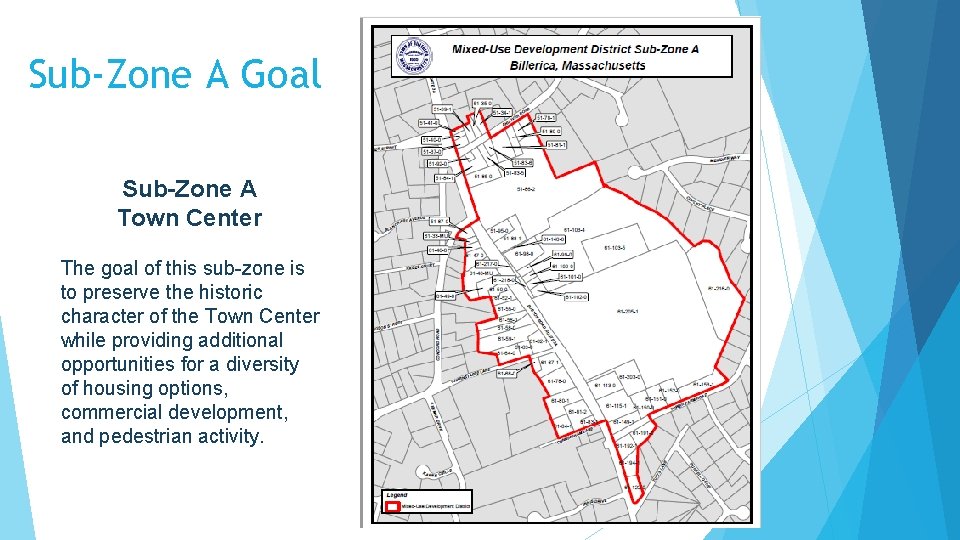
Sub-Zone A Goal Sub-Zone A Town Center The goal of this sub-zone is to preserve the historic character of the Town Center while providing additional opportunities for a diversity of housing options, commercial development, and pedestrian activity.

Sub-Zone B Goal Sub-Zone B Boston Road The goal of this sub-zone is to provide additional opportunities for commercial growth through the addition of housing. This sub-zone will also act as an anchor to increase commercial growth along Boston Road outside of this Overlay District.
Special Permits All development projects within the Mixed Use Overlay District will require a special permit from the Planning Board. There is criteria that needs to be met by each project proposed within the District, such as All mixed use development shall contain a balance of commercial and residential uses Uses shall be constructed simultaneously Uses shall be designed to generate pedestrian traffic Parking shall be located to the rear or side of the building, whenever physically feasible Parking lots shall not separated by use.

Dimensional Requirements Sub-Zone A Maximum building coverage Minimum green space Minimum width of side yard Minimum width of front yard Minimum width of rear yard Maximum height of buildings Maximum stories 50% 20% 15 feet N/A 20 feet 45 feet 3 stories Sub-Zone B Maximum building coverage Minimum green space Minimum width of side yard Minimum width of front yard Minimum width of rear yard Maximum height of buildings Maximum stories 50% 20% N/A 20 feet 45 feet 3 stories
Density Regulations Sub-zone A - 6 units per acre Sub-zone B - 8 units per acre Density Bonuses A density bonus shall be awarded to increase the number of dwelling units beyond the maximum number permitted in the Mixed Use Overlay District, under the following circumstances: In sub-zone A, a maximum of 10 units per acre shall be permitted when a project provides for increased pedestrian activity and connectivity between properties In sub-zone B, a maximum of 12 units per acre shall be permitted when a project provides for alternate modes of transportation, including increased bicycle access between and/or off site and public transit throughout the Boston Road corridor. . In both sub-zone A and sub-zone B, one additional market rate residential unit shall be permitted for each additional affordable housing unit provided above the number required by this Section, provided that in no case the unit density bonus shall exceed 25% of the total residential units of the project. Only one density bonus per development project may be utilized.
Design Guidelines The design guidelines are not intended to inhibit design creativity or discourage innovative architectural design solutions. Rather, they provide general standards for building massing, siting, and design solutions. For example, Retail, restaurant, and other lively pedestrian friendly uses are encouraged on the ground floor Residential units must be located on the upper floors Buildings on a corner lot should relate to the corner Projects located adjacent to the Concord River, shall provide public access to the river whenever feasible All development should encourage the use of bicycles to and from the site through the installation of bike racks, or by other means as determined feasible Site lighting should be integral to the design of the project Projects outside the Historic District should adhere to the Historic District requirements when feasible.
Affordable Housing Requirement Every development within the Mixed Use Overlay District must provide a minimum of 10% of the housing units as affordable. As an alternative, the Planning Board may request an applicant contribute to a designated housing entity to be used for the development of affordable housing in lieu of constructing and offering affordable units onsite.
Parking Required parking for the residential units is a minimum of 1. 5 parking spaces per unit. There are options available for shared parking or off-site parking.

Comments Thank you, Smart Growth Committee
- Slides: 14